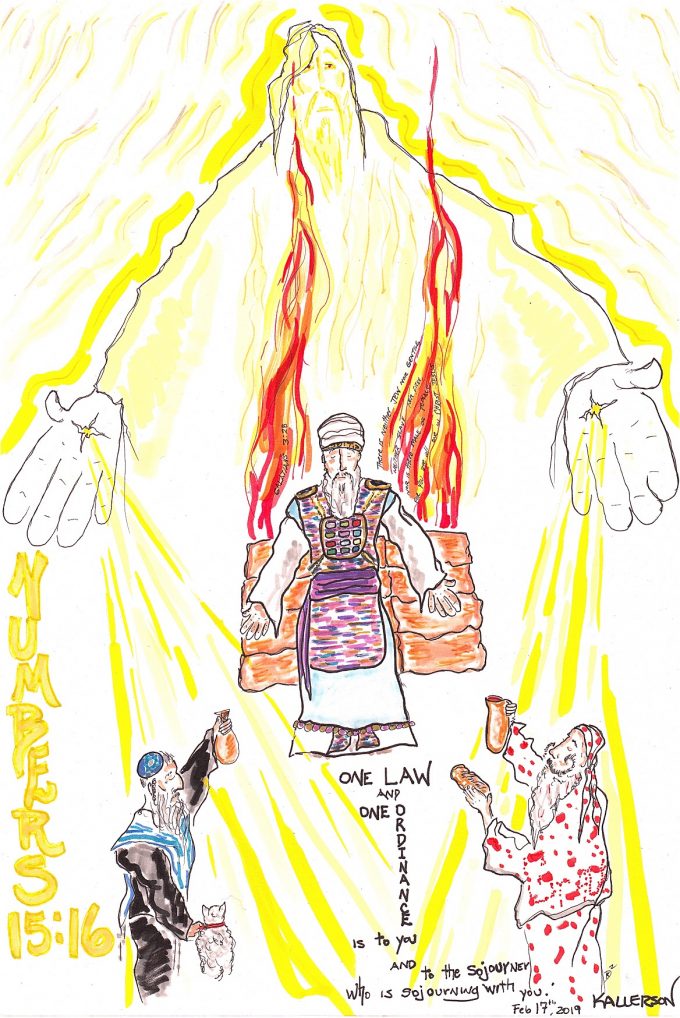
Numbers 15:1-21
When You Have Come Into the Land
In their commentary on the two short sections we will look at today, the Pulpit Commentary says, “The two enactments have the same supplemental and (humanly speaking) trivial character.” In other words, they simply fill in supplementary information from other passages already given, mostly from Leviticus. They then mention their “trivial character,” but qualify that with their parenthetical and otherwise unexplained words, “humanly speaking.” Are the words trivial?
Before beginning, would anyone like to present their thoughts on what we’ve just read and will next analyze? Unless you cheated by reading the sermon in advance, the verses do seem repetitive in nature. We’ve seen these concepts introduced elsewhere, and we have probably forgotten most of what we learned. That’s ok. Our minds were molded to know that it was of value in those passages, and we can go back and review anytime we wish.
But for now, we can simply consider what the book of Hebrews says about the things of the law. In Hebrews 9:9, the author says, of the topic of the first tabernacle and its associated rites and rituals, that, “It was symbolic for the present time.”
There the word he uses which is translated as “symbolic” is parabole. It is the same word translated as “parable” in the gospels. The author is saying that the things of the Old Covenant – such as the layout, structure, and materials of the sanctuary, all of the rites associated with that sanctuary, and even the days associated with those rites (such as the Day of Atonement) were teaching aids and living lessons which only figuratively pointed to what Christ would do. The people of Israel were living out a 1500 year long parable every time they interacted with these priestly things.
Well, if we hold fast to, seek to understand, and repeat the parables Jesus spoke, and the parables that He lived out, doesn’t it make sense that we should seek to understand the parables that point to that same wonderful Lord?
Text Verse: “All these things Jesus spoke to the multitude in parables; and without a parable He did not speak to them, 35 that it might be fulfilled which was spoken by the prophet, saying:
‘I will open My mouth in parables;
I will utter things kept secret from the foundation of the world.’” Matthew 13:34, 35
Of the verses of our first section today, Adam Clarke – someone I respect immensely and quote from time to time, but who is often overly legalistic – says the following about the requirement of the offerings and sacrifices to be made by the Israelites –
“All strangers – all that came to sojourn in the land, were required to conform to it; and it was right that those who did conform to it should have equal rights and privileges with the Hebrews themselves, which we find was the case. But under the Christian dispensation, as no particular form of worship is prescribed, the types and ceremonies of the Mosaic institution being all fulfilled, unlimited toleration should be allowed; and while the sacred writings are made the basis of the worship offered to God, every man should be allowed to worship according to his own conscience, for in this respect every one is
‘Lord of himself, accountable to none
But to his conscience and his God alone.’” Adam Clarke
It was hard for me to imagine he said these things. He often puts worship, and worshipers, in boxes that are very restrictive. But here, he casts that aside and shows that all of the rigidity of the law is set aside, and we can worship in spirit and in truth. And indeed, if you go to a hundred cultures, there will be a hundred individual ways that they work their culture into their style of worship. As long as it doesn’t violate Scripture, it is acceptable. And why not!
The parables of the Old Testament are fulfilled in Christ. This will be seen again in our verses today. If they are fulfilled, and they are, then they are obsolete, just as Hebrews says of them. We are not bound to conduct our affairs in the church except in honor of the One who accomplished all these things for us. Today’s passage is one which pointed to Christ as a parable. He – in His person and in His life – fulfilled the meaning and purpose of these shadows, or parables.
Let us give Him glory in the way that we feel is our very best way to do so. Such freedom for us is revealed as a marvelous part of His superior word. And so let’s turn to that precious word once again and… May God speak to us through His word today and may His glorious name ever be praised.
I. One Law and One Custom (verses 1-16)
And the Lord spoke to Moses, saying,
It is completely uncertain when these words were spoken to Moses, and the dating of them by scholars goes from just after the departure from Sinai all the way through until just before entrance into Canaan. Some liberal scholars say that only parts of the coming words were given by Moses, and that some of what is stated here is actually amended from after the time of Ezekiel. The stupidity of that thinking isn’t worth contemplating. It says, “And the Lord spoke to Moses, saying,” and there is nothing to support anything, but a literal reception of these words directly from the Lord to Moses.
As to why they are placed here, regardless of when they were received by Moses, the words of verse 2 help to explain the matter. They begin with…
2 “Speak to the children of Israel, and say to them:
The words are “to the children of Israel.” It does not say, “speak to all the congregation,” as if the people needed to know them and apply them to their lives at that moment. Rather, they are for all of Israel, at any time, but not necessarily for the congregation alive at that time. In other words, if a principal said, “Speak to the students in your classes,” the teachers would know it was something for the students at the school at that time. However, if the principal said, “Speak to the Riverview Rams,” it would be something that applied to all students at all times. This is the idea here. That this is certain is because the Lord continues with…
2 (con’t) ‘When you have come into the land you are to inhabit,
What just occurred in the previous chapter? It was a rebellion against the Lord, and a pronouncement of judgment upon the people. There the Lord said –
“The carcasses of you who have complained against Me shall fall in this wilderness, all of you who were numbered, according to your entire number, from twenty years old and above. 30 Except for Caleb the son of Jephunneh and Joshua the son of Nun, you shall by no means enter the land which I swore I would make you dwell in. 31 But your little ones, whom you said would be victims, I will bring in, and they shall know the land which you have despised. 32 But as for you, your carcasses shall fall in this wilderness. 33 And your sons shall be shepherds in the wilderness forty years, and bear the brunt of your infidelity, until your carcasses are consumed in the wilderness.” Numbers 14:29-33
The Lord judged, the Lord convicted, and the Lord sentenced. The generation of those twenty and above would not come into the land of Canaan. However, those 19 and below, along with Caleb and Joshua, would enter according to the promise of the Lord. It is a certainty that Israel is not wholly rejected, and the words are here to provide assurance that what is to be mandated will be possible. The things mandated require possession and cultivation of the land.
They cannot be accomplished while dwelling in the wilderness, and so there is an assurance that entry and possession is coming. An important point is to be considered as stated by the scholar Baumgarten. He said, “…the fighting men of Israel had fallen under the judgment of Jehovah, and the sacred history, therefore, was no longer concerned with them; whilst the youth, in whom the life and hope of Israel were preserved, had as yet no history at all.”
Whereas those who left Egypt had a history which they looked back on and whined about, a newer generation would have only their time in the wilderness as a point of reference. Only a limited number of people, probably from about mid-teens to nineteen, would have any real memory of Egypt at all. Thus, the words here are a great hope for those born and raised in the wilderness. Someday they will receive a land. And the guarantee of that is…
2 (con’t) which I am giving to you,
The children of Israel are being given the land previously promised. No, not those under sentence of death in the wilderness, but Israel will still be given the land. The promise has not been revoked, nor would it ever be. Leviticus 26 states this with certainty. The land is the Lord’s, He has given it to Israel, and they may dwell in it when obedient, and they may not when they are disobedient. As a part of this surety, the words ahead are stated…
3 and you make an offering by fire to the Lord,
The implication here, based on the words of the previous verse, is that these offerings were not conducted in the wilderness. Indeed, they could not be as will be seen in the verses ahead. An offering made by fire signifies any offering that is burnt in part or in whole upon the altar. Leviticus, in particular, went into great detail concerning each of them. These continue to be defined by saying…
3 (con’t) a burnt offering or a sacrifice,
These sacrifices and offerings were carefully detailed in Leviticus. However, there are now provisions which will be added to them. What is being referred to here does not include sin offerings or trespass offerings, but only to the two classes of 1) burnt-offerings, and 2) peace offerings. These are further defined first as…
3 (con’t) to fulfill a vow
When making a vow to the Lord. This would be a votive offering. A vow was made, and the offering is presented in fulfillment of that. Such a vow was normally made in times of need, such as, “O God, if you get me out of this, I will present an offering to you.”
3 (con’t) or as a freewill offering
Such an offering would be made in times of prosperity, or in gratitude to the Lord for His provision.
3 (con’t) or in your appointed feasts,
Feasts, such as the Feast of Firstfruits, required products of the land which had been cultivated to be presented before the Lord. This was not possible in the wilderness. Whether Israel celebrated any of these feasts or not can only be speculated on. Did those who came out of Egypt who were circumcised still observe the Passover?
That was discussed in a previous sermon, but in the end, certain things, including some entire feasts, could not be observed due to the requirements of the feast. It is absolutely certain that the Sabbath, which is a feast, continued to be observed throughout the time in the wilderness. Burnt offerings and sacrifices were offered during these feasts. All of these mentioned were for a specific purpose which was…
3 (con’t) to make a sweet aroma to the Lord, from the herd or the flock,
The idea of a sweet aroma is that which is pleasing. In the case of such offerings, they were from the herd or from the flock. They were clean animals, each of which pictures Christ in one way or another, as has been seen, and as will be partially re-described as we go along in this passage.
4 then he who presents his offering to the Lord shall bring a grain offering of one-tenth of an ephah of fine flour mixed with one-fourth of a hin of oil;
Various animal offerings are going to be described. Before actually naming the first, the grain offering that is to accompany it is specified. In this case, it is to be one-tenth of an ephah of fine flour. The flour is solet, or “fine flour.” This comes from an unused root meaning “to strip.” Thus it is fine flour, indicating purity.
It is, as previously seen, reflective of the purity of Christ. This was to be mixed with one-fourth of a hin of oil. The ephah is a dry measure. The hin is a liquid measure. The mixing of the oil in the grain pictures the complete intermingling of the Spirit into Christ.
5 and one-fourth of a hin of wine as a drink offering you shall prepare with the burnt offering or the sacrifice, for each lamb.
Along with the grain offering, there is to also be a drink offering of one-fourth of a hin of wine. The nesek, or drink offering, comes from a word meaning “cover.” The idea is that when the drink offering is poured out, it will cover that onto which it is poured.
The drink offering is of yayin, or wine. As a review, in the Bible, wine symbolizes the merging together of cultural expressions into a result. The thing that ought to happen can happen, symbolized by wine. In the drink offering, it signifies rest and celebration.
A drink offering is only offered after entry into the Land of Promise, a land of defeated enemies. Thus it is a land of rest. Only when rest is provided, would the Lord accept the wine libations. And so, during the time in the wilderness, they were not offered. Further, a drink offering is poured out in its entirety to the Lord. No part of it was drunk by the priests or people. This signifies that the people were partially excluded from the full blessings of the Lord while still under the Law of Moses. This is what Jesus was referring to in Matthew –
“Nor do they put new wine into old wineskins, or else the wineskins break, the wine is spilled, and the wineskins are ruined. But they put new wine into new wineskins, and both are preserved.” Matthew 9:17
Jesus was speaking of the law and grace. The new wine is the new dispensation of grace to come. The old wine was the dispensation of the law. If one were to introduce the new concept into the old, it would not work because the two were incompatible. Only if one put the new wine into the new wineskins, and received the new wine, would the mind be changed. Only in Christ does man truly enter into God’s victory and rest. This is why Paul could say in Philippians 2 –
“Yes, and if I am being poured out as a drink offering on the sacrifice and service of your faith, I am glad and rejoice with you all. 18 For the same reason you also be glad and rejoice with me.” Philippians 2:17, 18
Paul’s labors in the vineyard anticipated his victory and rest in Christ. This is made all the more evident in his words to Timothy –
“For I am already being poured out as a drink offering, and the time of my departure is at hand. 7 I have fought the good fight, I have finished the race, I have kept the faith. 8 Finally, there is laid up for me the crown of righteousness, which the Lord, the righteous Judge, will give to me on that Day, and not to me only but also to all who have loved His appearing.” 2 Timothy 4:6-8
Finally, in this verse, it specifies these for a lamb. The word is kebes, and it means to dominate. It pictures Christ who dominated over sin and the law for His people.
6 Or for a ram you shall prepare as a grain offering two-tenths of an ephah of fine flour mixed with one-third of a hin of oil;
Next is specified an ayil, or ram. Ayil indicates strength. It pictures that Christ’s strength was expended in the accomplishment of His work. It reflects His total commitment when He offered all of His natural strength to His Father. He is fully sufficient to redeem.
The grain offering is larger now because the animal is also larger. There is a proportional increase with each larger animal. Instead of one-tenth and a fourth, it is now two-tenths and a third, and…
7 and as a drink offering you shall offer one-third of a hin of wine as a sweet aroma to the Lord.
Instead of one-fourth, it is now one-third. Once again, there is an increase in offering based on an increase in size of the animal. The wording here could be better. By saying, “as a sweet aroma to the Lord,” it seems as if the wine is the sweet aroma. Rather, it is the entire offering of verses 6 & 7. A period instead of a comma would help, or a short paraphrase explaining this could also be of help. Next is an even larger and more expensive animal…
8 And when you prepare a young bull as a burnt offering, or as a sacrifice to fulfill a vow, or as a peace offering to the Lord,
The third animal specified is ben baqar, or “son of an ox.” The word is from the verb baqar which means to inquire or seek out. Christ seeks out those He redeems, just as the Lord is said to seek out His sheep in Ezekiel 34. In this verse, the Lord re-specifies the purposes – as a burnt offering, or as a sacrifice to fulfill a vow, or as a peace offering to the Lord. In such cases…
9 then shall be offered with the young bull a grain offering of three-tenths of an ephah of fine flour mixed with half a hin of oil;
With this larger animal another increase is made, three-tenths for a grain offering, and a half hin of oil mixed into it, also…
10 and you shall bring as the drink offering half a hin of wine as an offering made by fire, a sweet aroma to the Lord.
Like the first two instances, the size of the drink offering is the same as the amount of oil added to the grain offering. This one goes from one-third for the ram to one-half for the bull. Also, the same issue of verse 7 is repeated here. The sweet aroma to the Lord is the entire offering, not just the drink offering of this verse. Clarification is needed to avoid confusion. However, the really important point is to see Christ in each of the three animals, in the grain offering mixed with oil, and in the drink offering.
Regardless as to the wealth of the owner, or the intent of the offerer, the same picture is seen in these additions to each offering, although the aspect of the work of Christ differs in each animal.
As a curiosity for those who like such things, and which is missed in many translations, verse 8 says, “when you prepare,” in the second person singular. Verse 9 then says, “then he shall offer” in the third person, singular. And then verse 10 says, “and you shall bring,” in the second person, singular again.
Of this, Keil notes it “is certainly striking and unusual, but not so offensive as to render it necessary to alter it.” He says it as if it were any weirder, one would be compelled to change the text to help things out. The Pulpit Commentary says –
“The rapid interchange of the second and third persons in these verses is awkward and perplexing. No doubt it is due to some sufficiently simple cause in the inditing of the original record, but we are not in a position even to guess at its nature. Meanwhile the broken construction remains as a witness to the faithfulness with which the record has been handed down.”
Nobody else that I found even commented on it, but it doesn’t seem perplexing at all. There are things the priest does, and there are things expected of the offerer in the process. If one looks at these things in light of Christ, God prepares a body in Christ (Hebrews 10:5), Christ offers Himself to God (Hebrews 10:7), and God brings about the intended effect in Christ (Hebrews 2:17). The Lord is simply instructing as if He were showing Moses and Israel what would occur in Christ. It is treasure tucked away in the detail.
11 ‘Thus it shall be done for each young bull, for each ram, or for each lamb or young goat.
Although this is an explanatory verse concerning the offerings, that each type of animal is to be accompanied with the corresponding size of grain and drink offering, the verse adds in the ez, or “young goat,” not previously mentioned. That would be in place of the lamb mentioned in verse 5. The word ez comes from azaz, meaning to prevail. It again looks to the work of Christ who prevailed in His ministry, accomplishing all that was set before Him to redeem man.
12 According to the number that you prepare, so you shall do with everyone according to their number.
This verse is similar to 11, but it is dealing with the number of offerings, not the types. In other words, if one gives ten young bulls, then for every animal offered, a corresponding offering of grain and drink offerings were to be made according to that type of individual animal. One could not offer ten bulls and give just one grain and drink offering for all ten. No way, Jose.
13 All who are native-born shall do these things in this manner, in presenting an offering made by fire, a sweet aroma to the Lord.
kal ha’ezrakh – all the natives. The word comes from zarakh, signifying to irradiate, or shoot forth beams, from a source. Thus, it is referring to any who are native Israelites. If they made such offerings, they were required when presenting these offerings to ensure that they brought the specified grain and drink offerings. Only together were they then truly considered a sweet aroma to the Lord. The typology of Christ, and of what God would do in Christ, was to be maintained at all times.
But, this went beyond Israel, to those who would join themselves to Israel in these sacrifices and offerings…
14 And if a stranger dwells with you, or whoever is among you throughout your generations, and would present an offering made by fire, a sweet aroma to the Lord, just as you do, so shall he do.
Two classes of people are mentioned here. One is the ger, or sojourner who is sojourning among the Israelites. The word comes from a root signifying “to turn aside from the road” as in for lodging or any other purpose. It is a person who has come among the people and stayed.
The other is “whoever.” If he happens to be among the Israelites, it applies to him. It is basically an all-inclusive statement concerning any and all who desired to make an offering to the Lord. None were forbidden, and all were required to do as Israel did.
It demonstrates an exclusivity before God who can only be approached or pleased through one means in these things, but at the same time any and all – whether Jew or Gentile – could, in fact, approach through that means. As long as the typology of Christ is maintained, all who desired to come could come. It bears the same spirit as the words of Revelation 22:17 –
“And the Spirit and the bride say, ‘Come!’ And let him who hears say, “Come!” And let him who thirsts come. Whoever desires, let him take the water of life freely.” Revelation 22:17
Yes, all could offer, but there is only one proper and acceptable way to do so. That is again reflected in the next words…
15 One ordinance shall be for you of the assembly and for the stranger who dwells with you,
ha’qahal khuqah akhat – “The assembly ordinance one.” That’s it. The Lord says it `pertains to Israel, and it pertains to the sojourner who is sojourning among them as a single assembly ordinance. There is an inclusivity, and there is an exclusivity working out at the same time. It is exactly what the New Testament reveals concerning our relationship with God. There is no sacrifice or offering acceptable to God apart from Christ – by either Jew or Gentile. And there is no person – either Jew or Gentile – whose offering is not accepted by God when that offering is Christ. And this will never change…
15 (con’t) an ordinance forever throughout your generations;
khuqat olam l’dorotekem – “ordinance forever throughout your generations.” First is the reality of the covenant being spoken of. The word olam, or forever, signifies “to the vanishing point.” In this case, when the covenant is fulfilled in Christ, the shadows of these rituals are ended in Christ. The law has reached its vanishing point. However, the precept is forever as it is fulfilled in Christ. What the shadows prefigured is now realized in Him. And so the truth of the substance is forever. God accepts only one, in Christ, in this regard, and no one is accepted apart from Christ – forever. As it says…
15 (con’t) as you are, so shall the stranger be before the Lord.
Thank God for Christ Jesus who allows us to come near God in thanks, in praise, and in our offerings of those things. God accepts those things from us because of Christ.
16 One law and one custom shall be for you and for the stranger who dwells with you.’”
The Hebrew follows a logical progression that is not followed in any English translation. English translations say, “one law and one custom,” “one law and one rule,” “one law and one ordinance,” “one law and one regulation,” and so on. It makes the responsibility and burden solely that of the offeror.
However, that does not appear to be what is going on. In the previous verse, it said, “ordinance forever throughout your generations.” That is the khuqat, or main body of what has been said. It applies to all – native and foreigner. Here it says torah akhat u-mishpat echad, literally, “instruction one and judgment one.”
The torah, or instruction, is for the responsibility and burden of the people. The mishpat, or judgment, is the response of the Lord based on the people’s adherence to the instruction. There is one instruction for the conduct of these sacrifices and offerings, and there is one judgment in their being offered. The instruction is applied equally to both the native and the stranger, and the judgment is applied by the Lord equally upon the native and the stranger. It is an obvious and clear reference to all coming solely through Christ, and God judging all solely on their adherence to Christ. It is… Christ, all Christ, and only Christ – for all.
For the first time in this chapter, one scholar, John Gill – who lived in the 1700s – also sees a hint of Christ here. When I read his words, I had to say out loud, “Good job, John.” The entire passage has looked to Him, and I’m glad he began to recognize this. He said –
It is “…for Israelites and proselytes; which is said to invite and encourage the latter, and may have a distant view to the calling of the Gentiles in Gospel times, when there should be no difference between Jews and Gentiles called by grace in matters of religion, but would be one in Christ, Galatians 3:28.”
What he cited is exactly what this passage is intended to show –
“There is neither Jew nor Greek, there is neither slave nor free, there is neither male nor female; for you are all one in Christ Jesus.” Galatians 3:28
The very size of the animals, and the proportions of grain and drink offerings prescribed reveal this as well. Paul’s writings show that there are no distinctions in Christ. One can be rich or poor, slave or free, male or female, Jew or Gentile, strong or weak, or any other such distinction, and yet be found to have no difference in value when in Christ.
An offering to God; an offering for peace
One which signifies fellowship so sweet
It stems from our daily trod, and in Christ it shall never cease
Because in Him our fellowship is complete
Cleanse us in our inward parts; lead us in Your peace
May we join together with You, O precious Lord
Purify our minds and hearts; may this joy never cease
Through Christ, may we always be in one accord
Thank You for the cross from whence atonement came
Upon that offering, we can now add an offering of peace
Together they point to the same great Name
Both look to Jesus where joyous fellowship will never, never cease
II. A Heave Offering to the Lord (verses 17-21)
17 Again the Lord spoke to Moses, saying,
The often stated, friendly, and familiar words of introducing a new section into this precious word is again given – v’daber Yehovah el Moshe lemor, “And spoke Yehovah to Moses saying.” The NKJV chose to say, “Again, the Lord spoke,” but the Hebrew simply says, “And.” Something different is to be detailed, which is…
18 “Speak to the children of Israel, and say to them: ‘When you come into the land to which I bring you,
The words begin the same way as verse 2, but then what Moses is told to say differs. In verse 2, it said, “When you have come into the land you are to inhabit, which I am giving to you.” Now it says, “When you come into the land to which I bring you.” It is a note of confirmation that the Lord will be the One to ensure they attain what He has promised. There is a land they will inhabit, that land is promised to them, and the Lord is the One who will bring them into that land. What a picture of the promises of Christ for humanity.
These two verses, separated by many verses, show us the promise of God in Christ. Paradise was lost, but it is a land intended for man to dwell in. A return to it is promised. And, it is the Lord who makes that possible. He is the One to bring us again to that land. For now, once the people are brought into Canaan…
19 then it will be, when you eat of the bread of the land, that you shall offer up a heave offering to the Lord.
This is again addressed only to those who will actually enter. Those who are under sentence of death in the desert are not included in these words, whenever they were spoken. It is the others who are being given this surety. To eat the bread of the land implies that they will be in the land. To offer this offering every year implies that they will possess the land. For those who were born in the wilderness, this would be a great delight to anticipate. They would have never tasted bread, and they had never worked their own fields. This is a promise and a guarantee that it will come about.
The previous section dealt with offerings and sacrifices which covered three main categories – 1) to fulfill a vow, 2) as a freewill offering, and 3) in your appointed feasts. Here we have what is also a part of a three-fold harvest offering. The first was seen in that of the first sheaf offered in Leviticus 23:11 during the Feast of Firstfruits. The second is the one detailed now. It is a dough offering. The third is that of the bread offering, offered in Leviticus 23:17 during the Feast of Weeks.
The one now, the dough offering, is instructed first to be offered up as a terumah, or a heave offering to the Lord. Terumah comes from rum, meaning high, exalted, or to rise. It is to be presented before the Lord and lifted up. For Israel, it says…
20 You shall offer up a cake of the first of your ground meal as a heave offering;
Here we have a new and rare word, arisah. It comes from a root which means to grind up, pulverize, etc. Thus, it is translated as ground meal. It is found only here and the next verse, and in Nehemiah 10:37 and Ezekiel 44:30. It is always prefixed by the word reshit, or first. It is the first in time, place, order, rank, etc.
Thus, it is considered the best. Again, it repeats that they shall offer it up as a heave offering, but in the form of khalah or a cake. That comes from the word khalal or “to pierce.” Thus, it is a punctured cake of the first ground-up dough. It is…
20 (con’t) as a heave offering of the threshing floor, so shall you offer it up.
The goren, or threshing floor, is a smooth, even, and hard surface where sheaves were brought and then crushed in one of various ways, such as having animals tread over it to crack the scaly chaff which surrounds the grain. The grain would come out and then all of this would be picked up by winnowing forks and cast into the air. The wind would blow all the chaff away, leaving only grain.
The threshing floor, in both testaments, signifies judgment. John the Baptist spoke of Christ who would come to separate sinners from believers. The believers would be gathered as the precious grain for their place in heaven, and the sinners, meaning the chaff, would be burned in the fires of hell. The people are said to take the first of the pulverized grain and offer it up as a heave offering to the Lord. This is again stated in our final verse of the day…
*21 (fin) Of the first of your ground meal you shall give to the Lord a heave offering throughout your generations.
m’reshit arisotekem titenu l’Yehovah terumah l’dorotekem – “of the first of your pulverized grain you shall give to Yehovah an offering of raising up throughout your generations.” The entire thought points to Christ.
It is the first, and thus considered the best of the grain harvest. Christ is the called Firstborn among many brethren according to Romans 8:29. The grain is crushed; Christ is said, in Isaiah 53:5, to have been crushed for our iniquities. It is a cake of khalah, or bread which is pierced. Christ, our Bread of Life, is said to have been pierced in Psalm 22:16 and Zechariah 12:10, and which is confirmed in John 19:31.
He is given to Yehovah as such, and He was rum, or lifted up, as an offering for us in that capacity, first on the cross of Calvary, as is stated in Isaiah 52:13, and then He is raised up and esteemed among those He has redeemed. He becomes our terumah, or heave offering, in our acceptance of Him. And this is an offering of the threshing floor, the place of judgment where sinners are separated from those who believe.
As I mentioned in our introduction, the Pulpit Commentary said of the two sections of these 21 verses, “The two enactments have the same supplemental and (humanly speaking) trivial character.” It is so very good that they qualified their thought with the words, “humanly speaking.” There is nothing trivial at all in the verses we have read. On the surface, they seem as such, and they are held in low esteem by most – read maybe once and then never again. Or, they are quickly passed over by those who read them each time they go through the Bible.
But there is nothing trivial about them. In one sermon, of 21 verses, there have been several dozen, if not more, pictures of Christ. We have been given secrets in living parables of those who for 1500 years made their offerings to the Lord in anticipation of the coming of the Lord, who would then be the very fulfillment of what these offerings pictured. Trivial? Not in the slightest. Without the fulfillment of what these things picture, there would be only a certain anticipation of death, followed by eternal separation from God. As He is the Source of all that is good, it means an eternity of nothing which is good.
What a great and marvelous Creator who has so lovingly fashioned redemptive history, that we can find His Son in a thousand ways before we even get to the story of His coming. This, so that we can be as assured that His coming was the very thing that would bring about what the pictures were meant for us to see – grace, mercy, restoration, future hope, and certain glorification.
Going through today’s verses would have been a ton easier on me if I had simply spent an hour typing up a fun life-application about something irrelevant to the text. You would have gone home uplifted, encouraged, and not the least bit edified about the surety you need when times get rough. But in knowing the details about Christ, tucked away in every word and thought, the promises which are given after Christ’s coming are all the more certain to us. Be confident of this, and be confident that Your reliance on the grace of Jesus Christ for your hope of future glory is absolutely assured.
Closing Verse: “What then shall we say to these things? If God is for us, who can be against us? 32 He who did not spare His own Son, but delivered Him up for us all, how shall He not with Him also freely give us all things?” Romans 8:31, 32
Next Week: Numbers 15:22-41 To these things, you should be conforming… (Remembering and Performing) (29th Numbers Sermon)
The Lord has you exactly where He wants you. He has a good plan and purpose for you. It may seem at times as if you are lost in a desert, wandering aimlessly. But the Lord is there, carefully leading you to the Land of Promise. So follow Him and trust Him and He will do marvelous things for you and through you.
When You Have Come Into the Land
And the Lord spoke to Moses, saying
These are the words He was to him then relaying
“Speak to the children of Israel, and say to them:
‘When you have come into the land
You are to inhabit, which I am giving to you
Please then, you are to understand
And you make an offering by fire to the Lord
A burnt offering or a sacrifice
To fulfill a vow or as a freewill offering
One that will in these suffice
Or in your appointed feasts
To make a sweet aroma to the Lord
From the herd or the flock
According to this word
Then he who presents his offering to the Lord
Shall bring a grain offering
Of one-tenth of an ephah of fine flour
Mixed with one-fourth of a hin of oil
———-such shall be with his proffering
And one-fourth of a hin of wine as a drink offering
You shall prepare with the burnt offering or the sacrifice
For each lamb
Such will then suffice
Or for a ram you shall prepare as a grain offering
Two-tenths of an ephah of fine flour, so you shall do
Mixed with one-third of a hin of oil
As I am now instructing you
And as a drink offering you shall offer according to this word
One-third of a hin of wine as a sweet aroma to the Lord
And when you prepare a young bull as a burnt offering
Or as a sacrifice to fulfill a vow
Or as a peace offering to the Lord
As I am instructing you now
Then shall be offered with the young bull
A grain offering of three-tenths of an ephah of fine flour
———-mixed with half a hin of oil, according to this word
And you shall bring as the drink offering
Half a hin of wine as an offering made by fire
———-a sweet aroma to the Lord
Thus it shall be done for each young bull, please take note
For each ram, or for each lamb or young goat
According to the number that you prepare, so shall it be
So you shall do with everyone according to their number
———-as is now instructed by Me
All who are native-born shall do these things in this manner
And according to this word
In presenting an offering made by fire
A sweet aroma to the Lord
And if a stranger dwells with you
Or whoever is among you throughout your generations
———-as I am instructing you
And would present an offering made by fire
A sweet aroma to the Lord, just as you do, so shall he do
One ordinance shall be for you of the assembly
And for the stranger who dwells with you, according to this word
An ordinance forever throughout your generations
As you are, so shall the stranger be before the Lord
One law and one custom shall be for you
And for the stranger who dwells with you too
Again the Lord spoke to Moses, saying
These continued words He was to him relaying
“Speak to the children of Israel, and say to them:
‘When you come into the land to which I bring you
———-according to this word
Then it will be, when you eat of the bread of the land
That you shall offer up a heave offering to the Lord
You shall offer up a cake of the first of your ground meal
As a heave offering; so you shall do
As a heave offering of the threshing floor
So shall you offer it up, as I am instructing you
Of the first of your ground meal you shall give to the Lord
A heave offering throughout your generations
———-according to this word
Lord God, we are even now in a wilderness
And we are wanting to be led by You
Without You to direct, our lives would be a mess
And so be our guide, O God; You who are faithful and true
We long for the water in this barren land
May it flow forth from the Rock, our souls to satisfy
Give us this refreshing, spiritual hand
And may we take it, and to our lives daily it apply
And we shall be content and satisfied in You alone
We will follow You as we sing our songs of praise
Hallelujah to You; to us Your path You have shown
Hallelujah we shall sing to you for all of our days
Hallelujah and Amen…