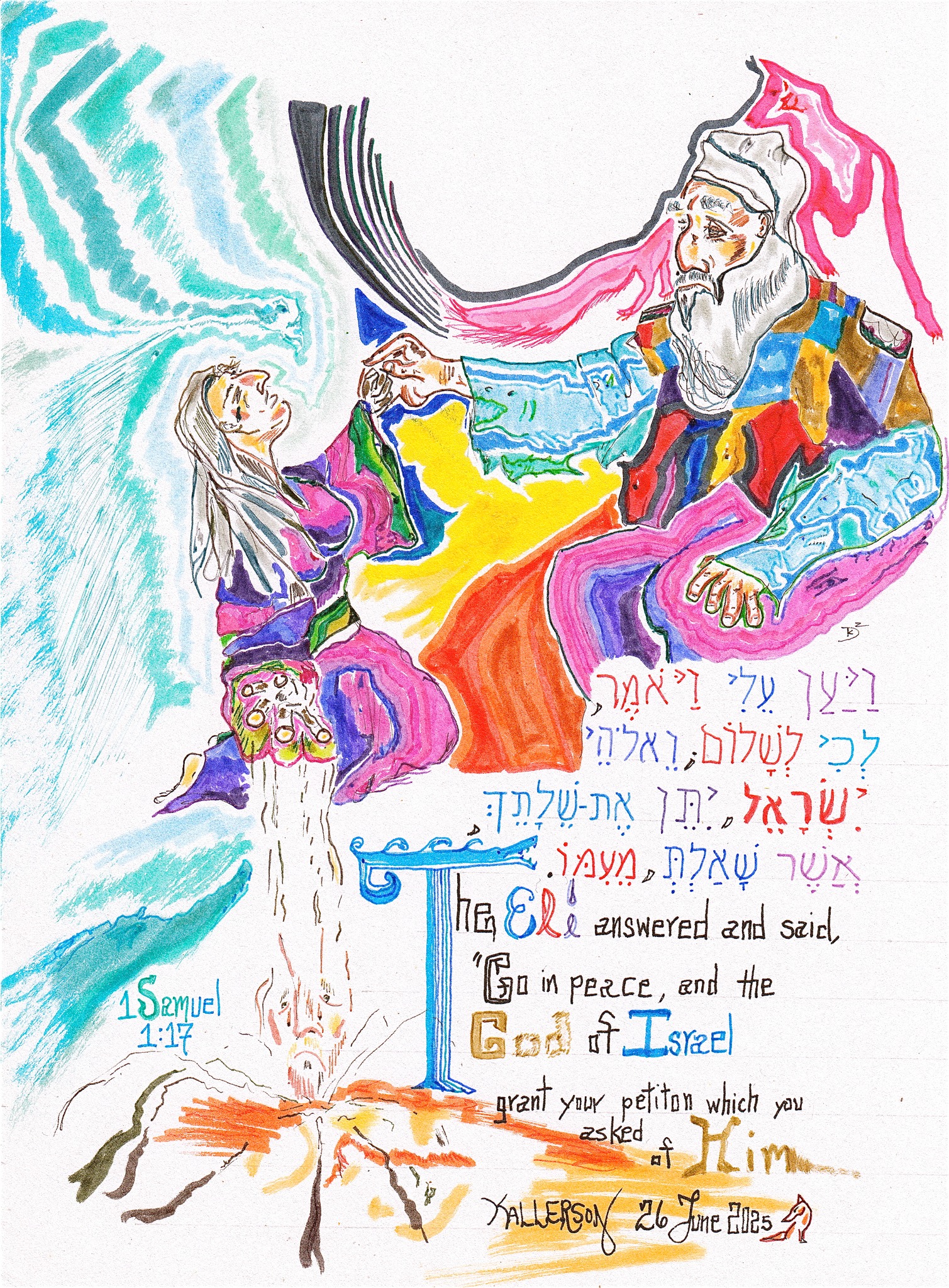
Artwork by Douglas Kallerson
1 Samuel 1:8-18
Grace in Your Eyes
(Typed 7 April 2025) Since President Trump’s inauguration, he has handed out a great number of pardons. A pardon is an act of grace. A person may be charged with an offence or already convicted of one.
And yet, the president has the right to pardon a person, through no merit of his own, for any federal offence. President Trump has even pardoned people who were caught up in the illegal dealings of the previous administration.
Unfortunately, some of those pardoned have already been rearrested for other offenses. And he has only been in office for a couple of months! This isn’t unique to his presidency, though. Many of those who have been pardoned have been rearrested. It is as if we cannot keep ourselves out of trouble.
But what is it that causes someone to get rearrested? A violation of the law. This is the problem with law. Unless there is no law, there is really no way other than following the law perfectly that you are safe from the consequences of its penalties.
Again and again, the problem concerning law is seen in Scripture. And this isn’t just the case with direct violations of the law. We have also seen it numerous times in typology as well. Despite that, people keep going back to law observance instead of trusting in God’s grace…
Text Verse: “But when the fullness of the time had come, God sent forth His Son, born of a woman, born under the law, 5 to redeem those who were under the law, that we might receive the adoption as sons.” Galatians 4:4, 5
Jesus brought His people out from being under law to instead being under grace. Grace and law are mutually exclusive. But people can’t seem to get this. They may say, “I trust in the grace of Christ,” and then they turn around and explain why you cannot eat pork or why you must tithe or worship on a Saturday.
The thinking is convoluted. Paul says, “For sin shall not have dominion over you, for you are not under law but under grace” (Romans 6:14). Either you are under one or you are under the other. You cannot be under both.
Think this through and determine that you will completely and continuously rely on God’s grace. This doesn’t mean you have license to sin, but it does mean that when you do wrong, you are not cast from God’s favor.
As we will see in the passage, in typology, this was Hannah’s hope for the people of the world. Think about what is presented. God is, once again, telling us about this vitally important issue found in His superior word. And so, let us turn to that precious word once again, and… May God speak to us through His word today, and may His glorious name ever be praised.
I. Better to You Than Ten Sons (verses 8-11)
8 Then Elkanah her husband said to her, “Hannah, why do you weep?
vayomer lah elqanah ishah khanah lameh tivki – “And he will say, to her, Elkanah her husband, ‘Hannah, why will you weep?’” Remembering the meaning of the names will help you form patterns in your mind as we go. Elkanah is derived from el, God, and qanah, which literally signifies to erect. But that is used to indicate something more than the action.
It leads to the thought of acquisition. In other words, Eve had Cain and said, “I have acquired [qanah] a man with Yehovah.” Thus, a literal explanation of Elkanah would be God Has Erected, but with the intent of God Has Acquired (through a purchase, as a possession, thus Redeemed). Hannah means Grace.
Peninnah (Pearl-ward) provoked Hannah because she had children, but Hannah had none. This occurred year after year. In her distress, Hannah wept and did not eat. This is what precipitates Elkanah’s question. Likewise…
8 (con’t) Why do you not eat? And why is your heart grieved?
velameh lo tokheli velameh yera levavekh – “And why not will you eat? And why will you break your heart?” It should be remembered that she did not eat only because she was picked on to the point of misery, but also because feasting times were for rejoicing before the Lord, not mourning.
Elkanah’s words introduce the word yara, a verb meaning to be broken up. Thus, it gives the sense of great fearing or being grievous. In this case, she is disheartened. It is as if her heart is broken up. To quell her state, he says…
8 (con’t) Am I not better to you than ten sons?”
halo anokhi tov lakh measarah banim – “Not I good to you from ten sons?” Scholars correctly say that the number ten speaks of an indeterminate number. This is often the case when it is used. However, this does not negate the necessity of understanding its symbolic meaning.
As this is its first use in 1 Samuel, it is good to have it fully explained. EW Bullinger says –
“It has been already pointed out that ten is one of the perfect numbers, and signifies the perfection of Divine order, commencing, as it does, an altogether new series of numbers. The first decade is the representative of the whole numeral system, and originates the system of calculation called ‘decimals,’ because the whole system of numeration consists of so many tens, of which the first is a type of the whole. Completeness of order, marking the entire round of anything, is, therefore, the ever-present signification of the number ten. It implies that nothing is wanting; that the number and order are perfect; that the whole cycle is complete.”
Elkanah’s words are all he can offer. She remained barren. Because of this, his statement is not one of boasting, but of practicality, in an attempt to give her comfort in her affliction.
9 So Hannah arose after they had finished eating and drinking in Shiloh.
Rather, it is feminine singular: vataqam khanah akhare akhelah beshiloh veakhare shathoh – “And she will arise, Hannah, after her eating in Shiloh, and after drinking.” Hannah did eat. This means that either Elkanah’s words cheered her up enough to eat, or she ate, but not of the sacrificial offerings due to her vexation. Either way, it refers to her.
Shiloh means Tranquility.
9 (con’t) Now Eli the priest was sitting on the seat by the doorpost of the tabernacle of the Lord.
The translation is wrong: veeli ha’kohen yoshev al ha’kiseh al mezuzath heikhal Yehovah – “And Eli the priest sitting upon the throne upon doorpost, portico Yehovah.” Eli was introduced in verse 3. His name may be derived from the word alah, to ascend. As such, it is defined as High, Ascended, Lofty, etc.
However, Jones’ Dictionary defines it as Foster Son based on it being a contracted form of ul, suckling, and a remnant of the divine name in the letter yod. Using this logic, it could then also mean My Suckling, where the yod is possessive.
Although it never says it, it is understood that Eli is the high priest. It would be illogical to have a judge of Israel who is only one of the many priests of the temple.
Therefore, at some point during the time of the judges, the line of the high priest went from Aaron’s son Eleazar to that of Ithamar, from whom Eli descends. That continues until the time of Solomon.
The words indicate that he is fulfilling the role of both high priest and judge. Priests did not sit in the performance of their duties. However, as judge, he had a throne set up, as it says, “upon doorpost, portico Yehovah.”
This includes a new word, heykal, translated as portico. Strong’s believes the word comes from yakol, to be able, meaning in the sense of capacity. It would thus speak of a large public building. At times, it is used to describe kings’ palaces.
It is only used to directly describe the area of the tabernacle here and in verse 3:3. However, David uses it in Psalm 5:7 in a similar manner, being at a time before the temple was constructed.
What this means is that there was probably a building erected, like a portico, that would have been set before the tabernacle. In verse 3:3, it indicates the place where Samuel was sleeping. Therefore, it is not the tabernacle. As porticoes are known to have sleeping porches, portico is probably the best meaning.
10 And she was in bitterness of soul, and prayed to the Lord and wept in anguish.
The first verb is reflexive: vehi marath naphesh vatitepalel al Yehovah u-vakhoh tivkeh – “Ands she bitter soul. And she interceded herself upon Yehovah. And weeping she weeps.” The words are rather astonishing when considered. This is the first time the word palal, intercede, is used when a person not commissioned for the task is said to intercede directly to the Lord.
In Genesis 20:7 & 17, it referred to Abraham, who is said to be a prophet, interceding for Abimelech. In Genesis 48:11, Jacob said, “To see your faces not I interceded…” The other five uses of the word all refer to Moses’ intercession.
She is standing before the Lord in the sight of the high priest. Instead of going through him, the designated intercessor for the people of Israel, she “interceded herself upon Yehovah,” meaning, she took her burdens and let them fall upon Him as if in a deluge, something accompanied by great weeping…
11 Then she made a vow
vatidor neder – “And she vowed vow.” This is something authorized for a woman to do according to Numbers 30. However, there are limitations, such as if the husband hears of the vow and disagrees with it. In such a case, he could override her words. From this point, the words of her vow will be made. They will consist of a stream of tightly packed thoughts, including her appeal and the promise if her appeal is granted…
11 (con’t) and said, “O Lord of hosts, if You will indeed look on the affliction of Your maidservant
The verbs are imperfect with an infinitive: vatomar Yehovah tsevaoth im raoh tireh baoni amathekha – “And she will say, ‘Yehovah Sabaoth, if seeing, You see in affliction Your maidservant.’” She calls Him Yehovah Sabaoth, the Lord of Hosts. In other words, He is responsible for the care of all of His people.
She is one of His people, being His maidservant. She is petitioning Him to not forget her amidst her afflictions and among the masses of people He oversees…
11 (con’t) and remember me, and not forget Your maidservant,
The first verb is now in the perfect aspect: u-zekartani velo tishkah eth amathekha – “And You remembered me, and not You will forget Your maidservant.” In other words, “If this and this (first clause), then you have done that and that (this clause), and also…”
11 (con’t) but will give Your maidservant a male child,
Rather: venathatah laamatekha zera anashim – “and You gave to Your maidservant seed men.” For the third time, she refers to herself as His maidservant. She is standing before Him, and she desires Him to recognize it, regardless of her lowly state.
The perfect aspect continues, meaning, “When this has come about.” She could have chosen another way to say “male child” that would have been clear. Rather, she is asking for a child who is born from the line of men. The fact that it is a male is only seen in the next words…
11 (con’t) then I will give him to the Lord all the days of his life,
u-nethativ leYehovah kal yeme khaiyav – “and I gave him to Yehovah all days his life.” Her response to His action is also in the perfect aspect, “When You have done as I have requested, I have done this in return.”
Also, she uses the male gender and vows that if she is given this child, she will return him as a permanent gift to Him. Being a Levite, he would already be dedicated to the service of the Lord. For those who could properly perform their service, it went from the age of twenty-five until fifty (Numbers 8:24, 25). However, at the direction of her vow, his service was to be permanent…
11 (con’t) and no razor shall come upon his head.”
u-morah lo yaaleh al rosho – “and razor, not it will ascend upon his head.” As such, this is a Nazirite vow. She is promising that if such a child is born to her, he will be consecrated to the Lord forever. Like Samson and other Nazirites, the hair on the head is the sign of the covenant between the two parties.
Hair signifies an awareness, especially the awareness of sin. When Samson’s hair was cut, he bore the appearance of all men, stained with sin. His covenant bond and his awareness of sin were removed. Hannah is saying that Samuel is dedicated to the Lord, and the uncut hair would be the sign of his dedication.
What is it that weakens the faith of men
Who would be so brash as to do such a thing
We have been told time and again
Salvation is a gift, let that message ring
We cannot earn what is given for free
Trying to do so isn’t very nice
In fact, that can only make God angry
Because through Jesus, He paid the full price
Let us learn the lesson of grace
And accept the gift without attaching a thing
To do otherwise is a total disgrace
And only the wrath of God will that bring
II. Which You Asked from Him (verses 12-18)
12 And it happened, as she continued praying before the Lord, that Eli watched her mouth.
The particular form of the two verbs adds intensity to the matter: vehayah ki hirbethah lehithpalel liphne Yehovah veeli shomer eth piha – “And it was, for she caused to increase to intercede herself to faces Yehovah, and Eli observing her mouth.” She probably started out with just an internal fervent petition intended to unload her woes upon the Lord.
As she continued, her intercessions welled up and expanded to the point where her thoughts overflowed and extended to being poured out upon her breath. As such, Eli sat and curiously observed her…
13 Now Hannah spoke in her heart;
Rather: vekhanah hi medabereth al libah – “And Hannah, she speaking upon her heart.” Saying “in her heart” is shown to be incorrect in the next clause. She is speaking “upon her heart.” It is a phrase seen only in Judges 19:3, here, and Hosea 2:14.
In other words, she is speaking to her heart, attempting to obtain solace and comfort by making her vow to the Lord. In this state…
13 (con’t) only her lips moved, but her voice was not heard.
raq sephatheha naoth veqolah lo yishamea – “Only her lips moving, and her voice – not it will be heard.” You can imagine her standing there, weeping and moving her lips like a mute person. It is a demonstration of great restraint. However, Eli takes it in just the opposite manner…
13 (con’t) Therefore Eli thought she was drunk
vayakhsheveha eli leshikorah – “And he will reckon her, Eli, to intoxicated.” Because Eli is the high priest, he would assume that anyone who wanted to petition the Lord there would do so through him or another attending priest. That is the point of coming to the tabernacle.
Because she didn’t do this, and because she is standing there weeping and moving her mouth, he didn’t expect that she was trying to communicate directly with the Lord. Thus, he naturally assumed she was drunk.
Drinking was a highlight of coming to the pilgrim feasts –
“And you shall spend that money for whatever your heart desires: for oxen or sheep, for wine or similar drink, for whatever your heart desires; you shall eat there before the Lord your God, and you shall rejoice, you and your household.” Deuteronomy 14:26
In the verse from Deuteronomy, the word translated as “similar drink” is the noun shekar, an intoxicant, coming from the verb shakar, to be intoxicated, which is the same root as the adjective shikor, intoxicated, used in this verse.
In other words, Eli thinks she has been leaning a little too heavily on the juice while celebrating before the Lord. She has gone from rejoicing to over-juicing. Therefore…
14 So Eli said to her, “How long will you be drunk?
Showing his great displeasure at her conduct, he uses a reflexive pronoun combined with a paragoge concerning her supposed actions: vayomer eleha eli ad mathay tishetakarin – “And he will say unto her, Eli, ‘Until when (surely) you will intoxicate yourself?’”
This gives the sense of not only drinking too much, but this was an intentional action that could only come from someone whose habit it was to be this way. Otherwise, she would have just fallen over and passed out. But someone who drank a lot and often would be up and about, stumbling around and embarrassing herself. Therefore…
14 (con’t) Put your wine away from you!”
He is assuming her actions were self-induced, and so he uses a causative verb to direct her to change her ways: hasiri eth yenekh mealayikh – “You must cause to turn your wine from upon you!” He is not telling her not to drink (from you). There is nothing in Scripture concerning this. Rather, he is telling her not to let the wine direct her (from upon you). Having misread the situation, she denies and explains…
15 But Hannah answered and said, “No, my lord, I am a woman of sorrowful spirit.
Her words are emphatic: vataan khanah vatomer lo adoni ishah keshath ruakh anokhi – “And she will answer, Hannah, and she will say, ‘No, my lord! Woman, severe spirit, I.’” Rather than sorrowful, which is certainly true, she denies the charge and says she is a woman of a severe spirit. The root verb gives the sense of that which is dense, hard, stubborn, severe, etc.
She feels the cruel hand of her situation upon her, and she cannot break out of it. Thus, she has come before the Lord to petition for a relaxing of her situation. In this state…
15 (con’t) I have drunk neither wine nor intoxicating drink,
veyayin veshekhar lo shathithi – “And wine and blinko drink not I drank.” She mentions the two forms of drink specifically listed by the Lord in Deuteronomy 14 as something the people should drink as they rejoiced before Him.
Therefore, she has not drunk these things to intoxication. She also hasn’t even partaken as a source of rejoicing along with her family. These drinks that acknowledge the blessings of the Lord are forsaken by her as she feels He may be punishing her through her barren state. Therefore, instead of rejoicing before Him…
15 (con’t) but have poured out my soul before the Lord.
vaeshepokh eth naphshi liphne Yehovah – “And I will pour, my soul, to faces Yehovah.” Instead of pouring out wine and blinko drink, she has poured out her soul in His presence. What else could she do? At the festivals, the people were instructed to participate and act in a certain way. She could not do these things, so she takes the only avenue that makes sense to her…
16 Do not consider your maidservant a wicked woman,
al titen eth amathekha liphne bath beliyaal – “Not you will give your maidservant to faces daughter worthlessness.” Although the words are not structured in the manner we would speak, they are understandable, nonetheless. The NKJV does a good job of getting the sense across. To give in this sense signifies to impute or designate. The word daughter is used to signify type or nature.
Therefore, she is saying, “I am not wicked by nature, so don’t impute such a charge to me.” Her words don’t imply any wrongdoing on the part of Eli. Rather, they imply he has completely misunderstood the situation…
16 (con’t) for out of the abundance of my complaint and grief I have spoken until now.”
ki merov sikhi vekhasi dibarti ad henah – “For from abundance my contemplation and my vexation I spoke until hither.” She introduces a word to Scripture, siakh. It signifies a contemplation, as if meditating upon a matter. That can then be transferred outward, such as in an utterance.
The sense is that in her constant state of contemplation over her plight, and in the vexation of her soul, she came forward to the Lord to speak. The word hennah, hither, can speak of both time and location.
It seems she is using it in both senses. In other words, “I have spoken until this time and until this location.” It is what brought her to the location and what caused her to speak until the time he accosted her. Understanding this…
17 Then Eli answered and said, “Go in peace,
His response is imperative: vayaan eli vayomer lekhi leshalom – “And he will answer, Eli, and he will say, ‘You must walk to peace!’” Without directly saying it, he acknowledges that he misjudged her and that she did nothing wrong.
Telling her, “You must walk to peace,” does give that sense because if she were a drunk woman, he would not have even contemplated pronouncing peace upon her. But in saying this, it is like saying, “All is well. You must be content in your situation.” This is because…
17 (con’t) and the God of Israel grant your petition which you have asked of Him.”
velohe Yisrael yiten eth shelathekh asher shaalt meimo – “And God Israel, He will give your petition which you asked from Him.” Several scholars adamantly declare, “There is no prophecy in this; it was a wish which God fulfilled” (John Lange, et al). This is incorrect. John, noting such utterances, explains the matter –
“And one of them, Caiaphas, being high priest that year, said to them, ‘You know nothing at all, 50 nor do you consider that it is expedient for us that one man should die for the people, and not that the whole nation should perish.’ 51 Now this he did not say on his own authority; but being high priest that year he prophesied that Jesus would die for the nation, 52 and not for that nation only, but also that He would gather together in one the children of God who were scattered abroad.” John 11:49-52
Eli wasn’t saying, “May the God of Israel grant you…” Rather, he has seen Hannah’s faith, he understands the matter, and as the high priest, he is prophesying that her petition will be granted. Because of this wonderful blessing bestowed upon her…
18 And she said, “Let your maidservant find favor in your sight.”
vatomer timtsa shiphkhathekha khen beenekha – “And she will say, ‘She will find, your maidservant, grace in your eyes.’” The words are somewhat of a pun. Her name, Hannah, comes from the same root verb, khanan, as the word khen that she uses. She is Grace, and she will find grace in his eyes.
She has already been blessed by his words concerning her petition. Her words ask for a continued blessing from him until its fulfilment. With this understood, it next says…
18 (con’t) So the woman went her way and ate,
vatelekh ha’ishah ledar’kah vatokhal “And she will walk, the woman, to her way, and she will eat.” Because of the good news bestowed upon her by Eli, her petitions to the Lord are complete. Therefore, she returned to be with the others, joining them to eat.
This is specifically stated to indicate the feasting of the pilgrim feast. Otherwise, there would be no reason to say it. With her state of vexation and mourning behind her, she could participate in the feast as allowed by the law. Accompanied by that, and which is actually the reason for it, it next says…
*18 (fin) and her face was no longer sad.
u-phaneha lo hayu lah od – “And her faces not became, to her, again.” The meaning of “her faces” is the change in countenance that would come from vexation to mourning to joy.
Like all of us, she would be going about life, and then she would get razzed by Peninnah, which would change her face. Then she would get over it. That would last until she thought of her barren state. Then would come another face.
With the promise from Eli, she was able to control that, even if Peninnah ridiculed her. She felt confident that her time of barrenness would end.
Who can defeat us with Christ as our Head?
We have nothing to fear as we continue on
Our sins are forgiven, placed on Him instead
Now, they are long gone
Because of this, we have a new hope in us
The enemy cannot stand against us any longer
We have won the victory because of Jesus
Against Him, no foe can stand because He is stronger
Thank God for His wonderful workings for us
Praises to Him for all He has done
All has been accomplished through Jesus
All praise and glory to God’s only begotten Son
III. Longing For Grace
The verses began with Elkanah, God Has Acquired (meaning Redeemed) the husband of Hannah (Grace), questioning why Hannah wept, did not eat, and had a broken heart. Last week I explained that the sacrificial portions were not to be eaten when in mourning.
She was barren, and that led her to not eat. That further exacerbated the situation and caused her heart to break. Elkanah asked her if he was better than ten sons. This cheered her up enough, apparently, to allow her to eat.
At this point in history, no one had been saved by grace, represented by Hannah, although God had redeemed Israel through the exodus. For example –
“You in Your mercy have led forth
The people whom You have redeemed;
You have guided them in Your strength
To Your holy habitation.” Exodus 15:13
Unfortunately, this act only brought them into the bondage of the law. Elkanah’s statement, then, indicates that despite those being redeemed, but who were under law (Israel), they are not comparable to the love of Elkanah for Hannah (the dispensation of Grace). And this, despite the fact that she had not borne sons.
The number ten signifies an indeterminate number, but it also refers in typology to the completion of a cycle where nothing is wanting and the cycle is complete.
As such, even at this point, one could paraphrase the thought, “Better is God’s love for grace, than for all of the sons of bondage.” This is actually seen in Jesus’ words concerning John –
“Assuredly, I say to you, among those born of women there has not risen one greater than John the Baptist; but he who is least in the kingdom of heaven is greater than he.” Matthew 11:11
This thought alone was enough to cheer up Hannah so that she could eat and drink in Shiloh, Tranquility. There is, in this, the idea of the hope of Grace to allow entrance into the place of rest. From there, the narrative immediately turned to Eli, Foster Son, the priest sitting on the throne upon the doorpost of the portico of Yehovah.
A foster son is a boy who is raised like one’s own son, though not related by birth or adoption. As the judge and priest of Israel, Eli’s name reveals what Paul makes explicit in our text verse from Galatians –
“But when the fullness of the time had come, God sent forth His Son, born of a woman, born under the law, 5 to redeem those who were under the law, that we might receive the adoption as sons.” Galatians 4:4, 5
Despite Eli being both judge and priest, thus representative of the people of Israel under the priesthood of Aaron, because of the law, Israel is considered only a foster son.
Verse 10 referred to Hannah’s bitter soul and how she interceded herself upon Yehovah while she wept. One can see the sad state of the world. Without the grace of salvation by faith, despite the words of Exodus 4:22, apart from Jesus, there are no true sons of God in the fullest biblical sense. Hannah represents the state of Grace just as Peninnah represents the state of the Law.
Lots of children under the law can never make up for the barrenness of Grace. Therefore, in verse 11, Hannah vowed a vow, three times noting herself as the Lord’s maidservant. She wishes to be remembered by Him because He is Yehovah Sabaoth, the Lord of Hosts, and she is one of His many subjects.
Her request is to be given “seed men.” She is a woman, and therefore, her child would be of the seed of men. It takes the reader back to Genesis 3:15 –
“And I will put enmity
Between you and the woman,
And between your seed and her Seed;
He shall bruise your head,
And you shall bruise His heel.” Genesis 3:15
In this, her child, if granted, would be seen as a type of Christ, or at least the effects of Christ in the redeemed. Her seed, even if the seed of a woman, would, by default, also be of the seed of men. This in no way mars the typology of Christ being the Son of God. It is a typological picture of what was promised and what will come in Christ.
Noting that no razor would come upon his head signifies consecration to the Lord. The uncut hair is the sign of his dedication, that he is set apart from sin, just as those in Christ are no longer imputed sin (2 Corinthians 5:19).
The words of verses 11-16, all referring to Hannah’s intercession, are an excellent foreshadowing of those under law, represented by Eli (Foster Son), not understanding the word of Grace. It is foreign to them and misunderstood by them. This is reflected in the words of Paul –
“But what does it say? ‘The word is near you, in your mouth and in your heart” (that is, the word of faith which we preach): 9 that if you confess with your mouth the Lord Jesus and believe in your heart that God has raised Him from the dead, you will be saved.’” Romans 10:8, 9
Those under law cannot understand the notion of salvation by grace, represented by Hannah. She is there pleading for the state of Grace to be revealed, and Eli, Foster Son, thinks she is drunk! To this day, the majority of the world, including many “Christian” sects, proclaim law observance.
It is exactly what happened in Acts 2 when the Spirit was poured out upon the believers gathered at Pentecost. At that time, those who had not received the Spirit accused those speaking in tongues of being drunk.
In Hannah’s response, she corrects Eli’s thinking, and the prophecy is uttered that she will, in fact, be granted her petition regarding a son. This is what the law has done. It prophesied concerning the coming of Christ, which is the state of sons being born to Grace.
Understanding that, it said that the woman walked her way and ate and that her “faces not became, to her, again.” With the hope of Grace coming through childbearing, there is a state of contentment that arises that the state of Law bearing sons could never bring. The two are mutually exclusive.
This is the repeated lesson in Scripture. God is working through various dispensations to effect a result that entirely removes law. That plan began with the giving of a law in Genesis 2. Despite more dispensations coming later, the catastrophic result of violating that law remains with every person born since.
The other dispensations were given to show how man relates to that first law in various ways. The dispensation of law, meaning the Law of Moses, was a markedly profound way of doing this. In essence, it says, “You are dead in Adam. I will give you more law to see how you respond to that.” In other words, Paul says when referring to the Law –
“Has then what is good become death to me? Certainly not! But sin, that it might appear sin, was producing death in me through what is good, so that sin through the commandment might become exceedingly sinful.” Romans 7:13
The law, even if it is good, cannot produce a good result. Rather, it only produces more sin. This horrific state of existence explains Hannah’s actions and conduct. Her life has been used to show us our dire need for something better. That thing we need is a Who, Jesus. As Paul says later in Romans –
“O wretched man that I am! Who will deliver me from this body of death? 25 I thank God—through Jesus Christ our Lord!” Romans 7:24, 25
Think on what you have heard today. Be determined to accept the grace of God in Christ and then to live by it all your days. Don’t let anyone or anything keep your eyes from focusing on the Prize. Fix your eyes on Jesus and be set in your understanding of that wonderful five-letter word – G R A C E!
Closing Verse: “For with the heart one believes unto righteousness, and with the mouth confession is made unto salvation. 11 For the Scripture says, ‘Whoever believes on Him will not be put to shame.’” Romans 10:10, 11
Next Week: 1 Samuel 1:19-28 When granted, a state of joy came in which she basked… (My Petition, Which I Asked)
The Lord has you exactly where He wants you. He has a good plan and purpose for you. He alone is the perfect example of love – untarnished, unblemished, and completely pure and holy. He offers this love to you. So, follow Him, live for Him, and trust Him, and He will do marvelous things for you and through you.
1 Samuel 1:8-18 (CG)
8 And he will say, to her, Elkanah her husband, “Hannah, why will you weep? And why not will you eat? And why will you break your heart? Not I good to you from ten sons?”
9 And she will arise, Hannah, after her eating in Shiloh, and after drinking. And Eli the priest sitting upon the throne upon doorpost, portico Yehovah. 10 Ands she bitter soul. And she interceded herself upon Yehovah. And weeping she weeps. 11 And she will vow vow. And she will say, “Yehovah Sabaoth, if seeing, You see in affliction Your maidservant, and You will remember me, and not You will forget Your maidservant, and You will give to Your maidservant seed men, and I will give him to Yehovah all days his life, and razor, not it will ascend upon his head.”
12 And it will be, for she caused to increase to intercede herself to faces Yehovah, and Eli observing her mouth. 13 And Hannah, she speaking upon her heart. Only her lips moving, and her voice – not it will be heard. And he will reckon her, Eli, to intoxicated. 14 And he will say unto her, Eli, “Until when (surely) you will intoxicate yourself? You must cause to turn your wine from upon you!”
15 And she will answer, Hannah, and she will say, “No, my lord! Woman, severe spirit, I. And wine and blinko drink not I drank. And I will pour, my soul, to faces Yehovah. 16 Not you will give your maidservant to faces daughter worthlessness. For from abundance my contemplation and my vexation I spoke until hither.”
17 And he will answer, Eli, and he will say, “You must walk to peace! And God Israel, He will give your petition which you asked from Him.”
18 And she will say, “She will find, your maidservant, grace in your eyes.” And she will walk, the woman, to her way. And she will eat, and her faces not became, to her, again.
1 Samuel 1:8-18 (NKJV)
8 Then Elkanah her husband said to her, “Hannah, why do you weep? Why do you not eat? And why is your heart grieved? Am I not better to you than ten sons?”
9 So Hannah arose after they had finished eating and drinking in Shiloh. Now Eli the priest was sitting on the seat by the doorpost of the tabernacle of the Lord. 10 And she was in bitterness of soul, and prayed to the Lord and wept in anguish. 11 Then she made a vow and said, “O Lord of hosts, if You will indeed look on the affliction of Your maidservant and remember me, and not forget Your maidservant, but will give Your maidservant a male child, then I will give him to the Lord all the days of his life, and no razor shall come upon his head.”
12 And it happened, as she continued praying before the Lord, that Eli watched her mouth. 13 Now Hannah spoke in her heart; only her lips moved, but her voice was not heard. Therefore Eli thought she was drunk. 14 So Eli said to her, “How long will you be drunk? Put your wine away from you!”
15 But Hannah answered and said, “No, my lord, I am a woman of sorrowful spirit. I have drunk neither wine nor intoxicating drink, but have poured out my soul before the Lord. 16 Do not consider your maidservant a wicked woman, for out of the abundance of my complaint and grief I have spoken until now.”
17 Then Eli answered and said, “Go in peace, and the God of Israel grant your petition which you have asked of Him.”
18 And she said, “Let your maidservant find favor in your sight.” So the woman went her way and ate, and her face was no longer sad.