Numbers 23:13-30
Balaam’s Second Oracle
What we can see from Balak in today’s passage is his continued thought that the Lord, meaning Yehovah, is one of many gods. Balaam cannot be said to disagree with this, because he continues to do what he is told by the Lord, but he also continues to make appeals which are based on what is contrary to what the Lord has said.
By understanding the nature of God, meaning the One and Only God, these things would cease and desist, but the people of the world are not used to thinking clearly, this goes for both Balak and Balaam.
It must be so, because if they knew the nature of God, they would have already stopped their appeals, but they don’t. And even after the second oracle, where God continues to reveal His nature, we see that Balak insists on a third attempt. This shows, without a doubt, that they believe Yehovah to be one of many gods.
This will become more apparent when we get to Balak’s words after this second failure. Critical thinking was not on the curriculum at these guys’ schools. And the first principles were certainly not explained either. Or, if they were, these guys didn’t pay attention.
Text Verse: “‘For I am the Lord, I do not change;
Therefore you are not consumed, O sons of Jacob.
7 Yet from the days of your fathers
You have gone away from My ordinances
And have not kept them.
Return to Me, and I will return to you,’
Says the Lord of hosts.” Malachi 3:6, 7
God is said to be pure Actuality, meaning He has no potential for change. As He created time, space, and matter, then He is before those things. Change occurs in time. If a supposed god changes, in any way at all, then it ain’t the God of the Bible.
From the first principles, we learn of the positive principle of modality. This principle says that as nothing cannot cause something, and one contingent being can’t be caused by another contingent being, then anything that comes to be must have been caused by a Necessary Being, meaning God.
The negative of this principle shows that a Necessary Being is a being that cannot not be and therefore cannot be caused. If we know that nothing cannot exist – because we exist – then we can deduce that a Necessary Being must exist. This is God.
Understanding this, we can also logically understand that only one Necessary Being can exist. If there were two “gods,” then one would have to be somehow different than the other, and yet, by the very definition of God, that cannot be.
The reason for all of this, isn’t to convince anyone that the Lord is God, but that there is a God, just one. As there is one God, why would there be a need for lesser gods? Unfortunately, there are some in Christian circles that have gotten off onto that tangent. They claim to have interesting insights into what the term elohim, or “God,” means.
By misusing Scripture, you can come up with all kinds of faulty conclusions about that. Standard orthodox thought is that there is one God who has revealed Himself in three Persons – Father, Son, and Holy Spirit. There is no need to go beyond that, and to do so inevitably leads down faulty trails.
Balak and Balaam continue to head down faulty trails, and in the end they will both suffer because of it. For now, let’s get into the passage. Great things are to be found in His superior word. And so let’s turn to that precious word once again and… May God speak to us through His word today and may His glorious name ever be praised.
I. The field of Zophim (verses 13-24)
13 Then Balak said to him, “Please come with me to another place from which you may see them;
Balak’s first attempt to have Israel cursed had failed, but he is intent on it coming to pass. And so, he suggests another location by which he could view Israel and bring about the desired curse. The reason for this isn’t stated, but it could be one of several possibilities.
It could be the location itself and how it was perceived by Balak in relation to the type of curse against Israel that could be uttered from the location. That will be explained at later point. It could be that he felt the location wasn’t deemed suitable by the Lord, and so attempting a curse at another location may be more suitable to Him.
It could even be that he thought that the layout of the camp in relation to the four directions in which they were situated made Balaam’s curse ineffective. For whatever reason, he determines to give it another shot. In this, he would take them to a place where…
13 (con’t) you shall see only the outer part of them, and shall not see them all;
The Hebrew of this clause is so obscure that what is being said is highly debated and argued over. The words, “outer part,” are ephes qasehu – “a ceasing extremity.” Some scholars say that he previously could only see a portion of Israel, and now he will be brought to see the entire assembly.
In order to come to this conclusion, they make the clause parenthetical and past tense. They would then translate it as if to say, “for you have seen but the outer extremity of them, but you have not seen them all.”
Others take exactly the opposite view. Balaam had already seen them all, and now he will only be presented with a view of a partial portion of them. In this, Balak might have thought that Balaam was so overwhelmed with the massive body of people that he saw, that he could not dare to attempt to curse them.
Now, by taking him to see only a part of them, he could curse that part. From there the curse would creep across the rest of the camp. This second view seems more probable. He had said in the previous oracle, “Who can count the dust of Jacob.” It indicates to Balak that what Balaam saw was beyond his ability to curse.
What Balak fails to understand is that the words were given, not by Balaam, but by the Lord. Balaam simply spoke what he was instructed to speak. Whatever words were spoken forth will not be retracted or overridden because the Lord does not change. Balak doesn’t know this and so from the new spot he bids Balaam to…
13 (con’t) curse them for me from there.”
As I said, it seems more likely that Balaam is now going to be presented with a view of a part of the camp. In this, he could curse a portion, go elsewhere and curse a portion, and so on. And so, he could whittle away at the whole until they were all one big cursed nation. Such seems to be the sense of Balak’s plan now.
14 So he brought him to the field of Zophim,
Here, Balaam is brought to sadeh tsophim, or the “field of the watchers.” This is the only time it is mentioned in the Bible. The word tsophim comes from tsaphah, to look out or about, to spy, or to wait upon. That is from a primitive root meaning to lean forward, and thus to peer into the distance.
The word sadeh, or field, comes from the same as Shaddai, or the “Almighty.” Those, in turn, come from shadad meaning to deal violently with, despoil, or ruin. Probably, the idea is that an open field is something that has been made barren, and thus it was as if the power of the Almighty has made it that way.
This “field of the watchers” is said to be an elevated field because Balak brought him…
14 (con’t) to the top of Pisgah,
Pisgah was seen in Numbers 21:20. It will continue to be seen a total of eight times through both Deuteronomy and Joshua. It is always preceded by a definite article, “THE Pisgah.” It comes from pasag, meaning to pass through, and thus it is a cleft. It is at this spot that Balak and Balaam stop…
14 (con’t) and built seven altars, and offered a bull and a ram on each altar.
It is the same offering recorded in verse 4 which was made at the high places of Baal. The “bull” or par, denotes wild strength. This would be as a petition for the Lord to break off his covenant with Israel, and to instead be favorable to the petitions of Balaam on behalf of Balak.
The ayil, or ram, signifies something fixed and firm, and denotes strength – like a firm pillar or a tree. Thus, this would be a petition to form a strong bond based on the request of Balak. If Balak can get the Lord to reject Israel, he would then be in a favorable position to make his own bond with Him.
15 And he said to Balak, “Stand here by your burnt offering while I meet the Lord over there.”
Balak is the one supplying the offering, and his staying by the offering is to acknowledge that. However, Balaam is the diviner, and he is the one to meet with the one he summons. In this case, the Hebrew is much simpler, saying, “and I will meet thus.”
The words, “the Lord” are inserted by the translators. He is implied, however, as Balaam has already said as much in verse 3 –
“Stand by your burnt offering, and I will go; perhaps the Lord will come to meet me, and whatever He shows me I will tell you.”
The divination is successful, and the Bible tells us that the Lord, does come to him…
16 Then the Lord met Balaam, and put a word in his mouth, and said, “Go back to Balak, and thus you shall speak.”
The words are very similar to verse 5. It is the Lord who meets Balaam, and it is the Lord who tells him what he is to say. As before, he is given a set, specific, and unalterable word to speak to Balak.” What Balak had hoped for, and what Balaam certainly desired, is again rejected.
17 So he came to him, and there he was, standing by his burnt offering, and the princes of Moab were with him.
Again, the words are close to those of verse 6. However, this time Balak is antsy and in high expectation and preempts Balaam…
17 (con’t) And Balak said to him, “What has the Lord spoken?”
Before Balaam could speak, as he did in verse 7, Balak excitedly anticipates that an oracle has been given, and he questions what the word was. One can see the anxiety which has built up in him since the previous encounter.
18 Then he took up his oracle and said:
It is the Lord’s words, but they are spoken by Balaam. Therefore, it is his oracle to speak. However, being the Lord’s word, he dare not speak anything but what was put into his mouth. And so he proceeds…
18 (con’t) “Rise up, Balak, and hear!
qum balak u-shama – “Rise Balak, and hear.” “Rise!” It is calling on Balak to arise in respect and focused attention. As the previous verse said he was already standing by the offering, it is a call to bring himself to complete attention. The Lord is to speak, and Balak is to pay heed to what is uttered, listening to and assimilating what is said.
The sentiment is similar to what occurs in Judges 3. Ehud of Israel told Eglon, the King of Moab “I have a message from God for you.” The response was, “So he arose from his seat.” This is the same sentiment that the Lord is now requiring of Balak through Balaam.
18 (con’t) Listen to me, son of Zippor!
haazinah adai benow tsippor – “Listen to me, son of Zippor.” The word, “listen,” is azan. It comes from the word ozen, meaning “ear.” The idea is to broaden out the ear, and thus to listen. One might say, “Give ear unto me!” It is a further call for completely focused attention.
In this clause, he identifies him by the name of his father, Zippor, or “bird.” It is a way of further identifying him, as we might do by saying, “Pay attention, Charlie. Be sure to listen to what I say, Mr. Garrett.” The words of the Lord through Balaam are in couplets to highlight what is said by restating it in a different way. This continues with…
19 “God is not a man, that He should lie,
lo ish el vikazev – “no man is God that He should lie.” Here, the word ish, or an individual male person, is used. In this, he provides the first words to Balak which indicate that he isn’t like men who are prone to falsity for the sake of gain, deception, or manipulation. Rather, God lacks nothing, He is consistent, and His word is fixed and final.
A new word, kazav, or lie, is seen here. It will be seen 18 times, and it comes from a root indicating to lie, meaning to deceive. In Isaiah 58, it is used figuratively to indicate a spring of water which does not fail. In other words, the spring won’t deceive by running dry. God is ever the same and consistent.
19 (con’t) Nor a son of man, that He should repent.
u-ben adam v’yitnekham – “nor son of Adam, and repents.” Here the word adam, or humanity is used. God isn’t a son of humanity, meaning a son of Adam. Interestingly, though Christ was born into humanity, he did not inherit Adam’s nature because He was born of a woman, but not by a man. Thus, this verse cannot be used as a denial of the divinity of Jesus who is eternal and unchanging in His divine nature, received from God in the incarnation.
The word nakham, or repent, is used, saying that He does not do this, and yet, in Genesis 6, and elsewhere, the same word is used to say that the Lord had repented, or changed His mind. This has caused many to attack the Bible as unreliable. But that is because of our inability to understand the context and the intent of what is said.
God’s “repenting,” “changing His mind,” or “being sorry” doesn’t presume any actual change in Him or in His intent. The Bible uses human terms and applies them to God so that we can understand His nature towards a matter, such as sin. There is not a changing feeling. Instead, His very nature is being expressed in a way we can comprehend. However, as this verse shows, there is actually no change in Him at all.
The words of this couplet are telling Balak that his sacrifices, even if repeated an infinite number of times, are worthless. They have made no impression upon Him, nor will they ever. He cannot be induced to curse those whom He has determined to bless.
The words here are similar to what Samuel said to Saul when he told him that the kingdom would be taken from him and given to another. To ensure Saul understood that this was a fixed, firm, and final decision, he said, “And also the Strength of Israel will not lie nor relent. For He is not a man, that He should relent.”
19 (con’t) Has He said, and will He not do?
hahu amar v’lo yaaseh – “has he said and no will He do?” A new couplet begins with a rhetorical question. Is there a word the Lord has spoken that will not be accomplished by Him? The question begs the answer, “No.” When He said that Israel will be blessed, and that He would bless Israel, the decision was final. The sentiment is seen in the words of Isaiah 14 –
“The Lord of hosts has sworn, saying,
‘Surely, as I have thought, so it shall come to pass,
And as I have purposed, so it shall stand’” Isaiah 14:24
The words of the couplet are then strengthened by the next clause, another rhetorical question…
19 (con’t) Or has He spoken, and will He not make it good?
v’dibber v’lo yeqimenah – “And has He spoken and not will He confirm it?” The previous clause used the word “said.” Here it says, “spoke.” The difference in the words is minimal, but it is an intensification of what is being relayed. The Lord says and He does; the Lord speaks, and He confirms what is spoken. It is the same sentiment that is seen repeated in Psalm 89 –
“My covenant I will not break,
Nor alter the word that has gone out of My lips.” Psalm 89:34
In the words, the unchanging nature of God is seen. It is a nature which James describes in a unique way in James 1:17 –
“Every good gift and every perfect gift is from above, and comes down from the Father of lights, with whom there is no variation or shadow of turning.”
In James’ words, he uses the term parallagé. It describes a transmutation of phase or orbit. One can think of a parallax. When one looks at an object from any second angle, no matter how minuscule the change, there will be a slight difference in it. However, if one were able to look at God, from any vantage point, there will be absolutely no change at all.
In God saying or speaking, what is said or spoken must come to pass because it is a reflection of His unchanging nature. Balak expects the word of the Lord to change, and he expects the result of that word to then reflect the change.
However, this is because he perceives Yehovah as one of many gods. As there are many gods to him, then there must be change in each of them because they are finite. But Yehovah does not fit into that mold and it is beyond Balak’s understanding that it is so. With this in mind, Balaam now speaks out concerning the matter…
20 Behold, I have received a command to bless;
hinneh barekh laqakhti – “Behold! To bless I have received.” Balaam confirms that he has been called to bless Israel. The Lord has moved in his spirit that it was so. Balak called him to curse Israel, but rather than this negative action being possible, the opposite is now revealed.
Not only will he not curse, but he is actively impelled to bless. The Hebrew does not say that he is commanded to bless. Instead, it is something that has been instilled in him that it must be because of what is, and that is…
20 (con’t) He has blessed, and I cannot reverse it.
u-berekh v’lo ashivenah – “and He has blessed, and no I reverse.” Balaam notes that the Lord has, in fact, blessed. Because this is so, and because it is the Lord who is being referred to, then the matter is accomplished and cannot be reversed, undone, redirected, or altered. As the scholar Keil notes –
“The unchangeableness of the divine purposes is a necessary consequence of the unchangeableness of the divine nature.” Keil
God is unchanging, and therefore what proceeds from God as to what He has determined must come about. From the moment the matter was initiated, the end of the matter was confirmed. This is beautifully expressed in Isaiah 46 –
“Remember the former things of old,
For I am God, and there is no other;
I am God, and there is none like Me,
10 Declaring the end from the beginning,
And from ancient times things that are not yet done,
Saying, ‘My counsel shall stand,
And I will do all My pleasure,’” Isaiah 46:9, 10
21 “He has not observed iniquity in Jacob,
lo hibit aven b’yaaqov – “no observed iniquity in Jacob.” The subject of this and the next clause are indefinite. Translators have chosen the word “He,” referring to the Lord, but that is left unstated in the Hebrew. A statement of fact is being made without regard to the observer.
In this couplet, a new word is introduced, aven. It comes from an unused root which means to pant, and thus to exert oneself, usually in vain. In this, it is translated in various ways, but iniquity will suffice.
As with the entire discourse, it has to be remembered that the anticipation for this group of people is that through them will come the Messiah. The words must be taken in that light. What is stated in this clause and the next would be laughable if it were not so. Israel has risen to levels of perversity and wickedness which find almost no parallel at any time or in any place in recorded history.
In the Bible, this word, aven, is used many times when referring to Israel, but in the annual atonement of their sin, and in the Lord’s purposes of leading to Messiah, the iniquity is purified from them in order to bring them to the point when He would come.
In His coming, the people who were considered as the Lord’s people would be granted His righteousness, and would not have their sins imputed to them. This then applies to those who anticipated His coming, and those who accepted Him when He came. As Paul says, “For they are not all Israel who are of Israel” (Romans 9:6). The same thought continues with…
21 (con’t) Nor has He seen wickedness in Israel.
v’lo raah amal b’yisrael – “and no seen mischief in Israel.” The word amal has only been seen once so far. It comes from a word meaning “toil.” In this, the toil of wrongdoing is not seen in the people Israel. And yet, the Lord – who sees the end from the beginning – uses the same word, amal, in Isaiah 59:4 to describe the conduct of the people –
“No one calls for justice,
Nor does any plead for truth.
They trust in empty words and speak lies;
They conceive evil and bring forth iniquity.” Isaiah 59:4
In the previous clause the people were called Jacob; here they are called Israel. The words are used in parallel, and the concept remains the same. Though wickedness was, in fact, seen in Israel, it is the anticipation of Messiah, and what He would accomplish for Israel, which is being referred to here.
The greater plan covers the lesser details. The entire point of the words, then, is that because these things are not found in the people, there is nothing that allows for a curse to stand upon them from him. Balak’s attempts are futile. Rather…
21 (con’t) The Lord his God is with him,
Yehovah elohav immo – “Yehovah his God is with him.” The Lord is with them. Who can curse them? He is the Source of all goodness and blessing, and He resides among Israel. Therefore, a curse upon Israel is ineffectual. It can be spoken, but it bears no weight.
From time to time I am emailed about this. “Someone cursed me. How do I remove the curse?” The answer is, “If you are in Christ, the curse had no effect in the first place.” This is the thought expressed here.
21 (con’t) And the shout of a King is among them.
u-teruat melekh bow – “and shout of a King is in him.” This is coupled to the previous clause. As God is within Jacob, so is the shout of a King in Israel. It is He who guides them and He who protects them. And it is not from without, but from within. They are His people, and He dwells in them. This is realized in its fullest sense in Christ as is recorded in 2 Corinthians 6 –
“And what agreement has the temple of God with idols? For you are the temple of the living God. As God has said:
‘I will dwell in them
And walk among them.
I will be their God,
And they shall be My people.’” 2 Corinthians 6:16
Though speaking of the church, the church is comprised of those truly of Israel and of those Gentiles who have been grafted into the commonwealth of Israel.
22 God brings them out of Egypt;
el motsiam mi-mitsrayim – “God is bringing them out of Egypt.” The verb denotes continuous action. He brought them out and He continues to direct them. The trek is not yet complete. Further, it wasn’t of their own doing, but it was because of God’s presence and direction.
Again, God literally brought Israel out of Egypt, but He brought the people of the world out of what Egypt pictured, bondage to sin. There is both the literal and the spiritual application to be seen.
22 (con’t) He has strength like a wild ox.
ketoaphot reem lo – “As strength of a wild ox He has.” This is a very difficult set of words. Two rare words are introduced here, toaphah, and reem. Toaphah signifies eminience and so one would think of horns, and thus strength.
The second word, reem, signifies something like a wild bull. It is used again in Deuteronomy 33:17 where it is described as having two horns. Thus if you have a KJV, you can line out “unicorn” and put in wild ox. Unicorn?
The words here are speaking of either God or Israel. As the clause is parallel to what was said in the previous clause, and as both are referred to, it is hard to be dogmatic, especially when it is referring to a bull and not a dog, but it is probably Israel.
This seems more likely, because in Deuteronomy 33, the same bull will be used to describe the tribe of Joseph. The idea being conveyed is that of a people mighty and invincible because of their God. And again, the next words also refer to the people…
23 “For there is no sorcery against Jacob,
ki lo nakhash b’yaaqov – “For no sorcery in Jacob.” Here is a word used just twice, now and in chapter 24, nakhash. It is a verb, coming from the noun meaning sorcery. The idea is that because God is with them, there is no need for them to resort to sorcery.
Most translations say, “There is no sorcery against Jacob,” as if He has blessed them, and is leading them, and so no type of sorcery can have any effect – of any degree – against them. That is possible, but it is more probable that it is speaking of the fact that Jacob has no need for sorcery…
23 (con’t) Nor any divination against Israel.
v’lo qesem b’yisrael – “And no divination in Israel.” The people do not need to resort to divination because God provides them with prophecy directly through His chosen seers and prophets. This is seen, for example, in 1 Samuel 9 –
“And the servant answered Saul again and said, “Look, I have here at hand one-fourth of a shekel of silver. I will give that to the man of God, to tell us our way.” 9 (Formerly in Israel, when a man went to inquire of God, he spoke thus: ‘Come, let us go to the seer’; for he who is now called a prophet was formerly called a seer.)” 1 Samuel 9:8, 9
23 (con’t) It now must be said of Jacob
ka-eth yeamer l’yaaqov – “According to the time it shall be said to Jacob.” In other words, when the time is right, God will speak to His people concerning whatever matter needs to be said. When it was time for the Lord to speak through Isaiah, he did so. When it was time to prophesy of the coming Messiah through David, so He relayed that to the people.
23 (con’t) And of Israel, ‘Oh, what God has done!’
u-l’yisrael mah paal el – “And to Israel what has done God.” Again, the words are coupled to the previous clause. It spoke of Jacob; it speaks of Israel. There is no need for the people to resort to hocus pocus because they have God’s immediate revelation to relay to them what He will do, when He will do it, and how it will be done. This is confirmed by Amos –
“Surely the Lord God does nothing,
Unless He reveals His secret to His servants the prophets.” Amos 3:7
24 Look, a people rises like a lioness,
hen am kelavi yaqum – “look people like a lioness rises.” The words in verse 24 look back to the blessing of Jacob upon Judah in Genesis 49:9. That is now transferred to the nation as a whole. The same words are seen here as there. It is another early indication that Judah will be the lead tribe of the people, and that the blessing upon Judah – meaning that of Messiah – will come about as prophesied.
Here, he notes that the people of Israel rise like a lion. It is a masculine word, but to show a distinction between here and the next words, some translations say “lioness.”
The idea is that of being unconquerable because of their fierceness. God is with them, and there is nothing to do but run from their attack. When the lion rises, it is to do battle. So it will be with Israel.
24 (con’t) And lifts itself up like a lion;
v’kaari yitnasa – “like a lion lifts itself up.” The word for lion here is ari. It comes from arah, meaning to pluck. Thus, one gets the idea of a lion tearing off limbs. When it lifts itself up, the battle will come, and there will be a tearing of their foes as it next says…
24 (con’t) It shall not lie down until it devours the prey,
lo yishkav ad yokal teeph – “Not it shall lie down until it devours prey.” When Israel battles, they will do so until the enemy is destroyed. This is seen in Deuteronomy 20 –
“When you go near a city to fight against it, then proclaim an offer of peace to it. 11 And it shall be that if they accept your offer of peace, and open to you, then all the people who are found in it shall be placed under tribute to you, and serve you. 12 Now if the city will not make peace with you, but war against you, then you shall besiege it. 13 And when the Lord your God delivers it into your hands, you shall strike every male in it with the edge of the sword.” Deuteronomy 20:10-13
24 (con’t) And drinks the blood of the slain.”
v’dam ha’lalim yishteh – “and blood the slain drinks.” The idea here is of complete destruction of the foe and the gathering of every bit of the plunder, symbolized by the lions’ drinking of the blood. Again, this is seen in Deuteronomy 20 –
“But the women, the little ones, the livestock, and all that is in the city, all its spoil, you shall plunder for yourself; and you shall eat the enemies’ plunder which the Lord your God gives you.” Deuteronomy 20:14
It didn’t work once, so we tried again
It didn’t work twice, and that’s too bad
Gather up your things, we’re heading out men
We’re going to another spot, over that way a tad
How can we get a curse against Israel to work?
What is it that we can do to make it come about?
Once again our tactics, we will have to rework
But we will get it right eventually, no doubt
Balak and Balaam, you are wasting your time
Think it through logically and give up on this pursuit
You shall not prevail in this, now or at anytime
Your continued attempts just don’t compute
II. To the Top of Peor (verses 25-30)
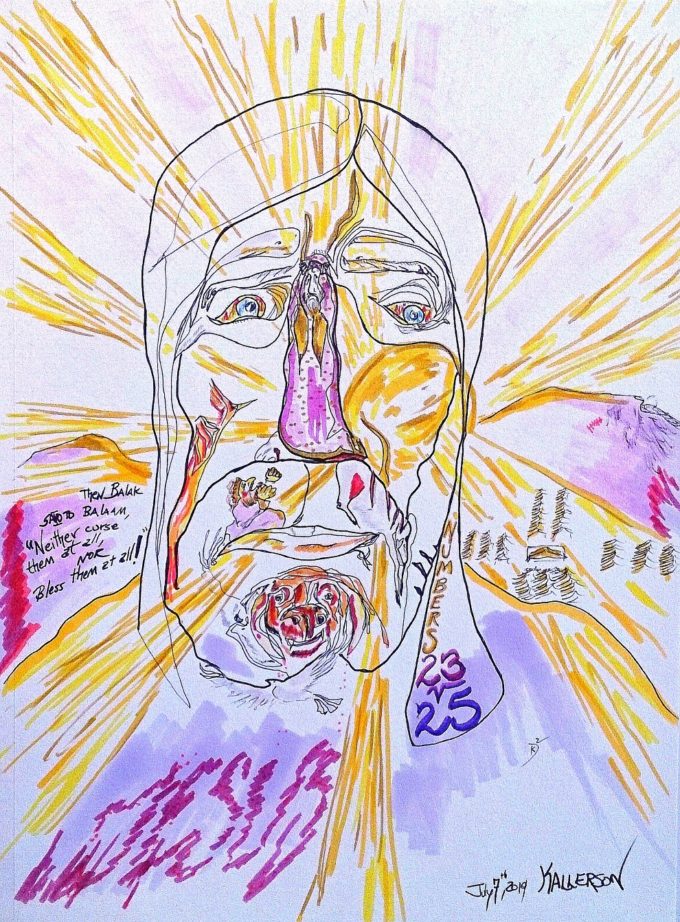
25 Then Balak said to Balaam, “Neither curse them at all, nor bless them at all!”
Balak is so upset at what he has heard that he excitedly shouts out his exasperation. The idea here is that it would be better to not curse them, than to do what he has done by blessing them. In essence, “Just shut up rather than bless them.” But he brought it on himself, as he is now reminded…
26 So Balaam answered and said to Balak, “Did I not tell you, saying, ‘All that the Lord speaks, that I must do’?”
In fact, that is exactly what he said toward the end of Chapter 22 –
“And Balaam said to Balak, ‘Look, I have come to you! Now, have I any power at all to say anything? The word that God puts in my mouth, that I must speak.’” Numbers 22:38
Yes, Balak remembers that is what was said, and it immediately brings to his mind another option…
27 Then Balak said to Balaam, “Please come, I will take you to another place; perhaps it will please God that you may curse them for me from there.”
Here, a completely new idea comes to his mind which he feels must be the answer. In this, he uses the term ha’elohim, or “the God.” It appears that Balak is intending on making an appeal to “the God” of all gods.
So far, Balaam has made his appeal and divination by the Lord, meaning Yehovah. Balak looks at Him as a limited God, such as Chemosh, Molech, or whatever other “god,” is named. But he is hoping that ha’elohim, the God, will override Yehovah. His theology is obviously severely deficient.
28 So Balak took Balaam to the top of Peor, that overlooks the wasteland.
Balak takes Balaam to a new location rosh ha’peor, or “head of the peor.” The word “top” is rosh. It signifies the top, first, highest, etc., but it also signifies head as in a person’s head, both literal and figurative. Peor comes from the verb paar, meaning “to open wide.” Thus, it means, “The Opening.” Abarim says of this word –
“It’s used to apply to the mouth but suggests to allude to other bodily cavities. This verb yields no nouns, which suggests that it describes doings out of a kind of hunger or desire rather than merely the mechanics of opening. In that sense it means to desire, to yearn and obviously also to lust.”
Their analysis of the word is clearly realized in the use of the name each time it is seen in Scripture. We are being asked to think on the meaning in relation to where they have been and where they now are. Balak is not following a willynilly pattern of attempting to curse Israel. Instead, he is doing his best to methodically determine what will work. With that in mind, the passage continues with…
29 Then Balaam said to Balak, “Build for me here seven altars, and prepare for me here seven bulls and seven rams.”
It is word for word and letter for letter exactly the same as was recorded in verse 1 of the chapter. The stupidity of Balaam is again revealed in this verse. He is still looking at Yehovah, the God of Israel, as just another God.
He has taken Balak’s advice which included the thought of “the God,” which indicates that he feels this way. Maybe he can get “the God” to override Israel’s God. Unfortunately for both of them, they failed to understand that they are one and the same. Because of this…
*30 (fin) And Balak did as Balaam had said, and offered a bull and a ram on every altar.
The only difference here from verse 2 is that it only notes that Balak, not Balaam also, made the offerings as he alone did at Pisgah in verse 14 as well. With this, the chapter closes out, and we must wait a bit longer to finish the long, involved, and highly complex passage which speaks of Balaam and Balak in their attempt to curse Israel and exalt Moab.
We are continuing through one passage of many parts, and it isn’t really easy keep in our heads everything that is happening, but the main idea that we need to remind ourselves is that the passage concerning Balaam is telling us of God’s faithfulness to His covenant with Israel, and what that means in relation to the church which Christ began when He introduced the New Covenant.
God is absolutely faithful to Israel, despite their unfaithfulness. That was seen in several ways today. Because of His faithfulness to them, and to the covenant He made with them, we can be completely confident of His faithfulness to each of us within the church.
He has established the covenant, set the parameters, and given His assurances. He asks us to do one simple thing to be a part of that – demonstrate faith. The Bible is given to tell us the story, we are to accept what it says, believe what it reveals, and be restored to God through that faith.
He has done the work. We just need to believe. Thank goodness for the vast body of Old Testament writings which give us the assurance that what we read in the New is reliable. Have faith. The book is written and God’s word is complete. Trust in Christ, rest in Christ, and hold fast to your faith in Christ.
Closing Verse: “Do you not know that you are the temple of God and that the Spirit of God dwells in you?” 1 Corinthians 3:16
Next Week: Numbers 24:1-11 His words are not just metaphorical (Balaam’s Third Oracle) (47th Numbers Sermon)
The Lord has you exactly where He wants you. He has a good plan and purpose for you. It may seem at times as if you are lost in a desert, wandering aimlessly. But the Lord is there, carefully leading you to the Land of Promise. So follow Him and trust Him and He will do marvelous things for you and through you.
Balaam’s Second Oracle
Then Balak said to him, “Please come with me to another place
From which you may see them; I will show you where
You shall see only the outer part of them
And shall not see them all; curse them for me from there
So he brought him to the field of Zophim
To the top of Pisgah, and built seven altars; so he did do
And offered a bull and a ram on each altar
In order to try to curse Israel anew
And he said to Balak, concerning this affair
“Stand here by your burnt offering
———-while I meet the Lord over there
Then the Lord met Balaam
And put a word in his mouth, and said
“Go back to Balak, and thus you shall speak
The words you are given, just as you are led
So he came to him, and there he was
Standing by his burnt offering, waiting for the token
And the princes of Moab were with him
And Balak said to him, “What has the Lord spoken?”
Then he took up his oracle and said:
The words he spoke as he was led
“Rise up, Balak, and hear!
Listen to me, son of Zippor!
“God is not a man, that He should lie,
Nor a son of man, that He should repent.
Has He said, and will He not do?
Or has He spoken, and will He not make it good?
Behold, I have received a command to bless;
He has blessed, and I cannot reverse it.
“He has not observed iniquity in Jacob,
Nor has He seen wickedness in Israel.
The Lord his God is with him,
And the shout of a King is among them.
God brings them out of Egypt;
He has strength like a wild ox.
“For there is no sorcery against Jacob,
Nor any divination against Israel.
It now must be said of Jacob
And of Israel, ‘Oh, what God has done!’
Look, a people rises like a lioness,
And lifts itself up like a lion;
It shall not lie down until it devours the prey,
And drinks the blood of the slain.”
Then Balak said to Balaam, with his Moabite bawl
“Neither curse them at all, nor bless them at all!”
So Balaam answered and said to Balak
“Did I not tell you, saying
All that the Lord speaks, that I must do’?”
Wasn’t I to you these words relaying?
Then Balak said to Balaam
“Please come, I will take you to another place
Perhaps it will please God that you may curse them
———-for me from there
Perhaps He will extend to me this grace
So Balak took Balaam to the top of Peor
That overlooks the wasteland, that land barren and sore
Then Balaam said to Balak
“Build for me here seven altars, as you know to do
And prepare for me here seven bulls and seven rams
As I am instructing you
And Balak did as Balaam had said
And offered a bull and a ram on every altar
———-according to the instructions as he was led
Lord God, we are even now in a wilderness
And we are wanting to be led by You
Without You to direct, our lives would be a mess
And so be our guide, O God; You who are faithful and true
We long for the water in this barren land
May it flow forth from the Rock, our souls to satisfy
Give us this refreshing, spiritual hand
And may we take it, and to our lives daily it apply
And we shall be content and satisfied in You alone
We will follow You as we sing our songs of praise
Hallelujah to You; to us Your path You have shown
Hallelujah we shall sing to you for all of our days
Hallelujah and Amen…