Numbers 27:1-11
The Daughters of Zelophehad
With only 1189 chapters in the Bible, and many of them a page or less in length, some a lot less, one surely must wonder when cursorily reading the Bible why a lot of space often seems taken up by things which could be shortened or restated in a way which would take up a lot less space.
And there are some things which seem like they could have been stated somewhere else, thereby saving unnecessary repetition. For example, the five daughters here were mentioned in the last chapter. Wouldn’t it have been better to just abbreviate this account and plug it in there instead of here?
Apparently not. Putting it here, after first mentioning them once already, is a way of getting us to consider the details more closely. It’s like when Rebekah was first introduced in Genesis 22. She was just casually referred to in a list of about 15 other names. But then, wahlah, she appears again in a pivotal section of the Bible.
As far as the daughters of Zelophehad, their story includes details concerning the disposition of property if there isn’t someone directly available to inherit the land of a deceased person. In such a case, there has to be someone to eventually take possession of it.
Who that is, and how far from the deceased, can show a lot about the life that person lived. Solomon referred to someone like this who is still living, but doesn’t have anyone to take over his inheritance. What he describes is the life of a lonely soul…
Text Verse: “Then I returned, and I saw vanity under the sun:
8 There is one alone, without companion:
He has neither son nor brother.
Yet there is no end to all his labors,
Nor is his eye satisfied with riches.
But he never asks,
‘For whom do I toil and deprive myself of good?’
This also is vanity and a grave misfortune.” Ecclesiastes 4:7, 8
Our lives are vanity, even under the best of circumstances. Our bodies grow old, our minds start to slip, we lose those around us we love, and the things we have stored up over the years often fade away before our eyes.
Everything is temporary, everything is transitory, and nothing is certain, including our next breath. This is true for every person on the planet. Life is futility, vanity, and then death. And all we saved up for ourselves will be passed on to another who may squander it in a moment.
This is reality, and it is futility – for all. That is, except for the one who has a hope which transcends this temporary, earthly existence. And even then, there are those who think they have such a hope, but their faith is misdirected. That’s an even worse fate.
They deprive themselves in this life expecting a trip to glory, and they deprive themselves of any hope of future glory by placing their expectations in the wrong path to that future glory. Without Jesus, this existence is truly the most heartbreaking of all possible things. But thank God for Jesus who gives us a sure hope, and a guarantee from God Himself that we are saved through Him.
This will be seen, once again, in today’s passage. It’s a wonderful part of His superior word. And so let’s turn to that precious word once again and… May God speak to us through His word today and may His glorious name ever be praised.
I. A Statute of Judgment (verses 1-11)
Then came the daughters of Zelophehad the son of Hepher, the son of Gilead, the son of Machir, the son of Manasseh, from the families of Manasseh the son of Joseph;
The narrative now turns to a matter which will become an obvious problem within Israel if it is not resolved now, before the family land inheritances are made. These daughters of Zelophehad were mentioned in the previous chapter. In verse 26:33, it said –
“Now Zelophehad the son of Hepher had no sons, but daughters; and the names of the daughters of Zelophehad were Mahlah, Noah, Hoglah, Milcah, and Tirzah.” Numbers 26:33
Eleven names are mentioned in this one verse. In the first half is the genealogical reference going back to the individual tribe of Manasseh, which in turn is one of the two tribes derived from Joseph. In the second half, the daughters of Zelophehad are reintroduced by name…
2 (con’t) and these were the names of his daughters: Mahlah, Noah, Hoglah, Milcah, and Tirzah.
The Hebrew reads Mahlah, Noah, and Hoglah, and Milcah, and Tirzah. However, their names are listed in a different order in Numbers 36:11, where it says, “Mahlah, Tirzah, and Hoglah, and Milcah, and Noah. Tirza and Noah switch places.
As Mahlah is named first in both, she may be the eldest, and the other four are probably on an equal footing with one another. The reason for this could be as simple as them being quadruplets, or that only the eldest was recognized with a particular status.
Whatever the reason, they came together as a single group to seek an answer to a dilemma that they faced as the daughters of a man who had no sons after him…
2 And they stood before Moses, before Eleazar the priest, and before the leaders and all the congregation, by the doorway of the tabernacle of meeting, saying:
The women have a case which requires some type of resolution, and it is obviously a matter which was not resolved at a lower level within the camp. Because of this, they present themselves before the lawgiver, the high priest, the leaders – probably meaning of the individual tribes – and finally “all the congregation.”
This doesn’t mean that all the congregation was there, but that the matter is open to any of the congregation who were there, whether leaders or laypeople. The matter is not being done in secret, but it is rather a matter which all would eventually need to be made aware of because it is precedent-setting.
The location is said to be “at the door of the tent (not tabernacle) of meeting.” The tent of meeting is the entire edifice, inside of which is the tabernacle, which consists of the holy and most holy places. The door of the tent means “by the altar of sacrifice.”
As has been seen since Exodus, the brazen altar and the door of the tent of meeting are actually united in thought. One cannot go through the door without first coming to the sacrifice. It is a picture of the work of Christ. One cannot go through the Door, meaning Christ, unless he goes through His cross. This is the place of judgment, and so they now present their case…
3 “Our father died in the wilderness;
On the surface, it seems that Zelophehad was of the generation of those 20 and above at the time of the sentence upon the congregation who were destined to wander and to die in the wilderness. But, in verse 4, it will seem more likely that he was under 20 and happened to die, meaning he was not one who was under sentence. If so, he could still have died as old as 58 or 59.
This even seems likely because he was named in the census which had just taken place. If he was alive, that means that he just – at this very time – died. If so, all of a sudden, his inheritance is called into question before he had a chance to have a male child.
The timing can’t be known, but the Lord has orchestrated this sequence of events to specifically resolve this matter at this time. Either way, the matter at hand is that an inheritance is expected, but with no male son, there is – as of yet – no guidance for what is to be done. This is based on the words of Numbers 14 –
“Except for Caleb the son of Jephunneh and Joshua the son of Nun, you shall by no means enter the land which I swore I would make you dwell in. 31 But your little ones, whom you said would be victims, I will bring in, and they shall know the land which you have despised.” Numbers 14:30, 31
Either Zelophehad, or his daughters, was entitled to entry into Canaan, and thus they were entitled to a land inheritance…
3 (con’t) but he was not in the company of those who gathered together against the Lord, in company with Korah,
It is questioned why they included this statement, but what seems obvious is that it is based upon what it said in the account when Korah was destroyed. At that time, it noted that all of those in the families of Korah, Dathan, and Abiram were swallowed up, including their wives, their sons, and their little children.
As even the little children were swallowed up, it meant that they were cut off from any inheritance. But such was not the case with the daughters of Zelophehad. Therefore, they have a much stronger argument that it was not intended that he be cut off completely as they were, even though he had only daughters.
It is apparent from later in the Bible that Korah had sons who did live, but they were obviously old enough to be in their own homes and not counted under the sins of Korah. But because these daughters were still a part of their father’s house, and because he was not such a villain as Korah, their legal rights to an inheritance seemed right and just. This is because…
3 (con’t) but he died in his own sin; and he had no sons.
This could mean one of several things. Two of the most likely are that he was one of those twenty and above who were forbidden from entry into Canaan, the penalty of which was death in the wilderness, or that he was simply a man who sinned before God as all people do. Either way, John Lange speaks highly of their understanding of theology. He says –
“Indeed these daughters of Zelophehad possessed a fair faculty for doctrinal discriminations. Death without sin going before it, was for them at any rate inconceivable.” John Lange
What is understood by them, either way, is that forgiveness of sin under the Mosaic Covenant did not mean the granting of life. When it says in Leviticus 18 that the man who does the things of the law will live by them, it obviously excludes being forgiven of sin, which is allowed under the law, such as on the Day of Atonement.
If it did, then the people would be forgiven and never die. However, they were forgiven, but still died. The imperfection of the Mosaic Law is seen in this simple statement by the daughters of Zelophehad. Death under the law of Moses was a natural result of life, not an exception to it. As his death was a common thing which came about through his sin, his name should not be forgotten…
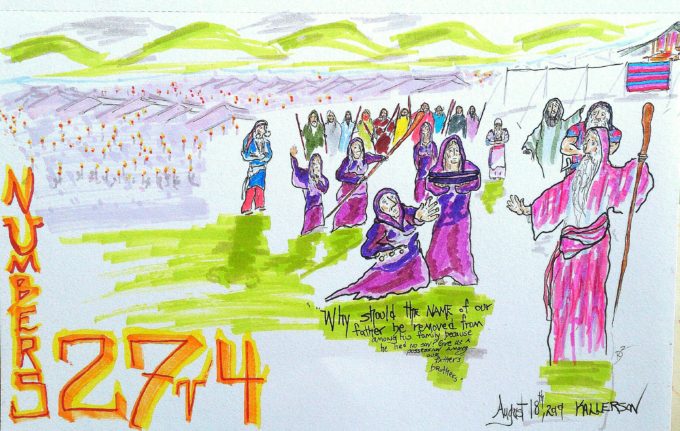
4 Why should the name of our father be removed from among his family because he had no son?
Without being dogmatic about the reason, because dogs have pedigrees, but not genealogies, it seems that Zelophehad was actually not one of those twenty and above who rejected the Lord in Numbers 14. This is because of these words. They say, “Why should the name of our father be removed.” The word is gara, coming from a root which means “to scrape off.”
If he was one of the older generation, his name would not have been entered in as an inheritor of the land in the genealogy of the previous chapter. But he was. Now that he has died, and because he has no sons, they are concerned that his name will be removed, scraped off, from the records for landed property.
What is seen here is that these girls were not simply looking for land, because when they got married, they would have land through their husbands. What they want is the preservation of their father’s name. All of them would marry and take on new family names, and the name of their father would disappear. Thus, the act by these girls is one of love for their father and his name, not greed.
4 (con’t) Give us a possession among our father’s brothers.”
The words here are actually words of faith. Israel has not yet entered Canaan. The last time they were this close to entry, the people rebelled and rejected the Lord in their cowardice.
Some wised up to their plight after the Lord’s words of punishment and decided to go into the land and subdue it without Him. That proved equally as much of a disaster. Now, they are just outside of Canaan, with the same large nations and well-defended cities as before, and yet, these young ladies stand before the Lord asking for a right to the land which is not even yet subdued.
They are looking forward to their own land and inheritance, within the people of Israel, as if it is already an accomplished fact. Their understanding of the law is remarkable, and their faith in the provision of the Lord is equally so, or even greater.
In this, they are like five wise virgins who anticipate the future and prepare for it. It very well may be that Jesus had them in mind when He spoke out His parable in Matthew 25. Because of these young ladies, Zelophehad is not only mentioned here, but nine times in Numbers, Joshua, and 1 Chronicles, and in each instance, he is named in reference to his daughters.
5 So Moses brought their case before the Lord.
It seems like a simple statement, but it must be contrasted with what it said in verse 2 –
“And they stood before Moses, before Eleazar the priest, and before the leaders and all the congregation, by the doorway of the tabernacle of meeting…”
The daughters of Zelophehad brought a request before those who sat in judgment over Israel. The lawgiver, the high priest, the leaders, and indeed the whole congregation – meaning whoever else was there at the time, could not come to a resolution concerning the matter.
And so Moses had to take their mishpat, or case, before the Lord. Thus, this makes the fourth and final matter which was of such importance that it specifically says Moses went in before the Lord to obtain clarification as to what should occur.
The first time was in Leviticus 24 when the blasphemer was put in custody while Moses went in to obtain direction from the Lord as to what should be done to him. After that, there needed to be an answer as to what should be done concerning those who were defiled by a dead body during the time of the Passover. That is recorded in Numbers 9.
The third instance is that of what was to be the fate of the Sabbath-breaker in Numbers 15. And finally, Moses required direction in this matter concerning the inheritance of Zelophehad.
The first was for a violation of the law, leading to someone’s death. The second was to gain understanding about something not specified in the law because of events surrounding someone who had died. The third was for a violation of the law, again leading to someone’s death. Again, the fourth is to gain understanding about something not specified in the law, because of events surrounding someone who had died. It is a marvelous a-b/a-b pattern.
In each of these, there is a connection to Christ. To reject Christ is to blaspheme the name of the Lord, who is Christ. To reject the Passover is to reject Christ, who is the Passover Lamb. To reject God’s rest, pictured in the Sabbath, is to reject Christ who is our rest. And to not receive God’s inheritance is to not receive Christ who is how we obtain our inheritance.
The matter of Zelophehad’s daughters is one which is more than just a minor issue, but it is one which anticipates much greater theological issues, at least implicitly.
6 And the Lord spoke to Moses, saying:
This would have been from above the mercy seat, as it says in Numbers 7 –
“Now when Moses went into the tabernacle of meeting to speak with Him, he heard the voice of One speaking to him from above the mercy seat that was on the ark of the Testimony, from between the two cherubim; thus He spoke to him.” Numbers 7:89
None of this surprised the Lord, and yet He allowed it to happen so that the precedent would be set, the decision would be rendered by Him, and then it would be recorded in His word as an everlasting testament to the faithfulness of these five wise virgins.
7 “The daughters of Zelophehad speak what is right; you shall surely give them a possession of inheritance among their father’s brothers, and cause the inheritance of their father to pass to them.
The words of this verse, as recorded in the Masoretic Text, have a gender discord in them. It says, naton titen lahem akhuzat nakhalah, or “in giving, you shall give them a possession of inheritance.” The words are in the masculine, even though it is speaking of the women.
Likewise, the words, betok ahe abihem, or “among brothers of their father,” are also masculine. However, at the end of the verse, it says, v’haabarta eth nakhalat abihen lahen, or “and cause to pass inheritance their father to them.” The words are feminine.
There are several suggestions as to why the Hebrew is this way. The common and easiest suggestion is that this is a scribal error. It is recorded in the masculine in this way in other manuscripts, and so – obviously – this must be an error. However, it would make more sense to correct a gender discord than to purposefully leave an error after it was found. That is not a good excuse.
A second possibility is that it is referring to their sons, when they get married and receive the inheritance through their daughters. This must assume that they will actually have sons, which – obviously – their mother and father did not.
A third option is that this is speaking of their husbands, who must be from the same tribe as them, as will be mandated in Chapter 36. Unfortunately, that cannot be the answer. That is putting the cart before the horse. The Lord has not yet given those instructions, because what brought them about has not yet been addressed.
A fourth reason is that because they are now regarded as the inheritors, they are regarded as sons as reflected in the Hebrew masculine. There is nothing, other than an obvious rejection of the intentional use of the masculine, that would preclude this.
If it is so, then it looks not to the permanent consideration of them as males, because it reverts to the feminine in the second half of the verse, but rather to a theological point about inheritance which is stated in Galatians 3 –
“For you are all sons of God through faith in Christ Jesus. 27 For as many of you as were baptized into Christ have put on Christ. 28 There is neither Jew nor Greek, there is neither slave nor free, there is neither male nor female; for you are all one in Christ Jesus. 29 And if you are Christ’s, then you are Abraham’s seed, and heirs according to the promise.” Galatians 3:26-29
Those verses must be taken in the proper context, which they usually are not. People use them to state that the Jews are no longer considered Jews, or that Gentiles are now Jews, because of Paul’s words. But that is as nutty as a football bat.
In the same set of verses, Paul writes of there being neither slave nor free, and yet he writes acknowledging that there are both elsewhere in his epistles. He also writes of their being neither male nor female, and yet – unless I am preaching in an Episcopal church today – I’m pretty sure there are both males and females present. I bet we could stop and I could identify which are which too. Well, at least with most of you.
What this verse in Numbers, and what Paul in Galatians, refers to is the concept of an equal position in Christ, regardless as to cultural identity, status before human law, gender, or whatever other distinction one can think up in their heads concerning how things are now.
Yes, there are still Jews and Gentiles, and it will continue to be so, just as there are males and females. However, our position in Christ makes no distinction despite the difference. This is certainly why it speaks of the daughters of Zelophehad in the masculine first, and then in the feminine. Their inheritance is positionally equal (distinction) despite their female gender (difference).
8 And you shall speak to the children of Israel, saying:
The Lord, having resolved the matter for these five wise virgins, decides to continue to clarify it so that other such possibilities, which arise along similar lines, will be taken care of as they come.
As we go through these, He ensures that the bases are covered by this subject matter, but he leaves other issues related to them unresolved. This is particularly what comes about in Numbers 36. In this, the matters will again have to be decided.
However, when that time comes, it won’t say that Moses went to ask the Lord for clarity. Rather, it will be Moses simply stating, “This is what the Lord commands.” Whether Moses went back in a second time, or whether he is told these things now, but it is only recorded later, isn’t revealed to us.
The Lord’s word is recorded in methodical steps, and it slowly reveals things, whether categorically, chronologically, or for whatever other reason. As each thing is revealed, the wisdom of its being disclosed at that time always becomes evident.
8 (con’t) ‘If a man dies and has no son, then you shall cause his inheritance to pass to his daughter.
As has occurred in this chapter with the daughters of Zelophehad, so the precedent is set for all such future occurrences in Israel and under the Law of Moses. The sons were to receive the inheritance from the father.
This would be in accord with any other inheritance provisions, such as the right of the firstborn to inherit a double portion. In accord with those other provisions, it is the sons, who bore the name of their father, that were to receive the inheritance. Of this, the Pulpit Commentary rightly states –
“Upon the land was to rest the whole social fabric of Israel, and all that was valued and permanent in family life and feeling was to be tied as it were to the landed inheritance. Hence the land was in every case so to pass that the name and fame, the privilege and duty, of the deceased owner might be as far as possible perpetuated.”
So thorough is this framework now being set forth that scholars note that the feudal law of Europe followed the same lines as are given here. Rather than the passing of inheritance by will or by grant, the parameters were carefully followed which reasonably mirror this code found in Numbers.
It was to the sons first, followed by daughters if there was no son. From there, the next parameter is given…
9 If he has no daughter, then you shall give his inheritance to his brothers.
The owner is now said to die without any children, either male or female. In this, his labors and his land will be transferred to any surviving brothers. This is appropriate, because if he didn’t exist, they would have received what he possessed. And it is true even if he died early before the inheritance was set forth. It is logical and appropriate. But…
10 If he has no brothers, then you shall give his inheritance to his father’s brothers.
This is, obviously, assuming that his father has died, and that is why he obtained his inheritance in the first place. However, exception is noted in Scripture where the father was still alive and yet an inheritance was handed out.
The Jewish law in the Mishnah actually says that if the father is alive, he would be preferred before the father’s brothers in this verse. However, the Bible does not make that statement. It would logically follow, but as far as the Bible, it only deals with a person that has no children and no brothers. After that, the father’s brothers are the recipients. From there, their children, meaning the dead man’s cousins, would be the eventual recipients. However…
11 And if his father has no brothers, then you shall give his inheritance to the relative closest to him in his family, and he shall possess it.’”
Supposing that all of the aforementioned possibilities failed, the nearest close relative was to be sought out and granted the land. This is seen in the book of Ruth. However, though not stated, it would be within the family on his father’s side. The family of the wife is not family in the sense spoken of within this context.
No matter how far distant, the records would eventually indicate someone within the father’s family who would be considered the closest relative and it would be to that person that the inheritance would be granted. Because of this provision, found here in Numbers 27, the Jewish scholar Maimonides said that an Israelite is never without heirs.
11 (con’t) And it shall be to the children of Israel a statute of judgment,
The term l’khuqat mishpat, or “for a statute of judgment,” is only found here and in Numbers 35:29 which deals with cities of refuge in relation to a man-slayer. The idea of both is a statute of the Lord that entails a fixed, permanent, and authoritatively established judgment. It defines and determines a legal right.
*11 (fin) just as the Lord commanded Moses.
Moses had sought the Lord’s guidance, and the Lord provided that same guidance. The wisdom of the statute of judgment, along with the other land rules – such as the return of a possession at the Year of Jubilee – kept the Israelite society harmoniously living in the land, for almost fifteen hundred years.
Though there was punishment and exile, the understanding concerning family inheritance was set and fixed, eliminating countless problems which could otherwise have arisen in that ancient agricultural society.
An inheritance awaits us that is sure and true
It is waiting for all who will come forward and receive
It was secured for us by what Christ Jesus did do
And it is ours for the taking, if we just believe
God has spoken that this thing we ask for is right
It belongs to us, though we did nothing for it to receive
With it comes an eternal life, dazzling and bright
And it is ours for the taking, if we just believe
Don’t fail to come forward; hear my plea
It is waiting for you if you will but receive
You and all the saints will be there around the glassy sea
It is yours for the taking, if you will just believe
II. Wisdom in the Words
There are five possibilities of inheritance seen in the verses today.
1) Sons receive the inheritance.
2) If no sons, daughters receive the inheritance.
3) If neither sons nor daughters, then the brothers receive the inheritance.
4) If no brothers are to be found, then the father’s brothers are to receive the inheritance.
5) If no father’s brothers are to be found, then the nearest close relative is to receive the inheritance.
There is no need to go past these five degrees of family structure because all families fell under the divisions within the tribes. And so, as long as a tribe existed, there would never be a lack of a close relative. One could continue all the way back to the last division before one of the twelve sons of Israel and still find a relative.
Five, being the number of grace, is perfectly revealed in the grace of these inheritance laws. An inheritance is something one does not deserve. It comes to them apart from merit, and this is exactly what is seen here. The Lord says of the land of Canaan –
“The land shall not be sold permanently, for the land is Mine; for you are strangers and sojourners with Me.” Leviticus 25:23
The land belongs to the Lord. He gave it to Israel as an inheritance, but it remained His in the ultimate sense. The grace of this land-inheritance statute of judgment was intended to keep the land carefully aligned with the families within the tribes, and to protect all in those families as they lived out their lives.
As the land is the Lord’s, it reminded them that they were the Lord’s possession. There is no way to separate the people from the land and still have both be true. When Israel was exiled for their rejection of Christ, they were also rejected by the Lord.
This was prophesied by Hosea where the Lord said, “You are not my people” (Hosea 1:9). However, He later said of them –
“Then I will sow her for Myself in the earth,
And I will have mercy on her who had not obtained mercy;
Then I will say to those who were not My people,
‘You are My people!’
And they shall say, ‘You are my God!’” Hosea 2:23
This is built upon by both Paul and Peter in the New Testament. The Lord has had mercy on Israel, and He has planted them back in their land. They are ready, once again, to be called the people of God. But that will only happen after they call out to Jesus, “You are my God.”
Together, Jew and Gentile have been brought into the family of God through Christ. Someday, that will extend to all of Israel. As Matthew Henry says of this passage –
“God himself gives judgment. He takes notice of the affairs, not only of nations, but of private families, and orders them according to his will. The petition is granted. Those who seek an inheritance in the land of promise, shall have what they seek for, and other things shall be added to them.”
Zelophehad, or Tselophekhad, means “Shadow of Fear.”
Mahlah, or Makhlah, means, “Infirmity.” It is akin to the name of one of the sons of Elimelech and Naomi in the book of Ruth – Makhlon.
Noah signifies, “Shaky Girl,” or “Wandering.” Her name comes from the word nua, which gives the sense of quivering, wavering, or tottering. However, it is used when speaking of Cain in Genesis 4 where he is sentenced to be a vagrant; a wanderer upon the earth.
Hoglah, or Khoglah, means, “Turning in joy.” It is akin to the word khag which is a festival.
Milcah means, “Queen.”
Tirzah means, “Well-pleasing,” or “Delight.”
Together, this family gives us a broad and general brushstroke of salvation as it occurs in Christ Jesus.
First, in general type concerning their actions, they have come forward to the lawgiver and the high priest, among others, in order to claim their right to an inheritance in the Promised Land. That inheritance is first secured for man through the work of the Lord, and then it is the right of those who call on Him to obtain their own inheritance. That is seen, for example, in Ephesians 1 –
“In Him also we have obtained an inheritance, being predestined according to the purpose of Him who works all things according to the counsel of His will…” Ephesians 1:11
As there are five unmarried daughters of Zelophehad, they can loosely be equated – as noted earlier – to the five wise virgins who anticipate their inheritance through the coming of Messiah in Matthew 25. Though dealing with Israel, under the law, the anticipation is that of their inheritance in Messiah.
As they are without a father, and with nothing said of their mother – whether living or not – they are as those who have no inheritance, and yet are sure that they have their own right to one. The law then provides for it by the word of the Lord.
That same Lord secured the inheritance through His own work, fully and completely rendered for the payment of the inheritance. And he grants it to those who – seemingly deprived of the inheritance – are exalted to the obtaining of it.
Sin ended their father’s life, but the law provided the path for his name to be continued and to ensure that the inheritance would not fail. This is seen in their names. Zelophehad who died in his sin represents those born in sin, in the “shadow of fear.” As Hebrews says –
“Inasmuch then as the children have partaken of flesh and blood, He Himself likewise shared in the same, that through death He might destroy him who had the power of death, that is, the devil, 15 and release those who through fear of death were all their lifetime subject to bondage.” Hebrews 2:14, 15
This state of fear of death, brings forth Mahlah, or the sickly, infirm person, bound in sin. There is a state of pain because the fallen condition in which man exists in this state. Such a person, like Cain, is left in a land of wandering, represented by Noah. This lasts until the person confronts Christ.
At that time, Hoglah or turning of joy, enters into the picture. And in that turning of joy at obtaining the inheritance, royalty is bestowed upon that soul, represented by Milcah, or Queen. In Revelation 1, this is recorded –
“To Him who loved us and washed us from our sins in His own blood, 6 and has made us kings and priests to His God and Father, to Him be glory and dominion forever and ever. Amen.” Revelation 1:5, 6
In this state, and as inheritors of the divine promises of God found in Christ, we are found “well pleasing” to God, represented by Tirzah. These five daughters names are otherwise superfluous to the narrative unless their meanings are intended to convey a thought which the Lord intends for us to see. If not, He would have simply said, “the five daughters of Zelophehad,” and left it at that.
However, by stating their names both in the previous chapter and here, He is asking us to consider them and contemplate their meaning. And in contemplating their meanings, we see what the Lord intends for us to see.
There is an inheritance awaiting any and all who are willing to receive it. And this is what these five wise daughters of Zelophehad did. They came forward and asked for that which already actually belonged to them, though it was only at that time in the mind of the Lord.
And this is what we are asked to do as well. Let us not fail to heed the call. There is, in fact, an inheritance awaiting us if we will simply come forward and receive it as such. It is already ours, if we will but act.
Closing Verse: “Blessed be the God and Father of our Lord Jesus Christ, who according to His abundant mercy has begotten us again to a living hope through the resurrection of Jesus Christ from the dead, 4 to an inheritance incorruptible and undefiled and that does not fade away, reserved in heaven for you, 5 who are kept by the power of God through faith for salvation ready to be revealed in the last time.” 1 Peter 1:3-5
Next Week: Numbers 27:12-23 Hip Hip Hoorah! (The Inauguration of Joshua) (53rd Numbers Sermon)
The Lord has you exactly where He wants you. He has a good plan and purpose for you. It may seem at times as if you are lost in a desert, wandering aimlessly. But the Lord is there, carefully leading you to the Land of Promise. So follow Him and trust Him and He will do marvelous things for you and through you.
The Daughters of Zelophehad
Then came the daughters of Zelophehad
The son of Hepher, the son of Gilead
The son of Machir, the son of Manasseh
From the families of Manasseh the son of Joseph; for sureza
And these were the names of his daughters:
Mahlah, Noah, Hoglah, Milcah, and Tirzah
And they stood before Moses
Before Eleazar the priest, with words to be conveying
And before the leaders and all the congregation
By the doorway of the tabernacle of meeting, saying:
“Our father died in the wilderness
But he was not in the company of those; no, not of those ones
Who gathered together against the Lord, in company with Korah
But he died in his own sin; and he had no sons
Why should the name of our father
Be removed from among his family, this isn’t our druthers
Because he had no son?
Give us a possession among our father’s brothers
So Moses brought their case before the Lord
To obtain from Him the appropriate word
And the Lord spoke to Moses, saying:
These words to him He was then relaying
“The daughters of Zelophehad speak what is right
You shall surely give them a possession, without haw or hem
Of inheritance among their father’s brothers
And cause the inheritance of their father to pass to them
And you shall speak to the children of Israel, saying:
‘If a man dies and has no son
Then you shall cause his inheritance
To pass to his daughter, so this shall be done
If he has no daughter, if not any others
Then you shall give his inheritance to his brothers
If he has no brothers, no other sons of his mother’s
Then you shall give his inheritance to his father’s brothers
And if his father has no brothers
Then you shall give his inheritance, so I submit
To the relative closest to him in his family
And he shall possess it
And it shall be
To the children of Israel
A statute of judgment
Just as the Lord commanded Moses; as He to Moses did tell
Lord God, we are even now in a wilderness
And we are wanting to be led by You
Without You to direct, our lives would be a mess
And so be our guide, O God; You who are faithful and true
We long for the water in this barren land
May it flow forth from the Rock, our souls to satisfy
Give us this refreshing, spiritual hand
And may we take it, and to our lives daily it apply
And we shall be content and satisfied in You alone
We will follow You as we sing our songs of praise
Hallelujah to You; to us Your path You have shown
Hallelujah we shall sing to You for all of our days
Hallelujah and Amen…