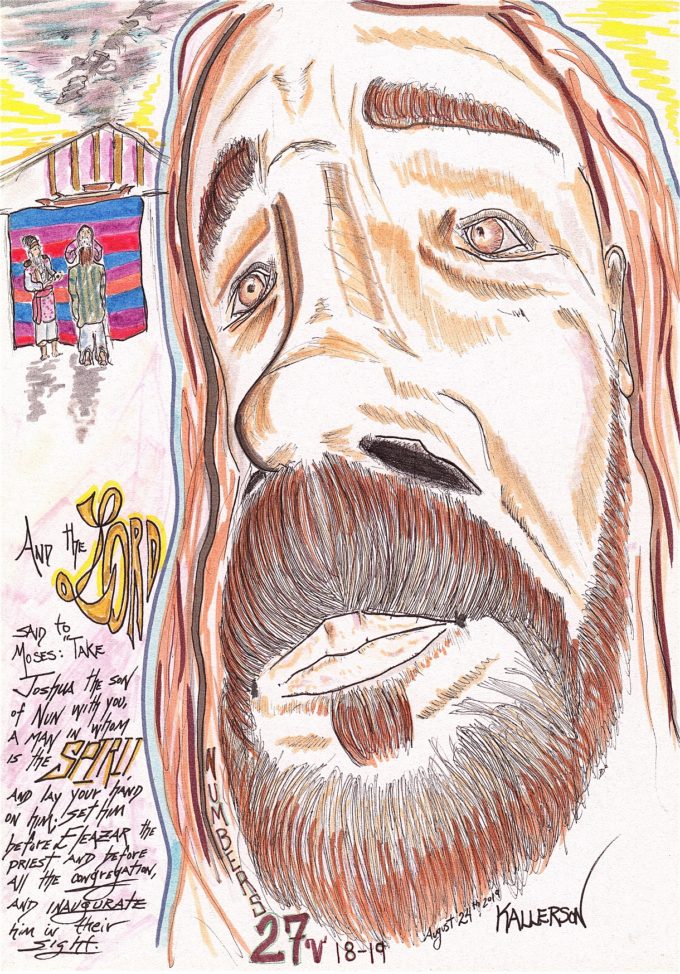
Numbers 27:12-23
The Inauguration of Joshua
The passage today deals with two different subjects. The first is that of Moses being told that his life is coming to an end, and a reminder of the reason for that. The second is that of the inauguration of Joshua to succeed Moses.
Despite these being recorded now, there is still quite a bit more to go in Numbers, and there is another book, Deuteronomy, coming from Moses as well. It may seem like a lot, and that the inauguration of Joshua should be kept till later, but all of the events between now and the end of Deuteronomy form a very short period of time, months at best, possibly much less.
It would make no sense to wait until the last minute to accomplish the things in this passage today any later than they are now occurring. There needs to be a time of transition which prepares both the leadership and the people for what lies ahead.
As for Moses, the passage today gives the highlights, but it skips some of the details of what occurs between the Lord and him when he is told he is to die. We’ll look at those things from Deuteronomy today, and we’ll go over them in detail when we get there.
But the point is, in both instances, that Moses resigned himself to the fact that he wasn’t going into Canaan, and that another would have to assume his position in order for Israel to take that giant step forward. For Moses, he is told to go up the mountains and see what he would not attain. His life was a pilgrimage that ended before receiving the promise…
Text Verse: “These all died in faith, not having received the promises, but having seen them afar off were assured of them, embraced them and confessed that they were strangers and pilgrims on the earth. Hebrews 11:13
For us, there are two parts to the promise we have been given. The first is that we have obtained the promise in Christ. It is ours, actual and whole, but it is not yet realized. The second part is when it is realized. Too often, we separate the two, as if we might not actually obtain the promise, even though it is ours.
People fret over their salvation, they believe that they can lose it, and they second-guess what they have heard, wondering if it is all just some type of hoax that they once believed. That is a sad state to be in, but it doesn’t change the reality of the situation. If one is in Christ, the promise is his and it comes with a guarantee.
The way to not fall into doubt, worry, or frustration is to keep in the word, understand what you have received, and simply hold fast to it. The promises of God are sure, and they are verifiable. We will talk about that at the end of the sermon, after we have looked over the verses in today’s passage.
Let us take comfort in our faith, hold fast to it, and not forget that the second part of our promise – the realization of entry into the inheritance – could come at any moment. The Lord may come and take His church home, or He may come and gather us to our fathers as has happened to so many before us.
Either way, we are going to be with Him. This is a great and perfect hope which is to be found in His superior word. And so let’s turn to that precious word once again and… May God speak to us through His word today and may His glorious name ever be praised.
I. You Also Shall Be Gathered to Your People (verses 12-14)
The last portion of Scripture we looked at last week dealt with the inheritance rights of the people of Israel, particularly the division of inheritance to someone who had no sons. With that matter settled, the Lord speaks to Moses once again about his not being one to enter into Canaan. Moses, or He Who Draws Out, would not be the one to bring the people in to receive their inheritance. The picture is obvious. Moses drew out the people from Egypt, but the law also came through him. The law draws out sin in man. It does not resolve the sin problem; it highlights it, as Paul explains –
“But sin, taking opportunity by the commandment, produced in me all manner of evil desire. For apart from the law sin was dead. 9 I was alive once without the law, but when the commandment came, sin revived and I died. 10 And the commandment, which was to bring life, I found to bring death.” Romans 7:8-10
Moses, who represents the law, cannot enter the promised inheritance. Rather, the law must die prior to granting salvation (pictured by entry into Canaan). Aaron, the high priest of the law, has already died. Moses must also die outside of the inheritance to fulfill the picture. But in the death of Moses, there must be another to lead the people. Today’s narrative will continue the picture…
12 Now the Lord said to Moses:
The Lord has set the parameters of all things, and the Lord has made the determinations contained within them. For Israel, one of those parameters is that the law will not lead the people into glory. It will lead the people to glory, but only “to,” not “into.” To meet one of the determinations contained within that parameter, the Lord continues by saying…
12 (con’t) “Go up into this Mount Abarim,
aleh el har ha’abarim hazeh – “Go up into Mount the Abarim the this.” Moses is instructed to go into the mount of the Abarim. The word comes from abar, meaning to pass over, by, or through. The “im” at the end is a plural marker, like our “s.” Thus, it is “The Crossings Over” or “The Regions Beyond.”
They are in the regions beyond Canaan, and so it is Canaan which is the point of reference. The instruction for Moses to go up is anticipatory. In other words, he is to do this, but the actual event doesn’t occur until Deuteronomy 31-34.
And so, this is not two different stories, as some scholars claim. Rather, it is an often-used literary tool found in Scripture. An event is spoken of, and the details are filled in later. It was what occurred with the creation accounts in Genesis 1 & 2, and it is something we have seen repeatedly in Numbers.
The reason for including this now, as seen, is to show that the law, typified by Moses, is not a part of the inheritance. It is also to reveal that a new leader must be identified and commissioned to lead the people into Canaan. This will continue to be revealed in the verses ahead.
The timing of the ordination of Joshua is actually later in the chronology of events in the book of Numbers, but the record of it now is necessary to establish the idea that he is the one to assume the role of leader after Moses. This will become more evident when we get to Chapter 31. For now, along with a new leader, a new generation – typified by the daughters of Zelophehad – will enter and receive the inheritance. Thus, the words of Paul concerning the law are seen here –
“Now to Abraham and his Seed were the promises made. He does not say, ‘And to seeds,’ as of many, but as of one, ‘And to your Seed,’ who is Christ. 17 And this I say, that the law, which was four hundred and thirty years later, cannot annul the covenant that was confirmed before by God in Christ, that it should make the promise of no effect. 18 For if the inheritance is of the law, it is no longer of promise; but God gave it to Abraham by promise.” Galatians 3:16-18
The generation of the law, meaning those who received it, died prior to entry into Canaan. But those of the promise – meaning their offspring – would enter. We are being given typological representations of what God would do in Christ who is the fulfillment of the law. His seed will, in fact, obtain the promise.
The words, “Go up into this Mount Abarim,” are general. However, they will become more specific as the narrative is expanded upon in Deuteronomy. Abarim will be defined as Pisgah, and then Pisgah will be further defined as Mount Nebo. To continue with the typology of the law’s inability to bring Israel in, the Lord continues with his words to Moses…
12 (con’t) and see the land which I have given to the children of Israel.
The land of Canaan is the Lord’s land. This was stated explicitly in Leviticus 25:23. However, he has given it to the children of Israel as an inheritance. As Moses is left east of the Jordan, he is not given that inheritance. Again, one can see the law bringing the people to, but not into, the inheritance.
The law performs its work, and it is then terminated upon its completion. The typology here in Numbers shouts out aloud anticipating those doctrines which are set forth in the gospels and which are then explained in the epistles. It cannot be said enough, for those under law, there is no inheritance. Again, this is seen…
13 And when you have seen it, you also shall be gathered to your people,
The term “gathered to your people” goes back even to the time of the death of Abraham in Genesis 25:8. It obviously doesn’t mean to a specific place, because Abraham was buried in Canaan and Moses will be buried outside of Canaan. It also does not mean that he is cut off from any future promises. This is obvious for several reasons, the main one of which is recorded in the gospels. There, it shows that Moses did, in fact, appear in Canaan with Jesus –
“Now after six days Jesus took Peter, James, and John his brother, led them up on a high mountain by themselves; 2 and He was transfigured before them. His face shone like the sun, and His clothes became as white as the light. 3 And behold, Moses and Elijah appeared to them, talking with Him. 4 Then Peter answered and said to Jesus, ‘Lord, it is good for us to be here; if You wish, let us make here three tabernacles: one for You, one for Moses, and one for Elijah.’” Matthew 17:1-4
Everything that is recorded of Moses in his earthly life is given to show us hints and pictures of Christ and His redemptive work, including the time and place of his death. It is outside of Canaan that he will be gathered…
13 (con’t) as Aaron your brother was gathered.
kaasher neesaph aharon akhikha – “as was gathered Aaron your brother.” These words could have gone unstated and nothing would be lost in the detail. It is already a known fact that Aaron had died. Further, Miriam had died, and she isn’t mentioned.
Therefore, the words are a poignant reminder of past misdeeds for Moses to reflect on. Further, they are a continued reminder to us of the insufficiency of the law – or those under it – to obtain the inheritance. If there is anything that we should learn from this passage, it is that.
It begs for us to come to Jesus, trust in Him alone, and be reconciled to God apart from our futile attempts to live out our lives in hopes of personal merit instead of what God offers apart from our efforts.
14 For in the Wilderness of Zin, during the strife of the congregation,
kaasher meritem pi b’midbar tsin – “as you rebelled against my mouth in the Wilderness of Zin.” Using the word kaasher, or “as,” the Lord just said in the previous verse “as Aaron your brother was gathered.” Now, he again uses the word kaasher, or as, concerning his rebellion in the wilderness of Zin – “as you rebelled.” The repetition of the word is not saying one is the cause of the other. Rather, it is being used in a comparative sense. The word translated as “you rebelled against” is plural. It speaks of both Moses and Aaron. And so, in essence, the Lord is saying, “As Aaron has been gathered, so you will be gathered. You both rebelled and you are both to receive the same fate.
14 (con’t) you rebelled against My command
As we just saw, the Lord doesn’t say, “My command.” He says, “My mouth.” Though it can be used figuratively to mean “command,” when the Lord speaks as He does, it is to be taken as authoritative.
He should not have to say, “I command you to do this Moses.” Rather, His word bears all of His authority. Moses disregarded that precept, and it cost him. But it had to happen in order to maintain the typology. The account of this matter is recorded in Numbers 20:1-13. If you didn’t see that sermon, you now know what you must do tonight when you are at home.
14 (con’t) to hallow Me at the waters before their eyes.” (These are the waters of Meribah, at Kadesh in the Wilderness of Zin.)
Again, as I said a moment ago, the words here follow from what was recorded in Numbers 20. It is an amazing passage that needs to be explored in order to understand all of the beauty that was presented there. If you missed the sermon, or if you forgot the details, be sure to go back and watch it.
As a quick reminder, the name Meribah comes from what occurred. There was riv, or strife, and so the name of the place was called Merivah, meaning Place of Quarreling. Likewise, the name Kadesh comes from the verb qadash, meaning to hallow or set apart.
Moses and Aaron failed to hallow the Lord, and the place was named based on that. Along with that, however, there are other puns in the three verses we have looked at so far. The name Abarim is the same as what was said to the people when they rebelled in Numbers 14. There it said –
“And Moses said, ‘“Now why do you transgress the command of the Lord? For this will not succeed.’” Numbers 14:41
There, Moses said, lamah zeh atemoberim eth pi Yehovah – “why this you transgress the mouth of Yehovah.” Abarim and oberim are the same word, meaning to pass over.
By telling Moses that he is to go up into the Abarim to die, it is a reminder to him that – like the people who overstepped, or transgressed, the mouth of the Lord and were condemned to die in the wilderness – he too overstepped that same mouth, and he too is condemned to die outside of Canaan.
But more, the word Abarim is also identical to the plural word for Hebrew, ivrim. The Hebrew people are those who have crossed over to the Lord, and yet they continue to cross over (meaning transgress) the word of the Lord.
The act of burying Moses in the Abarim signifies this. As long as Israel, the Hebrew people, trust in the law, they will overstep their boundaries, and they will be judged by that same law.
The filler information, necessary to understand a better picture of what is so briefly spoken to Moses here, is found in Deuteronomy 32 where it says –
Then the Lord spoke to Moses that very same day, saying: 49 “Go up this mountain of the Abarim, Mount Nebo, which is in the land of Moab, across from Jericho; view the land of Canaan, which I give to the children of Israel as a possession; 50 and die on the mountain which you ascend, and be gathered to your people, just as Aaron your brother died on Mount Hor and was gathered to his people; 51 because you trespassed against Me among the children of Israel at the waters of Meribah Kadesh, in the Wilderness of Zin, because you did not hallow Me in the midst of the children of Israel. 52 Yet you shall see the land before you, though you shall not go there, into the land which I am giving to the children of Israel.” Deuteronomy 32:48-52
Moses, My servant, you shall be gathered to your people
It is now time for you to come home
Though many will mourn ‘neath that steeple
Your time of rest has come; no more to roam
Another must now take your place
While you are gathered to a new home
But you shall rise to again see My face
But for now you shall rest; no more to roam
You have fulfilled your mission and you have done well
And you shall be remembered always after I gather you home
Until you are raised again after a short spell
But until then you shall rest; no more to roam
II. Set a Man Over the Congregation (verses 15-23)
15 Then Moses spoke to the Lord, saying:
The vast majority of sections which deal with a conversation between the Lord and Moses begin with the words, “And the Lord spoke to Moses, saying.” The words here are reversed. It is Moses who initiates this conversation, and it is based on the news he was just given. He shall not lead Israel into Canaan. Based on this, the first thing that comes to his mind is a concern for the people…
16 “Let the Lord, the God of the spirits of all flesh, set a man over the congregation,
Moses appeals to the Lord on behalf of the people, but he does it in a manner similar to what was said in Numbers 16 during Korah’s rebellion. In their distress, Moses and Aaron fell before the Lord and exclaimed –
“O God, the God of the spirits of all flesh, shall one man sin, and You be angry with all the congregation?” Numbers 16:22
Here, he doesn’t say, “O Yehovah, the God of the spirits of all flesh, please set a man over the congregation.” Instead of calling the Lord by His name and then stating his words, he uses the Lord’s name in his statement – “Let Yehovah.”
There is purpose to this. The name Yehovah comes from the verb hayah which signifies to come to pass, or to be. In essence, he says, “Let the One who Is, the God of the spirits of all flesh.”
He is making a contrast between the Lord, who is self-existent, and who knows all things, to himself, and indeed to all others as well. The “God of the spirits of all flesh” signifies that He is the Creator of them. They came into existence, and they will go the way of all flesh in death at some point.
Even apart from the obvious defect of sin in man, in all men there is a deficiency of knowledge, experience, and wisdom. In God is found only the perfection of each of them. No matter what choice Moses made, he would be incapable of determining who was the most capable person to assume the leadership of the people.
When the sanctuary was to be constructed, the Lord knew the exact person who had the proper skills to oversee the project. And so He called out for Bezalel the son of Uri. The construction of the sanctuary was a matter of the highest importance, and the choice of the overseer required the knowledge of the Lord in order to select the right man.
The leadership of Israel was no different. Even with all of the wisdom of the elders joined together, they could not look at the hearts of the men to determine who was most fit. The spirit of man is known but to God alone. Only the Lord could search each out.
This is what Moses is relaying in his words now. His petition is that the all-knowing God alone was capable of making the right selection, and so he defers to Him to do so. The people needed someone…
17 who may go out before them and go in before them,
The words concerning a person going out and going in speak of the common, private life of the man. It is what man does. He goes out in the morning to work, and he comes home at night exhausted from the labor. Or, he goes out to carouse, and he comes in drunk. Maybe he goes out to commit adultery, and he comes in with syphilis.
Moses knows that the Lord will pick someone who is reliable. Jesus uses this same thought in John 10 –
“I am the door. If anyone enters by Me, he will be saved, and will go in and out and find pasture.” John 10:9
Who is it that will go out and come in according to the will of the Lord? Moses defers to the Lord to decide.
17 (con’t) who may lead them out and bring them in,
Moses’s words now speak of the public, official life of man. What type of a leader will he be? The words speak of a shepherd who leads sheep out, and then leads them back in again. He cares for them and will be a faithful leader over them. Again, Jesus refers to this when speaking of Himself in contrast to false shepherds –
“Most assuredly, I say to you, he who does not enter the sheepfold by the door, but climbs up some other way, the same is a thief and a robber. 2 But he who enters by the door is the shepherd of the sheep. 3 To him the doorkeeper opens, and the sheep hear his voice; and he calls his own sheep by name and leads them out. 4 And when he brings out his own sheep, he goes before them; and the sheep follow him, for they know his voice. 5 Yet they will by no means follow a stranger, but will flee from him, for they do not know the voice of strangers.” John 10:1-5
Surprisingly, Jesus said these words to the people of Israel, who claimed to be followers of Moses, and yet John next says of them that “they did not understand the things which He spoke to them.” No wonder Moses deferred to the Lord to make the choice.
17 (con’t) that the congregation of the Lord may not be like sheep which have no shepherd.”
Moses’ concern for his people was because he knew the faithless character of man. Few could be trusted with the leadership of the Lord’s people, as is evidenced throughout the Old Testament, and as is witnessed by Matthew at the time of Jesus’ advent –
“Then Jesus went about all the cities and villages, teaching in their synagogues, preaching the gospel of the kingdom, and healing every sickness and every disease among the people. 36 But when He saw the multitudes, He was moved with compassion for them, because they were weary and scattered, like sheep having no shepherd.” Matthew 9:35, 36
One can see how heavily the New Testament relies on the Old for its symbolism and terminology. As far as the sequence of events which are now being relayed, before we get to the next verse, the words of Deuteronomy 3 must be seen to understand the full context of what occurs.
“Then I pleaded with the Lord at that time, saying: 24 ‘O Lord God, You have begun to show Your servant Your greatness and Your mighty hand, for what god is there in heaven or on earth who can do anything like Your works and Your mighty deeds? 25 I pray, let me cross over and see the good land beyond the Jordan, those pleasant mountains, and Lebanon.’
26 “But the Lord was angry with me on your account, and would not listen to me. So the Lord said to me: ‘Enough of that! Speak no more to Me of this matter. 27 Go up to the top of Pisgah, and lift your eyes toward the west, the north, the south, and the east; behold it with your eyes, for you shall not cross over this Jordan. 28 But command Joshua, and encourage him and strengthen him; for he shall go over before this people, and he shall cause them to inherit the land which you will see.’” Deuteronomy 3:23-28
The Lord told Moses he would be gathered to his fathers. Moses then petitioned the Lord for mercy. The Lord rebuked him as if he would waffle on such a matter. Moses then petitioned the Lord for the people, and only then did the Lord respond, as is now seen…
18 And the Lord said to Moses: “Take Joshua the son of Nun with you,
Joshua is selected, and the Lord commands that he be ordained. Joshua, or “Yehovah is Salvation,” is a type of Christ. He came under the law, and yet he prevailed over the law. He demonstrated faith in the Lord and was granted freedom from the curse of the law which came upon all others except Caleb.
Whereas Moses led the people to the land of promise, Joshua will lead them into the land of promise. The typology of Christ is obvious. Jesus was born under the law, a law waiting to be fulfilled. It brought the people to the land of promise, but it could not bring them in.
Only when Christ came, born under the law, and who died in fulfillment of the law, could the people be brought in – by faith in what He did. Joshua, or “The Lord is Salvation,” looks to Yeshua (Jesus), meaning “Salvation,” and who is the Lord.
The name Nun means “to propagate” or “increase.” God the Father, through the Son, propagates his offspring. The typology is set, and it all points to what God does in Christ.
18 (con’t) a man in whom is the Spirit,
Of the twenty-eight versions I checked for this sermon, only one gets this right. There is no article in front of the word “spirit” in the Hebrew. It simply says, “a man in whom is spirit.” The meaning is explained later in Deuteronomy 34 –
“Now Joshua the son of Nun was full of the spirit of wisdom, for Moses had laid his hands on him; so the children of Israel heeded him, and did as the Lord had commanded Moses.” Deuteronomy 34:9
18 (con’t) and lay your hand on him;
This is an outward consecration of the man. It is a public act which is intended to convey to the people that the transfer of leadership has been decided, and that it is ordained by the Lord through Moses. In typology, the law laid its hand upon Christ.
The transfer was made, and in His death, the law found its end. A new covenant was established, just as a new leader is now inaugurated. But all things must find their proper place, and so this is to be done publicly, before others as well…
19 set him before Eleazar the priest and before all the congregation, and inaugurate him in their sight.
We saw in Numbers 20 that the transfer of the priesthood from Aaron to Eleazar pictured the transfer of the priesthood from the Aaronic line to that of Christ. Here we see the acknowledgment of the priesthood in the ordination of Israel’s new leader.
Though under the law the two offices were separate, under the New Covenant, they are both found in Jesus. And it was not done in a corner. Rather, it was done before all the congregation. Nothing about Christ’s authority was kept from the people, even if they kept separate from Him.
20 And you shall give some of your authority to him, that all the congregation of the children of Israel may be obedient.
A new word, translated as “authority,” is seen here, hod. It signifies splendor, majesty, or vigor. This is its only use in the books of Moses. It is usually used when referring to the Lord. It comes from a root signifying grandeur, such as in an imposing appearance.
In the inauguration, Moses is associating Joshua with his own majestic office. One can see Christ bearing the majesty of the law which was transferred to Him as He hung on the cross. Moses is about to die; Joshua is about to be elevated as the new leader. The law died when Christ died, but Jesus came forth as the new Leader. Each thing that occurs is given in small hints of something much greater which was coming in Christ.
21 He shall stand before Eleazar the priest, who shall inquire before the Lord for him by the judgment of the Urim.
Moses talked to the Lord face to face, whereas Joshua receives the judgment of the Lord through the Urim, or lights, via Eleazar. This shows the greatness of Moses in all of the Old Covenant.
And yet, in type, because Jesus is both the Leader of the people of God, and the High Priest of the New Covenant – filling both roles stated here – He is superior to Moses. This is explicitly stated in Hebrews 3. In Him is also the true Source of light as stated in John’s gospel. The naming of the Urim here looks to the light of Christ to come.
21 (con’t) At his word they shall go out, and at his word they shall come in, he and all the children of Israel with him—all the congregation.”
This is speaking of the direction of the Lord, not Joshua or Eleazar. It further reads, “at his mouth they shall go out, and at his mouth they shall come in.” In other words, the shepherding of Israel is by Joshua, but only at the direction of the Lord.
This is why the calling by the people for a kingship was so repulsive to Samuel, and considered such a transgression by the Lord. The people had rejected their true Head, and called for a human to take the reigns instead. But it also shows the greatness of king David who understood the truth of his own position when he said, “The Lord is my shepherd.”
David did not shun his selection as king of Israel, but he understood that his kingship was one which was still rightly as a sheep before its shepherd. It also shows the boldness of Christ to proclaim to the people, “I am the good Shepherd.”
There are only two possibilities to His words. The first is that He was a blasphemer who rejected the authority of the Lord, and the second is that He is, in fact, the Lord. Taken in the context of what is said here and throughout the rest of Scripture, no other option is left for man to consider when evaluating who Christ Jesus is.
22 So Moses did as the Lord commanded him. He took Joshua and set him before Eleazar the priest and before all the congregation.
The words here are to show the obedience of Moses to every detail spoken to him. This is an often-repeated word concerning him. He is given directions, and he meticulously follows through with them. With only the exception of the waters of Meribah, Moses was faithful in all his house.
He stood Joshua before Eleazar and, as it says, before all the congregation. It is a public ceremony intended to leave no doubt at all who the successor to Moses will be. The high priest standing with him shows the alliance between the two offices.
Moses performing the rite demonstrates his approval of the Lord’s selection, and the congregation are all witnesses. No person could question the authority granted to Joshua, because all were witnesses to it.
And the same is true with Christ. The high priest witnessed Christ’s work, the law testifies to Christ’s work, and the people throughout Israel also were witnesses to what they saw. There is no more excuse for Israel’s rejection of Jesus than there would have been if they had rejected Joshua at some point after he was so inaugurated.
*23 (fin) And he laid his hands on him and inaugurated him, just as the Lord commanded by the hand of Moses.
The words here are simple and direct. With the authority and approval of the Lord, and by the hand of Moses, Joshua was inaugurated to the office of leader of the Lord’s people. A fuller set of details of this inauguration are found in Deuteronomy 31 –
“‘“Then Moses went and spoke these words to all Israel. 2 And he said to them: “I am one hundred and twenty years old today. I can no longer go out and come in. Also the Lord has said to me, ‘You shall not cross over this Jordan.’ 3 The Lord your God Himself crosses over before you; He will destroy these nations from before you, and you shall dispossess them. Joshua himself crosses over before you, just as the Lord has said. 4 And the Lord will do to them as He did to Sihon and Og, the kings of the Amorites and their land, when He destroyed them. 5 The Lord will give them over to you, that you may do to them according to every commandment which I have commanded you. 6 Be strong and of good courage, do not fear nor be afraid of them; for the Lord your God, He is the One who goes with you. He will not leave you nor forsake you.”’”
“Then Moses called Joshua and said to him in the sight of all Israel, ‘Be strong and of good courage, for you must go with this people to the land which the Lord has sworn to their fathers to give them, and you shall cause them to inherit it. 8 And the Lord, He is the One who goes before you. He will be with you, He will not leave you nor forsake you; do not fear nor be dismayed.’” Deuteronomy 31:1-8
Later in that same chapter, it again says –
“Then He inaugurated Joshua the son of Nun, and said, ‘Be strong and of good courage; for you shall bring the children of Israel into the land of which I swore to them, and I will be with you.’” Deuteronomy 31:23
What is recorded here about Joshua is not at all unlike that which is spoken by Peter about Jesus. Joshua was imparted the hod, or splendor of Moses at his inauguration. Peter says that Jesus bore the same splendor as the Father. He repeats the substance of the account of the transfiguration in his epistle with these words –
For we did not follow cunningly devised fables when we made known to you the power and coming of our Lord Jesus Christ, but were eyewitnesses of His majesty. 17 For He received from God the Father honor and glory when such a voice came to Him from the Excellent Glory: “This is My beloved Son, in whom I am well pleased.” 2 Peter 1:16, 17
The patterns between Moses and Joshua and that of the law and Jesus were recorded about 1400 years apart, and yet they show marvelous similarities between the two accounts in order to let us know that what is recorded about Jesus isn’t just arbitrary or happenstance, but it is purposeful.
Further, if these similarities were purposefully manufactured they would have been called out as such from the moment they were written. But there could be no argument at all that what was recorded was exactly what happened.
If someone in the congregation of Israel had said, “Moses never ordained Joshua,” he would have been locked up as a lunatic. Moses stood and openly ordained him. Eleazar was there. The leaders were there, and indeed, the entire congregation was called to witness it. And further, the account was written down to ensure that it would be remembered properly.
Likewise, the same thing happened in regards to Jesus. Those things which were only seen by the apostles might have been dismissed as nonsense, except that the apostles were willing to die for what they proclaimed. Nobody in their right mind would purposefully die for what they knew was a lie.
As you defend your faith in Christ, remember the lessons concerning what is recorded, not just from the New Testament, but even from the Old. In Acts 17, the saints at Berea were called more noble than the saints at Thessalonica because they not only accepted the word, but they searched the Scriptures to see if what they were told was true and accurate.
The Scriptures which are spoken of were not the New Testament, but the Old. They heard the gospel, and of the things accomplished by the Lord, and they went back to their own Scriptures in order to determine if the things they were told matched the things they should anticipate from the Law and the Prophets.
And guess what? They do. Be assured and reassured that what you are told about Christ in the New Testament is sufficiently well-documented in the Old to validate the faith you have placed in Him. And more, the New Testament is so perfectly woven together between the books that we can have a complete assurance that what we have received, is exactly what the Lord intended for us to have.
Faith comes by hearing, and hearing by the word of God. Hear, have faith, and be confident in the faith you have professed.
Closing Verse: “This Jesus God has raised up, of which we are all witnesses. 33 Therefore being exalted to the right hand of God, and having received from the Father the promise of the Holy Spirit, He poured out this which you now see and hear.
34 “For David did not ascend into the heavens, but he says himself:
‘The Lord said to my Lord,
“Sit at My right hand,
35 Till I make Your enemies Your footstool.” ’
36 “Therefore let all the house of Israel know assuredly that God has made this Jesus, whom you crucified, both Lord and Christ.” Acts 2:32-36
Next Week: Numbers 28:1-10 Detailing these most important profferings… (The Daily and Sabbath Day Offerings) (54th Numbers Sermon)
The Lord has you exactly where He wants you. He has a good plan and purpose for you. It may seem at times as if you are lost in a desert, wandering aimlessly. But the Lord is there, carefully leading you to the Land of Promise. So follow Him and trust Him and He will do marvelous things for you and through you.
The Inauguration of Joshua
Now the Lord said to Moses:
“Go up into this Mount Abarim, as to you I now tell
And see the land which I have given
To the children of Israel
And when you have seen it
You also shall be
Gathered to your people
As Aaron your brother was gathered, as now directed by Me
For in the Wilderness of Zin
During the strife of the congregation
You rebelled against My command
To hallow Me at the waters before their eyes
———-yes before the whole nation
These are the waters of Meribah, where you did sin
At Kadesh in the Wilderness of Zin
Then Moses spoke to the Lord, saying:
These words to the Lord he was relaying
“Let the Lord, the God of the spirits of all flesh
Set a man over the congregation
Who may go out before them and go in before them
Who may lead them out and bring them in, yes before this nation
That the congregation of the Lord, as I petition You this day
May not be like sheep which have no shepherd
———-hear my petition I pray
And the Lord said to Moses:
“Take Joshua the son of Nun with you
A man in whom is the Spirit
And lay your hand on him, so you shall do
Set him before Eleazar the priest
And before all the congregation
And inaugurate him in their sight
Yes, in the site of the whole nation
And you shall give some of your authority to him
That all the congregation
Of the children of Israel may be obedient
Yes, so shall it be among the nation
He shall stand before Eleazar the priest
Who shall inquire before the Lord
For him by the judgment of the Urim
According to My word
At his word they shall go out
And at his word they shall come in; yes, the whole nation
He and all the children of Israel with him
All the congregation
So Moses did as the Lord commanded him
He took Joshua and set him before Eleazar the priest
And before all the congregation
Yes, before them all, from greatest to least
And he laid his hands on him and inaugurated him
———-as we now understand
Just as the Lord commanded by Moses’ hand
Lord God, we are even now in a wilderness
And we are wanting to be led by You
Without You to direct, our lives would be a mess
And so be our guide, O God; You who are faithful and true
We long for the water in this barren land
May it flow forth from the Rock, our souls to satisfy
Give us this refreshing, spiritual hand
And may we take it, and to our lives daily it apply
And we shall be content and satisfied in You alone
We will follow You as we sing our songs of praise
Hallelujah to You; to us Your path You have shown
Hallelujah we shall sing to You for all of our days
Hallelujah and Amen…
12 Now the Lord said to Moses: “Go up into this Mount Abarim, and see the land which I have given to the children of Israel. 13 And when you have seen it, you also shall be gathered to your people, as Aaron your brother was gathered. 14 For in the Wilderness of Zin, during the strife of the congregation, you rebelled against My command to hallow Me at the waters before their eyes.” (These are the waters of Meribah, at Kadesh in the Wilderness of Zin.)
15 Then Moses spoke to the Lord, saying: 16 “Let the Lord, the God of the spirits of all flesh, set a man over the congregation, 17 who may go out before them and go in before them, who may lead them out and bring them in, that the congregation of the Lord may not be like sheep which have no shepherd.”
18 And the Lord said to Moses: “Take Joshua the son of Nun with you, a man in whom is the Spirit, and lay your hand on him; 19 set him before Eleazar the priest and before all the congregation, and inaugurate him in their sight. 20 And you shall give some of your authority to him, that all the congregation of the children of Israel may be obedient. 21 He shall stand before Eleazar the priest, who shall inquire before the Lord for him by the judgment of the Urim. At his word they shall go out, and at his word they shall come in, he and all the children of Israel with him—all the congregation.”
22 So Moses did as the Lord commanded him. He took Joshua and set him before Eleazar the priest and before all the congregation. 23 And he laid his hands on him and inaugurated him, just as the Lord commanded by the hand of Moses.