Numbers 31:1-11
Take Vengeance on the Midianites
What is it that breaks our hearts? And why does it happen? I would suggest to you that the main driver of our sadness comes from one thing – familiarity. I know people that love to hunt. They will shoot bears, wild cats, wolves – whatever. They never blink an eye when shooting, and what they shoot becomes a trophy to them.
And yet, I have seen them weep over the death of a family pet, literally mourning over it. And I could go so far as to say that if one of my friends who has many such trophies lost them in a fire, he would mourn over the loss. He didn’t bat an eye when shooting the animals, and yet he would feel loss over the same stuffed animals.
We don’t care diddly about mice – get out the rat trap and get rid of them! And yet, we may have a little mouse cage for our children, and when the mouse dies, we will feel bad for it.
Take this to anything we have around us. Who cares about a mug? You can buy 10,000 different mugs in any store in town. If we go to buy one and drop it in the aisle and it breaks, it means nothing to us. But, we may have a mug that we especially love and have used for years. If we drop it, we will be especially upset over it.
And, though it sounds cold, when a catastrophe happens, and we hear of many deaths, it is separate and dispassionate for the most part. We don’t just break down and mourn over those people. There is no personal connection to them.
But, if we lose our best friend, our father, our brother, or whatever, the loss is personal because there is familiarity. What would happen if we had a brother we never knew? If we read in the paper that Jo Schmo died, and we didn’t know he was our real brother, we would go on to the next obituary without a care.
It is familiarity that brings about closeness, and also a sense of loss. “My car! I’ve had that since I was 16.” And the tears flow…
Text Verse: “O daughter of Babylon, who are to be destroyed,
Happy the one who repays you as you have served us!
9 Happy the one who takes and dashes
Your little ones against the rock!” Psalm 137:8, 9
That may be the most disturbing and depressing text verse we will ever encounter. How could someone be happy about such a thing? It is a hard verse for us to think about, but it is a part of God’s word. The commentaries on that verse go to every possible extreme that one can think of.
But the verse is no less striking than what will come up in some of the verses found in Numbers 31. We won’t go through them today, but we will go through them. What is the difference to God of a man killed in battle or a child that dies in an avalanche?
The answer is not, “One is a child and the other is a man?” Nor is it, “One is innocent and one is not.” The same man who died in battle was once a child. The life of that person, from beginning to end, is known to God. Is the size of the person what brings him value? Does age, or the lack of it, bring inherent value? Does God know one person more or less than another? No, no, and no.
We must remember this, and then consider all things from God’s perspective. A cute chihuahua has no more value as an animal than a horse or a lizard. We assign value to things arbitrarily without considering what God has done. Is He less satisfied with a spider than He is with an elephant? Both are magnificent in what they represent – the wisdom of God and the intricacy of His handiwork.
We should never let our emotions drive our theology. Rather we should allow our theology to drive our emotions. When we do this, we will see the world from its proper perspective. And please, never impute wrongdoing to God. That is dangerous waters. Such things as these are to be found in His superior word. And so, let’s turn to that precious word once again and… May God speak to us through His word today and may His glorious name ever be praised.
I. Take Vengeance (verses 1-4)
And the Lord spoke to Moses, saying:
The account now resumes the narrative which ended six chapters ago. In Numbers 25, the people of Israel are said to have committed harlotry with the women of Moab. These women invited them to the sacrifices of their gods, and those of Israel are said to have eaten with them and bowed down to their gods.
From this came the saddening and terrible words, “Israel was joined to Baal of Peor, and the anger of the Lord was aroused against Israel.” In that account, the hero Phinehas arose and turned back the wrath of the Lord from the children of Israel. As that chapter closed out, the final verses said –
“Then the Lord spoke to Moses, saying: 17 ‘Harass the Midianites, and attack them; 18 for they harassed you with their schemes by which they seduced you in the matter of Peor and in the matter of Cozbi, the daughter of a leader of Midian, their sister, who was killed in the day of the plague because of Peor.’” Numbers 25:16-18
From there, the book has dealt with 1) the second census of Israel (Chapter 26); 2) inheritance laws brought before the Lord because of the daughters of Zelophehad, and then the ordaining of Joshua as Israel’s next leader (Chapter 27); the daily, weekly, monthly, and festal offerings of Israel (Chapters 28 & 29); and then the laws concerning vows (Chapter 30).
Each of those matters was rightly placed into the on-going narrative at that point because each of them dealt with matters which would be needed for the people to know prior to entrance into Canaan.
As Moses is the lawgiver, and the one to ordain his replacement, their placement at that point was necessary before the Lord was to speak out his words, initiated here by verse 1, and which leads directly into the thought of verse 2…
2 “Take vengeance on the Midianites for the children of Israel.
neqom niqmat bene yisrael me-et ha’midyanim – “Avenging vengeance sons Israel on the Midianites.” As was spoken at the end of Chapter 25, so the act of vengeance is now required. This explains the words of Chapter 25.
There, the Hebrew basically said, “Treat them as enemies because they treated you as enemies.” They were instructed to attack them, and that attack is as vengeance for what they did. Their schemes brought about the disgraceful conduct of Israel, and it brought about the death of twenty-four thousand. Now, they were to be repaid with destruction.
It is questioned why Moab was not included in the destruction which has been pronounced. This is especially so because it was their women who had been the ones to seduce Israel, and it was their gods whom Israel bowed down to.
What has been, and continues to be, apparent is that Midian ruled over Moab to some extent, and it is they who were behind the actual planning of the seduction of Israel. This, however, doesn’t give a full and satisfactory answer for why Moab wasn’t also destroyed.
The answer will be seen more completely in a few verses, but there are purposes beyond the moment for sparing Moab. The Lord is the One who has established the nations, and He is the One who allows them to continue, or to end, according to His plans and purposes.
There is a need for Moab to continue as a people. To destroy them now would change all of redemptive history. Moab will interact with Israel throughout the generations ahead, and those interactions would be in accord with what the Lord has laid out, to include the movement of a family of Judah to the land of Moab during a time of famine.
In that move, one of them would marry a woman of Moab named Ruth. He would die, but Ruth would return to Israel with her mother-in-law and become the wife of a man of Bethlehem named Boaz. From that union would descend David, and from David would come the Messiah, Jesus.
If Moab were exterminated now, this would not occur, but it takes us back to the faith of the two daughters of Lot many centuries earlier who had anticipated the coming of Messiah and did what was otherwise considered unthinkable. But the story of Lot and his daughters led to the very events which are now unfolding before Israel, and to the reason why Moab, despite being a part of the turning of Israel from the Lord at Peor, is spared from destruction.
As far as the timing of the Lord’s words to Moses now, whether they are spoken within days after those which ended Numbers 25, or whether they were weeks later, the time between the two is not long. In Numbers 20, Aaron died on Mount Hor. This was on the 1st day of the 5th month of the 40th year.
The people then mourned for him for 30 days before moving on. That takes them to the 6th month of the 40th year. Moses’ death occurred before the first date noted in Joshua when the people crossed the Jordan on the 10th day of the 1st month of the 41st year. The people also mourned for him for 30 days as is recorded in Deuteronomy 34:8. And before that, this is recorded –
“Now it came to pass in the fortieth year, in the eleventh month, on the first day of the month, that Moses spoke to the children of Israel according to all that the Lord had given him as commandments to them, 4 after he had killed Sihon king of the Amorites, who dwelt in Heshbon, and Og king of Bashan, who dwelt at Ashtaroth in Edrei.” Deuteronomy 1:3, 4
That accounts for all of the specifically recorded dates from the death of Aaron to the crossing of the Jordan, and it means that everything which has occurred since the death of Aaron, and the coming death of Moses, including the speaking out of the entire book of Deuteronomy, had to have occurred within less than five months.
That includes Israel’s travels around Edom, their battles with Sihon and Og, their settling into the area where they now are across from Jericho, and Balak’s request for Balaam to come and curse them. That alone would have taken weeks because he had to be summoned twice before coming.
Therefore, it is not inconceivable that the account of Numbers 25 with the harlotry of Israel, and the order to now destroy Midian, occurred almost immediately after the census of Chapter 26, just a very short time after the people’s transgression. However, you will see below that it was certainly at least seven days after the incident of Peor. When we get there, we will give a defense as to why this is so.
With the battle’s successful completion, however, there will come a great change in the course of events in the narrative – both for Moses and for the people of Israel…
2 (con’t) Afterward you shall be gathered to your people.”
The idea of being gathered to one’s people doesn’t mean burial itself. Moses is going to be buried in a location that nobody would be aware of. It means to die, but it also means that there is a state of consciousness in death for those redeemed by the Lord.
This is certain based on what it says concerning Samuel after his own death. When he was brought up by the witch of En Dor in 1 Samuel 28, he questioned as to why Saul had disturbed him. He further had an awareness of the ongoing events and even of what would occur.
It would not be right to establish a complete doctrine over such an account, but Jesus noted the fact that God is not the God of the dead, but of the living. Whatever the state of those who have been gathered to their people, it is certain that there is potentially some type of awareness among them, even if in a state of restful sleep.
As for the timing and the reason for the Lord’s words to Moses now, this was previously explained to him just prior to the account concerning the inauguration of Joshua –
“Now the Lord said to Moses: ‘Go up into this Mount Abarim, and see the land which I have given to the children of Israel. 13 And when you have seen it, you also shall be gathered to your people, as Aaron your brother was gathered. 14 For in the Wilderness of Zin, during the strife of the congregation, you rebelled against My command to hallow Me at the waters before their eyes.’” (These are the waters of Meribah, at Kadesh in the Wilderness of Zin.) Numbers 27:13
Moses and his brother Aaron were judged for their having rebelled against the command of the Lord. They failed to hallow Him before the children of Israel, and they were sentenced to die outside of the promised inheritance. However, we have seen that this was necessary to maintain the typology of the dispensations of law and of grace, and how they relate to the work of Christ.
The law, meaning the Mosaic Covenant (represented by Moses and Aaron) cannot bring anyone into the true inheritance and the presence of God. Only Christ, who fulfilled and embodies the law, and Who is the One to establish a New Covenant, can do so.
God used their rebellion as justification to keep them from the inheritance, but they would not have entered even if they had not rebelled. The typology is set, and it must be maintained. Each story has been carefully placed into the chronology of events to show us exemplary truths of how God is working in Christ to reconcile the world to Himself.
3 So Moses spoke to the people, saying, “Arm some of yourselves for war,
Moses was just instructed that after the battle, he would be gathered to his fathers. There is no record here or in Deuteronomy that Moses then said, “Weeeellllll, we need to whip the men into shape and get them ready for what lies ahead. Let’s plan this for August a year from now.” Rather, without delay – and in obedience to the command despite what that means for him after it is duly fulfilled – he goes to the people and tells them what to do – prepare men for war.
An interesting word is used here, khalats. It means to draw off. If one were to tear stones from a wall, they would be drawn off from their normal purpose. One can draw off his sandal as well. Here, that word is used when speaking of having men drawn off for war.
They are being detached from their regular purpose within the community and they are being assigned to battle duties. Instead of saying, “Arm some of yourselves for war,” it would more understandably say, “Draw some of yourselves out for war.”
3 (con’t) and let them go against the Midianites to take vengeance for the Lord on Midian.
latet niqmat Yehovah b’midyan – “give vengeance Yehovah in Midian.” In verse 2, the Lord spoke of imposing the vengeance of the children of Israel on the Midianites. Here Moses speaks of giving the vengeance of Yehovah in Midian.
An act against Israel is an act against the Lord. When Israel was seduced, the dignity and the honor of the Lord was violated. Therefore, the vengeance of Israel is the Lord’s vengeance. The state of Israel is the Lord’s interest. There is no disconnect between the two unless it is one brought about by Israel.
This is why the Lord could send a plague against Israel, and yet could – at the same time – determine to destroy those who precipitated the need for the plague in the first place. The plague was a religious war against the disobedient within the community, and yet, the calling of Israel to battle is a religious war against those who had caused the violation to occur.
As I say from time to time, Israel means, “He strives with God.” Israel either strives with God, against God, or he strives with God, for God. But either way, Israel strives with God.
In this coming battle, there will obviously be people on the side of Midian who probably weren’t even aware of what the leaders had done to invite the coming destruction. This is true with those enlisted for service in any situation.
People were pulled out of the woods of Tennessee and from the fields of Kansas in World War II, and other than whatever they were told concerning the enemy, they may not have not had a clue as to what their role was or why they were to go and possibly die.
The same is true with those in Japan or Germany. Some bore no part in what the leaders began and what the populace approved of. But they became guilty of the offense because of the nationality they bore and the language they spoke. The nations have been ordained by God, and the people born into them are a part of them, for good or for ill. The sin of a nation transfers to the people of the nation, regardless as to their own personal guilt. Likewise, the responsibility to live in, participate in, defend, and possibly die for one’s nation is what God has ordained.
Unless it is against the will of God to render unto Cesar what belongs to him, then the people of a nation are obligated to – in fact – render unto Ceasar. For Israel, the call is made to defend the honor of the Lord…
4 A thousand from each tribe
eleph la’matteh eleph la’matteh – “A thousand for a staff a thousand for a staff.” The tribe is represented by the staff of its leader. Each tribe is to draw out one thousand from its number.
4 (con’t) of all the tribes of Israel you shall send to the war.”
Levi is a tribe, but it is not a tribe of war. There are twelve tribes reckoned as designated for war. Levi is not, but Joseph is reckoned between Manasseh and Ephraim. Thus, a thousand from each tribe is a force of twelve thousand to be drawn away from the total and prepared for battle. That is next explicitly stated (after a poem)…
Vengeance is mine, says the Lord
I will repay as I see fit
I will put forth my destroying sword
And those whom I cut will go down to the pit
Israel is my vengeance-taking sword
And with them I shall destroy those set for the pit
In this is nothing unreasonable or untoward
I am the Lord, and I will repay as I see fit
For those who fail to come to Me
Through My Son, Christ the Lord
There lies ahead a time of great calamity
I have offered grace, and they have rejected My word
Come to the Fount now while blessing is at hand
Before the time comes when I sweep clean the land
II. Vengeance Taken (verses 5-11)
5 So there were recruited from the divisions of Israel
va’yimaseru me-alphe yisrael – “And were set apart from the thousands of Israel.” It is a new word, masar, which will only be seen here and in verse 16 in the Bible. It comes from a primitive root meaning “to sunder.” Thus, it means “to set apart.”
Interestingly, here, it will be the setting apart of the people from the others and to the Lord for battle. Whereas in verse 16, it will refer to the people of Israel who trespassed against the Lord. In this, they were set apart from the Lord in apostasy.
The only two uses of the word, found in all of the Bible, show a curious and sad contrast between obediently following the Lord, and disobediently turning away from Him. The results of the two are highlighted in Scripture. One has been seen, the other will be seen before the end of the chapter.
As a side note to this special word, the nimwits at Cambridge say that it must be an incorrect reading, otherwise it is a later composition because the word is only found much later in post-biblical Hebrew. But, as the word is used again in verse 16, they say that word must also be an incorrect reading.
The stupidity of that is first seen in the contrasting of the two uses of the word, which is obviously intentional. The Lord is making a theological point concerning separation to Him or from Him based on the word in the context it is presented. This would be entirely lost unless the two different uses Cambridge appeals to were used. And secondly, the use of an ancient word at later times in history is not an unknown event. When someone needs a word to fit a situation, and they find one in an old text or book that suits, that word is brought forward into modern usage.
This short diversion into the foibles of the Cambridge commentary has been brought to you as a public service warning. Please do not simply accept what you read or hear because it comes from a seemingly legitimate source.
5 (con’t) one thousand from each tribe, twelve thousand armed for war.
If Levi was reckoned for war, there would be thirteen thousand mustered, but that issue was settled long before in the narrative. The word tsaba, or war was used numerous times in the early chapters of numbers concerning the tribes, other than Levi, who would be counted for war.
The warfare of Levi was defensive only. They were responsible for the service and defense of the sanctuary, even in regards to people from other tribes of Israel. Levi was the line of defense for this purpose, but not as a force to go forth to engage in battle.
The word tsaba was again used in Numbers 26:2 during the second census when counting the men to be considered ready for war. However, Levi was – again – not counted among Israel for that purpose. Now, the first calling of the people for war is made, and twelve thousand are selected. Levi is not considered in this mustering of men.
6 Then Moses sent them to the war, one thousand from each tribe;
The number here, twelve thousand men, is obviously a rather small force in comparison to the force they will face. The number of virgins who will be taken as plunder is thirty-two thousand. The number of non-virgins would take the total up much, much higher.
Thus, the total number of men in Midian would have been a sizable force. But the small number of men set apart now, with the guarantee of success, was to embolden the people before their entry into Canaan.
They were to see that it is the Lord who ultimately fights and wins the battle for them when they are aligned with Him in obedience. When this is so, great things will occur. This will be evident based on the details seen later in verses 48-50.
However, this is now given to contrast what will be seen on the other side of the Jordan when Israel chooses a group of men to face a small and insignificant city, but it is after a time when they have been disobedient to the Lord. In this, they will be beaten down by their enemy.
Jonathan, son of king Saul, understood this when he decided to single-handedly engage a larger force in battle in 1 Samuel 14:6 –
“Then Jonathan said to the young man who bore his armor, ‘Come, let us go over to the garrison of these uncircumcised; it may be that the Lord will work for us. For nothing restrains the Lord from saving by many or by few.’”
It is the Lord who wins the battles, or who stands against His people in their own attempts to do so.
6 (con’t) he sent them to the war with Phinehas the son of Eleazar the priest, with the holy articles and the signal trumpets in his hand.
Curiously, the name of the leader of the battle is not given. One would assume it was Joshua, but that is left unstated. The point is that the Lord is their Head, regardless of a human leader. However, Phinehas is sent to carry out the priestly function of ministering for the people and before the Lord in regard to the holy articles.
This term, u-kele ha’qodesh, or “and articles the holy,” leaves a bit of a problem to be resolved. If the ark went, it would have said so. The ark is never referred to except as a proper name – the ark; the ark of the covenant of the Lord; the ark of the Testimony, etc.
It also cannot be speaking of the Urim and Thummim which were kept in the breastplate of the high priest. As he is not going to battle, that leaves them out. But even if they were taken, there would be no need for them. The matter is decided, and they were used for deciding matters.
There are no other articles which would qualify as “holy articles” which would be necessary for Phinehas to take for the purpose of war. However, the way the Hebrew is structured, it is argued that the words say, “and the holy articles, to wit: the signal trumpets.”
In other words, it isn’t saying there are holy articles and signal trumpets, but that the signal trumpets are the holy articles. These are, in fact, holy articles, and they were used for holy purposes. The same use of the Hebrew, where the word “and” is used in this way is found elsewhere, and so this is certainly what is being said.
These khatsotseroth, or trumpets, were described in Numbers 10. They are two silver trumpets which were to be used at various times when the congregation moved, or when the assembly was to be gathered together. And during feasts and over offerings as a memorial before the Lord. But they were also specifically given to be sounded before war. There it said –
“When you go to war in your land against the enemy who oppresses you, then you shall sound an alarm with the trumpets, and you will be remembered before the Lord your God, and you will be saved from your enemies.” Numbers 10:9
Outside of that passage where they are described, this is the only time they are mentioned in the books of Moses. They will not be mentioned again until the times of the kings.
The name phin’khas, or Phinehas means “Mouth of Brass,” and thus, “Mouth of Judgment,” because brass signifies judgment. Eleazer means, “Whom God Helps.”
As the trumpets are to be blown by Phinehas, his name finds a literal fulfillment in what occurs. Mouth of Judgment blows for the call to judgment by the Lord. And it is against Midian, or Place of Judgment. The picture of the impending defeat of God’s enemies is clearly seen in the names given in the narrative.
As I said in verse 2, and which I promised at that time to explain, the battle now ready to be conducted is at least seven days after the plague which came upon the camp because of the matter of Peor. Can anybody here explain why that must be so? The reason is because of what it says in verse 19 of this chapter –
“And as for you, remain outside the camp seven days; whoever has killed any person, and whoever has touched any slain, purify yourselves and your captives on the third day and on the seventh day.” Numbers 31:19
The law of the water of cleansing, described in Numbers 19, extended to purification of anyone who had killed any person. Phinehas had killed two people, Zimri and Cozbi. Thus, he would have been unclean until he had been purified on the seventh day. He could not take the holy objects in his hand until he was purified from defilement. Only after that, could he go forth in this manner.
7 And they warred against the Midianites, just as the Lord commanded Moses,
The note here is a confirmation of what has already been stated. The war is a holy war, and it is as directed by the Lord through Moses. This cannot be equated with any other supposed holy war in history, because there is one God. If the Lord is God, then His word is set, and it is to be obeyed.
But this also means that any claims to a holy war apart from what Israel conducted, cannot be a valid claim. First, this is because there is no other God who directs the nations. Secondly, because no other group or nation has been given explicit instructions to wage war by the Lord, although it has been claimed by some –
“Have I now come up without the Lord against this place to destroy it? The Lord said to me, ‘Go up against this land, and destroy it.’” 2 Kings 18:25
Sennacherib claimed that the Lord had sent him, but his words were proven false when the Angel of the Lord went out and killed one hundred and eighty-five thousand Assyrians in a single night, thus effectively defeating the army and causing the king to depart and return to Nineveh.
The Lord allowed other nations to come and defeat Israel, but these were not their holy wars. Rather, this was the Lord’s discipline upon His holy people. Therefore, no guilt can be imputed to Israel in their obedience to the Lord’s commands…
7 (con’t) and they killed all the males.
Of this, the nimwits at Cambridge state that it is –
“An imaginative description of success. If it were historically true, Midian would have disappeared from history; but they are found not long afterwards as one of Israel’s most troublesome neighbours (Judges 6-8).”
Thus, they call into question the truth and accuracy of God’s word without simply thinking the matter through. Israel fought Midian. It never says they fought all of Midian. Many people fought and defeated Israel, but none fought and defeated all of Israel.
The Midianites that Israel fought in this battle were defeated, and all of the males were killed. Imagine standing before the Lord on the day of judgment when you spent your life belittling God’s word. If they are saved, there will be a lot of burning up of their insufficient works. If they are not, there will be lots of additional punishment to go with their trip into the fiery pit.
As far as what it says about all the males, the reason for this clause being stated is because of what will be said by Moses concerning the women in verses 16 & 17. It was the women who actively participated in the seduction of Israel. And therefore, to kill only the males is to complete only half of the necessary task.
It was not at Israel’s discretion who should be slain and who should be saved. The order for annihilation was given and all should have been annihilated without mercy. However, they failed to consider this and thus failed to act.
When God determines that sinners will be destroyed, it will come about. His kingdom is one which will exclude all who have sinned. As all have sinned, and as only those in Christ have been forgiven of their sins and no longer have sin imputed to them, then only those in Christ will enter His kingdom.
God’s judgment is without regard to sex or age. All who are not of Christ will find their end apart from God. The sparing of the virgin females later in this chapter is a concession, not a set precept. When Israel enters Canaan, all with the breath of life – even the virgin females will be devoted to destruction.
8 They killed the kings of Midian with the rest of those who were killed—Evi, Rekem, Zur, Hur, and Reba, the five kings of Midian.
What the Hebrew seems to be saying is that these kings were killed after the battle, in addition to those slain during the battle. These five are only mentioned here and in Joshua 13:21 –
“…all the cities of the plain and all the kingdom of Sihon king of the Amorites, who reigned in Heshbon, whom Moses had struck with the princes of Midian: Evi, Rekem, Zur, Hur, and Reba, who were princes of Sihon dwelling in the country. 22 The children of Israel also killed with the sword Balaam the son of Beor, the soothsayer, among those who were killed by them.” Joshua 13:21, 22
There in Joshua they are called princes of Sihon. Thus, we can see a hierarchy which existed until the death of Sihon. He was obviously the ruler over a large area, including Midian, and these five were apparently set over their own people and over Moab.
Their names as best as can be determined mean – Evi – Desirous; Reqem – Many Colored; Tsur – Rock; Khur – White; Reva – Fourth. Tsur was the father of Cosbi, the woman who was impaled by Phinehas in Numbers 25. His end did not come much later.
It’s hard to determine why the special detail is given to these five kings, including their names, unless there is some future battle which will apparently be a typological match to what occurred here in Numbers. There isn’t much to go on, and the speculation could go on and on. Suffice it to say that Israel was completely victorious over all, including the kings of Midian.
8 (con’t) Balaam the son of Beor they also killed with the sword.
From this, it is obvious that Balaam either went back to his home country and then returned, possibly at the request of these kings, or he got on his donkey to go home and then decided to swing by Midian’s camp and try another tact in hopes of destroying Israel.
One way or another, he wound up with these five kings and was successful in influencing them that though a curse against Israel would not be effective, tempting them through seduction would be. In this, and as these five kings were over not only Midian but also Moab, they then took Balaam’s doctrine, passed it on to Balak, and thus Moab drew Israel into the incident at Peor. This is without a doubt, because in Revelation 2, Jesus says this –
“But I have a few things against you, because you have there those who hold the doctrine of Balaam, who taught Balak to put a stumbling block before the children of Israel, to eat things sacrificed to idols, and to commit sexual immorality.” Revelation 2:14
Despite not being mentioned here, Balak returned to the picture through the counsel of Balaam. And for his wicked conduct, Balaam was killed with the sword. In his first oracle over Israel he proclaimed, “Let me die the death of the righteous.” Such was not to be. He died the death of the wicked, and he is remembered as such throughout the rest of sacred history.
9 And the children of Israel took the women of Midian captive, with their little ones, and took as spoil all their cattle, all their flocks, and all their goods.
It was already said that all the men were killed, here, to set up what will follow in the verses ahead, he notes the various categories of those who were not killed, and that which was not destroyed. The men of war were all destroyed, as were the kings over them.
However, the women, virgins and otherwise, were spared and taken captive. Along with them, the Israelites took as plunder all the taph, or little ones. The word comes from taphaph, meaning to take small quick steps. This means these are just small children.
Further, all forms of livestock, meaning both large dumb animals and herding animals, were taken as plunder, and finally it says kal khelam bazazu, or “all wealth was plundered.” Everything of any value at all was gathered up and taken as spoils of war for Israel.
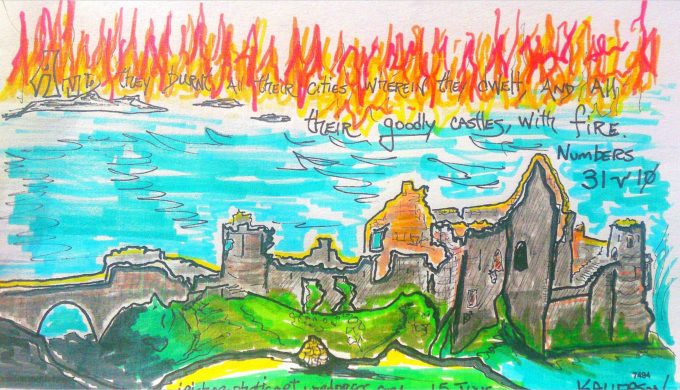
10 They also burned with fire all the cities where they dwelt, and all their forts.
Two things are mentioned here. The iyr, or cites, and the tirah, or forts. The cities are the commonly referred to dwellings of people. The tirah, or forts, is a much rarer word. It comes from a word meaning “rows.” It could be towers, forts, camps, battlements, or some other thing.
This is stated here to show the remarkable desolation of the area after Israel was done. Midian, as a people, was not completely destroyed, but only this portion of them, this would make others coming in and settling have to go through the laborious task of rebuilding from scratch. They could not just move in and immediately use the area for living or for waging wars. And finally, for today, it says…
*11 (fin) And they took all the spoil and all the booty—of man and beast.
Here again two different things are noted, the shalal, or spoil, and a new word, malqowakh, or booty. It comes from the word which begins the verse, laqakh or “took.” Thus, it signifies “the takings.” It is an all-encompassing thought that anything of any value was taken in the campaign. Midian was completely destroyed, and Israel’s vengeance was complete, and thus the vengeance for the Lord as directed in verse 3 was attained.
Due to the length of the passage, 54 verses long, we have to stop here and pick up with the narrative next week. Until then, continue to remind yourself about the precept that this is the Lord’s war, and thus it is a holy war.
We cannot speak against what God has ordained without falling into sin. Without having read the commentaries on the coming verses at this point, I can imagine that the liberal commentators will, in fact, find fault with what Moses is going to command in the verses ahead.
But that shows their own inability to perceive God as He is. And it is a giant defect in their understanding of His sovereign right to dispose with all life as He determines. Let us not fall into such error, but let us rather take the word of God as it is written, accepting the Lord’s judgments as they are given.
We are not God, nor can we speak for Him. And that goes with the very personal and solemn obligation of each person to receive His offer of peace which is found in Christ Jesus, or to reject it and suffer the consequences of our choice. God is God, and we must be obedient to His will if we are going to be included in what that will has in store for His redeemed.
Closing Verse: “What if God, wanting to show His wrath and to make His power known, endured with much longsuffering the vessels of wrath prepared for destruction, 23 and that He might make known the riches of His glory on the vessels of mercy, which He had prepared beforehand for glory, 24 even us whom He called, not of the Jews only, but also of the Gentiles?” Romans 9:22-24
Next Week: Numbers 31:12-24 This passage will make some leftie’s blood boil… (The Captives, the Booty, and the Spoil) (60th Numbers Sermon)
The Lord has you exactly where He wants you. He has a good plan and purpose for you. It may seem at times as if you are lost in a desert, wandering aimlessly. But the Lord is there, carefully leading you to the Land of Promise. So, follow Him and trust Him and He will do marvelous things for you and through you.
Take Vengeance on the Midianites
And the Lord spoke to Moses, saying:
These words to him He was then relaying
“Take vengeance on the Midianites
For the children of Israel
Afterward you shall be gathered to your people
Remember when you did rebel?
So Moses spoke to the people, saying
“Arm some of yourselves for war
And let them go against the Midianites
To take vengeance for the Lord on Midian
———-remember what they did at Peor!
A thousand from each tribe of all the tribes of Israel
You shall send to the war, as to you I now tell
So there were recruited
From the divisions of Israel, not less or more
One thousand from each tribe
Twelve thousand armed for war
Then Moses sent them to the war
One thousand from each tribe, so we understand
He sent them to the war with Phinehas
———-the son of Eleazar the priest
With the holy articles and the signal trumpets in his hand
And they warred against the Midianites
Just as the Lord commanded Moses; as He did tell
And they killed all the males
For the Midianite males, things didn’t go so well
They killed the kings of Midian
With the rest of those who were killed, as directed by the Lord
Evi, Rekem, Zur, Hur, and Reba, the five kings of Midian
Balaam the son of Beor they also killed with the sword
And the children of Israel
Took the women of Midian captive; so they did do
With their little ones, and took as spoil all their cattle
All their flocks, and all their goods too
They also burned with fire all the cities
Where they dwelt, and all their forts as well
And they took all the spoil and all the booty
Of man and beast; so much spoil for Israel
Lord God, we are even now in a wilderness
And we are wanting to be led by You
Without You to direct, our lives would be a mess
And so be our guide, O God; You who are faithful and true
We long for the water in this barren land
May it flow forth from the Rock, our souls to satisfy
Give us this refreshing, spiritual hand
And may we take it, and to our lives daily it apply
And we shall be content and satisfied in You alone
We will follow You as we sing our songs of praise
Hallelujah to You; to us Your path You have shown
Hallelujah we shall sing to You for all of our days
Hallelujah and Amen…