Numbers 35:9-21
A Place of Refuge
When I was young, probably about ten, my parents took my brothers and me to a place in North Carolina that had a golf course where the first tee-off point was off the side of a mountain. It was a nice place and, having never golfed in my young life, I went out with a few others to hit balls off the side.
When it was my turn, I stepped forward and gave it my best try. I have no idea if I even hit the ball, but a girl had walked right up to us as I was swinging, and I beaned her in the neck. It was so hard that her neck swelled up and she was in real pain. Just an inch higher, and she would have died.
What she did wasn’t intelligent, and what I did was unintentional. But it was also something that happened to a group that my grandfather was with in college. One guy went to hit a golf ball, and his club hit a guy behind him in the head. He immediately went into a seizure, and while he was being carried to get attention, his body slackened, and he was dead.
The person who hit the guy dropped out of school and apparently drank his life away. He became his own avenger of blood. Condemning himself for what was an innocent action.
Text Verse: “Thus God, determining to show more abundantly to the heirs of promise the immutability of His counsel, confirmed it by an oath, 18 that by two immutable things, in which it is impossible for God to lie, we might have strong consolation, who have fled for refuge to lay hold of the hope set before us.” Hebrews 6:17, 18
In Israel, the guy who struck the other would have actually been considered a manslayer, and the avenger of blood could have come after him. Understanding this was a part of the human condition, the Lord set aside cities where that person could have fled to in order to save his life.
We will see another part of the details of this today. For the innocent, there was a place of refuge. But, the truth that we discover in the Bible is that none of us are truly innocent. We stand guilty of committing the sins of life, and we can and should expect judgment for this.
But there is a place of refuge that we can flee to. For those who have so fled, we truly have a hope set before us. The saving message of Jesus is the place of refuge, and in reception of that word one can lay hold of that marvelous hope which He offers.
Though the author of Hebrews was writing to the Hebrew people, the message is applicable to all who come to Him for refuge. Whether an individual of the people Israel, or whether it is a Gentile from the furthest reaches of the planet, all can come to Him and find refuge.
For now, let us get into these verses and continue through the chapter. Great things are to be found in His superior word. And so, let’s turn to that precious word once again and… May God speak to us through His word today and may His glorious name ever be praised.
I. Six Cities for Refuge (verses 9-15)
9 Then the Lord spoke to Moses, saying,
Verses 1-8 described the cities designated for the Levites. However, if you remember, the designation of the six cities of refuge were actually mandated before the designation of the other forty-two Levitical cities. Thus, there was a stress upon them which anticipated further clarification. The passage now before us will respond to that by providing that clarification.
Thus, we now see the usual formula for opening a new section of law, even though it is actually a further explanation of what was mandated in verse 6 with the words, “Now among the cities which you will give to the Levites you shall appoint six cities of refuge, to which a manslayer may flee.”
10 “Speak to the children of Israel, and say to them: ‘When you cross the Jordan into the land of Canaan,
The words are anticipatory, speaking of the time when Israel has entered into the promised inheritance. As a typological reminder, the Jordan, or the Descender, is a type of Christ. Just as Jordan descends from the heights to the lowest place on earth, so Christ descended from the heights of heaven, even to the pit of death. It speaks of His advent. With that in mind, the passage takes on a much fuller meaning for us to consider…
11 then you shall appoint cities to be cities of refuge for you,
As noted in the previous sermon, the word miqlat, or refuge is seen eleven times in this chapter. This is the second use. It signifies a place of refuge and asylum. As noted before, the word comes from the word qalat, which means “stunted.”
Its one use in Leviticus spoke of not offering anything that was stunted to the Lord for the fulfilling of a vow. Thus, when one is in a place of refuge, or asylum, they are taken in. Their lives are stunted from going out. Such a place of confinement is so…
11 (con’ty) that the manslayer who kills any person accidentally may flee there.
This precept was originally promised in Exodus 21 –
“He who strikes a man so that he dies shall surely be put to death. 13 However, if he did not lie in wait, but God delivered him into his hand, then I will appoint for you a place where he may flee.” Exodus 21:12, 13
That note of what would occur is now dealt with, in detail, here in Numbers 35. It is for the ratsakh, or manslayer. As noted last week, it is a word defined by the law. Twenty of its forty-seven uses are in this chapter.
Of these twenty times, it is alternatingly translated as “manslayer” or “murderer” based on the guilt or innocence of the offender. However, because the same word is used for both, it carries an underlying thought that whether guilty or innocent, it was a form of unsanctioned taking of human life.
The cities of refuge are for those who have committed this act, but who have done so innocently. The guilt is there, but it is a guilt which falls under the covering and protection of the law. As John Lange says of these cities, they are –
“…places of refuge which were located among the Levitical cities, and were thus passed under the protection of the Levites, but by the law under which they were appointed, were not only bulwarks of justice and its enforcement, but also of grace and its dispensation, and thus glorified the holy land.”
These cities were to be conveniently accessible for all people within Israel. There was to be ready access to them so that the people would be unhindered in their flight to safety.
The word translated as “accidentally” means “unintentional.” It was used frequently in Leviticus and in Numbers 15 concerning unintentional sin. It is a noun which is here prefixed by a preposition. It is more precisely translated, “in his inadvertence.”
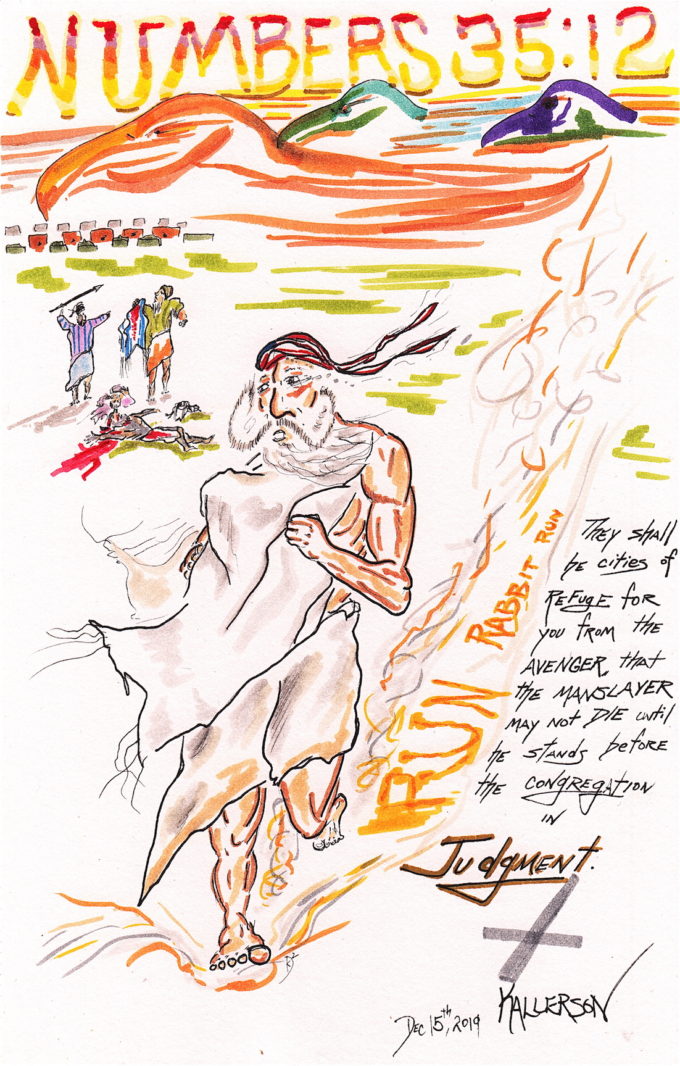
12 They shall be cities of refuge for you from the avenger,
Here the word gaal is used. It has already been seen numerous times in the sense of a kinsman who has the right to redeem his relative, or a person who desires to redeem property, or some other thing of value. For example, in Ruth, Boaz is termed a “kinsman redeemer.” The word is used to describe the Lord as the Redeemer quite a few times in Scripture.
Here, it speaks of the same kinsman relationship, but instead of being a redeemer, the individual is considered as the relative’s avenger. This will be seen in coming verses where the word dam, or blood, is added. He is the kinsman, or avenger, of blood.
The root of gaal is primitive, showing that it was a precept that went back into antiquity. It is originally based on the precept which predates the flood of Noah. In Genesis 4, Cain killed Abel and the Lord sentenced him for his act. Cain’s response was –
“My punishment is greater than I can bear! 14 Surely You have driven me out this day from the face of the ground; I shall be hidden from Your face; I shall be a fugitive and a vagabond on the earth, and it will happen that anyone who finds me will kill me.” Genesis 4:13, 14
Because of this, the Lord placed a mark on Cain, as it says, “lest anyone finding him should kill him.” Cain understood that his actions deserved death by the hand of another. As all men at that time were closely related, any of his relatives had the right to kill him. The Lord, by marking him, set a sign for refuge from such an action. This continued to be understood in Genesis 27. After Jacob stole Esau’s blessing, his mother Rebekah said to him –
“Surely your brother Esau comforts himself concerning you by intending to kill you. 43 Now therefore, my son, obey my voice: arise, flee to my brother Laban in Haran. 44 And stay with him a few days, until your brother’s fury turns away, 45 until your brother’s anger turns away from you, and he forgets what you have done to him; then I will send and bring you from there. Why should I be bereaved also of you both in one day?” Genesis 27:42-45
Rebekah feared for Jacob. Esau was mad enough to kill him, but she also knew that this would mean another close relative of Jacob could, in fact, kill Esau under the principle of the avenger of blood. Thus, she would be left without either.
For the manslayer noted here in Numbers, the death of the person he struck occurred in an unsanctioned way, meaning outside of the laws of war, judicial punishment, and so on. Because of this, the gaal, or avenger, had the right and the responsibility to avenge his relative’s blood.
The cities of refuge are set aside to protect this rightful avenger of blood from taking the life of one who may be innocent, so…
12 (con’t) that the manslayer may not die until he stands before the congregation in judgment.
Outside of the city of refuge, his guilt or innocence does not matter. If the avenger finds him, he may be killed without any wrongdoing being imputed to the avenger. Once inside, the manslayer is protected by the law of miqlat, or refuge, and he may not be harmed until his case is determined by the law of the land.
The word translated as “congregation,” is edah. It comes from ed which signifies a witness, or abstractly it speaks of testimony. Thus, the word is fitting for a trial which would take into consideration the details of the matter at hand.
This is important to understand, because verse 25 will show that the manslayer actually stands before the congregation of where the act was committed. And yet, in Joshua 20:4-6, we read –
“And when he flees to one of those cities, and stands at the entrance of the gate of the city, and declares his case in the hearing of the elders of that city, they shall take him into the city as one of them, and give him a place, that he may dwell among them. 5 Then if the avenger of blood pursues him, they shall not deliver the slayer into his hand, because he struck his neighbor unintentionally, but did not hate him beforehand. 6 And he shall dwell in that city until he stands before the congregation for judgment, and until the death of the one who is high priest in those days. Then the slayer may return and come to his own city and his own house, to the city from which he fled.”
There was to be an evaluation by the city of refuge. If accepted, he was to be protected by them. If the avenger of blood came to the city and requested his family right of revenge, stating that the slaying was not accidental but purposeful, then there would have to be a further trial.
Such a trial would take place before the congregation where the violation occurred, obviously still under protection of the Levites. If you remember, the Levites were taken in place of the firstborn of Israel, and so they actually stood in a unique way as a type of firstborn in relation to the people.
One can see Christ in this who is called by Paul “the firstborn among many brethren.” In this capacity as firstborn, the Levites could claim a sort of special family relationship to those who came to them, and also as appointed defenders of the innocent, the Levites could grant mercy on them through their defense.
If found innocent, he was returned to the city of refuge for safety until the death of the high priest. Only after the high priest’s death could he return home without fear of retribution.
13 And of the cities which you give, you shall have six cities of refuge.
This was stated first in verse 6. It is now repeated. The idea is that of closeness to all points within the land, so that anyone could find access to such a city within a day’s journey. The law is set here for the initial granting of land to Israel. Later, in Deuteronomy, Moses will expand on this –
“Now if the Lord your God enlarges your territory, as He swore to your fathers, and gives you the land which He promised to give to your fathers, 9 and if you keep all these commandments and do them, which I command you today, to love the Lord your God and to walk always in His ways, then you shall add three more cities for yourself besides these three, 10 lest innocent blood be shed in the midst of your land which the Lord your God is giving you as an inheritance, and thus guilt of bloodshed be upon you.” Deuteronomy 19:8-10
14 You shall appoint three cities on this side of the Jordan, and three cities you shall appoint in the land of Canaan, which will be cities of refuge.
The three on the east of the Jordan will be appointed by Moses in Deuteronomy 4 –
“Then Moses set apart three cities on this side of the Jordan, toward the rising of the sun, 42 that the manslayer might flee there, who kills his neighbor unintentionally, without having hated him in time past, and that by fleeing to one of these cities he might live: 43 Bezer in the wilderness on the plateau for the Reubenites, Ramoth in Gilead for the Gadites, and Golan in Bashan for the Manassites.”
These three on the east will be reaffirmed in Joshua 20. The three on the west of the Jordan will also be named at that time –
“So they appointed Kedesh in Galilee, in the mountains of Naphtali, Shechem in the mountains of Ephraim, and Kirjath Arba (which is Hebron) in the mountains of Judah.” Joshua 20:7
There is about 30 miles from any point in Israel to the nearest city of refuge.
15 These six cities shall be for refuge for the children of Israel, for the stranger, and for the sojourner among them, that anyone who kills a person accidentally may flee there.
Here, provision is made not only for an Israelite, but anyone who slayed another without intention. It includes the stranger, meaning someone who is simply passing through as a temporary dweller, and the sojourner, meaning someone who was not of Israel, but who dwelt among them. These held the same rights of refuge as a native of Israel. This looks to what Paul describes in Ephesians 2:11-13 –
“Therefore remember that you, once Gentiles in the flesh—who are called Uncircumcision by what is called the Circumcision made in the flesh by hands— 12 that at that time you were without Christ, being aliens from the commonwealth of Israel and strangers from the covenants of promise, having no hope and without God in the world. 13 But now in Christ Jesus you who once were far off have been brought near by the blood of Christ.”
The Gentiles, who temporarily or permanently took up residence in Israel were, included in this particular precept, sharing in Israel’s commonwealth. Today, that extends to all who come forward to what these cities of refuge anticipate and picture.
In the Mishnah, the Jews say that such a stranger or sojourner only had this right of refuge if he slayed another stranger or proselyte, but not if he slayed an Israelite. That flies in the face of the text of the Bible, which makes no such restriction. It diminishes the value and intent of how this passage points to Christ.
Concerning such refuge, there is a note in Exodus 21:14 which shows that the altar of the Lord was considered such a place of mercy as well. There it said –
“But if a man acts with premeditation against his neighbor, to kill him by treachery, you shall take him from My altar, that he may die.”
When one first came into the tabernacle, he would come to the altar of burnt sacrifice. The altar is where sins were expiated, where mercy was granted, and from which a propitious relationship was re-established with God. Charles Ellicott, citing several ancient sources, says that –
“In most parts of the ancient world a scruple was felt about putting criminals to death when once they had taken sanctuary, and those who did so were regarded as accursed … The Mosaic Law regarded this scruple as a superstition, and refused to sanction it.” Charles Ellicott
A person who had willfully and intentionally killed another was not to find mercy, even at this place of mercy. However, in the same chapter, the Lord said that He would appoint a place, meaning cities of refuge, where such a person could flee.
However, if the place where restoration with God was not available, then there would be no other place that he could flee to. He was to be taken from the altar and put to death. This actually occurred after the death of David.
In 1 Kings 2:5 & 6, David gave Solomon his final instructions before his death. This included a charge to bring the misdeeds of his general, Joab, back upon his own head –
“Moreover you know also what Joab the son of Zeruiah did to me, and what he did to the two commanders of the armies of Israel, to Abner the son of Ner and Amasa the son of Jether, whom he killed. And he shed the blood of war in peacetime, and put the blood of war on his belt that was around his waist, and on his sandals that were on his feet. 6 Therefore do according to your wisdom, and do not let his gray hair go down to the grave in peace.”
The killing of Abner and Amasa was exactly what that verse in Exodus was speaking of. Joab had acted on his own accord, and in a prideful manner against David’s orders. He used the death of his own brother, Asahel, as a pretext for killing Abner and Amasa.
Because of his actions, which brought a stain on David’s name, David so charged Solomon. After David’s death, Solomon took the appropriate action against Joab –
“Then news came to Joab, for Joab had defected to Adonijah, though he had not defected to Absalom. So Joab fled to the tabernacle of the Lord, and took hold of the horns of the altar. 29 And King Solomon was told, ‘Joab has fled to the tabernacle of the Lord; there he is, by the altar.’ Then Solomon sent Benaiah the son of Jehoiada, saying, ‘Go, strike him down.’ 30 So Benaiah went to the tabernacle of the Lord, and said to him, ‘Thus says the king, ‘Come out!’
And he said, ‘No, but I will die here.’ And Benaiah brought back word to the king, saying, “Thus said Joab, and thus he answered me.”
31 Then the king said to him, ‘Do as he has said, and strike him down and bury him, that you may take away from me and from the house of my father the innocent blood which Joab shed. 32 So the Lord will return his blood on his head, because he struck down two men more righteous and better than he, and killed them with the sword—Abner the son of Ner, the commander of the army of Israel, and Amasa the son of Jether, the commander of the army of Judah—though my father David did not know it. 33 Their blood shall therefore return upon the head of Joab and upon the head of his descendants forever. But upon David and his descendants, upon his house and his throne, there shall be peace forever from the Lord.’” 1 Kings 2:28-33
Joab died without mercy at the horns of the altar for the willful murder of the innocent. Therefore, the command of Exodus 21:14 was fulfilled in him with the exception of first removing him from the altar. Of this, the Geneva Bible states –
“The holiness of the place should not defend the murderer.” Geneva
The same is true with these cities of refuge now. All cities of refuge were Levitical cities, meaning that they were the property of the Lord in a more poignant way than the rest of Israel, and thus they were holy. They were set apart for the defense of the innocent, but not for the defense of murderers.
In Joab’s case, he was at the place of mercy, if it could be found. There was no point to run to a city of refuge because, first, he knew he was guilty. Secondly, he would have been returned to Jerusalem for a trial anyway.
As he was already there, and at the holy place of hoped-for mercy, a city of refuge could provide no more safety than the altar itself could. This is what the next verse now tells us…
Where can I go to save my life?
How can I get free from what I have done?
I killed a man, but not by strife
In innocence have I slain this one
But the avenger of blood waits for me
To take my life for what I have done
Is there a place to where I can flee?
Is there a place to where I can run?
Who will save me from what has come about?
Who can rescue me from what I have done?
Is there a chance for me? How will it come about?
Lord, my only hope is that to You I run
II. The Murderer Shall Be Put to Death (verses 16-21)
16 ‘But if he strikes him with an iron implement, so that he dies, he is a murderer; the murderer shall surely be put to death.
Here, begin several specific instances of murder rather than unintentional manslaying. This first speaks of a person who strikes another with barzel, or iron. The word is believed to come from an unused root meaning “to pierce holes.”
It is possible to hit someone with iron unintentionally and kill him. This is recorded, for example, in Deuteronomy 19 –
“And this is the case of the manslayer who flees there, that he may live: Whoever kills his neighbor unintentionally, not having hated him in time past— 5 as when a man goes to the woods with his neighbor to cut timber, and his hand swings a stroke with the ax to cut down the tree, and the head slips from the handle and strikes his neighbor so that he dies—he shall flee to one of these cities and live.” Deuteronomy 19:4, 5
However, it is obvious that such a person could intentionally kill another with an iron implement as well. The one who committed the act could flee to a city of refuge, proclaiming his innocence. The avenger of blood could come and claim it was premeditated.
In such a case, a trial would be necessary. If the act was deemed as intentional, as it says, rotseakh hu mot yumat ha’rotseakh – “murderer he; dying shall be put to death, the murderer.”
17 And if he strikes him with a stone in the hand, by which one could die, and he does die, he is a murderer; the murderer shall surely be put to death.
The idea here is a stone intentionally used to kill another. The Hebrew simply says, “with stone hand.” Thus, it could be one which is thrown, or one which is clunked on the head. Throwing a stone which kills another, however, could be without intent.
Again, the provision is for the city of refuge to give asylum to such a person until a trial could be conducted. If the act is determined to be intentional, then again, as before, “murderer he; dying shall be put to death, the murderer.”
18 Or if he strikes him with a wooden hand weapon, by which one could die, and he does die, he is a murderer; the murderer shall surely be put to death.
The word “weapon” is not in the original, even if it is implied because it became a weapon. It simply says, “instrument of wood.” One could accidentally whack someone else on the head with a club, a bat, or whatever.
However, such an item could also certainly be used intentionally to kill another person as Robert Duvall did in the movie The Apostle. As with the two previous instances, this is the purpose of both the city of refuge, and of any trial by the congregation. Guilt was to be determined, and if it is found to be so, the person is a murderer, and he shall be put to death.
As is obvious, the act of murder carries a penalty, and that penalty must be executed. The reason for this will be seen towards the end of the chapter. What is also obvious, is that no guilt is imputed to the one who kills the murderer. It is his right and his responsibility.
Understanding that, even though this is an Old Testament law and precept, it follows logically from both before the Mosaic covenant, and after it in New Testament times, that it is the right and responsibility of humanity to execute capital criminals.
Though there may not be an avenger of blood within the family to execute such, it is the obligation of society that capital criminals – in fact – face execution. This will be seen more clearly in verse 33. For Israel under the Mosaic law, provision is given first to the goel ha’dam, or “avenger the blood,” to handle the matter…
19 The avenger of blood himself shall put the murderer to death; when he meets him, he shall put him to death.
This verse applies in more than one way. It could be that the avenger came upon the murderer in a chance meeting, and he could kill the murderer without any fear of offense to God or of retribution from society. It can also mean that the murderer is handed to him by those who found him guilty. That is seen in Deuteronomy 19 –
“But if anyone hates his neighbor, lies in wait for him, rises against him and strikes him mortally, so that he dies, and he flees to one of these cities, 12 then the elders of his city shall send and bring him from there, and deliver him over to the hand of the avenger of blood, that he may die. 13 Your eye shall not pity him, but you shall put away the guilt of innocent blood from Israel, that it may go well with you.” Deuteronomy 19:11-13
However, of this verse, John Gill says –
“Not only shall have power to do it, but, as it seems, should be obliged to do it; be the executioner of the murderer; but not before his case has been heard, examined, tried, and judged.” John Gill
This is incorrect. It was the right of the avenger of blood to kill this person whether he was guilty of premeditated murder, or simply of accidental slaying of the avenger’s relative. This is exactly why there were to be at least six cities of refuge, and why the provisions later stated in this chapter are given.
The avenger of blood had the right to avenge the death of one who killed another, even if by accident. No guilt of murder was imputed by the Lord, and the society had no right to next convict him of murder for his avenging of his relative’s blood.
An example of what this verse speaks of is found in the account of the woman of Tekoa who went before king David with a petition. David understood the law and what the consequences for intentional murder were. But the woman came forward in hopes of obtaining mercy according to her account spoken to him –
“Indeed I am a widow, my husband is dead. 6 Now your maidservant had two sons; and the two fought with each other in the field, and there was no one to part them, but the one struck the other and killed him. 7 And now the whole family has risen up against your maidservant, and they said, ‘Deliver him who struck his brother, that we may execute him for the life of his brother whom he killed; and we will destroy the heir also.’ So they would extinguish my ember that is left, and leave to my husband neither name nor remnant on the earth.” 2 Samuel 14:5-7
Indeed, in this example, it says that “the whole family” had risen up to take vengeance. It wasn’t the nearest relative, but all of them who jointly looked to this precept as their right to do away with the offender. This is what the law demanded, as we continue to see…
20 If he pushes him out of hatred or, while lying in wait, hurls something at him so that he dies,
Here are several new words. The first is sinah, or “hatred.” It is a noun, coming from the word sane, to hate. Next, the word hadaph, or “to push,” is given. It can signify the act of pushing, or in a more general sense of driving out one’s enemies.
Another rare word is tsediyah, or the state of lying in wait. This will only be seen here and in verse 22. That comes from a more common verb which signifies the action “to lie in wait.” The words here, and in the next verse, are directed to indicate obvious intent leading to the state of death. An example of the first is found in Luke 4 –
“ So all those in the synagogue, when they heard these things, were filled with wrath, 29 and rose up and thrust Him out of the city; and they led Him to the brow of the hill on which their city was built, that they might throw Him down over the cliff. 30 Then passing through the midst of them, He went His way.” Luke 4:28-30
The One who gave the law to Israel, and who clearly spoke from the writings of that law truths which were found distasteful to them when they heard it, actually had such an attempt made against Him. In this, these people would have made themselves liable for punishment under this same law.
The irony is obvious. The intent of the people was restrained, however, so that the Lord could complete His work. Another example of such hatred leading to murder continues with…
21 or in enmity he strikes him with his hand so that he dies,
Again, there is fighting which is not done in enmity, but as sport. And there is fighting which is done with enmity towards one another. In that case, if one of those fighting kills the other then…
21 (con’t) the one who struck him shall surely be put to death. He is a murderer.
The same penalty exists whether a person uses an iron implement, a stone, a baseball bat, or even one’s hand. The result is what matters, not the means of obtaining it. This is the reason for stating these precepts here.
There was to be no leniency for any supposed mitigating circumstances. When someone committed murder, he was reckoned as a murderer, and therefore…
*21 (fin) The avenger of blood shall put the murderer to death when he meets him.
The goel ha’dam, or the “avenger of the blood” was to be the one to put the murderer to death. In the coming verses, we will see that this precept is firm and fixed, and the murderer had no way out for his actions.
This is the severity of the law, and what the law mandated. But Jesus came to those under this law and told them that the intent behind the actions are what truly demand judgment. When speaking out the sermon on the mount, He said this to the people gathered there –
“You have heard that it was said to those of old, ‘You shall not murder, and whoever murders will be in danger of the judgment.’ 22 But I say to you that whoever is angry with his brother without a cause shall be in danger of the judgment.” Matthew 5:21, 22
The law was given because intent is not always knowable. At times, as we have seen, it is evident, and it was to be used in judgment. But, the Lord always knows the intent of the heart. To Him, the intent behind the act, even if it is not carried out, is liable to judgment, and in such judgment, punishment is to be expected.
The law was the standard for Israel, but within the law is found the greater standard by which God judges all things. When He said, “Do not covet,” He spoke out a law, of which the breaking of it might not be known to anyone except the man and the Lord.
But the Lord does know, and He applies His standard of righteousness to all such things. In our society, we have tried to find every possible excuse imaginable for not upholding our own laws. And if guilt is found, we then go to great lengths to find exceptions for punishment of the violation.
But God does not work that way. He can be merciful, but His mercy must never violate another of His attributes. In order to be merciful, there must still be a meeting of the law in some other way. He cannot arbitrarily show mercy to one without arbitrarily seeming vindictive towards another.
Because God is perfectly righteous, any violation against His righteousness must be judged – or He is not perfectly righteous. But He is and therefore His righteousness cannot be compromised.
God is perfectly just. Because He is, the penalty for violation of His righteous laws must be perfect. The law demands that every violation be punished and “the wages of sin is death.” We have earned death and we have earned condemnation. If we do not receive this, then God is not perfectly just. But He is.
God is perfectly holy. Because we are made unclean from our transgressions against His perfectly holy nature, we must be forever separated from Him – or He is not perfectly Holy. But He is. The way that God resolves these tensions which arise through His many unchanging attributes is by accepting the responsibility for them in Himself.
In His uniting with humanity, he was able to do this. He lived righteously, and He offers that righteousness to us. He remained holy and separate from sin, and He offers that holiness to us. In His coming He gave grace, and in His cross, He offers mercy.
All of the tension between us and our Creator is reconciled through the blood of Christ’s cross. Through Him, and through Him alone, fellowship is restored, and peace is realized. This will be seen as we continue through the rest of this passage next week.
For now, please pay heed and understand that what God has done in Christ is available to you by a simple act of faith. Have faith, believe that Christ died for your sins, and that He rose again for your justification. Call on Christ Jesus today, and be reconciled to God through Him.
Closing Verse: “Sing praises to the Lord, who dwells in Zion!
Declare His deeds among the people.
12 When He avenges blood, He remembers them;
He does not forget the cry of the humble.” Psalm 9:12
Next Week: Luke 1:1 It’s all about the accomplishments of Jesus (Those Things Fulfilled Among Us) (Christmas Sermon)
The Lord has you exactly where He wants you. He has a good plan and purpose for you. It may seem at times as if you are lost in a desert, wandering aimlessly. But the Lord is there, carefully leading you to the Land of Promise. So, follow Him and trust Him and He will do marvelous things for you and through you.
A Place of Refuge
Then the LORD spoke to Moses, saying
The words to him He was relaying
“Speak to the children of Israel, and say to them:
‘When you cross the Jordan into the land of Canaan
———-yes, in Canaan is where
Then you shall appoint cities to be cities of refuge for you
That the manslayer who kills any person accidentally
———-may flee there
They shall be cities of refuge for you
From the avenger who his rage would otherwise vent
That the manslayer may not die
Until he stands before the congregation in judgment
And of the cities which you give
You shall have six cities of refuge there where you live
You shall appoint three cities on this side of the Jordan
And three cities you shall appoint
In the land of Canaan
Which will be cities of refuge: which is the city’s point
These six cities shall be for refuge
For the children of Israel
For the stranger, and for the sojourner among them
That anyone who kills a person accidentally may flee there
———-so to you I tell
‘But if he strikes him with an iron implement, so that he dies
He is a murderer; the murderer shall surely be put to death
———-do not heed his “I beg for mercy” cries
And if he strikes him with a stone in the hand
By which one could die, and he does die
He is a murderer
The murderer shall surely be put to death, as if an eye for eye
Or if he strikes him with a wooden hand weapon
By which one could die, and he does die
He is a murderer
The murderer shall surely be put to death; do not even bat an eye
The avenger of blood himself shall
Put the murderer to death, as to you I say
When he meets him
He shall put him to death; it shall be this way
If he pushes him out of hatred or
While lying in wait, hurls something at him so that he dies
Or in enmity he strikes him with his hand so that he dies
The one who struck him shall surely be put to death
———-do not heed his begging for mercy cries
He is a murderer, and his fate shall be swift and grim
The avenger of blood shall put the murderer to death
———-when he meets him
Lord God, we are even now in a wilderness
And we are wanting to be led by You
Without You to direct, our lives would be a mess
And so, be our guide, O God; You who are faithful and true
We long for the water in this barren land
May it flow forth from the Rock, our souls to satisfy
Give us this refreshing, spiritual hand
And may we take it, and to our lives daily it apply
And we shall be content and satisfied in You alone
We will follow You as we sing our songs of praise
Hallelujah to You; to us Your path You have shown
Hallelujah we shall sing to You for all of our days
Hallelujah and Amen…