Numbers 36:1-13
The Inheritance of Zelophehad
We have thirteen verses before us to close out the book of Numbers. In these thirteen verses, the idea of an inheritance is mentioned seventeen times. The inheritance, then, is an obviously important point that the Lord wants us to consider.
And, although this deals with only one family in one tribe, it actually possibly affects the inheritance of all of the people of Israel. This is because it is a conditional thing that could occur in any family, or to any person in Israel.
This is even more so, because the concept doesn’t just deal with a person who dies without having any sons. It would extend to a person who lost all his sons in battle. It would extend to a person whose only son was run over by a speeding donkey, or whose son fell off a cliff on a hike from Jericho to Jerusalem.
If any inheritance could likewise be called into question, then it actually means that every inheritance could be called into question. This is because we cannot see the day ahead of us. Not one person in Israel, even if he had seventy sons, could be sure all seventy of them would be alive the next day. If that sounds unlikely, then you have forgotten the story of Ahab –
“Now the king’s sons, seventy persons, were with the great men of the city, who were rearing them. 7 So it was, when the letter came to them, that they took the king’s sons and slaughtered seventy persons, put their heads in baskets and sent them to him at Jezreel.” 2 Kings 10:6, 7
We can be so sure of our inheritance that we may forget a loophole that we might not have even considered. What if… Is the inheritance assured? Can it be lost? How can we know?
Text Verse: “…giving thanks to the Father who has qualified us to be partakers of the inheritance of the saints in the light. 13 He has delivered us from the power of darkness and conveyed us into the kingdom of the Son of His love, 14 in whom we have redemption through His blood, the forgiveness of sins.” Colossians 1:12-14
Paul says that in Christ, the Father has qualified us to be partakers of the inheritance of the saints in the light. He goes on to tell us of the riches of the glory of what God has done in Christ. The story is magnificent, the details are choice morsels of delight, and the hope is a blessed one.
Well… that is, unless you accept the premise that you can, in fact, lose your salvation. The joy of the guarantee then fades. The hope of salvation becomes only a “hope” of salvation. What if what Christ did was lacking something. Suppose there is some legal loophole which could jeopardize the inheritance. Then what?
Imagine being one of the poor, uninformed, or willfully uneducated people who actually believes that he has to help God along in order to stay saved! But the problem with that idea is that if a person needs to do something, or not do something, in order to keep being saved, then it was never of grace and by faith. It is, by default, of works.
And if of works, it is not of Christ. Such is not the case, however. There are no loopholes in the law of God which declares a person justified, sanctified, and glorified. It is a done deal, and it is all to be found in His superior word. And so, let’s turn to that precious word once again and… May God speak to us through His word today and may His glorious name ever be praised.
I. To Protect the Inheritance (verses 1-13)
Now the chief fathers of the families
The translation is not correct. It says, “And came near chiefs, the fathers of the families.” The article is before “fathers,” not “chiefs.” This sets the stage for what is to be conveyed. The house of the fathers is the next division below the families. They are chiefs, the fathers of the families, which are being referred to.
The specificity is necessary for the passage to be properly understood, because a conflict has arisen which seems to put a previous law concerning tribal land possession in jeopardy.
1 (con’t) of the children of Gilead the son of Machir, the son of Manasseh,
I won’t hide it from you, what is presented here is confusing, but it is important for those who desire to be precise. What transpires in this passage concerns land belonging to the tribe of Manasseh. However, Manasseh has been divided into two halves. One half would reside on the eastern side of Jordan in Gilead, and one half would reside on the western side, in Canaan.
As this is dealing with land belonging to Machir, it would seem to involve land on the eastern side, outside of Canaan proper. This would seem to be so from what is seen in Numbers 32 –
“And the children of Machir the son of Manasseh went to Gilead and took it, and dispossessed the Amorites who were in it. 40 So Moses gave Gilead to Machir the son of Manasseh, and he dwelt in it.” Numbers 32:39, 40
However, this is not the case. Rather, the sons of Gilead who are listed in Numbers 32 are named again in Joshua 17 in the division of the land for the half-tribe of Manasseh who settled in Canaan. There it says –
“There was also a lot for the tribe of Manasseh, for he was the firstborn of Joseph: namely for Machir the firstborn of Manasseh, the father of Gilead, because he was a man of war; therefore he was given Gilead and Bashan. 2 And there was a lot for the rest of the children of Manasseh according to their families: for the children of Abiezer, the children of Helek, the children of Asriel, the children of Shechem, the children of Hepher, and the children of Shemida; these were the male children of Manasseh the son of Joseph according to their families.
3 But Zelophehad the son of Hepher, the son of Gilead, the son of Machir, the son of Manasseh, had no sons, but only daughters. And these are the names of his daughters: Mahlah, Noah, Hoglah, Milcah, and Tirzah. 4 And they came near before Eleazar the priest, before Joshua the son of Nun, and before the rulers, saying, “The Lord commanded Moses to give us an inheritance among our brothers.” Therefore, according to the commandment of the Lord, he gave them an inheritance among their father’s brothers. 5 Ten shares fell to Manasseh, besides the land of Gilead and Bashan, which were on the other side of the Jordan, 6 because the daughters of Manasseh received an inheritance among his sons; and the rest of Manasseh’s sons had the land of Gilead.” Joshua 17:1-6
The way that ten shares are counted is first by counting the six named sons – Abiezer, Helek, Asriel, Shechem, Hepher, and Shemida. But as Hepher’s son Zelophehad is dead, he is removed from the counting and in his place are listed his five daughters – Mahlah, Noah, Hoglah, Milcah, and Tirzah.
Thus, there are five plus five, or ten total shares which will be given to the family of Gilead west of Jordan in Canaan. The inheritance of these five daughters is raised to the level of the family of their grandfather due to the death of their father.
Each of these five noble and wise daughters received a one-tenth inheritance, or a total of fifty percent of that which is named, of the half-tribe of Manasseh in Canaan.
The division of land for their great-great-grandfather Machir is on both sides of the Jordan – one half in Gilead and one half in Canaan, but it is his descendants from Hepher and through Zelophehad who now are referred to. It is they who are…
1 (con’t) of the families of the sons of Joseph,
This note almost seems superfluous. The tribe in question is that of Manasseh, and so it doesn’t seem necessary to mention the genealogy all the way up to Joseph, but it is.
First, if this addition wasn’t made, then there could be a later problem between Joseph’s two sons – Ephraim and Manasseh. The word “sons” here is, in fact, plural. There are two sons of Joseph.
However, they were adopted by Jacob and thus reckoned as his. But someone might say that they are both sons of Joseph, and so this didn’t actually apply between the two of them. This will be seen as incorrect in verse 5.
Secondly, the name Joseph was given is based on the very words these men who have come forward will use. That was seen in Genesis 30 –
“Then God remembered Rachel, and God listened to her and opened her womb. 23 And she conceived and bore a son, and said, ‘God has taken away my reproach.’ 24 So she called his name Joseph, and said, “The Lord shall add to me another son.” Genesis 30:22-24
The word for “shall add” which she exclaimed is yasaph. It is the root of the name Joseph, or “He shall add.” In verse 3, they will use the same word, yasaph, to show that what they possess will be added to another tribe’s possession while it is taken away from them. Naming their father here is undoubtedly to make an intentional connection concerning what is going on.
1 (con’t) came near and spoke before Moses and before the leaders, the chief fathers of the children of Israel.
In this, there is no article before “fathers.” It says, “chiefs, fathers of the children of Israel.” This then would probably be referring to the seventy designated as a ruling council, or the chiefs of the named tribes of Israel. Following where and when the definite article is supplied is important to understand the details of what is being presented.
It is a matter which must go to the very top of the governmental structure in Israel because it is a matter which – by its very nature – cannot be handled without bias at a lower level. It involves inheritance between tribes which are already considered as permanent and fixed grants in perpetuity.
2 And they said: “The Lord commanded my lord Moses to give the land as an inheritance by lot to the children of Israel,
This was recorded in Numbers 26:52-56 –
“Then the Lord spoke to Moses, saying: 53 ‘To these the land shall be divided as an inheritance, according to the number of names. 54 To a large tribe you shall give a larger inheritance, and to a small tribe you shall give a smaller inheritance. Each shall be given its inheritance according to those who were numbered of them. 55 But the land shall be divided by lot; they shall inherit according to the names of the tribes of their fathers. 56 According to the lot their inheritance shall be divided between the larger and the smaller.’”
But there is more to consider…
2 (con’t) and my lord was commanded by the Lord to give the inheritance of our brother Zelophehad to his daughters.
This is exactly as it occurred, and as is recorded in Numbers 27 –
“And the Lord spoke to Moses, saying: 7 ‘The daughters of Zelophehad speak what is right; you shall surely give them a possession of inheritance among their father’s brothers, and cause the inheritance of their father to pass to them.’” Numbers 27:6, 7
The words spoken in this verse are in the singular to Moses. He says adoni, or “my lord.” Thus, there is one person speaking for, and on behalf of, the whole. This person brings up a logical difficulty which must be presented before land inheritances are granted, or there could immediately be problems.
What precipitated this isn’t known. It could be that one person simply thought it through after hearing the news about Zelophehad’s daughters. Or, it could be that one of the daughters is already being considered for marriage to someone and the realization of the difficulty suddenly came to light because of that.
Whatever brought this to light, it cannot be left unaddressed due to the permanent rights of land grants to each tribe. That difficulty is now seen with the words which follow…
3 Now if they are married to any of the sons of the other tribes of the children of Israel, then their inheritance will be taken from the inheritance of our fathers, and it will be added to the inheritance of the tribe into which they marry; so it will be taken from the lot of our inheritance.
This is an interesting set of words. The irregular construction of the verse is noted by scholars, but it is acknowledged that the sense is clear, nonetheless.
First, two words for “tribe” are used. The first is shevet, which signifies a scepter. It indicates rule, coming from a word which signifies “to branch off.” One can think of those below the main tribe as branching off.
The second word is matteh. It comes from the word natah, also meaning to branch off. It is used to indicate support, as a walking staff, and thus figuratively to indicate support of life, meaning bread which sustains.
The use of the two words is probably intentional in order to say something like, “If they are married to any of the sons of another authority of the children of Israel, their inheritance will be added to the inheritance of the support into which they marry.” Thus, the support for their tribe would be diminished.
The reason for this is that the sons born to the women would be reckoned not as sons of Manasseh, but as sons the tribe of the fathers. Therefore, the inheritance to the sons, meaning the land, which is within the boundaries of Manasseh, would no longer belong to Manasseh.
If no sons were born to the father, then the rules of inheritance found in Numbers 27 would prevail, but that would be the exception, not the rule.
However, as there is already the precedent of a father having daughters and no sons, it would be sure to arise from time to time. Eventually, the inheritance rights throughout Israel would become extremely complicated as land moved from one tribal inheritance to another.
The term “the land of Judah,” or “the land of Zebulun,” and so on, would no longer have the intended meaning it once did. Further, this would then violate another precept which has already been laid down in the law…
4 And when the Jubilee of the children of Israel comes,
The law of the Jubilee is recorded in Leviticus 25, with some specific details being conveyed in Leviticus 27. The term Jubilee comes from the Hebrew word which signifies a ram’s horn. The reason for this name is because of what the blowing of this ram’s horn signified –
“And you shall count seven sabbaths of years for yourself, seven times seven years; and the time of the seven sabbaths of years shall be to you forty-nine years. 9 Then you shall cause the trumpet of the Jubilee to sound on the tenth day of the seventh month; on the Day of Atonement you shall make the trumpet to sound throughout all your land.” Leviticus 25:8, 9
The yobel, or ram’s horn, is only mentioned four times outside of Leviticus, here and three times in Joshua. However, the three uses in Joshua refer not to this special event, but simply to the literal blowing of a ram’s horn.
In other words, apart from the instructions given in Leviticus, this is the only time that the Jubilee is mentioned in Scripture. And more, this is not even referring to it in its actual occurrence, but only in a hypothetical possibility which could occur on the Jubilee.
4 (con’t) then their inheritance will be added to the inheritance of the tribe into which they marry; so their inheritance will be taken away from the inheritance of the tribe of our fathers.”
Technically, the inheritance belonging to the daughter would transfer immediately to the tribe of the husband once the marriage took place. However, through other technical aspects of the law, it could potentially revert back to Manasseh.
If there was a divorce before children were born, if there were no children in the marriage, or if the inheritance was purchased in some manner, it may return to Manasseh, but the normal cycle of life would say otherwise.
But, the law of the Jubilee says that all landed property was to revert to its original owner, or to his legal heir. Any title to land which was not legally and successfully challenged would be confirmed.
And because the title of the children of one of the daughters of Zelophehad could not be challenged, then regardless as to what happened to the land after they inherited it, at the Jubilee, it would become permanently theirs as the landed title holders, even though they were not of Manasseh.
Regardless as to whether Israel ever observed the Jubilee or not, the precepts which surrounded the Jubilee are what matter. And the precept is that the land of a tribe was to never transfer out of that tribe – forever.
To understand this from an imperfect example, if the great state of Florida were to use its public funds to buy land in the less great state of, say, Hawaii, that land would still belong to Hawaii. The taxes owed to it would go to Hawaii. It would not become a part of Florida, except in the sense of any other ownership by an individual, a company, or whatever – we could say a company that prints Bibles.
The laws of Hawaii would still apply in the sale of that property to Florida, and they would have to be considered by the purchaser. With this understanding, that a law is necessary in order to protect the permanent ownership of a land granted by lot to a tribe, a law is needed for the security of that tribe to resolve this issue…
5 Then Moses commanded the children of Israel according to the word of the Lord, saying:
In Numbers 27, when this issue was first raised by the daughters of Zelophehad, it said –
“So Moses brought their case before the Lord.
6 And the Lord spoke to Moses, saying: 7 ‘The daughters of Zelophehad speak what is right; you shall surely give them a possession of inheritance among their father’s brothers, and cause the inheritance of their father to pass to them.’” Numbers 27:5-7
It is possible that this account in Numbers 36 actually happened at the same time as that account in Numbers 27, but it is recorded separately according to content, not as a chronology of events.
Or, it could be that Moses went in again to the Lord at this time, without it being stated. Either way, Moses now gives a command based on the word of the Lord, to the children of Israel.
5 (con’t) “What the tribe of the sons of Joseph speaks is right.
ken, matteh bene yoseph doberim – “Rightly so, tribe sons Joseph speakings.” Again, as before, the matter is elevated to the “tribe of the sons of Joseph,” or “He shall add,” rather than simply saying “Manasseh.” The word “tribe” here is singular.
This could ostensibly be taken in one of two ways. Joseph is a single tribe, and what the sons of that tribe have brought forward is correct. Or, it could be that this single tribe of Joseph, which is comprised of two separate tribes, has brought forward a premise which is correct.
The latter is certainly the case based upon the adoption of the two sons by Jacob, based upon the selection of Levi out of the tribes, and based upon the conducting of two census which included the counting of both Ephraim and Manasseh as separate tribes. In other words, Manasseh is a separate tribe from Ephraim, despite both being sons of Joseph.
But again, there is the subtle play on words which is being conveyed as well. Joseph means, “He shall add.” The men here do not want their land being added, at their expense, to that of the other tribes, despite the meaning of the name of their forefather.
6 This is what the Lord commands concerning the daughters of Zelophehad, saying, ‘Let them marry whom they think best, but they may marry only within the family of their father’s tribe.’
akh, l’mishpakhat matteh avihem tihyenah l’nashim – “surely to family of tribe of their father they may become married” Verses 6 and verse 8 are complicated. Most translations add in definite articles not found in the Hebrew, and scholarly comments say that this means they can only marry in the tribe, and also only in the family of their father.
This is not correct. They may marry anyone within the tribe. This will be seen as we go. In other words, instead of “within the family of their father’s tribe,” it means “within a family of the tribe of their father.”
They were not forced to marry anyone, but they could not marry outside of the tribe. Their inheritance was from their father Zelophehad, and his was from Manasseh. And therefore, they had to remain within that tribe. This restriction is only imposed upon heiresses and not upon daughters in other circumstances.
As stated earlier, this precedent was a part of the law and would have been adhered to as such. Even if Israel never celebrated a Jubilee, the codes which were set for such an event would not have been violated. Such an occurrence is actually recorded in 1 Chronicles –
“The sons of Merari were Mahli and Mushi. The sons of Mahli were Eleazar and Kish. 22 And Eleazar died, and had no sons, but only daughters; and their brethren, the sons of Kish, took them as wives.” 1 Chronicles 23:22
As seen earlier, there is nothing that says a state must buy land in another state, but the principle behind such a purchase would be binding if it did. The logical reason for this law continues to be explained with…
7 So the inheritance of the children of Israel shall not change hands from tribe to tribe, for every one of the children of Israel shall keep the inheritance of the tribe of his fathers.
That which was assigned by lot to the tribe was to forever remain joined to that tribe. The word translated here as “keep” is dabaq. It means to cleave or be fastly joined together. It is the word used in Genesis 2 when it says that a man would be joined to his wife and they would become one flesh. There was to be no separation between a tribe and its land forever.
This precept here is why even today the land of Asher in Israel is noted as such, and the land of Judah is noted as such, and so on. There were specific prophecies made over the sons of Israel which speak of the land of the sons of Israel.
In order for them to be fulfilled, the land would have to remain within the tribe. Otherwise, those prophecies would have no value. As an example, we read this in Deuteronomy 33 –
“Asher is most blessed of sons;
Let him be favored by his brothers,
And let him dip his foot in oil.
25 Your sandals shall be iron and bronze;
As your days, so shall your strength be.” Deuteronomy 33:24, 25
By strictly maintaining these inheritances in accord with the word of the Lord through Moses, right now in Israel a Christian oil company is in the traditional land of Asher, drilling oil wells. This could not have been possible if the laws we are looking at right now were not put in place.
8 And every daughter who possesses an inheritance in any tribe of the children of Israel shall be the wife of one of the family of her father’s tribe,
The translation is misleading. It says, l’ekhad mi-mishphakhat matteh abiha – “to one from family of tribe of her father.” This rule only applies, as it says, to every daughter who possesses an inheritance. If this is the case, she was to marry within a family of her father’s tribe. As he was of the tribe of Manasseh, they must marry someone descended from him. Thus, the family would be maintained in accord with the word of the Lord. This was…
8 (con’t) so that the children of Israel each may possess the inheritance of his fathers.
The land itself is governed by the tribe to which it belongs. Therefore, a female who was to inherit property had to maintain that tribe’s property through marriage.
This did not apply to women who were not set to inherit land. They were free to marry outside of tribe, without restriction. Thus, it is seen that Elizabeth, who was of the daughters of Aaron, meaning of the tribe of Levi and of the priestly class of Israel, was related to Mary, the mother of Christ Jesus.
How their relationship was connected is unknown. It could be that the mother of Mary, and the mother of Elizabeth, were sisters descended from Aaron, but Mary’s mother could have married a man of Judah. If so, then Mary would be reckoned as being of the tribe of Judah through her father.
That is just one possible scenario for how the two could be related despite being reckoned to different tribes. It is through the father that the tribe and family are reckoned. And therefore, unless the inheritor is a male, these special restrictions came into play in order to protect the possession of the tribe.
9 Thus no inheritance shall change hands from one tribe to another, but every tribe of the children of Israel shall keep its own inheritance.”
This verse rewords what was just stated in verse 7, confirming what was said there. The inheritance of the tribe would cleave to the tribe without fail, as long as these provisions were maintained. This was the intent of the year of Jubilee, but it would not have been possible without the addition of this provision now given.
The thing about this precept is that it plays upon the greed of the human heart. Where countless precepts of the law were constantly violated by Israel, and where there is not a single recording of a Jubilee having been conducted in Israel showing it probably wasn’t carefully adhered to – admittedly an argument from silence – the fact that land, and thus wealth, was at stake, it is certain that the precepts of this law now being given were never violated.
Despite flagrant violations of almost every precept handed down to the people by the Lord through Moses, this is one of the laws that would have been meticulously watched over by the leaders of the land. And to get things started in that vein of obedience we read…
10 Just as the Lord commanded Moses, so did the daughters of Zelophehad;
There is nothing stated in this law, now or afterward, about the possible effects and consequences of love. In other words, if one of these five daughters fell in love with a guy from Zebulun, could she have given up her inheritance and married him? The answer is probably, “Yes,” but it is not even addressed. What this passage is concerned with is the integrity of the tribal and family inheritances.
The matter here is simply stated as an act of obedience to the precept by the daughters of Zelophehad. In this, it sets the stage for the rest of the record of the Bible. Nothing is later recorded where there was some type of deviation from the precept.
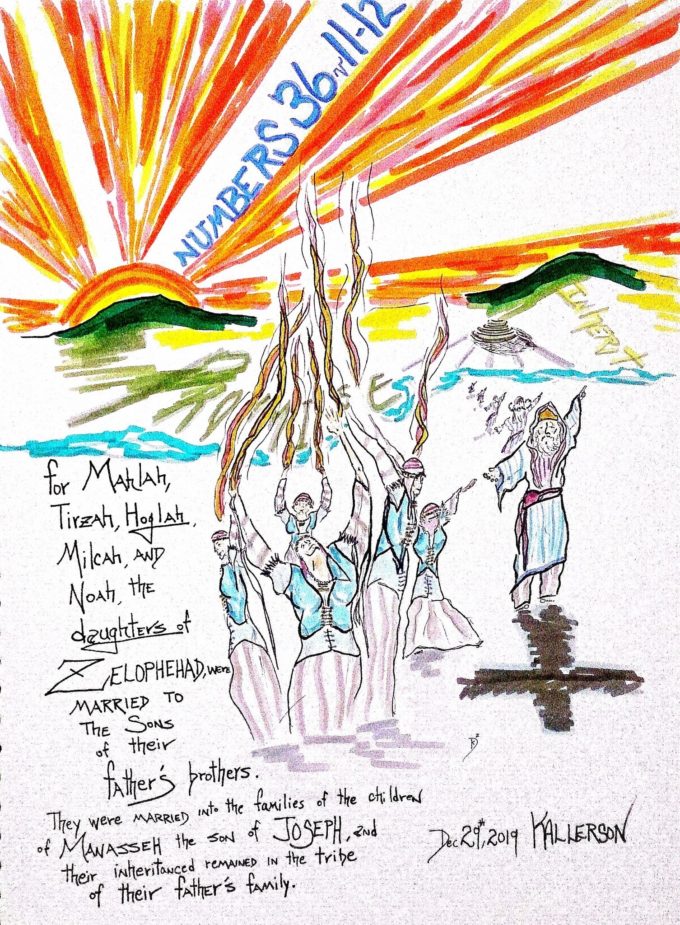
11 for Mahlah, Tirzah, Hoglah, Milcah, and Noah, the daughters of Zelophehad, were married to the sons of their father’s brothers.
The names of these five are recorded in the same order in Numbers 26:33 and 27:1 and in Joshua 17:3. However, in this listing, here in Chapter 36, the names of Tirzah and Noah are exchanged in the order. There is no reason given, but one commentator speculates that this is the order in which they were married.
As this particular verse is speaking of marriage, that sounds like a satisfactory reason for the matter, and we will go with it. The word translated as “father’s brothers” is dod. It means “uncle.” Thus, it means they married their cousins, first or otherwise.
There is no prohibition for this in the law, and thus it was acceptable and proper to maintain the inheritance within the family. It would also mean that the inheritance of those particular men would be rather large. They would have been willing accomplices in such an endeavor.
12 They were married into the families of the children of Manasseh the son of Joseph, and their inheritance remained in the tribe of their father’s family.
For the third time in the chapter, Joseph, or “He Shall Add,” is again named. This time it is in relation to the families of Manasseh, confirming again that the marriage was to take place within the single tribe, not within one of the two tribes descended from him.
Nothing was to be taken away from “He Shall Add.” But that which was to be added to him would be through the development of the tribe from within, or from without through marriages which would not bring a liability to the inheritance rights of themselves or another tribe.
From there, the words further define their marriages as al matteh mishpakhat avihem – “over tribe of family their father.” Without support, the NIV translates this as, “their inheritance remained in their father’s tribe and clan.” There is no “and” in the words. It is may be a true statement, because they married their uncles’ sons, but the verse itself is concerned with the tribal inheritance, that of Manasseh, only. The meaning of “uncle” is not defined, first or otherwise, and based on Joshua 17, it is certainly otherwise.
The precepts for protection of the inheritances have been laid down, and obedience to those precepts has been noted. From there we come to the closing verse of the passage, of the chapter, and of the book of Numbers.
*13 (fin) These are the commandments and the judgments which the Lord commanded the children of Israel by the hand of Moses in the plains of Moab by the Jordan, across from Jericho.
The words here are a mixture of that which was seen in Leviticus 26:46 and of those which closed out Leviticus one chapter later –
“These are the statutes and judgments and laws which the Lord made between Himself and the children of Israel on Mount Sinai by the hand of Moses.” Leviticus 26:46
&
“These are the commandments which the Lord commanded Moses for the children of Israel on Mount Sinai.” Leviticus 27:34
The Lord spoke out commands, and He made judgments which were commanded to the children of Israel, meaning all people of the nation, by the hand of Moses. This means that what is recorded was written as it was spoken. It is thus an expression of the Lord in written form for all to read, understand, and apply to their lives.
What this verse conveys speaks, of course, of the contents of this chapter, but they are an overall summary of everything that has been conveyed to the people since their arrival at this spot.
And the spot itself speaks of the coming Messiah. The Lord is the Source of what is presented. The words come by the hand of Moses, or “He who draws out.” Thus, it anticipates Christ.
The hand is what accomplishes things. It is given to man to complete the tasks set before him, just as Christ was sent to accomplish the tasks set before Him by the Father. It is He who draws out the will of the Lord and who embodies that will, pictured by Moses.
The words then say, “in the plains of Moab.” The word “plains” is arbot, which speaks of the deserts. That comes from arav meaning “to grow dark,” but it is identical with the word arav, meaning “surety” because a surety or a pledge covers over something. Arav is the basis for the magnificent word eravon used in Genesis 38 and which speaks in type of the sealing of the Holy Spirit.
Moab means “From Father.” And thus, it is in the place of sureties, From Father, which is said to be “by the Jordan.” As we have seen, Jordan, meaning Descender, pictures Christ who descended from heaven to earth to redeem man. He is the surety from the Father that this law drawn out from the Lord will be fulfilled.
And finally, it says, across from Jericho, or Place of Fragrance. To pass over Christ is to pass into the promise of heaven, the place of the fragrance of the knowledge of God in Christ. Like when Leviticus closed out at Sinai, each word of the verse here anticipates Christ and His mission to bring restoration between God and man.
But before His coming, these statutes and judgments would be given in order to anticipate Him and to be fulfilled by Him.
Giving thanks to God who has qualified us
To be partakers of the inheritance
It is a done deal through our Lord Jesus
And of losing this, there is just no chance
He has delivered us from the power of darkness
And He has conveyed us into the kingdom of the Son of His love
Without Christ, there would be no hope; we would be in a mess
But because of Christ, assurances of glory rain down from above
In Him we have redemption through His blood
And in Him there is the forgiveness of all of our sins
So come to Christ, and be immersed in the cleansing flood
Come to Christ who for you, the victory He wins
II. Restoration, Not Loss, at the Jubilee
What must be considered when reading this final chapter of Numbers is “What is the main purpose of what we are reading?” The answer is, as has been seen throughout this marvelous book, to discover Christ and what He would do.
The final verse of the chapter has shown that to us. Everything in that verse spoke in veiled terms of what God would do in and through Christ. In this chapter, the preservation of the land within the tribes was designed to protect the state of those families and tribes.
If mixture was allowed in, the defined lines leading to Messiah would be mixed and suspect. But, to ensure to each tribe that the land of the tribe remained consistent, these laws were given.
That way, when Messiah came, it would be clear and without question that He was of such a given place and that He belonged to such a given tribe. By closing out this marvelous book, filled with typological and pictorial hints of Christ, with the precepts of this chapter, that would remain possible.
Outside of ensuring the inheritances, the two other main points of what was seen in this chapter are the noting three times of Joseph, or “He Shall Add,” and of the mentioning of the year of Jubilee as the point in which no hope of retaining the inheritance would remain.
The idea of an inheritance is mentioned seventeen times in this one chapter. It is the main subject of everything conveyed. Adding in the name of Joseph was because of what his name, “He Shall Add,” signifies.
At his birth, it was seen that the account pictured the taking away of man’s reproach, meaning his sinful state, but that Christ would do it for both Jew and Gentile. Thus, “He Shall Add.”
Christ is the One who doubles through His work, because it is effective for all, not just those under the law. The stress on Joseph here is to remind us of that.
Mentioning the Jubilee means that we need to remember the significance of the Jubilee as it points to Christ. The Jubilee is based on God’s provision of Sabbaths. The Sabbath was a time where the people would rest and not work. That was the first marker in an amazing and intricate cycle of life.
The Sabbath day was given to be the great reminder of God’s creative and redemptive hand among the people. Every aspect of the Sabbath, as was detailed in Exodus and Leviticus, gave insights into what Christ would do.
From the Sabbath day, the next marker in the cycle was to be the Sabbath-month, the seventh month, which detailed the three fall Feasts of the Lord. In order, they pictured Christ’s birth into humanity, His atoning death, and His dwelling among and in His people.
After that, the next great marker was the Sabbath year. It anticipates a time when the Lord would tend to the people’s needs apart from any work. They could rest in Him and find that He would provide for them apart from their effort.
From there, those Sabbath years were to accumulate into the great year of Jubilee where debts would be released, properties would be restored, the land would produce on its own, and captives would be set free.
A total restoration of all things was prefigured in the great year of Jubilee. That year of Jubilee is reflective of the words of Paul concerning the position of believers in Christ –
“Therefore, if anyone is in Christ, he is a new creation; old things have passed away; behold, all things have become new.” 2 Corinthians 5:17
And yet, that position in Christ for us now is only an anticipatory taste of what will be realized in its fullness at the restoration of all things. That is described in Revelation 21:5 –
Then He who sat on the throne said, “Behold, I make all things new.”
So, understand – the seventh day Sabbath acknowledges the Lord’s Creation and Redemption. The seventh month anticipates His incarnation, atoning death, and dwelling in His people. The seventh-year Sabbath looks ahead to His millennial reign. And the year of Jubilee anticipates total restoration of what was lost at the beginning.
Everything, leading up to the Jubilee looks to the Lord and His work in the grand plan of redemption. Each step is fulfilled in Jesus, until we are again in the presence of God.
However, if the inheritance can be confounded, then the success of that great plan is put into question. That is what is being seen here. There is, until a law is given to correct it, a chance that this inheritance can be lost for God’s people. If it can be lost, and if that is solidified through the year of Jubilee, then it is lost forever.
And so, in order to ensure that this could not come about, the chapter today is given. A seeming difficulty is presented, and the Lord explains how to remedy it, which is that the female inheritor may only marry within the tribe of the father. The inheritance is granted through faith in Christ. That is spoken of by both Paul and Peter –
“In Him you also trusted, after you heard the word of truth, the gospel of your salvation; in whom also, having believed, you were sealed with the Holy Spirit of promise, 14 who is the guarantee of our inheritance until the redemption of the purchased possession, to the praise of His glory.” Ephesians 1:13, 14
&
“Blessed be the God and Father of our Lord Jesus Christ, who according to His abundant mercy has begotten us again to a living hope through the resurrection of Jesus Christ from the dead, 4 to an inheritance incorruptible and undefiled and that does not fade away, reserved in heaven for you, 5 who are kept by the power of God through faith for salvation ready to be revealed in the last time.” 1 Peter 1:3-5
There, and elsewhere, the inheritance is spoken of, and the surety of it is conveyed. The word used by Paul in Ephesians 1, and translated as “guarantee” is arrabón. It is the same word found in Genesis 38, eravon, and which comes from arav, meaning surety, which we just looked at a moment ago. However, the chapter now speaks of a loophole which could jeopardize the inheritance of God’s people. Is it a guarantee or not?
In order to correct this seeming deficiency, the rite of marriage is brought in, stating the limitations on it to ensure that the inheritance cannot be lost.
In the Bible, a betrothal confirms a marriage. As we saw in Numbers 30, the betrothed husband has the rights over his spouse to confirm or annul vows and the like. She is bound to him in a permanent bond once the betrothal is made. This is what Paul then speaks of for those who now possess the inheritance –
“For I am jealous for you with godly jealousy. For I have betrothed you to one husband, that I may present you as a chaste virgin to Christ.” 2 Corinthians 11:2
For the believer, the inheritance is given, it has been promised with a seal which is our guarantee, and it has also been assured, once and forever, through our betrothal to Christ. The consummation of that is simply a formality of which we now await. The guarantee has been made, and the inheritance is forever secured for the people of God.
The chapter today anticipates the doctrine known as “eternal salvation.” Where there are seeming loopholes in any person’s salvation and the granting of the inheritance, the Bible completely closes them up through Christ.
What He has done is sufficient to save, but even more, what He has done, and who He is in relation to us, is our guarantee that we are saved and will remain that way. If there was another note and point of rejoicing that could surpass this idea and which could have ended the book of Numbers, I don’t know what it could have been.
The patterns and pictures of what Christ would do have been many, but to know that what He has done for us in them is assured for all eternity is like sprinkles on top of the ice cream in the cone.
The chapter and the book close out with the words that this account came from the Lord by the hand of Moses in the plains of Moab by the Jordan, across from Jericho.
As we saw, every word of that speaks of what God would do in Christ. The Lord is the Source. By the hand Moses, or “He who draws out,” anticipates Christ, because Christ is the right hand of God who accomplishes the tasks set before Him by the Father. He draws out the will of the Lord and embodies that will.
“In the plains of Moab” speak of the pledge, or surety – meaning the giving of the Holy Spirit – Who is From Father, which is the meaning of “Moab.”
This was said to be “by the Jordan,” meaning the Descender – the Lord Jesus (See Ephesians 4:9, 10). And in passing though Him, one is in Jericho, the Place of Fragrance. To pass through Christ is to pass into the promise of heaven, the place of the fragrance of the knowledge of God in Christ.
God, in His infinite wisdom, took us through pictures of rejection of Him by His people, to their sentencing of them by Him to die in the wilderness, to pictures of simply looking to Him in faith in that wilderness and being saved from the viper, and through so many other varied hints of temporary difficulty and yet anticipated glory.
And through it all, He brought them right to the border of the Land of Promise, right to the Descender Himself. And along with them, He also brought along the Gentile people of the world. All are standing at the border, and all are welcome to come in.
And to finish off His anticipatory look into the inheritance, He ends with a note of surety that the inheritance is, it will be, and it will never pass away. One must pity those who believe they can lose their salvation. They are stuck in a hopeless condition of constant failure intermixed with a trembling but uncertain hope.
The name Tselophekhad means “Shadow of Fear.” Because of his family situation, there was a shadow of fear hanging over the inheritance of God’s people. But in Christ, that shadow of fear is forever removed.
Christ did not come to provide us with eternal insecurity. And He did not come to offer us an inheritance that can be lost. Rather, we are betrothed to Him to ensure that the inheritance will never pass away. This is the message of God in Christ, and it is a marvelous, glorious part of His superior word.
Closing Verse: “And whatever you do, do it heartily, as to the Lord and not to men, 24 knowing that from the Lord you will receive the reward of the inheritance; for you serve the Lord Christ.” Colossians 3:23, 24
Next Week: Don’t be a clod, so to you I saith… The Word of God – The Basis of our Faith (First Doctrine Sermon)
The Lord has you exactly where He wants you. He has a good plan and purpose for you. It may seem at times as if you are lost in a desert, wandering aimlessly. But the Lord is there, carefully leading you to the Land of Promise. So, follow Him and trust Him and He will do marvelous things for you and through you.
The Inheritance of Zelophehad
Now the chief fathers of the families
Of the children of Gilead, yes, these ones
The son of Machir
The son of Manasseh, of the families of Joseph’s sons
Came near and spoke before Moses
And before the leaders, with words to tell
To the chief fathers of
The children of Israel
And they said: “The Lord commanded my lord Moses
To give the land as an inheritance by lot
———-dividing among one another
To the children of Israel, and my lord was commanded
———-by the Lord
To give the inheritance to the daughters of Zelophehad our brother
Now if they are married to any of the sons
Of the other tribes of the children of Israel
Then their inheritance will be taken
From the inheritance of our fathers; this just doesn’t sit well
And it will be added to the inheritance
Of the tribe into which they marry
So, it will be taken from the lot
Of our inheritance, thus the borders will vary
And when the Jubilee of the children of Israel comes
Then their inheritance will be added, as we now describe
To the inheritance of the tribe into which they marry
So, their inheritance will be taken away
———-from the inheritance of our father’s tribe
Then Moses commanded the children of Israel
According to the word of the Lord, saying:
“What the tribe of the sons of Joseph speaks is right
Here now the words to you I am conveying
This is what the Lord commands
Concerning the daughters of Zelophehad
———-saying as to you I now describe
‘Let them marry whom they think best
But they may marry only within the family of their father’s tribe
So, the inheritance of the children of Israel
Shall not change hands from tribe to tribe
For every one of the children of Israel
Shall keep the inheritance of the tribe of his fathers
———-to where the Lord did first ascribe
And every daughter who possesses an inheritance
In any tribe of the children of Israel, such shall be the stance
Shall be the wife of one of the family of her father’s tribe
So that the children of Israel each may possess
———-his father’s inheritance
Thus, no inheritance shall change hands
From one tribe to another
But every tribe of the children of Israel
Shall keep its own inheritance
———-it is by father and not by mother
Just as the Lord commanded Moses
So did the daughters of Zelophehad, obeying the Lord’s druthers
For Mahlah, Tirzah, Hoglah, Milcah, and Noah
The daughters of Zelophehad
———-were married to the sons of their father’s brothers
They were married into the families
Of the children of Manasseh, the son of Joseph, as it was said to be
And their inheritance remained
In the tribe of their father’s family
These are the commandments and the judgments
Which the Lord commanded the children of Israel
———-as we now know
By the hand of Moses in the plains of Moab
By the Jordan, across from Jericho
Lord God, we are even now in a wilderness
And we are wanting to be led by You
Without You to direct, our lives would be a mess
And so, be our guide, O God; You who are faithful and true
We long for the water in this barren land
May it flow forth from the Rock, our souls to satisfy
Give us this refreshing, spiritual hand
And may we take it, and to our lives daily it apply
And we shall be content and satisfied in You alone
We will follow You as we sing our songs of praise
Hallelujah to You; to us Your path You have shown
Hallelujah we shall sing to You for all of our days
And Lord God, thank you for this wonderful book
Numbers! What a marvel to have studied it
Into every detail possible we took a look
And to You our thanks and praise we now submit!
Hallelujah to Christ our Lord!
Hallelujah for Numbers, a marvelous part of Your superior word!
Hallelujah and Amen…