The Trinity
Read 2 Peter 1:16-21. When I first typed this sermon, I had a cheesy joke to begin us. You would have thought it was funny and laughed, but it would have also been the one thing that you remembered above the rest of the sermon.
That is why I don’t include jokes in sermons. Nothing of real value is conveyed by them, and yet it is that one thing that will most stick in your memory. I know this is true because of all the great Adrian Rogers sermons that I listened to, the jokes he began his sermons with are what I still remember. That’s actually rather sad.
While typing my commentary on 2 Peter 1:17, I decided that citing the substance of it would be a better use of our precious time. That verse says, “…for having received from God the Father honour and glory, such a voice being borne to him by the excellent glory: ‘This is My Son — the beloved, in whom I was well pleased;’” (YLT).
This verse, like the account of Jesus at His baptism, teaches us a lesson in the nature of God. Though the word translated as “borne” is a commonly used word, it is of note that it is the same word used in Acts 2:2 and which is translated as “a ‘rushing’ mighty wind.”
In other words, the Excellent Glory refers to the Holy Spirit who transmits the word of God from God the Father. He does it in written form through men of God (2 Peter 1:21 – where the same word is also used there), and He does it in open displays of glory, such as on the Mount of Transfiguration and when He came to the people of Israel at Pentecost.
In this, it is seen that all three of the members of the Godhead were demonstrably present at that moment. Peter says the Source is God the Father. The Excellent Glory is the Holy Spirit conveying (bearing) the word, and Jesus, the beloved Son, is the recipient of the honor conveyed in that word.
It is a rather marvelous display of the workings of what we would call “the Trinity” as the members of the Godhead harmoniously interacted for us to more fully understand God’s nature.
This same basic proclamation was made upon Jesus twice during His ministry. The first time was at His baptism and is recorded in Matthew 3:16, 17 (also in Mark and Luke) –
“When He had been baptized, Jesus came up immediately from the water; and behold, the heavens were opened to Him, and He saw the Spirit of God descending like a dove and alighting upon Him. 17And suddenly a voice came from heaven, saying, ‘This is My beloved Son, in whom I am well pleased.’” Matthew 3:16, 17
The words of Peter in his epistle confirm that he and the others were eyewitnesses of the glory of Jesus Christ. Jesus told his apostles “Assuredly, I say to you, there are some standing here who shall not taste death till they see the Son of Man coming in His kingdom” (Matthew 16:28).
In all the three gospel accounts, the transfiguration immediately followed this statement, indicating that this is what Jesus was speaking of. The occurrence was like a note of deposit for the apostles to reflect on and stand by when times would get tough. Peter uses this to assure us that what he says is both true and reasonable.
There is a God, Peter calls Him the Father, but Peter also refers to the Son, and Peter speaks of the conveying of the Father’s word by the Excellent Glory – indicating that a third member is present and actively accomplishing a part of what is going on.
The Christian concept of God is that of a Trinity within the Godhead. There is, in fact, one God. The Bible – and indeed simple logic – tells us this. Despite that, the Bible also refers to God in a way which reveals that He is expressed in a Triune manner.
However, because the Bible never mentions the word “Trinity,” it is claimed that the idea of a Trinity is not reasonable. But such a statement is, by itself, unreasonable. A doctrine, idea, or concept may not be named in a text by using a particular word, but it does not mean that the concept is not fully fleshed-out in another way.
For example, you will not find the term “original sin” in the Bible. However, it is implicitly taught from the very first pages of Genesis all the way through to the final words of Revelation. It is also explicitly stated in another way in the 51st Psalm.
Likewise, the word “rapture” is not explicitly stated in the Bible, but it is a concept clearly taught there. The idea of the rapture first comes from a Greek word, harpazó, which signifies to be snatched up, suddenly and decisively.
This state of being snatched up suddenly is said by Paul to be an action accomplished by the Lord, and it is for the explicit purpose of changing the redeemed of the Lord from their earthly bodies to heavenly bodies.
In this action of being snatched up, there is a transformation from a state of mortality, pain, sorrow, and physical death to a state of immortality, health, joy, and eternal life – which is exactly what the word “rapture” implies.
Rapture means “intense pleasure or joy.” Therefore, the word does not translate harpazó, but it does explain what the harpazó initiates. The two are not synonymous; they are complementary.
This event, the rapture, is clearly laid out in exquisite detail by Paul in 1 Corinthians 15 and in 1 Thessalonians 4, and yet people skip over them as if they aren’t even written down, and their defense is to say, “The word ‘rapture’ is never mentioned in the Bible.”
We do these things because of our own faulty logic, we do them because of presuppositions, or we might do them because we want to show that we are more knowledgeable on a subject than others, even when we are not properly versed on it ourselves.
This is certainly true with the doctrine of the Trinity. If we want to deny – for whatever perverse reason – the nature of God as is revealed in Scripture, then we will use faulty logic to meet our goal. I say this because the Trinity is what Scripture reveals. Because it is, sound interpretation and proper logic will inevitably reveal the precept.
The same Bible that teaches that there is one God, that there is original sin, and that the rapture really will happen, also gives us insight and revelation concerning the doctrine of the Trinity.
Text Verse: “And I will pour on the house of David and on the inhabitants of Jerusalem the Spirit of grace and supplication; then they will look on Me whom they pierced. Yes, they will mourn for Him as one mourns for his only son, and grieve for Him as one grieves for a firstborn.” Zechariah 12:10
For those who deny the Trinity, such as the Jehovah’s Witnesses, Zechariah 12:10 is such a problematic verse that a literal reading is simply ignored, and a margin note is inserted into it instead.
The Lord, who is clearly presented as the One and only God in Scripture, is speaking in the passage. He says that He will pour out the ruakh, or Spirit upon the inhabitants of Jerusalem. Without the rest of Scripture, the meaning of ruakh could be debated if it is referring to the Holy Spirit or a general spirit.
Scripture elsewhere, however, does answer what is being referred to – meaning the Holy Spirit. After that, the Hebrew says, v’hibitu elay eth asher daqaru – and they will look on Me whom they pierced.” However, God is Spirit. And so, apart from accepting the Trinity, this makes no sense.
Because of this, a margin note, citing variant readings of the verse, is used by disbelieving Jews, Jehovah’s Witnesses, and others in their translations, thus changing the text to read “and they will look to the one whom they pierced.” That safely allows them to continue on in their otherwise incorrect and incoherent theology.
This is all the more so because the verse immediately goes from the first person common singular, Me, to third person masculine singular, Him, twice. The obviously correct reading is “Me” rather than “Him,” or “the one.” The reason for this is that the very difficulty of the use of “Me” sets it apart as otherwise impossible unless it was truly inspired.
In other words, the reading is so obvious as to what it proclaims that it would be impossible to accept unless it was exactly what God intended.
However, because there is a variant reading, the doctrine can be dismissed as an aberration – unless all of Scripture is laid out and analyzed in order to come to a final resolution of what is being conveyed to us concerning the nature of God.
Obviously, all of Scripture cannot be analyzed in a short sermon, but we can at least get a reasonable grounding in what Scripture says concerning this precept. And we will attempt to do just that. The mystery of the Trinity is, in fact, revealed in God’s precious and sacred word. And so, let us turn to that precious word once again and… May God speak to us through His word today and may His glorious name ever be praised.
I. Monotheism – One God
Malik Jabbar says –
“All of the monotheistic religions, which primarily include Islam, Christianity and Judaism are mythological representations of the natural environment. The ancients fashioned their spiritual concepts as mythical copies of natural phenomena, the environment and its interactions. They pictured the sun as the ruler of the universe, the life giver, the conqueror of darkness and cold, the scorcher with its intense fire, the compassionate with its soothing heat. When the sun triumphantly appeared on the eastern horizon at the dawning of the day, the whole universe (from our earthly perspective) was seen bowing in submission to the greatest of all lights. All the stars and planets of the higher and lower heavens were vanquished without trace at the dawning of the great sun god. This physical reality is the true seminal generator of our religious rituals in reference to an omnipotent conquering god, evolved from the customs of the ancients”.
What Jabbar says here is both an irrational and an incoherent attempt to explain away monotheism. If man were to make a religion based on natural phenomena, which has happened innumerable times, he would certainly not be a monotheist. The sun would be one of many gods, and this is what has occurred as religion has devolved throughout the ages.
In the 19th psalm David skips over the created god Jabbar proclaims and exalts the God who created the very sun who was supposedly the object of reverence in his confused analysis.
“The heavens declare the glory of God;
And the firmament shows His handiwork.” …
“In them He has set a tabernacle for the sun.” Psalm 19:1 & 4
David understood that the Creator is above, not subservient to, or part of, His creation.
However, liberal theologians have twisted the evolution of religion, turning it completely upside down. It is evident from the historical record in the worship of God by man that the most ancient belief is that of monotheism. From that point, worship has devolved into polytheism, animism, etc., not the other way around. Assyriologist Stephen Langdon says –
“The history of Sumerian religion, which was the most powerful cultural influence in the ancient world, could be traced by means of pictographic inscriptions almost to the earliest religious concepts of man. The evidence points unmistakably to an original monotheism, the inscriptions and literary remains of the oldest Semitic peoples also indicate a primitive monotheism, and the totemistic origin of Hebrew and other Semitic religions is now entirely discredited.” Stephen Langdon
The region of Sumeria, which Langdon cites, is where many of the early Bible figures find their homes. And it is the record of these early people, by those who descended from them, who have given us the pages of the Bible as breathed out by the One true God.
From the first page of the Bible to its last, the idea that there is One and only One true God is proclaimed. And this goes in both directions, meaning from the top-down and from the bottom up.
God speaking to man –
“For thus says the Lord,
Who created the heavens,
Who is God,
Who formed the earth and made it,
Who has established it,
Who did not create it in vain,
Who formed it to be inhabited:
“I am the Lord, and there is no other.’” Isaiah 45:18
In the book of Isaiah alone, this claim is explicitly made almost a dozen times.
Man speaking to God –
“For You are great, and do wondrous things;
You alone are God.” Psalm 86:10
Yes, the Bible proclaims that there is one God. But reason and intellect tell us this as well. We can know it is true by simply thinking things through in a rational manner. Of the twelve First Principles, points 8, 9, and 10 reveal this.
First, point 8 states that a Necessary Being Cannot Cause A Necessary Being. In other words, if there is a God, there can only be one God. This is known as the Negative Principle of Modality. It is undeniable. Only one Necessary Being can exist. Any being which exists apart from a Necessary Being is contingent and could simply Not exist. It is not “necessary.” This is self-evident.
Point 9 then says that Every Contingent Being Is Caused by a Necessary Being. This is known as the Principle of Existential Causality. The fact that there are contingent beings necessitates that a Necessary Being (God) exists. We exist, therefore a Being that cannot Not exist must exist. The principle is undeniable in and of itself.
And, point 10 then concludes that a Necessary Being Exists. This is the Principle of Existential Necessity. Contingent beings exist (such as you and I); therefore, a Necessary Being must exist. The principle is reducible to the undeniable.
We did not need the Bible to come to those conclusions. And yet, we logically came to those conclusions. The Bible does not argue the existence of God. It proclaims that He is. It is our responsibility to contemplate this God and to logically and rationally consider if what it presents is true or not.
I say this because other texts, such as the Koran, also proclaim that there is a “god.” But does what the Koran teach about God reflect the truth of God. If so, then we should all become Muslims? If not, then Muslims are following a false god. How can you know unless you think these things through?
The Koran teaches that God is a monad, a single God who is not part of a Godhead. But how could a being that didn’t understand fellowship create anything beyond Himself which fellowships? He would be completely contained within Himself. The twelfth First Principle, the Principle of Analogy states that “The cause of being cannot produce what it does not possess.”
If God does not possess – and thus understand – fellowship, He could not create that which fellowships. The principle is undeniable, and the precept which comes from the principle is irrefutable. Because of this, the mere fact that we are social beings confirms a plurality within a single essence such as the Trinity.
As a demonstration of the soundness of the doctrine, early church fathers, even before the compilation of the various books of the Bible, taught the doctrine of the Trinity in their writings. They didn’t just pull this out of the wind. Rather, it was handed down to them directly from the Apostles.
Polycarp, the Bishop of Smyrna, was a personal disciple of John the Apostle. In other words, he knew John and learned directly at his feet. He wrote –
“O Lord God almighty… I bless you and glorify you through the eternal and heavenly high priest Jesus Christ, your beloved Son, through whom be glory to you, with Him and the Holy Spirit, both now and forever.” Polycarp
What he wrote was from a clear understanding of the specific roles within the Godhead. Tertullian, who lived during the second and third century, was an African apologist and theologian. He wrote a great deal in defense of Christianity, including on the doctrine of the Trinity –
“We define that there are two, the Father and the Son, and three with the Holy Spirit, and this number is made by the pattern of salvation… [which] brings about unity in trinity, interrelating the three, the Father, the Son, and the Holy Spirit. They are three, not in dignity, but in degree, not in substance but in form, not in power but in kind. They are of one substance and power, because there is one God from whom these degrees, forms and kinds devolve in the name of Father, Son and Holy Spirit.” Tertullian
Such writings are not easily dismissed, because these people were right there at the beginning of the Christian faith. It is true that there were many heresies early on as well, and so even early writings have to be analyzed in light of Scripture itself. It is through Scripture that we find the final authority for the teaching of Trinitarianism.
As Scripture reveals only one God, and yet Scripture reveals a Trinity within the Godhead, then true Christians are Trinitarian monotheists.
Unfortunately, the idea of the Trinity is so dismissed by cults, such as the Jehovah’s Witnesses, that they are trained to claim that what mainstream Christians believe is actually a Triad within a godhead, not a Trinity within the Godhead. But this is certainly not the case. The difference between a Triad and the Trinity is the difference between the finite and the infinite.
A Triad speaks of three “gods,” a logical impossibility. The Trinity speaks of One God, in three Persons – which is what the Bible proclaims. There is a fullness to God which Scripture then reveals – not of two or four or ten Persons, but three – Father, Son, and Holy Spirit.
As the Bible is God’s revelation of Himself, and as it is the rule and guide of proper faith, we would be ignorant at best, and found false teachers as well, should we deny what it proclaims.
But this doesn’t mean it is an easy concept to understand. Scholars have struggled with it all along, and we continue to do so. John Wesley said, “Bring me a worm that can comprehend a man, and then I will show you a man that can comprehend the Triune God.”
This may be true to some extent, but just because we cannot fully comprehend the Triune God, it does not mean that we cannot at least explain how He can be Triune, and what the aspects of each member of the Godhead will be like.
Holy, Holy, Holy is the Lord God of Hosts
He is glorious and almighty
To Him we give our praises, and in Him are found our boasts
Now and forevermore, there before the glassy sea
In Him is all majesty and all power
In Him is all glory, now and forevermore
For all eternity and from this very hour
Our God we shall praise, for it is He our hearts adore
Holy is the Lord our God, yes holy is He
Father, Son, and Holy Spirit whom we adore
And so, to Him we trod, to the shores of that glassy sea
Where we shall behold His glory forevermore
II. One God in Three Persons – The Trinity
The Trinity is hinted at throughout the Bible – Old Testament and New. However, it remained a mystery long-hidden at God’s prerogative. It wasn’t until the coming of Christ that the mystery of this profound secret was finally and fully revealed. As Paul says as he closes out the book of Romans –
“Now to Him who is able to establish you according to my gospel and the preaching of Jesus Christ, according to the revelation of the mystery kept secret since the world began but now made manifest, and by the prophetic Scriptures made known to all nations, according to the commandment of the everlasting God, for obedience to the faith—to God, alone wise, be glory through Jesus Christ forever. Amen.” Romans 16:25-27
As already noted, the doctrine of the Trinity states that God is threefold in Person and yet they together are one God – three Persons in one Essence. The term “persons” comes from the writings of Augustine who agreed that it wasn’t the best of terms but, as he said, “rather than being silent on the subject…”
The reason he said this is because he could not be silent on the subject. Scripture is not, and – therefore – the Christian cannot be. This Trinity as revealed throughout Scripture is:
God the Father
God the Son
God the Holy Spirit
In the Bible, at one time or another, each of these Persons is referred to either implicitly or explicitly as God. He has the attributes of God, accomplishes that which belongs to God, and so on. And yet, each is spoken of as an individual Person. As this is so, then there are individual Persons, three being identified, who make up the Godhead.
For example, each is stated as being involved in the act of creation; He is the Creator. Each is referred to as being eternal. Both Jesus and the Spirit are said to search out the heart and mind, but that is what God in the Old Testament is said to do. Etc.
Other such things as these, time and again, are attributed to the Lord God in the Old Testament, and yet they are things which are spoken of as being attributed to the Father, to the Son, and/or to the Holy Spirit in the New.
Either the Bible is filled with confusion, or each of these is God. When Jesus uttered the Great Commission to his apostles, he said the following:
“Go therefore and make disciples of all the nations, baptizing them in the name of the Father and of the Son and of the Holy Spirit.” Matthew 28:19
In the Greek, the word “name” is onoma. It is a singular noun. This means that the three – the Father, the Son, and the Holy Spirit – are spoken of as one essence. Is this an aberration? It is something completely unique to the New Testament? Or, can we find parallels even in the Old? No, No, and Yes.
For example, Deuteronomy 6:4, is known as the Shema, or “Hear.” It is the Hebrew statement of faith which is faithfully repeated thousands of times a day by observant Jews ever since it was given to Moses 3500 years ago –
Shema Yisrael Yehovah Elohaynu Yehovah ekhad
“Hear, O Israel: Yehovah our God, Yehovah is one!”
In this, it says “The Lord (Yehovah) is One.” A cluster of grapes is one; the people Israel are one people. Both of these are made up of individual parts and yet are termed “one.”
The word ekhad used in the Shema allows for this interpretation. There is another word which means one and only one – yakhid. It was used, for example, when speaking of Abraham’s one and only son, Isaac. It is remarkable, but not unexpected that ekhad, rather than yakhid, was used in the Shema, because the Bible elsewhere reveals that the Godhead is a plurality within a single essence.
But even though Scripture reveals this Godhead, is there any way of accurately describing it without being utterly incorrect in our thinking? A friend of mine said that the more you continue to talk about the Trinity, the more likely you are to devolve into heresy. That is certainly true. Eventually, words can no longer explain every detail of what God is like, and we run off into error.
But that does not mean we cannot form a basic concept of the Trinity which, at least partially, reveals it without being incorrect. And yet, we have to be careful in attempting to do so.
Throughout the ages, people have used tangible concepts to try to explain this Trinity. One is to equate it to water which can be steam, liquid, or solid. Another is to take a circle and divide it into three equal parts. The egg has been used because it has a shell, a yolk, and the white. But, none of these accurately portrays the concept. In fact, if used they lead to heresy.
So, is there is no proper analogy? Has God left us with a concept in Scripture, but no way to rightly contemplate it or explain it? Interestingly, a concept has been provided, and it is visible everywhere you look. It is beautifully explained by Dr. Nathan Wood in the book The Secret of the Universe. I cited it in a sermon from Numbers 6, but it is useful and proper to cite again here.
He explains that the universe is made of a trinity of Space, Time, and Matter. Further, each of these is a trinity itself. Space is comprised of Length, Breadth, and Height. Time is expressed in Past, Present, and Future. And matter consists of Energy in Motion producing Phenomena. The universe itself is a trinity of trinities.
But more, we can equate Space with the Father – unseen and yet omnipresent; matter with the Son – visible, tangible, understandable; and Time with the Spirit – which is unseen and yet it is a medium in which we move and gain understanding.
From that, Dr. Wood further defines a trinity using Time as his primary example. He breaks it down into an understandable concept. After doing this, he changes only four words and thereby accurately explains the mystery of the Trinity as revealed in Scripture –
The Future is the source. The Future is unseen, unknown, except as it continually embodies itself and makes itself visible in the Present. The Present is what we see, and hear, and know. It is ceaselessly embodying the Future, day by day, hour by hour, moment by moment. It is perpetually revealing the Future, hitherto invisible.
The Future is logically first, but not chronologically. For the Present exists as long as Time exists, and was in the absolute beginning of Time. The Present has existed as long as Time has existed. Time acts through and in the Present. It makes itself visible only in the Present. The Future acts, and reveals itself through the Present. It is through the Present that Time, that the Future, enters into union with human life. Time and humanity meet and unite in the Present. It is in the Present that Time, that the Future, becomes a part of human life, and so is born and lives and dies in human life.
The Past in turn comes from the Present. We cannot say that it embodies the Present. On the contrary Time in issuing from the Present into the Past becomes invisible again. The Past does not embody the Present. Rather it proceeds silently, endlessly, invisibly from it.
But the Present is not the source of the Past which proceeds from it. The Future is the source of both the Present and the Past. The Past issues in endless, invisible procession from the Present, but, back of that, from the Future out of which the Present comes.
The Past issues, it proceeds, from the Future, through the Present.
The Present therefore comes out from the invisible Future. The Present perpetually and ever-newly embodies the Future in visible, audible, livable form; and returns again into invisible Time in the Past. The Past acts invisibly. It continually influences us with regard to the Present. It casts light upon the Present. That is its great function. It helps us to live in the Present which we know, and with reference to the Future which we expect to see.
Dr. Wood next substitutes Time with God, Future with Father, Present with Son, and Past with Spirit. And the result is –
The Father is the source. The Father is unseen, unknown, except as He continually embodies Himself and makes Himself visible in the Son. The Son is what we see, and hear, and know. He is ceaselessly embodying the Father, day by day, hour by hour, moment by moment. He is perpetually revealing the Father, hitherto invisible.
The Father is logically first, but not chronologically. For the Son exists as long as God exists, and was in the absolute beginning of God. The Son has existed as long as God has existed. God acts through and in the Son. The Father makes Himself visible only in the Son. The Father acts, and reveals Himself through the Son. It is through the Son that God, that the Father, enters into union with human life, and so is born and lives and dies in human life. God and humanity meet and unite in the Son. It is in the Son that God, that the Father, becomes a part of human life, and so is born and lives and dies in human life.
The Spirit in turn comes from the Son. We cannot say that it embodies the Son. On the contrary the Spirit in issuing from the Son into the Spirit becomes invisible again. The Spirit does not embody the Son. Rather it proceeds silently, endlessly, invisibly from Him.
But the Son is not the source of the Spirit who proceeds from Him. The Father is the source of both the Son and the Spirit. The Spirit issues in endless, invisible procession from the Son, but back of that, from the Father out of whom the Son comes.
The Spirit issues, He proceeds, from the Father, through the Son.
The Son therefore comes out from the invisible Father. The Son perpetually and ever-newly embodies the Father in visible, audible, livable form; and returns again into invisible God in the Spirit. The Spirit acts invisibly. It continually influences us with regard to the Son. It casts light upon the Son. That is His great function. He helps us to live in the Son which we know, and with reference to the Father which we expect to see.
And that is just what has been evident since creation in the physical universe and to which the Bible faithfully testifies to concerning the nature of the Godhead. Examples from the Bible –
Then God said, “Let Us make man in Our image, according to Our likeness…” Genesis 1:26
Right in the first chapter of Scripture the terms “Us” and “Our” are used by the Creator reflecting His triune nature. Again, in Isaiah –
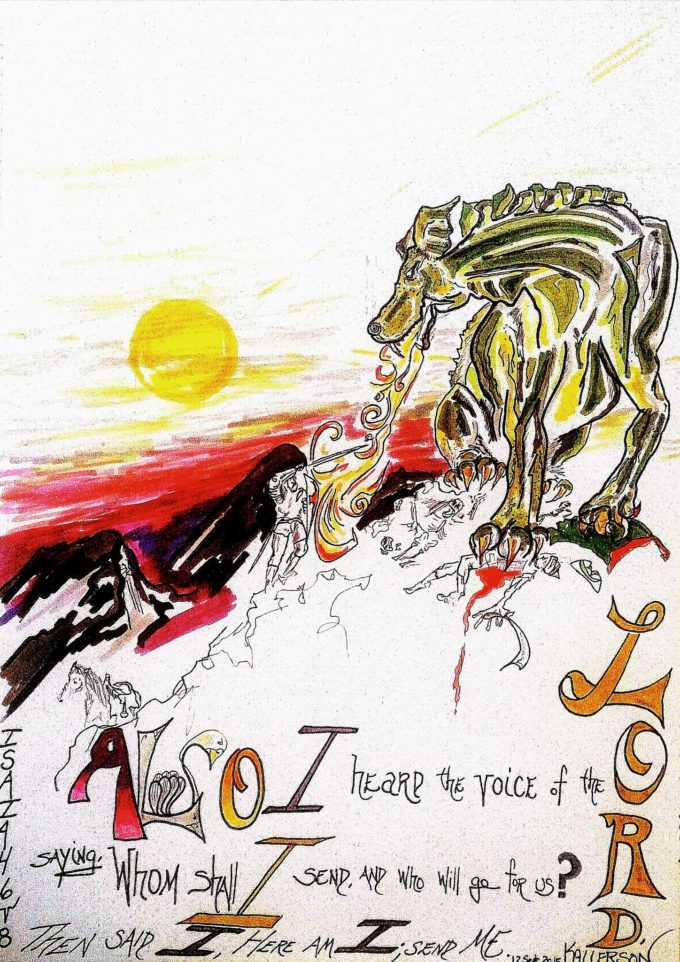
Also I heard the voice of the Lord, saying:
“Whom shall I send,
And who will go for Us?”
Then I said, “Here am I! Send me.” Isaiah 6:8
As we saw in our text verse, Chapter 12 of Zechariah, still Old Testament, places all three members of the Trinity together in one passage. The Gospel of John, time and again, reflects the relationship between the Father and the Son as well as the Spirit –
Philip said to Him, “Lord, show us the Father, and it is sufficient for us.”
9 Jesus said to him, “Have I been with you so long, and yet you have not known Me, Philip? He who has seen Me has seen the Father; so how can you say, ‘Show us the Father’? John 14:8, 9
And again, in John 16 –
“Nevertheless I tell you the truth. It is to your advantage that I go away; for if I do not go away, the Helper will not come to you; but if I depart, I will send Him to you. 8 And when He has come, He will convict the world of sin, and of righteousness, and of judgment: 9 of sin, because they do not believe in Me; 10 of righteousness, because I go to My Father and you see Me no more; 11 of judgment, because the ruler of this world is judged.” John 16:7-11
Next, Paul shows that he clearly understood God’s triune nature. He alludes to it here and elsewhere many times in his epistles –
“The grace of the Lord Jesus Christ, and the love of God, and the communion of the Holy Spirit be with you all. Amen.” 2 Corinthians 13:14
And again in 1 Timothy 6:13-16 he writes –
“I urge you in the sight of God who gives life to all things, and before Christ Jesus who witnessed the good confession before Pontius Pilate, 14 that you keep this commandment without spot, blameless until our Lord Jesus Christ’s appearing, 15 which He will manifest in His own time, He who is the blessed and only Potentate, the King of kings and Lord of lords, 16 who alone has immortality, dwelling in unapproachable light, whom no man has seen or can see, to whom be honor and everlasting power. Amen.”
Who is Paul speaking about when he says that “God gives life to all things?” God obviously. But in Job 33, John 6, Romans 8, and 2 Corinthians 3, it is said that the Spirit gives life.
And who is Paul speaking of when he says, “the King of kings and Lord of lords?” It must be the Lord God, and yet it is the same title which John uses when referring to Jesus in Revelation 19:16. We could go on and on in this, but – instead – we will go on…
Oh God! You are our Father, and we are your children
You brought us forth for Your honor and glory
You have brought forth all the sons of men
We have become a part of Your redemption story
It is You who begat us, and to You we lift our praise
It is You who created so that we came forth to You
It is we who turned away, for seemingly endless days
But You never abandoned us; You are ever faithful and true
And so, O God our Father, bring us back to You
Turn our hearts to You so that we are right again
Lead us on paths that are righteous and true
Look with favor on Your wayward children
III. The First Member – God the Father
God the Father is clearly acknowledged by all Christians as well as most cults and sects who use the Bible as their reference. An unfortunate exception of course has come out of modern liberal denominations with songs and hymns which have purposed a gender-neutral God. Such perversity has taken over many major denominations –
Praise God from whom all blessings flow
Praise Him all creatures here below
Praise Him above the Heavenly host
Praise Father, Son, and Holy Ghost (Good and proper)
Praise God from whom all blessings flow;
Praise God, all creatures here below;
Praise God for all that love has done;
Creator, Christ, and Spirit, One. (Bad and contemptible)
This gender-neutral trend is not how God has revealed Himself, nor shall we. Regardless of such depravity, the texts as received from God for our Bible are in the masculine and for that reason, we adapt political correctness in this matter at our own peril. God’s word stands though. Concerning God the Father we read –
“Have we not all one Father? Has not one God created us?” Malachi 2:10
“Not that anyone has seen the Father, except He who is from God; He has seen the Father.” John 6:46
This verse from John 6, plus those from both John 14 and John 16 which I read earlier, perfectly match the description Dr. Wood made concerning the nature of the Trinity. God is One, and within the Godhead, there is the Person and the role of the Father.
Who is like the Son of God that came from above?
Who can compare in splendid majesty?
Where can be found the depth of His love?
When God reveals Himself as such, how can it be?
Great are You O God, who came from the eternal realm
And who for fallen men stepped out of eternity
We behold Jesus, our Captain! He at the helm
And He is taking us to His place of victory
Hail the Son who died upon the cross!
Hail the One who died upon Calvary!
In Him is the triumph – to the devil only loss
For in Christ Jesus is God’s perfect victory
IV. The Second Member – God the Son
“In the beginning was the Word, and the Word was with God, and the Word was God. 2 He was in the beginning with God. 3 All things were made through Him, and without Him nothing was made that was made. 4 In Him was life, and the life was the light of men. 5 And the light shines in the darkness, and the darkness did not comprehend it.” John 1:1-5
This could not have been stated any more clearly concerning the nature of the Word, meaning the Son, and His eternal relationship with God. And yet, people perversely twist something so clear and so concise in order to deny the truth of the very words so meticulously penned by John under inspiration of the Spirit.
In his first epistle, John follows the exact same pattern concerning the Word. These verses, along with everything else John writes, are so absolutely clear concerning the deity of Jesus that it is without excuse to misunderstand or deny what he is saying –
“That which was from the beginning, which we have heard, which we have seen with our eyes, which we have looked upon, and our hands have handled, concerning the Word of life— 2 the life was manifested, and we have seen, and bear witness, and declare to you that eternal life which was with the Father and was manifested to us.” 1 John 1:1, 2
Later in Revelation, John quotes Jesus’ own words – His own claim to deity. If the resurrection didn’t prove it to us, He clarifies it to us out of His own mouth –
“I am the Alpha and the Omega, the Beginning and the End, the First and the Last.” Revelation 22:13
Of course, that is not Jesus’ only claim to eternality, and thus deity. There are many examples of it. However, we have to be careful that we only use that which is intended to be used in this way. The next verse speaks of Jesus’ eternality, but maybe not the way you have thought, or been taught –
“Most assuredly, I say to you, before Abraham was, I AM.” John 8:58
If you have heard that the words here, translated as “I AM” prove Jesus was claiming to be God, it is not that simple. The Greek reads ego eimi. However, if you go to the very next chapter, the same words are used by the man Jesus healed –
“Therefore the neighbors and those who previously had seen that he was blind said, ‘Is not this he who sat and begged?’
9 Some said, ‘This is he.’ Others said, ‘He is like him.’
He said, ‘I am he.’” John 9:8, 9
In this exchange, the man states ego eimi just as Jesus did. He clearly wasn’t claiming to be God, so we need to be careful to not swallow the wrong colored pill.
The claim of deity in John 8 is evident from the construct of the verse – “Before Abraham was.” Jesus was saying that He is before Abraham was. Thus, He preceded Abraham and must be God. It is also evident from the actions of the people based on the Hebrew or Aramaic Jesus would have spoken, not necessarily the Greek used in the translation. How do we know this?
“Then they took up stones to throw at Him;” John 8:59
The very fact that they picked up stones to throw at Him testifies that He had claimed an existence which only belonged to Yehovah. Thus, He was being accused of blasphemy, for which stoning was the penalty. And again, this next verse leaves no doubt –
“‘I and My Father are one.’ Then the Jews took up stones again to stone Him.” John 10:31
Here, it is both what Jesus said and the reaction of the people that assure us that Jesus was claiming deity. Luke had no doubt of Christ’s deity. Listen to how carefully he worded the following which is a pattern seen throughout his writings –
“Now the man from whom the demons had departed begged Him that he might be with Him. But Jesus sent him away, saying, 39 “Return to your own house, and tell what great things God has done for you.” And he went his way and proclaimed throughout the whole city what great things Jesus had done for him.” Luke 8:38, 39
Either Luke was making a point for us to read and understand, or he was an incompetent blasphemer. Next, Paul completely supports the deity and Godhood of Christ Jesus –
“He is the image of the invisible God, the firstborn over all creation. 16 For by Him all things were created that are in heaven and that are on earth, visible and invisible, whether thrones or dominions or principalities or powers. All things were created through Him and for Him. 17 And He is before all things, and in Him all things consist.” Colossians 1:15-17
In these verses, the JW’s NWT adds in the word “other” before the word “created” in both verses 16 and 17 – “He created all other things.” The word cannot even be inferred from the context, but more, it is incomprehensible and illogical to think that a created being could somehow “create all things,” or “all other things.”
The sixth First Principle, that of Contingency (or Dependency) disallows it. It says that “Contingent Being Cannot Cause Contingent Being.” This would lead to an infinite regress of causes which is disproved by Relativity.
Time, Space, and Matter came into existence simultaneously. The existence of each is dependent on the existence of all. And all are dependent on both a Creator and a Sustainer. The principle is undeniable. A contingent, or created being, cannot create or sustain anything else because it is already contingent.
In theology, 1+1 always equals 2, and Jesus is the eternal God. The writer of Hebrews makes the same claim as Paul concerning God’s sustaining power for the entire universe as being held in the Person of Christ Jesus –
“The Son is the radiance of God’s glory and the exact representation of His being, sustaining all things by His powerful word.” Hebrews 1:3
No matter what else, the deity of Jesus Christ is not only fully supportable by the text of the Bible, but it is the only logical and reasonable conclusion that we can come to. It is through Jesus that the Eternal God reveals Himself to us. And it is the Holy Spirit who will, if we allow Him, teach us the proper doctrine concerning the nature of God. This, through the word He breathed out to us.
By the Spirit I search out the things of God
Things gloriously breathed out for us to search and see
For all the days upon this earth as I trod
I shall seek my God as His Spirit lovingly guides me
It is the word He has given, through men selected O so carefully
That I can see what God has done, even for one such as me
The words are given, and they are presented so beautifully
Marvelous things are hidden there for us to search and see
Give us wisdom in Your word, O God
Help us find those things hidden away so secretly
Open the treasures of Your word as in this life we trod
May Your Spirit guide us as we search to see
V. The Third Member – God the Holy Spirit
“That which is born of the flesh is flesh, and that which is born of the Spirit is spirit. 7 Do not marvel that I said to you, ‘You must be born again.’ 8 The wind blows where it wishes, and you hear the sound of it, but cannot tell where it comes from and where it goes. So is everyone who is born of the Spirit.” John 3:6-8
In the Bible, the work of “begetting” sons is the job of the Father, but it is also the work of the Spirit. To attribute this to the Spirit, were it not the case, would be blasphemous.
The Jehovah’s Witnesses call the Spirit an “active force” – whatever that means. They have to make up a term for the Spirit which is completely unsupportable in order to diminish His proper role as the third member of the Godhead. But the Spirit is the One who searches the Godhead and reveals to us God’s workings –
“For what man knows the things of a man except the spirit of the man which is in him? Even so no one knows the things of God except the Spirit of God.” 1 Corinthians 2:11
Next, Paul – after talking about Christ (the Lord) – does a change-up and says in practically in the same breath…
“Now the Lord is the Spirit; and where the Spirit of the Lord is, there is liberty.” 2 Corinthians 3:17
Either Paul is completely confused theologically, or He is as clear as a crystal in his claim – Christ is the Lord, the Spirit is the Lord, and the Spirit is the “Spirit of the Lord.”
Numerous other examples of the workings of God the Spirit are found in both testaments of Scripture. They identify Him either implicitly or explicitly as God. Thus, the Bible reveals that there is one Godhead which then is expressed in three Persons – Father, Son, and Holy Spirit. Each is God, but each expresses God to us in a different and yet understandable way.
As we finish today, please remember a few things. The first is that the Bible both implicitly and explicitly shows that each of these three Persons is God. As the Bible also says that there is only one God, then it must be that there is a Godhead comprised of them.
Secondly, just because we don’t fully understand a thing, it does not mean that such a thing does not exist. I don’t fully understand my wife, but I am quite certain she exists. It is illogical to make a claim that the Trinity is not possible simply because we cannot perfectly explain every point concerning it.
If you think it through, there is nothing that we can fully explain, even the composition of a single atom. We can explain it to some extent, but the further we look into it, we eventually break down in our ability to define all that comprises that one, single atom.
Third, as you heard today, there is a logical and acceptable model for the Trinity that we subsist in at every moment of our existence, Time. As this is so, and as it adequately reflects the Trinitarian model, we are not left completely excluded from understanding a principle that the Bible proclaims as true, but which is otherwise very complicated.
And fourth, a monad God has been proven impossible by simple logic as revealed in the First Principles. As a monad is not true, then a multiplicity within the Godhead must be true. That multiplicity is defined in the God of Scripture as not being 2, 5, 17, or 120, but 3 – Father, Son, and Holy Spirit. Such is God, and such is how we are to accept this revelation of Himself to us.
Surely, we praise our Creator – Father, Son, and Holy Spirit! May you be blessed as you read the Word in the future, observing and accepting the Trinity.
Closing Verse: “Holy, holy, holy is the Lord of hosts;
The whole earth is full of His glory!” Isaiah 6:3