Jesus Christ, The God-Man
Part I – His Humanity
“That which was from the beginning, which we have heard, which we have seen with our eyes, which we have looked upon, and our hands have handled, concerning the Word of life— 2 the life was manifested, and we have seen, and bear witness, and declare to you that eternal life which was with the Father and was manifested to us— 3 that which we have seen and heard we declare to you, that you also may have fellowship with us; and truly our fellowship is with the Father and with His Son Jesus Christ. 4 And these things we write to you that your joy may be full.” 1 John 1:1-4
There are a host of views concerning the nature of the Person of Jesus Christ. Scholarly, and quite unscholarly, comments go back to the beginning of the Christian faith, and they go in every possible direction one could conceivably imagine.
It would be impossible to even touch upon every point of doctrine that has been developed over the centuries, and there really is no need to do so for a series on basic doctrine. What needs to be understood about Christ Jesus is that He is fully God, and that He is also fully Man.
Any departure from those two principle points is, by default, heretical. But how one gets to those points can also be a source of either very poor doctrine or even heresy. Care needs to be taken to explain these things without going off on a bad path.
As far as His humanity, there is no scriptural doubt about it. By the words of the prophets, by the typological pictures which anticipate Him, by His own words, and by the words of the apostles who came after Him, the humanity of Jesus Christ is an undeniable point of biblical doctrine.
But to make sure that we understand the nature of that manhood, we need to at least make a short review of Scripture, and then look over one or two views which are contrary to what is sound. Often, evaluating that which is incorrect can lead us to more rightly see what is correct.
In this sermon, as in other sermons to come, we will evaluate the doctrine of others, including some who are still alive today. To determine what is correct, one should determine what is error. To this day, we speak of the Arian heresy. That was named because of the unsound doctrine of someone named Arius.
Just because someone is alive, it does not mean that their doctrine cannot be called out. In fact, the opposite is true. Paul called out unsound teachers by name, such as in 2 Timothy 2:17. If I teach poor doctrine, or even heresy, that should be noted. If someone is going to step up to the pulpit, that person is – by default – expected to teach what is orthodox.
Text Verse: “He is despised and rejected by men,
A Man of sorrows and acquainted with grief.
And we hid, as it were, our faces from Him;
He was despised, and we did not esteem Him.” Isaiah 53:3
The Messiah was anticipated. What His role and work detailed was certainly debated, but Israel knew one thing for certain – He would be a human being. Andrew understood this and he excitedly proclaimed it to his brother, Simon Peter –
“He first found his own brother Simon, and said to him, ‘We have found the Messiah” (which is translated, the Christ). 42 And he brought him to Jesus.’” John 1:41
Even people not of Israel knew this would be the case. We learned this from a woman of Samaria –
“The woman said to Him, ‘I know that Messiah is coming’ (who is called Christ). ‘When He comes, He will tell us all things.’” John 4:25
There was no question in anyone’s mind at the time that the coming Messiah, or Christ, would be a human being. Scripture was clear, and the genealogies were perfectly understood that it was so. What the purpose of Christ’s humanity served is a different subject and for a different time.
The fact that He is a human, and how that came to be, is what needs to be detailed here today. It is a marvelous truth which is revealed in His Superior Word. And so, let us turn to that precious word once again and… May God speak to us through His word today and may His glorious name ever be praised.
I. Jesus Christ – A Body Prepared
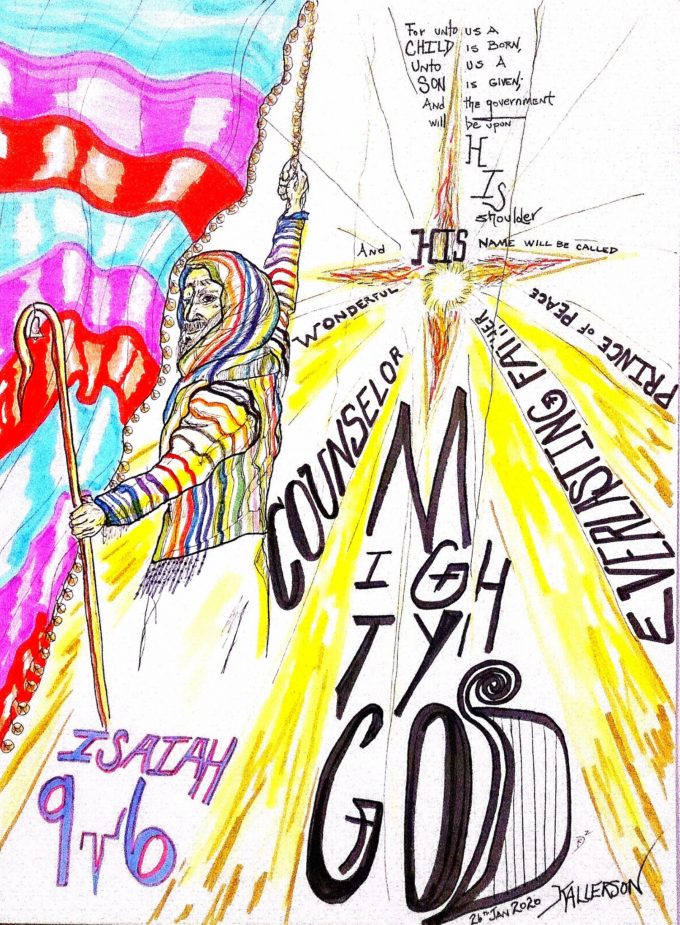
Isaiah 9:6 says, “For unto us a Child is born.” It is a confirmation of what was already anticipated, even since moments after the fall of man. A human being was promised who would be born into the world, and He would be unlike all other human beings. But He would, in fact, be a human being. The word was prophesied by the Lord to the serpent who had led humanity into the sin of disobedience –
“And I will put enmity
Between you and the woman,
And between your seed and her Seed;
He shall bruise your head,
And you shall bruise His heel.” Genesis 3:15
The Lord God promised that One would come who would bruise the head of the serpent. From the details of Genesis 4, it is evident that Eve understood exactly what was meant. The naming of her first son Cain, and the exclamation she made concerning him, reveals that truth – qaniti ish eth Yehovah – “I have acquired a man with Yehovah.”
She anticipated that her child would be the One to take on the serpent and lead her back to the Garden of Delight that she had been expelled from. That is not a dubious inference, but rather it is a proclamation based on one thing alone – the promise spoken in Genesis 3:15 – Messiah would be the Seed of the woman.
At this point in the biblical narrative, all we know is that this One will be the Seed of the woman. Thus, as she rightly deduced, He would come from her, the mother of all living. Therefore, He would be a human being. Nothing else is yet explicit. However, the curious use of the words, her Seed, do leave unanswered questions.
The reason for this is that the Bible consistently speaks of the seed of man. It is through man that generations are noted and spoken of. The genealogical listings consistently refer to children being begotten of a father, and when a woman is introduced into a record, it is to clarify a matter, or resolve some sort of dilemma.
For example, the daughters of Zelophehad are referred to several times in the book of Numbers, and in Joshua and 1 Chronicles as well. In fact, great detail is given concerning them, but it is specifically because they are daughters of a man without sons that the specificity is given.
It is the line, or seed, of the male – and that alone – that bears the importance of the generational promises and inheritances. And so, to speak of the Seed of the woman should at least cause the reader to stop and ponder why the statement was given. One could not, until after the coming of Messiah, deduce the full import or implication of the term at this point.
For now, the Bible is focusing on His human nature – He will come from a human being, regardless of any other characteristics. Indeed, unto us a Child is born.
From this point, the fact that this One will be the Seed of the woman is carefully tucked away, as if a precious jewel which needs to be protected and cared for until it is needed again some future day when God so determines it.
In its place, or rather maybe, from a different perspective, the narrative now goes solely to the seed of man. With many stories interspersed throughout the narrative, it is the generations of Adam, the first man, that are highlighted. Genesis 5 gives the first notable genealogy – Adam, Seth, Enosh, Cainan, Mahalalel, Jared, Enoch, Methuselah, Lamech, and Noah.
They are ten names which detail the progression of the generations of man, from man to man. They state that one begets the next and then so on down the line. No women are listed, though some are incidentally mentioned for specific purposes, but which are not especially related to the genealogical records.
After Noah, the pattern continues. There is one main line which continues to feed the hungry belly of time, filling it up with one generation after another. Eventually, the line leads to the family of Abraham, of which a lot of detail is provided, and many names are mentioned.
At times, women are included in the narrative by name, such as Sarah and Rebekah. At others, they are referred to by family, such as the two daughters of Lot. But the focus of the lines is based on the male throughout the narrative, even if the lines of those people – including the women, such as the daughters of Lot – lead to the anticipated Messiah.
It is important, however, to stop with Abraham, and to highlight one of the chief aspects of his walk before the Lord in order to understand more about this coming Seed of the woman. God, in Genesis 17, says to Abraham –
“As for you, you shall keep My covenant, you and your descendants after you throughout their generations. 10 This is My covenant which you shall keep, between Me and you and your descendants after you: Every male child among you shall be circumcised; 11 and you shall be circumcised in the flesh of your foreskins, and it shall be a sign of the covenant between Me and you. 12 He who is eight days old among you shall be circumcised, every male child in your generations, he who is born in your house or bought with money from any foreigner who is not your descendant. 13 He who is born in your house and he who is bought with your money must be circumcised, and My covenant shall be in your flesh for an everlasting covenant. 14 And the uncircumcised male child, who is not circumcised in the flesh of his foreskin, that person shall be cut off from his people; he has broken My covenant.” Genesis 17:8-14
The lines of man have been highlighted, and the Seed of the woman has also been referred to. But now, something new is introduced. The male organ, from which issues the seed of the man, is minutely discussed here and elsewhere from this point on.
One who is astute will at least question, “Why?” Couldn’t God have said to Abraham that he and his descendants should wear a certain hairstyle? Maybe shave their heads completely? Or, maybe wear a beard but no mustache? Couldn’t they have had a specific body mark, such as a tattoo or cutting in a conspicuous place?
Such things are found in cultures throughout the world. In fact, later in the narrative, there will be a group identified by their necks, the Anakim, first mentioned in Numbers 13. Either they have long necks, or they ornamented their necks in some obvious way, but they had a family identifier which was readily viewable to all.
However, Abraham has one that is secreted away, and it is also one which involves the very spot of the transmission of what begets humans from one generation to the next. Indeed, a connection is being made for us to ponder and contemplate.
From Abraham, the genealogical listings continue, but those which are especially highlighted are those which descend from a son of promise, Isaac, and not from a son who came in the natural way, Ishmael and other sons of Abraham.
Abraham’s many sons are listed, and at times the sons of their sons are listed as well, but these are branches off the main trunk. The main line is Isaac. And from Isaac comes Esau and Jacob. But Jacob quickly becomes the main line of note, and Esau is easily understood to be another branch.
But then, interestingly, all twelve of Jacob’s sons are highlighted as a single unit, with two more added through adoption. However, from this large assembly, hints begin to develop early on that one of these lines is of special import, Judah.
Several stories clue us into this. Eventually, it becomes perfectly obvious. By the time of David, it can be taken as an axiom that those early stories and prophecies were pointing – once again – to one particular and special listing of the generations of men.
And with the coming of David, it becomes obvious that the line, which is minutely and exactingly being detailed, is to specifically continue through him. The line of man is being highlighted, but a particular line of man is granted special note as it winds through the corridor of unfolding time.
And during this process of unfolding, promises are made which speak of a Man who is anticipated to come. Sometimes these promises, or prophecies, are veiled. Sometimes they are specific, even if the object of them is as of yet unknown.
Jacob speaks of the scepter and of Shiloh, Balaam speaks of one in the distant future who would be the Star out of Jacob and the Scepter out of Israel. The Lord spoke to David concerning the establishment of an everlasting throne and kingdom which would come from him.
And then the Psalms open up revelations, time and again, of One – a human being – who would be the fulfillment of all of the promises which had been made. Page after page of the psalms introduce new insights about Him. Quite often these could only be fully understood after His coming, but many were known to be Messianic all along.
There is enough to know that He is coming, but not enough to be definitive about who He would be, when He would come, and so on. But the overall and most evident aspect of Him is that He would be a Man. Unto us a Child is born. Humanity would clothe Him, and His garments would not be unlike our own.
And of course, the prophets also chimed in, time and again, concerning this exceptional Man to come. Micah even fills in the information that Isaiah leaves out concerning the birth of this anticipated Child –
“But you, Bethlehem Ephrathah,
Though you are little among the thousands of Judah,
Yet out of you shall come forth to Me
The One to be Ruler in Israel.” Micah 5:2
Bethlehem is a place. It is a part of creation. It is a fixed and definite spot. But it is not just a location, like a lake or a mountain. And it is not a spot for particular animals. For example, in the Bible, there is a place called En Gedi. That means “Fountain of a Goat.” It then speaks of a place where goats are seen.
Bethlehem is a place of people. It is a city inhabited by human beings. The implication is that the anticipated Ruler would be a human as well. One plus one equals two. Nobody who reads those words from Micah would think otherwise. If He comes from a created place, and if He comes from the created people of that place, then He is a human being.
This Person would be from the city of Bethlehem, and He would be from the tribe of Judah. Judah descends from Jacob, Jacob descends from Isaac, and Isaac descends from Abraham. From there, the genealogies which have been carefully recorded go right back to Adam. Do you see how logical and orderly it all is?
Human beings beget human beings, and, therefore, this will be a Man who comes from human beings. The male line is carefully recorded for us to see this. If there is more to this Man than meets the eye, it does not negate that He will be a Man descended from humanity.
So obvious was the prophecy concerning this coming One in Micah, that when Herod the king heard the news that the King of the Jews had been born, he went to the chief priests and scribes and asked where He was to be born… this Christ; this Messiah.
Their answer was clear and precise. They simply cited Micah and told him that it would be Bethlehem. A human being, from a city of human beings, had been prophesied to come and rule.
We could go on and on, with prophecy after prophecy, clearly demonstrating that the Messiah would come into the stream of humanity as a human being, being begotten from human beings.
To state otherwise would not only violate every aspect of Scripture from Genesis to Matthew and then beyond, it would deny the very purpose of the sacrificial system of Israel which anticipated – in the minutest detail – of the need for blood atonement of a like-kind of being.
That isn’t perfectly obvious until the book of Hebrews in the New Testament, but it is as clear as can be when detailed there. Based on this, to state that this coming Messiah is either not a human being, or that He did not come through the line of humanity – from Adam, Seth, Enosh, Cainan, Mahalalel, Jared, Enoch, Methuselah, Lamech, Noah and then later through Abraham by Sarah, Lot via both of his daughters, Isaac, Jacob, Judah via his daughter-in-law Tamar, Boaz through his mother Rahab the harlot, David through his wife Bathsheba, and so on down the line – yes from all of these and so many others faithfully recorded in Scripture – to state that He did not come through them, then, you are not just dealing with faulty doctrine, you are dealing with heresy. It is a fundamental denial of the genealogical humanity of the coming Messiah.
However, the world is full of heretics, and of those who deny this fundamental basis for the coming Messiah. One of these heresies is Docetism. This doctrine states that the occurrence of the coming of Jesus, His historical and bodily existence – and in particular His human form – was only a semblance without any true reality.
The heretic Marcion held to such a belief. He dismissed the advent of Christ as being the Jewish Messiah. To Him, Jesus was rather a spiritual entity. He viewed Christ as so Divine, that He could not have been human. Such views deny what is both logically and Scripturally necessary concerning the humanity of Jesus.
On the other side is Arianism, or its modern equivalent, the heretical doctrine of the Jehovah’s Witnesses. They state that Jesus was a created being and not God. The deity of the God-Man Jesus will be addressed, and this heresy will be refuted then.
There are many odd and heretical teachings between the two as well. For example, there are those who may agree that He is a human, and yet they deny that He was born into humanity. For example, let us take this quote from the sermon “The Two Adams” by Jacob Prasch and see if you can detail his errors –
“As far as God is concerned, there’s only two men who have ever existed, Adam and Yeshua. The first Adam and the second Adam. Everybody is either part of the first Adam, or part of the second Adam. Adam and Yeshua were both created by Ha’Shem by God directly and personally. And they were both created without sin. They did not have a fallen nature.” Jacob Prasch
I don’t know if he still teaches this or not. I don’t listen to other preachers unless someone tells me what they have said, and they want clarification on whether it is correct or not. If he hasn’t corrected this, then he continues in serious theological error. If he has, fine. But the video was sent to me, I was asked if it was Scriptural, and I evaluated it for that reason. I will admit that I learned a couple interesting things from the sermon, but what is said here involves a serious deficiency in Christology.
Briefly, the first error is contained in the first sentence, “As far as God is concerned, there’s only two men who have ever existed, Adam and Yeshua.” This is such a strange statement that cannot be reconciled with reality. There are countless men who have existed, and all are known by God. Jesus Himself said as much in Mark 12:26 –
“But concerning the dead, that they rise, have you not read in the book of Moses, in the burning bush passage, how God spoke to him, saying, ‘I am the God of Abraham, the God of Isaac, and the God of Jacob’?”
Being gracious, we will overlook the obvious error that says that there are only two men who have ever existed and grant that he later defines it as referring to the state of man. Man is either in Adam, or in Christ – and there is no other option apart from those two. That is made explicit in Scripture by Paul in both Romans 5 and 1 Corinthians 15.
He next says, “Everybody is either part of the first Adam, or part of the second Adam.” This is an error in terminology which is not supported in Scripture. One is either “in” Adam, or “in” Christ. The term “part of” is not found in Scripture, nor does it align with sound doctrine.
One is “in” another because he bears the traits of another. One is in Adam, and he bears the traits of Adam. He may be a part of Adam’s offspring, but that is incidental. When one is “in” Christ, it means that he now bears the traits of Christ. He no longer possesses Adam’s sin nature. One may be a part of what Christ is doing in the world, but again – such a term is incidental.
When Jesus said to Peter in John 13:8, “If I do not wash you, you have no part with Me,” He was not speaking of physically being a part of Christ, but of having a portion, or share with Christ.
His third, and most egregious error, and which is heretical in what it teaches, is the statement, “Adam and Yeshua were both created by Ha’Shem, by God, directly and personally.” This is the heresy known as Valentinianism.
Jesus is not a created being. That is the error of many cults, such as the Jehovah’s Witnesses. However, Jesus, in His humanity, is a part of the creation. There is a world of difference between the two, and it is what defines the distinction between orthodoxy and heresy.
To state that God created Jesus directly and personally as He did with Adam, is to then deny the entire body of Scripture which points to the begetting of human beings, one to another, from Adam to Christ.
God created all things, it is true, but the body of Christ, is an incidental part of creation, not a direct act of creation. Rather, God prepared a body out of that creation for the incarnation. This is evidenced by Hebrews 10:5 –
“Therefore, when He came into the world, He said:
‘Sacrifice and offering You did not desire,
But a body You have prepared for Me.’” Hebrews 10:5
Scripture, given by God, carefully – even meticulously – details the preparation of the body of Christ, through seventy-five direct generations of fallen human beings as is recorded in Luke 3, and with the introduction of even more fallen souls who are found in the pages of Scripture, and who likewise enter into His genealogy.
To say that Jesus was created by God, directly and personally, and to have that mean what is being conveyed in that sermon, would be exactly the same thing as saying that Charlie Garrett was created by God, directly and personally.
It is at best a category mistake, but such a category mistake results in the formulation of a heretical doctrine. The body of Christ, despite having come through these innumerable fallen souls was prepared perfectly by God, not suddenly created. Jesus is the seventy-seventh name noted in Luke’s genealogy, and God is the first.
The record is given, and the details are provided, to ensure that the error of assuming that Jesus was a being created directly and personally by God, would not be made. The statement that Jesus was created is incorrect, but that He was – and is – without sin is true.
But how can that be reconciled? If Jesus’ humanity descended from fallen beings, then how can it be that Jesus was without sin? The answer is found in what was commanded to Abraham in Genesis 17, and which is found in the body of every properly observant Jew concerning this precept to this day, even if they missed the significance of what it anticipated – circumcision.
It was fitting for Him, our Lord Jesus
For whom are all things, and by whom they are as well
In bringing many sons to glory, even us
As the precious words of Scripture do tell
To make the Captain of our salvation
Perfect through sufferings, His great tribulation
For both He who sanctifies
And those who are being sanctified too
Are all one; in His death each of us dies
A marvel in how His children He does accrue
For which reason He is not ashamed, time and again
To call them brothers, you and me too
Saying “I will declare Your name to my brethren
In the midst of the assembly I will sing praise to You”
II. Jesus Christ – the Sinless Man
God said to Abraham in Genesis 17:11 that being circumcised in the flesh of the foreskin was “a sign of the covenant between Me and you.” A sign is representative of something else. It is not a thing all by itself, as many Jews seem to perceive it. “See, I am circumcised, and this is the sign of the covenant between God and me. I am right because of the cut in my flesh.”
That is incorrect. A sign anticipates, pictures, and reveals something else. This is why Moses speaks twice in Deuteronomy of circumcision of the heart in verses 10:16 and 30:6, why Jeremiah repeats that many hundreds of years later in Jeremiah 4:4, and then Paul explains what a true Jew is with these words –
“For he is not a Jew who is one outwardly, nor is circumcision that which is outward in the flesh; 29 but he is a Jew who is one inwardly; and circumcision is that of the heart, in the Spirit, not in the letter; whose praise is not from men but from God.” Romans 2:28, 29
The physical aspect of circumcision looks to an inner aspect. If the latter is missing, the former is void of any value. Indeed, circumcision is not limited to the Jewish people. Rather, it has been and is practiced by Gentile cultures around the world, and their circumcision is as meritless as the circumcision found in Jews whose hearts are not circumcised along with their flesh.
If circumcision is a sign of something else, then what is it a sign of? It is that which many other signs from the Old Testament anticipate, Christ. Adam, a true and actual human, was created without sin, but fell through disobedience. In his fall, sin entered the world, and as Paul then explains –
“Therefore, just as through one man sin entered the world, and death through sin, and thus death spread to all men, because all sinned— 13 (For until the law sin was in the world, but sin is not imputed when there is no law. 14 Nevertheless death reigned from Adam to Moses, even over those who had not sinned according to the likeness of the transgression of Adam, who is a type of Him who was to come.” Romans 5:12-14
In other words, all bear Adam’s image, meaning his sin nature. Adam sinned, and in Adam all sinned. Because of sin, man is unrighteous. But God declared Abraham righteous by a simple act of faith. That is seen in Genesis 15, prior to the giving of the sign of the covenant –
“‘Look now toward heaven, and count the stars if you are able to number them.” And He said to him, “So shall your descendants be.’
6 And he believed in the Lord, and He accounted it to him for righteousness.” Genesis 15:6
The righteousness of Abraham led to the covenant with Abraham, and the covenant of Abraham was given a sign – circumcision. That sign anticipated the coming of Christ. Abraham understood this because he had already been told as much in Genesis 12 –
“Now the Lord had said to Abram:
‘Get out of your country,
From your family
And from your father’s house,
To a land that I will show you.
2 I will make you a great nation;
I will bless you
And make your name great;
And you shall be a blessing.
3 I will bless those who bless you,
And I will curse him who curses you;
And in you all the families of the earth shall be blessed.’” Genesis 12:1-3
The promise of Messiah had already been made, the continued understanding of His coming is implied in the words to Abraham, and thus, Messiah would come through Him. As Abraham was not the father of all the families of the earth, then it follows that the words spoken to him were in relation to Messiah who would descend from him. This is something that would be again confirmed to him.
Later, as we saw, Abraham was declared righteous by faith in God’s words. And today, how is one declared righteous? It is through faith in Christ. But that is getting ahead of ourselves.
We have to remember that it is the humanity of Christ which makes this obtainable. As Christ was not created, directly and immediately, then He descended from Adam and his subsequent generations – as the Bible clearly lays out.
But if all in Adam have sinned, then how can Christ, who is descended from Adam, be sinless? And indeed, Paul clearly says that Christ is so descended. Was David descended from Adam? Yes or no? We all agree that it is so. And, in fact, David inherited sin because of this –
“Behold, I was brought forth in iniquity,
And in sin my mother conceived me.” Psalm 51:5
David is descended from Adam. But Paul says of the gospel to his protégé Timothy –
“Remember that Jesus Christ, of the seed of David, was raised from the dead according to my gospel, 9 for which I suffer trouble as an evildoer, even to the point of chains; but the word of God is not chained.” 2 Timothy 2:8
If David is of the seed of Adam, and Christ is of the seed of David, then Christ is of the seed of Adam. In proper theology one plus one always equals two. To support this further, the author of Hebrews says that Christ arose from Judah (7:14).
The term “seed of David” cannot be misconstrued or twisted because of this. The genealogical record does not allow anything but a real descent from Adam through these men, and then to Christ Jesus. But this is only true in His human nature. And so, where is the dilemma resolved?
It is because of a young Jewish girl named Mary. Whether Mary is of the line of David or not is debated. She was a cousin of Elizabeth who is clearly from the priestly line of Levi through Aaron. But this does not mean Mary was.
It could be that the mother of Mary, and the mother of Elizabeth, were sisters descended from Aaron, but Mary’s mother could have married a man of Judah. If so, then Mary would be reckoned as being of the tribe of Judah through her father. Regardless of this though, Joseph was of the tribe of Judah and the house of David –
“Now in the sixth month the angel Gabriel was sent by God to a city of Galilee named Nazareth, 27 to a virgin betrothed to a man whose name was Joseph, of the house of David.” Luke 1:26, 27
Because the line of a child is based on that of the father, to include all inheritance rights, the birth of Jesus would have been reckoned as such. However, as the account tells us, the Holy Spirit came upon her, and the power of the Highest overshadowed her. God is the Father of Christ.
As sin travels through the father, and as Christ’s true Father is God, He inherited no sin. The rite of circumcision, the sign of the covenant, is simply a picture of the incarnation of Jesus Christ. It is the cutting of the sin nature because of the cutting of that which transmits the sin from father to child. Picture fulfilled. Hence, circumcision is not required to be included in the New Covenant, as Paul clearly states again and again in his epistles.
This then takes us back even further. The Bible has spoken of the generations of Adam, the generations of Noah, the generations of Shem, Terah, Ishmael and Isaac, Esau, Levi, and so on. The seed of the man has directed the course of human history, even to Christ.
But there is another Seed which affects all of them – the Seed of the woman. We were admonished earlier to stop and ponder why the Messiah would be called the Seed of the woman. It is the seed of man by which genealogies would be determined. Right?
However, it is the Seed of the woman that would bruise the serpent’s head. The Lord didn’t say to Eve, “Your seed will bruise the serpent’s head.” She just assumed it was so. He said to the serpent, v’evah ashit benekha u-ben ha’ishah – “And enmity I will put between you and between the woman.”
Eve had to assume that “the woman” was her, and the assumption was wrong. One can argue at another time if the woman is Israel or Mary, but Mary is of Israel. The Seed of the woman is the Man, Christ Jesus. Mary was the human receptacle for the God-Man. Thus, He bears all of her humanity, but none of man’s sin.
The sign of circumcision is fulfilled. The sin-nature of Adam is cut, and the righteousness of God is found in Him. This would not be true if Jesus were a created being. He would not bear the humanity of David, which Paul clearly states is found in Him.
He would also not be a descendant of Abraham, or Isaac, or Jacob, as promised to them. Paul explicitly says that, and he cited Scripture to show that the human link is found in Christ –
“Now to Abraham and his Seed were the promises made. He does not say, ‘And to seeds,’ as of many, but as of one, ‘And to your Seed,’ who is Christ.” Galatians 3:16
Again, to deny the genealogical record of Christ, leading to His incarnation and which makes up His humanity, one has to completely abuse the force and intent of the entire body of Scripture. Jesus was born into the stream of humanity, not created, and He was and is fully human.
More importantly, a denial of the truth of the genealogical humanity which led to Him would result in a problem with the deity of Christ as well. If Mary was just a receptacle for the creation of Jesus as some have claimed, then 1) Jesus is not God, because there is only One God who cannot create another God, or 2) God would have had to create a body for Christ, which He then united with.
There would be no begetting of His humanity in the process. This is similar to a confusion of thought concerning Christ’s deity which is seen in the error of the heretic Arius. He said, “If the Father begat the Son, then he who was begotten had a beginning in existence, and from this it follows there was a time when the Son was not.”
This is an error in understanding the nature of God. Jesus Christ is God. If God created Jesus in the womb of Mary, and yet He is God, then God and His creation are one indivisible single unit, but they are not. The incarnation says that God is the Creator and the creation is created.
Therefore, there is a distinction between the humanity and deity of Christ, a doctrine known as the hypostatic union. This describes the union of God and Man in the person of Jesus Christ – two hyposies, or states, in one.
He didn’t possess humanity before His conception, but since His conception, He is clothed in humanity forevermore. And although He is united with human flesh in this “hypostatic union,” He is not bound by the human nature; He remains fully God. His two natures are not in any way separate and yet they in no way intermingle. But if His body was created in the womb by God, for Jesus who is God, the two would intermingle.
Rather, His humanity remains human. He has all the attributes of man.
- Human genealogy
- He aged and increased in knowledge,
- He prayed
- He got hungry.
- He got tired.
- He felt compassion.
- He wept.
- He was thirsty.
- Many times, more than 100 in fact, He is called the Son of Man or the Son of David, demonstrating his human nature.
Adam was created, and he is not God, though he wanted to be like God. Jesus Christ IS God. This is exactly the opposite of what Mr. Prasch later says in his sermon. He says, “He was God who became a man” (23:50). This is incorrect. He IS God who united with humanity in the incarnation. But unlike Adam, He treated His state in exactly the opposite way–
“Let this mind be in you which was also in Christ Jesus, 6 who, being in the form of God, did not consider it robbery to be equal with God, 7 but made Himself of no reputation, taking the form of a bondservant, and coming in the likeness of men. 8 And being found in appearance as a man, He humbled Himself and became obedient to the point of death, even the death of the cross.” Philippians 2:5-8
In the womb of Mary, there was not a creation of man and a uniting with that man, thus forming a human who is God – a logical impossibility, because God is infinite.
Instead, there was a human who was a part of the creation and who was designed to bear children, who then was overshadowed by the Creator in order to beget a Son. The result is the God-Man, Jesus Christ. He is a fully human, but He is also God. This is why the very first page of the Bible tells us that all things reproduce after their own kind. Humans beget humans. God begat a Son. And Jesus Christ is the God-Man.
The humanity of Jesus Christ serves all of the purposes of redemption for fallen man, because He is the embodiment of all that is needed to redeem fallen man. Without this humanity, man could not be redeemed, but through the shed blood of Christ, it is possible. But more, without the shed blood of Christ, it is impossible.
All of the types and pictures of the sacrificial system of the Old Covenant only anticipated the coming of Messiah. As Hebrews 10:4 says –
“For it is not possible that the blood of bulls and goats could take away sins.”
If one thinks about it logically, Christ is both the sacrifice for sin, and He is the standard for judgment. He was found without sin, and He prevailed over death because of it. He is the embodiment of the law, and therefore, what He has done is the ideal to which all others must attain in order to meet God’s standard and be accepted by Him.
Therefore, one will either be found in Christ, and thus acceptable to God, or he will not be in Christ and be found unacceptable to God. The judgment will be that simple to conduct. There will be no balances to weigh out good and bad. There will be no listing of deeds leading to justification. There will be no time in purgatory which leads to a state of sanctification and holiness. There will only be those in Christ and those who are not in Christ. Those in Christ will be saved; the others will be condemned.
For now, we will close with the thought that theology matters, doctrine matters, and both of them matter in being precise. It is one thing to not know a matter, be given the gospel, and to then be saved by receiving the gospel.
It is another thing to be taught a heretical teaching and then be asked to trust in the one whom that heretical teaching proclaims. The first will be saved. Such a person does not need to be told the many intricate details of the incarnation of Jesus Christ in order to be saved. He simply hears the gospel, receives it, and is saved.
However, when someone is told in advance of hearing the gospel that Jesus is a created being; or that Jesus Christ is not God; or that people need to continue to observe the law in order to be saved; or that a person can lose his salvation; and on and on and on, he has put his trust in a false Jesus and he will not be saved.
How can we know this is true? Because Paul says as much in Galatians 1 –
“I marvel that you are turning away so soon from Him who called you in the grace of Christ, to a different gospel, 7 which is not another; but there are some who trouble you and want to pervert the gospel of Christ. 8 But even if we, or an angel from heaven, preach any other gospel to you than what we have preached to you, let him be accursed. 9 As we have said before, so now I say again, if anyone preaches any other gospel to you than what you have received, let him be accursed.” Galatians 1:6-9
Another gospel is no gospel. Be sure to share the gospel, but don’t confuse who Jesus is, what the nature of Jesus Christ who is God is, or anything else in your presentation. Stick to the basics, and then they can go about ruining their doctrine all by themselves if they so wish. Or, they can pursue that which is sound and reasonable in order to stand approved before the Lord on the Day when we face Him for our rewards and losses.
Closing Verse: “For it is evident that our Lord arose from Judah…” Hebrews 7:14