Deuteronomy 1:26-33
The Goer Before You – HE
When we come to a passage like the one before us, there are certainly several things we might think, “Well, yeah, that would upset the Lord.” There is rebellion, there is impudence, there is accusation, there is cowardice, and there is unbelief.
All in all, in eight verses, Israel could be accused of quite a few offenses against the Lord. The psalmist goes further though. In recounting this very incident, he adds in contempt, complaint, and willful ignorance. Further, he also acknowledges their unbelief.
For which of these should Israel receive their just punishment? There is one which is more offensive to Him than any other because it is a sin which simply cannot be overcome by God who does not force His will upon His people.
Text Verse: Then they despised the pleasant land;
They did not believe His word,
25 But complained in their tents,
And did not heed the voice of the Lord.
26 Therefore He raised His hand in an oath against them,
To overthrow them in the wilderness,
27 To overthrow their descendants among the nations,
And to scatter them in the lands. Psalm 106:24-27
It’s interesting that the psalmist ties the actions of this wicked generation in with the “overthrow of their descendants among the nations,” and that He would “scatter them in the lands.” Nothing of this occurred in the books of Moses.
Rather, after their time of punishment while wandering in the wilderness, He brought them across Jordan and into Canaan. They lived there for many hundreds of years before they were exiled. From there, he brought them back to the land for many more hundreds of years before they were exiled again.
And yet, He speaks of the actions of the people at this time in their history as a reason for the scattering of them those many hundreds of years later. What is this thing, this ongoing thing, which brought them such trouble and disaster throughout their history?
It is spoken of in our verses today. In fact, it is specifically mentioned by Moses by the use of a participle in verse 32. We’ll be there in a due time, but in short, of all of the sins of Israel – both active and ongoing – there is one thing, above all else, which brought about their many woes.
Unfortunately, it is the same sin which permeates their society today, and because Israel is a corporate entity, Israel is corporately affected by it. That will continue into the tribulation period, and it will only be resolved when they are so broken as a people that they have nowhere else to turn.
In their stubborn obstinacy throughout the years, their greatest sin – and the sin which has brought about many, many terrible woes – is the seemingly minor (and yet immensely huge) sin of… unbelief. As Joseph Benson says of this sin –
“…no sin will ruin us but unbelief, which is a sin against the remedy, and therefore without remedy.” Joseph Benson
One cannot obtain a remedy for an ill if he refuses to accept the remedy. It is the consistent, continuous, and ongoing problem for the people of Israel, and it is the same for much of the world’s population to this day – unbelief. This is a truth which is to be found in His superior word. And so, let’s turn to that precious word once again and… May God speak to us through His word today and may His glorious name ever be praised.
I. Where Can We Go Up? (verses 26-28)
26 “Nevertheless you would not go up,
v’lo avitem laalot – “And no you would go up.” The spies had gone out, they had acknowledged that the land was good which the Lord had promised, and they had all of the previous experiential knowledge of the capabilities of the Lord – from the signs, to the plagues upon Egypt, to the parting of the Red Sea. They had been given manna and quail.
On and on, He had proven Himself to them. There was no good or reasonable excuse for not simply going in and possessing the land which lay before them. And, as we have seen since Moses came to the burning bush on Sinai, all of these signs and wonders pointed to Christ.
Everything that has been recorded was there to alert the people to the fact that Messiah was coming, and that who He is and what He would do was already revealed to them through these types and pictures. This is no stretch of the intent of the passage. Rather, it is exactly what Jesus Himself said, using the same words –
“Jerusalem, Jerusalem, who kills the prophets, and stones those who are sent to her! How often I would have gathered your children together, even as a hen gathers her chicks under her wings, and you would not!” Matthew 23:37 (WEB)
The people failed to “go up” and receive Him. They had all the necessary information…
26 (con’t) but rebelled against the command of the Lord your God;
va’tamru eth pi Yehovah elohekem – “and rebelled against the mouth of Yehovah your God.” The Lord did not “command” the people to go up. Instead, He promised to go before them. The implication is that they would believe Him and His promises and willingly follow His lead.
The action of the people was a direct attack against the spoken word, or mouth, of Yehovah. He had promised the people a land of milk and honey, and He had promised that His Angel would go before them and cut off their enemies.
This was explicitly repeated by Moses in verse 21 where He said, “Look, the Lord your God has set the land before you; go up and possess it, as the Lord God of your fathers has spoken to you; do not fear or be discouraged.” That then follows after the words of Joshua and Caleb in Numbers 14 where they said –
“Only do not rebel against the Lord, nor fear the people of the land, for they are our bread; their protection has departed from them, and the Lord is with us. Do not fear them.” Numbers 14:9
There is a difference in words translated as “rebel” between here and that of Numbers 14. There, Joshua and Caleb used the word marad, but here Moses uses the word marah. The second word, marah, signifies “to make bitter.”
The difference is that the word used by Joshua and Caleb is in the context of breaking a covenant. In essence, “Do not break covenant faithfulness with the Lord.” However, Moses now essentially says, “You brought a state of bitterness to the mouth of the Lord.”
These minute and often almost imperceptible changes of carefully chosen wording open up the narrative so that we can see the full import of what is being relayed. The covenant was broken by the people, it was bitter to the mouth of the Lord, and the resulting covenant punishments would come upon the people. For now, Moses continues the narrative…
27 and you complained in your tents,
Here is a new and rare word, ragan. It signifies “to grumble.” It is only used three times. The second use is in Psalm 106:25 (our text verse), and it refers to this same account. The last time it will be seen, in Isaiah 29:24, it refers to a time when the people will finally gain wisdom and learn proper doctrine.
For now, Moses lays the fault directly on the people there before him. “You complained.” He doesn’t say, “Your fathers complained.” They are the same group of people with the same propensities as their fathers. The complaining in their tents refers back to Numbers 14:1, where the people held a pity party –
“So all the congregation lifted up their voices and cried, and the people wept that night.” Numbers 14:1
If you close your eyes, you can almost hear the moaning throughout the camp. The tents’ walls would resonate with the sound of an entire camp of people whining about how bad their existence had suddenly become. But worse is the content of their words…
27 (con’t) and said, ‘Because the Lord hates us, He has brought us out of the land of Egypt to deliver us into the hand of the Amorites, to destroy us.
It is the strongest expression found concerning the attitude of the people, expanding upon what was said in Numbers 14. They actually brought an indictment against the Lord, accusing Him of hating them, and because of this He purposely brought them out of Egypt, so that He could have the Amorite destroy them.
It is almost a play on words. The name Amorite essentially means “Renowned.” Here, they accuse the Lord of using these renowned people to wipe out their name so that nothing is left of it. Further, Egypt signifies “Double Distress.”
In this, they are saying they were taken from a place of great distress just to be destroyed in a worse place. The accusations against the Lord are the highest marks of contempt.
28 Where can we go up?
To go up implies entry into the Promised Land. It is always considered an ascension to a higher place when entering Canaan, then Jerusalem, and then the temple, and even into the rooms of the temple, culminating in arrival at the Most Holy place.
The picture of failing to accept Jesus, the way of restoration to God in heaven, is obvious. The words are chosen to show hints of the rejection of Christ by Israel after He accomplished His work, granting them access to restoration with God.
28 (con’t) Our brethren have discouraged our hearts,
Here they use the word masas, signifying “to melt.” Further, the word “heart” is singular akhenu hemasu eth l’vavenu – “our brothers have melted our heart.” It is a collective heart of the people which is referred to. The contrast to the state of Christ on the cross is then seen. From Psalm 22 –
“I am poured out like water,
And all My bones are out of joint;
My heart is like wax;
It has melted within Me.” Psalm 22:14
The people’s collective heart melted from fear, not trusting in the Lord. Whereas Christ’s heart melted from full trust in the Lord, not fearing the ordeal He faced, but rather petitioning the Lord for deliverance. Israel on the other hand only saw the state of the foe…
28 (con’t) saying, “The people are greater and taller than we;
There is no article before the word. It is an exclamation of awe – “People greater and taller than we.” The word greater speaks of the number of them. But the spies had also told the people of the immense size of some of the inhabitants using the term anshe midot, or “men of measures.”
It is a way of saying they were twice as tall as normal men. Even if it is true that there were men of great size living in the land, the implication is that this is the state of all of them. It is a great exaggeration.
The people were just like any others, but with some exceptions. However, in their cowardice, they magnified the lie in order to stop the heart of even the most trusting soul in regard to the word of the Lord. And more…
28 (con’t) the cities are great and fortified up to heaven;
Again, there is no article before “cities,” and the word “heavens” is plural – “the heavens.” The words are of awe and fear – “…cities, great and fortified, up to the heavens.” It is a hyperbolic statement that goes all the way back to Genesis 11 where the people determined to build a tower “whose top is in the heavens.”
The idea is that those in Canaan were like gods, dwelling in inaccessible strongholds which cannot be defeated. It is undoubtedly the Lord’s intent, as revealed through the author of Hebrews, to show that the work of Christ is contrasted, directly, to this statement of the people here in Numbers and Deuteronomy.
In Hebrews 7, speaking of the priesthood of Christ, and in His mediatorial role which grants His people access to God in heaven, he says, “For such a High Priest was fitting for us, who is holy, harmless, undefiled, separate from sinners, and has become higher than the heavens” (Hebrews 7:26). Paul then uses this notion of Christ’s capabilities, now accessible to God’s people, to explain our abilities now in Christ –
“For the weapons of our warfare are not carnal but mighty in God for pulling down strongholds, 5 casting down arguments and every high thing that exalts itself against the knowledge of God, bringing every thought into captivity to the obedience of Christ, 6 and being ready to punish all disobedience when your obedience is fulfilled.” 2 Corinthians 10:4-6
What Israel was to face in a physical realm is equated directly to what the church faces in a spiritual realm. Where Israel failed to trust the Lord, we are asked to be resolute in trusting Him. The foes we face are far greater, but through Christ, we can indeed prevail.
28 (con’t) moreover we have seen the sons of the Anakim there.”’
Again, the article is left off and the clause begins with a superlative, v’gam bene anaqim rainu sham – “And moreover, sons Anakim we have seen there.” It is as if this is the epitome of the dangers. “Yes, there are many and huge people. And yes, there are great and fortified cities reaching to the heavens. But even more, this! These fellows are to be feared even more than the rest!”
Anakim comes from anaq, meaning “neck.” Thus, the Anakim are a clan of people known for their unusual long or thick necks, or the adornments on their necks. In stating the name, it shows that their reputation went ahead of them.
There was no need for further explanation. The name itself drew fear from those who heard it spoken. In this, their reputation is elevated to a position greater than even that of the giant, fortified cities already described.
In Numbers 13:22, it was seen that they were associated with the Egyptians. In this, they presented a fearful challenge to Israel. They had left Egypt and the Egyptians behind, but these people are probably a force allied with Egypt through their ancestry, and they will be eager to destroy the people who had destroyed their families at the Red Sea.
But the thinking is confused, because it was the Lord who had destroyed all of the Egyptians at the Red Sea. To fear a group of people such as this, when the Lord had already proven His capabilities, was dismissive of the greatness He had already displayed. What is ironic, is that Moses takes these words of cowardice, and he appropriates them in chapter 9, saying –
“Hear, O Israel: You are to cross over the Jordan today, and go in to dispossess nations greater and mightier than yourself, cities great and fortified up to heaven, 2 a people great and tall, the descendants of the Anakim, whom you know, and of whom you heard it said, ‘Who can stand before the descendants of Anak?” Deuteronomy 9:1, 2
Moses takes their words and turns them around to make the point to the people who are about to enter Canaan that even if it seems like the obstacles are so great, the Lord is far greater. But he was consistent in this, even when they first were set to enter…
Woe to us, for we shall die
And woe to us that it shall come to pass
There is no hope in the Lord; no need to try
Through this great chasm, we cannot pass
We might as well go back from where we came
Living there was better than we have it now
We are going to die, either way, just the same
We might as well live it up there; some way, somehow
Oh! My people, if you know already that you are going to die
Then why not trust Me and take the path that I provide
Is it not better to simply believe? Give it a try!
Just have faith, and I will be your Guide
II. Yet, For All That! (verses 29-33)
29 “Then I said to you, ‘Do not be terrified, or afraid of them.
Here is a new word, arats. It signifies being in fearful awe, and thus terrified. Moses supplements that with another word with a similar meaning showing how truly terrified the people were.
What Moses now says, through the next few verses, was not recorded in Numbers 14. All it says is that Moses and Aaron fell on their faces before the assembly. Putting the two accounts together shows that what is now stated was while they were there humbling themselves in that way.
However, the words now are a repeat of what was said to the people before they had sent out the spies. In verse 21, which we looked at last week, he had already told them to go possess the land and to not fear or be discouraged.
However, in verse 22, they asked first for men to go before them. These men, meaning the spies, had gone before them. Based on their report, it is obvious what would be the outcome. Despite this, Moses’ words were of confident assurance. There was no need to be in any type of fear because of…
30 The Lord your God, who goes before you,
In the Hebrew there is a strong emphatic form used by Moses, Yehovah elohekem ha’holek liphnekem hu – “Yehovah your God the Goer before you, HE.” It was Moses’ way of recalling to their minds what He had already done.
HE had gone before them. HE had taken them through the Red Sea. HE had brought water out of the rock, provided manna each morning, gave quail when desired, and so on. This same God who tended to them before, was THE GOER before them and He would continue to do so…
30 (con’t) He will fight for you,
As background to these words, Moses called to their memory the events which came about after they departed from Egypt. At that time, Israel found themselves in a fearful position. As it said in Exodus 14:10-12 –
“And when Pharaoh drew near, the children of Israel lifted their eyes, and behold, the Egyptians marched after them. So they were very afraid, and the children of Israel cried out to the Lord. 11 Then they said to Moses, “Because there were no graves in Egypt, have you taken us away to die in the wilderness? Why have you so dealt with us, to bring us up out of Egypt? 12 Is this not the word that we told you in Egypt, saying, ‘Let us alone that we may serve the Egyptians’? For it would have been better for us to serve the Egyptians than that we should die in the wilderness.”
After their cries of terror, it then said –
“And Moses said to the people, ‘Do not be afraid. Stand still, and see the salvation of the Lord, which He will accomplish for you today. For the Egyptians whom you see today, you shall see again no more forever. 14 The Lord will fight for you, and you shall hold your peace.’” Exodus 14:13, 14
This is the same thing that Moses now again conveys to them. The Lord is their God, He is the One who goes before them, and it is He would will fight for them. The battle is decided, and the victory is already attained, if they will simply believe and act. Just as when He redeemed them, so He will follow through and deliver them…
30 (con’t) according to all He did for you in Egypt
Egypt was the enemy, they were in hot pursuit, and the people had nowhere to flee to. And yet, the Lord acted, and He delivered. The event was just a year earlier, and it ended more than two hundred years of waiting, many of them in hard bondage and labor. Of that affliction, they had been personally freed by the Lord.
Now this same group of people stood at the door of Canaan. It was they who had been hemmed in on the shores of the Red Sea. The warriors were coming, the battle would be engaged, but the people of the Lord did not have to lift a finger in the process.
All they had to do was, by faith, step between the walls of water on the dry ground and pass through the sea. In doing so, the Lord would be at their head, guiding them, and the Lord would be their rearguard, protecting them. They did, and – by faith – they passed through the sea and to safety on the other shore.
But Moses adds in another note for them to consider. They were not blind and needing to be led by the hand from a foe they could not see or perceive. Rather, the events which occurred did so, as Moses says…
30 (con’t) before your eyes,
The events occurred, they were accomplished solely by the Lord, and He had done it right before their eyes. It wasn’t a story that had been passed down from one generation to the next, embellishing the account as the years passed.
Their eyes beheld the events, and they personally participated in them through a simple act of faith. Moses said this as an appeal. The people were to favor their past experiences, in regard to the power of the Lord, over the current dismal report of the spies about a matter which had not even been beheld by their same eyes.
“You have seen what came about! And this… this is nothing in comparison to what has been. Have faith! Trust in the Lord! It is He who will deliver!” But even that was not the end of the Lord’s tender care for them – by a longshot. Rather, Moses continued to remind the people, as he humbled himself on his face before them, of the other tender acts of the Lord…
31 and in the wilderness where you saw how the Lord your God carried you,
This is not speaking of the time of the wilderness wanderings after turning from Canaan. This is speaking of the journey from the Red Sea to Mt. Sinai. It is a general repeat of the words of the Lord in Exodus 19, after the people had arrived at the sacred mountain –
“And Moses went up to God, and the Lord called to him from the mountain, saying, ‘Thus you shall say to the house of Jacob, and tell the children of Israel: 4 ‘You have seen what I did to the Egyptians, and how I bore you on eagles’ wings and brought you to Myself.’” Exodus 19:4
Moses is remembering that and reminding the people of it. They had been without water, and the Lord provided water. They had been without rest, and the Lord gave them the Sabbath. They had been without food, and the Lord gave them manna. They had been attacked by Amalek, and the Lord defeated them before Israel.
On and on, every step of the way, the Lord tended to Israel, carrying them upon Himself as they approached the sacred mountain that He had promised they would come to.
One can look at the entire history of Israel. They had been redeemed from Egypt. They had been brought out of the nations and into their own land. Throughout all of their years, they complained and moaned and turned away from the Lord, and yet the Lord kept them as a unique possession.
And eventually, He brought them to the Promise. Christ came, they saw Him, and they interacted with Him. He promised them Himself, the true Manna. He offered of Himself, the true Rock from which the water flowed.
He said that He would give them rest from their weary labors if they only came to Him. He even called the law up to the sacred mountain where He reminded the people of these things when that same law was nailed to the cross. He bore Israel through the wilderness of their years…
31 (con’t) as a man carries his son,
In Isaiah 46, the Lord makes a contrast between His care for Israel and how a man cares for his dead idols. Speaking to them about His care for them, He says –
“Listen to Me, O house of Jacob,
And all the remnant of the house of Israel,
Who have been upheld by Me from birth,
Who have been carried from the womb:
4 Even to your old age, I am He,
And even to gray hairs I will carry you!
I have made, and I will bear;
Even I will carry, and will deliver you.’” Isaiah 46:3, 4
And of how man treats his dead idols, He then says –
“To whom will you liken Me, and make Me equal
And compare Me, that we should be alike?
6 They lavish gold out of the bag,
And weigh silver on the scales;
They hire a goldsmith, and he makes it a god;
They prostrate themselves, yes, they worship.
7 They bear it on the shoulder, they carry it
And set it in its place, and it stands;
From its place it shall not move.
Though one cries out to it, yet it cannot answer
Nor save him out of his trouble.’” Isaiah 46:5-7
This is the same thought, though less refined in some ways, that Moses presented to the people. Moses is asking the people to remember His care for them, how He carried them, even as a Father carries His son, bearing them upon Himself.
But in not trusting the Lord who had carried them, they were placing their trust either in themselves, or in something, or someone, who had no power to deliver them.
The Lord had proven Himself reliable throughout their walk to Sinai. He had proven Himself reliable at Sinai. And, further, he had brought them right to the doorstep of promise…
31 (con’t) in all the way that you went until you came to this place.’
The words, “until you came to this place,” mean Kadesh in the Wilderness of Paran, where they camped and waited for, and received, the report from the spies. From Egypt to Canaan, the Lord had carried them.
Now, even after the bad report, they were petitioned to trust the Lord, have faith in His abilities, capabilities, and promises, and to step – by faith – into the promised possession.
Here is Israel, sitting on the banks of the Jordan in Moab, and being given a recounting of what occurred, and what brought them to 38 years of disaster and death in the wilderness. In preparation for them to trust the Lord and to enter the promise, Moses will give them the most comforting of words to hold fast to. It is a word similar to what he had spoken to their fathers there in Kadesh –
“The eternal God is your refuge,
And underneath are the everlasting arms;
He will thrust out the enemy from before you,
And will say, ‘Destroy!’” Deuteronomy 33:27
Again, and after having gone through the Numbers sermons, we don’t need to go back and review all the details of how what occurred was given to point to Israel’s rejection of Christ. We know this and we know the consequences of it.
Suffice it to say that God brought Israel out for Himself. He brought them through the wilderness of the years leading up to Christ. He gave them every hint of who He would be, what He would do, and how He would do it – even if only in type and shadow.
From there, He brought them through the cross and directly to the promised inheritance. All they needed to do was to believe, nothing more. If so, entry into the true Land of Promise would be theirs…
32 Yet, for all that,
u-vadavar hazeh – “And in the word, the this.” The structure of the words, and the inclusion of a strong pause mark, known as an athnakh, calls for a paraphrase to grasp the meaning, “And yet, despite all that, and as incredible as it may seem…”
There is a note of utter astonishment at what he is about to say. It is as if Moses has laid the entire presentation out before them from his first appearance to the people in Egypt, through the plagues, through the Exodus, through the wilderness, through almost a year at Sinai – never without the pillar of cloud by day and the pillar of fire by night – through the giving of the law, the construction of the tabernacle, the ordination of the priesthood, the acceptance of the priesthood in a display of fire from heaven, in the organization of the people around the sanctuary, in the march to Canaan, and in ten thousand details which came about in between these magnificent events, and which were accompanied by the daily giving of enough manna to feed a company of well over a million people… “And yet, despite all of that, and as incredible as it may seem…”
32 (con’t) you did not believe the Lord your God,
The sin of unbelief is laid at the feet of the people there listening to Moses. And his words contain a participle which indicates ongoing, even permanent, unbelief, “You still were not believing.”
It doesn’t matter that his audience was underage at that time and that it was actually their fathers before them – all of whom had now died, minus Moses, Joshua, and Caleb. Moses tells those before him that they did not believe, and the condition persisted. Israel is a collective whole, and the guilt of the congregation is imputed to the whole, even if believing individuals (such as Joshua and Caleb) are excepted from the overall program.
The typology is not to be missed. God had brought Israel out, He had brought them through the law, through the prophets, through the feasts, and through the types and pictures of the coming Messiah. He brought them through the birth of the King, through the confirmation of that by the Magi, through the young Boy who astonished those at the temple, through the miracle at Cana in Galilee, through the healing of lepers, through the restoration of sight to the blind, through the sinless Life which they beheld, through the raising of the widow’s son, and the raising of Lazarus. He had brought them through the events of Palm Sunday, through the passion of His Christ, through the cross and burial, and through the resurrection and ascension of the Lord, and in ten thousand details which came about in between these magnificent events… “And yet, despite all of that, and as incredible as it may seem…”
“You still were not believing the Lord your God…”
33 who went in the way before you
ha’holekh liphnekem ba’derek – “The Goer before you in the way.” What is Moses speaking of? The way to the promise – the inheritance. He is speaking of the way to the land where the Lord’s people would dwell. In order to go to that place, the Lord went the way to that place first. One cannot reach the promise without first taking the way to it.
And if the Lord took that way, then that way is the same that His people would take. In other words, what Moses says here is repeated by Jesus in John 14:2, “I go to prepare a place for you.”
Christ spoke of the true Land of Promise – the inheritance. He was speaking of the way to the land where His people will dwell. In order to go to that place, He had to go the way to that place first. And in so going, He made the way clear.
This is because He is not only the GOER, but He is the WAY. Nothing about what lies ahead can be separated from who the Lord is. Understanding the connection, Moses continues by saying to them that the Lord went in the way before them…
33 (con’t) to search out a place for you to pitch your tents,
The Lord led the way in order for the people to follow. The ultimate destination was Canaan, the Land of Promise. The people were led, every step of the way, even to the threshold of the land, by the Lord. The path was clear, the steps forward were set, and all the people had to do was simply believe and press on.
This is an obvious statement reminding the people that they had asked for the spies to be sent. This was not the Lord’s decision, but rather He approved of their request. But it was an unnecessary part of what the Lord was doing. He was going to prepare a place for them. He had gone first, and He had provided the way. Again, “I go to prepare a place for you.”
33 (con’t) to show you the way you should go,
The Lord went first so that His people would know how to arrive at the location He had determined for them. They need do nothing but follow the way which He determined in advance. The march of Israel, and the Lord’s going forth before them was not because the Lord needed to discover something unknown to Him, but to provide a picture of what He was going to do in Christ –
“Thomas said to Him, ‘Lord, we do not know where You are going, and how can we know the way?’”
6 Jesus said to him, ‘I am the way, the truth, and the life. No one comes to the Father except through Me.’” John 14:5, 6
The way was to be set, it was to be fixed, and the inheritance was not to be obtained in any other way than at the determination of the Lord. But the way was marked out in such a way that for any who desired to take it, it could be taken…
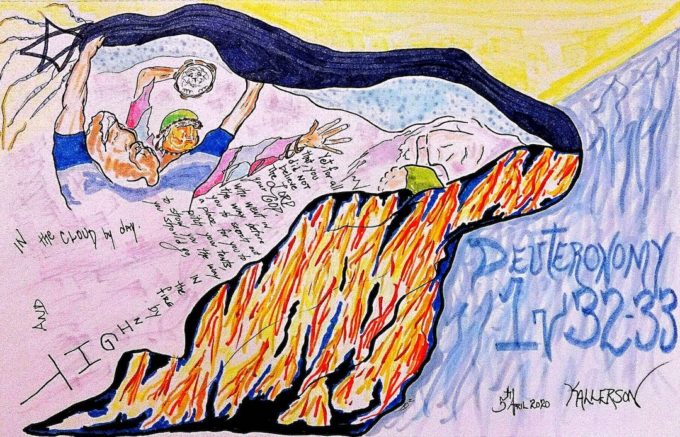
*33 (fin) in the fire by night and in the cloud by day.
The fire and the cloud were visible manifestations of the invisible God. The Lord made His presence known so that the people would know He was among them. All they had to do was to accept the Lord’s word at face value, believe that same word, and enter into the promise by following the visible manifestation He provided.
But even with all of those evidences, Israel failed to simply believe. They didn’t believe the Lord at Kadesh in the Wilderness of Paran, and they didn’t believe the Lord Jesus as He revealed His glory to them when He came to dwell among them – He, the visible manifestation of the invisible God.
As Joseph Benson says, and as we partially cited in our opening, “…their disbelief of that promise which was typical of gospel grace; to signify that no sin will ruin us but unbelief, which is a sin against the remedy, and therefore without remedy.”
This is confirmed in Scripture by the author of Hebrews who refers to this very passage while making his case for the people to let go of their unbelief and to come to Christ for the true rest which these types and shadows only anticipated, as seen in Hebrews 3:16-19 –
“For who, having heard, rebelled? Indeed, was it not all who came out of Egypt, led by Moses? 17 Now with whom was He angry forty years? Was it not with those who sinned, whose corpses fell in the wilderness? 18 And to whom did He swear that they would not enter His rest, but to those who did not obey? 19 So we see that they could not enter in because of unbelief.”
Moses, through this discourse, diligently set about to impress upon the minds of the people that the fault of not entering the promise, not obtaining the inheritance, and not receiving the promised rest was entirely their own fault, and the guilt of their actions rested solely upon them.
The author of Hebrews then shows that the fault of the people, and of every evil that has come upon them for the past two thousand years, is entirely of their own making, and the guilt of their actions rests solely upon them.
The Lord provided everything necessary for them to enter, and yet they did not enter in because of unbelief. May that not be said of us here today.
Rather, through a simple act of faith, for Jew or for Gentile, the author of Hebrews clearly and unambiguously states the result with the words, “For we who have believed do enter that rest.” Look to the cross, understand what it means to you as a person, and by a simple act of faith receive the good news of Jesus Christ. Be reconciled to God and enter into the promised rest.
Closing Verse: “Let not your heart be troubled; you believe in God, believe also in Me. 2 In My Father’s house are many mansions; if it were not so, I would have told you. I go to prepare a place for you. 3 And if I go and prepare a place for you, I will come again and receive you to Myself; that where I am, there you may be also. 4 And where I go you know, and the way you know.”
5 Thomas said to Him, “Lord, we do not know where You are going, and how can we know the way?”
6 Jesus said to him, “I am the way, the truth, and the life. No one comes to the Father except through Me.” John 14:1-6
Next Week: It is Christ who for us, the victory He did win… (He Brought Us out From There That He Might Bring Us In) (Resurrection Day Sermon)
The Lord has you exactly where He wants you. He has a good plan and purpose for you. But He also has expectations of you as He prepares you for entrance into His Land of Promise. So, follow Him and trust Him and He will do marvelous things for you and through you.
The Goer Before You – HE
“Nevertheless you would not go up
But rebelled against the command of the LORD your God
And you complained in your tents, and said
Words which were tragically flawed
“Because the LORD hates us, He has brought us out of the land
Of Egypt to deliver us into the hand of the Amorites, to destroy us
Where can we go up?
That day you all made a terrible fuss
Our brethren have discouraged our hearts, saying
“The people are greater and taller than we, so we are aware
The cities are great and fortified up to heaven
Moreover we have seen the sons of the Anakim there
“Then I said to you, ‘Do not be terrified, or afraid of them
The LORD your God, who goes before you, He will fight for you
According to all He did for you in Egypt before your eyes
And in the wilderness, so also He did do
Where you saw how the LORD your God carried you
As a man carries his son, in all the way that you went
Until you came to this place
Upon you all that care He lovingly spent
Yet, for all that, you did not believe the LORD your God
Who before you to search out a place went in the way
For you to pitch your tents, to show you the way you should go
In the fire by night and in the cloud by day
Lord God, turn our hearts to be obedient to Your word
Give us wisdom to be ever faithful to You
May we carefully heed each thing we have heard
Yes, Lord God may our hearts be faithful and true
And we shall be content and satisfied in You alone
We will follow You as we sing our songs of praise
Hallelujah to You; to us Your path You have shown
Hallelujah we shall sing to You for all of our days
Hallelujah and Amen…
26 “Nevertheless you would not go up, but rebelled against the command of the Lord your God; 27 and you complained in your tents, and said, ‘Because the Lord hates us, He has brought us out of the land of Egypt to deliver us into the hand of the Amorites, to destroy us. 28 Where can we go up? Our brethren have discouraged our hearts, saying, “The people are greater and taller than we; the cities are great and fortified up to heaven; moreover we have seen the sons of the Anakim there.”’
29 “Then I said to you, ‘Do not be terrified, or afraid of them. 30 The Lord your God, who goes before you, He will fight for you, according to all He did for you in Egypt before your eyes, 31 and in the wilderness where you saw how the Lord your God carried you, as a man carries his son, in all the way that you went until you came to this place.’ 32 Yet, for all that, you did not believe the Lord your God, 33 who went in the way before you to search out a place for you to pitch your tents, to show you the way you should go, in the fire by night and in the cloud by day.