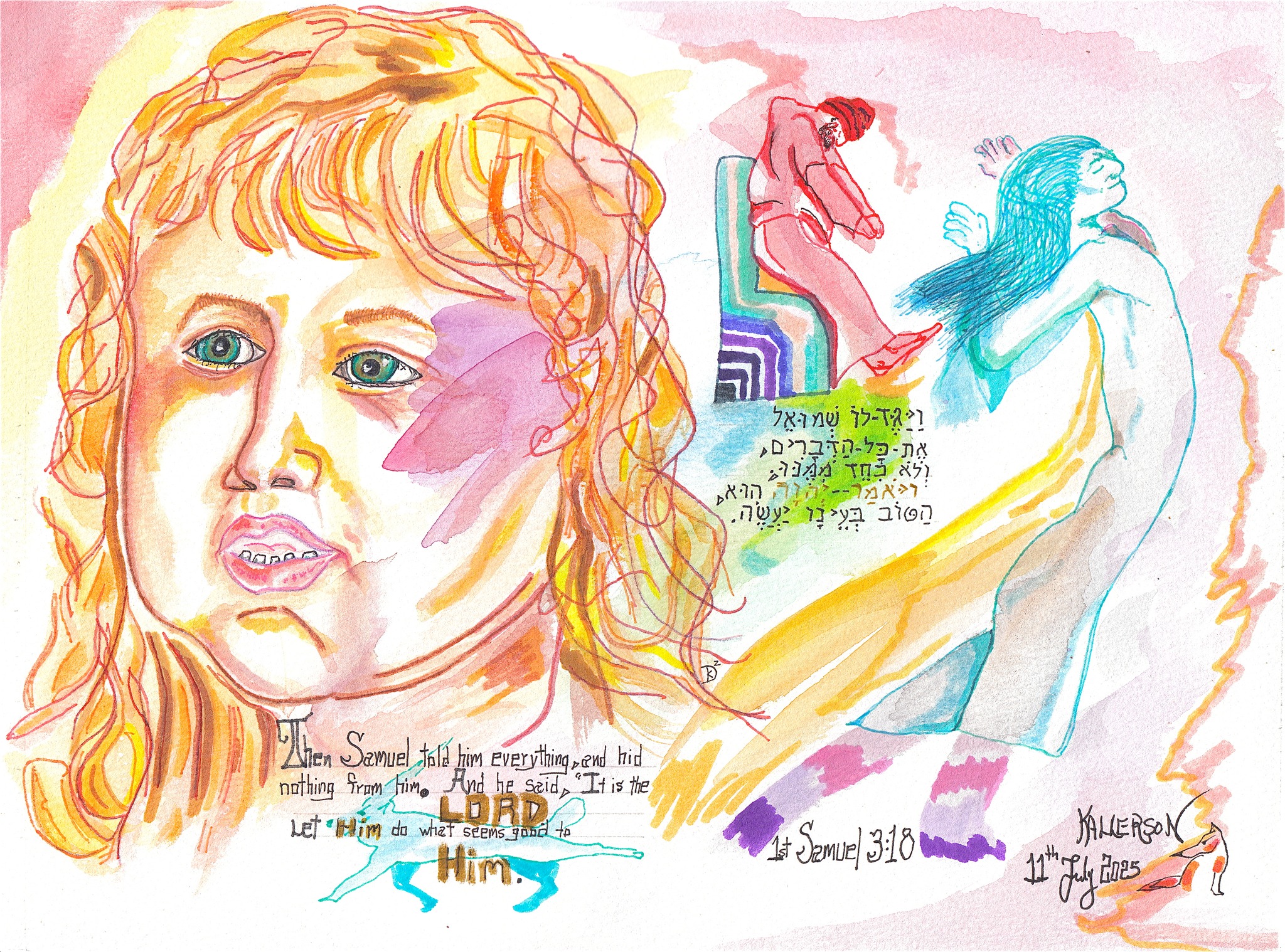
Artwork by Douglas Kallerson
1 Samuel 3:1-21
Before It Was Denuded Unto Him
(Typed 12 May 2025) In the verses today, it said Samuel did not know the Lord because he was unaware of the word of the Lord. When the Lord called to him, he needed to have it explained that it was the Lord speaking to him. Then he was able to respond and receive the word intended for him to hear.
As we will see, this doesn’t mean he doesn’t know who the Lord is. Rather, he doesn’t have an intimate relationship with Him because His word was unknown.
If that concept doesn’t bring up memories of previous times I have spoken to you, it means that either you haven’t heard me speak before or you haven’t paid attention to what I have said to you.
If the former, welcome! I hope you will learn the lesson of the word of the Lord and apply it to yourself. If the latter, you must not pay attention while I’m speaking, because I repeat the same sentiment … a lot.
Pretty much everyone knows who the Lord is. But most of the world, including churches full of people, don’t know the Lord because they don’t know the word of the Lord.
Text Verse: “None of them shall teach his neighbor, and none his brother, saying, ‘Know the Lord,’ for all shall know Me, from the least of them to the greatest of them.” Hebrews 8:11
In this verse, the author of Hebrews was speaking of the people of Israel. They had been brought out of Egypt, and He had made a covenant with their fathers, but they didn’t continue in His covenant.
Samuel was at the place of the Lord, near the tabernacle in Shiloh, and yet he didn’t know the Lord until he knew the word of the Lord. The implication is that none of Israel knew the Lord because none of them knew the word of the Lord. It was lacking in Israel at the time.
My repeated statement to the people in this church is that you cannot know God unless you know Jesus, and you cannot know Jesus unless you know the word that tells of Jesus, meaning the Bible.
Jesus explicitly told Israel that in order to know the Father, they had to know Him. For us, the only source we have to know Jesus is the Bible. As such, if you do not know the Bible, you, like Samuel in this story, do not know the Lord.
Jesus is the Word of God, and therefore, despite “knowing God,” people do not “know God.” This is the sense of what is said about Samuel. This truth continues to this day. Only when the word of the Lord was revealed to him as such did he then come to know the Lord.
The word denude means to strip something of its covering. In verse 8, it says that the word of the Lord was not “revealed” to Samuel. The word is literally “denude.” The word of God is how the Lord strips Himself of what is unknown, making Himself known to us.
Without the Bible, the Lord and His word remain unknown to us. It cannot be stressed enough, and so I say it almost every time we are together. Please! Read your Bible. It is where the Lord is revealed to us. This is a great truth that is to be found in His superior word. And so, let us turn to that precious word once again, and… May God speak to us through His word today, and may His glorious name ever be praised.
I. For You Called to Me (verses 1-9)
Now the boy Samuel ministered to the Lord before Eli.
vehanaar shemuel meshareth eth Yehovah liphne eli – “And the lad, Samuel, attending Yehovah to faces Eli.” In Chapter 1, Samuel was born to Hannah. Once he was weaned, he was presented to Eli, having been “asked” to the Lord for all his days. After that, statements about Samuel were interspersed between other events in Chapter 2, leading to this –
“And Samuel, ministering faces Yehovah. Lad being girded ephod – linen.” 1 Samuel 2:18
“And he grew, the lad Samuel, with Yehovah.” 1 Samuel 2:21
“And the lad, Samuel, walking and growing, and good with Yehovah and also with men.” 1 Samuel 2:26
“And the lad, Samuel, attending Yehovah to faces Eli.” 1 Samuel 3:1
The meaning of this verse is that Samuel is ministering, not to Eli but to the Lord. He is doing it in the presence of Eli, as if Eli is superintending over his ministrations. Samuel means Asked from God. Eli means Foster Son.
1 (con’t) And the word of the Lord was rare in those days;
u-devar Yehovah hayah yaqar bayamim hahem – “And word Yehovah it is valuable in the days, the those.” The adjective, yaqar, valuable, is introduced here. It is derived from the verb yaqar, to be valuable or precious, which is derived from a root presumably meaning to be heavy.
Translating this as “rare” is probably a good paraphrase. When something is uncommon, it has more value. The more available something is, the less value is assigned to it. It’s why a handful of dirt is free. However, for a heavy load of dirt, there is added expense. This is next explained…
1 (con’t) there was no widespread revelation.
ein khazon niphrats – “Naught vision being breached.” Another new word, the noun khazon, vision, is introduced. It is derived from khazah, to gaze at or mentally perceive. This is the only time it is mentioned in 1 Samuel, and it only becomes common later in the Old Testament.
Of this type of visual or mental perception, the word parats is used. It signifies to break out. In Genesis 30:43, it says of Jacob –
“Thus the man became exceedingly prosperous [parats], and had large flocks, female and male servants, and camels and donkeys.”
The idea is that the wealth of Jacob broke out and spread before him. The direction of the Lord through vision was valuable because it was uncommon.
2 And it came to pass at that time, while Eli was lying down in his place,
vayhi bayom hahu veeli shokev bimeqomo – “And it was, in the day, the it, and Eli lying in his place.” As nothing has been said to define the day at this time, the words “the day, the it” are anticipatory of what lies ahead in verse 3:4. Eli is lying down…
2 (con’t) and when his eyes had begun to grow so dim that he could not see,
Though not a single translation is as mine, it reads: veeno hekhelu khehoth lo yukhal liroth – “And his eye – they caused to bore dim. Not he will be able to see.” The written Hebrew is not the same as the spoken –
veeno – And his eye (written)
veenav – And his eyes (spoken)
The change is probably deemed necessary because the verse goes from the singular, eye, to the plural, they. But there is no need to divert from the written word. In this case, the singular stands for the plural. This is seen elsewhere, such as –
“And thou sayest unto thy servants, Bring him down unto me, and I set mine eye upon him.” Genesis 44:21 (YLT)
The singular eye refers to the perception of both eyes. As such, this is probably referring not only to Eli’s failing eyesight in both eyes, but also his lack of receiving vision in his mental perception. It is an explanation for the coming account. There was no vision left to Eli…
3 and before the lamp of God went out
vener elohim terem yikhbeh – “And lamp God, before it will extinguish.” This is at the end of the night hours before the dawn comes, as can be deduced from Exodus 27:20, 21 –
“And you shall command the children of Israel that they bring you pure oil of pressed olives for the light, to cause the lamp to burn continually. 21 In the tabernacle of meeting, outside the veil which is before the Testimony, Aaron and his sons shall tend it from evening until morning before the Lord. It shall be a statute forever to their generations on behalf of the children of Israel.”
The wee hours of the morning would be the time of day when the lamp would be close to running out of oil.
3 (con’t) in the tabernacle of the Lord where the ark of God was, and while Samuel was lying down,
In the NKJV, the clauses are jumbled, and thus the sense is lost. Also, saying “tabernacle” is wrong: u-shemuel shokev beheikhal Yehovah asher sham aron elohim – “and Samuel lying in portico Yehovah, where there Ark God.” Samuel is not lying where the ark is. Rather, he is lying in the area where the ark is.
The ark was in the most holy place of the tabernacle. The lamp was in the holy place outside the veil of the most holy place. The words show the nearness of Samuel to the tabernacle. He is residing in the area where he can minister to the Lord before Eli. It is at this time…
4 that the Lord called Samuel.
vayiqra Yehovah el shemuel – “And He called, Yehovah, unto Samuel.” Yehovah calls with an audible voice to him. It is possible, but seemingly unlikely based on verse 10, that this was from the Most Holy Place where the ark was located. Rather, it seems more likely that His word is coming to Samuel’s ears directly in an audible form of revelation without regard to location.
4 (con’t) And he answered, “Here I am!”
vayomer hineni – “And he answered, ‘Behold me!’” Samuel hears a call. As a young man in the portico, placed there to tend to the needs of the tabernacle and those who ministered there, he naturally responds and gets up…
5 So he ran to Eli and said, “Here I am, for you called me.”
vayarats el eli vayomer hineni ki qaratha li – “And he ran unto Eli, and he said, ‘Behold me! For you called to me.’” Knowing that Eli’s eyes were bad, he would have assumed the old man needed help with something and rushed over to see how he could assist…
5 (con’t) And he said, “I did not call; lie down again.”
The verbs in Eli’s response are imperative: vayomer lo qarathi shuv shekhav – “And he said, ‘Not I called! You must return and you must lie down!’” The use of the imperative may indicate Eli was annoyed at the disturbance. Therefore, it says…
5 (con’t) And he went and lay down.
vayelekh vayishkav – “And he walked, and he laid down.” Samuel was probably thinking it had been a dream, but it had seemed real to him.
6 Then the Lord called yet again, “Samuel!”
vayoseph Yehovah qero od shemuel – “And He added, Yehovah – call again Samuel.” Although He probably called him by name, as in verse 10, that is probably not the intent. Rather, at this time, like before, it is a narrative explaining that the Lord called him.
6 (con’t) So Samuel arose and went to Eli, and said, “Here I am, for you called me.” He answered, “I did not call, my son; lie down again.”
vayaqam shemuel vayelekh el eli vayomer hineni ki qaratha li vayomer lo qarathi veni shuv shekhav – “And he arose, Samuel, and he walked unto Eli, and he said, ‘Behold me! For you called to me.’ And he said, ‘Not I called, my son! You must return and you must lie down!’” This time, it doesn’t say he ran to Eli. Rather, he got up and went to him, probably without feeling rushed like the first time. Maybe he thought Eli was calling out in a dream.
It could be that the sharp response of Eli last time has made Samuel leery about annoying him. And that seems to be what happened because Eli again uses the same imperative verbs, repeating himself. Both of them are probably confused at this point. Thus, the narrator provides an explanatory insert…
7 (Now Samuel did not yet know the Lord, nor was the word of the Lord yet revealed to him.)
u-shemuel terem yada eth Yehovah veterem yigaleh elav devar Yehovah – “And Samuel – before he knew Yehovah, and before it was denuded unto him word Yehovah.” The words introduce the subject, “And Samuel.” They next explain his state.
Not knowing Yehovah does not mean he didn’t know about Him. It means he didn’t have a personal connection to Him through divine revelation (word Yehovah). Having the word denuded indicates the intimate connection between the word and the Lord Himself. When the word is uncovered, the Lord is made known.
8 And the Lord called Samuel again the third time. So he arose and went to Eli, and said, “Here I am, for you did call me.”
Then Eli perceived that the Lord had called the boy.
vayoseph Yehovah qero shemuel bashelishith vayaqam vayelekh el eli vayomer hineni ki qaratha li vayaven eli ki Yehovah qore lanaar – “And He added, Yehovah – call Samuel in the third. And he arose, and he walked unto Eli, and he said, ‘Behold me! For you called to me!’ And he discerned, Eli, for Yehovah calling to the lad.” Being a bit slow on the uptake, Eli finally realizes what is going on. He probably didn’t expect the word to come to Samuel like this, but now he has to admit it has taken place.
Ellicott rightly says, “…this ignorance of Samuel served God’s design, as it gave Eli the fuller assurance of the truth of God’s call and message to Samuel.”
9 Therefore Eli said to Samuel, “Go, lie down; and it shall be, if He calls you, that you must say, ‘Speak, Lord, for Your servant hears.’” So Samuel went and lay down in his place.
vayomer eli lishemuel lekh shekhav vehayah im yiqra elekha veamarta daber Yehovah ki shomea avdekha vayelekh shemuel vayishkav bimeqomo – “And he said, Eli to Samuel, ‘You must walk! You must lie down! And it became if He will call unto you, and you said, “You must speak, Yehovah, for hearing – your servant.”’ And he walked, Samuel, and he laid down in his place.”
Again using imperatives, but this time understanding the situation, Eli urges him to go lie down again in anticipation of another calling. As for the words, “You must speak, Yehovah,” this is one of many verses that disproves the common Jewish teaching that people never spoke the divine name. The text would not say he was to do so if they never did. Despite Eli’s instructions, Samuel doesn’t address Him by name…
10 Now the Lord came and stood and called as at other times, “Samuel! Samuel!”
And Samuel answered, “Speak, for Your servant hears.”
vayavo Yehovah vayithyatsav vayiqra khepaam bepaam shemuel shemuel vayomer shemuel daber ki shomea avdekha – “And He came, Yehovah, and He will station Himself. And He called, according to beat in beat, ‘Samuel, Samuel.’ And he said, Samuel, ‘You must speak, for hearing, Your servant.’” The reflexive verb, translated as “He will station Himself,” does not have to mean that the Lord is physically present there, although that is also not out of the question.
It may mean that the Lord’s presence, regardless of any physical manifestation, has manifested Himself. The word coming in verse 15 describes a sort of manifestation, like looking in a mirror.
The words “according to beat, in beat” are a Hebraism meaning “done as it was done before.” The Lord called for Samuel, and he responded accordingly…
The word of God, holy and pure
Given to us from His wise and loving hand
Through it, our faith can be strong and sure
Through it, the Lord’s will we understand
What is right for salvation unto life?
How can we know when something is wrong?
Through the word, we can weed out theological strife
And have doctrine sure, sound, and strong
Praise be to God for this precious word
Praise to Him who has shown us what is true and right
The pages of the Bible are a precious cutting sword
Weeding out falsity and revealing His glorious light
II. Until Vanishment (verses 11-21)
11 Then the Lord said to Samuel: “Behold, I will do something in Israel at which both ears of everyone who hears it will tingle.
vayomer Yehovah el shemuel hineh anoki oseh davar beyisrael asher kal shomeo tetsilenah shete azenav – “And He said, Yehovah, unto Samuel, ‘Behold! I doing word in Israel which all hearing it, they will tinkle, two his ears.’” The Lord introduces a word, tsalal, signifying to tinkle as through vibration. It is used here to describe a coming disaster.
It will be used in a similar fashion concerning the destruction of Jerusalem in 2 Kings 21:2 and Jeremiah 19:3. The last use will be in Habakkuk 3:16 when referring to the quivering of lips while in distress. Thus, this is an expression of horrified shock, as if the ears are ringing from the vibration of bad news.
12 In that day I will perform against Eli all that I have spoken concerning his house, from beginning to end.
bayom ha’hu aqim el eli eth kal asher dibarti el beitho hakhel vekhaleh – “In the day, the it, I must cause to rise unto Eli all which I spoke unto his house, beginning and completing.” The words “all which I spoke” refer to the words of the Lord through the man of God in verses 2:27-36. Saying “beginning and completing” means that nothing that He spoke would be omitted.
The Lord is repeating this to Samuel so that he is aware of what will take place…
13 For I have told him that I will judge his house forever for the iniquity which he knows,
vehigadti lo ki shophet ani eth beitho ad olam ba’avon asher yada – “For I caused to disclose to him, for judging, I, his house – until vanishment – in perversity which he knew.” The meaning of “caused to disclose” is that God sent His messenger to Eli to tell him what was coming in the judgment He would mete out.
The “perversity which he knew” is…
13 (con’t) because his sons made themselves vile, and he did not restrain them.
ki meqalelim lahem banav velo khihah bam – “For trivializing to them, his sons, and not he rebuked in them.” The word qalal means to be or make light. Just as honoring someone gives the sense of heaviness, trivializing someone is to make them light.
One can get the sense from Genesis 12:3, “And let me bless ‘blessing you,’ and trivializing you – I will execrate.” The meaning is that the Lord promised to bless those blessing Abraham, but He would execrate those who trivialized (made light of) him.
The sons of Eli had trivialized themselves despite their office, which demanded that they honor the Lord through their actions. It was Eli’s responsibility to rebuke them, but he failed to do so. Therefore, judgment was coming upon Eli’s house.
14 And therefore I have sworn to the house of Eli that the iniquity of Eli’s house shall not be atoned for by sacrifice or offering forever.”
velakhen nishbati leveith eli im yithekaper avon beith eli bezevakh u-beminkhah ad olam – “And thus I was sevened to house Eli if it will atone itself, perversity house Eli, in sacrifice and in present until vanishment.” The word shava signifies to swear. However, it is derived from sheva, seven, the number of spiritual perfection.
The idea is that of completion, as if having repeated a declaration seven times. Saying “I was sevened” means that the Lord has determined and affirmed the matter. In this case, sacrifices and presents required by the law will never atone for their conduct again.
The repetition of ad olam, until vanishment, from the previous verse fully explains the matter. The judgment is determined, and it will be permanent. With that understood, it next says…
15 So Samuel lay down until morning, and opened the doors of the house of the Lord.
vayishkav shemuel ad ha’boqer vayiphtakh eth dalthoth beith Yehovah – “And he will lie, Samuel, until the morning. And he will open doors, house Yehovah.” This is the first reference to something other than the tabernacle that the Lord directed to be constructed while in the wilderness. That was a movable tent with a surrounding courtyard that was also movable.
However, now being at Shiloh, some sort of edifice was built around it, or instead of it, or part of it. Samuel’s duties apparently included the opening of these doors. The matter-of-fact nature of the words signifies that this was a regular occurrence.
15 (con’t) And Samuel was afraid to tell Eli the vision.
u-shemuel yare mehagid eth hamareah el eli – “And Samuel, he feared from causing to declare the manifestation unto Eli.” The word here, mareah signifies a type of vision. In Exodus 38:8, it is used of the bronze mirrors of the women who served at the tabernacle. Therefore, it is some type of manifestation, whether physical or merely visual. Despite his fear of speaking…
16 Then Eli called Samuel and said, “Samuel, my son!”
He answered, “Here I am.”
vayiqra eli eth shemuel vayomer shemuel beni vayomer hineni – “And he will call, Eli, Samuel. And he will say, ‘Samuel, my son.’ And he will say, ‘Behold me!’” A friendly relationship is noted in the words “my son.” But it is also a note of authority from a greater to a lesser. It is how Joshua addressed Achan after his sin was exposed through the casting of the lot.
Samuel acknowledges this state of authority in his response, awaiting Eli’s continued words…
17 And he said, “What is the word that the Lord spoke to you?
Rather, leaving the source somewhat indefinite: vayomer mah ha’davar asher diber elekha – “And he will say, ‘What the word which He spoke unto you?’” Eli doesn’t have to say, “the Lord.” It is understood who the word came from. He next intensifies his words…
17 (con’t) Please do not hide it from me.
al na tekhakhed mimeni – “Not, I pray, you will secrete from me.” He asked for the word of the Lord. Now he asks for the entire word without anything kept back. In other words, “Don’t paraphrase his words, don’t generalize them, and don’t attempt to withhold them either.” He is asking for an exacting account of what was said. He then intensifies his words further…
17 (con’t) God do so to you, and more also, if you hide anything from me of all the things that He said to you.”
koh yaaseh lekha elohim vekhoh yosiph im tekhakhed mimeni davar mikal ha’davar asher diber elekha – “Thus He will do to you, God, and thus He will cause to add, if you will secrete from me word from all the word which he spoke unto you.’” This is a particular adjuration that began in Ruth and continues until 2 Kings.
It is used to form an absolute assertion or a firm adjuration. Associated with it comes an implied threat upon the speaker or the one being spoken to, sometimes for noncompliance and sometimes as a matter of fact.
In this case, Eli is adjuring Samuel to speak as requested. If he fails to do so, he will ask God to take corrective action on Samuel even more severe than he knows is coming upon him, which he knows is coming because the Lord has circumvented him and gone to Samuel. Therefore…
18 Then Samuel told him everything, and hid nothing from him. And he said, “It is the Lord. Let Him do what seems good to Him.”
vayaged lo shemuel eth kal ha’devarim velo khikhed mimenu vayomer Yehovah hu ha’tov beenav yaaseh – “And he caused to declare to him, Samuel, all the words. And not he secreted from him. And he will say, ‘“Yehovah, He. The good in his eyes He will do.’” The NKJV gives the sense, even if a bit of a paraphrase.
Eli is resigned to the word, knowing it will come about. At the same time, he indicates his understanding that the Lord is just and fair. Despite his weakness and unprofitableness as a judge and priest, he was still faithful to accept the will of the Lord.
19 So Samuel grew, and the Lord was with him and let none of his words fall to the ground.
vayigdal shemuel veYehovah hayah imo velo hipil mikal devarav artsah – “And he will grow, Samuel. And Yehovah, He was with him. And not He caused to fall from all his words, ground-ward.” It seems unlikely that this refers to Samuel’s words, but the words of the Lord through Samuel. The verb is causative. As such, the Lord is upholding the prophecies Samuel spoke. This is similar to other instances –
“Blessed be the Lord, who has given rest to His people Israel, according to all that He promised. There has not failed one word of all His good promise, which He promised through His servant Moses.” 1 Kings 8:56
20 And all Israel from Dan to Beersheba knew that Samuel had been established as a prophet of the Lord.
vayeda kal Yisrael midan vead beer shava ki neeman shemuel lenavi laYehovah – “And it will know, all Israel, from Dan and until Beer-Sheba, for being faithful, Samuel, to prophet to Yehovah.” This is the second of seven times this phrase is used in the Old Testament. It will be used twice in reverse in the Chronicles, saying, “from Beersheba to Dan.” It signifies the entirety of the land and people of Israel within the borders of Canaan.
Dan is the northernmost point of reference, while Beersheba is the southernmost.
Dan means Judge. Beersheba means both Well of Seven and Well of Oath. As for the statement about Samuel, the same word was used when referring to Moses –
“Not so with My servant Moses;
He is faithful in all My house.” Numbers 12:7
Moses was faithful in the Lord’s house, and Samuel is a faithful prophet to the Lord.
21 Then the Lord appeared again in Shiloh.
vayoseph Yehovah leheraoh veshiloh – “And He will cause to add, Yehovah, to be seen in Shiloh.” The chapter began with no vision coming through. Now, at the end of the chapter, that is turned around. Because of Samuel, there is vision once again. Shiloh means Tranquility.
The appearing of the Lord is explained in the next words…
*21 (fin) For the Lord revealed Himself to Samuel in Shiloh by the word of the Lord.
ki niglah Y’hovah el shemuel beshilo bidvar Yehovah – “For He was denuded, Yehovah, unto Samuel in Shilo in word Yehovah.” Notice that the final h drops off Shiloh of the previous clause. The appearance of the Lord is through the word of the Lord. It is how the Lord reveals Himself.
From this point, Samuel will be mentioned one more time in verse 4:1 and then not again until verse 7:2.
The Word of God – holy, pure, and perfect too
It is given to satisfy man’s weary soul
Let us take an eternal view
And come to know this precious scroll
In the Book of Life, our names will be
We pursued His word and found Jesus
The Lord’s redeemed by the glassy sea
Great things God has done for us
Open it! The precious Book of Life
Accept what it says, it is holy and true
Through the word comes ending of the strife
And the beginning of something new
III. Know the Lord
In the verses today, it noted Samuel ministering to the Lord before Eli. It is reflective of Christ’s work to the Lord being accomplished before the precepts of the law, represented by Eli, Foster Son, meaning the state of being under the law.
That the word of the Lord was valuable, meaning rare, in those days is an excellent representation of the state of Israel. There was no prophetic utterance during the intertestamental period from the time of Malachi until the coming of John the Baptist, a period of about 430 years.
Eli is described as lying down and not being able to see. It is an excellent description of the law at that time. It was old, ineffective, and unable to perceive its unprofitableness. The singular use of eye instead of eyes shows the myopic nature of the law. Thus, they, meaning vision and prophecy, were lost to it.
The note about the lamp of God going out is an indication that the light of the law, which only anticipated the coming of Christ, would go out at the dawning of the day. This is exactingly reflected in Jesus’ words about John –
“If I bear witness of Myself, My witness is not true. 32 There is another who bears witness of Me, and I know that the witness which He witnesses of Me is true. 33 You have sent to John, and he has borne witness to the truth. 34 Yet I do not receive testimony from man, but I say these things that you may be saved. 35 He was the burning and shining lamp, and you were willing for a time to rejoice in his light. 36 But I have a greater witness than John’s; for the works which the Father has given Me to finish—the very works that I do—bear witness of Me, that the Father has sent Me.” John 5:31-36
John was the last prophet before Jesus. He was the end of the burning, shining lamp of the law, which was given to anticipate the coming of Christ. With his arrival, the lamp was all but through.
The threefold calling by the Lord to Samuel, Asked from God, who represents the seed of the state of grace (Hannah), signifies the divine completeness of the time of the law. The seed of the state of grace is being called while under the law (Eli, Foster Son), alerting it that the time had come.
The back-and-forth between Samuel and Eli is given to reveal this. Finally, the Lord’s calling is responded to by Samuel, and the assurance was that the Lord’s prophecy against Eli, Foster Son, would be fulfilled in its entirety (begging and completing). It would be a judgment on his house until vanishment, meaning forever. Every word would be accomplished, without anything being left undone.
The deeds of Eli’s sons are particularly highlighted, along with his not restraining them. Though their names are not used in this passage, remembering them is appropriate: My Hollow and Mouth of Brass (meaning Mouth of Judgment).
Eli is the state of those under law. Hophni is not the law itself but the medium by which the Lord conducted his affairs. The law is the filling of that medium. It is that which fills the Hollow. Phinehas is the judgment of the law. Those who had administered the law had trivialized these things, and nothing was said about it in correction.
For this reason, the Lord told Samuel, adamantly affirming, that sacrifices and presents (the basis for atonement under the law) would never atone for such transgressions again, forever.
The meaning of these verses is clear: the state of the law (Eli) and its house (meaning the roles of Hophni and Phinehas) would be ended forever. The sacrifices and offerings of the law would no longer be effective.
The reason this was spoken by the Lord to Samuel, who had not yet known the word of the Lord, was rightly noted by Ellicott, “this ignorance of Samuel served God’s design, as it gave Eli the fuller assurance of the truth of God’s call and message to Samuel.”
Those under law would never imagine that the law would end were it not for the Lord’s word to be spoken through the seed of grace. This fact is proven true to this day as those under the law still disregard the premise entirely, and even those who were called by grace continually get seduced back into law observance.
The final three verses are not given as a chronological marker that necessarily occurs before the events of Chapters 4 to 6. They simply form points of fact –
1) Samuel grew and the Lord was with him, and He caused none of his words to fall groundward, 2) All Israel, from Dan to Beersheba, knew that Samuel had been established a prophet of the Lord, and 3) Yehovah appeared again in Shiloh and he was denuded (made fully known) unto Samuel “in Shilo in word Yehovah.”
Being points of fact, they are to be offset from the rest of the narrative. From there, the opening clause of Chapter 4 will then be followed by a long parenthetical thought that ends in Chapter 7. After the events of those chapters are explained, I will explain why this is so.
The explanation for the contents of the chapter is complete, except for those points. The time of the law had a promised end. It was to be replaced by the time of grace. Jesus is the Seed of grace that allows us to likewise become the seed of grace, represented by Samuel and the “seven” that Hannah’s song proclaimed were born to her.
Samuel has thus far dealt almost exclusively with the idea of law versus grace. God is telling the world, beginning with Israel, both in the word and in historical lessons, that the law is incapable of restoring us to Him. Only through Jesus’ fulfillment of it is that restoration possible.
But this brings us back to the main point of the opening comments today. How can you know if you are obligated to observe the law, some select parts of it, or if it is entirely set aside unless you know the Bible?
I can tell you until I am blue in the face, but if I die this afternoon (then I will really be blue in the face!), someone else will take my place in your life. That person may say just the opposite of what I tell you. “Charlie didn’t know what he was talking about! If you eat pork, you can’t be saved.”
And so, for the rest of your life, you give up on ham, pork, chitlins, bacon (oh, bacon!), and all of the other delicious byproducts that come from our porky friends. What a waste! And it is all because you failed to check the manual.
Your walk with the Lord is ultimately up to you. My advice is that you make it a good one by knowing what He has done for you. In doing so, you will know of the freedom that He offers to the people of the world. Be sure to know the Lord by knowing His word.
Closing Verse: “And Pharaoh said, ‘Who is the Lord, that I should obey His voice to let Israel go? I do not know the Lord, nor will I let Israel go.” Exodus 5:2
Next Week: 1 Samuel 4:1-11 To make a rhyme, I made up a word, envampment… (He Came, God, Unto the Encampment) (8th 1 Samuel Sermon)
The Lord has you exactly where He wants you. He has a good plan and purpose for you. He alone is the perfect example of love – untarnished, unblemished, and completely pure and holy. He offers this love to you. So, follow Him, live for Him, and trust Him, and He will do marvelous things for you and through you.
1 Samuel 3:1-21 (CG)
And the lad, Samuel, attending Yehovah to faces Eli. And word Yehovah it is valuable in the days, the those. Naught vision being breached. 2 And it was, in the day, the it, and Eli lying in his place. And his eye – they caused to bore dim. Not he will be able to see. 3 And lamp God, before it will extinguish, and Samuel lying in portico Yehovah, where there Ark God. 4 And He called, Yehovah, unto Samuel. And he answered, “Behold me!” 5 And he ran unto Eli, and he said, “Behold me! For you called to me.”
And he said, “Not I called! You must return and you must lie down!” And he walked, and he laid down.”
6 And He added, Yehovah – call again Samuel.
And he arose, Samuel, and he walked unto Eli, and he said, “Behold me! For you called to me.” And he said, “Not I called, my son! You must return and you must lie down!” 7 (And Samuel – before he knew Yehovah, and before it was denuded unto him word Yehovah.)
8 And He added, Yehovah – call Samuel in the third. And he arose, and he walked unto Eli, and he said, “Behold me! For you called to me!”
And he discerned, Eli, for Yehovah calling to the lad. 9 And he said, Eli to Samuel, “You must walk! You must lie down! And it will be if He will call unto you, and you will say, ‘You must speak, Yehovah, for hearing – your servant.” And he walked, Samuel, and he laid down in his place.
10 And He came, Yehovah, and He will station Himself. And He called, according to beat in beat, “Samuel, Samuel.”
And he said, Samuel, “You must speak, for hearing, Your servant.”
11 And He said, Yehovah, unto Samuel, “Behold! I doing word in Israel which all hearing it, they will tinkle, two his ears. 12 In the day, the it, I must cause to rise unto Eli all which I spoke unto his house, beginning and completing. 13 For I have caused to disclose to him, for judging, I, his house – until vanishment – in perversity which he knew. For trivializing to them, his sons, and not he rebuked in them. 14 And thus I was sevened to house Eli if it will atone itself, perversity house Eli, in sacrifice and in present until vanishment.”
15 And he will lie, Samuel, until the morning. And he will open doors, house Yehovah. And Samuel, he feared from causing to declare the manifestation unto Eli. 16 And he will call, Eli, Samuel. And he will say, “Samuel, my son.”
And he will say, “Behold me!”
17 And he will say, “What the word which He spoke unto you? Not, I pray, you will secrete from me. Thus He will do to you, God, and thus He will cause to add, if you will secrete from me word from all the word which he spoke unto you. 18 And he caused to declare to him, Samuel, all the words. And not he secreted from him. And he will say, “Yehovah, He. The good in his eyes He will do.”
19 And he will grow, Samuel. And Yehovah, He was with him. And not he caused to fall from all His words, ground-ward. 20 And it will know, all Israel, from Dan and until Beer-Sheba, for being faithful, Samuel, to prophet to Yehovah. 21 And He will cause to add, Yehovah, to be seen in Shiloh. For He was denuded, Yehovah, unto Samuel in Shilo in word Yehovah.
1 Samuel 3:1-21 (NKJV)
Now the boy Samuel ministered to the Lord before Eli. And the word of the Lord was rare in those days; there was no widespread revelation. 2 And it came to pass at that time, while Eli was lying down in his place, and when his eyes had begun to grow so dim that he could not see, 3 and before the lamp of God went out in the tabernacle of the Lord where the ark of God was, and while Samuel was lying down, 4 that the Lord called Samuel. And he answered, “Here I am!” 5 So he ran to Eli and said, “Here I am, for you called me.”
And he said, “I did not call; lie down again.” And he went and lay down.
6 Then the Lord called yet again, “Samuel!”
So Samuel arose and went to Eli, and said, “Here I am, for you called me.” He answered, “I did not call, my son; lie down again.” 7 (Now Samuel did not yet know the Lord, nor was the word of the Lord yet revealed to him.)
8 And the Lord called Samuel again the third time. So he arose and went to Eli, and said, “Here I am, for you did call me.”
Then Eli perceived that the Lord had called the boy. 9 Therefore Eli said to Samuel, “Go, lie down; and it shall be, if He calls you, that you must say, ‘Speak, Lord, for Your servant hears.’” So Samuel went and lay down in his place.
10 Now the Lord came and stood and called as at other times, “Samuel! Samuel!”
And Samuel answered, “Speak, for Your servant hears.”
11 Then the Lord said to Samuel: “Behold, I will do something in Israel at which both ears of everyone who hears it will tingle. 12 In that day I will perform against Eli all that I have spoken concerning his house, from beginning to end. 13 For I have told him that I will judge his house forever for the iniquity which he knows, because his sons made themselves vile, and he did not restrain them. 14 And therefore I have sworn to the house of Eli that the iniquity of Eli’s house shall not be atoned for by sacrifice or offering forever.”
15 So Samuel lay down until morning, and opened the doors of the house of the Lord. And Samuel was afraid to tell Eli the vision. 16 Then Eli called Samuel and said, “Samuel, my son!”
He answered, “Here I am.”
17 And he said, “What is the word that the Lord spoke to you? Please do not hide it from me. God do so to you, and more also, if you hide anything from me of all the things that He said to you.” 18 Then Samuel told him everything, and hid nothing from him. And he said, “It is the Lord. Let Him do what seems good to Him.”
19 So Samuel grew, and the Lord was with him and let none of his words fall to the ground. 20 And all Israel from Dan to Beersheba knew that Samuel had been established as a prophet of the Lord. 21 Then the Lord appeared again in Shiloh. For the Lord revealed Himself to Samuel in Shiloh by the word of the Lord.