Deuteronomy 4:41-49
On the East Side of the Jordan
Four times in today’s nine verses the east side of the Jordan is mentioned, and each time it is given a description of the side to ensure we understand that it is referring to the east side. The east side is outside of the inheritance, and yet there is hope throughout the verses.
In the first three verses, it speaks of the cities of refuge – a clear allusion to Christ as we saw when the main passage of the cities of refuge was analyzed in Numbers 35. There is a place for those who had remained outside of the inheritance to go in order to be safe. What a wonderful promise that is.
And in the last six verses, the victories of Israel’s recent past are again highlighted, and once again give minute detail concerning the layout of the land. Yes, it is all east of the Jordan, but the Jordan is there, and the Land of Promise lays on the other side. And yet, the law is highlighted at the beginning of those six verses. Why would the Lord structure these passages the way He has?
Text Verse: “Is the law then against the promises of God? Certainly not! For if there had been a law given which could have given life, truly righteousness would have been by the law. 22 But the Scripture has confined all under sin, that the promise by faith in Jesus Christ might be given to those who believe. 23 But before faith came, we were kept under guard by the law, kept for the faith which would afterward be revealed. 24 Therefore the law was our tutor to bring us to Christ, that we might be justified by faith. 25 But after faith has come, we are no longer under a tutor.” Galatians 3:21-25
Every single word of the word has meaning. Every verse is perfectly placed. Every passage has been carefully laid out through the wisdom of God. And for sure – nothing said in this word is superfluous. We may not understand why things are the way they are, but that is what study is for.
That is what meditating on the word of God is for. And, that is what prayer concerning the word is for. If we study and meditate on the word and we still don’t understand what we are being told, we shouldn’t give up. Rather, we should come to the Lord with our desires.
He expects us to do our part, but He also really wants the word revealed. Paul says the law was a tutor to bring us to Christ. That is true in several ways. First, it is a steppingstone in the redemptive plan; teaching us about the nature of God – His perfection.
Secondly, it is given to show us how far we fall short of the standard. As Paul says, it is so that sin through the commandment might become exceedingly sinful. These, and other such things are obvious, and they are explicitly stated in the New Testament.
However, the law is also given to show us types and pictures of other things. These can then help us to understand why certain passages are repeated, or why they are positioned in seemingly incorrect locations. In understanding the typological pictures, we find out that they are not. And, in understanding those pictures, we can also discern how the law is a tutor to bring us to Christ.
I could be wrong, but I don’t think it’s going to be the overt nature of the law which is going to lead Israel to the Lord. I think it is the typological pictures that will. Israel has had the law and the prophets for 2000 years, and they have failed to come to Christ.
Someday, they will see the typology back here in the Old Testament, maybe even in just the first five books of Moses, and it will suddenly dawn on them that the Lord has been there revealing Himself to them all along. I could be completely wrong, but it is what seems likely to me.
The pictures fill in what can’t be seen on the surface. Such marvelous truths as this are to be found in His superior word. And so, let us turn to that precious word once again and… May God speak to us through His word today and may His glorious name ever be praised.
I. Three Cities of Refuge (verses 41-43)
So far, Deuteronomy has been a long recounting of what occurred, from the time after leaving Sinai until the point where Israel is presently at. Moses also reminded the people here in Chapter 4 of what they beheld at the giving of the Ten Commandments, and which established them as the Lord’s covenant people at that time.
Interspersed into all of that have been exhortations and instructions concerning the statutes and judgments which have been taught, and which will be repeated and expanded upon in the chapters ahead. With all of this introductory information now recorded, and before Moses returns to the giving of the Ten Commandments in Chapter 5, this short section is carefully placed here.
The land east of Jordan has been acquired, the instruction for those who will dwell in this land concerning the conquest of Canaan have been given, and the surety that Moses will die outside of the promise has been settled. With all of that recorded, an aspect of the law which has already been given must now be settled. This then, explains the reason for the placement of this passage here. The last words of the last passage we reviewed last week said –
“You shall therefore keep His statutes and His commandments which I command you today, that it may go well with you and with your children after you, and that you may prolong your days in the land which the Lord your God is giving you for all time.” Deuteronomy 4:40
Because the land is subdued, and what lies ahead concerns the land of Canaan, this point of law must be settled now. If it were not so, then Moses could be accused of failing to keep the very statutes and judgments of law which he has exhorted Israel to keep.
But, being prompt and obedient to his duties, Moses does what the law expects him to do. That is introduced with the words of verse 41…
41 Then Moses set apart three cities
az yabdil Mosheh shalosh arim – “At that time set apart Moses three cities.” The verse begins with az, a demonstrative adverb which gives the sense of, “At that time.” It indicates that this passage is placed here, between two separate and independent dialogues, to complete the necessary details of law in accord with the word of the Lord. That was first stated in Numbers 35:9-16 –
“Then the Lord spoke to Moses, saying, 10 ‘Speak to the children of Israel, and say to them: ‘When you cross the Jordan into the land of Canaan, 11 then you shall appoint cities to be cities of refuge for you, that the manslayer who kills any person accidentally may flee there. 12 They shall be cities of refuge for you from the avenger, that the manslayer may not die until he stands before the congregation in judgment. 13 And of the cities which you give, you shall have six cities of refuge. 14 You shall appoint three cities on this side of the Jordan, and three cities you shall appoint in the land of Canaan, which will be cities of refuge. 15 These six cities shall be for refuge for the children of Israel, for the stranger, and for the sojourner among them, that anyone who kills a person accidentally may flee there.’”
In Moses’ words, the verb “set apart” is in the imperfect tense. Thus, it has the sense of, “Moses began to set apart three cities.” The reason is certainly because the land grant is still conditional. It will only belong to these tribes “if” they perform according to Moses’ words of Numbers 32 (and as repeated in Chapter 3) –
“If the children of Gad and the children of Reuben cross over the Jordan with you, every man armed for battle before the Lord, and the land is subdued before you, then you shall give them the land of Gilead as a possession. 30 But if they do not cross over armed with you, they shall have possessions among you in the land of Canaan.” Numbers 32:29, 30
If they perform according to the word, these cities will be formally consecrated at that time. What is said here, and understanding all it entails, is actually more important than may seem. If everything concerning the designation of these cities of refuge isn’t taken properly, it appears that there is an error in the word.
Indeed, this is how Cambridge views it. Without directly citing their woefully incoherent argument, they say that what is said in Numbers 35, here, in Deuteronomy 19, and in Joshua 20 demonstrates that some various obscure people compiled the accounts.
They say this because Moses could not have known that three cities would be designated on the other side of the Jordan as is indicated in Deuteronomy 19 –
“When the Lord your God has cut off the nations whose land the Lord your God is giving you, and you dispossess them and dwell in their cities and in their houses, 2 you shall separate three cities for yourself in the midst of your land which the Lord your God is giving you to possess. 3 You shall prepare roads for yourself, and divide into three parts the territory of your land which the Lord your God is giving you to inherit, that any manslayer may flee there.” Deuteronomy 19:1-3
But that fact was already stated by the Lord in Numbers 35. The Lord told Moses the exact details of all of the borders of Canaan in Numbers 34. The claim of Cambridge implies that the Lord, and what He said, cannot actually be the word of the all-knowing Lord. Cambridge then says that the actual designation of these cities didn’t occur until Joshua 20, where it says –
“The Lord also spoke to Joshua, saying, 2 ‘Speak to the children of Israel, saying: ‘Appoint for yourselves cities of refuge, of which I spoke to you through Moses.’” Joshua 20:1, 2
A few verses later, it then says –
“So they appointed Kedesh in Galilee, in the mountains of Naphtali, Shechem in the mountains of Ephraim, and Kirjath Arba (which is Hebron) in the mountains of Judah. 8 And on the other side of the Jordan, by Jericho eastward, they assigned Bezer in the wilderness on the plain, from the tribe of Reuben, Ramoth in Gilead, from the tribe of Gad, and Golan in Bashan, from the tribe of Manasseh. 9 These were the cities appointed for all the children of Israel and for the stranger who dwelt among them, that whoever killed a person accidentally might flee there, and not die by the hand of the avenger of blood until he stood before the congregation.” Joshua 20:7-9
In these accounts, Cambridge makes several points to justify their reasoning. It is that Numbers 35 states it (1) far more elaborately, (2) in a different vocabulary, and (3) with some differences of substance. And that in Joshua 20 this is stated again, but with some different terms. Their conclusion then is –
“This is the only fair interpretation; if the law Deuteronomy 19:1 ff. had meant three cities in W. Palestine in addition to the three already set apart by Moses on the E. of Jordan, it would surely have alluded to the latter. The law was obviously made in consequence of the institution of the single sanctuary and without regard to any historical tradition of what Moses or Joshua had done.” Dolts at Cambridge
First, the difference in vocabulary is exactly why these accounts are written where they are and as they are. Secondly, the form of the verb given by Moses in this verse which is in the imperfect tense is exactly why it is so.
Numbers 35 gave the law for designating the cities of refuge. Deuteronomy 4 obediently designates the three cities in accord with that word. Deuteronomy 19 is Moses’ reiteration that the law for cites of refuge must also be adhered to when the other tribes cross into and subdue Canaan. And Joshua 20 finalizes that law for both sides of the Jordan.
Moses “began” to appoint the cities. But the appointment is conditional based on these tribes east of the Jordan helping the tribes west of the Jordan. Until that happens, the appointment is not settled.
Further, Moses says to badal, or separate, these cities for this purpose. It is simply an acknowledgement that these cities will, in fact, be the ones given for the set purpose. That same word is used by Moses in Deuteronomy 19 concerning the other three cities west of Jordan.
Then, in Joshua 20:2 the Lord says to nathan, or give, the cities of refuge to the tribes. This is the formal grant of the cities to Israel for the set purpose of refuge. In Joshua 20:7, it then uses the word qadash – to set apart or consecrate. Once the cities were given, they were then consecrated for the purpose.
Finally, in Joshua 20:9, a word used only once in Scripture, muadah, is seen. It signifies “to appoint,” and it is the final note concerning the obedience of the command of the Lord which began all the way back in Numbers 35.
The very thing that Cambridge uses to claim the words of Deuteronomy are a hodgepodge of later scribal insertions, coming hundreds of years after the account, is the thing that fully supports that it is one unified whole which was received by Moses and then Joshua at the times the Bible carefully records what occurred.
All of this detail, which took several hours for me to compile, is so that you can be certain of the fact that the word is reliable, without error, and it is exactly what it claims to be – the word of God. Concerning the three cities now being discussed, Moses says…
41 (con’t) on this side of the Jordan,
b’ever ha’yarden – “in side the Jordan.” It should not say, “this,” but rather “on the side of the Jordan.” Where the account is written is irrelevant. The word always is in relation to Canaan, regardless of which side is being spoken of. In order to then define which side is referred to, Moses then says…
41 (con’t) toward the rising of the sun,
mizrekhah shamesh – “toward rising sun.” This explains what was lacking in the previous clause. The word mizrakh signifies the place of the rising of the sun. It comes from zarakh, which means “to rise” or “come forth.” That, in turn, comes from a root signifying “to shoot forth beams.” Thus, it speaks of the place from which the sun rises, and therefore the east.
It is east of the Jordan that these cities are now first designated for a particular and important purpose. It is so…
42 that the manslayer might flee there,
lanu shamah rotseakh – “That might flee there the manslayer.” As described in detail in Numbers 35, the word is ratsakh. It signifies the unsanctioned taking of a human life – whether it is intentional or unintentional. Whichever it is, it makes no difference. If the death was unsanctioned killing, the avenger of blood had the right – and indeed the responsibility – to take the life of the slayer.
However, the Lord determined that if the slaying was unintentional, the slayer could flee to one of these cities and be given protection from the avenger of blood. If he was a true murderer, or even if he was innocent, but he didn’t flee to one of these cities, his life was to be taken by the avenger. The cities then were for a person…
42 (cont) who kills his neighbor unintentionally,
The Hebrew reads, “who slays another without knowing.” In Numbers 35, a different word was used, signifying a mistake, or in ignorance. Either way, both accounts signify that he did not realize that his actions would lead to the death of another person.
He may have been building a brick wall and accidently dropped a brick on another person’s head (making him dead). He may have been playing baseball, hit the ball, broke the bat, and the broken bat flew into the head of someone watching from the sidelines. And so on.
It is an unintentional slaying of another human, but it was not sanctioned killing – such as in war, a judicial execution, and so on. Despite being unintentional, he is a slayer and the avenger had the right and responsibility to then take his life. The reason for the killing is irrelevant, as is seen in the next words…
42 (cont) without having hated him in time past,
The Hebrew here contains an idiomatic expression, mi’temol shilshom – “yesterday, three days since.” It is a way of saying “before,” or “in the past.”
There was no animosity toward the person at any time. They could have been complete strangers or even good friends. Whatever the case, the person slayed another human without it being legally sanctioned. In this, he had only one choice open to him, a provision granted by the Lord for his protection…
42 (cont) and that by fleeing to one of these cities he might live:
Here, the Hebrew is very specific, akhat min he’arim ha’el – “one from the cities the these.” He could flee to any one of these cities, but it had to be one of them. He could not flee to just any city and take up residence.
If he were equal distance between two of them, he could choose which one he would go to. And he would need to choose well because he could, ostensibly, be spending the rest of his life within the walls of that city. And those cities were…
43 Bezer
All three cities to be named are introduced into the Bible in this verse. The first is Betser. The name comes from batsar, meaning to enclose or make inaccessible, and so it means “Fortress,” or “Defense.” However, it is identical to the word betser, which means “precious ore.” That is seen only in Job 22 –
“Then you will lay your gold in the dust,
And the gold of Ophir among the stones of the brooks.
25 Yes, the Almighty will be your gold
And your precious silver.” Job 22:24, 25
The idea is that the ore is what people use as a defense or a protection, but the person would put away this protection and trust in the Lord as his gold – meaning his protection – instead.
43 (con’t) in the wilderness on the plateau for the Reubenites,
More correctly, it reads, “in the wilderness, in the land of the plain.” The midbar, or wilderness, is a place of God’s grace and of closeness to God, but it is also a place of testing. Next, ha’mishor, or “the plain,” is a word which signifies a level place. Thus, it figuratively speaks of uprightness. It is “the place of uprightness.” Reuben means, “See, a Son.”
43 (con’t) Ramoth
Ramoth comes from rum, meaning “high” or “exalted.” Thus, it signifies “Heights,” or “Lofty Place.”
43 (con’t) in Gilead for the Gadites,
Gilead is prefixed by an article, and it means, “The Perpetual Fountain.” Gad means, “Troop,” or “Fortune.” It signifies “a fortune for which a troublesome, invasive effort is made” (Abarim).
43 (con’t) and Golan
Golan comes from golah, meaning “Exile.” The NET Bible also defines it as “Their captivity: Their Rejoicing.”
43 (con’t) in Bashan for the Manassites.
The Bashan means something like “The Place of Fertile Soil.” Manasseh means “He shall Forget.”
These are the three cities of refuge, and they each are beautifully named to highlight the purpose of the city. In turn, each city highlights the One who these cities represent.
Bezer – The manslayer can run to the Defense, laying aside his own “gold” or protection, coming to the One who will protect him with Himself. This is in the place where God’s grace is displayed, and it is the place of the uprightness. As Paul says, “For Christ is the end of the law for righteousness to everyone who believes” (Romans 10:4). It is the state that one possesses when he comes to Christ.
That is found in the territory of Reuben, or “See, a Son.” It refers then to the Defense of Christ, God’s grace, and it is in a place of uprightness.
Ramoth – The manslayer can run to the Lofty Place. Though his actions deserve death, in Christ, God is willing to accept the one who comes to Him through Christ. As Peter says, “Therefore humble yourselves under the mighty hand of God, that He may exalt you in due time” (1 Peter 5:6).
In this, the person comes to The Perpetual Fountain and is granted eternal life. Being in the land of Gad, it signifies a fortune for which a troublesome, invasive effort is made. In other words, it acknowledges the trials Christ went through in order to bring him to this fortunate spot of favor.
Golan – The person who flees into exile is the freest person of all if it is captivity in Christ. As Paul says, “…bringing every thought into captivity to the obedience of Christ” (2 Corinthians 10:5). This is said to be in the Bashan, or “The Place of Fertile Soil.”
This then speaks of the fertile soil of the word of God. As Paul says, “So then faith comes by hearing, and hearing by the word of God” (Romans 10:17). This is in the land of Manasseh, or “He Shall Forget,” signifying that Christ shall forget the past deeds of the person who has come to Him. He is secure in the place of refuge, meaning Christ.
Without expanding on his thoughts at all, Adam Clarke curiously tossed out the following concerning these cities –
“As the cities of refuge are generally understood to be types of the salvation provided by Christ for sinners; so their names have been thought to express some attribute of the Redeemer of mankind.” Adam Clarke
A simple study of the words shows that what Adam Clarke surmised is exactly what the Lord is conveying to us in these three remarkable locations.
Where can I go to save my life?
How can I get free from what I have done?
I killed a man, but not by strife
In innocence have I slain this one
But the avenger of blood waits for me
To take my life for what I have done
Is there a place to where I can flee?
Is there a place to where I can run?
Who will save me from what has come about?
Who can rescue me from what I have done?
Is there a chance for me? How will it come about?
Lord, my only hope is that to You I run
II. After They Came out of Egypt (verses 44-49)
44 Now this is the law which Moses set before the children of Israel.
v’zot ha’torah asher sham Moseh liphne bene Yisrael – “And this, the Torah, which set Moses before the sons of Israel.”
The first main discourse of Deuteronomy – that going from verse 1:1 until verse 4:40 – is complete. As there was an introductory statement which led into the first discourse, so there is now one which leads into the second.
In other words, what is said here looks forward to Chapter 5. It is an anticipatory statement concerning the law that Moses will speak out to the people. He then next further defines what that means…
45 These are the testimonies, the statutes, and the judgments
The Torah, or law, is subdivided by Moses into several categories which are variously translated. Using the NKJV, as I do for all sermons, this is the breakdown of the Torah that Moses uses –
The testimonies – ha’edot. It is the word edah, a witness or testimony, coming from the word ed, meaning a witness or testimony. One could think of something set out for the well-being of God’s people.
The statutes – ha’khuquim. It is the word khoq. It signifies something prescribed or owed, and thus a statute. It comes from khaqaq, which means to cut, inscribe, or decree. One could think of a written precept that is to be obeyed.
The judgments – ha’mishpatim. It is the word mishpat; a judgment, determination, verdict, etc. It comes from shapat, meaning to judge or govern. A judge will put down a ruling which is legal and is to be obeyed. The Lord is the ultimate Judge. His rulings are to be followed.
These divisions of law, which together form the Torah, or law, are those…
45 (con’t) which Moses spoke to the children of Israel after they came out of Egypt,
The Hebrew says, b’tsetam mi’mitsraim, “in their coming out from Egypt.” It speaks of the entire time of their coming out, even until the present time. Egypt means “double distress.” They were brought out of that and to Sinai. The Lord spoke out some of these words at Sinai – such as the giving of the Ten Commandments, which will be seen in the next chapter.
However, there are differences which will be seen in the Ten Commandments between Exodus 20 and Deuteronomy 5. There are other words of law which have not been spoken before – such as the details of what to do with the annual tithes in Chapter 14.
Therefore, the words, “in their coming out from Egypt,” are an all-inclusive statement which brings them up to the moment in which Moses is now speaking. All of this is the Torah, or law, which Moses revisits and expands upon now…
46 on this side of the Jordan,
b’ever ha’yarden – “In side the Jordan.” It is the same phrase as verse 41. It is an expression which requires further explanation, and so Moses next provides it…
46 (con’t) in the valley opposite Beth Peor,
The word for “valley” here is gai. It comes from gevah, meaning exaltation. Figuratively, at times, it speaks of arrogance or pride. That comes from gaah, exaltation or triumph.
46 (con’t) in the land of Sihon king of the Amorites, who dwelt at Heshbon,
This goes back to Numbers 21 and the repeated story in Deuteronomy 2. Sihon means “Tempestuous” or “Warrior.” Amorite comes from amar, meaning to utter or say. Therefore, the name signifies being spoken of, and thus “Renowned.”
Also, the word kheshvon, comes from khashav. It is a word which signifies to consider, calculate, or devise. Therefore, it signifies an explanation of things, or “Intelligence.” This is the land where they are now, and what occurs here is included in the thought of the previous verse – “in their coming out from Egypt.”
They have come out of Egypt, but they have not yet entered into the promise. In this location where they are, we then read…
46 (con’t) whom Moses and the children of Israel defeated
The defeat of the kings on the east side of the Jordan has been highlighted several times already. It is a statement surely given to bolster the confidence of those who will cross over and enter into the promise. These great foes were defeated, and so how much more will the Lord defeat the foes Israel would face once they entered into the Promise.
Although this is speaking of Israel collectively, the truth applies to any who have come to Him. We have had enemies we faced before coming to Christ, and Christ defeated them. How much more then should we trust that in our life in Christ, He will defeat any and all foes who come our way!
The repetition for Moses is a call to us as well. He has defeated sin and the power of the devil in our lives. How much more will He defeat death, though it may come, through the power of His own resurrection. We are to be confident in our walk with the Lord, trusting Him from beginning to end. For now, Moses goes on…
46 (con’t) after they came out of Egypt.
It is the same expression used in the previous verse, b’tsetam mi’mitsraim, “in their coming out from Egypt.” This shows that the entire process of coming out is what is spoken of here. It is an ongoing statement which has even now not been fully realized.
47 And they took possession of his land and the land of Og king of Bashan,
Sihon is mentioned first in this because it is the land taken from him in which Israel is currently dwelling. He was also the first king defeated, followed by Og. It is in this land that they wait out their final moments, receiving the words of Moses and looking forward to their long-awaited entrance into Canaan.
As was seen in Numbers and Deuteronomy, Og comes from uggah, which is a round baked cake. That comes from ug, to bake. The Bashan signifies “The Place of Fertile Soil.” Together, these two are jointly described as…
47 (con’t) two kings of the Amorites,
shene malke ha’emori – “two kings of the Amorite.” In verse 46 and here the word Amorite is singular. It speaks of the people group as a whole. Each king had his own sphere of rule, but they ruled over the same ethnic group of people.
47 (con’t) who were on this side of the Jordan,
It is the same phrase already seen three times in our few verses today. It speaks of a side of the Jordan without any particular distinction of which side. The indicator of which side is affixed by the subsequent clause. Which is, as closely stated in verse 41…
47 (con’t) toward the rising of the sun,
Place of rising sun, meaning “eastward.” The repetition of these verses throughout the past chapters, and even in this chapter, is given for specificity, it is given for a reminder of the past, it is given for encouragement in the future, and it is given as a testimony that what is written actually happened.
It occurred at a specific place, at a particular point in time, and it is in a location that was settled based on the events which preceded what is being conveyed now. All of the repetition is an important note of surety to Israel, and to the reader of Scripture, and yet, Cambridge flippantly states the following –
“This part of Deuteronomy 4:46 and Deuteronomy 4:47 are [Sic], of course, superfluous after chs. 2 and 3.” Cambridge
Can you imagine calling a part of the word of God “superfluous,” as if God had wasted His breath in specifically detailing everything He has given us in His word? The arrogance of such an attitude is astonishing.
At times, I will say during a sermon something like, “The words here seem almost superfluous,” and then I go on and explain why they are not. To simply state that it is so without any qualification is a damnable offense against the word, and thus against the One who gave us this wonderful treasure.
But enough of that for now. Moses continues with his description of the land which was previously possessed by these two kings…
48 from Aroer, which is on the bank of the River Arnon,
As has been seen, Aroer means “Stripped,” “Bare,” or “Naked.” The word translated as “bank” is saphah. It signifies a border as in a lip, edge, or bank like in the lip of a river, a garment, the mouth, etc. Thus, it also means speech, language, etc, because that is where language proceeds from.
The noun meaning “river,” is nakhal, and it implies a wadi which flows during the times of rain. The word is from the verb nakhal which speaks of obtaining as an inheritance or possession. And, Arnon means “Rejoicing.” This large expanse of land then extends…
48 (con’t) even to Mount Sion (that is, Hermon),
This is the only time that name Mount Sion is used in the Bible, but it is explained as being Hermon. The name Sion may be a shortening of the name Sirion which was given in Chapter 3, but it is said to come from the word siy, which means “loftiness.” That comes from nasa, to lift up, or carry. Hermon means “Sacred.”
These borders describe the southernmost and northernmost areas of the land that Israel had conquered. This land is then further described…
49 and all the plain on the east side of the Jordan
The word aravah, translated as “plain,” goes back to a word signifying a pledge, and thus it speaks of a guarantee. This plain is again described as being on the east side of the Jordan and it stretches…
49 (con’t) as far as the Sea of the Arabah,
It is the same word, aravah, which was just translated as “plain” in the previous clause. This is why some translations will call the plain “the plain of the Arabah,” or some will call the sea “the sea of the plain.” This is translator’s preference and one shouldn’t get confused by any reading because of this. Finally, we come to…
*49 (fin) below the slopes of Pisgah.
The word here translated as slopes was first seen in Chapter 3. It comes from a word signifying a foundation or bed. That then comes from a root meaning an outpouring. Therefore, it means either springs or slopes – both of which pour out. As ha’pisgah or the Pisgah is a mountain with a cleft in it, it probably means “Slopes of the Cleft.”
The words of these six verses first spoke of the Torah, or law, and all of its testimonies, statutes, and judgments – spoken out by Moses. Moses means, “He who draws out.” Here as is seen elsewhere, he pictures Christ. It is He who draws out the will of the Lord and who embodies that will.
There is the note that this is spoken in the coming out of Israel from Egypt. Egypt, or “double distress,” speaks of the land where man lives. He is born in sin, and he cannot redeem himself. Thus, he is in double distress.
The words are ongoing and speak of the process of bringing Israel out. It is not “after” they came out of Egypt, but “in their coming out.” Christ has accomplished His work, but Israel never accepted it, and so the narrative is ongoing.
Hence, there is the continued stress – saying it again and again in different ways – that they are still on the eastern side of the Jordan, meaning the Descender – which pictures Christ. They are in the gai, or valley opposite Beth Peor, or the House of the Opening.
Peor comes from paar which is used in Isaiah 5 when speaking of Sheol, the pit of death, opening its mouth beyond measure to receive those who reject the Lord.
When under law – whether trusting in the law for righteousness, or in rejecting the law and satisfying one’s own desires – the inevitable outcome is death.
It is a reminder of their previous failure of falling into idolatry. But being in the gai, or valley opposite it, this speaks of the triumph over that. They are in this place of exaltation, right on the border of the Jordan or Descender, picturing Christ. It is a way of showing that they can go in either direction – toward Beth Peor, or toward the Jordan and into the promise.
It then noted that this is the land of Sihon and Og with all of the specificity connected to their names – meaning their titles and the land which they ruled. But it notes that they were defeated, again using the term “in their coming out of Egypt.”
Previous sermons have shown that they pictured the Antichrist and the False Prophet. The foes are defeated – these two great kings of the Renowned. After mentioning them, the land was again described. Aroer means, “Stripped,” “Bare,” or “Naked. It is what Hebrews refers to –
“For the word of God is living and powerful, and sharper than any two-edged sword, piercing even to the division of soul and spirit, and of joints and marrow, and is a discerner of the thoughts and intents of the heart. 13 And there is no creature hidden from His sight, but all things are naked and open to the eyes of Him to whom we must give account.” Hebrews 4:12, 13
Aroer is said to be on the sephat, or lip, of the nakhal, or River, Arnon – signifying the inheritance of Rejoicing. This land then extends all the way from there to Sion, or Loftiness, also known as Hermon, or Sacred Mountain – a picture of heaven.
After noting that entire expanse, it then mentioned ha’aravah, or the plain, and the sea of ha’aravah. The word, as we saw, comes from a root signifying a pledge, or guarantee.
The whole area – from the inheritance of rejoicing, all the way to heaven itself, as well as the plain, is given as a picture of what is offered to Israel. The same word aravon, which is the root of aravah, is also found in the New Testament – arrabon. It is used to describe the pledge or guarantee when one believes in Christ.
In Paul’s letter to the Ephesians, one can see a summary of what Moses is relaying to us now in just two verses –
“In Him you also trusted, after you heard the word of truth, the gospel of your salvation; in whom also, having believed, you were sealed with the Holy Spirit of promise, 14 who is the guarantee of our inheritance until the redemption of the purchased possession, to the praise of His glory.” Ephesians 1:13, 14
There is the inheritance, there is the guarantee, there is the praise, there is the rejoicing, there is the attainment of the heavenly place. And all of this is summed up with the final words, “below the slopes of Pisgah.” It is the Outpouring of the Cleft.
It is the spot where in Numbers 21 it was said to look down on the wasteland. That would be to the east. In Deuteronomy 34, it is where Moses will ascend to before he dies in order to look to the west – towards Jericho. The wasteland signifies what is past, Jericho and the Land of Promise signify what is ahead.
It is an offering to Israel to speak the word, receive the inheritance, obtain the guarantee, and enter the promise. But one must pass through Christ to do so. They can look back to the past or forward to the promise.
This is what is being presented here as an introductory passage which will reiterate the law – the impossible body of requirements that will be set before Israel. That body of law must die outside of the promise, and the inheritance must be received by faith.
The enemies are defeated, access to the promise is right there awaiting the people, the cities of refuge have all been named, and they all point to Christ. The layout of the land speaks of Christ, of the inheritance, and of the promise, but the law must first be repeated to the people once again.
The reason for this is that the law itself will call out for its own ending. It did not get them into the promise the first time, and it cannot get them into it the next time.
Having said that, this is all typology. Israel will, in fact, enter Canaan. And when they do, they will be under law. That will continue for the next 1400 years until Christ comes and completes His work.
The typology is given to show us Christ and His work, but the actual narrative is given to show us true history of what occurred with Israel under the time of the law.
We can’t miss this particular point. The failings of Israel under the law are as important in revealing Christ as are the pictures of Christ within the law. They could not have known these things at that time, because the law was to be a tutor to the world of what the pictures only anticipate.
However, since Christ’s coming, these things are known, and they are explained in the word. The problem is that Israel rejected Christ, and they rejected that word. Thus, the very lives these people lived have a become picture of their own exile, punishment, and future reconciliation.
I think this is probably why the same names, places, and descriptions have been given so many times in Numbers and in Deuteronomy. It is to alert them to inspect the words, see the patterns, and then respond to what is presented.
And though we are not Israel, we are all expected to do the same. The word – this beautiful self-confirming word – has been given to show us again, and again, and yet again, that God has sent the Messiah. He has sent Christ. And we are under obligation to respond to that.
Let us be responsible and act accordingly, calling out to Jesus, leaving the barren wasteland of our past existence, and accepting the inheritance which is pictured in our passage today. Jesus Christ is our place of refuge, and He is the One who will guard us as His possession until the day He brings us home to glory. Yes, let us pay heed and respond according to that wonderful call.
Closing Verse: “…that the God of our Lord Jesus Christ, the Father of glory, may give to you the spirit of wisdom and revelation in the knowledge of Him, 18 the eyes of your understanding being enlightened; that you may know what is the hope of His calling, what are the riches of the glory of His inheritance in the saints, 19 and what is the exceeding greatness of His power toward us who believe, according to the working of His mighty power 20 which He worked in Christ when He raised Him from the dead and seated Him at His right hand in the heavenly places, 21 far above all principality and power and might and dominion, and every name that is named, not only in this age but also in that which is to come.” Ephesians 1:17-21
Next Week: Deuteronomy 5:1-6 It’s like going from a miry bog and into a swampy pondage… (From Bondage to Bondage) (19th Deuteronomy Sermon)
The Lord has you exactly where He wants you. He has a good plan and purpose for you. But He also has expectations of you as He prepares you for entrance into His Land of Promise. So, follow Him and trust Him and He will do marvelous things for you and through you.
On the East Side of the Jordan
Then Moses set apart three cities on this side of the Jordan
Toward the rising of the sun, is where they shall be
That the manslayer might flee there
Who kills his neighbor unintentionally
Without having hated him in time past, these cities he did give
And that by fleeing to one of these cities he might live
Bezer in the wilderness on the plateau for the Reubenites
Ramoth in Gilead for the Gadites
And Golan in Bashan for the Manassites
These were those three sites
Now this is the law which Moses set before the children of Israel
This is the law which he to the people did tell
These are the testimonies, the statutes, and the judgments
Which Moses spoke to the children of Israel
After they came out of Egypt
On this side of the Jordan as well
In the valley opposite Beth Peor, in the land of Sihon
King of the Amorites, who dwelt at Heshbon
Whom Moses and the children of Israel defeated
After they came out of Egypt, by the Lord’s hand alone
And they took possession of his land
And the land of Og king of Bashan, two kings of the Amorites
Who were on this side of the Jordan
Toward the rising of the sun
———-where starts the day and ends the nights
From Aroer, which is on the bank of the River Arnon
Even to Mount Sion (that is, Hermon) – Hallelujah!
And all the plain on the east side of the Jordan
As far as the Sea of the Arabah, below the slopes of Pisgah
Lord God, turn our hearts to be obedient to Your word
Give us wisdom to be ever faithful to You
May we carefully heed each thing we have heard
Yes, Lord God may our hearts be faithful and true
And we shall be content and satisfied in You alone
We will follow You as we sing our songs of praise
Hallelujah to You; to us Your path You have shown
Hallelujah we shall sing to You for all of our days
Hallelujah and Amen…
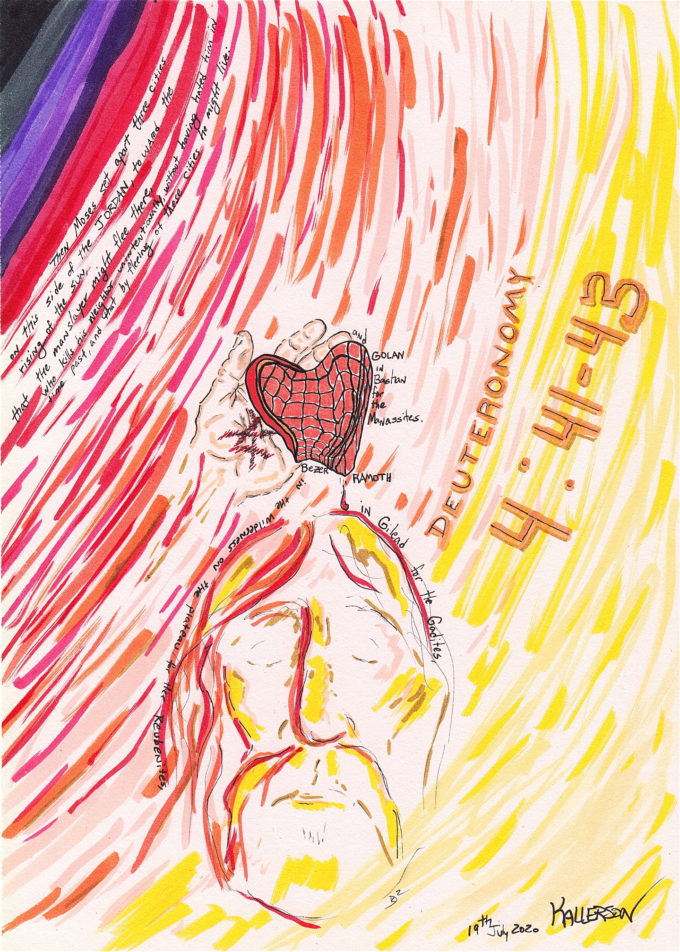
41 Then Moses set apart three cities on this side of the Jordan, toward the rising of the sun, 42 that the manslayer might flee there, who kills his neighbor unintentionally, without having hated him in time past, and that by fleeing to one of these cities he might live: 43 Bezer in the wilderness on the plateau for the Reubenites, Ramoth in Gilead for the Gadites, and Golan in Bashan for the Manassites.
44 Now this is the law which Moses set before the children of Israel. 45 These are the testimonies, the statutes, and the judgments which Moses spoke to the children of Israel after they came out of Egypt, 46 on this side of the Jordan, in the valley opposite Beth Peor, in the land of Sihon king of the Amorites, who dwelt at Heshbon, whom Moses and the children of Israel defeated after they came out of Egypt. 47 And they took possession of his land and the land of Og king of Bashan, two kings of the Amorites, who were on this side of the Jordan, toward the rising of the sun, 48 from Aroer, which is on the bank of the River Arnon, even to Mount Sion (that is, Hermon), 49 and all the plain on the east side of the Jordan as far as the Sea of the Arabah, below the slopes of Pisgah.