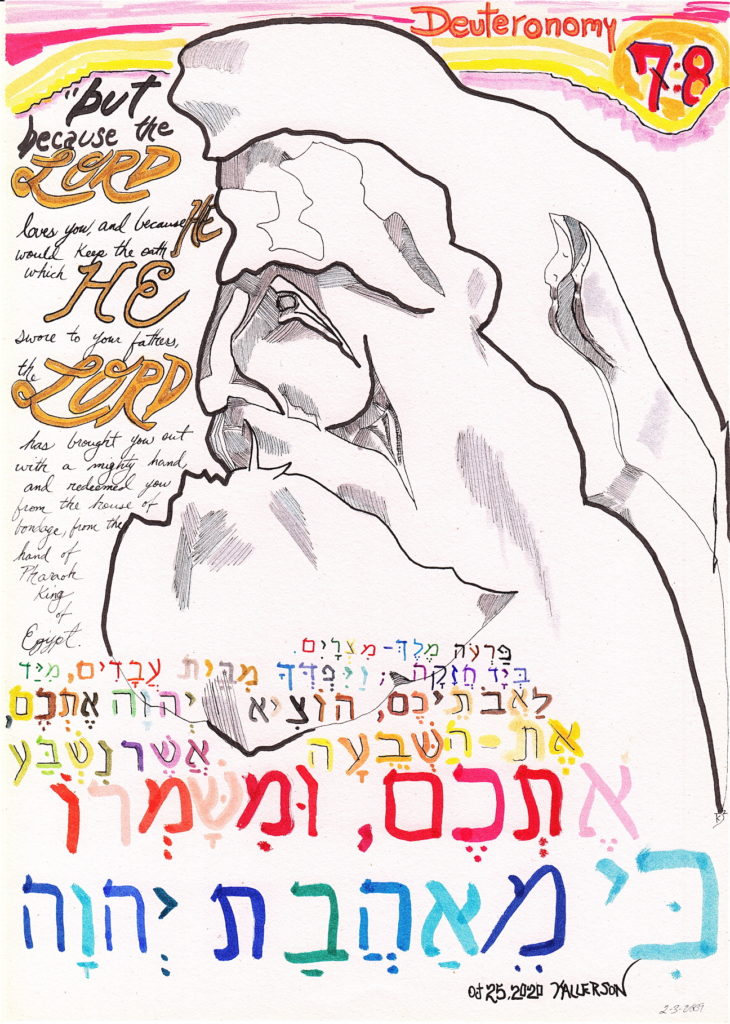
Deuteronomy 7:1-8
Because the Lord Loves You
The day I typed this sermon started out, as always, with my morning Bible reading. A part of what I read was Deuteronomy 28. In that passage is the woeful reminder to Israel of what got them into the pickle they were in when exiled to Babylon, and then what got them into the pickle they have been in for the past two thousand years. Their troubles have been a self-inflicted wound.
Until they realize this, there will be no change for them. They project outward at the world over every infraction against them, and indeed many are unjustified. But none of the ills they face would come to pass if they had been obedient to the covenant that they agreed to.
As I will point out today, and continue to point out again and again, this covenant anticipates its own ending, and the introduction of a New Covenant.
In rejecting Christ, they were disobedient to the Mosaic Covenant, and they are outside of the New Covenant. Such is the state they have been in, and that they will continue to be in, until the day they – as a nation – call out to Him.
But, even in life under the Old Covenant, as is recorded in the Bible, God has used the misdeeds of Israel to bring glory to Himself. An example of this will be explained later when we hear about Rahab the harlot.
Something occurred in the account concerning her which is in violation of the word given by Moses today. That is a bad thing. However, the result of that bad thing led to good things. Even Israel under the law could figure that out from their writings.
And so, they could – perversely – say, “We brought glory to God through our misdeed. Therefore, what we do as a people – right or wrong – is an instrument to bring glory to the Lord.” Sounds unreasonable, doesn’t it?
Text Verse: “For if the truth of God has increased through my lie to His glory, why am I also still judged as a sinner? 8 And why not say, “Let us do evil that good may come”?—as we are slanderously reported and as some affirm that we say. Their condemnation is just.” Romans 3:7, 8
Unfortunately, this is the attitude of many in Israel, and that attitude continues in the church today. Is it evil to violate Scripture? Are Paul’s words Scripture? When Paul says concerning theological matters that a woman is not to teach or have authority over a man, is that prescriptive or descriptive? Is it optional or mandatory?
But many females have become pastors. Some have great insights, lead people to Christ, and run what would otherwise be considered important ministries. And yet, it is exactly what Paul argues against in our text verse – “Let us do evil that good may come.” The end cannot justify the means, and God cannot reward open disobedience to His word.
We will learn about that today. We will also learn a lot more. So buckle your seat, and put on your helmet. There is a lot to learn and it will come at you quickly. Great things are to be found in His superior word. And so, let us turn to that precious word once again and… May God speak to us through His word today and may His glorious name ever be praised.
I. Make No Covenant with Them (Verses 1-5)
Moses had given a brief review of some of Israel’s history in Chapters 1-3, highlighting events from leaving Sinai until the spot where they now sat, across the Jordan from Canaan.
In Chapter 4, there was a bit more review, but the chapter focused on idolatry and being sure to obey the commands of the Lord, forsaking any such idolatry. At the end of that chapter, the defeat of Sihon and Og was again repeated, even though it had been reviewed in Chapters 2 and 3. They and their people were exterminated, and that was the expectation west of Jordan as well.
Chapter 5 again commanded obedience as the Ten Commandments were repeated. They also warned against idolatry as well as the other major points of the law, focusing on love for the Lord and love for one’s neighbor.
Chapter 6 continued to stress love for the Lord and holding fast to Him in obedience. At the end of Chapter 6, Moses explained that the meaning of all of these testimonies, statutes, and judgments was based on the Lord having delivered Israel from Egypt, from the house of bondage.
It was a land of idolatry and bondage, but they were brought out from that in order that He might bring them into their own land. One can see that Chapter 6 expanded upon the first command –
“I am the Lord your God who brought you out of the land of Egypt, out of the house of bondage.
7 ‘You shall have no other gods before Me.’” Deuteronomy 5:6, 7
Understanding this progression of thought, Moses now opens Chapter 7 saying –
“When the Lord your God brings you into the land which you go to possess,
The purpose of bringing them out is so that He might bring them in. They were held in a land they did not possess; they were being given a land of their own to possess. In this, there were certain obligations that needed to be performed to keep them from violating the very commands that have been so heavily stressed.
One of those commands was to dispossess the inhabitants of Canaan. Moses says that it will be the same Lord who brought them out who will now accomplish that task…
1 (con’t) and has cast out many nations before you,
Here, Moses uses a rather rare word, nashal – to slip off, draw off, or clear away. It has only been used so far in Exodus 3:5 –
“Do not draw near this place. Take your sandals off your feet, for the place where you stand is holy ground.” Exodus 3:5
Moses promises that the Lord will be the one to draw the people off of the land, just as a person draws of his shoe. Those who will be ejected are…
1 (con’t) the Hittites
ha’khiti – “the Hittite.” It should be noted now that all seven of the named people groups are in the singular, not the plural. Hittite means, Terrible or Fearsome. They were introduced into the Bible in Genesis 15. They are referred to throughout the Old Testament writings, and the name will last be seen in Ezekiel 16:45 when speaking of Jerusalem –
“You are your mother’s daughter, loathing husband and children; and you are the sister of your sisters, who loathed their husbands and children; your mother was a Hittite and your father an Amorite.”
1 (con’t) and the Girgashites
v’ha’girgashi – “and the Girgashite.” The exact meaning of the name is unknown. It may mean, “Dweller in a Clayey Soil.” They are sparsely noted between Genesis 10:16 and Nehemiah 9:8.
1 (con’t) and the Amorites
v’ha’emori – “and the Amorite.” The name means, “Spoken Of” and thus, “Renowned.” They are noted many times throughout the Old Testament, from Genesis 10:16 until Amos 2:10. They are, at times, used as a catchall name to describe the inhabitants of the land of Canaan. The same is true with…
1 (con’t) and the Canaanites
v’ha’kenaani – “and the Canaanite.” The name Canaanite may mean Merchant or Servant. The latter is more likely. They were cursed by Noah as the lowest of slaves, and they also picture those who bring others into slavery.
Canaan was the firstborn of Ham, and his name identifies with the land and people groups in the land. The name is mentioned throughout the Old Testament and even into the New, beginning in Genesis 9:18 and seen last in Acts 13:19.
1 (con’t) and the Perizzites
v’ha’perizi – “And the Perizzite.” The name means Villagers, or Dwellers in the Open Country. They are seen mostly in the Books of Moses and the writings of the Old Testament from Genesis 13:7 until Nehemiah 9:8.
1 (con’t) and the Hivites
v’ha’khivi – “And the Hivite.” Hivite might mean “Tent Villagers.” They are also seen in the Books of Moses and the writings from Genesis 10:17 until 2 Chronicles 8:7.
1 (con’t) and the Jebusites,
v’ha’yebusi – “And the Jebusite.” The name means “Treading Down” or “Trodden Underfoot.” They are found mostly in Moses and the writings, but Zechariah mentions them also, going from Genesis 10:16 until Zechariah 9:7. It was the Jebusites who held the main body of Jerusalem until the time of King David. Of these people groups, Moses says they are…
1 (con’t) seven nations greater and mightier than you,
It should be noted that ten people groups were mentioned as possessing the land in Genesis 15:18-20. That was when the Lord promised the land to Abraham. At times, even in Deuteronomy, the names of the people groups will vary from this list now. For example, Deuteronomy 20 will say –
“But of the cities of these peoples which the Lord your God gives you as an inheritance, you shall let nothing that breathes remain alive, 17 but you shall utterly destroy them: the Hittite and the Amorite and the Canaanite and the Perizzite and the Hivite and the Jebusite, just as the Lord your God has commanded you, 18 lest they teach you to do according to all their abominations which they have done for their gods, and you sin against the Lord your God.” Deuteronomy 20:16-18
There, only six groups are named. The Girgashite is left out. Therefore, the list is to be taken as a general list speaking of all of the inhabitants, even if not all are named at all times. The words of Moses, “seven nations greater and mightier than you,” are certainly intended to mean that each, by itself, is mightier and greater. Despite this, Moses continues…
2 and when the Lord your God delivers them over to you,
Here it is clearly stated by Moses that the Lord will, in fact, deliver the inhabitants to them. This is an important statement because the Lord’s deliverance of the peoples precedes the destruction of them. Because the Lord is God, this cannot be considered either indiscriminate or unsanctioned killing.
And more, because He will deliver them, there is no excuse for any to survive. This is especially so concerning the next words. The Lord will deliver them, and they must then take action…
2 (con’t) you shall conquer them and utterly destroy them.
v’hikitam hakharem takhrim – “and you shall strike them and accursing them, you shall make them accursed.” The word is kharam, and it signifies to devote to destruction as an offering to God. When kharam is pronounced, whatever the Lord included as kharam was to be utterly destroyed.
For example, Jericho was to be completely destroyed. All people, all possessions, all animals – everything. The only thing to be spared is noted in Joshua 6, saying, “But all the silver and gold, and vessels of bronze and iron, are consecrated to the Lord; they shall come into the treasury of the Lord.”
At times, the animals might be spared. Or maybe the people were to be killed but the city could be inhabited. It was the Lord’s decision and whatever level of kharam was determined, it had to be accomplished to the last thread or stone.
In case of the inhabitants of Canaan, all were to be completely exterminated. None were to survive. As it next says…
2 (con’t) You shall make no covenant with them nor show mercy to them.
The command is given and thus it is a point of law. The words say, “You shall not cut with them a covenant.” The idea surely extends to treaties or making alliances. The reason is obvious. They were to be exterminated in order to prevent taking up their idolatrous practices. Thus, making a covenant with them would preclude this.
In having a covenant with them, the land would not be a solely Israelite possession. There would be the constant warring over whose land it was, what rights did the inhabitants have, and so on.
Israel was to move in, dispossess the inhabitants, and thus be the sole possessors of the land – unhindered by the idolatry which would be sure to arise without these mandates being fulfilled.
One would think that not cutting a covenant would even extend to swearing an oath of protection for someone who sides with Israel. The Lord said to destroy all, and there is no caveat presented to make exceptions.
As this is so, it would be logical to assume that the shevua or oath sworn to Rahab the harlot to spare her and her family would fall under this. Either way, it is absolutely certain it extends to the treaty that Joshua made with the Gibeonites.
They were a clan under the Hivites mentioned in verse 1 who came in through deception. Joshua, without checking with the Lord, made peace with them and cut a covenant with them (it is the same words as are used in this verse now). Thus, the law was violated in their actions.
Despite this, we see later that Rahab came into the line of David, and thus into the line of Christ. The Gibeonites are seen still among Israel, even after the exile in the book of Nehemiah, helping to repair the wall and governor’s residence in Jerusalem.
The failings of Israel are still used for good purposes by the Lord, demonstrating that His plan includes even the countless failings of His people. As we sit here today, that includes each of us. We fail, and yet the Lord works out a good end despite it. It is a marvelous lesson we can learn and cling to, knowing that He has it all figured out, even if we grieve over our own faithlessness or incompetence.
3 Nor shall you make marriages with them.
Of the previous verse, concerning utterly destroying the inhabitants, Joseph Benson (and others) says –
“That is, in case they continued obstinate in their idolatry, they were to be destroyed, as nations, or bodies politic. But if they forsook their idolatry, and became sincere proselytes to the true religion, they would then be proper objects of forgiveness, as being true penitents.” Joseph Benson
Now, of this verse concerning marriage, Joseph Benson says –
“From this prohibition it has been justly inferred that the Canaanites, as individuals, might be spared upon their repentance and reformation from idolatry. For on the supposition that nothing that breathed was to be saved alive, but that all were to be utterly destroyed, there could be no occasion for this injunction. What end could it answer to forbid all intermarriages with a people supposed not to exist?” Joseph Benson
It is hard to understand how scholars can insert into the text something which is not to be found. Moses says, “utterly destroy,” not “utterly destroy unless…” No exceptions were to be made.
The answer to Benson’s question is, “The people were set for destruction and yet Israel failed to carry through with the command. Thus, intermarriages were forbidden, even if those people still existed.” This is perfectly evident from examples such as Solomon, even more than four centuries later –
“But King Solomon loved many foreign women, as well as the daughter of Pharaoh: women of the Moabites, Ammonites, Edomites, Sidonians, and Hittites— 2 from the nations of whom the Lord had said to the children of Israel, ‘You shall not intermarry with them, nor they with you. Surely they will turn away your hearts after their gods.’” 1 Kings 11:1, 2
The failure to be obedient to one command allowed for Solomon’s failure to be obedient to another one. Hittites are under the ban now mentioned in this passage.
The Bible, whether in the Old or the New Testament, is not a book of personal exceptions when convenient. It is the word of God, and it is to be accepted as such. The context is to be maintained, and when the context commands or forbids something in that context, it is to be adhered to.
3 (con’t) You shall not give your daughter to their son, nor take their daughter for your son.
The pronouns are singular – “to his son, nor take his daughter.” This is speaking of the inhabitant, whoever he may be.
Again, John Gill qualifies the words of verse 3, saying, “Unless they became proselytes…” There is no qualifier given by the Lord or by Moses. The point of the later exceptions is not to say that such exceptions are ok. It is to show that the Lord can still work through Israel’s disobedience for a good end.
This does not mean that we should think it is acceptable to marry a Muslim or a Buddhist, for example, knowing that God can use our disobedience for a good end. The New Testament shows that believers are to marry believers. Anything else than that is disobedience.
And yet, I personally know Christians who have disobeyed this precept and good has come out of it in the conversion of the spouse. The end, however, does not justify the means. There will be a loss of reward for the disobedience, and there will also be joy in heaven despite it.
This precept is what Paul spoke against in our Text Verse today, “Let us do evil that good may come.” Such is actually perverse thinking. The marvel of God, however, is that He can turn our perverse ways into a marvelous part of the beautiful tapestry He is weaving in the unfolding plan of redemption. For now, Moses explains his words, and in a rather exceptional way…
4 For they will turn your sons away from following Me,
Again, this needs correction. It says, “For he (singular) will turn away your son (singular) from following Me.” It is speaking of the foreigner, whoever he may be. However, the interesting part of the verse is that it is Moses who is speaking, and yet, he says, “from following Me.”
The two possibilities are that 1) he is referring to the body of law coming from him (aka the Law of Moses), or 2) he says “Me” as if the Lord is speaking in order to ensure that the words “he will turn” is not speaking of the Lord, but of the foreigner.
The second option is certainly what is being conveyed. Moses, speaking under inspiration, has transferred his words to be as if those spoken directly by the Lord in order to ensure clarity. It is in not following after the Lord that they will turn…
4 (con’t) to serve other gods;
This is the whole point of the passage so far, and as we saw, this passage continues in thought from the previous chapter, and that passage continues in thought from Chapter 5 where it said –
“I am the Lord your God who brought you out of the land of Egypt, out of the house of bondage.
7 ‘You shall have no other gods before Me.’” Deuteronomy 5:6, 7
Intermarriage will result in turning away from the Lord. Turning away from the Lord will result in turning to serve other gods. Remember what we read about Solomon in the previous verse. What was the result of what he did? The very next verses say –
“And he had seven hundred wives, princesses, and three hundred concubines; and his wives turned away his heart. 4 For it was so, when Solomon was old, that his wives turned his heart after other gods; and his heart was not loyal to the Lord his God, as was the heart of his father David. 5 For Solomon went after Ashtoreth the goddess of the Sidonians, and after Milcom the abomination of the Ammonites.” 1 Kings 11:3-5
The same chapter directly credits Solomon’s faithlessness in this to the division of the nation. And yet, the Lord used both the division of Israel, and one of Solomon’s marriages to continue marvelous events in the redemptive narrative. One of the wives, an Ammonite, became the mother of Rehoboam, and thus entered into the genealogy of Christ as noted in Matthew 1:7.
But just because good comes out of such things, it does not mean that the Lord is pleased with our disobedience. As Moses says…
4 (con’t) so the anger of the Lord will be aroused against you and destroy you suddenly.
Again, the ends do not justify the means. The Lord brought good out of many instances of Israel’s disobedience. In fact, the Redeemer of man came through some of them. But that is because of the Lord’s overarching sovereignty.
But our negative decisions will negatively affect ourselves and those around us. God does not impose His will on us, be it in who we marry, or whether we choose Christ for salvation or not. Those are personal, free-will choices.
When those choices are against the stated will of the Lord, that disobedience against the Lord will be judged. In the case of this verse, the “you” is plural. He is speaking to the people, “You all will be destroyed.” The very thing they were to do to the peoples in Canaan will come upon them. To avoid this, Moses continues…
5 But thus you shall deal with them: you shall destroy their altars, and break down their sacred pillars, and cut down their wooden images, and burn their carved images with fire.
Moses now turns from the people to what the people worship. And yet, they are united as one thought. The people are intimately connected to that which they worship. And so, each was to be destroyed according to what it is.
The altars were to be torn down. The matstsevah, or pillars were to be broken in pieces. The Asherim, or wooden images, were to be gada, or cut down. Here Moses introduces this word into Scripture. It means to cut off or cut down.
And, finally, the pasil, or carved images (another new word in Scripture, coming from a verb meaning “to cut”) were to be burned in the fire. In the Hebrew, a special emphasis is placed on burning these carved images by the addition of a suffix on the word.
As for the thought of these words, similar words have already been put forth by the Lord –
“You shall not bow down to their gods, nor serve them, nor do according to their works; but you shall utterly overthrow them and completely break down their sacred pillars.” Exodus 23:24
But the Lord spoke even more precisely in Exodus 34, where He ties all of these things together as Moses now repeats here –
“Take heed to yourself, lest you make a covenant with the inhabitants of the land where you are going, lest it be a snare in your midst. 13 But you shall destroy their altars, break their sacred pillars, and cut down their wooden images 14 (for you shall worship no other god, for the Lord, whose name is Jealous, is a jealous God), 15 lest you make a covenant with the inhabitants of the land, and they play the harlot with their gods and make sacrifice to their gods, and one of them invites you and you eat of his sacrifice, 16 and you take of his daughters for your sons, and his daughters play the harlot with their gods and make your sons play the harlot with their gods.” Exodus 34:12-16
The people are tied to their altars, and a covenant with the people means that a covenant has been made with their false deities. The resulting chaos, and turning from the Lord, is thus inevitable. The jealousy of the Lord will be aroused, And, in the arousal of His jealously will come forth His anger. Moses next explains why these things were to be so…
Be obedient to what I say
Even if not doing so will turn out for good
It is not right for you to ever disobey
Be sure that this is perfectly understood
If My word is violated, and good comes from that
It is because I ordained that it would be this way
But your disobedience only makes you a brat
Even if good comes from it, you have no right to disobey
Turn from disobedience, and always do right
Do not use the excuse that, “Things will turn out ok!”
That is wickedness in My sight
There is never a time when it is right to disobey
II. A Special Treasure (verses 6-8)
6 “For you are a holy people to the Lord your God;
ki am qadosh attah l’Yehovah elohekha – “For people holy you to Yehovah your God.” The words of this verse, with differences, comes in thought from the words of the Lord in Exodus 19:5, 6 –
“Now therefore, if you will indeed obey My voice and keep My covenant, then you shall be a special treasure to Me above all people; for all the earth is Mine. 6 And you shall be to Me a kingdom of priests and a holy nation.’ These are the words which you shall speak to the children of Israel.” Exodus 19:5, 6
There, the Lord made the words conditional, “if you will indeed obey My voice and keep my covenant, then you shall be…” Here, Moses simply says, “you are.” There, the Lord says, “a holy nation.” Here, Moses says, “a holy people.”
The words beg for us to consider them. The Lord says, “if/then” in order to be a holy nation. Moses says, “you are a holy people.” What is obvious is that a people can be holy – meaning set apart to God, and yet not be a holy nation – meaning a nation which is set apart to God.
Israel is set apart as holy, whether they act like it or not. But Israel can be unholy even in their being set apart. The resolution to the two states is obeying the Lord’s words and keeping His covenant. In understanding this, it resolves one of the greatest misunderstandings concerning Israel in the world today.
Israel misunderstands it, the church – in large part – misunderstands it, and the world at large misunderstands it. Israel is a holy people, regardless as to how they act. The Lord has set them apart, He has put His name on them – Israel – and He has covenanted with them. That has not changed, nor will it change.
Israel as a nation thinks it is holy, meaning right with God, because they are Israel the people. This is incorrect. As a nation, they are right with God when they are obedient to the Lord. As a people, they are to be obedient to the Lord in order to be holy as a nation.
If I adopt a child, we could say he is set apart (holy) to the family. He is to act as a member of the family in order to be right with (holy to) the family. If he doesn’t act in accord with the rules of the family, it doesn’t mean he isn’t a child of (holy to) the family. It means that he is an unholy child.
This is where Israel fails to understand their obligations. It is also where the church fails to understand Israel. The church says Israel is no longer a holy nation. They have disobeyed the Lord, and thus they are also not now the Lord’s people. The theological categories are thus mixed.
That is entirely incorrect. Israel is a holy (set apart) people to the Lord – forever. But they are not a holy nation to the Lord. The latter does not negate the status of the former. It simply means they, as a holy people, are not a holy nation.
Israel looks at themselves as a holy people, and thus they are a holy nation. Many in the church look at Israel as an unholy nation, and thus they are an unholy (meaning not the Lord’s) people. Both are incorrect, and both require correction. They are category mistakes.
The world at large (meaning the nations who reject the God of Israel – from either testament) looks at Israel as an unholy nation, and an unholy people. To them, they are not set apart by God as a people, because their God is not the true God. And, they are even disobedient to the word of their God which they claim gives them holiness. Thus, the nations view them as double unholy.
Each of these, and you can see there is overlap between views – be it positive or negative – is an error in thinking. The nations, in general, are in error because they reject the God of the Bible. People in the church, in general, are in error because they fail to understand the unconditional decrees of God. And Israel, the nation, is in error because, as a people, they fail to conduct themselves in the manner which is in accord with who they are as set apart by God – meaning to Himself. Moses continues to show this, saying…
6 (con’t) the Lord your God has chosen you to be a people for Himself,
The words here, and in the next clause, are rendered in various ways. We will put two side by side to see this –
the Lord your God has chosen you to be a people for Himself, a special treasure above all the peoples on the face of the earth. NKJV
The LORD your God has chosen you to be a people for his treasured possession, out of all the peoples who are on the face of the earth. ESV
The NKJV gives two separate designations, “a people for Himself,” which is then qualified by “a special treasure above all peoples.” The ESV gives one, saying, “a people for his treasured possession, out of all the peoples.”
The words read lihyot lo l’am segulah mikol ha’amim – “to for Him to people treasure from all the peoples.” It comes down to the word l’am, or “to people.” Is it “for Him to people, a treasure,” or is it “for Him, to people treasure.”
The meaning is similar in either case, but I wanted you to be aware of the Hebrew, because either way, they – as a people – are set apart to the Lord. Thus, the error of thinking by all can be corrected if they accept 1) the God of the Bible, 2) that God’s decrees are unconditional, and 3) that being set apart as a holy people does not mean that the holiness is “in the people” but “as the people.”
Because the Lord has chosen Israel as a people for Himself, they are to Him…
6 (con’t) a special treasure above all the peoples on the face of the earth.
The word is segulah. It signifies possession or property, coming from an unused root meaning “to shut up” as in wealth. One would take something precious, like treasure, and shut it up and keep it close by. Thus, it is variously translated as peculiar treasure, possession, jewels, special possession, and so on.
Moses says that they, as a people, are this treasure. And yet, as a nation, in order to be so they must be obedient to His commandments. Thus, it is both conditional and unconditional, depending on the context. Peter, speaking to the Jews who have come to Christ, cites these words in his first epistle, saying –
“But you are a chosen generation, a royal priesthood, a holy nation, His own special people, that you may proclaim the praises of Him who called you out of darkness into His marvelous light; 10 who once were not a people but are now the people of God, who had not obtained mercy but now have obtained mercy.” 1 Peter 2:9, 10
Paul uses the same word in Ephesians 1:14 concerning the Gentiles who have been brought into the commonwealth of Israel. We have become a possession of the Lord through obedience to, meaning calling on, Christ.
More directly, however, Paul uses the same phrase, laon periousion, in Titus 2:14 that is used in the Greek translation of this verse in Deuteronomy –
“For the grace of God that brings salvation has appeared to all men, 12 teaching us that, denying ungodliness and worldly lusts, we should live soberly, righteously, and godly in the present age, 13 looking for the blessed hope and glorious appearing of our great God and Savior Jesus Christ, 14 who gave Himself for us, that He might redeem us from every lawless deed and purify for Himself His own special people, zealous for good works.” Titus 2:11-14
Vincent’s word studies notes of this, “The phrase was originally applied to the people of Israel, but is transferred there to believers in Messiah – Jews and Gentiles.”
The people of the church have been redeemed in order that we can become a special people to God, just as Israel is. In this act, and in the use of this term by Paul, many scholars unfortunately then make the jump in logic that this means that the Church has now replaced Israel, thus becoming “spiritual Israel.”
This is a category mistake, and it is gigantic error in theology. Just because we in the church have become a special people to God, it doesn’t mean that we have replaced God’s chosen people, Israel. We have simply joined into the commonwealth of blessing of which they already participate in.
Others will use Paul’s words to justify that there are two gospels, one for the Jews and one for the Gentiles – a heresy known as hyperdispensationalism. That is proven false by Paul’s words in verse 2:11 where he says, “the grace of God that brings salvation has appeared to all men.” There is one gospel for all.
However, to understand how the church did not replace the people Israel, we can make a simple example. The church was once predominantly Jewish. It later became predominantly Gentile. In this, we can think of two separate baskets of olives.
God chooses one basket and draws it out for Himself, Israel. He takes the fruit out of it as needed for His oil. At some point, however, the olives in the basket which are good are so few in number that He then draws out from another basket, Gentiles.
That basket has an immense supply of good fruit, so much so that it becomes the predominant fruit used for the oil. The oil running into the bottles is mixed with an almost insignificant amount of Jewish oil. However, that is still coming from the basket of Israel. The two baskets remain separate and distinct.
Now, over the many centuries, the basket of Gentile fruit is starting to wane. The number of good olives is rapidly diminishing, but the number of Israel fruit is on the increase. The categories have never changed, and one did not replace the other.
It simply has become the predominant source of oil for a period of time. It’s not a perfect analogy, but one can see that each basket remained the same. One did not replace the other. Israel as a people is set apart unto the Lord. But only those of Israel who do what the Lord expects are of use by the Lord.
Someday, the set-apart people of Israel will, as a nation, come to Christ (a precept anticipated in the Mosaic Covenant) through the New Covenant, and they – as a nation – will be holy to the Lord.
Israel, as a people, was selected by the Lord as His own, and for His own good purposes. They, and no one else, were offered the Mosaic Covenant, and they accepted it. They are a physical group of people united to the Lord in this manner.
The church, as a people, is received by the Lord as His own, and for His own good purposes. All, without any exceptions, are offered the New Covenant. Those in the church are those who have accepted its offer. They are a spiritual group of people united to the Lord in this manner. As for Israel…
7 The Lord did not set His love on you nor choose you because you were more in number than any other people,
The word translated as “set His love” is khashaq. It comes from a word meaning “to cling to.” In the construction of the tabernacle, it was translated as “bands” which bound two things together. Here, it is as if the Lord bound Himself to Israel through an act of love. However, He didn’t do it based on their size as a nation.
Many groups descended from Terah, Abraham’s father – the people of Edom, Moab, Ammon, and Ishmael, for example. However, the line of promise from Abraham to Isaac to Jacob started slowly. For example, Ismael gave Abraham twelve grandsons. However, it wasn’t until Jacob that there were twelve tribes, meaning Abraham’s great grandsons.
And not only that, Isaac was sixty when he had Esau and Jacob. And Jacob was over 85 when he started having children. Despite the smaller numbers, God had chosen this line and had sovereignly watched over it, binding Himself to it, nurturing it, and loving it.
7 (con’t) for you were the least of all peoples;
God upturns the thinking of man. We look to large numbers and see greatness. We expect that God would do the same. But where is the glory for Him in that? He called a small and insignificant group of people for Himself, and He brought them into a situation where they would greatly multiply.
However, in their multiplication, they were in bondage. And yet, the Lord brought them out, destroying a greater and mightier nation in the process. The glory belongs to the Lord. Such is true with every aspect of what the Lord does. He uses that which is considered less to glorify His greatness. The same thought transfers to those in the church. As Paul says –
“For you see your calling, brethren, that not many wise according to the flesh, not many mighty, not many noble, are called. 27 But God has chosen the foolish things of the world to put to shame the wise, and God has chosen the weak things of the world to put to shame the things which are mighty; 28 and the base things of the world and the things which are despised God has chosen, and the things which are not, to bring to nothing the things that are, 29 that no flesh should glory in His presence. 30 But of Him you are in Christ Jesus, who became for us wisdom from God—and righteousness and sanctification and redemption— 31 that, as it is written, “He who glories, let him glory in the Lord.” 1 Corinthians 1:26-31
It must be understood what Paul’s word are conveying. The calling of the Lord is what is responded to by the individual. It is generally those who are of low esteem who will humble themselves and admit they need a Savior. The call is made, but it is a call that is generally responded to by the lowly.
Israel’s calling was active; the calling to the church is passive. But both are to what would otherwise seem unimpressive, lowly, etc. For Israel, it was not because of their size…
8 but because the Lord loves you,
ki me-ahavat Yehovah etkem – “Because for love Yehovah for you.” In Chapter 4, the Lord says it was because of love for their fathers –
“And because He loved your fathers, therefore He chose their descendants after them; and He brought you out of Egypt with His Presence, with His mighty power, 38 driving out from before you nations greater and mightier than you, to bring you in, to give you their land as an inheritance, as it is this day.” Deuteronomy 4:37, 38
In Chapter 9, Moses says it is not because of their righteousness, but because of the wickedness of the nations that the Lord was giving them Canaan. Further, he says that it is in order to fulfill His word to the fathers. He then ensures they understand this by calling them stiff-necked.
Understanding that the Lord’s love for Israel is originally based on His love for the fathers, there is nothing intrinsically worthy of that love in them. Rather because of His nature – which is love – it is then directed to those of the covenant promises. As Moses says…
8 (con’t) and because He would keep the oath which He swore to your fathers,
The Lord spoke an oath, and therefore He must perform. His very nature demands that His word will be fulfilled. Therefore, His word must come to pass. Because of this…
*8 (fin) the Lord has brought you out with a mighty hand, and redeemed you from the house of bondage, from the hand of Pharaoh king of Egypt.
The idea of these words, from both verses 7 and 8, is that the Lord bound Himself to this people in order to love them and in order to keep His oath. Both have a divine motive behind them. It’s not that He loved Israel for who they were, but because of who He is.
We could say, “I’m not loving you for who you are, but for who you could be in relation to Me.” When the Lord saves a person, it is because He is love. The saving is in anticipation of the relationship, not the other way around – because the relationship did not exist until the saving.
This is how it is with Israel. Because of who He is, He brought Israel out from the house of bondage. Because of who He is, He sent His Son to die for us. The love extends from God to us. Only when we rightly respond to that love does the relationship begin.
What we see in this final verse is Israel’s selection and calling being equated directly to the individual believer. We are in sin. We are in bondage. And, we can do nothing to redeem ourselves. But more, we have no idea about the love of God. It is foreign to us.
Israel was brought out, and that act was to alert them to the fact that God is covenant-keeping, and that He is loving. They were to respond in kind because of that understanding.
We are told the message of Christ, that He has potentially redeemed us from our bondage. When we understand that God did that as an act of love, we are to respond, accepting what He has done, and thus making that redemption actual. It is the acceptance of the love of God that is found in Jesus Christ.
This is what this passage today tells us. God is sovereign over the process, be it in exterminating the inhabitants of Canaan, using Israel’s failure to do so in unique and glorious ways – such as the saving of Rahab the harlot – or be it in the offer of Jesus for the sins of the world.
No person can question what God is doing. We can only accept that what He is doing is for the greatest good of all. If you don’t believe that, then you have misunderstood the significance of the cross. Contemplate what God has done, and then accept it for what it is. And then, receive it by faith. The offer stands open for any and all who will reach out and receive it.
Closing Verse: “Love has been perfected among us in this: that we may have boldness in the day of judgment; because as He is, so are we in this world. 18 There is no fear in love; but perfect love casts out fear, because fear involves torment. But he who fears has not been made perfect in love. 19 We love Him because He first loved us.” 1 John 4:17-19
Next Week: Deuteronomy 7:9-16 That it is wonderful is beyond controversy… (The Covenant and the Mercy) (27th Deuteronomy Sermon)
The Lord has you exactly where He wants you. He has a good plan and purpose for you. But He also has expectations of you as He prepares you for entrance into His Land of Promise. So, follow Him and trust Him and He will do marvelous things for you and through you.
Because the Lord Loves You
“When the LORD your God
Brings you into the land (as He promised to do)
Which you go to possess
And has cast out many nations before you
The Hittites and the Girgashites and the Amorites
And the Canaanites and the Perizzites
And the Hivites and the Jebusites
Seven nations greater and mightier than you; a bunch of “ites”
And when the LORD your God
Delivers them over to you
You shall conquer them
And utterly destroy them, so you shall do
You shall make no covenant with them
Nor show mercy to them, not even one
Nor shall you make marriages with them
You shall not give your daughter to their son, nor take
———-their daughter for your son
For they will turn your sons away from following Me
To serve other gods, so I tell you plainly
So the anger of the LORD will be aroused
Against you and destroy you suddenly
But thus you shall deal with them
You shall destroy their altars, and down their sacred pillars
———-you shall break
And cut down their wooden images
And burn their carved images with fire, for goodness sake
“For you are a holy people to the LORD your God
The LORD your God has chosen you with joy and mirth
To be a people for Himself
A special treasure above all the peoples on the face of the earth
The LORD did not set His love on you
Nor choose you because you were more
In number than any other people
For you were the least of all peoples, such is the score
But because the LORD loves you
And because He would keep the oath, please understand
Which He swore to your fathers
The LORD has brought you out with a mighty hand
And redeemed you from the house of bondage
———-out of his grasp, you He stripped
From the hand of Pharaoh king of Egypt
Lord God, turn our hearts to be obedient to Your word
Give us wisdom to be ever faithful to You
May we carefully heed each thing we have heard
Yes, Lord God may our hearts be faithful and true
And we shall be content and satisfied in You alone
We will follow You as we sing our songs of praise
Hallelujah to You; to us Your path You have shown
Hallelujah we shall sing to You for all of our days
Hallelujah and Amen…
“When the Lord your God brings you into the land which you go to possess, and has cast out many nations before you, the Hittites and the Girgashites and the Amorites and the Canaanites and the Perizzites and the Hivites and the Jebusites, seven nations greater and mightier than you, 2 and when the Lord your God delivers them over to you, you shall conquer them and utterly destroy them. You shall make no covenant with them nor show mercy to them. 3 Nor shall you make marriages with them. You shall not give your daughter to their son, nor take their daughter for your son. 4 For they will turn your sons away from following Me, to serve other gods; so the anger of the Lord will be aroused against you and destroy you suddenly. 5 But thus you shall deal with them: you shall destroy their altars, and break down their sacred pillars, and cut down their wooden images, and burn their carved images with fire.
6 “For you are a holy people to the Lord your God; the Lord your God has chosen you to be a people for Himself, a special treasure above all the peoples on the face of the earth. 7 The Lord did not set His love on you nor choose you because you were more in number than any other people, for you were the least of all peoples; 8 but because the Lord loves you, and because He would keep the oath which He swore to your fathers, the Lord has brought you out with a mighty hand, and redeemed you from the house of bondage, from the hand of Pharaoh king of Egypt.