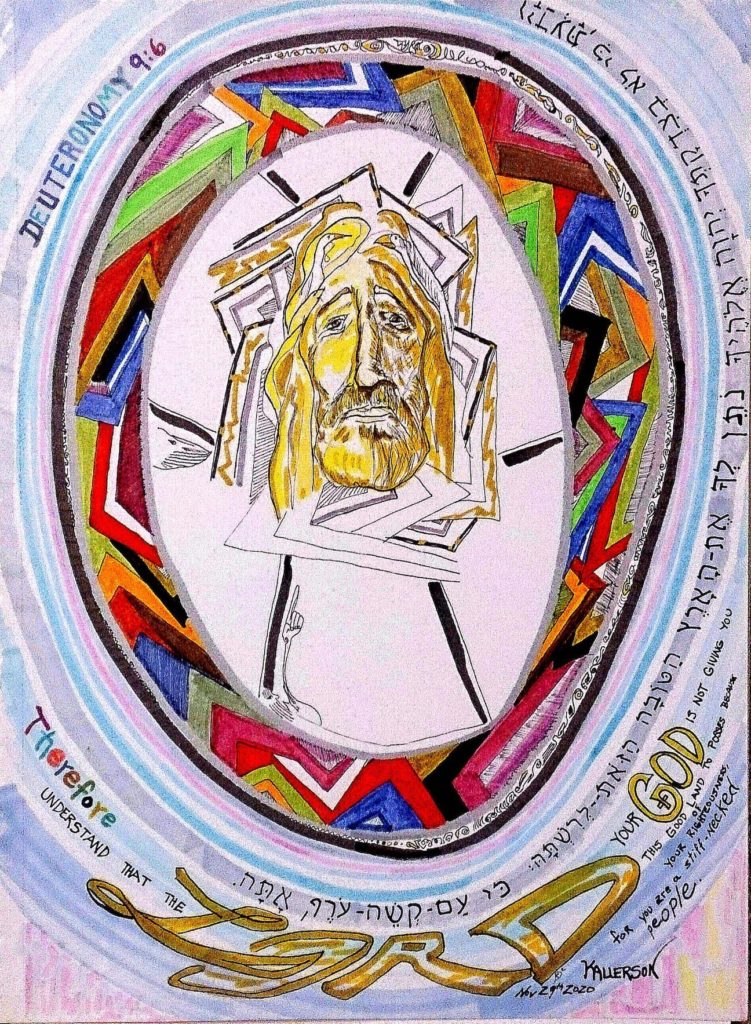
Deuteronomy 9:1-6
Not Because of Your Righteousness
Insightfully, and right off the bat, Albert Barnes comments on this chapter saying, “The lesson of this chapter is exactly that of Ephesians 2:8, ‘By grace are ye saved through faith; and that not of yourselves; it is the gift of God: not of works, lest any man should boast.’”
As obvious as that seems once you have somebody tell you, it is not something one would normally think of while toiling away through the Law of Moses. The people have been given law, they will be given more law, and in the process, they are told – again and again – that adherence to the law is necessary for them.
However, throughout the law, and even in the passage today, more than mere observance of the law is defined. Living out the law, without an upright heart, means nothing. That is testified to elsewhere – outside of the covenant people – as we will briefly look at today.
And so, as we progress, we continue to see hints of what God is up to in our return to the paradise we lost so long ago. Adam was covered by the Lord after he demonstrated faith in the Lord’s promise. Abraham was counted as righteous by simply believing the Lord; accepting His word at face value.
People outside of the covenant line are considered upright and blameless by the Lord. And even those who were under the law have found righteousness apart from the law by a mere act of faith, as Paul says in our text verse today –
Text Verse: “Beware of dogs, beware of evil workers, beware of the mutilation! 3 For we are the circumcision, who worship God in the Spirit, rejoice in Christ Jesus, and have no confidence in the flesh, 4 though I also might have confidence in the flesh. If anyone else thinks he may have confidence in the flesh, I more so: 5 circumcised the eighth day, of the stock of Israel, of the tribe of Benjamin, a Hebrew of the Hebrews; concerning the law, a Pharisee; 6 concerning zeal, persecuting the church; concerning the righteousness which is in the law, blameless.
7 But what things were gain to me, these I have counted loss for Christ. 8 Yet indeed I also count all things loss for the excellence of the knowledge of Christ Jesus my Lord, for whom I have suffered the loss of all things, and count them as rubbish, that I may gain Christ 9 and be found in Him, not having my own righteousness, which is from the law, but that which is through faith in Christ, the righteousness which is from God by faith; 10 that I may know Him and the power of His resurrection, and the fellowship of His sufferings, being conformed to His death, 11 if, by any means, I may attain to the resurrection from the dead.” Philippians 3:2-12
Israel is being schooled on what pleases the Lord. Through Israel’s schooling, we too can be instructed. Their history is recorded for exactly that reason, and it is a history that calls out for something more than anything they, or we, can bring out of ourselves.
Rather, it calls out for a yielding to God and a submission to what He offers at whatever time in history we live. We will see that today, and we will also begin a short chiasm with our last verse from our text today. As it begins there, we will lay it out today and then go through the rest of it next week.
Deuteronomy 9:6-13 – Breaking the Covenant
While Moses was on the mountain of God (6/3/2008 – refined in 2020)
a 9:6 You are a stiff-necked people
—- b 9:7, 8 You who came out of Egypt provoked the LORD to wrath
——-c 9:9, 10 I received two tablets of stone when on the mountain 40 days and nights
X 9:10 the words which the LORD had spoken to you on the mountain from the
midst of the fire
——-c 9:11 At the end of 40 days and nights, the LORD gave me the two tablets of stone
—–b 9:12 The people who came out of Egypt acted corruptly and disobeyed the LORD
a 9:13: Indeed, they are a stiff-necked people
Great things such as justification by grace through faith, and interesting patterns such as chiasms, are just a few wonderful aspects of the marvels to be found in His superior word. And so, let us turn to that precious word once again and… May God speak to us through His word today, and may His glorious name ever be praised.
I. As the Lord Has Said to You (verses 1-3)
“Hear, O Israel: You are to cross over the Jordan today,
shema Yisrael atah ober ha’yom eth ha’yarden – “Hear, Israel: you are passing over today the Jordan.” The words of Moses are as if it is happening right at the moment, and thus it is as if the action is already assured – it is happening, and it is today. Because of this, the word “today” is to be taken as at a point in time, and not literally on the day the word is spoken.
It places the speaking out of Deuteronomy in the light of one moment in time – regardless as to how long that time is. When we speak of “the Day of the Lord,” it doesn’t mean a single day, but a period of time that is set before the people of the world, regardless as to its actual length.
This then takes us back to the thought of the previous chapter. Moses reminded the people to observe the commandment of the Lord when they went in to possess the land. He recounted the Lord’s care of the people in the wilderness, showing them that their chastening was a part of their instruction.
Just as the Lord cared for them, so He would do so in Canaan, but they were to remember that it was the Lord who brought them in, not they themselves. To complete the chapter, he said –
“And you shall remember the Lord your God, for it is He who gives you power to get wealth, that He may establish His covenant which He swore to your fathers, as it is this day. 19 Then it shall be, if you by any means forget the Lord your God, and follow other gods, and serve them and worship them, I testify against you this day that you shall surely perish. 20 As the nations which the Lord destroys before you, so you shall perish, because you would not be obedient to the voice of the Lord your God.” Deuteronomy 8:18-20
Now, Moses continues the instruction of “this day” by explaining what those nations the Lord will destroy before them are like…
1 (con’t) and go in to dispossess nations greater and mightier than yourself,
The thought here rotates back to the words of Chapter 7 –
“When the Lord your God brings you into the land which you go to possess, and has cast out many nations before you, the Hittites and the Girgashites and the Amorites and the Canaanites and the Perizzites and the Hivites and the Jebusites, seven nations greater and mightier than you,” Deuteronomy 7:1
Moses has already said who they will face. He has also explained that not only are the inhabitants jointly greater and mightier than Israel, they are individually greater and mightier than they are. And yet, they will possess the land because they will dispossess the inhabitants of the land. And this, despite them having…
1 (con’t) cities great and fortified up to heaven,
arim gedoloth u-betsuroth bashamayim – “cities great and fortified in the heavens.” Here Moses uses the exact same words that the moaners of Israel spoke in Deuteronomy 1:28, as they complained about the land when it was first presented to them –
“The people are greater and taller than we; the cities are great and fortified up to heaven;” Deuteronomy 1:28
Like at that time, Moses’ words now contain no article before “cities.” Also, the word “heavens” is plural and prefixed by an article – “in the heavens.” The words would normally be expected to elicit awe and fear as Moses repeats this hyperbolic statement that goes all the way back to Genesis 11. There, it said that the people determined to build a tower “whose top is in the heavens.”
The idea is that to any other army, those in Canaan would seem like gods, dwelling in inaccessible strongholds that could not be defeated. However, the Lord was to be with Israel, and so the victory was assured. Paul uses Moses’ terminology in Ephesians 6 to make a spiritual application of what is stated here –
“For our battle is not against flesh and blood, but against the rulers, against the authorities, against the world powers of this darkness, against the spiritual forces of evil in the heavens.” Ephesians 6:12 (Holman)
Paul, being trained in the Law of Moses as a Pharisee, and then coming to Christ who is the fulfillment of the law, was able to see the direct connection between what occurred with Israel in a temporal way and what believers now face on a spiritual level.
Just as Moses reminds Israel that it is the Lord who made the victory possible, and who was then due the glory of it, so Paul makes the same connection, saying that we prevail when we put on the whole armor of God. If it is the armor of God that makes the victory possible, then it is the Lord who is to receive the glory. With this advanced understanding, Moses continues…
2 a people great and tall, the descendants of the Anakim,
Again, Moses reaches back to the second clause of the same verse from Deuteronomy 1 –
“moreover we have seen the sons of the Anakim there.” Deuteronomy 1:28
He is taking the words of the pusillanimous people who stood at the door of Canaan, and he is turning them around for this new generation to consider and understand. The Lord is, in fact, with Israel. They didn’t just have the Exodus from Egypt, but they also had the Lord’s care of them throughout the wilderness wanderings.
This is why in Chapter 7 Moses so carefully explained the Lord’s care of them in the wilderness. As we saw then, it was to demonstrate 1) His greatness in not destroying them for rejecting Him, 2) that it is by His power that the inheritance is acquired because they are the “least of all the peoples,” 3) His love for them as a people, and 4) His faithfulness to the oath He swore to their fathers.
As was noted then concerning the third point, the Lord’s love for Israel is one originally based on His love for the fathers. There is nothing intrinsically worthy of that love in them, but rather because of His nature – which is love – He then directs it to those of the covenant promises.
Before going on, we have to remind ourselves of what all of this is typologically representing, meaning salvation and obtaining a heavenly inheritance in Christ.
Israel had rejected the Lord’s offer of Canaan after they left Mount Sinai. Because of that, they were sent into exile in the wilderness. And yet, they were preserved as a people through that exile. The land now stands before them, but it must be acquired through faith – the same faith that their fathers lacked.
That scenario pictured Israel’s rejection of Christ, their exile among the nations, their preservation as a people because of the four points just noted a minute ago, and His offer to them – once again – to enter the inheritance.
What the Gentiles received, by faith, two thousand years ago, will be offered once again to Israel. It is good to keep reminding ourselves of the typology so that we don’t get too far from what the Lord is telling us.
For those in the world who have never received Christ, or who are attempting to earn God’s favor through the law, the offer is being shouted out for them to consider – “Just look at the Lord’s faithfulness to unfaithful Israel! Consider it, take it to heart, and come to Christ through faith. The inheritance awaits!” For now, we return to Moses’ ongoing words to the people…
2 (con’t) whom you know, and of whom you heard it said, ‘Who can stand before the descendants of Anak?’
The words of Moses bear an emphasis, asher atah yadata v’atah shamata – “which you know and you heard.” The people standing before Moses now had heard the words of their fathers after the spies’ report, which said –
“There we saw the giants (the descendants of Anak came from the giants); and we were like grasshoppers in our own sight, and so we were in their sight.” Numbers 13:33
The spies described the Anakim, and out went the word throughout the camp. Though it is not recorded before, Moses ironically repeats what the people called out, “Who can stand before the descendants of Anak?”
Egypt had been destroyed, water came from the rock, manna came to the people daily, the law had been received accompanied by the terrible and awesome display of the Lord, and on and on… and yet! The people worried about the descendants of Anak!
In their faithless conduct, they were rewarded for that conduct – death in the wilderness. And it was those standing before Moses now who had seen these things with their own eyes. They had watched their grandparents and parents die in the wilderness…
3 Therefore understand today that the Lord your God is He who goes over before you as a consuming fire.
The Hebrew bears a strong emphasis and uses a verb to describe the Lord: v’yadata ha’yom ki Yehovah elohekha hu ha’ober lephanekha esh okelah – “And understand today, for Yehovah your God, He, the Passer Over before your face, fire consuming.”
In other words, “What your fathers failed to accept, you are to now understand and to acknowledge. The Lord is the One who is the Passer Over before you. He is the consuming fire.
The sight of the Lord on the mountain was, to the people, like a consuming fire. The fire of the Lord came out to consume the offerings on the altar, the fire of the Lord consumed the moaners at Kibroth Hattaavah, and the fire of the Lord consumed the two hundred and fifty rebels.
The people had seen these and other such things, and they had survived. If the Lord wanted to, He could have destroyed them all. The fact that they were there on the shore of the Jordan after the many years in the wilderness testified to the fact that the Lord both had positive intentions for them, and that He had the power and ability to destroy their enemies before them. As Moses says…
3 (con’t) He will destroy them and bring them down before you;
Again, the Hebrew is emphatic: hu yashmidem v’hu yakniem lephanekha – “He will overthrow them, and He will humble them before your face.” The path will be cleared, and every obstacle will be removed from before Israel.
Further, in the use of the word translated as “bring them down,” Moses is making a pun. The word is kana, the root of Canaan. It signifies to humble. The Lord is the one who will humble those who are humbled. In this, it will allow for what will then be a synergistic accomplishment, as is seen in the next words…
3 (con’t) so you shall drive them out and destroy them quickly,
Using two different words than the previous clause, Moses says, v’horashtam v’haabadtam maher – “and you shall dispossess them, and you shall annihilate them quickly.” The words are not in any way contradictory to Chapter 7, where it uses the same word as here which is translated as “quickly” –
“And the Lord your God will drive out those nations before you little by little; you will be unable to destroy them at once, lest the beasts of the field become too numerous for you.” Deuteronomy 7:22
It is a subjective term, used the first time in the sense of the overall process of clearing out the inhabitants of the land. Here, it is referring to the destruction of the various nations as they are brought forward for individual destruction, highlighted by the Anakim who were just mentioned. They will be destroyed quickly.
What is important about the words stated here is that the previous clause said the Lord would accomplish the destruction. Now Israel is said to be the instrument by which that occurs – “you shall.” Thus, there is a synergy between the two.
The question before us is, “Has Jesus accomplished everything necessary for us to enter the promised inheritance?” The answer is, “Yes.” And yet, if we do not act, there will be no reception of the inheritance. The lie of the monergistic model of salvation is exposed in these Old Testament passages.
The Lord paved the way for Israel to enter the promise, but they at first rejected that path. He now sets before them the same opportunity, but Israel must choose to believe the Lord and cross the Jordan. And so, it is true with our own spiritual walk now, even after salvation.
The Lord has saved us. It is a done deal. And yet, there are battles that must be fought. We can lie down before the enemy, just as Israel could have, or we can take up the implements (Ephesians 6) of our salvation and use them to actively go forward.
Have we heard the truth? Have we been given the breastplate of righteousness? Have we been provided the gospel of peace? And so on. Of course, we have! The Lord has already accomplished all of this for us, and He has already made these things available to us.
And yet, we must do our part. As Paul says, we must “stand,” we must “gird,” we must “put on.” If we don’t, we will remain ineffective in our salvation just as Israel became ineffective in the possession of the land of their inheritance.
And when we do our part, we cannot take a mote of credit for it. We simply did what we were supposed to do because of what He has already done for us. And this is what Israel must face in the future as well. They must acknowledge that the entire process is solely of the Lord, and yet they must do their part in order to receive what the Lord has already provided.
For Israel ready to enter Canaan, they must remember the past and act upon it. Crossing the Jordan and subduing the land is as simple for them as trusting the Lord’s past performance, and then acting upon that.
For Israel in relation to Christ Jesus, they must remember the past and act upon it. They rejected Him, they went into exile, and yet they were tended to and maintained as a people through that. They will be brought forward to the place where they must face Him again. Israel must learn from their past failures, acknowledge that the Lord has faithfully proven Himself, and respond accordingly…
3 (con’t) as the Lord has said to you.
Not only has He said it, He has done so repeatedly both from His own mouth, and through Moses who speaks forth His word –
“If you should say in your heart, ‘These nations are greater than I; how can I dispossess them?’— 18 you shall not be afraid of them, but you shall remember well what the Lord your God did to Pharaoh and to all Egypt:” Deuteronomy 7:17
Understanding these things, and reflecting on them – whether speaking of Israel in Canaan, or a believer in Christ – all need to consider why the Lord does these things. It is not that Israel was righteous, nor is it because we are righteous. None should ever come to that conclusion…
Our God is a consuming fire
He will destroy the enemies arrayed against you
Though their fortifications go up higher and higher
They will be torn down, and you shall go through
What have you to fear? The Lord is on your side
He has promised that He will carry you through
He will bring you near; the one without pride
It is just as He has promised to do
Nothing in all of creation can separate you
From the love of God that is found in Jesus Christ our Lord
|Be confident of this; God will carry you through
There at the end stands our glorious Reward
II. You are a Stiff-necked People (verses 4-6)
4 “Do not think in your heart,
al tomar bilvavekha – “Not do say in your (singular) heart.” Translating this as “think” is perfectly fine, because the heart is the seat of reasoning and understanding. To “say” in one’s heart implies thinking something is so. Because of this, the heart is the source of many woes for incorrect thinking. As Jeremiah says –
“The heart is deceitful above all things,
And desperately wicked;
Who can know it?” Jeremiah 17:9
Moses is careful to admonish Israel (the collective – as indicated by the singular “heart”), in advance, of the error of incorrect thinking concerning what is happening in relation to their entry into Canaan. It is a lesson we also need to consider as we continue. What is the inevitable conclusion Israel is bound to make…?
4 (con’t) after the Lord your God has cast them out before you,
Israel will go into a land that the Lord prepared for them. It is a good and productive land, it is a land that had everything necessary for them already available to just pick up life as if they had been there for generations, and it will come through their simply acting in obedience to what the Lord told them to do.
What is it that will inevitably go through their minds, unless they are told – in advance – that it is otherwise? The answer is that they will be…
4 (con’t) saying, ‘Because of my righteousness the Lord has brought me in to possess this land’;
“Look at all the Lord has done for us! We must be pretty swell for the Lord to have done it. We must be deserving of what has happened, and because the Lord is righteous, we must – likewise – be righteous! We are the cat’s meow and the bee’s knees.”
Examples of this type of thinking are found throughout the Old Testament. Isaiah 65 provides a beautiful example –
“I was sought by those who did not ask for Me;
I was found by those who did not seek Me.
I said, ‘Here I am, here I am,’
To a nation that was not called by My name.
2 I have stretched out My hands all day long to a rebellious people,
Who walk in a way that is not good,
According to their own thoughts;
3 A people who provoke Me to anger continually to My face;
Who sacrifice in gardens,
And burn incense on altars of brick;
4 Who sit among the graves,
And spend the night in the tombs;
Who eat swine’s flesh,
And the broth of abominable things is in their vessels;
5 Who say, ‘Keep to yourself,
Do not come near me,
For I am holier than you!’
These are smoke in My nostrils,
A fire that burns all the day.” Isaiah 65:1-5
Paul uses Isaiah’s words to describe Israel –
“But to Israel he says:
‘All day long I have stretched out My hands
To a disobedient and contrary people.’” Romans 10:21
But who is the New Testament’s premier example of self-righteousness? The Pharisees. They looked to their selves as the epitome of righteousness and favor with God. They were of the covenant people, they possessed wealth and status, and therefore they thought that the Lord must truly be pleased with them.
But from what tradition did Paul arise? Yes! From the Pharisees, just as we saw in our text verse today. Did Paul deserve the inheritance? Was it because of his righteousness that it came about? On the contrary, he said, “and be found in Him, not having my own righteousness.”
Paul understood that the inheritance was not because of who he was, what culture he came from, what schooling and instruction he had, or in his obedience to the law. He obtained the inheritance by faith. He crossed the Jordan, or believed in what Christ did, and nothing more. And so, in obtaining the inheritance, he wasn’t there because of his righteousness. Nor was it so for us in Christ or for Israel in Canaan…
4 (con’t) but it is because of the wickedness of these nations that the Lord is driving them out from before you.
A new noun, rishah, is introduced here. It will be used again in the next verse. It signifies a wrongdoing, but especially in the moral sense. Thus, it is wickedness. The Lord has a land of promise where Israel is to dwell. He will dwell with His people in that land. But the Lord is holy and therefore His people are to be separate from unholiness. He is righteous, and therefore the people are to be righteous.
The assumption of Israel, and the assumption of many in the church, is that because we are selected to participate in this state of holiness and righteousness that we must possess our own righteousness. This is the lie that our heart is brimming over with.
It was (and remains to this day) an infection in Israel, and it is an infection in the hearts of the church right now. But Moses is telling Israel, in advance, that they are not to claim it is because of their righteousness at all. Rather, there is wickedness that must be purged from the land.
And that wickedness is reflected in those things that are contrary to the holiness of the Lord. If Israel participates in those unholy things then they will, by default, demonstrate their own wickedness. The law is supposedly given to avoid that. As Leviticus says –
“For I am the Lord who brings you up out of the land of Egypt, to be your God. You shall therefore be holy, for I am holy.” Leviticus 11:45
Why would the nations of Canaan need to be exterminated if Israel was already righteous? They have the Law! If that were a means to righteousness, then the inhabitants would not need to be exterminated. Israel could do its thing and the nations could do their thing, and everything would be fine. But such is not the case.
Now put the church in place of Israel. We are given the inheritance. That is assured already. And yet, we cannot claim it was because of our righteousness. The fact that we accepted Christ because He died for our sins means that we were sinners.
And the fact that we – we who have entered the inheritance – must put on the whole armor of God, shows us that we are still unrighteous in and of ourselves.
Israel’s position in Canaan was as a holy people to the Lord. Because of this, they were to conduct themselves in righteousness before the Lord – driving out the wicked in order to be kept from their unrighteousness.
Our position is a holy people of the Lord. Thus, we are to display His righteousness to the people among whom we dwell. The way we do that is to drive out the wickedness from ourselves, conforming ourselves to Him.
Israel is the template, the law is the standard, and perfect execution of the law is the expectation. Israel failed because the expectation was impossible for them to meet. We (Israel someday and we today) will prevail because the expectation is realized in Christ – who alone is our righteousness. This is what Israel will someday realize –
“Behold, the days are coming,” says the Lord,
“That I will raise to David a Branch of righteousness;
A King shall reign and prosper,
And execute judgment and righteousness in the earth.
6 In His days Judah will be saved,
And Israel will dwell safely;
Now this is His name by which He will be called:
THE LORD OUR RIGHTEOUSNESS. Jeremiah 23:5, 6
Israel is being schooled in the Source of righteousness, it is something they – in and of themselves – did not possess…
5 It is not because of your righteousness or the uprightness of your heart
lo b’tsidqatekha u-b’yosher l’vavekha – “Not in your righteousness, and in uprightness to your heart.” Now, another new noun is introduced, yosher, or uprightness. That comes from the verb yashar, signifying what is straight or right.
Moses is rewording the previous verse to ensure that not only does Israel not think to themselves that it is because of their righteousness, but so that they know that the notion is entirely excluded.
But in these words, he goes further. In saying, “or the uprightness of your heart,” he is showing that righteousness is not an externally achieved state. In other words, as Keil says, it is “to indicate briefly that outward works do not constitute true righteousness.”
Rather, works must be of faith. If they are not of faith, then they are useless. This is more fully fleshed out by the author of Hebrews, and then the examples are used by James in some of the most misunderstood verses of the Bible.
Everything comes back to the heart and its properly directed faith in, and love of, the Lord. Understanding this, Moses says…
5 (con’t) that you go in to possess their land,
The pronoun is emphatic, atah ba lareshet eth artsam – “you go in to possess their land.” Not only should Israel not think the Lord is dealing with them because of their righteousness, such is definitely not the case. In them, there is absolutely no reason that they are preferred above anyone else.
The Lord could have chosen any people group and there would have been as much righteousness in them as in Israel. Rather, they are being brought in for an entirely different reason. Actually, two reasons, beginning with…
5 (con’t) but because of the wickedness of these nations that the Lord your God drives them out from before you,
The first reason is based on the moral nature of the Lord in relation to the conduct of the land’s inhabitants. It goes all the way back to Genesis 15, but it is also connected to the second reason. The Lord said to Abraham that He is Yehovah who brought him out of Ur of the Chaldeans to give him the land of Canaan. After that, He said –
“Now as for you, you shall go to your fathers in peace; you shall be buried at a good old age. 16 But in the fourth generation they shall return here, for the iniquity of the Amorites is not yet complete.” Genesis 15:15, 16
The Lord had a set marker placed upon the Amorites who dwelt in Canaan. That marker was one of incurred iniquity. When the level of their iniquity had risen to the height of His marker, as is based upon His moral character, the time for their judgment was set.
This shows the gracious and patient nature of the Lord. The promise to Abraham was made, but it would not be implemented until the Amorites had been given the chance to seek Him while He could be found.
We can know this is true because Job, a man not of the covenant people, was considered a blameless and upright man before the Lord. Among others, who were outside of the covenant line, Job was considered a “son of God” through faith in the promise of the coming Messiah, as is recorded in Job 1:6.
Moses is clear that the Lord was driving out the inhabitants of the land because of the people’s wickedness, not because of either Israel’s righteousness, or because of the uprightness of their heart. But there is a second reason, notably connected to the first…
5 (con’t) and that He may fulfill the word which the Lord swore to your fathers,
u-l’maan haqim eth ha’dabar asher nishba Yehovah la’avotekha – “and to the end purpose to confirm the word which swore Yehovah to your fathers.” The words here are based on the Lord’s love for the fathers (Deuteronomy 4:37), and on His covenant-keeping faithfulness to them (Deuteronomy 7:8).
It is the covenant faithfulness that Moses highlights here. The love is what leads to the word, the word of the Lord is an oath, and the oath must stand because it is the word of the Lord. This oath to the fathers was specifically…
5 (con’t) to Abraham, Isaac, and Jacob.
l’avraham, l’yitshaq, u-l’yaaqov – “to Abraham, to Isaac, and to Jacob.” It wasn’t just to Abraham, which was then inclusive of Isaac and Jacob, but rather it was to each of them in turn. The word which the Lord swore to these men was given, it was binding, and it continues to this day.
And this brings in an important point. If the promise is made to these fathers – all three of them – and that promise is of the land inheritance, and if that land inheritance is typologically picturing Christ and the inheritance of the heavenly kingdom, then how can it be that the church has replaced Israel?
If the promise were only made to Abraham, one could make that argument, and indeed the world is full of such people. But because the promise is to Isaac and Jacob as well, and because Israel is the recipient of that promise, then it cannot be that the church has replaced Israel. No land promise is given to the gentile-led church.
The author of Hebrews specifically says that entering the land of Canaan did not equate to entering the promised rest. He proves that by citing David who wrote his words many years after Joshua was dead. Israel, the collective whole, is who is being addressed in these verses by Moses. They are consistently in the singular.
Though the earthly inheritance of Canaan is being referred to, it is only given as a typological picture of the final inheritance found in Christ. And it will come upon them someday when they come to understand what Moses finishes our verses with…
6 Therefore understand that the Lord your God is not giving you this good land to possess because of your righteousness,
Moses again repeats the same thought. The good land set before them is being given to the people not because of their righteousness. Rather, because of the continued repetition, such an idea is wholly excluded.
And it thus typifies the salvation of each one of us. Again, as Paul says, “For by grace you have been saved through faith, and that not of yourselves; it is the gift of God, 9 not of works, lest anyone should boast.” Israel had done nothing to merit what they were being given, and the believer has done nothing to merit what is bestowed upon us by God.
These words in Deuteronomy shout out that Moses is truly the author. Any other person would have lessened the force of the constant repetition we have seen, and they would certainly have excluded our final words of the day…
*6 (fin) for you are a stiff-necked people.
ki am qesheh oreph atah – “for people stiff neck you.” This is a favorite expression of both the Lord and of Moses concerning them. It is used by one or the other eight times in the books of Moses.
The phrase is normally explained as being obstinate, but it is more than that. It signifies a perverse people who want to behave in a way that is both unacceptable and unreasonable, even in spite of the consequences they will face.
It is a metaphor which finds its source in an animal which will not submit itself to yoke or bridle. It stiffens itself against the pull of the rein, even if it hurts.
These closing words of today set the stage for the many charges against Israel that Moses will lay out in the coming verses, proving to them that the term “stiff-necked” is both appropriate and just. His words will also confirm the fact that they are lacking any righteousness at all.
They are the sons of their fathers who acted corruptly from the moment they left Egypt. Moses will instruct them in how they can avoid continuing on in that vein and to be considered as right and acceptable before the Lord.
And though Moses will speak out words of law to them through the rest of the book, it will not be that law that will bring them closer to the Lord. It will be the right and pleasing state of their heart which softens their neck and makes them pliable to the reins of their Master.
Until that state is realized, the battle between the two will continue. It is a battle which continues for them today, and it is a battle that continues on in the lives of most of the world as well. The Lord has done the work, He has laid out the path to glory, and He stands as the door at the end of it for any to come through.
And yet, man stubbornly turns his neck and attempts to walk his own path. Like unreasoning animals, we buck against the goads, and we only harm ourselves in the process. The Lord cannot accept us in such a state. Only when our hearts are willing to acknowledge that we need the righteousness of Christ can we then call out for what He offers.
The good news for us is that when we do, He will hear, He will respond, and He will give us our part in the inheritance offered to His people. May you yield your stiff neck to Him today.
Closing Verse: “But now the righteousness of God apart from the law is revealed, being witnessed by the Law and the Prophets, 22 even the righteousness of God, through faith in Jesus Christ, to all and on all who believe. For there is no difference; 23 for all have sinned and fall short of the glory of God, 24 being justified freely by His grace through the redemption that is in Christ Jesus.” Romans 3:21-24
Next Week: Deuteronomy 9:7-17 While the people stayed below, Moses climbed up higher… (And the Mountain Burned with Fire) (32nd Deuteronomy Sermon)
The Lord has you exactly where He wants you. He has a good plan and purpose for you. But He also has expectations of you as He prepares you for entrance into His Land of Promise. So, follow Him and trust Him and He will do marvelous things for you and through you.
Not Because of Your Righteousness
“Hear, O Israel: You are to cross over the Jordan today
And go in to dispossess nations, at least seven
Greater and mightier than yourself
Cities great and fortified up to heaven
A people great and tall
The descendants of the Anakim, but don’t be in shock
Whom you know, and of whom you heard it said
‘Who can stand before the descendants of Anak?
Therefore understand today
That the LORD your God – He who is infinitely higher
Is He who goes over before you
As a consuming fire
He will destroy them and bring them down before you
So you shall drive them out, so you shall do
And destroy them quickly
As the LORD has said to you
“Do not think in your heart, after the LORD your God has cast
———-them out before you, saying
‘Because of my righteousness the LORD has brought me in
———-to possess this land
But it is because of the wickedness of these nations
That the LORD is driving them out from before you
———-please understand
It is not because of your righteousness
Or the uprightness of your heart that you go in to possess their land
———-that He will so do
But because of the wickedness of these nations
That the LORD your God drives them out from before you
And that He may fulfill the word (His word is true)
Which the LORD swore to your fathers, to Abraham, Isaac
———-and Jacob too
Therefore understand that the LORD your God
Is not giving you this good land
To possess because of your righteousness
For you are a stiff-necked people; so you shall understand
Lord God, turn our hearts to be obedient to Your word
Give us wisdom to be ever faithful to You
May we carefully heed each thing we have heard
Yes, Lord God may our hearts be faithful and true
And we shall be content and satisfied in You alone
We will follow You as we sing our songs of praise
Hallelujah to You; to us Your path You have shown
Hallelujah we shall sing to You for all of our days
Hallelujah and Amen…
“Hear, O Israel: You are to cross over the Jordan today, and go in to dispossess nations greater and mightier than yourself, cities great and fortified up to heaven, 2 a people great and tall, the descendants of the Anakim, whom you know, and of whom you heard it said, ‘Who can stand before the descendants of Anak?’ 3 Therefore understand today that the Lord your God is He who goes over before you as a consuming fire. He will destroy them and bring them down before you; so you shall drive them out and destroy them quickly, as the Lord has said to you.
4 “Do not think in your heart, after the Lord your God has cast them out before you, saying, ‘Because of my righteousness the Lord has brought me in to possess this land’; but it is because of the wickedness of these nations that the Lord is driving them out from before you. 5 It is not because of your righteousness or the uprightness of your heart that you go in to possess their land, but because of the wickedness of these nations that the Lord your God drives them out from before you, and that He may fulfill the word which the Lord swore to your fathers, to Abraham, Isaac, and Jacob. 6 Therefore understand that the Lord your God is not giving you this good land to possess because of your righteousness, for you are a stiff-necked people.