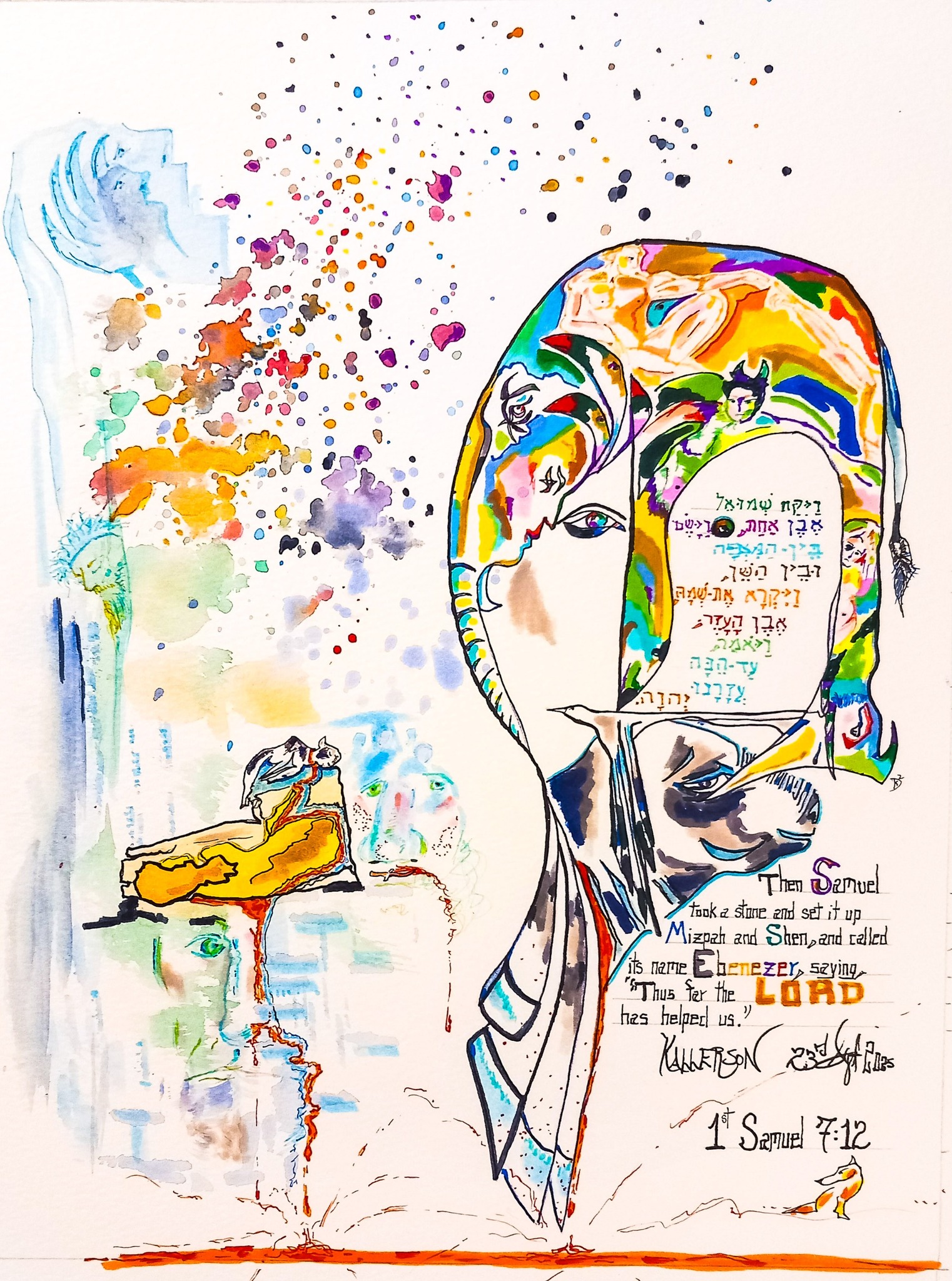
Artwork by Douglas Kallerson
1 Samuel 7:10-17
(The Stone of the Helper, Part II)
(Typed 30 July 2025) The verses in this sermon will complete an amazing journey, taking us typologically through dispensations of God’s redemptive plan. They convey truths that are presented logically so that things can be highlighted.
Some details are confusing unless laid out meticulously, but once they are, they resolve all kinds of difficulties that have arisen in the minds of scholars.
The way this is done is similar to many other passages in Scripture. For example, Genesis 1 gave a synopsis of the order of creation. However, there also needed to be a more detailed explanation so that we could understand why things are the way they are.
To do this, God gave us details of the sixth day of creation in Genesis 2, which flows logically into Genesis 3. Similarly, the narrative from the ending of 1 Samuel 3 through the end of 1 Samuel 7 somewhat follows this pattern, but it is a little more complicated.
Once you see how everything is presented, though, you will have a better understanding of why it was presented this way. It is orderly, fills in many necessary details, and allows us to see into the future concerning what God is doing.
Text Verse: “Let your conduct be without covetousness; be content with such things as you have. For He Himself has said, ‘I will never leave you nor forsake you.’ 6 So we may boldly say:
‘The Lord is my helper;
I will not fear.
What can man do to me?’” Hebrews 13:5, 6
The Hebrew words even ha’ezer mean Stone the Helper. The word even, stone, is used to describe the Lord at times, such as Genesis 49:24, where He is called the Stone of Israel. The Lord is called our Help or Helper in both testaments of the Bible.
One is a concrete image, the Stone. If someone asks you to describe the Lord in your life, you might say, “He is my Stone of Permanency.” People would understand that you mean an immovable stone.
The other is less concrete. If you ask someone to close his eyes and think of the Lord as his Helper, he might think of Him reaching down and grabbing him as he was drowning or boosting him over a wall he couldn’t quite scale. That, however, describes His actions, rather than an image of who He is.
Both types of thinking are helpful in grasping who the Lord is, because at times, understanding who He is relies on knowing what He does, what His thought process is like, or what His innate attributes are. He Helps. He is like a Stone. He is immortal. Each of these is a different aspect of how God is portrayed in the Bible.
Pay attention to these things. Revel in what you contemplate. And hold fast to such truths. As you go through life, you will need to consider the various presentations of God based on whatever situation you may be in or in how you are called to present Him for others to understand.
Such great truths as these are to be found in His superior word. And so, let us turn to that precious word once again, and… May God speak to us through His word today, and may His glorious name ever be praised.
I. Stone the Helper (verses 10-12)
10 Now as Samuel was offering up the burnt offering, the Philistines drew near to battle against Israel.
vayhi shemuel maaleh ha’olah u-phelishtim nigeshu lamilkhamah beyisrael – “And it was, Samuel causing to ascend the burnt offering, and Philistines they were approached to the battle in Israel.” This verse explains and expands upon what was said in the previous verse –
“And he took, Samuel, lamb – milk, one. And he caused to ascend burnt offering, whole, to Yehovah. And he shrieked, Samuel, unto Yehovah for Israel. And He answered him, Yehovah.” 1 Samuel 7:9
While the Philistines were approaching, Samuel offered the lamb and called out to the Lord for deliverance. Yehovah responded. That is explained in the next words…
10 (con’t) But the Lord thundered with a loud thunder upon the Philistines that day,
vayarem Yehovah beqol gadol bayom ha’hu al pelishtim – “And He caused to tumble, Yehovah, in voice great in the day, the it, upon Philistines.” This is the same word introduced in 1 Samuel 1:6 when Peninnah would vex Hannah, mocking her because of her barren womb. It signifies to tumble, meaning to violently agitate.
Likewise, it was used again in Hannah’s prayer, pretty much describing what is happening in this verse –
Yehovah:
They will sink – He causing to grapple upon Him.
In the heavens – may He cause to tumble [raam].
Yehovah:
He will judge extremity earth,
And He will give strength to His King,
And may He cause to rise horn His Messiah.” 1 Samuel 2:10
Saying He thundered assumes that He did this actively, like with a storm or other elements to confuse the Philistines. It may be that this occurred through the heat of battle. However the Lord tumbled the Philistines, His actions were effective…
10 (con’t) and so confused them that they were overcome before Israel.
vayhumem vayinagephu lipne Yisrael – “And He confused them, and they were smitten to faces Israel.” The word hamam is used. It has been seen at other times during great battles or events. It is derived from hum, to make an uproar. Thus, it is an onomatopoetic word referring to the loud hum of battle.
In this case, it is the Philistines who are confused and disorganized through the resounding voice, the hamam, of the Lord. Because of the great confusion of the Philistines, Israel seized the initiative…
11 And the men of Israel went out of Mizpah and pursued the Philistines,
vayetseu anshe Yisrael min ha’mitspah vayirdephu eth pelishtim – “And they went, men Israel, from the Mizpah, and they pursued Philistines.” Israel saw that the line of the Philistines had been broken. Therefore, leaving The Watchtower, they chased after them. As they did…
11 (con’t) and drove them back as far as below Beth Car.
vayakum ad mitakhath leveith kar – “And they struck them until from under to Beth Car.” This is the only mention of Beth Car in Scripture. Its location is unknown, but saying “from under to Beth Car” seems to indicate that it was on a hill above the path of flight used by the Philistines.
The meaning of the name is debated. The word kar has various meanings, including a type of domesticated animal, like a lamb, a battering ram, a pasture, or even a camel’s saddle. It is derived from the verb karar, to dance, but more specifically to twirl, found only in 2 Samuel 6.
Each of the meanings of kar gives the sense of accumulation, as in something circular that amasses as the circle is formed. The name is thus variously defined as House of a Lamb, House of Battering Rams, etc. Abarim goes to the source verb and says House of Accumulation. More simply, it could mean House of Twirling, as in forming a circular motion.
Because of the rout, it next says…
12 Then Samuel took a stone and set it up between Mizpah and Shen,
vayiqakh shemuel even akhath vayasem ben ha’mitspah u-ven ha’shen – “And he took, Samuel, stone one, and he put between the Mizpah and between the Shen.” Samuel set up a commemorative stone because of the events that took place. The location is between The Watchtower and The Shen, a place only mentioned here. Shen is identical to shen, a tooth. Thus, it literally means The Tooth.
The word shen is derived from shanan, to whet or sharpen. Intransitively, it means to pierce. In Deuteronomy 6:7, it is used to indicate the inculcation of instruction, as in “teach diligently,” but that is more of a paraphrase.
The idea in that verse of Deuteronomy is inculcating the commands into the children, but by using this word, it includes the idea of sharpness. It is as if the process of instilling the commands is so personal that the parent is cutting into the child and inscribing them into his heart and mind.
To get the sense, the word is used in Psalm 73:21 –
When my heart was embittered,
And I was pierced [shanan] within. Psalm 73:21 (NAS)
This was the responsibility of the parents, inscribing the commands of the law in the children. Paul uses a similar thought in Ephesians –
“And you, fathers, do not provoke your children to wrath, but bring them up in the training and admonition of the Lord.” Ephesians 6:4
This place, The Shen, was probably a pointed rock that stood out prominently like a tooth. As for the stone Samuel set up…
12 (con’t) and called its name Ebenezer, saying, “Thus far the Lord has helped us.”
There is an article which defines the stone: vayiqra eth shemah even ha’azer vayomar ad henah azaranu Yehovah – “and he called its name Stone the Helper. And he said, ‘Until hither He helped us, Yehovah.’” The stone is named Ezer, Helper. This is where it is named, but it was referred to in verse 4:1, anticipating this event –
“And he went out, Israel, to encounter Philistines to the battle. And they inclined upon the stone, the Ezer.” 1 Samuel 4:1
The use of two articles, the stone, the Ezer, shows that it was named previously. Samuel named it here in Chapter 7, but as it is referred to in Chapter 4, it shows that the narrative there was an insert. If you recall, the first words of Chapter 4 merged with the words of verse 7:3.
As an example, there is the story of Joseph being sold off to Egypt by his brothers in Genesis 37. Then the story of Judah and Tamar comprises Genesis 38. The narrative then returns to the life of Joseph in Egypt in Genesis 39.
Information needs to be inserted somewhere to explain events as they occur and which bear on redemptive history. Israel rejected the Lord after Jesus completed His work. The information about that and about what happened until the time Israel will accept Jesus in the future has been inserted between the opening clause of 4:1 until 7:3.
At verse 7:3, the narrative about Israel interacting with Samuel resumed. This will be explained more fully as the verses are evaluated. For now…
A twirling has taken place
It is recorded in a book
In it, you will find God’s face
Open it up and take a look
A story was compiled for us
Leading us from one point and back again
The word is about our Lord Jesus
He is the Redeemer, the Savior of men
Be sure to see how it is laid out
Look into it and see what has been amassed
The details will make you whoop and shout
Yes, its contents are an amazing blast
II. And He Judged Israel (verses 13-17)
13 So the Philistines were subdued, and they did not come anymore into the territory of Israel.
vayikaneu ha’pelishtim velo yasephu od labo bigvul Yisrael – “And they were humbled, Philistines, and not they added again to come in border Israel.” As noted in 1 Samuel 4:1, it is possible that this statement aligns with Judges 13:1 –
“Again the children of Israel did evil in the sight of the Lord, and the Lord delivered them into the hand of the Philistines for forty years.”
The narrative of Samson went through Judges 16. After his time, the Philistines continued to come into the borders of Israel until this point of Samuel’s time of judging. The statement is given as a fact. The Philistines were humbled, and after this, they no longer came across Israel’s border.
These words are not contradictory to what is next said, nor of verse 15…
13 (con’t) And the hand of the Lord was against the Philistines all the days of Samuel.
vatehi yad Yehovah ba’pelishtim kol yeme shemuel – “And it was, hand Yehovah, in the Philistines all days Samuel.” The “days Samuel” are interpreted by some scholars as the time of his judging Israel until the time when Saul became king. This is incorrect.
Verse 7:15 will say that Samuel judged Israel for his entire life. That would be inclusive of the time after Saul was anointed. There continued to be engagements with the Philistines during Saul’s time and into the time of David.
The words don’t mean that there were no battles with the Philistines. Rather, the Lord was against the Philistines all the days of Samuel, including when they warred against Israel. Embraced in this…
14 Then the cities which the Philistines had taken from Israel were restored to Israel, from Ekron to Gath;
vatashovenah hearim asher laqekhu phelishtim meeth Yisrael leYisrael meeqron vead gath veeth gevulan – “And they returned, the cities – which they took, Philistines, from Israel – to Israel, from Ekron and until Gath and their border.” This does not mean that Ekron and Gath were returned to Israel.
The word “from” appears to mean that there were cities in Israel that had been taken by the Philistines. These cities, up to the borders of Ekron and Gath, were restored to Israel.
Ekron comes from aqar, to pluck up or uproot. But that is from the same as eqer, an offshoot or descendant. Hence, the name could mean either Offshoot or Uprooted. Gath means Winepress.
The restoration of the cities and land next continues to be explained…
14 (con’t) and Israel recovered its territory from the hands of the Philistines.
hitsil Yisrael miyad pelishtim – “He caused to snatch, Israel, from hand Philistines.” Israel was able to reacquire all that was lost to the Philistines as they continued pushing back the Philistines to the borders of Ekron and Gath.
14 (con’t) Also there was peace between Israel and the Amorites.
vayhi shalom ben Yisrael u’ven ha’emori – “And it was peace between Israel and between the Amorite.” The Amorite is only mentioned in this verse in 1 Samuel. At times, like the word Canaanite, it is a general term for the inhabitants of the land. That is probably the intent here. A similar use was seen in Judges 6:10.
Though the statement may indicate that this peace resulted from the Amorites seeing the defeat of the Philistines and not wanting to be subdued in a similar manner, it may simply be a way of saying that not only were the Philistines no longer a threat, but there was no threat from the other inhabitants as well.
The latter seems likely because nothing has been said about them since Judges 11. Therefore, the statement would essentially mean, “Israel found peace throughout all its territory.”
Amorite means Renown.
15 And Samuel judged Israel all the days of his life.
vayishpot shemuel eth Yisrael kol yeme khaiyav – “And he judged, Samuel, Israel all days his livings.” This is a clear indication that even though Saul will be anointed and reign as king, Samuel will continue to judge Israel. This included judging Saul, as will be seen in his future interactions with him.
Therefore, it can be assumed that until the death of Samuel, the king held a military authority while Samuel continued as the highest judicial authority. He also served as prophet and even conducted mediatorial duties. Only after his death would these offices be separately and more precisely defined.
16 He went from year to year on a circuit to Bethel, Gilgal, and Mizpah,
v’halakh mide shanah beshanah vesavav beith el vehagilgal veha’mitspah – “And he walked from day year in year, and he revolved – Bethel and the Gilgal and the Mizpah.” The NKJV appears to be a proper paraphrase of the intent of the Hebrew. Each year at a set time, Samuel would head out on a circuit to each of these locations in order to judge the people.
Bethel means House of God. It is certain that this location is the city known as Bethel in the territory of Benjamin, the same spot which was visited by Jacob as he fled from Esau. There is no reason to assume it is referring to the place where the ark was, which would make it the “house of God” rather than Bethel.
Gilgal is from the same as gilgal, wheel. It signifies a circle, generally of stones. There are many such circles still in Israel today. There are three locations with this name in the Bible, but it is likely this is the spot referred to in Joshua, where Israel first set up camp after crossing the Jordan.
The name literally means The Wheel or The Rolling Away, but due to the Lord’s proclamation in Joshua 5, it metaphorically and typologically means The Liberty –
“Then the Lord said to Joshua, ‘This day I have rolled away the reproach of Egypt from you.’ Therefore the name of the place is called Gilgal to this day.” Joshua 5:9
As seen earlier, the Mizpah means The Watchtower. This is likely the Mizpah located in the land of Benjamin as well.
From year to year, Samuel would go to these three places on a circuit…
16 (con’t) and judged Israel in all those places.
veshaphat eth Yisrael eth kal hameqomoth ha’eleh – “And he judged Israel all the spots, the these.” The locations were suitable for people to easily come and receive his judgments. They are, however, located in a more southerly area of the land of Israel. Thus, his judging was rather localized, as was the case with the other judges.
17 But he always returned to Ramah, for his home was there.
utheshuvato ha’ramathah ki sham beito – “And his recurrence the Ramah-ward. For there his house.” In the first clause, there is a new word, teshuvah. It signifies a recurrence. This can be either in location or time. In Job 21, it even signifies the repetition of responses in a conversation.
In this case, it means that after going to judge each town in his circuit, he would head home toward Ramah, the place where his house was. This was where his father was from, also called Ramathaim Zophim in 1 Samuel 1:1.
The Ramah means The Height or The Lofty Place. As with the other three locations…
17 (con’t) There he judged Israel,
vesham shaphat eth Yisrael – “And there, he judged Israel.” As such, Samuel judged Israel in four locations, but mainly from his home in Ramah. Also…
*17 (fin) and there he built an altar to the Lord.
vayiven sham mizbeakh leYehovah – “And he built there altar to Yehovah.” At some point, Shiloh stopped being the place where the tabernacle was located. It could be that when the Philistines took the ark, Shiloh fell into disuse.
It doesn’t seem likely that it was destroyed by the Philistines because that is where Eli and his family were. Nothing is said of the Philistines destroying it. Whatever the case was with the tabernacle, the ark rested in Kiriath Jearim.
Despite the lack of information, we have this note concerning Samuel building an altar. This would have been constructed according to the law of the altar given in Exodus 20 –
“Then the Lord said to Moses, ‘Thus you shall say to the children of Israel: “You have seen that I have talked with you from heaven. 23 You shall not make anything to be with Me—gods of silver or gods of gold you shall not make for yourselves. 24 An altar of earth you shall make for Me, and you shall sacrifice on it your burnt offerings and your peace offerings, your sheep and your oxen. In every place where I record My name I will come to you, and I will bless you. 25 And if you make Me an altar of stone, you shall not build it of hewn stone; for if you use your tool on it, you have profaned it. 26 Nor shall you go up by steps to My altar, that your nakedness may not be exposed on it.”’” Exodus 20:22-26
With the verses complete, we can now look at why the Lord included the details of this chapter…
The time is yet ahead
When they shall know their Lord
No longer in their sins, dead
This is revealed in the word
Their history has been troubled
Because they didn’t know the Lord
At times, their punishment was doubled
Because they failed to heed the word
But a time lies ahead for Israel
When this will be forever ended
What a glorious story to tell
When their relationship with the Lord is mended
III. Pictures of Christ
Chapter 6 detailed the catastrophe of what occurred at Beth Shemesh, where the people looked into the Ark, and the Lord struck fifty thousand and seventy men of the people. That was explained as pointing to the period of time when Israel would suffer the punishment of “looking at the law” without the atoning blood of Christ.
In other words, Israel rejected the lesson of the Weakeners that was provided in the previous account, assumed that they were acceptable to God through the Law of Moses, and rejected the atonement that only Jesus can provide.
The ark was typologically given to prefigure Jesus. He is the One who embodies the law. The blood sprinkled on the mercy seat, anticipating His shed blood, is what protects believers from the consequences of law violation
Because of what happened, messengers were sent to Kirjath Jearim, telling them to come down and take it with them. It formed a picture of Jesus having been rejected by Israel. The picture is that of the church being offered Christ as its Head.
Chapter 7 began with the men of Kirjath Jearim taking the ark. It signifies the acceptance of Jesus’ work by the church. The ark was taken to the house of Abinadab in the hill. Abinadab, Father of Liberality, is a reference to the willing and generous nature of the Father to share the work of His Son with all –
“For the Scripture says, ‘Whoever believes on Him will not be put to shame.’ 12 For there is no distinction between Jew and Greek, for the same Lord over all is rich to all who call upon Him. 13 For ‘whoever calls on the name of the Lord shall be saved.’” Romans 10:11-13
Saying Abinadab’s house was “in the hill” is a way of tying this generosity to Christ’s cross. The word givah, hill, is identical to givah, Gibeah. Both are etymologically connected to Gabbatha. It was used many times in Judges as a typological representation of Christ’s work, culminating in His judgment and cross.
The liberality of this extends to the liberality of what results from accepting it –
“Blessed be the God and Father of our Lord Jesus Christ, who has blessed us with every spiritual blessing in the heavenly places in Christ, 4 just as He chose us in Him before the foundation of the world, that we should be holy and without blame before Him in love, 5 having predestined us to adoption as sons by Jesus Christ to Himself, according to the good pleasure of His will, 6 to the praise of the glory of His grace, by which He made us accepted in the Beloved.” Ephesians 1:3-6
Verse 1 continued with the words, “And Eleazar, his son, they will consecrate to guard Ark Yehovah.” Eleazar means Whom God Helps. In the final Judges 20 sermon, a person with the same name pictured Jesus the High Priest. The symbolism remains the same here. It is exactingly reflected in the words of Hebrews –
“As He also says in another place:
‘You are a priest forever
According to the order of Melchizedek’;
7 who, in the days of His flesh, when He had offered up prayers and supplications, with vehement cries and tears to Him who was able to save Him from death, and was heard because of His godly fear, 8 though He was a Son, yet He learned obedience by the things which He suffered. 9 And having been perfected, He became the author of eternal salvation to all who obey Him, 10 called by God as High Priest “according to the order of Melchizedek.” Hebrews 5:6-10
Verse 2 said that the days the ark was there increased. It is a way of saying, “a long time.” That is a great description of the church age while Israel remains under punishment and without the Lord.
The noted time period, twenty years, wasn’t the time the ark was at this location, but the time that “groaned, all house Israel, after Yehovah.” It was during this period that the state of Israel was described by the Pulpit Commentary.
They were merely commenting on what those twenty years would have been like, but listen to their words again and think of the state of Israel for the past two thousand years. What they say could not better describe Israel’s situation –
“The words dwell wearily upon the length of this mournful period, during which Israel was in a state of subjection to the Philistines, with its national life crushed to the ground, and its strength wasted by unjust exactions and misrule. For though the Philistines gave up the ark, there was no restoration of the national worship, nor did they abandon the political fruits of their victory at Eben-ezer. But quietly and calmly Samuel was labouring to put all things right. It was the principle of the theocracy that Jehovah punished his subjects for their sins by withdrawing his protection, and that on their repentance he took again his place at their head as their king, and delivered them.” Pulpit Commentary
The spiritual meaning of twenty in the Bible is expectancy. It is an exact description of Israel’s past two thousand years. They have held fast to the idea of the coming Messiah this whole time, not realizing they missed Him when He came. And so, they remain lamenting after the Lord until this day.
The narrative completely changed direction in verse 3. But to understand the flow of the book, we have to go back and revisit the end of Chapter 3, where I promised to explain how it all fits together.
The narrative of Eli ended in Chapter 3 with verse 18. From there, three points of fact about Samuel were introduced. After that, Chapter 4 began with a single clause about Samuel and then went back to the narrative beginning with the ark being captured. That goes from 4:1b until 7:2. As such, the words form a long parenthetical insert, ending with the church age (verses 7:1, 2).
The church age ends with the rapture. It is at that time that the narrative that began in 3:19 resumes. 3:19-21 provided information about Samuel, which takes place after the church age –
Points of fact concerning Samuel:
3:19 And he will grow, Samuel. And Yehovah, He was with him. And not he caused to fall from all His words, ground-ward. 20 And it will know, all Israel, from Dan and until Beer-Sheba, for being faithful, Samuel, to prophet to Yehovah. 21 And He will cause to add, Yehovah, to be seen in Shiloh. For He was denuded, Yehovah, unto Samuel in Shilo in word Yehovah.
The meaning is that Samuel, Asked from God and signifying the seed of grace (Christ and those in Him), will eventually be recognized by all of Israel. The words from Dan to Beersheba speak of the totality of Israel, just as in Judges 20.
Because this comes after the rapture, it is inclusive of the tribulation period. Dan represents the time of and after the rapture, something hinted at by James 5:9, where he says the Judge stands at the door. Beersheba refers to the seven years of the tribulation initiated by the antichrist, as was the case in the story of Genesis 26 and Judges 20.
During this period, Yehovah “will cause to add” to be seen in Shiloh (Tranquility), meaning the state of those who have come to Christ. This is because the Lord revealed (denuded) Himself unto the seed of grace in Shilo (the time before the giving of the Spirit, indicated by the missing letter hey (h) on Shiloh during the tribulation. That is what the state of being under the law is: a time lacking grace.
It is at that time that the words of 7:3 resume the narrative. The details of 4:1b to 7:2 had to be stated somewhere. Looking at it in this manner exactingly resolves all of the seeming conflicts and contradictions referred to by scholars throughout the centuries.
Verse 7:3, after reintroducing Samuel, then went on to say, “If in all your heart you returning unto Yehovah, you must cause to turn aside gods the foreign from your midst, and the Ashtaroth. And you must cause to erect your heart unto Yehovah. And you must serve Him to His separation. And may He cause to snatch away, you, from hand Philistines.”
According to the dispensational model, this is just what is expected to happen at the end of the tribulation. Remember the meaning of Ashtaroth! One Law. Israel is being told to have no other gods (something they have a lot of now) and to remove the ONE LAW!
Jesus fulfilled the law. It is not what God wants for Israel. Rejecting Jesus and sticking to Moses is exactly what caused all of their troubles for the past two millennia. Instead, they are collectively told to “erect your heart unto Yehovah. And you must serve Him to His separation.” It is Jesus Christ, plus nothing, to whom they are to direct their hearts!
In doing that, Israel will be saved from the hand of the Weakeners. Verse 4 said this is just what they did. In verse 5, they were told to gather at the Mizpah. As in Judges, Mizpah signifies that the Lord is watching over the process of what transpires.
There, Israel gathered and poured out water before the Lord and fasted. It is the national contrition referred to, particularly in the book of Zechariah where the people will acknowledge their sin before the Lord.
“And I will pour on the house of David and on the inhabitants of Jerusalem the Spirit of grace and supplication; then they will look on Me whom they pierced. Yes, they will mourn for Him as one mourns for his only son, and grieve for Him as one grieves for a firstborn. 11 In that day there shall be a great mourning in Jerusalem, like the mourning at Hadad Rimmon in the plain of Megiddo.” Zechariah 12:10, 11
Verse 6 ended with the words that Samuel judged the sons of Israel in the Mizpah. It is also just what will occur at this time according to the dispensational model. Naturally, there will be an upheaval at this time when the Weakeners, those who refuse to come to Christ and insist on law observance, will come against those who have received Christ. That is reflected in verses 7 and 8.
Because of this, it says that Samuel took a lamb – milk one, and offered it. This type of lamb is noted only here and in Isaiah 65:25. It signifies one that is spotted. The word comes from tala, to patch or cover with pieces. That word was used six times in Genesis 30 when referring to the spotting of Jacob’s flocks.
That was a picture of the growth of the church based on Paul’s epistles, which detail the work of Christ. This is the same thought here. Paul’s letters will be accepted by Israel, and his words will be returned in their hearts as an offering to God. The fact that it is a milking lamb signifies acceptance of the milk of the word as well.
In accepting the full revelation of the word, last week’s sermon ended with, “And He answered him, Yehovah.” The Lord will accept those who accept Him. Because of this, verse 10 began the verses today noting that Yehovah caused to tumble upon the Philistines, the Weakeners.
The meaning is that this unsound doctrine is rejected by the Lord and will be overthrown. Israel then chased after them and drove them back to Beth Car, House of Twirling. It signifies a circular motion while accumulating. It is the same symbolism as the agalah, the cart, of Chapter 6. It refers to the circular nature of the Bible.
As it turned in redemptive history, it accumulated, book after book, until it returned to its beginning. The idea is “The detailed record, from paradise to paradise.”
With this victory, it next said in verse 12, “And he took, Samuel, stone one, and he put between the Mizpah and between the Shen.” The meaning of Shen is Tooth, but that is derived from shanan, to whet or sharpen. Intransitively, it means to pierce.
It is a noun, thus indicating to sharpen, to pierce, and to inculcate through instruction. All three thoughts coalesce in one verse in Scripture when referring to… Scripture –
“For the word of God is living and powerful, and sharper than any two-edged sword, piercing even to the division of soul and spirit, and of joints and marrow, and is a discerner of the thoughts and intents of the heart.” Hebrews 4:12
Understanding this, verse 12 continued with Samuel calling the stone Stone the Helper, saying, “Until hither He helped us, Yehovah.” A truer statement could not be said of Israel at the end of the tribulation period. From beginning to end, He has been their Stone, the Helper, even when they failed to recognize it.
Verse 13 noted that the Philistines (Weakeners) did not come again into the border of Israel. Adam Clarke, who almost wholly dismisses typology as a biblical doctrine, commented on this verse. Despite not believing in any future typological pictures, his words perfectly match the state of Israel at that time –
“They came no more into the coast of Israel – Perhaps a more signal victory was never gained by Israel; the Lord had brought them low, almost to extermination; and now, by his miraculous interference, he lifts them completely up, and humbles to the dust their proud oppressors. God often suffers nations and individuals to be brought to the lowest extremity, that he may show his mercy and goodness by suddenly rescuing them from destruction, when all human help has most evidently failed.” Adam Clarke
For Israel, it is the end of the nightmare of law observance being shoved down their throat since its fulfillment by Christ. The Lord will stand against it as long as the seed of Grace, pictured by Samuel, continues.
Verse 14 noted the returned cities from Ekron to Gath. Ekron means Uprooted and Offshoot. It is a double entendre. Those who remain under law observance will be uprooted, but those who acknowledge Christ alone will have their sins uprooted. They will be the offshoot of their response to the law or the Lord.
Gath signifies Winepress. It refers to the judgment at the end of the tribulation period. All that belongs to Israel on that day, as promised in the prophets, will once again be restored to them in preparation for the millennium. Verse 14 also mentioned peace between Israel and the Amorite, Renown.
As seen in Judges 1, the name can be used positively about believers or negatively about nonbelievers. In this case, it is referring to those who have their renown because of Christ. All believers will be in a state of peace at that time.
Verse 16 noted that Samuel judged Israel all the days of his life, going from Bethel (House of God) to the Gilgal (The Liberty) to the Mizpah (The Watchtower). It is reflective of the all-encompassing work of Christ from heaven, in freedom from law, and with the supervision of God over His people.
Verse 17 finished with the note concerning Samuel returning Ramah-ward where his house is. From there, he judged Israel, and it is where he built an altar.
The Ramah is The Height (meaning The Lofty Place). As in previous sermons, it signifies the position the Lord places believers because of their faith in Him. Building an altar there is a picture of the Lord Jesus in His humanity.
To understand the significance, you are encouraged to go back and watch the Exodus 20:18-26 sermon entitled “The Earthen Altar” –big fun for you tonight. It is an exceptionally fitting end to the chapter, highlighting the humanity of the Lord Jesus who took on the sin of the world to redeem fallen man. Israel will finally understand this someday and call out to Him for salvation.
With these verses complete, a snapshot of Israel’s history, which also typologically concerns the relationship of the Lord and the church during this dispensation, has been presented. These chapters have set forth propositions that need to be understood. They have set forth truths which are to be believed. And they have repeatedly revealed the problem with law and our need for grace.
From here, 1 Samuel will develop in dispensational theology. It was necessary that these points be presented for a fuller and more complete understanding of what God is doing in redemptive history. There has been enough overlap with other such accounts to ensure we know the accuracy of what has been presented.
And yet, there has been enough new information to continue to instruct us on what God is doing and why. Above all, the message of Jesus’ work and His fulfillment of the law is on prominent display. Please learn the lesson of law versus grace.
One will lead to alienation, the other to salvation. Hold fast to the grace of God which is found in Jesus Christ our Lord. This is what will bring you to a state of harmony with God once again.
Closing Verse: “We then, as workers together with Him also plead with you not to receive the grace of God in vain. 2 For He says:
‘In an acceptable time I have heard you,
And in the day of salvation I have helped you.’
Behold, now is the accepted time; behold, now is the day of salvation.” 2 Corinthians 6:1, 2
Next Week: 1 Samuel 8:1-22 Until it is done, we will from verse to verse leaple… (Hear the Voice of the People) (15th 1 Samuel Sermon)
The Lord has you exactly where He wants you. He has a good plan and purpose for you. He is the One who abases the haughty and exalts the humble. He regards the lowly, and the proud He knows from afar. So yield yourself to Him, trust Him, and believe His word. In this, He will do great things for you and through you.
1 Samuel 7:10-17 (CG)
10 And it was, Samuel causing to ascend the burnt offering, and Philistines they were approached to the battle in Israel. And He caused to tumble, Yehovah, in voice great in the day, the it, upon Philistines. And He confused them, and they were smitten to faces Israel. 11 And they went, men Israel, from the Mizpah, and they pursued Philistines. And they struck them until from under to Beth Car. 12 And he took, Samuel, stone one, and he put between the Mizpah and between the Shen, and he called its name Stone the Helper. And he said, “Until hither He helped us, Yehovah.”
13 And they were humbled, Philistines, and not they added again to come in border Israel. And it was, hand Yehovah, in the Philistines all days Samuel. 14 And they returned, the cities – which they took, Philistines, from Israel – to Israel, from Ekron and until Gath and their border. He caused to snatch, Israel, from hand Philistines. And it was peace between Israel and between the Amorite.
15 And he judged, Samuel, Israel all days his livings. 16 And he walked from day year in year, and he revolved – Bethel and the Gilgal and the Mizpah. And he judged Israel all the spots, the these. 17 And his recurrence the Ramah-ward. For there his house. And there, he judged Israel. And he built there altar to Yehovah.
1 Samuel 7:10-17 (NKJV)
10 Now as Samuel was offering up the burnt offering, the Philistines drew near to battle against Israel. But the Lord thundered with a loud thunder upon the Philistines that day, and so confused them that they were overcome before Israel. 11 And the men of Israel went out of Mizpah and pursued the Philistines, and drove them back as far as below Beth Car. 12 Then Samuel took a stone and set it up between Mizpah and Shen, and called its name Ebenezer, saying, “Thus far the Lord has helped us.”
13 So the Philistines were subdued, and they did not come anymore into the territory of Israel. And the hand of the Lord was against the Philistines all the days of Samuel. 14 Then the cities which the Philistines had taken from Israel were restored to Israel, from Ekron to Gath; and Israel recovered its territory from the hands of the Philistines. Also there was peace between Israel and the Amorites.
15 And Samuel judged Israel all the days of his life. 16 He went from year to year on a circuit to Bethel, Gilgal, and Mizpah, and judged Israel in all those places. 17 But he always returned to Ramah, for his home was there. There he judged Israel, and there he built an altar to the Lord.