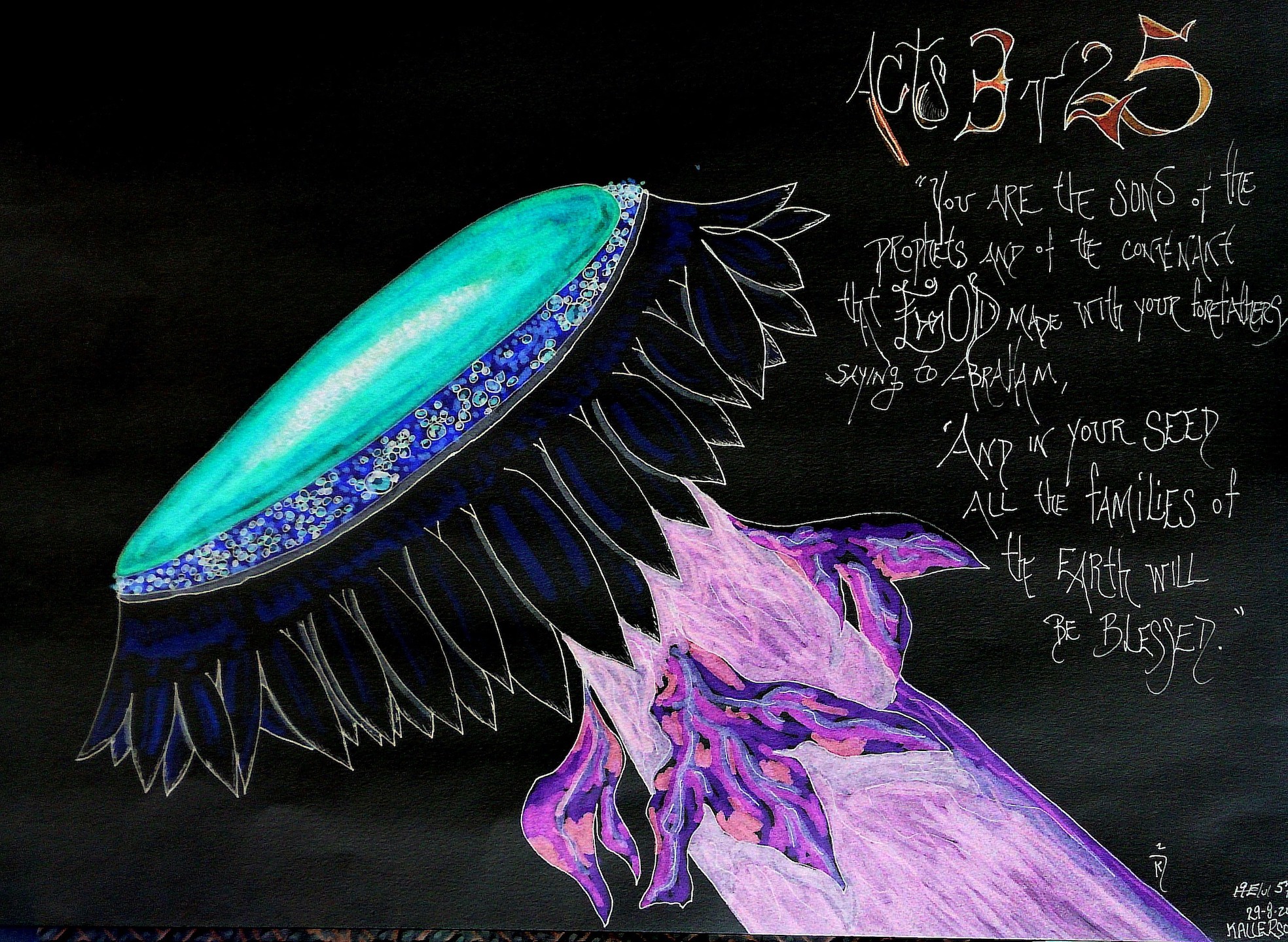
Deuteronomy 29:1-9
I Have Led You Forty Years in the Wilderness
In Amos 9, and which is referring to Israel, it says –
“‘I will plant them in their land,
And no longer shall they be pulled up
From the land I have given them,’
Says the Lord your God.” Amos 9:15
It is one of those verses that simply cannot be spiritualized, and so I like to remind people of it from time to time. It is speaking of a particular group of people, a particular land that they were given, and of an occurrence that can have only one meaning.
That meaning cannot be, “This was fulfilled when they were returned from Babylon.” This is because the people being addressed were sent into exile from their land again after that.
Nor can the meaning be, “This is fulfilled in Christ’s work during His first advent and the church has now replaced Israel.” Only a fool would attempt to make such a claim. The church is not given a land grant to where Israel is today. In fact, it is given no land grant at all.
Either the words are in error, and thus the Bible is not the word of God, or the words – without any other possible meaning – are that Israel the people will be brought back to Israel the land, and when that occurs, they will never be uprooted from the land again.
Any other analysis does damage to the intent of the words. But this should not surprise us that the Lord would bring them back and do this. The reason why is not because of them at all, but because of Him – His glory, His honor, His covenant-keeping.
The keeping of Israel, even through the destruction of Israel, is seen once again in our passage today. It is because of the righteousness of the Lord, and nothing that they have done, that this has come about.
Text Verse: “But now the righteousness of God apart from the law is revealed, being witnessed by the Law and the Prophets, 22 even the righteousness of God, through faith in Jesus Christ, to all and on all who believe.” Romans 3:21, 22
What is important to understand concerning Israel is that Isaiah said, even before there was a first exile, that there would be a second one –
“It shall come to pass in that day
That the Lord shall set His hand again the second time
To recover the remnant of His people who are left,
From Assyria and Egypt,
From Pathros and Cush,
From Elam and Shinar,
From Hamath and the islands of the sea. Isaiah 11:11
The return of Israel to the land in our day was clearly spoken of and it is something that will never be needed to occur again. God’s word tells us that this is the case.
The righteousness of God is reflected in the law. That should be taken as an axiom. “This is God’s law, and therefore, it reflects His righteousness.” That isn’t a problem at all. The problem isn’t found in the law. Rather, it is found in our inability to meet the demands of the law. As Moses says to Israel, “Therefore, keep the words of this covenant, and do them.”
If one was actually able to perform as Moses says, what would that mean concerning such a person? Think on that and we’ll find out before we close. Once you realize what the inevitable answer must be, you can see why even thinking it is an utterly crazy notion.
And this is why Paul says, “But now the righteousness of God apart from the law is revealed.” He then explains what that means, saying, “…even the righteousness of God.” What is it that pleases God? It isn’t our attempts at being righteous, but in trusting in His provision of righteousness.
As Paul says, this is revealed in “the Law and the Prophets.” Israel is promised to never be uprooted from their land again. And this is, according to Isaiah, after a second exile.
That will take some doing. In failing to uphold the law, being uprooted from the land is an inevitable consequence. But we are assured in the word that they will be planted, and they will remain. That can only mean one possible thing as well… Jesus.
It’s all to be found in His superior word. And so, let us turn to that precious word once again and… May God speak to us through His word today and may His glorious name ever be praised.
I. The Words of the Covenant (verse 1)
These are the words of the covenant
The Hebrew Bibles will have this verse affixed to the end of Chapter 28 as a completing thought for the blessings and the curses. But the word translated as “these” does not necessarily speak of either what precedes or what follows. It simply speaks of something in the surrounding text.
In this case, Moses speaks of the covenant in the coming verses. Therefore, this verse is surely rightly fixed as an opening to Chapter 29, as he says in verse 29:12, “that you may enter into covenant with the Lord your God, and into His oath, which the Lord your God makes with you today.” He again refers to it in verse 29:15.
1 (con’t) which the Lord commanded Moses to make
asher tsivah Yehovah eth Moshe likrot – “which commanded Yehovah Moses to cut.” The word karath signifies to cut off, cut down, etc. A covenant is said to be “cut” because it involved the cutting of flesh and then the parties passing through the pieces of the animal.
As such, it was a witness to the severity of the covenant. One might say, “Just as this animal was cut in order to establish this covenant, so may it happen to me if I violate it.” In the case of this covenant, it is one commanded to be enacted by Moses at the command of the Lord. The other party is next stated…
1 (con’t) with the children of Israel
The Hebrew reads, “sons of Israel,” signifying those who represent the tribes from whom the people issue. Jacob, who is Israel, was the son of promise, and his twelve sons, along with his two adopted sons – meaning the sons of Joseph – comprise the family whom the Lord chose to continue to reveal Himself in the history of redemption. This is next specifically said to be…
1 (con’t) in the land of Moab,
This is now almost forty full years after the reception of the law at Sinai. It is in another country, and it is after an extended period of exile in the wilderness. And yet, the words are being spoken forth as law to which Israel is to be bound to.
The name Moab means, “From Father.” As such, the words anticipate that which comes from God, and which will be carried out by Him in the giving of Christ. For now, one might ask, “Under what authority does the right exist to heap more laws upon the people…”
1 (con’t) besides the covenant which He made with them in Horeb.
milebad ha’berit asher karath itam b’khorev – “from alone the covenant which cut with them in Horeb.” It is of note that this is the last time the name Horeb is used in Deuteronomy. It means “Arid,” “Waste,” or “Desolate,” coming from kharav, meaning to be dry or dried up.
It was first used in Exodus 3:1 when Moses came to the mountain and the Lord spoke to him from the burning bush. The idea that is being conveyed is that the word of the Lord, meaning that which provides life, is coming from the barren place. The Lord is doing something in the world to bring restoration. That process is uniquely tied into this covenant that was made at Horeb.
The words of the Lord, through Moses, which comprise this part of the law, are specifically said to be “apart” or “besides” those given at Horeb (meaning Sinai). What authority is there to add these words? That will be explained in a moment.
As far as the words here, they are similar to those that ended Chapter 26 of Leviticus. That was the chapter that detailed the blessings and the curses that could be expected to come upon Israel as spoken forth by the Lord.
This first verse of Deuteronomy 29 also follows right after the chapter that detailed the blessings and the curses of this book –
“These are the statutes and judgments and laws which the Lord made between Himself and the children of Israel on Mount Sinai by the hand of Moses.” Leviticus 26:46
“These are the words of the covenant which the Lord commanded Moses to make with the children of Israel in the land of Moab, besides the covenant which He made with them in Horeb.”
If the covenant was cut at Sinai, how can it be that more laws can be added to the covenant? The word “besides” is not indicating a new covenant, but that the words are added to the covenant besides that which has already been given.
The answer goes back to Exodus. The covenant was first agreed to in Exodus 19:7, 8 –
“So Moses came and called for the elders of the people, and laid before them all these words which the Lord commanded him. 8 Then all the people answered together and said, “All that the Lord has spoken we will do.”
Then, in Exodus 24, the ceremony for the cutting of the covenant was conducted, animals were sacrificed, and the blood was sprinkled. At that time, it said –
“Then he took the Book of the Covenant and read in the hearing of the people. And they said, ‘All that the Lord has said we will do, and be obedient.’” Exodus 24:7
The words they spoke, qol asher dibber Yehovah na’aseh v’nishma, mean, “All that the Lord has said we will do, and we will hear.” The word used there, shema, means to hear, but hearing is often associated with obedience, such as “I want you to hear me,” which means “I want you to do as I say.”
However, one cannot be obedient unless he first hears. In the preceding chapter of Exodus, before this covenant rite was conducted, it said –
“Behold, I send an Angel before you to keep you in the way and to bring you into the place which I have prepared. 21 Beware of Him and obey His voice; do not provoke Him, for He will not pardon your transgressions; for My name is in Him. 22 But if you indeed obey His voice and do all that I speak, then I will be an enemy to your enemies and an adversary to your adversaries.” Exodus 23:20-22
In other words, despite the covenant being cut in Exodus 24, more words of instruction were already said to be coming from the Lord to which the people must be attentive. This is why the people said the words, “…and we will hear.” They committed to doing even before hearing.
The people didn’t say that they would hear and then they would obey. They said that they would do, and then they will hear – meaning both hear and then do what has been heard. The Book of the Covenant which was presented to them, and which led to the cutting of the covenant, was not the entire body of the law. It is what the entire body of the law was based on.
After that, however, Israel violated that same covenant. While Moses was on the mountain receiving the continued law, the people fashioned the golden calf. In this, they violated the covenant, and the Lord had every right to destroy them based on their disobedience.
However, Moses petitioned for them, and the Lord – full of grace and mercy – forgave their sin –
“The Lord, the Lord God, merciful and gracious, longsuffering, and abounding in goodness and truth, 7 keeping mercy for thousands, forgiving iniquity and transgression and sin, by no means clearing the guilty, visiting the iniquity of the fathers upon the children and the children’s children to the third and the fourth generation.” Exodus 34:6, 7
It was at this time, while Moses was again on the mountain, that the Lord agreed to Moses’ petition and said to him –
“Behold, I make a covenant. Before all your people I will do marvels such as have not been done in all the earth, nor in any nation; and all the people among whom you are shall see the work of the Lord. For it is an awesome thing that I will do with you.” Exodus 34:10
The words confirmed that Moses’ request was granted. The Lord said, hinneh anoki koreth berit – “Behold, I cut a covenant.” The Lord was confirming that the covenant would continue.
Israel had broken it and it could have been annulled. As such, they would have been liable to the entire weight of the penalty – meaning death – as pictured in the original shedding of the blood of the animals. But they had found grace.
Moses interceded for the people, and the Lord relented from fulfilling the terrifying terms of the covenant which they had violated. From here on, it is the Lord God that made, or “cut,” the covenant. It is one-sided and therefore if there was any disagreement, Israel would bear the blame. Likewise, if there was harmony between the two, only the Lord would receive the glory.
What occurred in Exodus 34 did not mean that the original covenant was simply reinstated. Nor did it mean that there was a “new covenant.” In the forgiving of the people’s transgressions, the thought “describes rather His future rule as a constant, continuous establishment of a covenant” (Lange).
Therefore, the entire time of His dealing with Israel under the covenant is a transitional phase that only anticipates a New Covenant. This is confirmed many hundreds of years later in the words of Jeremiah –
“Behold, the days are coming, says the Lord, when I will make a new covenant with the house of Israel and with the house of Judah— 32 not according to the covenant that I made with their fathers in the day that I took them by the hand to lead them out of the land of Egypt, My covenant which they broke, though I was a husband to them, says the Lord. 33 But this is the covenant that I will make with the house of Israel after those days, says the Lord: I will put My law in their minds, and write it on their hearts; and I will be their God, and they shall be My people. 34 No more shall every man teach his neighbor, and every man his brother, saying, ‘Know the Lord,’ for they all shall know Me, from the least of them to the greatest of them, says the Lord. For I will forgive their iniquity, and their sin I will remember no more.” Jeremiah 31:31-34
The word of the Lord through Jeremiah points back to the covenant that was broken by Israel after being brought out by the Lord. Thus, the law of Moses is a transitional phase of the Lord’s redemptive workings. It only anticipates a New Covenant at some point in the future.
Until that time, the Mosaic Law continued to be added to in Moab, and it was then explained and spoken forth by prophets during the time of its administration, right up until the coming of Christ who would fulfill it, annul it through His blood, and at the same time initiate a New Covenant.
Because of these things, there is no need for sacrifices to confirm the covenant. It is a part of the ongoing covenant that began at Horeb (Sinai). This is confirmed by what was said early in Deuteronomy as well –
“The Lord our God made a covenant with us in Horeb.” Deuteronomy 5:2
It is taken as an axiom there that what Moses says afterwards in Deuteronomy is all a part of this same covenant. But an important point concerning this on-going giving of the law is that it anticipates the call of the Gentiles as well as the restoration of Israel. That will be seen later, in Chapter 32 –
“Rejoice, O Gentiles, with His people;
For He will avenge the blood of His servants,
And render vengeance to His adversaries;
He will provide atonement for His land and His people.”
Paul cites this in Romans 15 to show that even the Mosaic Covenant anticipated the inclusion of the Gentiles in what God is doing in His redemptive plans. Everything is tied up in the coming of Messiah, everything.
Looked at from this perspective, and understanding what He is doing, it is incredible that people believe the church has replaced Israel. What the Lord has done is for them and through them. The Gentiles are graciously grafted into what is promised to Israel. With this understood, the narrative continues…
The covenant is made, and it will stand
Even if you fail to do your part of it
You may be exiled from your land
But I will keep you always; to this, I commit
When you fail to keep and to do
I will still be sure to uphold My part, My friend
My words, like Me, are faithful and true
And I will perform My word, even to the end
**You, O God, are our only hope, it is true
And to You, O God, shall our praises forever ring
We shall hold fast to the One who is faithful and true
And to Him shall our voices forever sing
II. That You May Prosper (verses 2-9)
2 Now Moses called all Israel and said to them:
What Moses will do now is comparable to what Joshua will later do in Joshua 24. It is a way of reminding the people of the past so that they will pay heed into the future. In order to do this, he calls together the entire assembly. In their gathering, he says…
2 (con’t) “You have seen all that the Lord did before your eyes in the land of Egypt,
The words “You have seen” are emphatic. It is as if he says, “You most certainly have seen.” Although it was forty years earlier, the elders were alive at the time and they can speak for all, witnessing to the truth of Moses’ words.
In this, Moses returns the minds of the people back to Egypt once again. He is doing this to make a point concerning the greatness of the Lord. If He has performed magnificently and fearfully in the past, He is fully capable of doing so in the future as well.
The covenant is what binds the two parties together, and the Lord has the right to judge every infraction against it. If the Lord did the great things that Moses now describes in order to establish His covenant with Israel, then how much more should He do great things against those who trample underfoot the covenant!
2 (con’t) to Pharaoh and to all his servants and to all his land—
The Lord brought plagues against the mighty nation that Israel was in bondage to. Pharaoh ruled over them and yet, the Lord was victorious over him. At the same time, the Lord brought judgment against the servants of Pharaoh while sparing Israel. Likewise, the Lord brought destruction upon the land, and yet He spared the land of Goshen where Israel was.
The judgments were targeted, precise, and severe. Israel, even those before Moses now, saw this with their own eyes…
3 the great trials which your eyes have seen,
The previous verse was in the plural – “Now Moses called all Israel and said to them: “You (pl) have seen all that the Lord did before your (pl) eyes in the land of Egypt, to Pharaoh and to all his servants and to all his land.” This verse now switches to the singular, addressing the nation collectively –
“the great trials which your (sg) eyes have seen, the signs, and those great wonders.” As normally is the case, Cambridge arrogantly denies the words are from a single source, saying that the singular “betrays the composite nature of the passage.”
Anyone adding new verses in, and wanting them to look original, would have consistently used the plural. But when considering this from Moses’ seat as he addresses the people, the change from the plural to the singular is both natural and expected.
Not every person gathered before him was alive during the entire time from the exodus until arriving at Moab. The change to the singular acknowledges that.
As far as the words here, they reflect the sentiment spoken by him in Chapter 4, repeating what he said there to some extent –
“Or did God ever try to go and take for Himself a nation from the midst of another nation, by trials, by signs, by wonders, by war, by a mighty hand and an outstretched arm, and by great terrors, according to all that the Lord your God did for you in Egypt before your eyes?” Deuteronomy 4:34
In this he begins with the word massah, meaning testing or trials. It is derived from nasah, to test, or try. This is probably referring to the trials of the people prior to Moses’ arrival. They were in hard bondage, they were afflicted and tested –
“Then the children of Israel groaned because of the bondage, and they cried out; and their cry came up to God because of the bondage. 24 So God heard their groaning, and God remembered His covenant with Abraham, with Isaac, and with Jacob. 25 And God looked upon the children of Israel, and God acknowledged them.” Exodus 2:23-25
3 (con’t) the signs,
The othoth, or signs, are things given to represent something else. The Lord gave Moses three signs to give to Israel – the rod which turned into a snake, the leprous hand, and the water which turned to blood. He also gave signs to Pharaoh concerning what would come upon them as the Lord accomplished His work. Next…
3 (con’t) and those great wonders.
v’ha’mophtim ha’gedolim ha-hem – “and the wonders, the great, the those.” The mopheth, or wonder, comes from yaphah, or beautiful. It speaks of that which is conspicuous and amazing.
This then refers to the plagues which came upon the land. And yet, it also speaks of the fact that Israel was spared at the same time. While Egypt was destroyed, Israel survived through the plagues – each time, it was a wonder in itself. Despite seeing these…
4 Yet the Lord has not given you a heart to perceive
The words continue in the singular. There are those in the congregation that this doesn’t apply to, like Joshua and Caleb. However, as a whole, Israel is being exactingly described by their leader.
He uses the word yada, meaning “to know.” It is something that is ascertained by seeing. In the Bible, the heart is the seat of reasoning and intellect. But what occurs in the heart must be processed after information has been obtained. Israel has been presented with the sights –
“You have seen all that the Lord did before your eyes in the land of Egypt, to Pharaoh and to all his servants and to all his land— 3 the great trials which your eyes have seen, the signs, and those great wonders.”
Despite the sensory input, there is no perception as to the meaning behind what they have seen. This is then explained by the next words…
4 (con’t) and eyes to see and ears to hear, to this very day.
This is not referring to their literal eyes and ears. He has just told them that their eyes saw. In this, he has moved to metaphor and is equating the eyes and the ears to spiritual sensors. This is repeated by Jeremiah where he uses the word “heart” which is translated as understanding, as well as eyes and ears –
“Hear this now, O foolish people,
Without understanding,
Who have eyes and see not,
And who have ears and hear not:” Jeremiah 5:21
This is a theme that carries on throughout the Old Testament, and it is repeated in the New, both when referring to Israel, such as when Paul cites Isaiah in Acts 28 –
“Go to this people and say:
‘Hearing you will hear, and shall not understand;
And seeing you will see, and not perceive;
27 For the hearts of this people have grown dull.
Their ears are hard of hearing,
And their eyes they have closed,
Lest they should see with their eyes and hear with their ears,
Lest they should understand with their hearts and turn,
So that I should heal them.’” Acts 28:26, 27
It is also a prayer that Paul made, desiring that his disciples would receive these spiritual sensors –
“that the God of our Lord Jesus Christ, the Father of glory, may give to you the spirit of wisdom and revelation in the knowledge of Him, 18 the eyes of your understanding being enlightened; that you may know what is the hope of His calling, what are the riches of the glory of His inheritance in the saints, 19 and what is the exceeding greatness of His power toward us who believe, according to the working of His mighty power 20 which He worked in Christ when He raised Him from the dead and seated Him at His right hand in the heavenly places, 21 far above all principality and power and might and dominion, and every name that is named, not only in this age but also in that which is to come.” Ephesians 1:17-21
As with Jeremiah just a moment ago, Paul’s words literally state “being enlightened the eyes of your heart.” The spiritual sensors are to work in accord with the intellect, producing discernment concerning the things of God. However, Moses tells Israel that they still had not arrived at this type of wisdom.
Considering the fact that the time of wilderness wandering is a mirror of the exile of Israel over these past two thousand years, it is evident that Moses’ words are being prophetically directed to Israel today.
After all this time, they still do not understand their role in the redemptive scenario, and they still do not understand that they are, even now, being directed by Moses to look and find Christ –
“But their minds were blinded. For until this day the same veil remains unlifted in the reading of the Old Testament, because the veil is taken away in Christ. 15 But even to this day, when Moses is read, a veil lies on their heart. 16 Nevertheless when one turns to the Lord, the veil is taken away.” 2 Corinthians 3:14-16
This lack of discernment by Israel is next explained to them beginning in the most basic way…
5 And I have led you forty years in the wilderness.
The word is holek, to walk. More literally, it says, “And I walked you.” To walk signifies the conduct of one’s life. Israel is walking under the law.
In verse 8:2, it said that “the Lord your God led you all the way these forty years in the wilderness.” Now, Moses unites his words with those of the Lord, “And I have walked (meaning led).” Moses, typical of the law itself, represents the direction of the Lord.
Israel disobeyed the law and the Lord punished Israel. And yet, He led them through their time of punishment. Moses, as the lawgiver, conveyed the punishment that resulted, and Moses continued to lead Israel in their punishment. In other words, the law maintained its authority over them in their exile.
Nothing could be clearer than the typology we are seeing. Israel was punished under the law, Israel remains under the law, and Israel is restored based on the promises of the law – leading them to restoration and rest in Canaan, but in type, it anticipates restoration and rest in Christ.
5 (con’t) Your clothes have not worn out on you,
It is a most interesting set of words. Moses is referring to the salmah, or garment. That ultimately comes from semel, or image. The idea is that the garment takes on the image, or shape, of the person it is on. The image of Israel remained through their wanderings.
The words are to be taken literally. The Lord kept their garments from wearing out. This is the literal occurrence. However, it is to be understood typologically as well. The words have been carefully chosen to reveal what would happen to Israel in the future.
One would think that upon exile, Israel would be disbanded and simply take the image of those around them, like all of the other exiled nations of the world. But this did not happen. The garments not wearing out in the wilderness are typologically given to show us the Lord’s supernatural care of preserving Israel in exile.
This is evident because this verse is a close repeat of verse 8:4 with a specific difference –
8:4 – Your (singular) garment not did wear out on you (singular).
29:5 – Not have worn out your (plural) garments on you (plural).
The people are Israel, and Israel is comprised of the people. We are being instructed in the Lord’s care for Israel. Next, more remarkably, the words now go from the plural to the singular – just to make sure this is understood…
5 (con’t) and your sandals have not worn out on your feet.
It is incorrect. It says, “and your (singular) sandal not has worn out on your (singular) foot.” The sandal is a symbol of authority over the place it rests. The sandal of Israel, on the foot of Israel, has not worn out, even in their exile.
They still retain the authority that was promised to them. Despite rejecting Christ, they will someday rule the world with Christ as their Head –
“Now it shall come to pass in the latter days
That the mountain of the Lord’s house
Shall be established on the top of the mountains,
And shall be exalted above the hills;
And all nations shall flow to it.
3 Many people shall come and say,
“Come, and let us go up to the mountain of the Lord,
To the house of the God of Jacob;
He will teach us His ways,
And we shall walk in His paths.”
For out of Zion shall go forth the law,
And the word of the Lord from Jerusalem.
4 He shall judge between the nations,
And rebuke many people;
They shall beat their swords into plowshares,
And their spears into pruning hooks;
Nation shall not lift up sword against nation,
Neither shall they learn war anymore.” Isaiah 2:2-4
For now, Moses is still schooling Israel on their lack of understanding…
6 You have not eaten bread, nor have you drunk wine or similar drink
Moses tells Israel that they have not participated in three different things during their time in the wilderness.
First, lekhem, or bread, is representative of that which sustains life. It can be used synonymously with food in general. Next is yayin, or wine. It represents our reasoning and that which will change our mind. An example of this is found in Jesus’ words of Matthew 9 –
“Nor do they put new wine into old wineskins, or else the wineskins break, the wine is spilled, and the wineskins are ruined. But they put new wine into new wineskins, and both are preserved.” Matthew 9:17
Jesus was speaking of the law and grace. The new wine is the new dispensation of grace to come. The old wine was the dispensation of the law. If one were to introduce the new concept into the old, it would not work because the two were incompatible. Only if one put the new wine in the new wineskin and received the new wine would the mind be changed.
The third item is shekar, or intensely strong drink. That comes from shakar, to be drunk. It is almost always, but not always, used negatively. It is also almost always cited in conjunction with yayin (wine).
Shekar was not to be drunk by the priest while performing his duties, by the Nazirite during his time of separation to the Lord, and Solomon notes that it is not for kings to drink shekar (Proverbs 31:4). As those each imply separation to the Lord, then it can be inferred that shekar is typical of being closely in fellowship with others. This is certainly the case in Deuteronomy 14 –
“And you shall spend that money for whatever your heart desires: for oxen or sheep, for wine or similar drink, for whatever your heart desires; you shall eat there before the Lord your God, and you shall rejoice, you and your household.” Deuteronomy 14:26
However, this fellowship with others should not be at the exclusion of the Lord.
What this verse is saying is that Israel was wholly dependent on the Lord. They lacked the things that would normally keep people alive and united – food, wine, and strong drink. And yet, they remained a people. The Lord provided manna (Christ) and they drank the water from the rock (Christ) and He kept them as a people, even though they did not recognize Him.
Likewise, Israel in exile has lacked the Bread of Life (Christ), and yet they have been kept alive. They have not had a united cultural expression, and yet they have maintained their culture, and they have not had fellowship as a nation, and yet they have been nationally kept in fellowship – meaning they have remained favorable toward one another despite their separation.
Without recognizing the hand of the Lord in keeping them, they were kept by Him. All of this was done in the wilderness, and all of this was done while they were in exile…
6 (con’t) that you may know that I am the Lord your God.
Who is speaking here? l’maan tedeu ki ani Yehovah elohekem – “to end purpose you (all) may know that I Yehovah your (all) God.” Moses is relaying this, but he is speaking the law, and the law is spoken forth by the Lord. The Lord has a purpose for what He is saying, and what He is saying is based upon what He has been doing.
He has done all of these things with an end goal and purpose, which is for them to know what they have consistently failed to learn. It is that Yehovah is the Lord their God, and that Jesus is the incarnate Lord God. If this is not true, then there would be no reason, at all, to keep them as a people. The end purpose is Christ.
With that understood, Moses next turns to events that only just recently transpired…
7 And when you came to this place, Sihon king of Heshbon and Og king of Bashan came out against us to battle, and we conquered them.
“This place” means, east of Canaan. The account of the defeat of Sihon and Og is recorded in Numbers 21:21-35. These two represent the last two foes to be defeated before Israel would receive their inheritance.
Despite coming against Israel, they were both defeated, assuring Israel of their ability to enter into the promise. The Lord brought about the victory through them. Likewise, the two great foes of the end times will come out against Israel, and they will likewise be defeated. What they possessed will be possessed by Israel.
8 We took their land and gave it as an inheritance to the Reubenites, to the Gadites, and to half the tribe of Manasseh.
To be precise, the names are in the singular. “to the Reubenite, and to the Gadite, and to half-tribe the Manassite.” The land that was conquered was given to them as an inheritance.
This is especially recorded in Numbers 32. The account focused on the livestock of the people and their desire to not enter the inheritance because of it. But the main point is that the land was conquered by Israel, and it was possessed by several tribes of Israel.
Moses is reminding them, only a short time after the events took place, that it was the Lord who had brought them to this point, and that it was the Lord who led Israel and who then ultimately won the battles for them. Because of this care for them, and because of His ever-present hand upon them, they are admonished, once again, to think and to act upon that knowledge…
9 Therefore keep the words of this covenant, and do them,
The Hebrew reads, “And you (pl. all) shall keep words the covenant, the this, and you (pl. all) shall do them.” One can keep and not do – “This is our law, but I am not going to do it.” Or one can “not” keep and yet do – “There is no law that says I should do this, but I am doing it because it is right.” Israel is instructed to keep and to do.
This is a heavy burden to bear if you think about it. In order to keep and do, the people must know. Otherwise, this would be impossible to perform.
One might not know the law at all. This is a person with no understanding. One may know the law and fail to do what the law says. That demonstrates understanding, but a lack of wisdom. And one can know the law and also do what the law says. That would demonstrate a person with both understanding and wisdom. This is what Moses is conveying to the people.
The Lord had been with Israel, He had clearly displayed Himself and His capabilities to them all along, and He expected them to acknowledge Him by doing what He had (and continues to) instruct them. If they are willing to comply, there is a benefit…
*9 (fin) that you may prosper in all that you do.
It is direct and bears an emphasis: l’maan taskilu eth ka lasher taasun – “to end purpose you (all) will prosper in all that you all (certainly) do.”
The word translated as “prosper” is sakal. It actually bears two separate meanings that unite as one. It means both to prosper and to be wise. It is used by Isaiah when referring to the Messiah –
“Behold, My Servant shall deal prudently;
He shall be exalted and extolled and be very high.” Isaiah 52:13
This is why some translations say, “Behold My Servant will prosper” (BSB). The Amplified Bible goes an extra step and includes both, to carry the meaning to its fullest intent – “Indeed, My Servant (the Messiah) will act wisely and prosper.”
Moses is certainly thinking on the same lines. In being wise (keeping and doing), the people will prosper. But, as just noted, one cannot do without knowing. There must be an understanding of the law to do the things of the law.
In understanding, there must also be a willingness to perform. And more, there must be a constant willingness to perform. There is not a day where one can take off. Any day without performing (keeping and doing) is a violation of the law.
This is the burden of the law. And it is this very thing that Israel must learn. The law, though good, is an impossible yoke upon the neck of the people. To say, “I have fulfilled the law all of my life, without failing,” is to say, “I am as righteous as God.”
It is a one-for-one correspondence, and it is something the Bible dismisses wholly and entirely. This is why the Bible repeatedly speaks of, and exalts, the righteousness of the Lord. We can do what is righteous, but we can never truly be righteous without it being imputed to us.
Hence, God sent Christ into the world to bring us to that state of perfection that He demands. And without it, there is only an infinite gap between us. Israel has yet to figure this out, and it will continue to be a costly lesson to them. But someday they will learn it. Moses will not enter Canaan because the law has no inheritance with the promise, and the typology must be maintained.
Israel must leave the law behind, trusting in Christ’s fulfillment of it. When they come to that point, they will be in the sweet spot. And the same is true with countless people in the “Christian” world today. They keep bringing themselves back under this impossible weight, looking to merit God’s favor apart from Christ.
Let us be wise and not go down that road. Instead, let us hold fast to the Lord, our Righteousness. Let us hold fast to Jesus.
Closing Verse: “My mouth shall tell of Your righteousness
And Your salvation all the day,
For I do not know their limits.
16 I will go in the strength of the Lord God;
I will make mention of Your righteousness, of Yours only.” Psalm 71:15, 16
Next Week: Deuteronomy 29:10-19 Be sure to follow obediently in the way… (That He May Establish You Today) (85th Deuteronomy Sermon)
The Lord has you exactly where He wants you. He has a good plan and purpose for you. But He also has expectations of you as He prepares you for entrance into His Land of Promise. So, follow Him and trust Him and He will do marvelous things for you and through you.
I Have Led You Forty Years in the Wilderness
These are the words of the covenant
Which the LORD commanded Moses to make
———-and Moses obeyed
With the children of Israel in the land of Moab
Besides the covenant which with them in Horeb He made
Now Moses called all Israel and said to them:
“You have seen all that the LORD did; wonders so grand
Before your eyes in the land of Egypt
To Pharaoh and to all his servants and to all his land—
The great trials which your eyes have seen
The signs, and those great wonders He did display
Yet the LORD has not given you a heart to perceive
And eyes to see and ears to hear, to this very day
And I have led you
Forty years in the wilderness; now your wandering is complete
Your clothes have not worn out on you
And your sandals have not worn out on your feet
You have not eaten bread
Nor have you drunk wine or similar drink
That you may know
That I am the LORD your God; so that you would stop and think
And when you came to this place
Sihon king of Heshbon and Og king of Bashan
Came out against us to battle
And we conquered them, and from there we pressed on
We took their land and gave it as an inheritance
To the Reubenites, to the Gadites, and to half the tribe
———-of Manasseh too
Therefore keep the words of this covenant
And do them, that you may prosper in all that you do
Lord God, turn our hearts to be obedient to Your word
Give us wisdom to be ever faithful to You
May we carefully heed each thing we have heard
Yes, Lord God may our hearts be faithful and true
And we shall be content and satisfied in You alone
We will follow You as we sing our songs of praise
Hallelujah to You; to us Your path You have shown
Hallelujah we shall sing to You for all of our days
Hallelujah and Amen…
These are the words of the covenant which the Lord commanded Moses to make with the children of Israel in the land of Moab, besides the covenant which He made with them in Horeb.
2 Now Moses called all Israel and said to them: “You have seen all that the Lord did before your eyes in the land of Egypt, to Pharaoh and to all his servants and to all his land— 3 the great trials which your eyes have seen, the signs, and those great wonders. 4 Yet the Lord has not given you a heart to perceive and eyes to see and ears to hear, to this very day. 5 And I have led you forty years in the wilderness. Your clothes have not worn out on you, and your sandals have not worn out on your feet. 6 You have not eaten bread, nor have you drunk wine or similar drink, that you may know that I am the Lord your God. 7 And when you came to this place, Sihon king of Heshbon and Og king of Bashan came out against us to battle, and we conquered them. 8 We took their land and gave it as an inheritance to the Reubenites, to the Gadites, and to half the tribe of Manasseh. 9 Therefore keep the words of this covenant, and do them, that you may prosper in all that you do.