Deuteronomy 31:9-13
So Moses Wrote This Law
I don’t want to put up a mental wall around you even before we start today, but I want you to know that some of the things that are in this sermon are on a level of 8 or 9 out of 10 in regard to being complicated. So, if you feel like you had no idea what I was talking about during the sermon when you go home, don’t feel bad. It is just plain complicated.
There is some speculation about the order of things in the passage today as well as the meaning of what is said. In verse 9, it will speak of Moses writing out the law and then giving it to the priests and the elders. And yet, it will say in verses 24-26 that Moses will write the words of the law in a book, and it will be presented to the priests.
As you will see, there are a wide variety of opinions as to what each of these things means. The fact is, that the intent is often difficult, and one view seems as right as another. It would be easy to just go with “whichever” and type up a sermon for you. But it would also mean that I took the expedient path without thinking through what might actually be one thing rather than the other.
But I couldn’t live with that. And so, like in many other sermons, I found myself talking out loud to the Lord, “What are you telling us here, Lord? I don’t want to be wrong in this. What if what I type up is wrong?” It worries me.
Text Verse: “My brethren, let not many of you become teachers, knowing that we shall receive a stricter judgment. 2 For we all stumble in many things. If anyone does not stumble in word, he is a perfect man, able also to bridle the whole body.” James 3:1, 2
The reason these things worry me is not merely because I may be wrong. I have read Deuteronomy 31 many times in my life. When reading it, my mind – like yours when you read a passage – makes an evaluation of what is presented, and then a conclusion is made.
This is how we do things. If you watch Perry Mason, you will begin to guess who the guilty party is in the case being presented. Your mind forms a conclusion and you wait to see if you are right or not. At the end, the true perpetrator of the crime is revealed, and you say, “Aha! I was right,” or you might say, “I never thought of that,” or “Ohhhhh, I should have known!”
Nothing was lost in your incorrect guess, and you simply file away what you now know is right. During my times of reading Deuteronomy 31, or any other passage of Scripture, I have made my conclusions and gone on from there without giving it much more thought.
If I was wrong, it really won’t make that much difference. Someday, the correct analysis will be made known, and I might say, “Oooh, I never thought of that!” But there was no wrongdoing to be held accountable for. However, something different comes about when a person evaluates a passage and then presents it to others, doesn’t it?
All of a sudden, he becomes a teacher of the law, and we know what James says about that. I am truly concerned that an evaluation of something as basic and seemingly unimportant as the various interpretations of what the meaning of “the law” is or what the meaning of “he delivered” is.
It suddenly takes on a great deal of importance because I am now instructing you. If I am wrong, I bear the guilt of my mis-instruction of this precious word.
Two things bother me, and they happen quite often. The first is when someone emails and tells me I’m wrong in something I presented when he has no idea what he is talking about. I find it distasteful because he hasn’t even taken the time to try to figure out what he is claiming. He is just spouting off what he heard without checking out what he is saying. He is a time-waster who hasn’t taken the time to figure out what he is wasting my time over.
The second thing, that really bothers me, is when someone emails with something I have said, and he is right – I was wrong. That doesn’t bother me because I was wrong and, “Oh, now I look stupid.” It bothers me because I was wrong concerning God’s word. It eats me up and it terrifies me.
Thank God for His grace towards my incompetence in presenting His word. Otherwise, there would truly be left no hope at all. Let us remember to handle this word carefully. There is a point where we have to simply decide and go on, but we should do so by telling people what options may also be correct when we do, or at least admitting we might not be right.
The word is too precious to do otherwise. Marvelous and beautiful things are to be found in His superior word. And so, let us turn to that precious word once again and… May God speak to us through His word today and may His glorious name ever be praised.
I. At the End of Every Seven Years (verses 9-11)
9 So Moses wrote this law
v’yiktov mosheh eth ha’torah ha’zoth – “And wrote Moses the torah, the this.” The debate over the meaning of this goes on and on. Is it speaking of Deuteronomy only? Is it referring to the commandments, blessings, and curses only? Is it referring to the civil law of Leviticus and Deuteronomy only? And so on.
What seems clear is that what it is referring to is the same thing that was spoken of in the law of the king in Deuteronomy 17 –
“Also it shall be, when he sits on the throne of his kingdom, that he shall write for himself a copy of this law in a book, from the one before the priests, the Levites.” Deuteronomy 17:18
That this is speaking of the same thing is obvious for several reasons. It is a copy of the same law now being again described. It is the law that will be given to the priests, the Levites, who are responsible for bearing the ark. And it is the law that is also given to the elders of Israel.
The instruction for these various people is scattered throughout Exodus, Leviticus, Numbers, and Deuteronomy. The king himself was to make a copy of the law. As such, it certainly does not mean only the book of Deuteronomy, but rather the entire Torah – meaning the five books of Moses.
The king was to be trained in the creation, the history of sin, the anticipation of the Messiah, the call of the patriarchs, the bondage of his people, their redemption from Egypt, the giving of the law, the turning of their hearts away from the Lord, of the Lord’s faithfulness to them in punishment, the anticipated establishment of them in the land, and even of the prophecy of the Song of Moses that calls attention to both heaven and earth of the future apostasy of Israel.
With the end of Moses’ instruction now being anticipated, this note is given to show that the law is complete, and it is being presented to the proper authorities who will continue to lead the people in their various capacities. As such, it next says…
9 (con’t) and delivered it to the priests, the sons of Levi,
v’yitenah el ha’kohanim bene levi – “and gave unto the priests, sons Levi.” The meaning here does not have to be, “and he handed the scroll to them.” Rather than the physical book itself, this is more probably a way of saying, “Moses wrote the words of this law and then read it to the priests, the sons of Levi.”
The “giving” is then a formal reading forth of it to them as instruction. This is then in contrast to what will be done in verses 24-26 where the written law is then given into the custody of the priests. It is these priests…
9 (con’t) who bore the ark of the covenant of the Lord,
A verb stands here as a noun: ha’noseim eth aron berit Yehovah – “the bearers ark covenant Yehovah.” The reason for including these words is that the ark is where the tablets of the law, the basis for the Law of Moses, were placed.
The ark, in every detail, points to the work of Christ Jesus. He is the embodiment of the law contained within. The priests, signifying the mediatorial role of the law, bear the law in this regard. Their duties anticipate the coming Christ as well.
Thus, the instruction of the law, being given to them, is so that they will faithfully execute their duties until the time when their duties were to end with the coming of Messiah. But others had duties as well…
9 (con’t) and to all the elders of Israel.
Again and again, in Deuteronomy, the elders were singled out to make judgments for the people in the gates of the city. And, as with the priests, their duties and judgments under the law were anticipatory of the coming of Christ.
They were instructed by Moses until the time when their duties too would end with the coming of Messiah. They are now being given this instruction, and it was probably accompanied by their questions asking for clarification and Moses then explaining those things so that no misunderstandings of the law would arise. This seems not just likely, but probable. The reason for this is seen in the next words…
10 And Moses commanded them, saying:
These words really seem to indicate that what is given to the priests and elders in the previous verse is an oral instruction in the law, rather than him handing the writings to them. The command is to “them” in the plural. He is speaking to a group. In his oral instruction, he continues his dialog with these words…
10 (con’t) “At the end of every seven years,
mi’qets sheva shanim – “From extremity seven years.” The meaning of “end,” or “extremity,” is not “after seven years,” but “the end of the seven-year cycle,” meaning the seventh year is what is being discussed.
This was seen in Leviticus. It is not “seven and then,” but “six and then.” Each six-year period is followed by a special one-year time of remission. This is the same idea as the year of tithe which was not “three and then,” but “two and then.” In the seventh year…
10 (con’t) at the appointed time in the year of release,
This particular event was carefully explained in Deuteronomy 15 –
“At the end of every seven years you shall grant a release of debts. 2 And this is the form of the release: Every creditor who has lent anything to his neighbor shall release it; he shall not require it of his neighbor or his brother, because it is called the Lord’s release.” Deuteronomy 15:1, 2
This was the set time known as the sh’mita, or “release.” It would correspond also to the sabbath year of rest for the land as detailed in Leviticus 24. To get a full understanding of what the year of release details, and how it anticipated Christ, you can go back and watch that sermon.
As noted, then, it has nothing to do with the false teaching of certain people concerning events in today’s world. It was solely given in anticipation of Christ, and the precept of the law is fulfilled and ended in Christ. For now, Moses further defines the set timeframe that he will provide instruction on, saying…
10 (con’t) at the Feast of Tabernacles,
b’khag ha’sukoth – “in feast the tabernacles.” Tabernacles was one of the three pilgrim feasts. It occurred in the fall time of the year, and it was the last event of the original festal year set forth by the Lord in Leviticus 23.
The pilgrim feasts specifically anticipate life in Christ. This is explained in the Leviticus 23 series. There is the work of the Lord revealed in the feasts, and there is life in the Lord detailed in the khag, or pilgrim feasts. Thus, what Moses is to describe is set forth to close out the festal year, the year of the sabbath of the land, and the year of release in regard to redemptive events.
All of the men of Israel, inclusive of all in their families, their servants, the Levites, and the strangers within their gates, were to attend the feast and rejoice in the presence of the Lord. None were to be excluded. That continues to be seen in the next words…
11 when all Israel comes to appear before the Lord your God
The Hebrew is more expressive: b’bo kal Yisrael l’raoth eth pene Yehovah elohekha – “in coming all Israel to see face Yehovah your (singular) God.” Moses changes in the middle of the thought to the singular – from speaking to “them” to “your (singular) God.” The curious change will be looked at in a minute.
For now, all of Israel was to come before the Lord at the pilgrim feasts, there, they were to rejoice and be thankful for all the Lord provided for them. None was to be in mourning, but rather all were to be filled with gladness as they sought out the face of the Lord…
11 (con’t) in the place which He chooses,
This is wherever the tabernacle, or later the temple, was located. Where the Lord rested, and where the altar of sacrifice was, that is considered the place that the Lord had chosen.
11 (con’t) you shall read this law before all Israel in their hearing.
tiqra eth ha’torah ha’zot neged kal Yisrael b’azenehem – “you (singular) shall read the Torah, the this, before all Israel – in their ears.” The singular continues, and so this could be taken in various ways.
Maybe the simplest solution (?) is that Moses spoke to all of them, but he is now speaking directly to Joshua. As the leader, he represents the whole. This is possible because it is Joshua, as the leader, who first read the law to the people –
“Then all Israel, with their elders and officers and judges, stood on either side of the ark before the priests, the Levites, who bore the ark of the covenant of the Lord, the stranger as well as he who was born among them. Half of them were in front of Mount Gerizim and half of them in front of Mount Ebal, as Moses the servant of the Lord had commanded before, that they should bless the people of Israel. 34 And afterward he read all the words of the law, the blessings and the cursings, according to all that is written in the Book of the Law. 35 There was not a word of all that Moses had commanded which Joshua did not read before all the assembly of Israel, with the women, the little ones, and the strangers who were living among them.” Joshua 8:33-35
If this is so, and if this account in Joshua is in fulfillment of the command of Moses now, it then brings in more to consider. The account in Joshua does not tell when the event occurred. On a cursory reading, one would think it happened right after the destruction of Ai, not long after the people entered the land.
But the timing is not given. It could be that it actually occurred after the land is subdued years later. If so, then the account in Joshua is not chronologically placed. If that is the case, it was placed there to show obedience to the command concerning having done it at the time of earliest convenience.
Regardless of that, the fact that Joshua read the law to the people may explain the change from the plural to the singular. The leader of the people, in this case, Joshua, is given the charge to read the words of law to all Israel.
An obvious question arises, and which is highly debated, is “Does this refer only to Deuteronomy, or does it refer to the entire Torah, meaning the five books of Moses?” The fulfillment of this is not only seen in Joshua, where the answer cannot be fully known, but this same reading is also noted in Nehemiah 8.
Before reading that, I have to tell you that the study for this question, meaning just to figure out for you whether all of the Torah is read or just the book of Deuteronomy, took on such a point of difficulty that several hours were spent on it.
The study became one of the most complicated that I have faced in the book of Deuteronomy, and I cannot give you a full and complete answer to the question.
Rather, I can only tell you that trying to figure it out opened up a can of worms that is problematic. It may even be tedious to you, unless you really want to know the intricacies of what is involved in what I will explain.
I emailed Sergio to get help, and he gave me his thoughts, but what is said in Nehemiah becomes so complicated that I hope you can follow along without getting lost. But it is important. This is what it says there, starting at the beginning of the chapter –
“Now all the people gathered together as one man in the open square that was in front of the Water Gate; and they told Ezra the scribe to bring the Book of the Law of Moses, which the Lord had commanded Israel. 2 So Ezra the priest brought the Law before the assembly of men and women and all who could hear with understanding on the first day of the seventh month.” Nehemiah 8:1, 2
The first thing to note in these words of Nehemiah is that the first day of the seventh month, is not the feast of Tabernacles. Tabernacles doesn’t begin until the fifteenth day of the month. But what is being described here is clearly a pilgrim feast.
The people were not required to gather before the Lord on the first of the month, even the first of the seventh month which is the special day known as Yom Teruah described in Leviticus 23.
Therefore, the words of Nehemiah 8:2 may not be referring at all to the first day of the month, as one would initially think – and as all translations make clear – but rather to “day one” of the Feast of Tabernacles.
The Hebrew reads plainly: b’yom ekhad la’khodesh ha’shevii – “in day one to month the seventh.” Any reasonable translation of this would be, “on the first day of the seventh month.” Even the Greek agrees with this. And that very well may be what is meant.
However, a reasonable translation does not mean a scholarly one. The work of translators should rely on scholars, but it does not necessarily need to do so. If this is actually referring to the Feast of Tabernacles, as I think it does, then an inference must be made and inserted for clarity, as happens in many Bible translations –
“…in day one [of the feast of] the seventh month.” Only this would bring the actions of Ezra and the people to align with the words of Moses now. If so, then this first day of the khag, or feast, that is celebrated in the seventh month, is what is being referred to. This seems confirmed later in the chapter –
“Now on the second day the heads of the fathers’ houses of all the people, with the priests and Levites, were gathered to Ezra the scribe, in order to understand the words of the Law. 14 And they found written in the Law, which the Lord had commanded by Moses, that the children of Israel should dwell in booths during the feast of the seventh month, 15 and that they should announce and proclaim in all their cities and in Jerusalem, saying, ‘Go out to the mountain, and bring olive branches, branches of oil trees, myrtle branches, palm branches, and branches of leafy trees, to make booths, as it is written.’” Nehemiah 8:13-15
This seems to be clearly speaking of the second day of the same event introduced in Nehemiah 8:1, 2. And more, it is clearly speaking of the Feast of Tabernacles. As such, and with that in mind, the chapter then closes out with these words, still speaking of the same Feast of Tabernacles, which Moses refers to now –
“Also day by day, from the first day until the last day, he read from the Book of the Law of God. And they kept the feast seven days; and on the eighth day there was a sacred assembly, according to the prescribed manner.” Nehemiah 8:18
This, though complicated, is important because it changes the dynamics of many things evaluated by many people over the years, including me. But more, it demonstrates that though being a priest and a scribe of the law, Ezra didn’t know the law as well as he should have.
If he only realized that they were to build booths during the second day of reading, then they were already in violation of the law –
“You shall dwell in booths for seven days. All who are native Israelites shall dwell in booths, 43 that your generations may know that I made the children of Israel dwell in booths when I brought them out of the land of Egypt: I am the Lord your God.” Leviticus 23:42, 43
To “find” something in the law means he did not know it was there to be found. Either way, the first day of the seventh month, or day one of the feast in the seventh month, Ezra was unaware of the requirements of the law that had been entrusted to him as a priest.
Despite these things, which seem like a complete misdirection from the passage we are dealing with in Deuteronomy, the words that are cited concerning the building of booths are found only in Leviticus 23, not in Deuteronomy.
Moses does instruct the people to observe Tabernacles in Deuteronomy 16, and again now in Chapter 31, but the instructions referring to what they were to do are found in Leviticus 23. And so, what this means, must – again – be speculated on.
Was only Deuteronomy read, as many assume? If so, then referring to Leviticus by Ezra does not indicate that the whole law was read, but that they didn’t know how to observe the feast, and thus they went to Leviticus and only found out then.
Or it may mean that all of the books of Moses were read in part or in whole. If in whole, at least from reading them in English, it takes about 3 ½ hours to read Genesis, 3 hours to read Exodus, 2 hours to read Leviticus, 2 ½ hours to read Numbers, and 2 ½ hours to read Deuteronomy. In total, it comes to plus or minus 13 ½ hours. That could easily be read in the seven days of the Feast of Tabernacles.
No matter what, Ezra – the priest and scribe – was not versed in what to do in matters of his own law. Having seen this same type of a lack of knowledge recorded in Nehemiah before in our Deuteronomy sermons, it shows that the people who returned from exile had largely forgotten what was required of them, or they were entirely unaware of a proper reading of the law.
Nehemiah is a historical account of what occurred. It is given to show the state of the people before the Lord, not that they were right before the Lord (as many in the book were not right before the Lord), nor that the men who are highlighted in the books were infallible in their theology.
On the contrary, we see – quite clearly – that they were not. The errors in thinking and in theology concerning them are carefully recorded in the narrative.
But this lack of knowledge concerning the law continues on with the rabbis of the law to this day. Despite making convincing arguments concerning the law, they really have no idea – for the most part – what they are talking about. Without seeing Christ as the fulfillment of Scripture, they are blinded to the importance of this word that sits before them as they read. With this complicated evaluation now behind us, Moses continues on…
We are here in Your presence, dwelling in temporary tabernacles
And we are rejoicing in all that You have done for us
A fire is inside to warm us as each ember burns and crackles
We are safely secure as we await the Lord Jesus
Oh! To dwell in our eternal home; for this we long
May that day be soon, but we will rejoice until then
Hear our praises; hear our joyous song
Coming forth from the lips of Your redeemed among men
Thank You for our great hope, and the peace it does provide
Thank You for the surety we have in Christ Jesus
In His hope, we now patiently abide
Anticipating all that He has prepared for each of us
II. As Long as You Live in the Land (verses 12 & 13)
12 Gather the people together,
The verb is singular and imperative – “(You) gather the people!” All of the people of the land (all Israel of verse 11) were to be assembled in the presence of the Lord during this pilgrim feast in the seventh month, but more especially in the seventh year of the sabbatical cycle in the time of the release. This was to include…
12 (con’t) men and women and little ones, and the stranger who is within your gates,
Important articles have been left out of the translation, and another was incorrectly added in. It reads, “the men, and the women, and the little ones, and your (singular) stranger who is within your (singular) gates.” The wording is very specific to ensure that no person was to be excluded. Every single person was to be assembled and in attendance. This special assembly was not without a set purpose as well. It is so…
12 (con’t) that they may hear and that they may learn to fear the Lord your God
yishmeru u-l’maan yilmedu v’yareu eth Yehovah elohekem – “they may hear and to end purpose they may learn and to fear Yehovah your (plural) God.” This is the end purpose of the reading of the law every seven years. It was for the people to clearly hear it read, which then had a dual purpose. They would 1) learn what they were to do, and 2) they were also to fear the Lord.
The switch to the plural, “the Lord your God,” seems to indicate that Moses has been speaking directly to Joshua, but then one can imagine him opening his arms wide to the priests and the elders there before him and saying these words. With that stated, he adds on a third purpose…
12 (con’t) and carefully observe all the words of this law,
v’shameru laasoth eth kal divre ha’torah ha’zot – “and they keep to do all words the Torah the this.” The people cannot keep and do what they do not know. But that is what the agreement to the covenant is conditioned upon.
It isn’t just a document that they are to know, which even Ezra was unaware of points within it, but it is a law that was to be known and to be observed. Hence, when Ezra and those with him “found” out what to do while reading the law, they set about to keep and to do what they had discovered.
It should be noted now that this was a perfect time for the reading of the law. They were in the sabbatical year where the land was to lie fallow. They were in the year of release where all debts were forgiven, as such, this would have been the most carefree period of their lives.
And so, to hear the law read would not be accompanied by the thought of owing people money, harvesting the crops that had been sown, and so on. It would be somewhat like what was lost in Eden.
There were no debts of sin because the Day of Atonement had just been observed, there was no labor and toil of the land because that only came after the fall, and so on. There was really nothing to bog down their minds, and they could focus on being pleasing to the Lord.
But the Feast of Tabernacles was only anticipatory of believers’ lives in Christ. We are dwelling in our tents, saved by the Lord, and guaranteed a place in heaven at the restoration of all things.
We should, for all intents and purposes, have our minds focused on what the Lord has done for us in fulfilling the law. It is He who kept and did all the words of the Torah. We are the benefactors of His time tabernacling among us.
From that understanding, we should be without the cares of this world when we contemplate and understand the glory of the next. We should be in a constant state of rejoicing before the Lord – at least, that is what we should be doing.
He has paved the road that lies before us. That should be our source of joy and rejoicing. That then leads to what is next stated by Moses…
13 and that their children, who have not known it,
It should say, “and their children who have not known.” The word “it” should be italicized or, better, left out. It speaks of their lack of knowledge concerning what is in the law in general.
The words themselves are speaking of those born within the past seven years. When the next time for the full reading of the law (I would argue for the entire five books of Moses) arrived, those who had never heard it, or who had heard it when still infants, would begin to grasp and understand the magnificence of what the Lord had done for them.
They would hear of creation, the fall, and the exile. They would hear of the flood and the ark of Noah. They would hear of the mercy of God upon Noah and his family, the cursing of Canaan, the call of Abraham, the stories of Ishmael and Isaac, of the deceit of Jacob, and on and on. It is hard to imagine that these things would be left out of the reading of these seven days.
Instead, they would be a central part of captivating the young minds, of explaining to them why sin is in the world, in helping them to understand the glories hidden behind the walls of the tabernacle or temple, and so on.
Without hearing these things read to them, they would have a complete void in what their calling as a people was. But in hearing them, they would begin to understand the importance of what it meant to be an Israelite. Everything about their lives, their culture, the restrictions, and their allowances would make proper sense to them. As such, these young minds would have the words read to them so that they…
13 (con’t) may hear and learn to fear the Lord your God
The words continue to refer to the children. They cannot fear the Lord if they remain unaware of the words of the law.
This is the purpose of knowing the law. The children are to be brought up hearing the words which will then bring them to a fear of who the Lord is, what He is capable of, and to then trust that He is worthy of their attention at all times. And this is to be…
13 (con’t) as long as you live in the land
kal ha’yamim asher atem khayim al ha’adamah – “all the days which you (plural) live upon the ground.” Moses continues to address all of the elders, but because the words are recorded in the Torah, his words are inclusive of all who hear them.
The change between the singular and the plural is purposeful as Moses thinks out his words carefully. The people occupied the ground beneath their feet, and they are admonished to continue with this practice, inclusive of even the youngest children, all their days upon that ground…
*13 (fin) which you cross the Jordan to possess.”
asher atem oberim eth ha’yarden shamah l’rishtah – “Which you (all) crossing over the Jordan there to possess.” The priests and the elders of verse 9 are being addressed, but they represent the congregation. Therefore, what Moses says to them applies to all of the people.
The people are to attend to the words of the Lord, to do them, to fear the Lord, and to be observant of everything the law proclaims. This is the charge set before them. Inclusive in those words of law are further instructions concerning the law –
“And these words which I command you today shall be in your heart. 7 You shall teach them diligently to your children, and shall talk of them when you sit in your house, when you walk by the way, when you lie down, and when you rise up.” Deuteronomy 6:6, 7
In other words, in the charge of Moses here in Deuteronomy 31, there is the continued charge of Deuteronomy 6. The law was not just to be a thing to hear and to do, but to hear and to live out continuously and to share continuously. To not do so is to not live out the law as instructed by Moses now.
As such, the law was to be a part of every aspect of the person’s life at every moment of his existence. It shows the utter impossibility that it could ever be perfectly lived out by a fallen man.
The words of this verse pretty much close out the actual instructions of the Law of Moses, by Moses, to the people. Everything after this point deals with addendums to the instruction to the people and other matters that are for all to know, even if they are not things the people are to actually do. This includes the Song of Moses and the blessing of Moses upon the people.
As such, the instruction concerning the reading of the law at the Feast of Tabernacles holds a particular point of importance, and it is thus a point that we should carefully reflect on. As it is a pilgrim feast, and as it anticipates the life of the believer in Christ, we should look at it in this light.
We are to remember what Christ did. It is He who fulfilled the law, and it is He who made our access into the land of promise possible. If Israel’s fulfillment of the law was necessary for the world to be reconciled to God, we all would be chucked into the Lake of Fire on judgment day.
But God knew this, and He gave us the lesson of the law to help us appreciate the enormity of what He did in Christ when He reconciled the world to Himself.
We, because of what He did, are living out our pilgrim feast and we are awaiting the realization of the promise that was obtained when we crossed over the Jordan and into God’s rest through a simple act of faith in what He has done. This is what Paul refers to in 2 Corinthians 5 –
“For we know that if our earthly house, this tent, is destroyed, we have a building from God, a house not made with hands, eternal in the heavens. 2 For in this we groan, earnestly desiring to be clothed with our habitation which is from heaven, 3 if indeed, having been clothed, we shall not be found naked. 4 For we who are in this tent groan, being burdened, not because we want to be unclothed, but further clothed, that mortality may be swallowed up by life. 5 Now He who has prepared us for this very thing is God, who also has given us the Spirit as a guarantee.” 2 Corinthians 5:1-5
We are dwelling in tents and waiting on what lies ahead. And as a surety that it will be received, Paul says God has given us the Spirit as a guarantee. The Spirit is given by an act of faith.
Nothing else will obtain it, no work can procure it, and once it is received, it can never be taken away. Have faith in Christ, believe the gospel, and begin your true pilgrim feast – your Feast of Tabernacles – today.
And once you enter in, be sure to thank God for the giving of His Son who did what Israel could not do. Yes, thank God that Christ Jesus has fulfilled the law and set it aside for all who come to Him by faith. What a marvelous thing God has done for us.
Closing Verse: “So we are always confident, knowing that while we are at home in the body we are absent from the Lord. 7 For we walk by faith, not by sight. 8 We are confident, yes, well pleased rather to be absent from the body and to be present with the Lord.” 2 Corinthians 5:6-8
Next Week: Deuteronomy 31:14-21 It will stand forever, as the Lord to Moses does tell… (A Witness for Me Against the Children of Israel) (91st Deuteronomy Sermon)
The Lord has you exactly where He wants you. He has a good plan and purpose for you. But He also has expectations of you as He prepares you for entrance into His Land of Promise. So, follow Him and trust Him and He will do marvelous things for you and through you.
So Moses Wrote This Law
So Moses wrote this law
And delivered it to the priests, the sons of Levi
Who bore the ark of the covenant of the LORD
And to all the elders of Israel, each and every guy
And Moses commanded them, saying
“At the end of every seven years, this you shall do
At the appointed time in the year of release
At the Feast of Tabernacles, as I am instructing you
When all Israel comes to appear before the LORD your God
In the place which He chooses, it shall be
You shall read this law before all Israel
In their hearing, just as is now instructed by me
Gather the people together, men and women and little ones
And the stranger who is within your gates, whether young man
———-or grandpa
That they may hear and that they may learn to fear
———-the LORD your God
And carefully observe all the words of this law
And that their children, who have not known it
May hear and learn to fear as to you I now address
The LORD your God as long as you live
In the land which you cross the Jordan to possess
Lord God, turn our hearts to be obedient to Your word
Give us wisdom to be ever faithful to You
May we carefully heed each thing we have heard
Yes, Lord God may our hearts be faithful and true
And we shall be content and satisfied in You alone
We will follow You as we sing our songs of praise
Hallelujah to You; to us Your path You have shown
Hallelujah we shall sing to You for all of our days
Hallelujah and Amen…
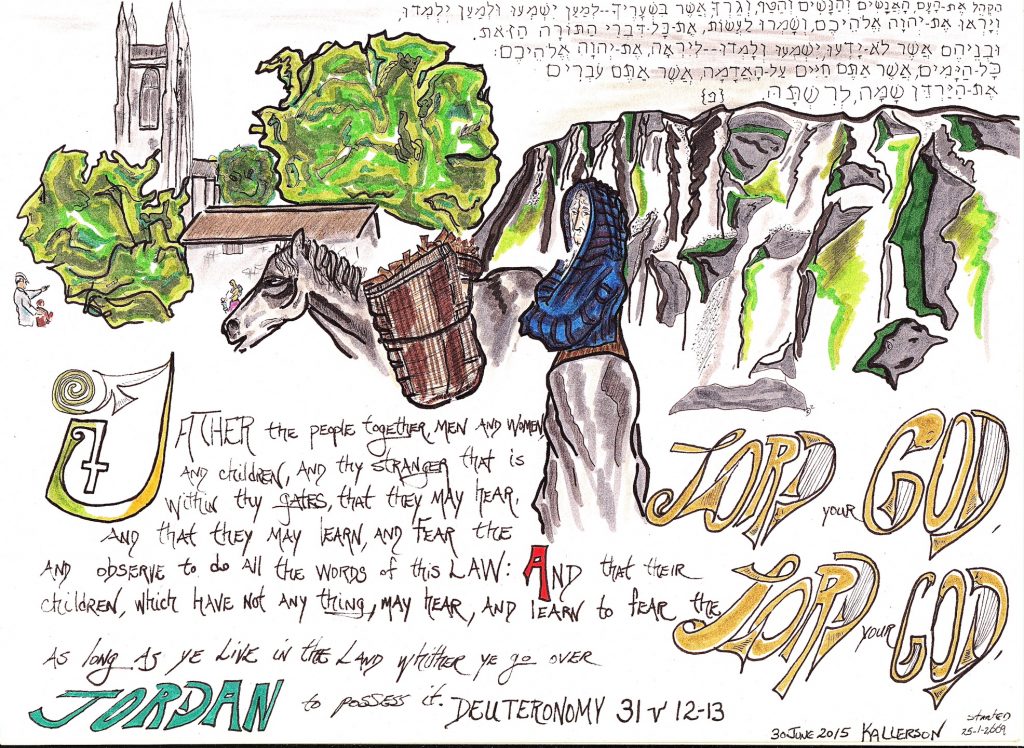
9 So Moses wrote this law and delivered it to the priests, the sons of Levi, who bore the ark of the covenant of the Lord, and to all the elders of Israel. 10 And Moses commanded them, saying: “At the end of every seven years, at the appointed time in the year of release, at the Feast of Tabernacles, 11 when all Israel comes to appear before the Lord your God in the place which He chooses, you shall read this law before all Israel in their hearing. 12 Gather the people together, men and women and little ones, and the stranger who is within your gates, that they may hear and that they may learn to fear the Lord your God and carefully observe all the words of this law, 13 and that their children, who have not known it, may hear and learn to fear the Lord your God as long as you live in the land which you cross the Jordan to possess.”