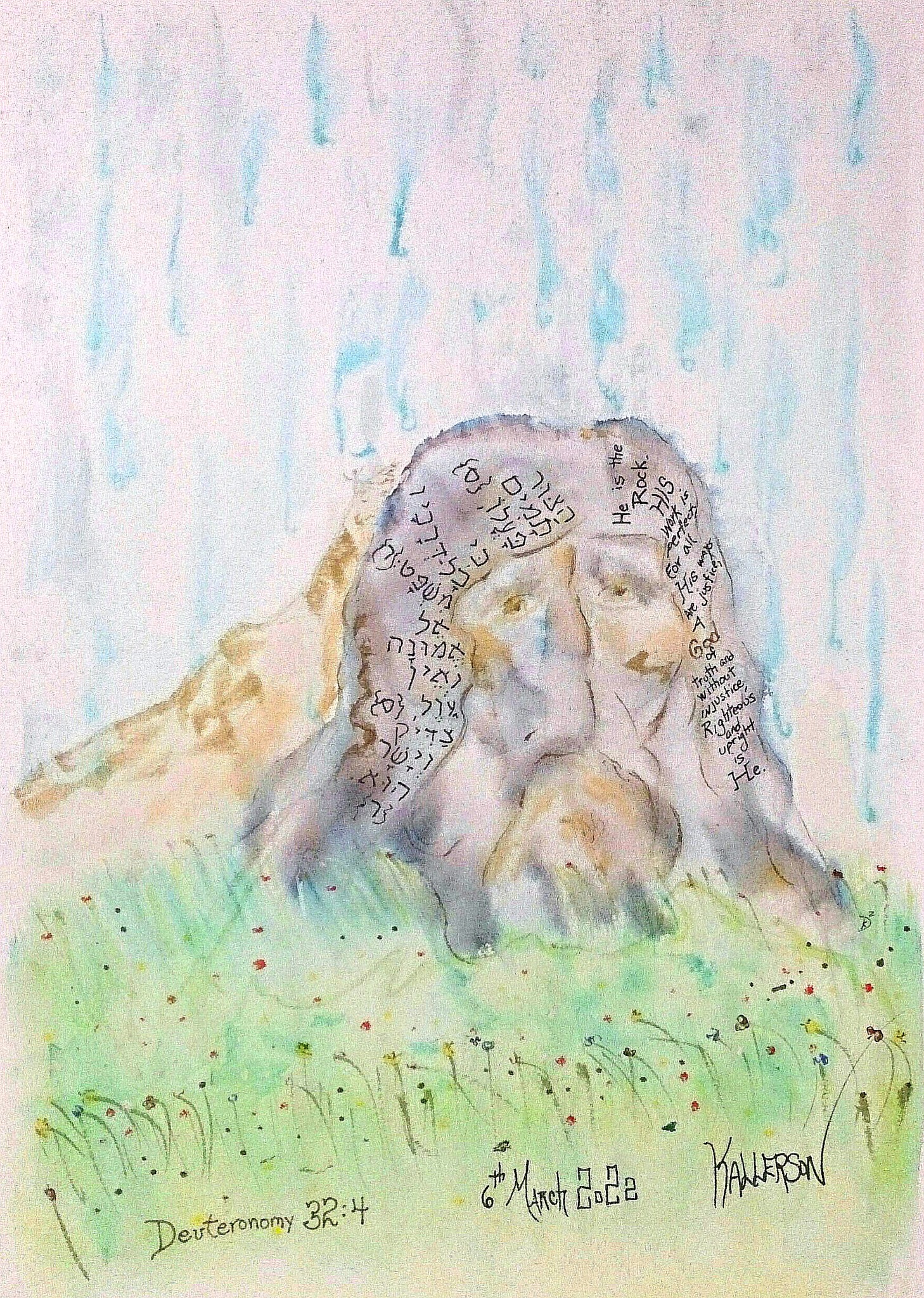
Deuteronomy 32:1-6
The Song of Moses, Part I
Of our passage today, the John Lange commentary correctly states, “Gen. 49 is ‘the prophetic life-picture of the future of Israel’ … Israel’s position in the world is the prophetic element in this song.”
Moses will describe the future of Israel as they stand before the Lord and among the nations of the world in exacting detail. It is such an accurate description of what lies ahead that it provides a roadmap for pretty much all of their future – much of it sadly, but ultimately, happily.
The words Moses uses, the phraseology he employs, and the concepts that he puts forth are so magnificent in the original that it is more delightful than reading the finest novel or the most beautiful poetry. This is noted by Jamieson-Faucet-Brown –
“The magnificence of the exordium, the grandeur of the theme, the frequent and sudden transitions, the elevated strain of the sentiments and language, entitle this song to be ranked amongst the noblest specimens of poetry to be found in the Scriptures.” Jamieson-Faucet-Brown
The next few weeks will be quite an adventure if you really love the details. In this, we will be looking at a written form and structure that can be difficult and even puzzling at times. Like many poems, the words can be hard to grasp at first, but with careful thought, none of what is said is beyond the ability to discern Moses’ actual intent.
What is exciting though is that, like much of Scripture, there is a prophetic element to what is penned here. If we know the Bible, and we also understand the world around us concerning the nation of Israel, much of what Moses says is, at least in content, like reading a current newspaper.
Text Verse: “Lord, You have been our dwelling place in all generations.
2 Before the mountains were brought forth,
Or ever You had formed the earth and the world,
Even from everlasting to everlasting, You are God.” Psalm 90:1, 2
As with the song of Moses, the 90th Psalm was also penned by Moses, so you can see the similarities in thought that he pens in both. And yet, both were inspired by the Lord. As such, one can see this connecting hand of the Lord just as throughout the rest of Scripture.
He is the One who was there at the beginning. His years are without end, and all things come from Him and are sustained by Him. Thus, as we contemplate the word of God with each passage we read, we are considering His mind, His intents, and His purposes for us.
As for the song of Moses, it carries those same designs, but it is in a special form that is tragically lost with many older translations. The NKJV, regardless of the accuracy of the translation, at least put it in a more proper format. Of this, Adam Clarke notes the following –
“On the inimitable excellence of this ode much has been written by commentators, critics, and poets – and it is allowed by the best judges to contain a specimen of almost every species of excellence in composition. It is so thoroughly poetic that even the dull Jews themselves found they could not write it in the prose form; and hence it is distinguished as poetry in every Hebrew Bible by being written in its own hemistichs or short half lines, which is the general form of the Hebrew poetry; and were it translated in the same way it would be more easily understood.” Clarke
Some things just need to be set forth as they were originally designed. This is true with the Song of Moses. It is good that most newer translations properly form the song so that we can more fully appreciate the beauty of it.
We’ll give a short breakdown of the chapter, and then we will use that as we begin to look it over today as well as in the sermons to come. As he progresses, Moses will spare no expense in using rare or completely unique words. This makes it a real treasure to read.
Also, as Clarke noted, it is broken up into a poetic form that, in turn, carries in it several other literary forms such a metaphor, parallelism, and so on. Great stuff is to be seen in this Song. As far as a basic outline, I would submit the following –
Verses 1 & 2 are an introduction concerning the words to be conveyed.
Verses 3 & 4 proclaim the perfections of Yehovah.
Verses 5 & 6 provide a contrast by noting the imperfections of Israel.
Verses 7-14 speak of the calling, establishment, and exalting of the nation.
Verses 15-18 tell of Israel’s abandonment of Yehovah because of prosperity and ease, leading to apostasy from Him and to false gods.
Verses 19-25 bring out Yehovah’s rejection of Israel, His turning from them, and His judgment upon them. But, in this time of rejecting them, verse 21 alludes to His plan to lure Israel back to Himself through His active turning to another group of people.
Verses 26 & 27 detail the reason for Yehovah’s sparing, and not utterly destroying, the disobedient nation – the safeguarding of His own honor and glory.
Verses 28-33 detail the evident nature of Israel’s unworthiness to be spared. As such, it highlights the very fact that they are spared.
Verses 34-38 reveal the wisdom of allowing Israel to be brought to a state of utter calamity, when all of the other gods fail to deliver, it is to…
Verse 39 reveals that Yehovah has, through His interaction with Israel, demonstrated that He alone is God.
Verses 40-42 call out the judgment of the nations for failing to recognize what God has done, which is manifestly evident through His treatment (establishment, care for, spurning of, punishment upon, sparing, and defense) of Israel.
Verse 43 is a final climactic call to the world who knows Yehovah that He has kept His covenant promises to this nation of disobedience by providing them the atonement they do not, in fact, deserve.
I do hope you will enjoy the coming sermons based on this passage. It is a marvelous part of God’s superior word. And so, let us turn to that precious word once again and… May God speak to us through His word today and may His glorious name ever be praised.
I. Give Ear and Hear (verses 1 & 2)
“Give ear, O heavens, and I will speak;
haazinu ha’shemayim va’adeberah – “Give ear you, the heavens, and I will speak.” This is a literal translation, but the way the Hebrew is structured it gives the sense of: “Give ear you, the heavens, so then I will speak.” When the first occurs, the next will then take place.
Moses uses what is known as a prosopopoeia. It is a literary device where an abstract thing is personified. In calling for these bodies to give ear, it is as if they were to listen carefully to the words he will speak. In them, we have an immediate fulfillment of the words from last week –
“Gather to me all the elders of your tribes, and your officers, that I may speak these words in their hearing and call heaven and earth to witness against them.” Deuteronomy 31:28
Moses is the speaker, and yet as the song proceeds, the words will be Moses quoting the very thoughts of the Lord, such as in verses 20-35 and again in verses 37-42.
Moses’ words are words of the covenant, and they will provide insights into the very mind of God as He reveals His glory in and through the nation there before Moses. The heavens are called forth to witness what will be said. Further…
1 (con’t) And hear, O earth, the words of my mouth.
v’tishma ha’arets imre pi – “And hear, the earth, words my mouth.” This was also mentioned by Moses when he said, “and call heaven and earth to witness.” Together, they form the sum of the witness, meaning all of creation. As this is exactly what Moses said he would do, the commentary from last week necessarily needs to be restated.
In calling for the heavens and the earth to witness, he is not calling for judgment, but for witnesses that will testify to the just nature of the coming judgment and punishment. It takes us back to the first sentence of the Bible, “In the beginning God created the heavens and the earth.”
The heavens and the earth themselves are being likened to the surety of the covenant, of which the song is a prophetic anticipation of how Israel will conduct itself before the Lord in relation to the covenant.
When Moses calls the heavens and the earth to witness against Israel, it is not speaking of calling those who dwell in the heavens or those who dwell on the earth to be witnesses. Rather, it is saying that even the heavens and earth are the witnesses.
As evident as these are to remind us of the existence of God, so shall it be the same when the actions against – and for – Israel come. Thus, Israel (and indeed all humanity) should then rightfully say, “As surely as I am standing on the ground, and as surely as the heavens are above my head – both created by God – so is this punishment deserved.”
The inanimate heavens and earth metaphorically speak out the obvious reality of what has occurred when Israel fails and is punished. Just as the Lord is the Creator and Sustainer of the heavens and the earth, He is the Initiator and Monitor of the covenant with Israel.
The sentiment is not unlike that which is stated in Job 20 –
“The heavens will reveal his iniquity,
And the earth will rise up against him.” Job 20:27
It is also what David means when he says that –
“The heavens declare the glory of God;
And the firmament shows His handiwork.” Psalm 19:1
And again, this is unmistakably seen in the words of Paul –
For the wrath of God is revealed from heaven against all ungodliness and unrighteousness of men, who suppress the truth in unrighteousness, 19 because what may be known of God is manifest in them, for God has shown it to them. 20 For since the creation of the world His invisible attributes are clearly seen, being understood by the things that are made, even His eternal power and Godhead, so that they are without excuse.” Romans 1:18-20
The very fact that the heavens and the earth exist, and that they show order, harmony, and structure demonstrate that God is righteous.
They testify to Him, to His power, to His faithfulness, to His right to judge, and also to His eternal nature in what He proclaims. This is both a knowledge that should be terrifying to the nation now being addressed, as well as reassuring to them. Again, this is exactly what the psalmist refers to –
“Forever, O Lord,
Your word is settled in heaven.
90 Your faithfulness endures to all generations;
You established the earth, and it abides.
91 They continue this day according to Your ordinances,
For all are Your servants.” Psalm 119:89-91
One can see the parallel nature of this first verse of the song –
(a) *Give ear you, +the heavens, *and I will speak.
(a) *And hear, -the earth, *words my mouth.”
As it is so that the heavens and the earth are witnesses, Moses continues his introduction to the song, calling for Israel – and indeed all to whom the word is presented – to pay heed…
2 Let my teaching drop as the rain,
ya’aroph ka’matar liqkhi – “Let drop as the rain my teaching.” Two new words are immediately given. The first is araph, coming from a primitive root signifying to droop. Hence, it means to drip or drop. It will be seen only here and in Deuteronomy 33:28.
The next is leqakh. It signifies a learning or a teaching, whether on the part of the teacher or the hearer. Six of its nine uses will be in the proverbs.
Here, the words of this verse can be tied into the heavens and the earth of verse 1. The heavens are the source of the rain as it descends from above. The earth is what receives what then flows downward from above.
The actual intent of Moses’ words is hard to know. It can be translated passively as “Let my words…” If so, Moses is calling for the hearer to listen and to let what he says alight upon him and begin to fill him.
It can be as a petition, “May my words…” If so, Moses is indicating that the wise person will listen, hear, and begin to understand what is being conveyed.
Or, it could be as a statement of fact, “My words shall…” The words will drop slowly at first, word by word. They will then increase as he speaks until they overflow with the wisdom they contain and until they have revealed all that is to descend from the heavenly realm into the minds of those who hear.
Whichever way, the idea is that Moses’ teaching will come down, dropping from above to nourish the soul, just as raindrops upon the earth to nourish it. Next…
2 (con’t) My speech distill as the dew,
tizal ka’tal imarti – “Stream as the dew, my speech.” The word tal, or dew, is used. It comes from talal, meaning to cover over, like a roof. In the first clause, the teaching was to drop as the rain. It is a sign of abundance coming down. Now, the speech which carries the teaching is to spread out as dew, permeating every part of the hearer. Moses next provides parallelism to the first two clauses…
2 (con’t) As raindrops on the tender herb,
kisirim ale deshe – “As showers upon the tender grass.” Here is a word found only this once in Scripture, sair. It signifies rain (drop). The word is formed in the same way as the word sa’iyr, or hairy. Being in the plural, it gives the sense of abundance of rain, like hair flowing on a hairy goat.
Due to it being the same form as “hairy,” we are given an additional insight into what is being said. Hair in the Bible signifies an awareness, especially an awareness of sin as represented in the hairy goat sin offering.
Moses’ idea is that his words will show the greatness of God contrasted to the corrupted, sinful state of Israel. Moses is imploring his people to see the connection and perceive its meaning. It is as if showers of rain come down upon the newly sprouted grass. The grass will benefit from the rain, and the wise will benefit from the instruction of the speech.
2 (con’t) And as showers on the grass.
v’kirvivim ale esev – “And as abundant drops upon the tender herbs.” The word revivim, or abundant drops, is introduced. It comes from ravav, meaning “many.” Thus, it is an accumulation of drops, a shower.
When the showers alight upon the tender herbs, they will feed from the water and gain nutrients from the soil. The heavens and the earth work together to produce a crop that is beneficial to man and to beast.
In this case, Moses is imploring (or affirming) that the divine wisdom will be conveyed, and that it will be considered so that a mature understanding of it will result. One can see the parallelism between the clauses when they are properly translated –
(a) +Let drop as the rain *my teaching. (heavy)
(a) -Stream as the dew, *my speech. (light)
(b) As +showers ^upon the tender grass (heavy)
(b) And as –abundant drops ^upon the tender herbs. (light)
The main force of the words is that of the agency of them being sent in order to produce its intended effect. The resulting effects are a secondary, and hopefully anticipated, result. The instruction is rained down, and it then permeates everything that will receive it. With that in mind, Moses will next exalt the Lord…
Seek the Lord and none other, always
For He is the Rock, Faithful and True
Seek out the Lord for all of your days
Hide yourself in Him and He will establish you
His righteousness is near; it is close at hand
And salvation has gone forth from Him
Be without fear, for goodness He has planned
Lovingkindness and mercy; full to the brim
Even overflowing are these things from Him
For His righteousness is forever; it has no end
Yes, goodness and mercy overfloweth the brim
On the Lord our God, you can depend
II. The Rock! (Verses 3 & 4)
3 For I proclaim the name of the Lord:
ki shem Yehovah eqra – “For Name Yehovah I invoke.” The word qara means to call (actively or passively), to proclaim, to read, and so on. Most translations here use the word “proclaim.” That would mean Moses is making an affirmative statement concerning Him. This is then followed by more affirmative statements. That may be the case.
However, I would think Moses is invoking, or making an appeal to, the name of the Lord. In Exodus 34, the Lord proclaimed His name –
“And the Lord passed before him and proclaimed, ‘The Lord, the Lord God, merciful and gracious, longsuffering, and abounding in goodness and truth, 7 keeping mercy for thousands, forgiving iniquity and transgression and sin, by no means clearing the guilty, visiting the iniquity of the fathers upon the children and the children’s children to the third and the fourth generation.’” Exodus 34:6, 7
The Lord’s name has been proclaimed. As such, I believe Moses is now invoking that name as a witness against Israel for their corrupt ways that begin to be referenced in verse 5. After this appeal to the Name, then the affirmative statements that follow are given to bolster why the Lord is just in His judgments.
The introductory words have been stated, the Name Yehovah has been invoked, and now Moses will call for others to acknowledge this and then He will proclaim Yehovah’s perfections…
3 (con’t) Ascribe greatness to our God.
havu godel l’lohenu – “Ascribe you (all) greatness to our God!” This is to be the natural response to invoking His name – “I appeal to the Name of Yehovah!” / “We ascribe greatness to His name.” The structure of the verse is a standard a/b contrasting parallel –
(a) For Name Yehovah I invoke. (singular)
(b) Ascribe you (all) greatness to our God! (plural)
It is an acknowledgment of what He is because of who He is. “He is great because He is Yehovah. He is our God!” And the reason He is great, in His being and in our eyes, is…
4 He is the Rock,
The words are placed absolutely: ha’tsur – “The Rock!” It is an indication of permanence, stability, and immutability. It is the first time He is called this in Scripture, but it is not the first time He has been equated to it in typology.
The Lord as the Rock was typologically seen in Exodus 17 when the rock was struck and then water issued forth. Likewise, Moses was hidden in the rock in Exodus 33. Both times were clear typological anticipations of Christ. In fact, Paul explicitly says this concerning the Rock and the water in 1 Corinthians 10 –
“Moreover, brethren, I do not want you to be unaware that all our fathers were under the cloud, all passed through the sea, 2 all were baptized into Moses in the cloud and in the sea, 3 all ate the same spiritual food, 4 and all drank the same spiritual drink. For they drank of that spiritual Rock that followed them, and that Rock was Christ.” 1 Corinthians 10:1-4
Further, the term is specifically cited by both Paul in Romans 9:33, and by Peter in 1 Peter 2:6, as cited from Isaiah 8:14, where the Lord, Yehovah, is referred to –
“He will be as a sanctuary,
But a stone of stumbling and a rock of offense
To both the houses of Israel,
As a trap and a snare to the inhabitants of Jerusalem.” Isaiah 8:14
With these New Testament references to Christ Jesus as the Rock being directly equated to Yehovah of the Old Testament, it is without excuse that anyone would deny that Scripture indicates that Jesus is Yehovah incarnate.
Someone may not believe the Bible, or in the Lord, but nobody can honestly deny that the intent of Scripture is that Jesus and Yehovah are one and the same.
As far as the term itself, four more times the Lord will specifically be called “the Rock” in this chapter. But more, he will twice be contrasted to other rocks, meaning false gods. Of the Rock, Moses next says…
4 (con’t) His work is perfect;
Rather than how the NKJV translates this, the perfection is stated first: tamim paolo – “Perfect His work.” It is a new word, poal, signifying deeds or work. Being described as tamim means without blemish. It is the word used to describe the sacrificial animals that were presented to the Lord.
All that the Lord does is complete, sound, and flawless. Thus, it is upright. This would include, but not be limited to, His work of creation, interactions, redemption, and salvation. When He purposes something, it will come to pass.
As such, it is a note of surety for Israel both in judgment and in preservation. The Lord will judge perfectly according to His word. The Lord will preserve perfectly according to that same word. In the same manner, because Jesus is the Lord, it is a note of the same for those who are His people.
What God in Christ does will be perfectly handled in the judgment of His people, but it will also be in accord with the promise of His salvation –
“For no other foundation can anyone lay than that which is laid, which is Jesus Christ. 12 Now if anyone builds on this foundation with gold, silver, precious stones, wood, hay, straw, 13 each one’s work will become clear; for the Day will declare it, because it will be revealed by fire; and the fire will test each one’s work, of what sort it is. 14 If anyone’s work which he has built on it endures, he will receive a reward. 15 If anyone’s work is burned, he will suffer loss; but he himself will be saved, yet so as through fire.” 1 Corinthians 3:11-15
4 (con’t) For all His ways are justice,
ki kal derakha mishpat – “For all His ways just.” There is one way with the Lord, even if it is expressed in many ways. In other words, His way is just, and thus all His ways are just. He will never deviate from being just, so every avenue He takes is just. This is not unlike James’ words –
“Every good gift and every perfect gift is from above, and comes down from the Father of lights, with whom there is no variation or shadow of turning.” James 1:17
The meaning of James’ words is that there is no parallax in the Lord. No matter what angle he is viewed from, He is perfectly unchanging. As such, there is no shadow that can move in relation to Him. This is essentially how Moses speaks of the Lord now. Further, He is…
4 (con’t) A God of truth and without injustice;
El emunah v’ein avel – “God of stability and no unrighteousness.” The first word is emunah. It signifies firmness, steadfastness, fidelity, and so on. Thus, the sense is stability. The second word is avel, signifying injustice, unrighteousness, moral wrong, and the like.
He will not be moved, and He will never do wrong. There is no iniquity, bias, or prejudice in Him. Rather, He is firm, fixed, and steadfast in His being. And more…
4 (con’t) Righteous and upright is He.
The words are emphatic: tsadiq v’yashar hu – “Righteous and upright HE.” Thus, it is an expression of His very being. The words tsadiq and yashar point to that which is righteous and that which is right (straight or upright). The words of Peter in the New Testament tie Christ directly to the thought of Moses now –
“But you denied the Holy and Righteous One, and asked for a murderer to be granted to you,” Acts 3:14 (WEB)
The very being of Christ is that of One who is Righteous. The sentiment of this verse is, at least partly, seen in Psalm 145 –
“The Lord is righteous in all His ways,” Psalm 145:17
Likewise, the words mirror the description of Christ as He returns in glory in Revelation 19 –
“Now I saw heaven opened, and behold, a white horse. And He who sat on him was called Faithful and True, and in righteousness He judges and makes war.” Revelation 19:11
What Yehovah does is embodied in the Person and actions of Jesus Christ. With this noted, we can again, as in verse 2, see the parallelism of the words shining forth in an a/b/a/b structure –
(a) *The Rock! +Perfect His work. (stable/no fault)
(b) ^For all His ways just. (expresses His being)
(a) *God of stability and +no unrighteousness. (rock/perfect)
(b) ^Righteous and upright HE. (expresses His being)
With this stated, we can – at least from my perspective – next see why Moses invoked the name of the Lord in verse 1…
I have stretched out My hands all day long
To a people rebellious and without sense
They sing to other gods, a distasteful song
The guilt of their iniquity is more than immense
What would the end of them be?
Were it not for the promise that I made?
If not for that, they would have perished quickly
They are not worth even the most useless trade
But for My sake they shall be made right
Because I am Faithful and True to the words I speak
For them, there will be an end to the fright
When in the future, it is Me they finally seek
III. A Perverse and Crooked Generation (Verses 5 & 6)
Where verses 3 and 4 highlighted the perfections of the Lord, verses 5 & 6 provide a contrast, revealing the imperfections of Israel…
5 “They have corrupted themselves;
Though almost everyone translates it this way, it is incorrect. The verb is singular as is the preposition: shikhet lo – “Corruption to him.” It can either be a statement concerning the nation, or a question concerning the Lord.
Therefore, it either says, “He (Israel) has corrupted himself” or “Is corruption His?” (JPS Tanakh). In other words, “Is corruption found in Him?” Or “Is He the source of corruption?”
If it is a statement of fact, then the words mirror the words of Isaiah 1 where the same word is used –
“Alas, sinful nation,
A people laden with iniquity,
A brood of evildoers,
Children who are corrupters!
They have forsaken the Lord,
They have provoked to anger
The Holy One of Israel,
They have turned away backward.” Isaiah 1:4
If it is a rhetorical question, it is asking if the defect that will be presented is the Lord’s fault. If so, the answer is obvious, and it explains why Moses would invoke the name of the Lord in verse 2.
Due to the parallelism, I would go with the words of this clause as speaking of Israel, thus forming a parallel. However, it could just as easily be a contrasting parallel. Either way, a matter must be resolved because of His perfect nature…
5 (con’t) They are not His children,
lo banav – “Not His sons.” The inserted words are correct, “They are not His sons.” They can’t be because there is no corruption in Him. He is perfect in all His ways. As such, there can be no harmony; the bond is severed…
5 (con’t) Because of their blemish:
muman – “Their blemish.” The whole thought so far can now be more clearly understood –
“Is corruption His? (or “He has corrupted himself!)
They are not His children!
It is their blemish!”
The people called by the Lord have severed themselves from the family of the Lord. They bear a defect that is of their own doing and was not derived from Him.
It is the state of Israel of the future. A time is prophesied when the people would be entirely cut off from fellowship with the Lord because of their own doings. They are…
5 (con’t) A perverse and crooked generation.
dor iqesh u-pethaltol – “Generation twisted and warped.” Moses uses two new words. The first is iqesh, signifying distorted, false, crooked, or perverse. It comes from aqash, to twist, and it is mostly used in the book of Proverbs.
The next word is found only here in Scripture, pethaltol. It is derived from pathal, to twine, thus, to struggle, wrestle and so on. It signifies being crafty or crooked like one who is warped and always trying to wrestle off the authority over him.
This is the defect that Israel has, and it is not something derived from the Lord, but rather from their own warped senses. The words perfectly call to mind what Peter says in Acts 2 –
“And with many other words he testified and exhorted them, saying, ‘Be saved from this perverse generation.’” Acts 2:40
With this stated, one can now see the parallelism in an a/b/a/b structure –
(a) *Corruption to him. (reference to defect)
(b) ^Not His sons. (identifies the state of Israel)
(a) *Their blemish. (reference to defect)
(a) ^Generation twisted and warped. (identifies the state of Israel)
The generation that rejected Christ, and which still exists to this day, is a perverse generation. They bear the defect of having severed themselves from Christ. Until that is corrected, they are not – and indeed cannot be – His children. Because of their unwieldy, twisted nature, Moses asks…
6 Do you thus deal with the Lord,
The order of the words bears an emphatic nature: ha l’Yehovah tigmelu zot – “Do to Yehovah you (all) do this?” The words would be well paraphrased by saying, “Is this how you act toward the Lord?” It is a question of incredulity. Moses sees the future and he knows the outcome of their conduct. And he is appalled at what he knows is coming. As such, he calls out…
6 (con’t) O foolish and unwise people?
am naval v’lo khakam – “People foolish and no wise.” It is a new adjective, naval. It signifies a person who is stupid or wicked. He is vile. It is the same as the name of Nabal in 2 Samuel 25. Thus, it explains the words his wife uses when describing him –
“Please, let not my lord regard this scoundrel Nabal. For as his name is, so is he: Nabal is his name, and folly is with him!” 2 Samuel 25:25
Israel is just like Nabal according to Moses. They are a foolish and unwise people. As such, the following words are set against the previous words that said, “They are not His sons.” Moses says…
6 (con’t) Is He not your Father, who bought you?
halo hu avikha qanekha – “Not HE your Father your Purchaser?” The words take Israel back to the first Song of Moses, just after having been brought out from Egypt. There, the same word, qanah, is used –
“Fear and dread will fall on them;
By the greatness of Your arm
They will be as still as a stone,
Till Your people pass over, O Lord,
Till the people pass over
Whom You have purchased.” Exodus 15:16
Thus, Moses is saying that even though they are not His children, He is their Father. He purchased them and, therefore, they will be brought to Himself at some point. It is a truth spoken forth as both songs of Moses conclude –
You will bring them in and plant them
In the mountain of Your inheritance,
In the place, O Lord, which You have made
For Your own dwelling,
The sanctuary, O Lord, which Your hands have established.
18 “The Lord shall reign forever and ever.” Exodus 15:17, 18
&
“Rejoice, O Gentiles, with His people;
For He will avenge the blood of His servants,
And render vengeance to His adversaries;
He will provide atonement for His land and His people.” Deuteronomy 32:43
With this understanding, Moses completes the words of the passage for today, saying…
*6 (fin) Has He not made you and established you?
Again, there is an emphatic nature to the words: hu asekha v’konenekha – “HE made you and established you.” The Lord personally intervened in their history, time and again, in order to bring them into being and then to establish them.
There was nothing random about what He did. Rather, everything was, continues to be, and will continue to be purposeful in regard to them. But there is a point of contention that exists between them, and it is a personal defect in the nation.
For now, and to understand the parallelism, the following is seen. It is, again, an a/b/a/b structure –
(a) Do to Yehovah you (pl) do this? (question to the people)
(b) People foolish and no wise. (a truth concerning Israel)
(a) Not HE your (sg) Father your (sg) Purchaser? (question to the nation)
(b) He made you and established you. (a truth concerning Israel)
Until the defect of Israel is resolved, they are not His children, and they are not His people. In the coming verses, Moses will show just what the Lord did to establish them, and he will show them – in advance – exactly what they will do to provoke Him, thus cutting themselves off from Him.
In cutting themselves off, the Lord will respond by cutting them off. Israel’s position in the land, and as the people of the Lord, is solely determined by their actions and conduct before Him. The final state of Israel is set, and it is predetermined.
He will never cut them off completely, and Moses will explain exactly why as he continues. Thus, the severity and the honor of being Israel are tied together in one package. It demonstrates the unfailing nature of the Lord that this is so.
The same treatment can be expected by each of us. There can be severity in His hand against us, but there will never again be a separation from Him. We have the lesson of Israel, and we have the words of the epistles to direct us.
In the end, we who are the redeemed of the Lord must make our own choices. Will we be foolish and unwise, thus arousing the Lord’s displeasure, or will we be people of integrity and live for Him as we live out our lives?
The song of Moses is written to Israel, but the precepts that are derived from it can be just as easily applied to us. Be wise, be discerning, and be circumspect in your life and conduct before this great God – the Rock! May it be so, to His glory.
Closing Verse: “In the name of our Lord Jesus Christ, when you are gathered together, along with my spirit, with the power of our Lord Jesus Christ, 5 deliver such a one to Satan for the destruction of the flesh, that his spirit may be saved in the day of the Lord Jesus.” 1 Corinthians 5:4, 5
The people of Israel were handed over to the Satan to suffer because of their conduct before the Lord. The sinner at Corinth was to be handed over as well. However, Israel the nation as well as that wayward sinner, will find that God is ultimately faithful, even when they were not.
Next Week: Deuteronomy 32:7-14 Slowly pecking away at it until it is through (The Song of Moses, Part II) (94th Deuteronomy Sermon)
The Lord has you exactly where He wants you. He has a good plan and purpose for you. But He also has expectations of you as He prepares you for entrance into His Land of Promise. So, follow Him and trust Him and He will do marvelous things for you and through you.
The Song of Moses, Part I
“Give ear, O heavens, and I will speak out
And hear, O earth, the words of my mouth; hear my shout
Let my teaching drop as the rain
My speech distill as the dew
As raindrops on the tender herb
And as showers on the grass may they be to you
For I proclaim the name of the LORD:
Ascribe greatness to our God; hear my word
He is the Rock, His work is perfect
For all His ways are justice, as all the world can see
A God of truth and without injustice
Righteous and upright is He
“They have corrupted themselves
They are not His children, this disobedient nation
Because of their blemish
A perverse and crooked generation
Do you thus deal with the LORD
O foolish and unwise people? Is this what you do?
Is He not your Father who bought you?
Has He not made you and also established you?
Lord God, turn our hearts to be obedient to Your word
Give us wisdom to be ever faithful to You
May we carefully heed each thing we have heard
Yes, Lord God, may our hearts be faithful and true
And we shall be content and satisfied in You alone
We will follow You as we sing our songs of praise
Hallelujah to You; to us Your path You have shown
Hallelujah we shall sing to You for all of our days
Hallelujah and Amen…
“Give ear, O heavens, and I will speak;
And hear, O earth, the words of my mouth.
2 Let my teaching drop as the rain,
My speech distill as the dew,
As raindrops on the tender herb,
And as showers on the grass.
3 For I proclaim the name of the Lord:
Ascribe greatness to our God.
4 He is the Rock, His work is perfect;
For all His ways are justice,
A God of truth and without injustice;
Righteous and upright is He.
5 “They have corrupted themselves;
They are not His children,
Because of their blemish:
A perverse and crooked generation.
6 Do you thus deal with the Lord,
O foolish and unwise people?
Is He not your Father, who bought you?
Has He not made you and established you?