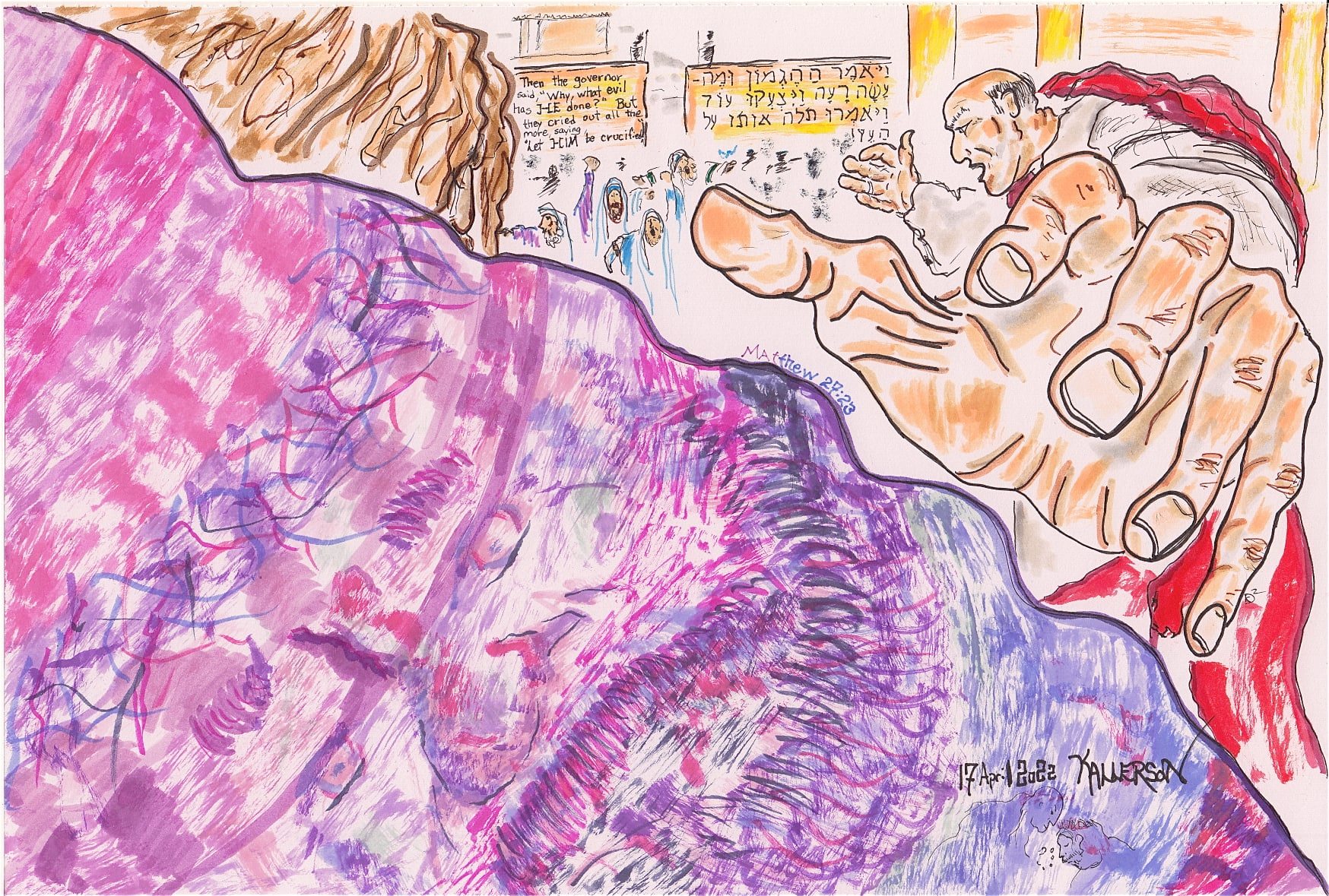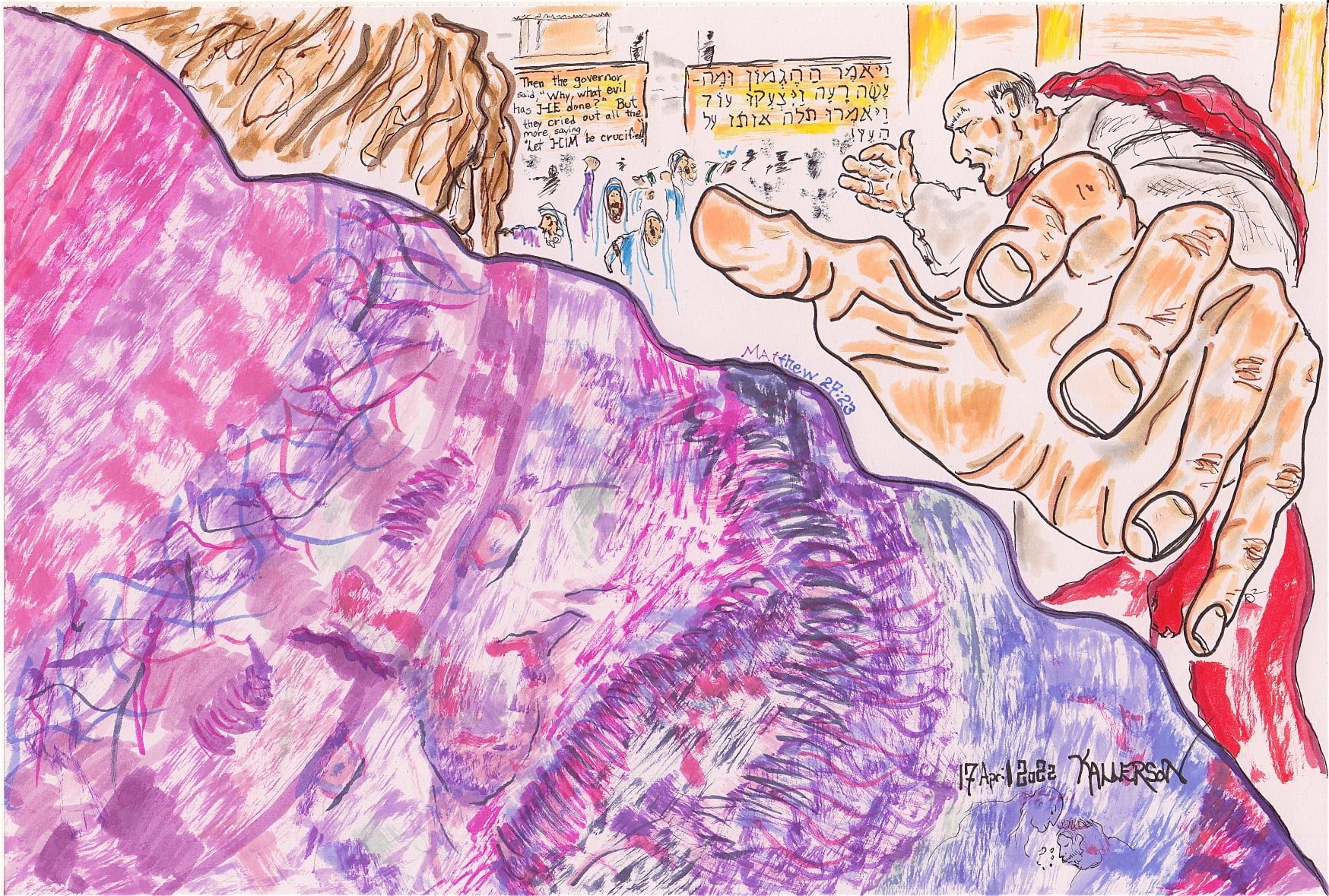
Artwork by Doug Kallerson
Matthew 27:23
What Evil Has He Done?
Now at the feast the governor was accustomed to releasing to the multitude one prisoner whom they wished. 16 And at that time they had a notorious prisoner called Barabbas. 17 Therefore, when they had gathered together, Pilate said to them, “Whom do you want me to release to you? Barabbas, or Jesus who is called Christ?” 18 For he knew that they had handed Him over because of envy.
19 While he was sitting on the judgment seat, his wife sent to him, saying, “Have nothing to do with that just Man, for I have suffered many things today in a dream because of Him.”
20 But the chief priests and elders persuaded the multitudes that they should ask for Barabbas and destroy Jesus. 21 The governor answered and said to them, “Which of the two do you want me to release to you?”
They said, “Barabbas!”
22 Pilate said to them, “What then shall I do with Jesus who is called Christ?”
They all said to him, “Let Him be crucified!”
23 Then the governor said, “Why, what evil has He done?”
But they cried out all the more, saying, “Let Him be crucified!”
24 When Pilate saw that he could not prevail at all, but rather that a tumult was rising, he took water and washed his hands before the multitude, saying, “I am innocent of the blood of this just Person. You see to it.”
25 And all the people answered and said, “His blood be on us and on our children.”
26 Then he released Barabbas to them; and when he had scourged Jesus, he delivered Him to be crucified.
In the time allotted to each of us during the years we walk through life, and to varying degrees based upon where one is, the seasons of the year closely match the normally lived-out seasons of life. There is the spring where life begins, everything is fresh, young, pliable, vibrant, colorful, sweet-smelling, and so on.
Then comes the summer. It is a time of endurance. Life permeates everything, but it has become a more mature and developed life. It is a time of adulthood and strength. It is a time of great productivity, hard work, and revealed potency. For the wise, it is a time to store up for the future. The period will arrive when the provisions of this season’s produce will be needed.
Eventually, the fall comes along. It is a time of beauty, but of increasing tiredness. There is a change from the strength and productivity that so highlighted the summer to a time of slowing down, a need to rest from labor, and of diminishing output.
Those who stored up in the summer can rely on those stores to carry them through this period without forcing themselves to overwork. And that is a good thing because overwork can overload. And in being overloaded, damage can result. It’s surely not called “fall” simply because the leaves fall, but because man in this season can too.
The once-simple task of pruning the trees becomes a possibly life-threatening undertaking. Life slows down. Man can look back on the earlier days, remembering what once was, but he cannot get himself to go back there in reality. The season has taken over and it moves him further from who he once was with each day that passes.
And then comes the winter. The bleakness of ever-hardening joints and atrophying muscles sets in. The trees do nothing productive, the animals secret themselves away, hoping to not become prey to some other animal, and man’s faculties fail.
Solomon marvelously describes this condition in Ecclesiastes 12. That which once was vibrant and new, and which then became strong and developed, has gone through its failing fall, and has arrived at its woeful winter. It is the time when death is at hand and only the prospect of the coldness of a grave cut out of the frozen ground remains.
Man’s years end because his life force has been depleted. The journey that began in the spring has come to its termination.
Text Verse: “Seeing then that we have a great High Priest who has passed through the heavens, Jesus the Son of God, let us hold fast our confession. 15 For we do not have a High Priest who cannot sympathize with our weaknesses, but was in all points tempted as we are, yet without sin. 16 Let us therefore come boldly to the throne of grace, that we may obtain mercy and find grace to help in time of need.” Hebrews 4:14-16
If you take time to consider the world around you, one of the things you will notice, is that among individuals, cultures, and nations, there are hints of the biblical story everywhere you look. They may not be in line with the narrative, but it is as if there is a faint memory or inkling of what happened, or how things should be, still evident.
For example, most people agree that there is an evil force that exists. There is the idea that there is life after death. Many cultures have their own flood stories. The Chinese alphabet consists of characters that carry numerous hints of the creation story. And so on.
There is this ingrained knowledge in us of how things were, of how they should be, or of how they could be. They may just be vapory hints of the way the Bible presents these things, but they are there.
When I was young, one of my favorite albums was by the Beach Boys. It was entitled Endless Summer. To this day, if one of the songs from that album comes up – and even though I may not have heard it since I was 15 – I can remember every single word and every single note as if it had just played this morning.
Adam was created. The Lord breathed the breath of life into him, and he became a living being. From there, he was placed in a garden. From the account, it reads – at least to me – of a life more comparable to the summer span of man.
He wasn’t created as a little baby that had to grow. He wasn’t created as a failing older fellow that began to salivate every time he saw a rocking chair. Rather, he was – ostensibly – like any person in the prime of life that we may see today.
He was set in the garden and there was nothing set before him that would cause him to go through any seasonal changes that we now go through. Nothing except one simple thing…
“Of every tree of the garden you may freely eat; 17 but of the tree of the knowledge of good and evil you shall not eat, for in the day that you eat of it you shall surely die” (Genesis 2:16, 17).
How simple that is! The man’s Endless Summer lay before him. It is that vapory hint of the ideal span of life that the Beach Boys sang about. A life of mature youth, vigor, productivity, unceasing enjoyment, and contentment. It is as if it is ingrained in us.
Hollywood movies, books, songs, and – indeed – entire albums, all hint at this marvelous state of life, as if it could be a reality. And because it could be, even though it is not, it is a hope that still exists because we want it to.
Because this hidden hope is so prevalent among humanity, it partly reveals why the gospel of Jesus is so relevant to all people. Every culture where the gospel is presented understands its premise. They get what it means because it speaks of the answer to something in us that is already there, but that previously had no suitable resolution.
It is the gospel – and it alone – that accurately, perfectly, and wholly meets the previously unfulfilled hope that exists in man’s soul. This is the relevance of the Person of Jesus Christ because the gospel is based upon His work. It is the greatest story ever told because it is the most relevant story ever told.
Truly unimaginable marvel and wonder suddenly becomes both imaginable and real through this most pertinent message that is revealed in God’s superior word. And so, let us turn to that precious word once again and… May God speak to us through His word today and may His glorious name ever be praised.
I. A Messiah is Coming
Adam’s “endless summer” in Eden didn’t last very long. We can only speculate on how long he remained in the garden, but his son Seth was born in his 130th year of life. Seth came some unknown time after the births of Cain and Abel, but which was inclusive of all of Abel’s life, even if Cain was still alive.
As such, it takes Adam’s 930-year lifespan down to a rather short time in comparison to his years, and my guess is that the time in Eden was a lot shorter than that as well. How quickly paradise was lost! Regardless of the exact time, two major things resulted from his transgression.
The first is that he died on the day he ate of the fruit. But this death was not in regard to his physical life. Rather, it was regarding his spiritual life. We know this for several reasons, but the main one is based on what Paul says in his epistles, especially Romans, but probably most explicitly in Ephesians –
“But God, who is rich in mercy, because of His great love with which He loved us, 5 even when we were dead in trespasses, made us alive together with Christ (by grace you have been saved), 6 and raised us up together, and made us sit together in the heavenly places in Christ Jesus, 7 that in the ages to come He might show the exceeding riches of His grace in His kindness toward us in Christ Jesus.” Ephesians 2:4-7
Adam sinned, meaning he committed evil (the reason for saying this will be explained later), by violating the law set before him. In his sin, he died on that same day. From there, that same state of death (spiritual death, aka “dead in trespasses”) then infected all of humanity. A detailed explanation of that is recorded for us in Romans 5 –
“Therefore, just as through one man sin entered the world, and death through sin, and thus death spread to all men, because all sinned— 13 (For until the law sin was in the world, but sin is not imputed when there is no law. 14 Nevertheless death reigned from Adam to Moses, even over those who had not sinned according to the likeness of the transgression of Adam, who is a type of Him who was to come.” Romans 5:12-14
This was the first, and immediate, consequence of his sin. He committed evil, and the spiritual connection to God – meaning the true life of man – was lost. Adam, and all who follow after him, are dead in this manner. The second, and obvious consequence of this state is physical death. It is this death we fear more, though it is only a death that results from the death we already possess –
“In the sweat of your face you shall eat bread
Till you return to the ground,
For out of it you were taken;
For dust you are,
And to dust you shall return.” Genesis 3:19
The anticipated endless summer has become an endless winter. We are dead, and we shall die. And in our death, we shall remain dead forever. What a bleak and dreary existence it ultimately is. It is a world without hope, even for those who possess that inner elusive vapor of hope that there is something more.
Death awaits and when it comes, even that secreted away hope is snuffed out. But correction of this state is what the biblical narrative reveals. Adam had a hope, but it was not a vapory hint that remained from some long-hidden memory within the collective mind of man.
Instead, he had the words of the Lord that had just been spoken concerning a coming Redeemer. The promise of One who would bruise the head of the serpent was conveyed. The implication was that if the serpent was crushed, a return to paradise now lost would come about.
Therefore, Adam’s hope was a real, certain hope. The Lord had spoken and, therefore, it could come to pass. And, indeed, it must. The Lord had spoken.
It is this truth, passed on to Adam, and that was then passed on to his own children, that has been remembered in the subconscious man. The Lord created the seasons, and it is the hope of spring – of the renewal of life after the bleak and dreary winter – that reminds us it is so. It tells us that life can come from death.
But knowing how it could come about is the uncertain element that man faced, and which many still face. Indeed, there is a promise of One who is to come who would restore humanity to that beautiful place and state of Eden’s perfection. And because there is the promise, it has sunk into the collective mind of man.
All around the world, in innumerable cultures, there is the hope of someone coming who would bring man back to where he belongs. That place, that understood place – which is not our current world – has been given many names. And just what it will be like varies by tradition as well. But when you talk to people about it, they will almost always describe something that is beyond what we now know.
And along with that “something,” there is more often than not a “Someone” who they believe will lead the way. Of course, there are lots of opportunists out there who will also claim that they are that “Someone.”
If you want to get something out of others, all you need to do is convince them that you are the promised One. Jesus Himself spoke of this reality when He said –
“Then if anyone says to you, ‘Look, here is the Christ!’ or ‘There!’ do not believe it. 24 For false christs and false prophets will rise and show great signs and wonders to deceive, if possible, even the elect. 25 See, I have told you beforehand.” Matthew 24:23-25
But by saying what He said, specifically that there will be false christs, it implies that there is a true Christ. His next words indicate exactly that, calling this true Christ “the Son of Man,” and thus a reference to Himself –
“Therefore if they say to you, ‘Look, He is in the desert!’ do not go out; or ‘Look, He is in the inner rooms!’ do not believe it. 27 For as the lightning comes from the east and flashes to the west, so also will the coming of the Son of Man be. 28 For wherever the carcass is, there the eagles will be gathered together.” Matthew 24:26-28
He said it. What makes Him different than all of these others whom He claims are false? What is it that sets Him apart? It can’t be because He is Jewish. Lots of people are Jewish. They aren’t all the Messiah. That may be a necessary factor for being the Messiah, but it is not the principal one.
It is true that lots of Jewish people have claimed to be the Messiah, and lots of others have been called the Messiah, whether they claimed it or not. Even today, right in the land of Israel there are people who are heralded as the Messiah.
Likewise, there are lots of supposed messianic figures outside of Israel – either who have come or who are anticipated to come. Buddhists believe that they are following the right guy. Branch Davidians thought they were as well. Muslims think they are waiting for the true Messiah.
Obviously, Christians believe that “right guy” is Jesus. But within Christianity, there are varying ideas on who Jesus is and what kind of a Messiah he is. It is with all certainty that the Jesus who is proclaimed by the Mormons or the Jehovah’s Witnesses, for example, is not the same Jesus who is proclaimed by others within the faith.
And, unfortunately, even within “mainstream” Christian denominations, there have arisen other false impressions about who Jesus is and what He is like.
And then, of course, there are those people who claim they actually are Jesus. Right now in the world today, there are supposed “Jesuses” in the UK, Sibera, Zambia, Brazil, Russia, South Africa, Australia, Japan, the Philippines, and even until a few years back, there was one in Miami. Others have come and gone, and more seem to crop up with each passing year.
They have latched onto the name of Jesus and claim that they are Him. It’s a bit problematic when Jesus Himself said that when He returns, it would be in an unmistakable manner. But a little fudging of the scenario, and people will believe pretty much anything.
Who is this Man, and what sets Him apart?
What is it about Him that tells us He is the One?
What is the way to know? Where should our thinking start…
To determine if He is truly God’s own Son?
Why should we cast our lot in with Him?
So many have claimed what He now speaks out
Following the wrong “Messiah” would be dark and grim
How can we know without a shadow of doubt?
What is it about Him that will tell us He is the One?
As we seek the Redeemer of Israel
This man claims that He is God’s own Son
If it is true, just how can we tell?
II. Born Under the Law
The Beach Boys sang about things related to their ideal of an endless summer. What is it that would really make your endless days a time of summer? For me, it’s hard to even think on those lines. I was born, eventually I matured into a man, and now I’m heading into the fall of life.
And I can say that if the summer I lived went on forever, I’d rather not live forever. The world has a lot of beauty, there are fun times, there are great people that have come along over the years, but there is also weariness by the end of every day.
For most of the world, the summer of their life is simply a quest to be ready for the fall and winter. What kind of an existence is that? Really.
We have a bit of enjoyment as we go, but we know – for sure and without a doubt – that we will get old and we will either need to prepare for that, or we hope that someone else will be there to help us along until we finally keel over and die.
Solomon speaks of this type of existence in Ecclesiastes, and he opens the book with a note that pretty much sums things up –
“‘Vanity of vanities,’ says the Preacher;
‘Vanity of vanities, all is vanity.’” Ecclesiastes 1:2
Other translations say “meaningless,” “futility,” “pointless,” and so on. What a miserable existence if this is all there is. And yet, Solomon elsewhere speaks of the summer gathering as a positive thing –
“He who gathers in summer is a wise son;
He who sleeps in harvest is a son who causes shame.” Proverbs 10:5
He doesn’t just limit this to humanity either –
“The ants are a people not strong,
Yet they prepare their food in the summer;” Proverbs 30:25
Obviously, Solomon is making a point about ants that should be then converted to a point about men. We know this because he had already noted the ant in relation to man earlier in Proverbs –
“Go to the ant, you sluggard!
Consider her ways and be wise,
7 Which, having no captain,
Overseer or ruler,
8 Provides her supplies in the summer,
And gathers her food in the harvest.
9 How long will you slumber, O sluggard?
When will you rise from your sleep?
10 A little sleep, a little slumber,
A little folding of the hands to sleep—
11 So shall your poverty come on you like a prowler,
And your need like an armed man.” Proverbs 6:6-11
But this begs the question. If we are to look to the ant and be like him by being prepared in the summer for what lies ahead, what is the point if everything is meaningless? The same end will come upon the industrious man as will come upon the sluggard, but the sluggard just doesn’t wear himself out in the process! Who is the smart one then?
This is true, but only if the premise is that there really is the same end for both. What if, however, being prepared in the summer points us to a spiritual truth. What if the seasons are there to teach us a lesson?
Night is coming when no one can work. Winter is coming when life is at an end. And so on. We are instructed to be wise with our time. We are to be prepared now for what is coming. Paul says it this way –
“See then that you walk circumspectly, not as fools but as wise, 16 redeeming the time, because the days are evil.” Ephesians 5:15
Whether a saved believer, or someone who is looking for salvation, the statement remains true. The days are evil. If they are evil, it is because this is not a place without evil. An endless summer of evil days would be a terrible existence. I dare say that I cannot even imagine it.
People who talk about living forever in this world are just plain nuts. Who would want to live forever in a world as things are now? And yet, there they are. People are working on medicines, DNA advancements, and all kinds of other technologies in hopes of living forever.
Just two days after I typed the first draft of this sermon, an article came out in the Guardian, saying, “If they could turn back time: how tech billionaires are trying to reverse the ageing process / Jeff Bezos and Peter Thiel are pouring huge sums into startups aiming to keep us all young – or even cheat death. And the science isn’t as far-fetched as you might think.” No thank you!
If I am going to store up in the summer of my life, it is going to be for something way better than this. Paul speaks of this in his first letter to Timothy –
“Command those who are rich in this present age not to be haughty, nor to trust in uncertain riches but in the living God, who gives us richly all things to enjoy. 18 Let them do good, that they be rich in good works, ready to give, willing to share, 19 storing up for themselves a good foundation for the time to come, that they may lay hold on eternal life.” 1 Timothy 6:17-19
When the Bible speaks of eternal life, it speaks of it in two different ways. The first is in that which is possessed, but not yet attained. The second is a state that is attained, but which is not at all like the one we now have. Thank God for that!
But, again, we need to know how to go from days that are evil to days without evil. This is the key to both understanding who the Messiah is and what He can truly provide. As this is so, defining what evil is becomes necessary.
In short, evil isn’t. It is not an entity that actually exists in and of itself. Rather, evil is a state (the state) of imperfection. To say that the days are evil is to say, “The days are not perfect.” To say that what Adam did was evil is to say, “What Adam did was imperfect.” It did not measure up to a standard of perfection.
To say that the virus in a sick person is evil is to note that something in him is not as it should be. Rust is a great example of this. A car without rust is as it should be. Its body is good. But when a hole occurs in the metal because of rust, that hole is a lack of metal. It is a lack of what is good.
If God created Adam as a living being, and if he died on the day he ate of the fruit that he was commanded to not eat, then it means that what he did was not good, and the result of what transpired, meaning death, is not good.
What is good is life. But it’s not the physical life that he continued to live. We know this, because the days are evil. As such, the life that is good, the life that is truly life, the life that is eternal, is found in the spiritual reconnection to God that was lost. Jesus said as much –
“Father, the hour has come. Glorify Your Son, that Your Son also may glorify You, 2 as You have given Him authority over all flesh, that He should give eternal life to as many as You have given Him. 3 And this is eternal life, that they may know You, the only true God, and Jesus Christ whom You have sent.” John 17:1-3
But again, how do we know that He is the One? How do we know that He can truly give this? The answer is found in the state of things as we have already gone over.
Adam sinned. He did something that lacked goodness. As such, it was evil. In this, he was separated from God. He spent the rest of his life apart from God and in a world that is evil. This doesn’t mean evil in the absolute sense.
Rather, it is a world lacking perfection. The good thing that once was has now been replaced with something less good. From there, we will experience different gradations of that lack of perfection because, as Paul said, “death spread to all men.”
This state of separation is inherited by all who descend from Adam as sin travels from father to child. So, we are imperfect and living in an imperfect world. As this is so, we now have a way of excluding those who claim to be the promised One, the Messiah.
It is not necessarily that they are living in the world that disqualifies them. The part of the car that doesn’t have rust is fine. It’s the hole where the rust consumed the metal that is lacking. The lack of goodness in one part of something doesn’t mean that everything lacks this goodness.
The thing that makes man evil isn’t that he is a man. It is that he is a man born from a man. Adam wasn’t evil when he was created. But in becoming evil, he passes his imperfection on to those who follow him. It is Adam, and each father after Adam, that passes on this state that is lacking goodness.
And so, how do we eliminate the false messiahs of the world? Well, if they are human beings that had a father that begat them, then they are not capable of being the true Christ. They bear the stain of sin, and they are thus disqualified.
Understanding this, every person ever born to a man and a woman, and thus every person ever born, stands disqualified. That is every person, except One. This is Jesus. But this is only the Jesus who is accurately portrayed and explained in the Bible. Jesus was born of a woman, but He was sent forth from God –
“But when the fullness of the time had come, God sent forth His Son, born of a woman, born under the law, 5 to redeem those who were under the law, that we might receive the adoption as sons.” Galatians 4:4
This is also explained by the angel Gabriel who was sent to Mary –
“And the angel answered and said to her, ‘The Holy Spirit will come upon you, and the power of the Highest will overshadow you; therefore, also, that Holy One who is to be born will be called the Son of God.’” Luke 1:35
Jesus was born of a woman and of God. As such, no sin – no imperfection or evil – transferred to Him. He is qualified to be the Messiah. However, Paul said something else in Galatians 4:4, didn’t he. He said that Jesus was “born under the law.”
Which law is he referring to? The question is important because the law was given to Israel, and yet Paul says that Jesus was sent to “redeem those who were under the law.” Paul is writing to the Galatians. They are not of Israel, and they were never under the Law of Moses. As such, he cannot merely be speaking of that law.
There is a law that man needs to be redeemed from. Paul using law as an example tells us about its effects on man –
“I was alive once without the law, but when the commandment came, sin revived and I died. 10 And the commandment, which was to bring life, I found to bring death. 11 For sin, taking occasion by the commandment, deceived me, and by it killed me.” Romans 7:9-11
Adam was given a commandment, a law. In his breaking of that law, he died, and “death spread to all men,” as we have already seen. As this is the state of all men, God put the onus on Himself. He did this by calling out a nation from the world and giving it a law, the Law of Moses. It was to be His standard for righteousness for them to see and live by. As He says –
“You shall therefore keep My statutes and My judgments, which if a man does, he shall live by them: I am the Lord.” Leviticus 18:5
To live is to not die. The law is explicit. The man who does the things of the law will live. But the law of Adam already condemned all men. Death spread to all. Therefore, the way for man to live was to live this law out perfectly.
Christ, however, was not born under the law of Adam. Adam’s death did not spread to Him. But Paul says that He was born under the law to redeem those who were under the law. How could Christ redeem those under the law if he was born under the law given to Adam? He would bear Adam’s sin.
Hence, God gave Israel the Law of Moses. He then sent forth Christ, born of a woman but not of a man, and so He was not under the law of Adam (and thus He was without sin). But He was born under the law of Israel, God’s standard by which if a man does those things, he shall live by them.
If you see the point I’m making, it’s not just that Jesus came, but there had to be a law other than Adam’s law for Him to come under. He could not come under Adam’s law because he would bear Adam’s sin. But by coming under another law, He could both perform and redeem.
There was no imperfection (no evil) in Him at His birth. There was no imperfection (no evil) in Him under the law. This is testified to by the four gospels. It is testified to by His question to those who came against Him when He asked, “Which of you convicts me of sin?” (John 8:46). None responded.
It is also testified to in the lack of a response to the question of the Roman authority appointed over Israel, and who was thus over Jesus who is of Israel, when he asked, “Why, what evil has He done?” No response was given because no evil had been committed by Him. As such, Pilate proclaimed, “I am innocent of the blood of this just Person.”
What Pilate could clearly see was ignored by those who stood against Jesus. No sin, no imperfection, and no evil were found in Him. And yet, they crucified Him.
What a wonderful, marvelous thing that God has done
He has brought us back to Himself this day
Through the giving of Jesus, His only begotten Son
We have the smooth path, He has paved the way
In Him is found life and length of days
And so, to Him we look and call out His name
To God, through Jesus, we shall give all our praise
He has removed our guilt and taken away our shame
Praise God all you saints of His, praise Him today!
Rejoice in the marvelous thing that He has done
God has brought us back to Himself this very day
Through the precious gift of Jesus, His only begotten Son
III. The Greatest Story Ever Told
One premise of the Bible, and which is something easily discernible among humanity, is that man is an imperfect being. If there is a God, it can be deduced that He is perfect. We don’t need the Bible to know this.
As this is so, then what He does is perfect. Because He created, His creation was perfect at the time He created. This can all be deduced without the Bible. And yet, there is now imperfection in the creation. The Bible explains how it came about, and it explains why things are the way they are at this time.
It also tells us that what is imperfect will be corrected, and that it will either be done through God’s giving of His own perfect Son, or through the purging of imperfection through the Lake of Fire. The Bible records that Jesus was born of a woman and of God. As such, He was born in a state of perfection.
He is fully God – perfect in all of His deity. And He was born fully Man – perfect in His humanity. There is no contradiction in this, something which is unlike the god seen in Mormonism or the Jehovah’s Witnesses.
Jesus, the God/Man, was born in a state of perfection, He lived perfectly under the law that promised life to the man who did the things of the law. And He died on the cross in a state of perfection, having never sinned. The disciples were unaware of the nuances and failed to make the necessary connection stating, “But we were hoping that it was He who was going to redeem Israel.”
Israel was redeemed from Egypt. They were brought into the covenant and under the law. As such, what did they need to be redeemed from? It’s curious that they would even say this, but Scripture had spoken of the redemption of Israel so much that it was something they knew they needed.
Scripture had taught about redemption from enemies, from oppression, and other such things. But these things point to something else, a state of imperfection, that which is evil. Logically, if there is evil – the lack of a good thing – then being redeemed must go much deeper than some temporary need.
They could not see that the very law that they were under only highlighted their own imperfections. As Paul said earlier, I was alive once without the law, but when the commandment came, sin revived and I died. 10 And the commandment, which was to bring life, I found to bring death” (Romans 7:9, 10).
Israel needed to be redeemed from the law, but the law was given to allow Jesus to redeem everyone, including Israel, from the law of Adam – the imperfection (the evil) – that condemned all men.
If Jesus had died under the law, it wouldn’t have meant very much to Israel, or to us, if He didn’t resurrect.
It would have meant that He was tainted with sin and the imperfection would have clung to Him. But if that was the case, it would mean He was not God. And if He is not God, then He would not have been born without sin. And if He was not born without sin, then He could not redeem us from the sin of Adam.
In other words, everything is tied up in the resurrection of Jesus Christ. In His coming out of the grave, it means that He was (and is) sinless. If He is sinless, and yet He is a Man (a sinless Man had to die for the sins of Adam), then it means that He is also God because He would not be sinless unless He is God.
If he was a man created in Mary’s womb, even as a perfect man, then he would not be God. If this was so, then he would not have possessed the knowledge of good and evil.
In order to possess that knowledge, he would have had to learn through law what that knowledge meant. And in order to learn what that knowledge meant, then he would have to sin by breaking the law. As such, he could not redeem fallen man.
Again, everything is tied up in the resurrection of Jesus Christ. It proves He is God. It proves He is the sinless Man. It proves that He can and did, in fact, redeem His people by dealing with our sin. And if He dealt with our sin in His death, then that means that our sin is dealt with forever. We have entered into a New Covenant where sin is no longer considered. We are not under law, either that of Adam or that of Moses, but under grace. And, as Paul says –
“Now all things are of God, who has reconciled us to Himself through Jesus Christ, and has given us the ministry of reconciliation, 19 that is, that God was in Christ reconciling the world to Himself, not imputing their trespasses to them, and has committed to us the word of reconciliation.” 2 Corinthians 5:18, 19
What are we doing here today? We are celebrating the greatest story ever told. Pilate asked, “Why, what evil has He done?” The answer, because of the resurrection of Jesus Christ, is “None.” The perfection of God in Christ has accomplished all things for us.
This story is logical, it is understandable, it is without fault in all that it proclaims, and it resolves the greatest problem that man has ever faced. Through Jesus Christ, evil is eliminated, and death is swallowed up in victory.
You can live your life in futility, pursue that which is meaningless, and perish in the vanity of your impoverished existence, or (OR) you can come to Jesus Christ, be reconciled to God through His full, finished, final, and forever work. Demonstrate wisdom today and yield your soul to the One who loves you enough to have done these things for you. Call on God through Jesus.
And for those who are the redeemed of the Lord, be sure to demonstrate your thanks to Him today and always. After all, it is a long, long time that you will live – even to eternal days. Thank God for Jesus Christ our Lord. And all of God’s people say… Amen.
Closing Verse: “Behold! The Lamb of God who takes away the sin of the world!” John 1:29
Next Week: Deuteronomy 33:1-5 Moses will pronounce his blessings and then he will die… (The Lord Came from Sinai) (99th Deuteronomy Sermon)
The Lord has you exactly where He wants you. He has a good plan and a purpose for You. Though Paradise was lost, He offers access to it once again through the death, burial, and resurrection of Jesus Christ. So call on Him, and trust Him, and He will do marvelous things for you and through you.
A Celebration of the Resurrection of Jesus Christ
This is the gospel which was preached to you
It is also the one you received and on which you stand
It is the gospel of salvation, providing life that’s new
And which will carry you to the promised Holy Land
What is delivered to you is what was before received
That Christ died for our sins according to God’s word
He was buried and He rose, and so we have believed
And many witnesses testify to this message you have heard
Now, if Christ is preached that He is risen from the dead
How can some among you say the resurrection isn’t true?
If there is no resurrection after Christ was crucified and bled
Then our faith as well as yours is certainly askew
And if so, we are found false witnesses of God
Because we have wrongly testified of this mighty deed
And our faith is futile, no heavenly streets we’ll trod
And we are still dead in our sins; fallen Adam’s seed
Even more, those who have fallen asleep in the Lord are gone
And we are the most pitiable creatures the world could ever look upon
But indeed, Christ is risen from the dead
He is the Firstfruits of those who have fallen asleep
And as death came through one man, Adam, our federal head
So Christ will make all alive; our souls He will keep
There is an order to the Resurrection call
Christ was first, the pattern for the rest when He comes
When He does, He will make a shout out to us all
And we will rise as if to the sound of heavenly battle drums
Then comes the time, when He delivers the kingdom to the Father
When all rule, authority, and power have come to an end
The last enemy to be destroyed is death, never more to bother
Then the Son will to the Father eternal rule extend
But you ask, “What will we be like after our time of sleep?
After we have been buried in corruption’s pit so deep?”
Our body is sown in dishonor, but it will be raised in glory
It is sown in weakness, but raised in power – the resurrection story
The first man Adam became a living being, it is true
The last Adam became a life-giving Spirit, life to me and you
And as was the man of dust, created so long ago
So are those likened unto him, also made of dust
And as is the Man, the Lord from heaven, you know
That we shall bear His image for eternity just as we’ve discussed
Flesh and blood cannot inherit the kingdom of God
Nor can corruption inherit that which is incorrupt
Be we shall all be changed, and so, heavenly streets we’ll trod
In the twinkling of an eye, the change will be abrupt
When the last trumpet sounds, we will be taken to glory
We shall all be changed, completion of the gospel story
Where O Death, O where is your sting?
When Christ our Savior, us to Himself does He bring
Where O Hades, O where is your victory?
When Christ translates His children to eternal glory
The sting of death is sin, and the strength of sin the law
But thanks be to God who gives us victory through our Lord
My beloved brethren be steadfast in all you’ve heard and saw
And cling confidently to God’s eternal word
Know for certain that your labor is not in vain
Be of good cheer, Christ is coming again
Hallelujah and Amen…