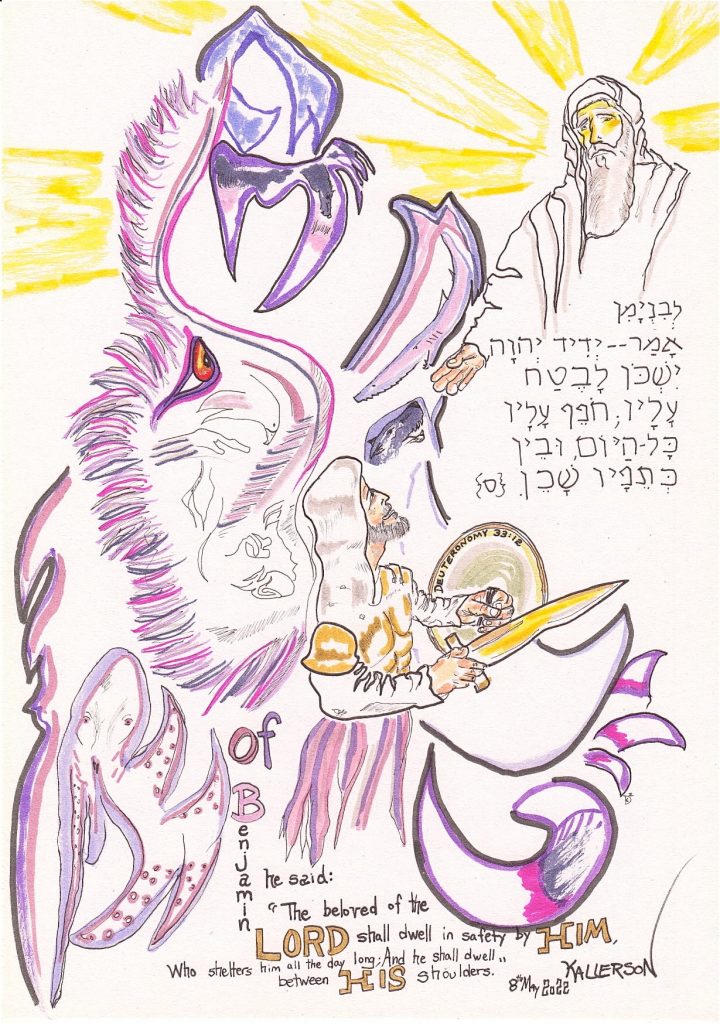
Artwork by Doug Kallerson
Deuteronomy 33:12-17
Moses Blesses Israel, Part II
This may seem like a curiosity to you but right now there is an American oil company in Israel, that is drilling for oil in the area referred to in Moses’ words today, and the owner is basing his reasoning on verses from Genesis 49 and Deuteronomy 33, both from the blessings spoken over Joseph –
“By the God of your father who will help you,
And by the Almighty who will bless you
With blessings of heaven above,
Blessings of the deep that lies beneath,
Blessings of the breasts and of the womb.
26 The blessings of your father
Have excelled the blessings of my ancestors,
Up to the utmost bound of the everlasting hills.
They shall be on the head of Joseph,
And on the crown of the head of him who was separate from his brothers.” Genesis 49:25, 26
&
“And of Joseph he said:
“Blessed of the Lord is his land,
With the precious things of heaven, with the dew,
And the deep lying beneath,
14 With the precious fruits of the sun,
With the precious produce of the months,
15 With the best things of the ancient mountains,
With the precious things of the everlasting hills,
16 With the precious things of the earth and its fullness,
And the favor of Him who dwelt in the bush.
Let the blessing come ‘on the head of Joseph,” Deuteronomy 33:13-16
Whether you agree with his reasoning or not, the land spoken of by both Jacob and Moses is still there, it is identifiable through historical records, and the company – Zion Oil and Gas – is there drilling wells.
Text Verse: “I am your fellow servant, and of your brethren who have the testimony of Jesus. Worship God! For the testimony of Jesus is the spirit of prophecy.” Revelation 19:10
Whether you agree with his insights into the prophecies of Jacob and Moses, one thing is for sure: their words, and all the other prophetic oracles of God that are found in the Bible are true and they ultimately lead us to Jesus or at least an understanding of what He has done, is doing, or will do.
We will see more of that in our verses today. As far as Zion Oil and Gas, they put out occasional updates on the status of things. At the time I typed this sermon, their most recent update was as of February 16 –
Dear Zion Supporters and Shareholders,
2022 has kicked off to a fast and exciting start for Zion and its operations team as we prepare to continue developing and testing the MJ-02 well.
We are pleased to announce that all necessary services for completing the well, along with enhancement and reservoir testing, have been secured.
Zion has partnered with some of the leading Petro physicists and stimulation experts in the United States to plan the next phase of the operation.
As Zion continues to navigate manufacturing and logistical delays, the plan is to resume operations in quarter one.
These operations will start with necessary re-certifications and inspection of the rig while also upgrading critical systems that will benefit this operation and allow for enhanced drilling operations in the future.
Upon completing the inspections, upgrades, and rigging up, the crew will complete the final casing and tubular run before moving on to the enhancement and reservoir testing phase.
We continually give thanks to God and our loyal shareholders and supporters who make all this possible.
We will continue to provide material updates when we have relevant information to share with the public.
Sincerely,
Rob Dunn
CEO
The company is registered with the SEC, it has stocks for purchase, and who knows if they will ever hit the big time. If they do, the stock will probably be worth a lot, but it may not last long. If large amounts of oil show up in Israel, the nations will suddenly find a reason to go in and take things over.
That is always a possibility based on other very clear passages of Scripture. Amazing things such as this possible prophecy of oil in the land of Joseph are based on verses found in God’s superior word. And so, let us turn to that precious word once again and… May God speak to us through His word today and may His glorious name ever be praised.
I. The Blessing to Benjamin (verse 12)
In the previous sermon, Judah – the fourth son of Jacob and Leah – was blessed before Levi, the third son. Simeon was left out of a blessing, probably because he was eventually dispersed in, and assimilated into, Judah.
Now, the two sons of Jacob and his beloved Rachel will be blessed, and they are again out of birth order. Moses first blesses Benjamin and only then will he bless Joseph.
Because Benjamin is blessed before Joseph, critical scholars try to say that this order, and thus the blessing, actually dates to the time of the kings where Benjamin was the tribe of the first king of Israel, Saul. But there is no reason to assume this at all. Judah was already blessed before Levi, and Simeon has been left out of a blessing.
There is more reason to believe that God’s foreknowledge of future events superintends over the blessings given by Moses than that the blessings are some sort of later fabrication.
As for an immediate reason why the blessings are noted as Judah / Levi / Benjamin, it cannot go without notice that the future temple of the Lord will be in Jerusalem.
This then forms a sort of geographical prophecy where Judah is to the south, the temple is in Jerusalem that is on Judah’s northern border, and then Benjamin is on the north of that.
As the temple is identified with those who ministered in it, meaning the priests and the Levites, we can see the pattern found in Moses’ order of blessing from south to north – Judah / Levi / Benjamin.
Later, Judges 1:8 says, “Now the children of Judah fought against Jerusalem and took it; they struck it with the edge of the sword and set the city on fire.” And yet, in the same chapter, it says, “But the children of Benjamin did not drive out the Jebusites who inhabited Jerusalem; so the Jebusites dwell with the children of Benjamin in Jerusalem to this day” (Judges 1:21).
Throughout the time of the kings, Jerusalem is said to be in Judah, and yet, again and again, people both from Judah and Benjamin are noted as being in Jerusalem. Further, the geographical overlapping of the two is also noted, even after the exile, such as in Ezra 1 –
“Then the heads of the fathers’ houses of Judah and Benjamin, and the priests and the Levites, with all whose spirits God had moved, arose to go up and build the house of the Lord which is in Jerusalem.” Ezra 1:5
But more, I would argue that the entire set of blessings upon the tribes – from Reuben to Asher – form an interesting pattern, a sort of circle around the temple in Jerusalem, in the order in which they are pronounced.
So far, Reuben is east of Jerusalem and outside of Canaan proper. Then it went south to Judah, which is inclusive of Simeon. This would explain why Simeon had no blessing. If the blessings are based upon situation in relation to the temple, and because Simeon is within the boundaries of Judah, then there was no need to give a separate blessing to them.
After Judah, it then went to Levi, emblematic of the temple, then it will next go to Benjamin, the land bordering the north of where the temple is. As such, the next blessing, the blessing of Benjamin, begins with…
12 Of Benjamin he said:
l’binyamin amar – “To Benjamin he said.” Benjamin is the younger of the two sons of Rachel and the twelfth son born to Jacob. Upon him, Moses pronounces that he is…
12 (con’t) “The beloved of the Lord shall dwell in safety by Him,
yedid Yehovah yishkon lavetakh alav – “Beloved Yehovah shall dwell to security upon Him.” The blessing of Benjamin speaks of his geographical situation. The words are difficult and highly debated, but it appears that this is, in fact, referring to Benjamin’s future placement in relation to the House of God. He thus dwells “upon” the Lord.
Lange says it cannot be speaking of this because the words Moses pronounces speak of the state (how) he lives rather than the location (where) he lives. But both can be true at the same time. The where, meaning in relation to the temple, leads to the how, meaning its safety and continuance.
The layout of the tribes provided a sort of buffer around where the temple is located, both in physical geography and in spiritual affiliation.
In his words now, Moses introduces the word yadid. It is an adjective that will be seen nine times, always in poetry. It is from the same root as dod, the noun meaning “beloved.” Benjamin is the beloved of Yehovah.
Benjamin means, “Son of the Right Hand.” As such, there is a definite hint of Jesus who is the Son at the right hand of the Father and who is the Beloved of the Lord. It is He who rests securely upon Him. Next, Moses says of him…
12 (con’t) Who shelters him all the day long;
khopheph alav kal ha’yom – “Covering him all the day.” This is a most rare word, found only here, khaphaph. It is related to yakheph, or barefoot. The foot is uncovered. Here, however, the word is speaking of being covered.
The word itself is closely connected to the word khuppah, which is a canopy for protection and a bridal chamber. Benjamin would be covered at all times in his dwelling. The sentiment of these words appears to be reflected extending into the future of Jerusalem where the word khuppah, or covering is explicitly used when referring to it –
“In that day the Branch of the Lord shall be beautiful and glorious;
And the fruit of the earth shall be excellent and appealing
For those of Israel who have escaped.
3 And it shall come to pass that he who is left in Zion and remains in Jerusalem will be called holy—everyone who is recorded among the living in Jerusalem. 4 When the Lord has washed away the filth of the daughters of Zion, and purged the blood of Jerusalem from her midst, by the spirit of judgment and by the spirit of burning, 5 then the Lord will create above every dwelling place of Mount Zion, and above her assemblies, a cloud and smoke by day and the shining of a flaming fire by night. For over all the glory there will be a covering [khuppah]. 6 And there will be a tabernacle for shade in the daytime from the heat, for a place of refuge, and for a shelter from storm and rain.” Isaiah 4:2-6
With this understood, Moses speaks on…
12 (con’t) And he shall dwell between His shoulders.”
u-ben kethepha shaken – “And between His shoulders dwells.” Between the shoulders would signify to ride upon the back, and thus to be carried along. Metaphorically, the shoulders are referring to mountain slopes.
As this is speaking of Benjamin, this is taken by many scholars to refer to the two mountain peaks, Zion belonging to Judah, and Moriah in the land of Benjamin. However, that seems to be coopting that which is intended for Judah.
As such, I would think it just as likely, or more so, to be referring to Mount Moriah on the south and Bethel on the north. Mount Moriah is where the temple, the house of God, was erected –
“Now Solomon began to build the house of the Lord at Jerusalem on Mount Moriah, where the Lord had appeared to his father David, at the place that David had prepared on the threshing floor of Ornan the Jebusite. 2 And he began to build on the second day of the second month in the fourth year of his reign.” 2 Chronicles 3:1, 2
Bethel, on the north, means “House of God.” Thus, the “shoulders” of Benjamin would then be referring to these two locations which include, or which are called, the “House of God.” When looked at on a map, the two locations literally look like the two shoulders of the land. Thus, the blessing is that of a realtor’s dream: location, location, location –
To Benjamin he said.
Beloved Yehovah shall dwell to security upon Him.
Covering him all the day.
And between His shoulder dwells.
The entire prophecy of Benjamin looks to the future concerning Jesus, the Son at God’s right hand, the beloved of the Lord who rests safely upon the Lord, covered by Him, and dwelling in the House of God. Next, Moses turns to Benjamin’s older brother…
I will bless you with a blessing
And you shall be blessed as My words convey
There will be no doubt; there will be no guessing
Things will come to pass just as I say
The future is known because I am already there
If you could understand this, things would go well
I tell in advance because I care
If My words you dismiss, you will pave a path to hell
But if you listen to My words, including this blessing
You will find the way to heaven is opened to you
There will be no doubt and there will be no guessing
Listen to My words which are faithful and true
II. The Blessing to Joseph (verses 13-17)
If you set the blessing of Jacob upon Joseph side by side with the one now from Moses, you will see how closely they parallel one another. I won’t highlight that for you, but if you have the time and motivation, it would be a short and fun project for you to do. With that, we now turn to Moses’ words to this son of Israel…
13 And of Joseph he said:
u-l’yoseph amar – “And to Joseph he said.” Joseph is the older of the two sons of Rachel and the eleventh son born to Jacob. Joseph is actually divided into the tribes of his sons Ephraim and Manasseh.
Ephraim is next north of Benjamin, and Manasseh is both north and then northeast of Ephraim, being divided into two sections that rest on both sides of the Jordan. Thus, the pattern of the order of the tribes surrounding Jerusalem in a somewhat discernible fashion continues with this tribe divided into two tribes. For now, upon Joseph, Moses pronounces that…
13 (con’t) “Blessed of the Lord is his land,
meboreket Yehovah artso – “Blessed Yehovah his land.” The blessing of Joseph pertains predominantly to the land. It is a land that would abound in productivity, and this has been noted as true concerning the areas where Ephraim and Manasseh, the two sons of Joseph who were adopted by Jacob, settled. The land is promised to be blessed…
13 (con’t) With the precious things of heaven, with the dew,
mi’meged shemayim mital – “From preciousness heavens, from dew.” Another new word, meged, is used. It is a noun that will be seen five times in the blessing upon Joseph, and then only three more times, all in the Song of Solomon.
The meaning of it is obscure, but James Strong places it as coming from a root probably meaning “eminent.” As such it is a distinguished thing or something valuable. That which is precious from heaven would be the rains, favorable climate, and so on.
The next word, mital, means “from dew.” However, some manuscripts have one letter changed, making it to say meal, or “from above.” Thus, some translations say this instead.
Either way, the thought is similar, but I would go with “from the dew.” As such, it would then be a separate category. One can see this when is the two are placed side by side –
Blessed Yehovah his land.
From preciousness heavens, from dew. (separate category)
Blessed Yehovah his land.
From preciousness heavens, from above. (second explains first)
Dew comes less from heaven than from the interaction between the immediate ground and the surrounding air as moisture condenses. When taken with the next clause, it being a separate category would then follow through more logically…
13 (con’t) And the deep lying beneath,
u’mi’tehom rovetseth takhath – “And from deep crouching underneath.” The tehom is a void or an abyss. As such, it is where water flows up from underground. Here Moses poetically portrays it as a recumbent animal that crouches below. Combining this with the previous clauses, one can see why I feel “from dew” is the correct meaning –
Blessed Yehovah his land.
From preciousness heavens (water from above), from dew (water from ground level).
And from deep crouching underneath (water from below).
Without water, life dries up and dies. But with water, everything is fruitful and abundant. That is what Moses will confirm concerning the land of Joseph in the next beautifully painted words…
14 With the precious fruits of the sun,
u-mi’meged tevuoth shamesh – “And from preciousness increases sun.” The sun is that which rises from day to day. Throughout the Bible, it is reflective of that state. Thus, it speaks of life being lived one day at a time as each day is “the day.” There is tomorrow, but when it comes, it becomes “the day.”
Each day, the sun will bless Joseph where he will receive abundance in the increases (produce, fruits, crops, etc.) of the day. The words speak of abundance arising from the events of the day…
14 (con’t) With the precious produce of the months,
u-mi’meged geresh yerakhim – “And from preciousness [the] casting moons.” Here is a word found only once in Scripture, geresh. It is a noun coming from the common verb garash which refers to casting out or driving out (such as an enemy), divorcing, and so on. Hence, one can think of expatriating.
The moon here speaks of the months. Each moon is one month, and thus, it speaks of the cycle of the year as it passes. As the various crops produce their fruit, they are said to cast them off. The contrasting parallelism between the clauses is evident –
And from preciousness increases sun. (daily cycle)
And from preciousness [the] casting moons. (monthly cycle)
One can see the workings of the Lord in this where Jesus speaks of each day being sufficient for its own trouble, meaning relying on the produce of the day as each day produces. And yet, He also speaks of the fields being white for harvest, which is a cyclical thing that comes as the months pass.
And more, Jesus is the fulfillment of both the daily sacrifices at the temple as well as each sacrifice that occurs during the months of the year. Now, with the marvelous words of this verse complete, Moses speaks on…
15 With the best things of the ancient mountains,
u-me’rosh harerei qedem – “And from excellency mountains ancient.” Translations will vary widely on this because the words can have several meanings. The word rosh means “head.” As such, it can signify the first, the top, the best, and so on.
The word “ancient” is qedem, which literally means “east,” but east in Scripture also signifies that which is before. The sun rises there. And because it comes from seemingly nowhere, it then speaks of the unknown past – that which is in antiquity, is ancient, is eternal.
I translate it as “excellency” because it is a singular noun, but the word “mountains” is plural. Also, I say “ancient” rather than “east,” otherwise, one might say “top of the mountains of the east,” signifying the mountains of Gilead and Bashan where some of Joseph settled. But more, using excellency will also maintain parallelism with the next clause.
The words now speak of what is derived from these higher areas, be it grasslands for flocks and herds, trees, vines, olives, minerals, and so on. Whatever these elevations uniquely provide, that is the excellency derived from them. Also…
15 (con’t) With the precious things of the everlasting hills,
u-mi’meged givoth olam – “And from preciousness hills antiquity.” It is the same word used three times already in the past two verses, meged, or preciousness. The word givah is a hill, and here it is plural, givoth. And the word olam signifies “to the vanishing point.” Thus, it is an indeterminate amount of time.
In other words, the clause is perfectly parallel to the previous clause –
And from excellency mountains ancient.
And from preciousness hills antiquity.
As for typology, I would say these words look beyond the hills and mountains, here termed Ancient and Antiquity. Though they are old, they didn’t create themselves. Rather, they came from the wisdom of God in creation. If there is an ancient hill, there is One more ancient that created it, meaning He was there before the hill.
As such, it is reflective of the words of James concerning God –
“Do not be deceived, my beloved brethren. 17 Every good gift and every perfect gift is from above, and comes down from the Father of lights, with whom there is no variation or shadow of turning.” James 1:16, 17
It is Christ who came from God and who is described with both the word qedem and olam in Micah –
“But you, Bethlehem Ephrathah,
Though you are little among the thousands of Judah,
Yet out of you shall come forth to Me
The One to be Ruler in Israel,
Whose goings forth are from of old,
From everlasting.” Micah 5:2
As for Joseph, the high places – the mountains and hills that were founded in the primeval past – will yield that which is excellent and precious for Joseph. And more…
16 With the precious things of the earth and its fullness,
u-mi’meged erets u-meloah – “And from preciousness land and its fullness.” This speaks of the overall favor of the land, whether on mountain, hill, valley, or plain. Where Joseph would settle, in its fullness, there would be abundance. But more…
16 (con’t) And the favor of Him who dwelt in the bush.
u-retson shokeni seneh – “And favor Him dwells bush.” Moses returns to his time of calling on Mount Sinai where he met the Lord God who called to him from the bush. It was there that Moses was told that the promise to the fathers – Abraham, Isaac, and Jacob – would be realized from Him through Moses.
Just as Israel had received His favor, and just as Moses has been bestowed the good pleasure of the Lord, so this same Source of blessing is now pronounced to come upon Joseph. The clauses are parallel –
And from preciousness land and its fullness.
And favor Him dwells bush.
The earth is the Lord’s, and all its fullness, and the Lord dwells in the bush that is on the earth. Moses pronounces that the blessing would come up from the land possessed by the Lord, and out from the Lord of the bush…
16 (con’t) Let the blessing come ‘on the head of Joseph,
tabothah l’rosh Yoseph – “Let come to head Joseph.” The verb is cohortative. Thus, it is like saying, “Let everything come upon the head of Joseph that has just been pronounced.” To have it come upon the head is its own blessing. An example of this is found in the 133rd Psalm –
“Behold, how good and how pleasant it is
For brethren to dwell together in unity!
2 It is like the precious oil upon the head,
Running down on the beard,
The beard of Aaron,
Running down on the edge of his garments.
3 It is like the dew of Hermon,
Descending upon the mountains of Zion;
For there the Lord commanded the blessing—
Life forevermore.” Psalm 133
A blessing upon the head is one that will then continue down the whole body and even to the feet. The clause is then set parallel to the next one…
16 (con’t) And on the crown of the head of him who was separate from his brothers.’
u-l’qadeqod nezir ekhav – “And to crown of head Nazirite his brothers.” The nazir signifies someone consecrated, devoted, and so on.
What this seems to be saying is that his brothers devoted him or consecrated him to taking on the bonds of a slave. As such, he was set apart to that. Despite this state, however, Moses asks for all of the blessings pronounced to come upon the very crown of his head.
The clauses form somewhat of a pun and a contrasting parallel. Joseph, or Yoseph, means “He shall add.” And yet, the brothers separated him from themselves –
Let come to head Joseph.
And to crown head Nazirite his brothers.
The four clauses anticipate Christ who is the One to receive the ultimate blessing of the inheritance of the earth from the Lord who dwells in the bush. Further, Joseph anticipates Christ in the meaning of his name.
Yoseph, or “He shall Add” speaks of the One who adds (yasaph) to the people of God through His ministry. But the name is also based on the word asaph, to take away. He is the One who takes away the reproach of His people.
At the same time, He was separated from His brothers being set apart to the bondage of the law in order to free His brothers from it. The totality of Moses’ words speaks of Joseph, but they anticipate Christ. Moses next says…
17 His glory is like a firstborn bull,
bekor shoro hadar lo – “Firstborn his bull magnificence to him.” The object of the words is his (Joseph’s) seed, not Joseph. Some say that this is referring to Ephraim as his firstborn bull.
This is because though not the firstborn, Jacob blessed Ephraim as such, placing him above his brother, Manasseh. When Joseph told Jacob he was blessing the wrong son, Jacob corrected him –
“I know, my son, I know. He also shall become a people, and he also shall be great; but truly his younger brother shall be greater than he, and his descendants shall become a multitude of nations.” Genesis 49:19
Ephraim was the one who grew into the most powerful of the sons and who was called melo ha’goyim, or “fullness the nations,” by Jacob. However, I would argue that this bull is referring to both sons – Manasseh, the firstborn, and Ephraim, the second, the one placed as firstborn.
I think this will be evident as we go on. It is the collective, Ephraim and Manasseh, that Moses is saying would be magnificence to Joseph. He next says…
17 (con’t) And his horns like the horns of the wild ox;
v’qarne ra’em qarna – “And horns [wild] ox His horns.” The horn is a symbol of power. It is saying that this bull’s power would be like the horns of the reem, or wild ox. The symbolism is both majestic and terrible.
As a side note for all KJV-only readers, the words here show a mistranslation and a contradiction in that translation. They say, “and his horns are like the horns of unicorns.”
The word “unicorns” is decidedly incorrect. First, there are no such things. But even if the old English word speaks of a rhino or something else with one horn, the Hebrew word is singular – “unicorn.”
And so, no matter what, the translation is wrong because a unicorn has only one horn. Therefore, this is another of the innumerable errors found in that translation. It is just a ridiculously funny one.
As for the words, the two clauses are parallel –
Firstborn his bull magnificence to him.
And horns [wild] ox His horns.
The bull is magnificent, and the horns stand out prominently, further revealing his magnificence. But a bull with two horns is a two-horned bull. The horns then represent the tribes of the two sons…
17 (con’t) Together with the
bahem – “In them.” Despite the division by the NKJV, this word should be a part of the next words. As such…
17 (con’t) He shall push the peoples
bahem amim yenagakh – “In them peoples he butts.” It is referring to the horns of the wild ox. In these two horns, Joseph’s seed would butt the peoples. It is a butting bull, pushing and goring as he goes, constantly moving the peoples back as he progresses, even…
17 (con’t) To the ends of the earth;
yakhdav aphse arets – “Together ends land.” The word “together” is referring to both horns working as one, pushing and thrusting the people to the ends of the land of Canaan. Again, the clauses are parallel –
In them peoples he butts.
Together ends land.
The horn pushes the people, and the horns work together to do so. The bull is the seed of Jacob, the horns represent the divisions, Ephraim and Manasseh working as one to clear the land. From there, the blessing now speaks of the two horns, naming them individually…
17 (con’t) They are the ten thousands of Ephraim,
v’hem rivoth Ephraim – “And they myriads Ephraim.” It refers to the immense size of the tribe. He has grown into a family of giant proportions, filling the land. Next, the second horn is named…
17 (con’t) And they are the thousands of Manasseh.”
v’hem alphe menasheh – “And they thousands Manasseh.” Though smaller by a factor of maybe ten or more, the tribe will be large and strong. Together, the two tribes form from one bull which is the magnificence to Joseph.
Ephraim means, “twice fruitful,” but it also means “ashes.” He pictures Jesus. He is twice fruitful in the land of His affliction, prevailing over the law and thus becoming the Savior of Jew and Gentile, but his work also meant that sin was judged in Him; thus the ashes, a sign of judgment.
Both names have a dual meaning, just as for Joseph. Manasseh means “to forget” but it also means “from a debt.” He pictures Christ who replaces Adam the man who owes a debt but whose debt is forgotten in Christ.
The two together then anticipate the explosive growth of the gospel as it pushes out further and further, even to the ends of the earth. There is both a literal and a symbolic meaning to the blessings of Moses. Each can be seen to anticipate what Christ would do –
Firstborn his bull magnificence to him.
And horns [wild] ox His horns.
In them peoples he butts.
Together ends land.
And they myriads Ephraim.
And they thousands Manasseh.
And to Joseph he said.
Blessed Yehovah his land.
From preciousness heavens, from dew.
And from deep crouching underneath.
And from preciousness increases sun.
And from preciousness casting moons.
And from excellency mountains ancient.
And from preciousness hills antiquity.
And from preciousness land and its fullness.”
And favor Him dwells bush.
Let come to head Joseph.
And to crown of head Nazirite his brothers.
Firstborn his bull magnificence to him.
And horns [wild] ox His horns.
In them peoples he butts.
Together ends land.
And they myriads Ephraim.
And they thousands Manasseh.
Typology is the kind of thing that one must be careful with, and it can be stretched too far if we aren’t careful. In the evaluation of these blessings, I have tried to be conservative in what is presented in this regard.
The literal is obvious. Moses is blessing these tribes in prophetic utterances that will literally take place. He is also doing it in a manner that makes a rather interesting pattern of the tribes around where the temple in Jerusalem is.
But more, the words are certainly anticipating the coming of Christ. Some of the typology is rather obvious. Some of it is a bit more difficult. But in the end, Moses is setting the tribes in their locations and in their circumstances which will continue on for well over a thousand years before Christ comes.
The land will continue to be occupied by Israel until He comes, even if it is ruled by outsiders. And when He came, it was to these twelve tribes. Paul makes this obvious when he spoke to King Agrippa in Acts –
“To this promise our twelve tribes, earnestly serving God night and day, hope to attain. For this hope’s sake, King Agrippa, I am accused by the Jews. 8 Why should it be thought incredible by you that God raises the dead?” Acts 26:7, 8
His words are in the present tense. Twelve tribes were serving God in hopes of attaining the promise. Though they had been jumbled around, dispersed among the nations, and bullied by those around them, the tribes remained, and the hope remained as well.
Christ, the fulfillment of that hope, came, and yet they missed Him. But the promise remains for them, and it will come to its fulfillment when they call out to Him. Until that day, the message – this wonderful message of hope – continues on in the world.
Let us be wise and check out whether it is true. I honestly believe that if you are willing to put in the effort and check, you will come to the conclusion that countless souls around the world have also come to. The hope of Israel, and the blessings they are promised, are realized in Christ.
And for any who will come to Him, he too will share in the commonwealth of Israel. Come to Christ and share in this wonderful state of blessing that the Lord has pronounced in His precious and sacred word.
Closing Verse: “Give ear, O Shepherd of Israel,
You who lead Joseph like a flock;
You who dwell between the cherubim, shine forth!
2 Before Ephraim, Benjamin, and Manasseh,
Stir up Your strength,
And come and save us!” Psalm 80:1, 2
Next Week: Deuteronomy 33:18-22 Moses continues to bless, as you will see... (Moses Blesses Israel, Part III) (102nd Deuteronomy Sermon)
The Lord has you exactly where He wants you. He has a good plan and purpose for you. But He also has expectations of you as He prepares you for entrance into His Land of Promise. So, follow Him and trust Him and He will do marvelous things for you and through you.
Moses Blesses Israel, Part II
Of Benjamin he said:
The beloved of the LORD
Shall dwell in safety by Him as well
Who shelters him all the day long
And he shall between His shoulders dwell
And of Joseph he said:
“Blessed of the LORD is his land
With the precious things of heaven, with the dew
And the deep lying beneath too
With the precious fruits of the sun
With the precious produce of the months, as the Lord wills
With the best things of the ancient mountains
With the precious things of the everlasting hills
With the precious things of the earth and its fullness
And the favor of Him who dwelt in the bush
———-according to His druthers
Let the blessing come on the head of Joseph
And on the crown of the head of him who was
———-separate from his brothers
His glory is like a firstborn bull
And his horns like the horns of the wild ox, such their worth
Together with them
He shall push the peoples
To the ends of the earth
They are the ten thousands of Ephraim
And they are the thousands of Manasseh, what a team!
Lord God, turn our hearts to be obedient to Your word
Give us wisdom to be ever faithful to You
May we carefully heed each thing we have heard
Yes, Lord God may our hearts be faithful and true
And we shall be content and satisfied in You alone
We will follow You as we sing our songs of praise
Hallelujah to You; to us Your path You have shown
Hallelujah we shall sing to You for all of our days
Hallelujah and Amen…
12 Of Benjamin he said:
“The beloved of the Lord shall dwell in safety by Him,
Who shelters him all the day long;
And he shall dwell between His shoulders.”
13 And of Joseph he said:
“Blessed of the Lord is his land,
With the precious things of heaven, with the dew,
And the deep lying beneath,
14 With the precious fruits of the sun,
With the precious produce of the months,
15 With the best things of the ancient mountains,
With the precious things of the everlasting hills,
16 With the precious things of the earth and its fullness,
And the favor of Him who dwelt in the bush.
Let the blessing come ‘on the head of Joseph,
And on the crown of the head of him who was separate from his brothers.’
17 His glory is like a firstborn bull,
And his horns like the horns of the wild ox;
Together with them
He shall push the peoples
To the ends of the earth;
They are the ten thousands of Ephraim,
And they are the thousands of Manasseh.”