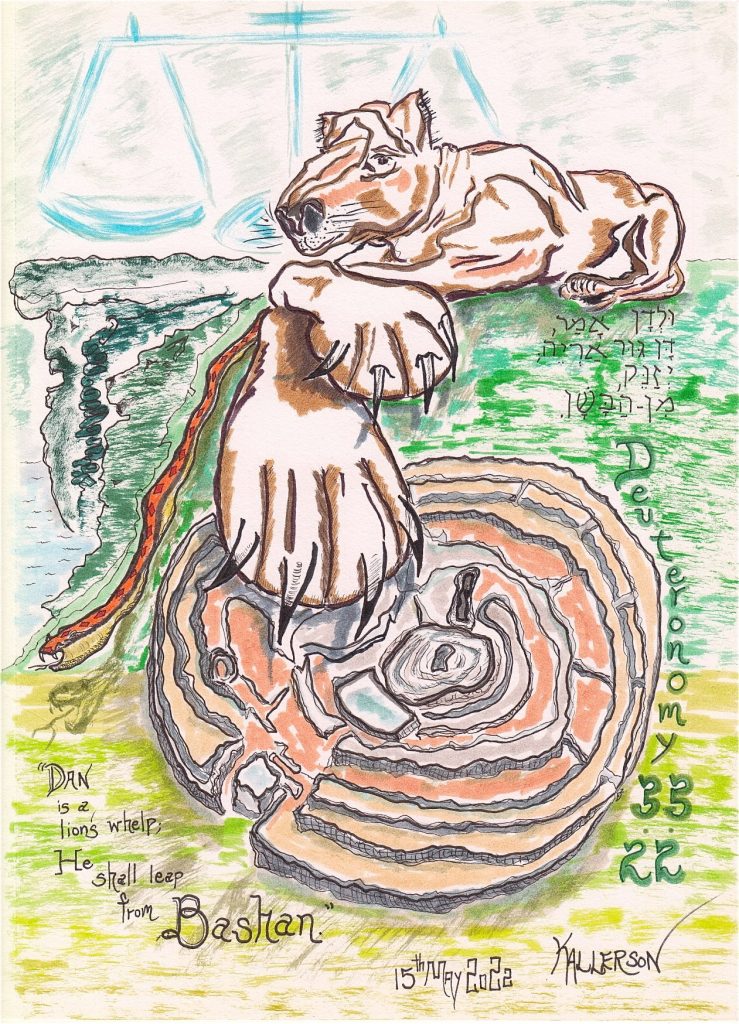
Deuteronomy 33:18-22
Moses Blesses Israel, Part III
The blessings of the individual tribes continue now with four more short blessings. The first two finish up the tribes of Jacob’s wives, Leah and Rachel. They then move to the sons of the handmaids, two of which will be seen today, and the other two will be in the final sermon of the chapter
Other than falling into the order of the sons of the wives and then the handmaids, the order seems rather obscure. The actual birth order goes Reuben, Simeon, Levi, Judah, Dan, Naphtali, Gad, Asher, Issachar, Zebulun, Joseph (Manasseh, Ephraim), Benjamin.
The order of blessing now lists the sons in order of wives and then handmaids, but not necessarily in birth order.
Wives:
Reuben (1)
Judah (4) (inclusive of Simeon (2))
Levi (3)
Benjamin (12)
Joseph (11) (Ephraim and Manasseh are reversed)
Zebulun (10)
Handmaids:
Gad (7)
Dan (5)
Naphtali (6)
Asher (8)
As such, the order doesn’t really make much numerical sense. But as I have said, the layout closely matches a somewhat circular pattern around Jerusalem where the temple is located. The progression is generally from east to west and south to north, but it also considers which tribe is of the wives and which are of the handmaids.
The order goes first to land outside of Canaan with the son of the wives (namely Leah). Then it essentially goes from south to north with the sons of the wives. Manasseh (a son of Joseph whose mother is Rachel), however, has land on both sides of the Jorden River which is dealt with together. When the sons of the wives are completed, it then goes east of the Jordan again to pick up the first of the sons of the handmaids.
From there, Dan is named, but Dan is said by Moses to “leap from Bashan.” That is all the way to the very north of Israel, and so one might wonder why he is mentioned next. It is because he was first allocated land to the west of Canaan, midway up the land near Benjamin and Ephraim.
However, the land he acquires in the north is situated where the Jordan issues from. As such, naming him before the other two tribes who descend from the handmaids makes complete sense. From there, the final two sons of the handmaids are the furthest north and west.
And so, the pattern essentially follows both a geographic surrounding of Jerusalem while also accounting for who was born to a wife of Jacob and who was born to a handmaid. It really is a unique and interesting pattern to consider, which only came to me while typing these sermons.
Other than being interesting and definitely a pattern in how it comes about, if you accept predictive prophecy, it shows that Moses’ blessing is inspired by the Lord. This is because Moses only knew where the division of land for the three tribes east of the Jordan would be.
Nothing else was known to him because the other divisions would only come after the land was occupied by Israel.
Text Verse: “And He brought them to His holy border,
This mountain which His right hand had acquired.
55 He also drove out the nations before them,
Allotted them an inheritance by survey,
And made the tribes of Israel dwell in their tents.” Psalm 78:54, 54
Other than being a definite pattern, and that it was laid out by Moses before it came about, I’m not personally sure what to make of it. But the fact that the tribes are laid out in this way based on the blessing of Moses inspires me, as do so many other curiosities in Scripture.
There may be a deeper meaning. For example, the directions in the Bible each have meaning. The east is that which is before in time, like the rising of the sun which comes first. The west is that which is after, as in the place where the setting of the sun is.
The east is also the place of exile. Man was cast out of the garden with cherubim placed at the east. That matches the layout of the temple which is laid out east to west and which must be accessed from the east. Outside of the most holy place, cherubim were woven into the veil, on the east and facing east.
The west is where the Lord dwells. It is that which is arrived at last. As such, the tabernacle is a picture of the way one goes – from east, outside of God’s favor (before), to west, union with the Lord (after). It is a journey where one returns to the presence of the Lord. It is the consummation of the trek man has been on since the fall, and it is one that is realized in the coming of Christ.
Because Jerusalem is north of the equator, the south – which is the right hand and that which is greater – is more illuminated. The left is that which is north, and which is increasingly dark and obscure. As such, one can see that Judah (Praise), which encompasses the land to the south (right) of the temple, is at the prominent position, the right hand.
This is the tribe Jesus came from. He who is the Praise of God now sits at the right hand, the position of prominence and authority of God. And yet, Benjamin, whose name means “Son of the Right Hand,” is to the north side of the temple area.
Thus, the idea of the right hand – that which is prominent and possesses authority – literally encompasses the area of the temple. These things are all a part of how God laid out the tribes through the blessing of Moses upon them.
To fully flesh out all the meaning that could be derived from these individual placements would be an immense and hugely rewarding study. There is just too much evidence for these things to be coincidence. There is marvelous beauty in everything seen, and it was all prophesied to be as it is even before Israel entered the land.
Many great things such as these are to be found in His superior word. And so, let us turn to that precious word once again and… May God speak to us through His word today and may His glorious name ever be praised.
I. The Blessings to Zebulun and Issachar (verses 18 & 19)
18 And of Zebulun he said:
v’lizvulun amar – “And to Zebulun he said.” Zebulun is the sixth and final son born to Jacob’s wife Leah and the tenth born to Jacob. He has another brother, Issachar, who was born to Leah before he was. And yet, both Jacob and Moses first bless Zebulun before Issachar.
The record of Zebulun’s birth is found in Genesis 30 –
“Then Leah conceived again and bore Jacob a sixth son. And Leah said, ‘God has endowed me with a good endowment; now my husband will dwell with me, because I have borne him six sons.’ So she called his name Zebulun.” Genesis 30:19, 20
Zebulun means Glorious Dwelling Place, and so Leah’s words at his birth, and the words of Jacob when he blessed him in Genesis 49, both make a play on his name. Using the thought of dwelling, Jacob said, “Zebulun shall dwell by the haven of the sea.”
Zebulun’s inheritance is located north of the tribe of those of Manasseh who are situated within the borders of Canaan. As such, the pattern of the order of the tribes surrounding Jerusalem in a somewhat discernible manner continues.
However, as noted in the introduction, because of Manasseh and Dan occupying more than one plot of land, this is not a hard and fast pattern, but it is surprising that the order of blessing continues, so far, to come as the tribes are further from the location of Jerusalem. To Zebulun Moses proclaims…
18 (con’t) “Rejoice, Zebulun, in your going out,
It is exactingly translated: semakh zevulun b’tsetekha – “Rejoice, Zebulun, in your going out.” The meaning of this is a blessing of trade and commerce and of skill and ability in war, both of which are used concerning the word yatsa, or “going out,” elsewhere.
The original borders of Zebulun, according to the division of land recorded in Joshua 19, does not include any sea borders. And yet, when Jacob blessed him, he said –
“Zebulun shall dwell by the haven of the sea;
He shall become a haven for ships,
And his border shall adjoin Sidon.” Genesis 49:13
In those words, the word “sea” is plural. Literally, it says zebulun lekhoph yammim yishkon – “Zebulun at the shore of the seas shall dwell.” What it implies is that this tribe would fill the land between the Sea of Galilee and the Mediterranean Sea, or at least they would have access to them.
In the next clause, the Hebrew literally says, “And he to a shore of ships.” Even if he had no direct access to a shore, his inheritance included access to a shore where ships are unloaded. Actually, this is twofold in nature. The first is seen in Issachar’s coming blessing.
Because Zebulun is blessed before his older brother Issachar, it implies that the land of Issachar is jointly used by Zebulun who has been given priority over Issachar. This is the case in both the blessing of Jacob and of Moses.
This explains the reason for the blessing of both Jacob and Moses upon Zebulun before Issachar, even though Issachar was born first. Zebulun could gain access to the Sea of Galilee by traveling through the inheritance of Issachar.
However, he not only had access there, but also through Sidon, the land to the north, outside of Canaan. Sidon was the firstborn of Canaan. His territory was at the northerly end of the land of Canaan and is known for its prominent cities of Tyre and Sidon, cities still known and occupied at Jesus’ time. The city of Sidon was at the extreme northern border between Canaan and Lebanon, quite a long way from Zebulun.
But the larger territory was known for the city. This is just like the city of Tokyo in the prefecture of Tokyo. Tokyo city is just a small place, but the prefecture is large. The use of the name of the city for the larger territory is seen in the gospel of Luke –
“But I tell you truly, many widows were in Israel in the days of Elijah, when the heaven was shut up three years and six months, and there was a great famine throughout all the land; 26 but to none of them was Elijah sent except to Zarephath, in the region of Sidon, to a woman who was a widow.” Luke 4:25, 26
The name Sidon means “catching fish” or “plenty of fish.” Because the name Sidon was also given in Jacob’s prophecy, the Bible confirms that Zebulun will have a portion of coastal territory for its use. But, as noted a minute ago, the term “goings out” is also used in referring to warfare.
Zebulun is noted for its skill in warfare in Judges 4 and 5, especially as is recorded in the Song of Deborah. As such, Moses prophesies over Zebulun and blesses him in this manner. Next…
18 (con’t) And Issachar in your tents!
Again, the translation is correct: v’yisakar b’ohalekha – “And Issachar in your tents!” Issachar is the fifth son born to Leah and the ninth born to Jacob.
Issachar’s land is just to the east of Zebulun and a little closer to Jerusalem, but that doesn’t really harm the pattern of the tribes encircling the temple. Rather, it actually highlights it because of their situation in relation to Gad who will next be named. The record of Issachar’s birth is found in Genesis 30 –
“Now Reuben went in the days of wheat harvest and found mandrakes in the field, and brought them to his mother Leah. Then Rachel said to Leah, ‘Please give me some of your son’s mandrakes.’
15 But she said to her, ‘Is it a small matter that you have taken away my husband? Would you take away my son’s mandrakes also?’
And Rachel said, ‘Therefore he will lie with you tonight for your son’s mandrakes.’
16 When Jacob came out of the field in the evening, Leah went out to meet him and said, ‘You must come in to me, for I have surely hired you with my son’s mandrakes.’ And he lay with her that night.
17 And God listened to Leah, and she conceived and bore Jacob a fifth son. 18 Leah said, ‘God has given me my wages, because I have given my maid to my husband.” So she called his name Issachar.’” Genesis 30:14-18
His name means “He is Wages.” As for Moses’ blessing, dwelling in one’s tent gives the sense of peace, quietude, and contentment. The sentiment of Moses is not unlike portions of the blessing of Jacob upon this fifth son of Leah –
“Issachar is a strong donkey,
Lying down between two burdens;
15 He saw that rest was good,
And that the land was pleasant;
He bowed his shoulder to bear a burden,
And became a band of slaves.” Genesis 49:14, 15
In the blessing of these two sons, one can see the contrasting parallel –
Rejoice:
(a) *+Zebulun, in your going out,
(a) *And -Issachar in your tents!
The rejoicing applies to both. For Zebulun, it is the bustle of commercial life, trade, shipping, warfare, and so on. For Issachar, it is the quiet pursuit of agriculture and home life. For both, Moses continues…
19 They shall call the peoples to the mountain;
amim har yiqrau– “Peoples mountain they call.” The idea of these words is that from this area, there shall be a call to the sacred mountain, the mountain of the Lord. This is literally fulfilled in the words of Isaiah concerning the ministry of Christ –
“Nevertheless the gloom will not be upon her who is distressed,
As when at first He lightly esteemed
The land of Zebulun and the land of Naphtali,
And afterward more heavily oppressed her,
By the way of the sea, beyond the Jordan,
In Galilee of the Gentiles.
2 The people who walked in darkness
Have seen a great light;
Those who dwelt in the land of the shadow of death,
Upon them a light has shined.” Isaiah 9:1, 2
This is cited in Matthew 4 as a direct reference to the ministry of the gospel going forth in this area. Because Issachar is blessed with Zebulun, they are, therefore, implicitly included in what is said by Isaiah.
Even though Jesus’ earthly ministry was specifically only to the people of Israel, it extended to Gentiles at times, and eventually, the New Covenant went out to all peoples. This is certainly the reference here. As such…
19 (con’t) There they shall offer sacrifices of righteousness;
sham yizbekhu zivkhe tsedeq – “There they offer sacrifices righteous.” The sacrifices of the righteous are not simply sacrifices upon the altar. David, Isaiah, and others confirm this –
“Deliver me from the guilt of bloodshed, O God,
The God of my salvation,
And my tongue shall sing aloud of Your righteousness.
15 O Lord, open my lips,
And my mouth shall show forth Your praise.
16 For You do not desire sacrifice, or else I would give it;
You do not delight in burnt offering.
17 The sacrifices of God are a broken spirit,
A broken and a contrite heart—
These, O God, You will not despise.
18 Do good in Your good pleasure to Zion;
Build the walls of Jerusalem.
19 Then You shall be pleased with the sacrifices of righteousness,
With burnt offering and whole burnt offering;
Then they shall offer bulls on Your altar.” Psalm 51:14-19
Only when the heart is right are sacrifices considered righteous. If the previous clause is referring to the ministry of Christ, this one – which is set in parallel – must as well. It is what Paul refers to in several ways, such as –
“I beseech you therefore, brethren, by the mercies of God, that you present your bodies a living sacrifice, holy, acceptable to God, which is your reasonable service.” Romans 12:1
The “great light” of Isaiah 9, the spreading of the gospel in Galilee of the Gentiles, leads to the righteous sacrifices being acceptable to God as they are sanctified by the Holy Spirit. Next, Moses notes…
19 (con’t) For they shall partake of the abundance of the seas
ki shepha yamim yinaqu – “For abundance seas they suck.” The word shepha, or abundance, is found only here in Scripture. It is from an unused root meaning to abound. It is referring to the two seas which lay on either side, Galilee and the Mediterranean.
Due to their closeness, they would benefit from that which is derived from them. The word yanaq means “to suck,” but it is consistently used of nursing a child, as when babes are suckled.
Because the seas in both directions lead to interaction with Gentiles, I would say this continues to refer to the ministry of Christ expanding to them, something that occurred in the gospels, and which has continued for millennia. Further…
19 (con’t) And of treasures hidden in the sand.”
It is a very complicated clause, maybe the most complicated. The first two words are plural verbs forming a play on words: u-sephune temune khol – “And concealed hidden sand.” Another unique word is seen here, saphan. It comes from a root meaning to conceal, and so it refers to hiding.
Next, the word “and” is tied to the thought, “For they suck.” Thus, it is saying that they will partake of that thing which is hidden and concealed in the sand. But even the word “sand” is to be taken in connection with the words hidden and concealed.
As such, the whole thought reads something like: “And they will suck of the most hidden things.” And so, this is a direct reference to the words of Jesus, and of the continued words of the apostles –
“In that hour Jesus rejoiced in the Spirit and said, ‘I thank You, Father, Lord of heaven and earth, that You have hidden these things from the wise and prudent and revealed them to babes. Even so, Father, for so it seemed good in Your sight. 22 All things have been delivered to Me by My Father, and no one knows who the Son is except the Father, and who the Father is except the Son, and the one to whom the Son wills to reveal Him.’” Luke 10:21, 22
&
“For you died, and your life is hidden with Christ in God.” Colossians 3:3
(a) Peoples mountain they call.
(a) There they offer sacrifices righteous.
(b) For *abundance seas they suck.
(b) And *concealed hidden sand.
Apart from the teachings of the Lord, including the gospel, the words have such a dubious meaning that they could mean almost anything. But in light of the gospel, they make complete sense. Especially when Jesus compares those who receive His words to babes. Next, we will see Gad and Dan…
When I bless you, you shall be blessed
And upon you shall come the blessings I state
When it is for comfort, you shall not be hard pressed
And when it is for love, there shall be no hate
With My blessing you will be blessed
You shall abound in the good things I proclaim
You need do nothing to receive it, you need take no test
My blessing is grace that stems from My name
Listen to My blessing and know it is true
It shall come pass, the words that I proclaim
The blessings I state shall come upon you
Because My blessing is grace that stems from My name
II. The Blessings to Gad and Dan (verses 20-22)
20 And of Gad he said:
u-l’gad amar – “And to Gad he said.” Gad is the first son born to Leah’s handmaid Zilpah and the seventh born to Jacob. Gad is east of Issachar and also east of the Jordan. The land extends from the Sea of Galilee almost to the Dead Sea, across from Benjamin. As such, it provides a buffer to the east for Jerusalem.
The record of his birth is noted in Genesis 30 –
“When Leah saw that she had stopped bearing, she took Zilpah her maid and gave her to Jacob as wife. 10 And Leah’s maid Zilpah bore Jacob a son. 11 Then Leah said, ‘A troop comes!” So she called his name Gad.” Genesis 30:9-11
Gad can mean “A Troop,” but it also means “Good Fortune.” Of him, Moses says…
20 (con’t) “Blessed is he who enlarges Gad;
barukh markhiv gad – “Blessed he enlarges Gad.” Gad settled east of the Jordan and in a very large parcel. The thought of saying, “Blessed is he who enlarges Gad,” is referring to what has already happened, even though it is stated as if it is ongoing. The Lord provided a great expanse for Gad, and so Gad is enlarged into the future as he fills that expanse, continuing to subdue it.
20 (con’t) He dwells as a lion,
kelaviy shaken – “As lion he dwells.” This is referring to his residence in the land given to him. Despite it being already apportioned out to him by the Lord, it still had inhabitants in it from the nations who had settled it long before.
Therefore, to dwell as a lion means that he is ready to pounce, taking dominion over that which belongs to him. That then leads to the next thought…
20 (con’t) And tears the arm and the crown of his head.
v’taraph zeroa aph qadeqod – “And has torn arm, yea, crown of head.” The arm is the symbol of strength. The crown of the head symbolizes leadership and command. The symbolism, then, is that of Gad dwelling in his land, ever ready to enlarge his dominion over the area that he has already been provided.
Blessed he enlarges Gad. (The ultimate Force behind Gad’s enlargement. He is the Enlarger)
(a) *As lion +he dwells.
(a) *And +he has torn arm, yea, crown of head.
Though this speaks of Gad and his dominion, it ultimately surely anticipates Christ who is equated to a lion (even if from Judah) who destroyed the strength and the authority of the devil.
21 He provided the first part for himself,
v’yar reshit lo – “And he saw first to himself.” To “see” signifies to attend to, as in “See to it yourself.” Hence, this is referring to the land that was subdued east of the Jordan, even before entering Canaan.
When it was seen, Gad wanted it and determined to have it for his possession. This is what is being referred to. Next…
21 (con’t) Because a lawgiver’s portion was reserved there.
khelqat mekhoqeq saphun – “Portion lawgiver covered.” Here is a new word, saphan. It signifies to cover, such as in paneling a house. It is the root of the unique word saphan just introduced in verse 19. It is assumed here that the lawgiver is Moses. As such, it would then mean that the portion of land granted by Moses to Gad is preserved for Gad.
21 (con’t) He came with the heads of the people;
v’yete rashe am – “And he comes heads people.” This is referring to the agreement made allowing Gad and the other tribes to remain in the land east of the Jordan –
“So Moses gave command concerning them to Eleazar the priest, to Joshua the son of Nun, and to the chief fathers of the tribes of the children of Israel. 29 And Moses said to them: ‘If the children of Gad and the children of Reuben cross over the Jordan with you, every man armed for battle before the Lord, and the land is subdued before you, then you shall give them the land of Gilead as a possession. 30 But if they do not cross over armed with you, they shall have possessions among you in the land of Canaan.’” Numbers 32:28-30
The conditions were agreed upon, and thus Gad, named first in regard to these tribes, was to lead the people in the conquest of Canaan.
21 (con’t) He administered the justice of the Lord,
sidqat Yehovah asah – “Justice Yehovah he has done.” The thought is to be considered with the next clause…
21 (con’t) And His judgments with Israel.”
u-mishpata im Yisrael – “And His judgments with Israel.” This and the previous clause could mean one of two things. Either he executed the justice and judgments of the Lord upon Canaan, or he complied with the justice and judgments of the Lord that were set in the conditions for him to return to his land.
Either way, the two clauses are referring to Gad’s obedience in going forth with Israel in order to secure their own possession in the land east of the Jordan.
(a) And he saw first to himself
(a) Portion lawgiver covered
(a) And he comes heads people
(b) +Justice Yehovah *he has done
(b) *And +His judgments with Israel
22 And of Dan he said:
u-l’dan amar – “And to Dan he said.” Dan is the first son born to Rachel’s handmaid Bilhah and the fifth born to Jacob. Dan’s allotment was originally West of Ephraim, and so it would seem that the pattern of the tribes encircling the area of Jerusalem is disturbed in his placement, but that would be incorrect.
Rather, Dan fills in the area westward, even to the Mediterranean Sea, but Dan eventually moved to the extreme north of the land in an area where the Jordan River begins, just below Mount Hermon. It straddles that, and so it meets together with the half-tribe of Manasseh to the east and Naphtali to the west.
As such, it is fitting that Dan is now mentioned, rather than where it was originally allocated land as noted in Joshua.
The record of his birth is found in Genesis 30 –
“Now when Rachel saw that she bore Jacob no children, Rachel envied her sister, and said to Jacob, ‘Give me children, or else I die!’
2 And Jacob’s anger was aroused against Rachel, and he said, ‘Am I in the place of God, who has withheld from you the fruit of the womb?’
3 So she said, ‘Here is my maid Bilhah; go in to her, and she will bear a child on my knees, that I also may have children by her.’ 4 Then she gave him Bilhah her maid as wife, and Jacob went in to her. 5 And Bilhah conceived and bore Jacob a son. 6 Then Rachel said, ‘God has judged my case; and He has also heard my voice and given me a son.’ Therefore she called his name Dan.’” Genesis 30:1-6
Dan means “Judge.” Of him, Moses says…
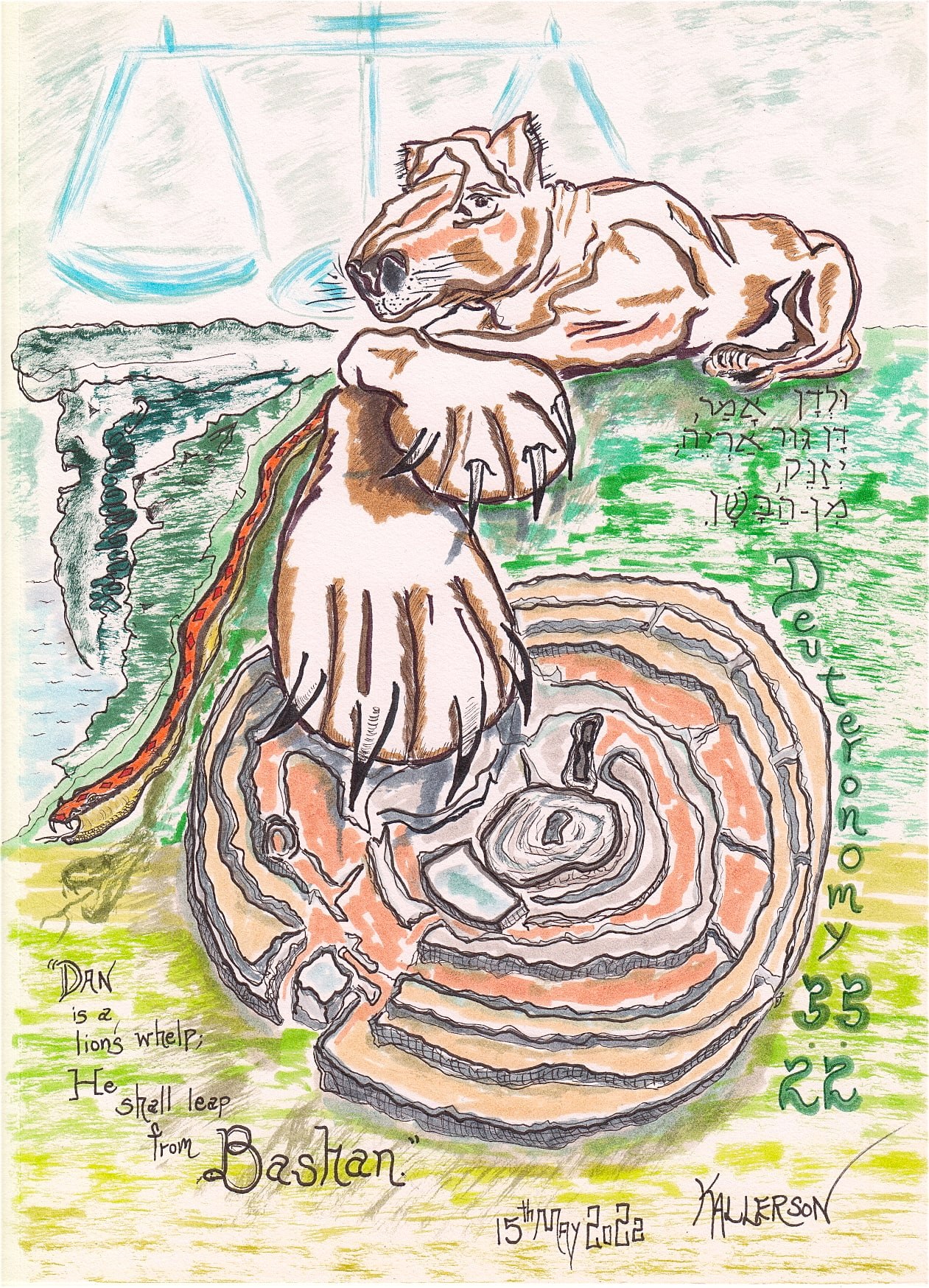
22 (con’t) “Dan is a lion’s whelp;
dan gur aryeh – “Dan whelp lion.” There is a play on words in this that is not yet evident. Moses is equating Dan with a lion, prophetically indicating both where and how he would settle. And this, despite the allocation for land originally given in Joshua. That is next seen with the words..
22 (con’t)He shall leap from Bashan.”
yezaneq min ha’bashan – “He leaps from the Bashan.” Here is a word found only this once in the Bible, zanaq. It comes from a root meaning to draw together the feet as an animal would when it is about to dart upon prey. Hence, it means to spring forward.
Moses identifies Dan with the Bashan, the area to the extreme north of the land, and – as I noted – it straddles the area that leads into the Jordan River. But more, when Moses goes to view the land before he dies, this is recorded there –
“And the Lord showed him all the land of Gilead as far as Dan.” Deuteronomy 34:1
Despite the lot for Dan being drawn in a completely different area, it was already known that Dan would settle to the far north, even beyond the land of Gilead. The lengthy record of the events of them moving to this area is found in Judges 18. Toward the end of the chapter, it says –
“So they took the things Micah had made, and the priest who had belonged to him, and went to Laish, to a people quiet and secure; and they struck them with the edge of the sword and burned the city with fire. 28 There was no deliverer, because it was far from Sidon, and they had no ties with anyone. It was in the valley that belongs to Beth Rehob. So they rebuilt the city and dwelt there. 29 And they called the name of the city Dan, after the name of Dan their father, who was born to Israel. However, the name of the city formerly was Laish.” Judges 18:27-29
The name Laish means “Lion.” Dan sprang forth upon Laish (Lion), just as a lion springs forth. Hence, Moses is making a prophetic pun upon what would occur in the future as Dan took its place to the far north.
With the short blessing complete, one can see the simple a/b structure of it –
(a) Dan whelp lion.
(b) He leaps from the Bashan.
Because of the obvious fulfillment of the words of Moses, liberal scholars take this – along with many other words of the blessings – as having been written many generations later. That is completely dismissive of the idea that God could inspire his prophets to proclaim the future.
As such, it is dismissive of the fact that this is God’s word. If these things were written later, then they would be the writings of man without God’s inspiration. And if this is so, then the Bible is simply a collection of man’s writings without any spiritual value at all, because man is – after all – a corrupt, fallen being.
But the writings here in Deuteronomy are God’s inspired words. I have personally never seen any study on the layout of these tribes as I mentioned them to you at the beginning of the sermon, and yet they form a definite and distinct pattern.
Therefore, it is its own confirmation that these are the words of Moses as inspired by the Lord. They were not written later in order to fulfill some sort of pre-set, or man-determined pattern. If they were, the pattern would have been noted and everyone would know about it.
And this is the same with dozens of other patterns that we have drawn out from the text as we have proceeded through the books of Moses. Whether they are geographical, ancestorial, numerical, word-based (such as chiasms), or other types of patterns, we have come across so many that have never been seen before that it is beyond credulity that they came about by mere chance.
And yet, as far as I know, there is no historical record of them having been noted by anyone else. This means that they were probably never seen before by anyone. And yet, they are there, and they are unmistakable.
And because many of them overlap with other things that also form patterns, they could not have been inserted later. They had to be there all along. Chiasms, for example, may overlap many verses that are prophetic in nature. If those prophetic verses were inserted later, as scholars who deny prophecy claim, then the chiasm would not exist.
Understanding these things, we have to either accept that this is truly the word of God, telling in advance what will come to pass before it happens, or this book is the greatest aberration in the history of the universe, because things that could not otherwise exist in it do, in fact, exist.
Where will you place your faith? If this book is not the word of God, then everything it says about Jesus – everything – is false. This is because Jesus Himself clearly stated that this is, in fact, the word of God and that it testifies to who He is.
One cannot logically say, “I accept the premise of the New Testament and I believe in Jesus and yet I do not accept as inspired the words of the Old Testament.” The thinking is confused, erratic, and clearly unclear.
It is no different than someone saying, I believe in Jesus and yet I do not believe that He is the only way to be reconciled to God. That is a logical contradiction because Jesus Himself said that He is the only way to be reconciled to God.
If you don’t believe what He says, then you don’t believe Him. And if He is a liar, then why – tell me why! – you would want to believe in Him. If you want to follow a god who lies to you, I can direct you to lots of other gods. You can pick any of them and you will get exactly what you are looking for.
But if you want to follow the God who is truthful because He is the Truth, I can only direct you to one God. He is the God of the Bible, and He is the embodiment of truth. And because Scripture is given by Him and tells us about Him, you can be fully confident that Scripture is absolute truth.
Be sound in your thinking, be confident in your theology, and be right in your doctrine. Come to the Source of all wisdom and truth. Come to Jesus, the Word of God.
Closing Verse: “Then He said to them, ‘These are the words which I spoke to you while I was still with you, that all things must be fulfilled which were written in the Law of Moses and the Prophets and the Psalms concerning Me.’ 45 And He opened their understanding, that they might comprehend the Scriptures.” Luke 24:44, 45
Next Week: Deuteronomy 33:23-29 Moses is almost through blessing, but there is still a little more… (Moses Blesses Israel, Part IV) (103rd Deuteronomy Sermon)
The Lord has you exactly where He wants you. He has a good plan and purpose for you. But He also has expectations of you as He prepares you for entrance into His Land of Promise. So, follow Him and trust Him and He will do marvelous things for you and through you.
Moses Blesses Israel, Part III
And of Zebulun he said:
Rejoice, Zebulun, in your going out
And Issachar in your tents! Give a shout!
They shall call the peoples to the mountain
There they shall offer sacrifices of righteousness in the land
For they shall partake of the abundance of the seas
And of treasures hidden in the sand
And of Gad he said:
“Blessed is he who enlarges Gad
He dwells as a lion in his spread
And tears the arm
And the crown of his head
He provided the first part for himself
Because a lawgiver’s portion was reserved there
He came with the heads of the people, so to you I tell
He administered the justice of the LORD
And His judgments with Israel
And of Dan he said:
“Dan is a lion’s whelp going on and on
He shall leap from Bashan
Lord God, turn our hearts to be obedient to Your word
Give us wisdom to be ever faithful to You
May we carefully heed each thing we have heard
Yes, Lord God may our hearts be faithful and true
And we shall be content and satisfied in You alone
We will follow You as we sing our songs of praise
Hallelujah to You; to us Your path You have shown
Hallelujah we shall sing to You for all of our days
Hallelujah and Amen…
18 And of Zebulun he said:
“Rejoice, Zebulun, in your going out,
And Issachar in your tents!
19 They shall call the peoples to the mountain;
There they shall offer sacrifices of righteousness;
For they shall partake of the abundance of the seas
And of treasures hidden in the sand.”
20 And of Gad he said:
“Blessed is he who enlarges Gad;
He dwells as a lion,
And tears the arm and the crown of his head.
21 He provided the first part for himself,
Because a lawgiver’s portion was reserved there.
He came with the heads of the people;
He administered the justice of the Lord,
And His judgments with Israel.”
22 And of Dan he said:
“Dan is a lion’s whelp;
He shall leap from Bashan.”