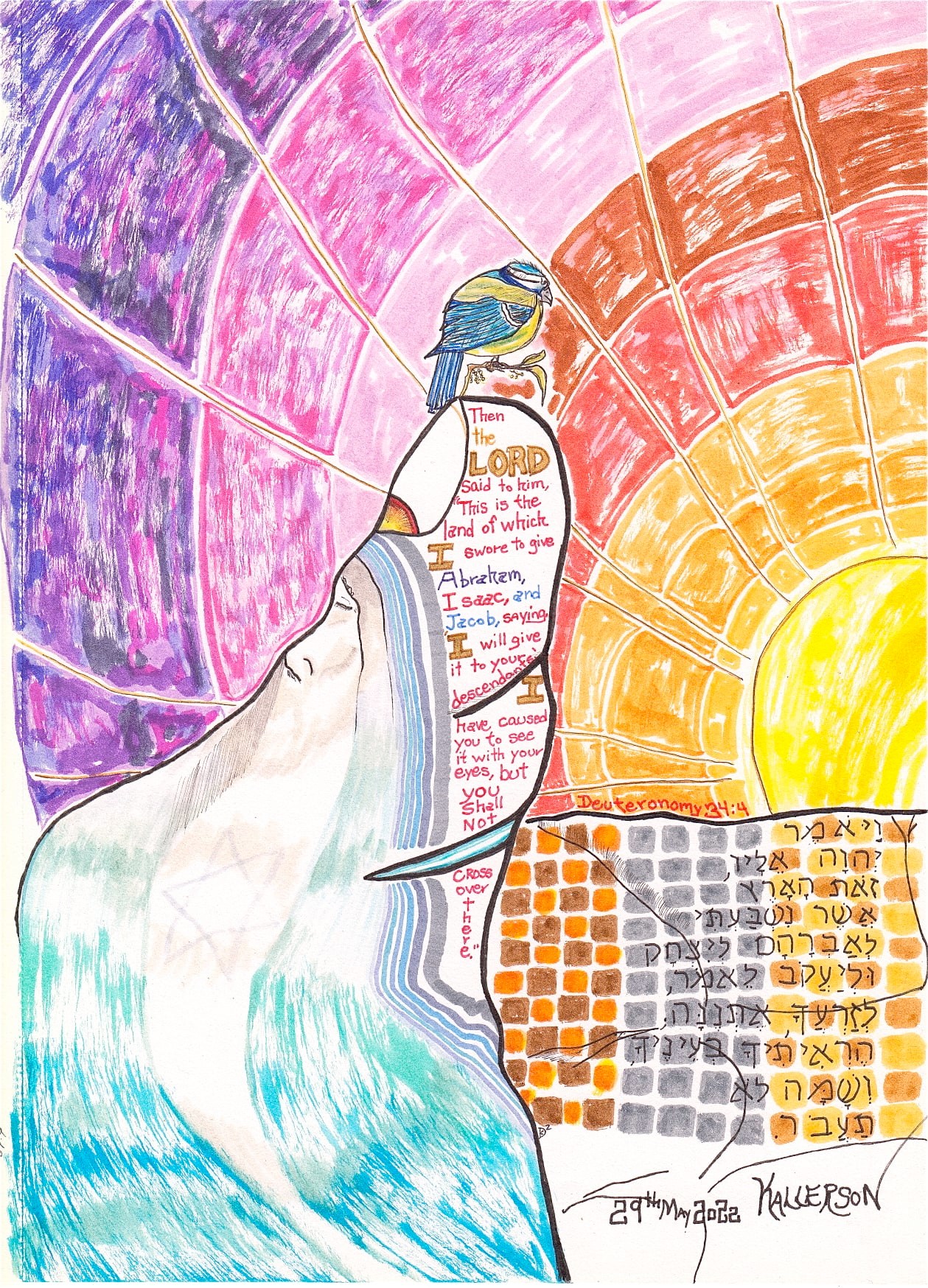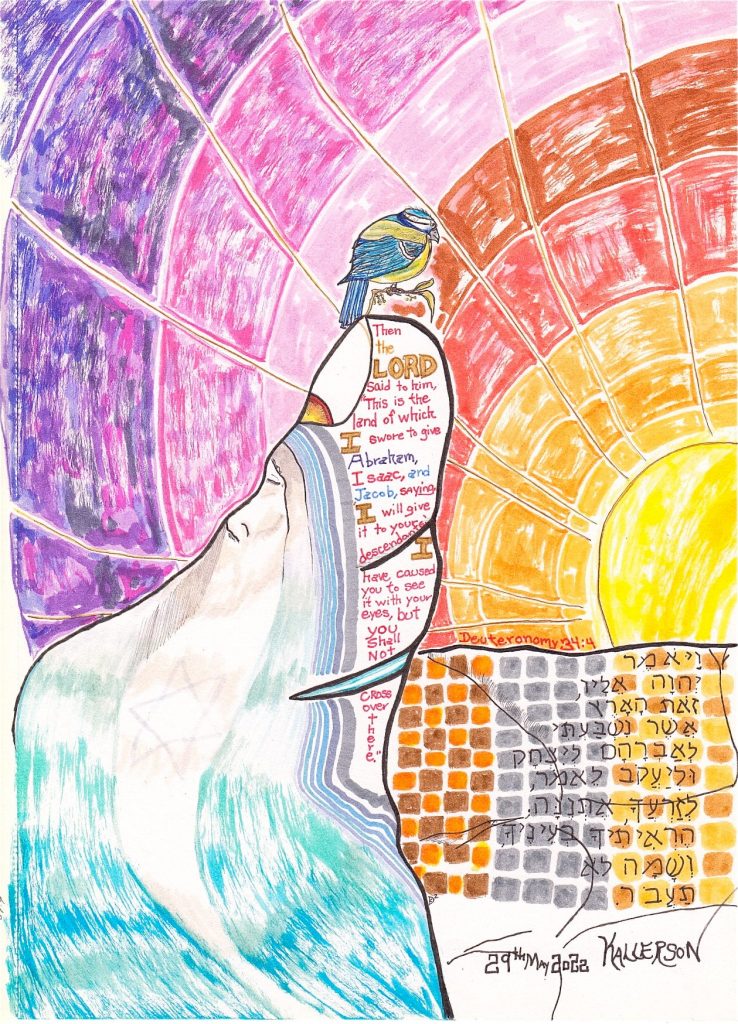
Artwork by Douglas Kallerson.
Deuteronomy 34:1-12
You Shall Not Cross Over There
When I worked at Florida Cities Water Company, a company no longer in existence, I was the Lead Operator of the Gulf Gate Wastewater Treatment Plant, just a couple of miles from here – also no longer in existence. The company handled all the water and wastewater for the entire Gulf Gate area.
Included in this was the big blue water tower just behind the church on Mall Drive, between us and the shopping center where Publix is. On the top of this tower and others like it are lights encased in thick red glass which gives them (and airport towers and the like) their distinctive appearance and which serve as a warning to aircraft.
I took care of those lights and always enjoyed climbing up the tower to scan pretty much everything from north of Tampa, all the way to south of Fort Myers, to way out in the Gulf of Mexico, and to the middle of the state. Trips up the tower were my own version of spying out the land.
Today, Moses will get his last view from the tower, so to speak, though his will be from a mountaintop. He will look over the land of promise, but alas, he will not make it there himself. He, typological of the law, cannot attain to the inheritance of the promise. He can only see it from a distance, but the law has no part or share in it.
Text Verse: “For this One has been counted worthy of more glory than Moses, inasmuch as He who built the house has more honor than the house. 4 For every house is built by someone, but He who built all things is God. 5 And Moses indeed was faithful in all His house as a servant, for a testimony of those things which would be spoken afterward, 6 but Christ as a Son over His own house, whose house we are if we hold fast the confidence and the rejoicing of the hope firm to the end.” Hebrews 3:3-6
Moses was introduced into the biblical narrative in Exodus 2:1. He has steadily been with us ever since. But he has actually been with us since Genesis 1:1. This is because it is he who received the five books of the Torah from the Lord, also known as the Pentateuch.
The amount of information that is contained in this law is far beyond anything that we could ever remember or even imagine. Unfortunately, we hardly touched the surface of what is contained in these books. And yet, Moses was only a servant in God’s house.
Jesus, on the other hand, is a Son over His own house. Everything that Moses penned was inspired by the Word of God, Jesus. It is an amazing and glorious thing to consider. It is all about Him. Moses looked at the inheritance from the eastern side of the Jordan. Jesus did, too. Moses died outside of the inheritance. Jesus did too. There is a difference, however. Jesus resurrected and entered into His glory. And because He did, Moses could too. Despite being the servant of the Lord, he was not the Servant of the Lord.
Thank God for Jesus Christ who fulfills that which Moses only hinted at as a mere shadow and type. Yes, Moses penned these books, but they ultimately have come from the mind of God and through the Word of God. Amazing, wonderfully amazing things are to be found in His superior word. And so, let us turn to that precious word once again and… May God speak to us through His word today and may His glorious name ever be praised.
I. You Shall Not Cross Over There (verses 1-4)
Chapter 32 contained the Song of Moses and the admonition for it to be adhered to. After that, the Lord said this to Moses –
“Then the Lord spoke to Moses that very same day, saying: 49 ‘Go up this mountain of the Abarim, Mount Nebo, which is in the land of Moab, across from Jericho; view the land of Canaan, which I give to the children of Israel as a possession; 50 and die on the mountain which you ascend, and be gathered to your people, just as Aaron your brother died on Mount Hor and was gathered to his people; 51 because you trespassed against Me among the children of Israel at the waters of Meribah Kadesh, in the Wilderness of Zin, because you did not hallow Me in the midst of the children of Israel. 52 Yet you shall see the land before you, though you shall not go there, into the land which I am giving to the children of Israel.’” Deuteronomy 32:48-52
With that stated, Chapter 33 gave us the blessings of Moses upon the tribes. From there, and in compliance with the word of the Lord, Moses now obediently adheres to what the Lord had said…
Then Moses went up from the plains of Moab
v’yaal Mosheh mearvot moav – “and ascended Moses from plains Moab.” The word “plain” in Hebrew is aravah. It comes from the word arav, meaning to become evening or grow dark. This is identical to arav, meaning to take or give on pledge. The name Moab means “From Father.” It is from this place, where Moses has carefully instructed Israel, that he ascends…
1 (con’t) to Mount Nebo,
As we saw in Chapter 32, the name Nebo is most likely derived from navi, or prophet. Thus, it means something like Prophet, Interpreter, Spokesperson, or Foreteller.
However, another word it is connected to is navah, meaning high or prominent. It is to the high places that people would go in order to get “nearer” to God and to receive a word from Him or sacrifice to Him. A secondary name is Height.
Therefore, it would be a high place where someone would go to receive a word, a vision, a prophecy, and so on. That is most certainly fitting for this occasion. The account next says…
1 (con’t) to the top of Pisgah,
Rosh ha’pisgah – “top the Pisgah.” Pisgah signifies a cleft. Thus, it is The Cleft. It comes from the word pasag, meaning to pass between. That, in turn, comes from a root signifying to cut up. Thus, pasag figuratively means, “to consider” or “to contemplate.”
1 (con’t) which is across from Jericho.
asher al pene Yerekho – “which upon face Jericho.” The meaning is “facing Jericho.” When on the mountain, the immediate sight would be the city. Jericho, or Yerekho, (with various spellings) has a dual significance. It means City of the Moon, and it also means Place of Fragrance. Of Moses standing in this place, it next says…
1 (con’t) And the Lord showed him all the land of Gilead as far as Dan,
vayarehu Yehovah eth kal ha’arets eth ha’gilad ad dan – “And showed him Yehovah all the land, the Gilead as far as Dan.” Gilead means “Perpetual Fountain.” Dan means “Judge.” It is to be noted again that the land to the extreme north is known as Dan. It does not say that Dan is a part of Gilead (which it is not) but that Moses sees the land of Gilead and his view extends as far as Dan which borders Gilead on its north.
And yet, the allotment for their land in Joshua will be to the west of Canaan, along the sea. Despite this, Dan will eventually settle in this extreme northern portion of Canaan, and it will become known as the territory of Dan. This is already predetermined by Lord.
But the name Dan has already been noted as early as Genesis 14 –
“Now when Abram heard that his brother was taken captive, he armed his three hundred and eighteen trained servants who were born in his own house, and went in pursuit as far as Dan.” Genesis 14:14
Obviously, it is claimed by some that these words must have been written much later, or that this is a different place named Dan, but why should it be so? First, the land is described by tribes in the next verse, Ephraim, Manasseh, and Judah. But these allocations will not be decided until the book of Joshua. Secondly, the Lord told Abraham that the land would be possessed by his descendants, and here it is coming to pass.
The Lord also tells us in the word that the Messiah would come, through what tribe He would come, where He would be born, and so on. And it came to pass. The Lord is telling us a pictorial story as the words are given to and through Moses. There is no reason to not assume that “Dan” here is the tribal land of the future. After looking north, the eyes of Moses will scan southward leading to the middle section of the land…
2 all Naphtali and the land of Ephraim and Manasseh,
Naphtali (My Wrestling) reaches north to the southern border of Dan. Ephraim (Twice Fruitful) is south of Manasseh (Forgetting). From there, Moses’ eyes continue south and west…
2 (con’t) all the land of Judah as far as the Western Sea,
Judah means Praise. They are the southernmost tribe, and their western border is the Mediterranean Sea, here called ha’yam ha’akheron, or literally, “the sea, the after,” but meaning “west.” East is considered “before,” while west is considered “after.”
It is based on the rising and setting of the sun, but more especially, the alignment of the temple which is in an east/west manner. From there, Moses’ eyes look to…
3 the South,
v’eth ha’negev – “And the Negev.” The word comes from a root meaning “parched.” This is the most southern area of Canaan that was included within the tribe of Judah. However, it was then given as the possession of Simeon because, as it says –
“The inheritance of the children of Simeon was included in the share of the children of Judah, for the share of the children of Judah was too much for them. Therefore the children of Simeon had their inheritance within the inheritance of that people.” Joshua 19:10
Being parched does not mean without life. It means life that must be obtained by bringing it up, as in a well, such as Beer Sheba. After this, Moses looks closer to his own position again…
3 (con’t) and the plain of the Valley of Jericho, the city of palm trees,
v’eth ha’kikar biqat yerekho ir ha’temarim – “and the circuit valley Jericho, city the palms.” The word kikar, or “circuit,” comes from karar, to dance. The word translated as “valley” signifies a split, as between mountains. Thus, this is an area in which is a valley forming a circuit. Jericho means “Place of Fragrance.” Palms are a symbol of uprightness. This extends…
3 (con’t) as far as Zoar.
It is debated if Zoar is at the north or south end of the Dead Sea. This verse reveals that it is at the north end. The valley of Jericho extends down to that area, and Jericho is just west of where Moses now stands. The only way Zoar could be at the south end of the Dead Sea would be if the description of the “circuit of the valley of Jericho” included all of the Dead Sea, which seems unlikely. The name Zoar means Small and signifies insignificance.
4 Then the Lord said to him, “This is the land of which I swore to give Abraham, Isaac, and Jacob,
The question is, “Did Moses actually see all of what is described, or did he merely look over that which is described?” In other words, was he given a vision that extends beyond normal perception? We can’t be dogmatic, but just as I could see very far into the distance from the top of a tower that is only about 130 feet tall, Moses – on a very clear day – could have seen a long, long way into the distance.
No matter what, he was given a bird’s eye view of the land of promise that was sworn to Abraham –
“And the Lord said to Abram, after Lot had separated from him: ‘Lift your eyes now and look from the place where you are—northward, southward, eastward, and westward; 15 for all the land which you see I give to you and your descendants forever. 16 And I will make your descendants as the dust of the earth; so that if a man could number the dust of the earth, then your descendants also could be numbered. 17 Arise, walk in the land through its length and its width, for I give it to you.’” Genesis 13:14-17
To Isaac –
“Dwell in this land, and I will be with you and bless you; for to you and your descendants I give all these lands, and I will perform the oath which I swore to Abraham your father. 4 And I will make your descendants multiply as the stars of heaven; I will give to your descendants all these lands; and in your seed all the nations of the earth shall be blessed; 5 because Abraham obeyed My voice and kept My charge, My commandments, My statutes, and My laws.” Genesis 26:3-5
And to Jacob –
“And behold, the Lord stood above it and said: “I am the Lord God of Abraham your father and the God of Isaac; the land on which you lie I will give to you and your descendants. 14 Also your descendants shall be as the dust of the earth; you shall spread abroad to the west and the east, to the north and the south; and in you and in your seed all the families of the earth shall be blessed.’” Genesis 28:13-14
This is important because it excludes any claim to the land for anyone outside of this line. One must be of this line to receive the inheritance. This is seen again in the next words…
4 (con’t) saying, ‘I will give it to your descendants.’
l’mor l’zarakha etenenah – “to say to your seed I will give it.” There is the promise of the land, and there is the promise of what the land signifies. Either way, it is through the line of Abraham, Isaac, and Jacob that this promise is made – none other.
4 (con’t) I have caused you to see it with your eyes, but you shall not cross over there.”
Moses will not enter the promise. But both Moses and the land are typical of something else. The object lesson for Israel is now being made perfectly clear.
The description of the land has been in a sweeping panorama, starting in the east of Canaan as Moses looked north, the east to his right side (Gilead to Dan), it then spanned across the north as his eyes moved to the left (over Naphtali), eventually reaching the middle area (Ephraim and Manasseh), then further to the left spanning over Judah with the Mediterranean Sea straight ahead of him. Further left, he saw the Negev (south), and then he came all the way left where the western border of Canaan would be at his left side, circling back up to Jericho, just across the Jordan from where he was. Hence, he viewed all of the land.
Before we continue on with the passage, a quick study on the typology of what is presented here would be in line. Moses, or He Who Draws Out, is about to die. Jesus is the One who draws out the will of the Father, as is recorded in the law.
Moses ascended from the plains of Moab. The word plains, aravoth, is derived from the same root as arav, pledge. Moab means “From Father.” The plains of Moab typologically mean “the pledge from Father.” It refers to the Spirit, the pledge (arrabon – from the Hebrew eravon) of Ephesians 1:13, 14 –
“In Him you also trusted, after you heard the word of truth, the gospel of your salvation; in whom also, having believed, you were sealed with the Holy Spirit of promise, 14 who is the guarantee of our inheritance until the redemption of the purchased possession, to the praise of His glory.”
There he goes to Pisgah, the Cleft – a place to contemplate – across from Jericho, the Place of Fragrance – a type of Eden Restored, heaven. There the Lord showed him the land. It includes:
Gilead, the Perpetual Fountain – the unceasing flow of the Spirit.
Dan, the Judge of man who had judged him innocent.
Naphtali, My Wrestlings, which made access possible.
Ephraim, Twice Fruitful, having brought in both Jew and Gentile.
Manasseh, Forgetting, where sadness and pains shall be forgotten.
Judah, Praise. Christ is the Praise of God and the Praise of His people.
The Western Sea, The place of “After,” even for eternal days.
The Negev. The Parched from which comes life by effort; Christ’s effort.
The Plain of the Valley of Jericho, The dance of the breach of the Place of Fragrance. Joyful entrance through the gates into heaven.
The City of Palms, The city of the righteous.
Zoar, Insignificant. Explained by 1 Corinthians 1:27-29. Your study for today.
The area described by what Moses saw is a typological anticipation of the glory of Christ and what He offers to those who come to Him. For Moses, despite this, the Jordan before Him was like an impassible wall. He would never enter through its life-giving waters, but would die outside of the inheritance…
Our guide has died; nailed to a cross
And now we have a new direction to go
We cannot count what happened as loss
Something new has come – astonishingly so
In that act, the divine erasure came out
It wiped out the handwriting that directed us
Requirements we could not meet, strong and stout
Have been annulled through the death of Jesus!
Moses served his role, and his law did too
Together they led us to knowledge sublime
They were a tutor to show what God would do
When had come the fullness of time
Jesus! Jesus! Thank God for Jesus!
Praise God for what He has done for us!
II. And the Children of Israel Wept (verses 5-8)
5 So Moses the servant of the Lord died there in the land of Moab,
Moses died no later than the 7th day of the 12th month of the 40th year (possibly earlier) in the year 2554 Anno Mundi, or from the creation of the world.
The words now are stated as a matter of fact, but they give high regard to the man, calling him eved Yehovah – “servant of Yehovah.” As our text verse noted, Moses was faithful as a servant in the Lord’s house, but he still died because of sin.
The law said that the man who did the things of the law would live. Moses, the Lord’s lawgiver, failed to live up to the standard of the law that he gave. Moses had to wait for Someone more perfect than he before he could finally enter into the true inheritance.
5 (con’t) according to the word of the Lord.
al pi Yehovah – “upon mouth Yehovah.” This is a common statement, used again and again in Scripture, meaning just as it is translated – “according to the word of the Lord.” However, Jewish commentators have spiced it up to mean, “At the kiss of the Lord.” There is nothing to suggest this and everything to argue against it.
The Lord spoke of the circumstances concerning this in advance and now the words have come to pass. For all we know, Moses may have seen the stunning beauty of the land and keeled over from a heart attack, knowing he would never enter into such marvelous beauty. And this would not be an improbable guess.
According to Joshua 4:19, Israel will enter into the land on the 10th day of the first month. Moses died about 35 days earlier. This would be at the time when Israel is at its most beautiful – filled with green grass and cool temperatures.
February through April is the greenest time of the year in Israel. It is the time when the rains have fallen during their season, and everything is vibrant and alive. No matter what actually brought his life to an end, it did end. The beauty of Canaan was just out of his reach.
6 And He buried him in a valley in the land of Moab,
There are all kinds of aberrant teachings that people hold onto. One of them is that Moses never actually died. Moses died, and Moses was buried. It is inexcusable to say otherwise. But there is typology here as well.
Moses died and was buried in Moab. Jesus, the fulfillment of the law died and was buried. Thus, the law is gone in His death and burial. Deuteronomy says it is in the land of Moab, or “From Father.” The symbolism is clear. God the Father sent Jesus to die in order to end the law.
Israel will not enter into the promise until after Moses dies. And Israel will not enter into the true inheritance until after they have buried the law –
“In Him you were also circumcised with the circumcision made without hands, by putting off the body of the sins of the flesh, by the circumcision of Christ, 12 buried with Him in baptism, in which you also were raised with Him through faith in the working of God, who raised Him from the dead. 13 And you, being dead in your trespasses and the uncircumcision of your flesh, He has made alive together with Him, having forgiven you all trespasses, 14 having wiped out the handwriting of requirements that was against us, which was contrary to us. And He has taken it out of the way, having nailed it to the cross.” Colossians 2:11-14
In this clause, a different word is translated as “valley,” gai. It comes from the word gevah, meaning pride. That comes from gaah, meaning exalted. The idea is that the surrounding areas are lofty and exalted above the land within. One can almost sense the reason for Moses’ death through the choice of location.
Moses and Aaron pridefully claimed they would draw water from the rock. They struck it twice with a rod instead of speaking to it as they were instructed. Hence, instead of being lifted up, or exalted, as his last moments of life on the top of the mountain would have one expect, he is laid low in this valley.
One can either live by faith in what Christ has done, or he can live by personal pride in attempting to merit God’s favor through the law. Moses himself shows us the difference between the two. The law cannot enter into the inheritance. It can only lead to abasement. If we think of the typology, it all becomes clear –
* Yehovah, sinless and pure, buried Moses (the law), whereas sinful men buried Jesus (the Lord).
* The Lord Jesus (Yehovah incarnate), sinless and pure, buried the law when the sinful men buried Jesus (the embodiment of the law).
And Moses was buried…
6 (con’t) opposite Beth Peor;
Beth Peor means “House of Peor.” Peor comes from the verb paar, meaning “to open.” Thus, it is the House of the Opening. It was a place known for a temple to the Moabite god known as Peor.
This word, paar, is used in Isaiah 5 when speaking of Sheol, the pit of death, opening its mouth beyond measure to receive those who reject the Lord. When under law – whether trusting in the law for righteousness, or in rejecting the law and satisfying one’s own desires – the inevitable outcome is death.
No matter which way one goes, man under law is condemned and will die outside of the promise. It is only through coming to Christ who fulfilled the law, and who embodies it on our behalf, that we can be made right before God. Moses is being used as an object lesson concerning this fact. As for the location itself…
6 (con’t) but no one knows his grave to this day.
The reason for these words now is certainly that Moses’ grave would never be used as a place of idolatry. The attention is to be on the Lord, not on Moses. However, again, there is typology in what we are seeing.
Moses (the law) can no longer be found. It is perfectly described by Paul in 2 Corinthians 5:18, 19–
“Now all things are of God, who has reconciled us to Himself through Jesus Christ, and has given us the ministry of reconciliation, 19 that is, that God was in Christ reconciling the world to Himself, not imputing their trespasses to them, and has committed to us the word of reconciliation.”
The words, “not imputing their trespasses,” mean “not under law.” It is by law that sin is imputed. For those who are in Christ, not only is the law gone, but it is gone forever. Not only does the law die in Christ, but it can never be found again.
7 Moses was one hundred and twenty years old when he died.
The Hebrew is beautifully expressive: u-mosheh ben meah v’esrim shanah b’moto – “And Moses was a son of one hundred and twenty years in his dying.” Moses’ life was divided up into three periods of forty years.
He was in Egypt until he was forty. He went to Midian and was there forty years until his calling. He then led Israel forty years (Acts 7:22, 30 & 36). Bullinger notes that the number one hundred and twenty “is made up of three forties (3×40=120). Applied to time therefore it signifies a divinely appointed period of probation.”
As Moses is typical of the law, the record of his years is given to show that the law is a time of probation. Until one is no longer under law (coming to Jesus), he remains under that set probation. Israel remains in that state to this day. Of Moses, it next says…
7 (con’t) His eyes were not dim nor his natural vigor diminished.
lo kahatah eno v’lo nas lekhoh – “No dim his eyes and no abated his vigor.” This is a noun found only here in Scripture, leakh. It signifies moisture or freshness, and it comes from the same root as the adjective lakh, or moist. It speaks of his inner force, including his virility. This is saying that Moses was functioning perfectly until the moment he died. When he did, only then, did this cease.
Again, the typology is flawlessly clear and can be understood easily by what is stated in Ezekiel 22, where the adjective form, lakh, is used when referring to the coming Messiah –
“Thus says the Lord God: ‘I will take also one of the highest branches of the high cedar and set it out. I will crop off from the topmost of its young twigs a tender one, and will plant it on a high and prominent mountain. 23 On the mountain height of Israel I will plant it; and it will bring forth boughs, and bear fruit, and be a majestic cedar. Under it will dwell birds of every sort; in the shadow of its branches they will dwell. 24 And all the trees of the field shall know that I, the Lord, have brought down the high tree and exalted the low tree, dried up the green tree and made the dry tree flourish; I, the Lord, have spoken and have done it.’” Ezekiel 17:22-24
Moses maintained his ability to perceive (his undimmed eyes) and his power to continue producing (his natural vigor) until the moment he died. Likewise, the power of the law allows that no transgressors go unnoticed, and it has the power to continue producing on its own until it is ended. Only in the ending of the law will those things also end.
With the death of Moses, it next says…
8 And the children of Israel wept for Moses in the plains of Moab thirty days.
Bullinger defines the number thirty, saying, “Thirty being 3 x 10, denotes in a higher degree the perfection of Divine order, as marking the right moment.” The right moment has come.
The record of what occurs is spiritually what pertains to any who come to Christ, but the story refers specifically to Israel. From their departure from the Lord in Numbers 14, to their sentence to wander for forty years, to them finally leaving the law behind, it has been a prophetic look into their future.
As we noted earlier, the words “the plains of Moab” typologically mean “the pledge from Father.” It refers to the Spirit, the pledge noted in Ephesians 1:13, 14. The weeping of Israel at the death of the law (meaning the death of Christ who fulfilled the law) and the giving of the Spirit is seen in Zechariah 12:10-14 –
“And I will pour on the house of David and on the inhabitants of Jerusalem the Spirit of grace and supplication; then they will look on Me whom they pierced. Yes, they will mourn for Him as one mourns for his only son, and grieve for Him as one grieves for a firstborn. 11 In that day there shall be a great mourning in Jerusalem, like the mourning at Hadad Rimmon in the plain of Megiddo. 12 And the land shall mourn, every family by itself: the family of the house of David by itself, and their wives by themselves; the family of the house of Nathan by itself, and their wives by themselves; 13 the family of the house of Levi by itself, and their wives by themselves; the family of Shimei by itself, and their wives by themselves; 14 all the families that remain, every family by itself, and their wives by themselves.”
The law will die in Israel when Israel comes to Christ…
8 (con’t) So the days of weeping and mourning for Moses ended.
As Solomon says, there is a time to weep and a time to laugh. There is a time to mourn and a time to dance. The time of Israel’s mourning will end, and it will be replaced with joy.
This is truly the Prophet of whom Moses foretold
He is the Prophet to come into the world
His words are purer than the finest gold
Through them, the mysteries are unfurled
This is He of whom Moses spoke
It is He who has lifted the burden from us
No more is the pall dark like smoke
Since the coming of this Man, Jesus
A Prophet is He like none other
One who even is greater than Moses, so we see
This One rose among us, He is our Brother
And yet He is higher than Moses – even infinitely
*III. In the Sight of All Israel (verses 9-12)
9 Now Joshua the son of Nun was full of the spirit of wisdom, for Moses had laid his hands on him;
Joshua was inaugurated as is recorded in Numbers 27 and as is also recorded in Deuteronomy 31. The laying of hands on him is specifically referred to in Numbers 27:23. He, as we have seen before, is typical of Christ.
Joshua means “The Lord is Salvation.” His father’s name being included anticipates Christ also. Nun is from the verb nun, to propagate, or increase. This is what Christ would do, increasing the family of God through His completed work.
He is said to be filled with the spirit of wisdom, something explicitly said of the Messiah – using the same words ruakh khakmah, spirit of wisdom – in Isaiah 11:2. The law confirmed Jesus’ ministry because it spoke of Him, anticipated Him, was fulfilled by Him, and was ended through Him. As such…
9 (con’t) so the children of Israel heeded him, and did as the Lord had commanded Moses.
Israel’s obedience to Joshua by obeying the law is what this speaks of. However, it also anticipates obedience by Israel to Moses by heeding Jesus. But it is something that must be considered carefully.
Of this, Charles Ellicott asks, “Is it not true that when the Israel of God hearken to the true Joshua, they must needs do as the Lord commanded Moses?” The answer is, “Yes.” But it is not, “Yes, you must observe the Law of Moses.” Rather, it is to do as Christ Jesus Himself said –
“But you do not have His word abiding in you, because whom He sent, Him you do not believe. 39 You search the Scriptures, for in them you think you have eternal life; and these are they which testify of Me. 40 But you are not willing to come to Me that you may have life.” John 5:38-40
This is what is being pictured right now in this verse concerning Joshua. It is the final anticipation of the time of the law. Israel will come to Christ, heed Him, and be saved by Him. In heeding Jesus, the people will then, and only then, be obedient to Moses in the truest sense. With this understood, it next says…
10 But since then there has not arisen in Israel a prophet like Moses, whom the Lord knew face to face,
The words now speak of the greatness of Moses in all of his house, meaning the time of the law. Moses acted as priest in the establishment of the law. He acted as the first prophet of the law. He served as the ruler of the people during the time of the law. And so on. He served in each of these capacities – something no other person had done.
But the specific point of note is that he was a prophet asher yadao Yehovah panim el panim – “whom knew him, Yehovah, face to face.”
It is assumed that this must have been written much later to include these words. If they were written at the time of Moses, it supposedly would have no meaning.
However, the word of the Lord is eternal. If He said this through Moses’ hand, and the law continues until the ending of the law – whenever that may be – then it is a true statement during all of that time. As such, there is no need to read this in any other light.
If it was written later, that might be fine to someone. But if it wasn’t written by Moses, and it was actually penned, say at the time of Jeremiah, then it could mean that after the time of Jeremiah, someone may arise to make the statement null and void.
Rather, only in the coming of Christ, and in the ending of the law, can this statement no longer be considered true. As such, I would argue that even this statement is from the Lord, through Moses. The account next explains what the ministry of Moses encompassed…
11 in all the signs and wonders which the Lord sent him to do in the land of Egypt, before Pharaoh, before all his servants, and in all his land,
The prepositions read “to” – “To all the signs and the wonders which sent him, Yehovah, to do in the land of Egypt, to Pharaoh, and to all his servants, and to all his land” (CG). The preposition can mean “before,” but these things were not just done before them. Instead, they were done to them.
And Jesus didn’t just perform before Satan, before his demons, and before their domain. Rather, He directly attacked them. He did this through the law, not around it. Satan used the law to destroy man’s fellowship with God (and thus destroy man). Jesus used the law to destroy the power of Satan and to restore man’s fellowship with God.
As for Moses, the narrative, the chapter, and the book of Deuteronomy conclude with the words…
*12 (fin) and by all that mighty power and all the great terror which Moses performed in the sight of all Israel.
The words are really superlative: u-l’kol ha’yad ha’khazaqah u-l’kol ha’mora ha’gadol asher asah mosheh l’ene kal Yisrael – “And to all the hand the mighty, and to all the terror, the great, which did Moses to eyes all Israel!”
This is literally true of the work of Moses, as the record of Exodus testifies. However, it is also true of the work of Jesus, both in His work under the law and of His coming work on behalf of Israel before they come to Him. The book of Revelation details those things, but they are spoken of by Peter in Acts –
“I will show wonders in heaven above
And signs in the earth beneath:
Blood and fire and vapor of smoke.
20 The sun shall be turned into darkness,
And the moon into blood,
Before the coming of the great and awesome day of the Lord.
21 And it shall come to pass
That whoever calls on the name of the Lord
Shall be saved.” Acts 2:19-21
In the end, what is recorded about Moses is given specifically to reveal Christ to us. If you had told me on 23 October 2011 that we would still be plugging along in the books of Moses in 2022, I would not have believed it.
But more, I never considered – in my wildest imagination – the enormity of the task that was begun on that day, or the magnitude of the detail that we would uncover as we progressed through these five books.
I rushed far too fast through Genesis, and I have made many errors in the analysis as we have progressed – each of which overwhelmed me with grief. And yet, I can say that I have done my very best to present to you an accurate and faithful examination of what the Lord has intended for us to see in the most marvelous masterpiece of literature.
I have made many new friends. For those of you who have been here a while, you have as well, and we have also lost some friends along the way. And yet, the word of God continues, and it shall continue until the time of the end.
We have much more to search out until that day, whenever it may be, and so I will press on, hoping you will come along as well. With Moses ended, a new section of literature – the historical writings, also known as the former prophets – will enter into the ongoing narrative and the unfolding story of redemptive history.
Just like almost eleven years ago, I cannot even imagine what treasures lie ahead. With each new sermon, a new Monday of wonder and delight will open up, and hopefully, a new Sunday of anticipation and blessing will follow for you.
For those who have been with us, and for those who are willing to stay as Scripture continues to unfold, I say, “Thank you.” And I would be remiss if I didn’t exhort you to take upon yourselves your own daily study of this word.
If there is no other lesson, outside of direct teaching to you, that I could impart, it would be for you to keep this word near, read it daily, think on it always, and cherish it with all your heart. It is the word of God, it is the revelation of Jesus Christ, and it is the basis of our knowledge of Him. As He is the basis of our faith, I can do no less than implore you to read this word.
Above all, I thank the Lord, Jesus, for having found something suitable in me – no matter how small it is – to allow me the honor of presenting this word to you each week. This alone, if nothing else, tells me of the immensity of our God. If he can use someone as unworthy as me for this highest of honors, it truly demonstrates the magnitude of his greatness.
All I want to do for You, Lord
is because I love You,
not as a tithe, not as a chore,
but because of Your love,
All I want to do for You, Lord,
is to serve You,
not because I must,
but because I trust You, Lord.
All I want to do for You, Lord
is to adore You,
because I’m free to worship You,
my Kings of Kings!
You broke my chains,
You saved my soul,
You broke my bonds
that drowned me, Lord.
You fished me out
from the pool of sins,
and raised me up
that I could live.
So I was freed
when I chose Your Grace
to abound in me,
when You took my place.
And I want to Love,
I want to serve,
because of the Cross,
because of Your Grace!
I want to serve You,
not because of guilt,
not because it’s a chore,
or a quota I must fill.
Not as a deposit
on blessings from You,
but because I want to, Lord,
to love You!
My peace and joy
comes not from what I do,
but from the love
that comes from You!
Izabela Bednara 5 April 2022
Closing Verse: “Do not think that I shall accuse you to the Father; there is one who accuses you—Moses, in whom you trust. 46 For if you believed Moses, you would believe Me; for he wrote about Me. 47 But if you do not believe his writings, how will you believe My words?” John 5:45-47
Next Week: Acts 26:6 We will be in Acts 26 for a span, I hope no one this bothers... (The Promise Made by God to Our Fathers)
The Lord has you exactly where He wants you. He has a good plan and purpose for you. But He also has expectations of you as He prepares you for entrance into His Land of Promise. So, follow Him and trust Him and He will do marvelous things for you and through you.
You Shall Not Cross Over There
Then Moses went up
From the plains of Moab to Mount Nebo
To the top of Pisgah
Which is across from Jericho
And the Lord showed him
All the land of Gilead as far as Dan, so far north he could see
All Naphtali and the land of Ephraim and Manasseh
All the land of Judah as far as the Western Sea
The South, and the plain
Of the Valley of Jericho
The city of palm trees
As far as Zoar, the Lord to him did show
Then the Lord said to him
“This is the land of which I swore
To give Abraham, Isaac, and Jacob, saying
‘I will give it to your descendants –
———-a land of blessing and so much more
I have caused you to see it with your eyes
But you shall not cross over there, so to you I apprise
So Moses the servant of the Lord
Died there to await his reward
In the land of Moab
According to the word of the Lord
And He buried him in a valley
In the land of Moab, hiding his body away
There opposite Beth Peor
But no one knows his grave to this day
Moses was one hundred and twenty years old when he died
So his days were finished
His eyes were not dim
Nor his natural vigor diminished
And the children of Israel
Wept for Moses until those days were expended
In the plains of Moab thirty days
So the days of weeping and mourning for Moses ended
Now Joshua the son of Nun was full of the spirit of wisdom
For Moses had laid his hands on him when the situation demanded
So the children of Israel heeded him
And did as the LORD had Moses commanded
But since then there has not arisen
A prophet like Moses in Israel
Whom the LORD knew face to face
In all the signs, and in all the wonders as well
Which the Lord sent him to do
In the land of Egypt, by the Lord’s hand
Before Pharaoh, before all his servants
And in all his land
And by all that mighty power
And all the great terror as well
Which Moses performed
In the sight of all Israel
Lord God, turn our hearts to be obedient to Your word
Give us wisdom to be ever faithful to You
May we carefully heed each thing we have heard
Yes, Lord God may our hearts be faithful and true
And we shall be content and satisfied in You alone
We will follow You as we sing our songs of praise
Hallelujah to You; to us Your path You have shown
Hallelujah we shall sing to You for all of our days
And Lord God, thank you for this wonderful book
Deuteronomy! What a marvel to have studied it
Into every detail possible we took a look
And to You our thanks and praise we now submit!
Hallelujah to Christ our Lord!
Hallelujah for Deuteronomy, a marvelous part of Your superior word!
Hallelujah and Amen!
Indeed, Hallelujah and Amen…
Then Moses went up from the plains of Moab to Mount Nebo, to the top of Pisgah, which is across from Jericho. And the Lord showed him all the land of Gilead as far as Dan, 2 all Naphtali and the land of Ephraim and Manasseh, all the land of Judah as far as the Western Sea, 3 the South, and the plain of the Valley of Jericho, the city of palm trees, as far as Zoar. 4 Then the Lord said to him, “This is the land of which I swore to give Abraham, Isaac, and Jacob, saying, ‘I will give it to your descendants.’ I have caused you to see it with your eyes, but you shall not cross over there.”
5 So Moses the servant of the Lord died there in the land of Moab, according to the word of the Lord. 6 And He buried him in a valley in the land of Moab, opposite Beth Peor; but no one knows his grave to this day. 7 Moses was one hundred and twenty years old when he died. His eyes were not dim nor his natural vigor diminished. 8 And the children of Israel wept for Moses in the plains of Moab thirty days. So the days of weeping and mourning for Moses ended.
9 Now Joshua the son of Nun was full of the spirit of wisdom, for Moses had laid his hands on him; so the children of Israel heeded him, and did as the Lord had commanded Moses.
10 But since then there has not arisen in Israel a prophet like Moses, whom the Lord knew face to face, 11 in all the signs and wonders which the Lord sent him to do in the land of Egypt, before Pharaoh, before all his servants, and in all his land, 12 and by all that mighty power and all the great terror which Moses performed in the sight of all Israel.