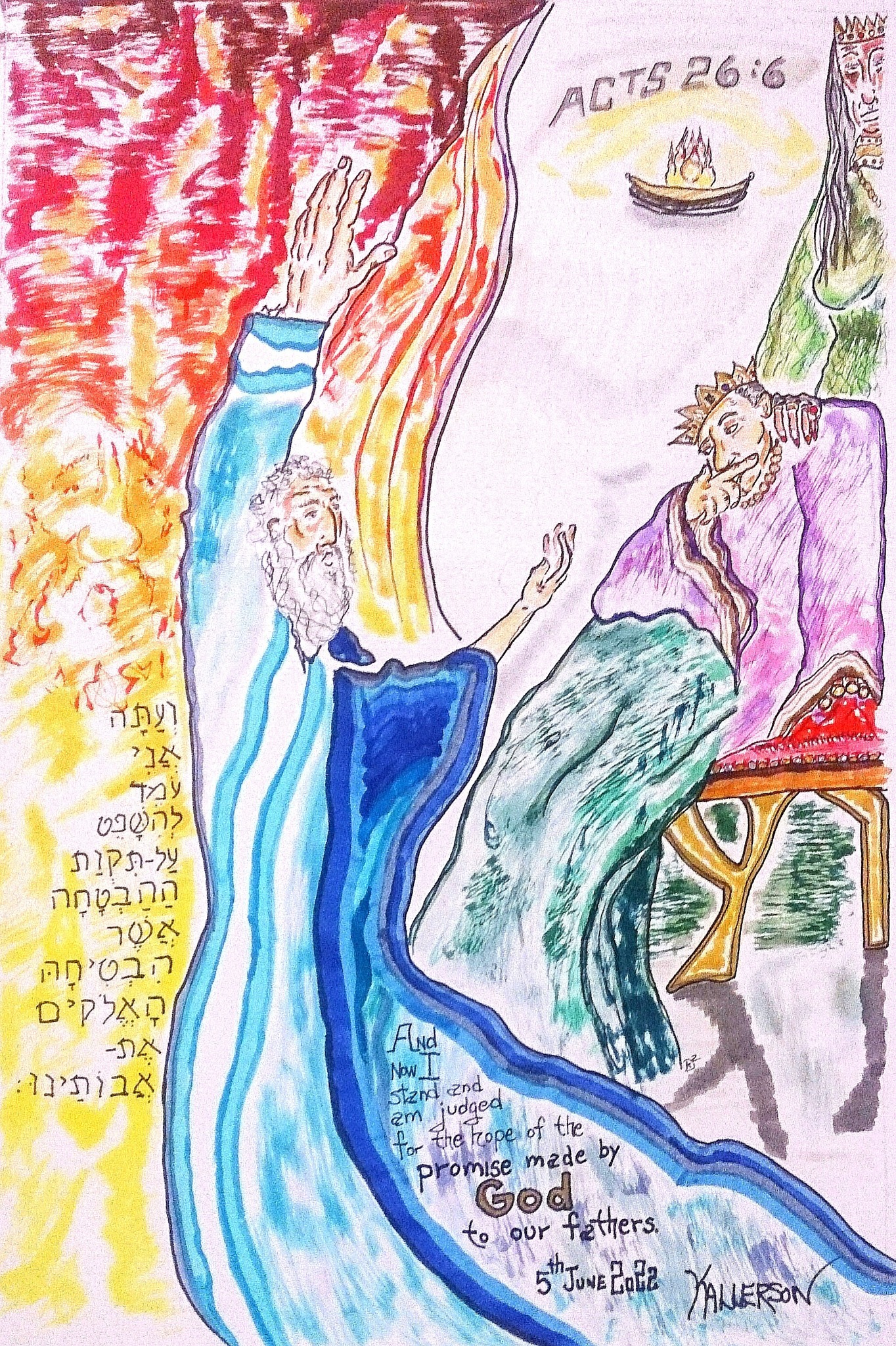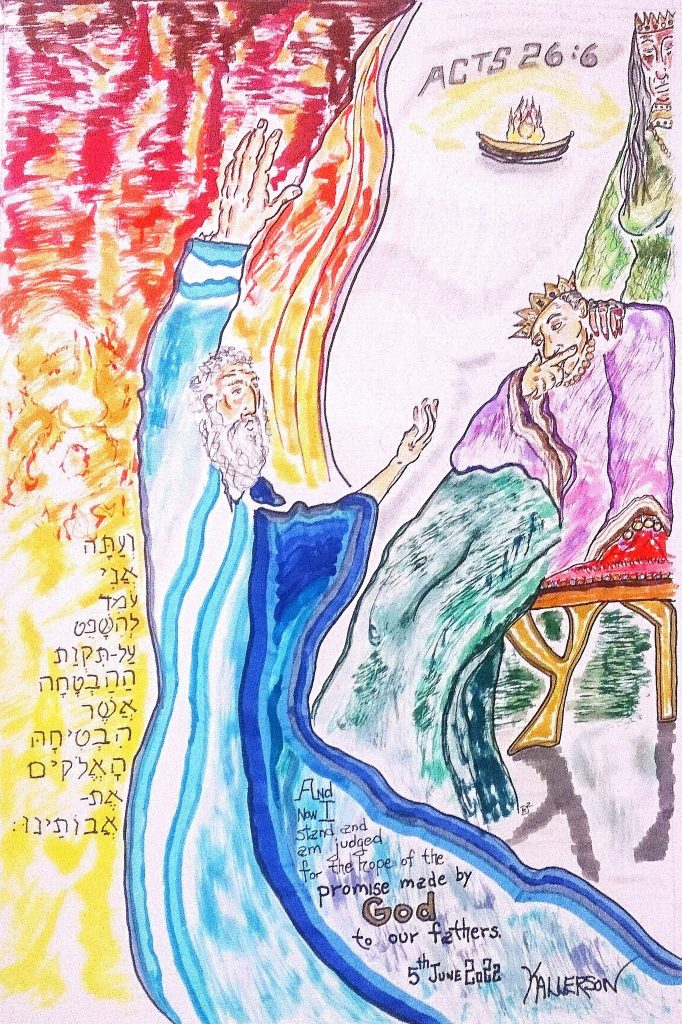
Artwork by Doug Kallerson
Acts 26:6
The Promise Made by God to Our Fathers
With Deuteronomy completed, I had hoped to go directly into Joshua. However, like being pestered by my friend Mike about doing a series on Doctrine after completing Numbers, I was pestered by someone here in the church to do a series on an imagined evangelization of King Agrippa by the Apostle Paul.
I don’t want to give away the name of the person who was behind this without permission, so after I ask Ron Bahra if I can use his name in the sermon, I’ll let you know if he says it’s OK.
His suggestions were – The character would be the Apostle Paul. The topic would be found in Acts 26: Paul’s defense before King Agrippa. Paul understands that King Agrippa knows and believes the prophets. King Agrippa responds to Paul’s words by saying;
“You almost persuade me to become a Christian.”
So, from the pulpit, you will be the Apostle Paul, your audience will be King Agrippa and his court. Your task will be to convince the king that Jesus Christ is the Son of God by use of the Old Testament prophets.
The question is, “Can you possibly reconstruct the argument Paul might have used in his defense of Christ using only the prophets of old?” If you can, you might just hear these words from the audience, “You have convinced me to become a Christian!”
I told Ron that this is not my style of doing sermons. He didn’t seem to care about my opinion. I told him that because this isn’t the kind of thing I feel I’m good at, this series may not be very good. Again, he was disinterested in my point of view.
I tried other avenues of getting out of this, including moving to Uganda, but he wouldn’t hear any of it. And so, for the next few weeks, we will attempt to evangelize King Agrippa in a manner that Paul may have done.
Text Verse: “For Moses writes about the righteousness which is of the law, ‘The man who does those things shall live by them.’ 6 But the righteousness of faith speaks in this way, ‘Do not say in your heart, “Who will ascend into heaven?” (that is, to bring Christ down from above) 7 or, “Who will descend into the abyss?” (that is, to bring Christ up from the dead).’ 8 But what does it say? ‘The word is near you, in your mouth and in your heart’ (that is, the word of faith which we preach): 9 that if you confess with your mouth the Lord Jesus and believe in your heart that God has raised Him from the dead, you will be saved. 10 For with the heart one believes unto righteousness, and with the mouth confession is made unto salvation.” Romans 10:5-10
How do you convince someone who only has the Old Testament that Jesus is the answer to everything the prophets said? Well, technically, you can’t. The reason why is because the only way we know about Jesus is by reading the New Testament that tells us about Him.
At the time of the Apostles, they testified to what they saw and heard. We cannot do that apart from what has now been recorded in the pages of Scripture. As this is so, and as the apostles spoke about Jesus in words that are now recorded in the New Testament, I have not withheld verses from the New Testament.
But I have used them as if they are from a dialogue that Paul presents to the king. The majority of what Paul will present, though, is found in verses from the Old Testament along with reasoning that is based upon those verses. Or, in one sermon, I have used a logical analysis of things to come to a conclusion about why certain doctrines concerning Jesus are true or not.
If you really enjoy these sermons, I will be happy to take the credit for what is presented. If you don’t, then I will be pleased to pass on your comments to Ron, blaming him for having come up with this idea in the first place. J
Actually, I do hope you will enjoy them. They are less formal than what you may be used to, but they are still based upon God’s superior word. And so, let us turn to that precious word once again and… May God speak to us through His word today and may His glorious name ever be praised.
I. How Shall I Take Your Words, O King?
—————
Most excellent king, I understand your words, but your intonation leaves me wondering as to the meaning of them. If I heard you rightly, you said, “You almost persuade me to become a Christian.”
Unless I know the intent of your words, I cannot be sure how to continue my defense. It is a defense that includes an appeal to you concerning Jesus, and how can I properly appeal to you unless I understand the intent of your words?
Do you mean “…you almost you persuade me?” (NKJV). If so, then I must speak on with convincing arguments to settle your doubt. Are you saying, “Do you think in such a short time you can persuade me…?” (NIV).
Good king, it doesn’t matter to me if it takes a short amount of time or long, I am willing to go to any length to persuade you. The Lord has placed me before you, and so to you the rights to my time now belong.
King Agrippa, if you mean, “In brief, you are doing your best to persuade me…” (Weymouth NT), it is only because I respect your time and wish nothing but to convince you with that in mind.
But I am a patient man, and I will expend my time according to your schedule. If you will just settle comfortably into your throne, I will stand before you until the day is expired (if need be) to convince you of your need for calling on the Savior of mankind.
If your words speak of a glimmer of hope that has now become established within you, which I certainly would love to be the case, then you must have meant, “…you are making short work of my conversion: you are persuading me to become a Christian as suddenly as you yourself did” (via Pulpit Commentary).
If this is so, and if I heard rightly, then the glimmer of hope concerning eternal life – that spark of belief – may already be lighting within you. And if this be the case, then ask of me clarification upon some point, and I will happily provide it.
Ask from me an explanation, and I will speak it forth. Ask me to alleviate some confusion, and I will untie the knot and return to you the line. With it, you can measure the borders of my words and determine if they stand within the boundaries of the promises of God to our fathers. Ask of me, and I shall answer accordingly.
But, King Agrippa, if your words speak of the derision of the title I bear, then maybe you meant to say, “Thou wilt soon have me one of that despised sect” (Jamieson-Fausset-Brown).
If this was your intent, and indeed I would rejoice at such a noble and exalted thought, then speak forth that it is so, and I will continue to bring you closer to being included in that despised title that brings man the highest of honor before God.
But my dear king, I almost believe you may have conveyed to me that you were saying, “By your appeal to the prophets you press me hard; you have got me into a corner. I am in a στενοχωρία [stenochória], a ‘narrow room;’ I hardly know how to get out of it” (via Pulpit Commentary).
If that be the true meaning of what you have said, I am willing to stand here before you as long as you wish, happily presenting to you a fuller and more detailed explanation of the words of the prophets that have so pressed you in. In this, what you have heard can lead you with joy from that narrow room, even to the wide expanses of heaven itself.
As you can see, King Agrippa, I am at a loss as to the true intent of your words, and I long to know what you meant so that I can properly adjust my footing as I continue my appeal to your mind, your reason, your logic, and – indeed – to your heart.
I honestly don’t know if your words “are to be taken ironically, or sarcastically, or jestingly, or whether they are to be taken seriously, as the words of a man shaken in his convictions and seriously impressed by what he had heard” (via Pulpit Commentary).
Finally, King Agrippa, it may possibly be that you “used the words in one sense” and I “(mistakenly or advisedly) took them in another” (Chrysostom via Pulpit Commentary). I stand here unsure, and so I would like to know what the intent of the words you have spoken actually is.
As I now have your ear, it is my greatest hope and desire that even while before you in these chains that can only restrain my body, I will be able to help break you from those chains which bind your soul. Tell me your answer, and I will respond again with words of life concerning the Author of life. Tell me, good king, I pray.
—————
Paul, the words of my mouth were clear, but the sound of my voice was not. God Himself and none other knows what I meant because my words were a challenge to you, an opportunity for you to respond with wisdom. And, indeed, your answer revealed just that.
Because you have spoken as you have, and because the day is young, and because I have all that I need to allow you to continue, I yield the conversation to you once again. Speak forth with your convincing arguments concerning this Man who has so profoundly changed your life.
You spoke of “the hope of the promise made by God to our fathers.” You then explained that hope by saying “that God raises the dead.” Start there, Paul. Tell me more about this … this hope. I have heard of it, but I am neither a Pharisee nor a rabbi – and to tell you the truth, I trust neither.
But you, Paul, you have gone beyond both. What they claim, and what they proclaim, is so mixed with rites and rituals that nothing they say ever makes sense to me. But my curiosity is piqued by your words. Explain this “raising the dead” to me first. Depending on what you say, I may order a meal and prod you further afterwards. Yes, tell me about the raising of the dead.
—————
King Agrippa, many centuries ago, King Solomon said, while speaking of God, “He has made everything beautiful in its time. Also He has put eternity in their hearts, except that no one can find out the work that God does from beginning to end” (Ecclesiastes 3:11).
If God has put eternity in our hearts, what would the purpose of that be if we were to simply die and return to the dust without any possible fulfillment of that desire? I know you feel this longing. We all do. What would that say of God if He were to create us this way and not allow us to realize the hope within us?
What would it say if God created man with thirst, but He made no water for him to drink? What would it say of God if He created us with the desire to be loved, but we could only convey hate? Such thoughts are contradictory to logic, King Agrippa. And we can look around at the world and see both logic and tender care.
He has made everything beautiful in its season and He has ordered everything to be reasonable and understandable. King Agrippa, if you let go of the fig in your hand, it will fall to the ground. Things happen reasonably, consistently, and purposefully.
Should God make an exception and give us an inner urge that has no purpose and no final way of being expressed? No! The eternity we yearn for that is seated deep within our hearts is there for a reason and God has given us a plan by which it can be realized.
You have heard the stories of creation. You know of how things once were. Right at the beginning, in Genesis, we are told that Adam and Eve were in the Garden of Eden. They had every possible delight that they could imagine. Nothing was withheld from them except the fruit of one tree; just one.
Eternity was set before them, and all they had to do was to obey God’s spoken word, simply and faithfully. But of all of the wonderful delights that they could have had, they instead had their eyes directed to the one thing that was forbidden to them.
This is because they believed the lies of the serpent. They disobeyed the Creator, and each was justly sentenced for what had been done. But in the sentencing of the serpent came a promise. It was something that both Adam and Eve will later respond to in their own way. The words there are what I would call, King Agrippa, “the first gospel.” Scripture says –
“And I will put enmity
Between you and the woman,
And between your seed and her Seed;
He shall bruise your head,
And you shall bruise His heel.” Genesis 3:15
King Agrippa, a promise was made that One would come to destroy the serpent. You know that is our hoped-for Messiah. I say He is Jesus. If you can see, what is implied in the word of the Lord is that if the serpent is destroyed, then the enmity between God and man would end.
What is explicitly stated in our Scriptures is that it would be the Seed of the woman who would bring this about. This is good news indeed, O King.
And, King Agrippa, what you surely know is that after the sentencing of the serpent, the Lord sentenced the woman and then Adam. After the sentencing, the first thing that is recorded is –
“And Adam called his wife’s name Eve, because she was the mother of all living.” Genesis 3:20
It seems odd that this would be the first thing that man would do after being sentenced for his crimes, but Scripture is showing us what was at the forefront of his mind. You know that Eve in Hebrew is Khavah. It means “Life.”
What are we being told then? Why did God put these words there? I say to you that Adam was just sentenced to death, and yet he names her Life. The Lord is telling us that the man had paid attention to His words.
Eve was told that her husband would rule over her. By naming the woman, he claimed dominion and authority over her, just as when he had named the animals, and just as when you name your children and your servants born into your house.
In choosing the name Khavah, “Life,” the man – our first father – was demonstrating faith in God’s promise that He would provide a Redeemer. Adam died spiritually, the state we are all born into. He was sentenced to a physical death because of his spiritually dead state, and yet, he looked forward to life! O King! This is the beginning of the most wonderful story of all.
The man knew that through this Redeemer would come restoration of life, and with it fellowship with God. He knew also that this coming One would be the Seed of the woman. He just didn’t know what seed or when. He just believed that He would, in fact, come.
The Lord had spoken, and the man believed the word. What was dead would be made alive. It was just after Adam showed this faith in the Lord’s promises that we read the next words of Scripture –
“Also for Adam and his wife the Lord God made tunics of skin, and clothed them.” Genesis 3:21
O King, I tell you that by an act of faith in the promises of God, Adam was clothed by Him. His shame was covered over. This is the pattern that our Scriptures have revealed ever since: demonstrate faith and then receive a suitable covering. Once the man and his wife were covered, the final, tragic words of life in the garden were written for us to consider –
“Then the Lord God said, ‘Behold, the man has become like one of Us, to know good and evil. And now, lest he put out his hand and take also of the tree of life, and eat, and live forever’— 23 therefore the Lord God sent him out of the garden of Eden to till the ground from which he was taken. 24 So He drove out the man; and He placed cherubim at the east of the garden of Eden, and a flaming sword which turned every way, to guard the way to the tree of life.” Genesis 3:22-24
For the man and his wife, it was the end of the garden of God. Paradise was lost and the way of access to the tree of life was guarded. All they had left was the hope of regaining that access somehow, some way … some day. The Seed would make it possible. This is where their hope rested. Surely a better day was yet ahead.
Until then, they could only carry the memory of the perfection they once knew. O King, think of it! This is the eternity that is set in our hearts. A return to this now lost perfection, a return to complete shalom, a return to the presence of God!
That memory must have been the most cherished and yet most painful part of their existence. No matter how good each day was, and even if ten thousand times ten thousand days lay ahead, each better than the one before, it would never compare to that longed-for day they had left behind.
This is what the Lord is showing us in His word, O King. It is this sad state that leads us into the next story in Genesis. But the next story seems like misery added to misery. It is the story of Cain and Abel that you surely have heard. What prompted the Lord to tell us of such things, especially with a story of such pitiful words? There must be a reason. The story begins with –
“Now Adam knew Eve his wife, and she conceived and bore Cain, and said, ‘I have acquired a man from the Lord.’ 2 Then she bore again, this time his brother Abel.” Genesis 4:1, 2
At some point after being cast from the garden, the very first thing we are told concerns the birth of Cain. In victory, Eve cried out, qaniti ish eth Yehovah – “I have acquired man with Yehovah.”
O King, if we just remember where they were, we can see what was on her mind. You see, King Agrippa, Eve was taking credit for what she thought would be the delivery of her Deliverer!
You say you are not a rabbi. Well, this is what rabbis do. We study and teach each word that is being conveyed in the original tongue of our father Moses. The Lord spoke out these things to him, and he carefully recorded them for us.
Instead of using the word im for “with,” she used the word eth. She was claiming that she was responsible for what had come about. O King, if I say that I am building a house with wood, the wood is not really doing anything except as I work with it.
But if I say that I am building a house with my brother Ethan, then Ethan and I are working together to build the house. Eve was crying out that she was an active part of bringing forth a man. But more, we can infer that her delight and her boast was that she was bringing the Seed into the world who would restore her to the Garden. “Look at me! I have done it! I have created a man just like the Lord did!”
But the pity of the story is seen in the very next words –
“Then she bore again, this time his brother Abel.” Genesis 4:2
O King, there is no note of victory, no hint of joy, nothing like that with the birth of this son. It doesn’t even say why he is named Abel. She just bore another son who was Abel. Why would anyone name him this unless that person was truly miserable? You know his name in Hebrew is hevel. Tell me its meaning, O King.
—————
Yes, it means “Breath.”
—————
You are right, O King. It is passing vapor, the kind of breath that one sees on a cold morning, just for a moment, and then it is gone. It is the vanity that King Solomon spoke of concerning our very existence –
havel havelim amar qohelet havel havelim ha’kol havel
“‘Vanity of vanities,’ says the Preacher;
‘Vanity of vanities, all is vanity.’” Ecclesiastes 1:2
Our first mother felt victorious at the birth of her first son. She thought that she had merited Paradise once again. She thought that through her efforts in the pain of childbirth, that she was giving birth to her Messiah. She thought she was responsible for making a man who would redeem her and return her to the paradise she had lost.
But with the second agony of childbirth, she realized that there was just another mouth to feed, another time of sleepless nights of tending to him until he could, hopefully, fend for himself. She only saw the woeful chores of being a mother and the prospect of even more children ahead.
Eve was under the authority of her husband, and she was subservient to the responsibilities she had for the children she bore. Her life under the sun was tedious, toilsome, and trying. It wasn’t at all like the life that she once knew.
For her, paradise was gone. She apparently misunderstood the Promise. For her, and for all who have followed her, everything is vanity. It is all meaningless. It is simply a life of chasing after the wind. What a sad end to the story of her life. She is never mentioned by name again in our Scripture, O King. She is simply referred to, one last time, as the wife of Adam.
And, O King, you know the rest of the story. As a final, tormenting disgrace for her, her first child – the first male ever born – turned out to be a murderer. He killed his little brother, and he was sentenced by the Lord to be a fugitive and a vagabond on the earth.
Cain moved to the east, even further from that wondrous spot of delight, both he and his seed living as enemies of God.
“Vanity of vanities, all is vanity,” says the Preacher
What a woeful, mournful life we lead
It is even tedious to be a renowned teacher
But that is no excuse students, so pay heed
Life under the heavens was grand indeed
But life under the sun is wearisome at best
Sit up straight and be sure to take heed
This life we have been given involves a test
Do you want to live out your life under the sun?
Chasing the wind, with never enough speed?
Or do you want to live life under the heavens with the Holy One
Sit up straight and listen, it is time to pay heed
II. He Has Borne Our Sufferings
————–
Paul, your words intrigue me. I have never really thought about why the Scriptures say what they say. I have heard them and listened, like any other story. But now, I am seeing that you believe there is more than just a history lesson here. Instead, there is a larger story being told where every word, every name, and every detail has a purpose.
I am intrigued by your thoughts. So please continue…
————–
O King, in order to tell you more, I must go back in the story. I appreciate you allowing me to consult my scroll so that I can read you what it said about these two sons of Adam. Here is what is recorded in our Scriptures concerning them –
“Now Abel was a keeper of sheep, but Cain was a tiller of the ground. 3 And in the process of time it came to pass that Cain brought an offering of the fruit of the ground to the Lord. 4 Abel also brought of the firstborn of his flock and of their fat. And the Lord respected Abel and his offering, 5 but He did not respect Cain and his offering. And Cain was very angry, and his countenance fell.
6 So the Lord said to Cain, ‘Why are you angry? And why has your countenance fallen? 7 If you do well, will you not be accepted? And if you do not do well, sin lies at the door. And its desire is for you, but you should rule over it.’” Genesis 4:2-7
It is a story of faith and of faithlessness, O King.
—————
What do you mean, Paul? I have heard this story and have wondered why it is recorded. But more, I have always been curious why one offering was accepted and the other wasn’t. Please explain this to me.
—————
O King, it is a story that leaves many, even most, guessing. The variety of opinions on why God respected one offering and didn’t respect the other are numerous, and they are highly argued over. As a Pharisee, I have studied some of the most noted scholars in our history. But between all of them, there is no happy resolution.
The proper way to determine why Abel’s offering was accepted is to consider what is said in relation to what has already been stated. The Lord is slowly and progressively revealing His thoughts to us in a methodical manner so that we can learn what is pleasing to Him and what is not.
As I said, there are many views on the “why” of what is said here. Let me tell you a couple of opinions. One is to be inferred from what is in the verse. It says that “Cain brought an offering of the fruit of the ground to the LORD,” whereas “Abel also brought of the firstborn of his flock and of their fat.”
The words concerning Abel’s offering being the “firstborn of his flock” have led some to believe that Cain’s offering wasn’t of the firstfruits of the harvest and therefore it wasn’t the first and best. Because of this, Abel’s offering was accepted as a good offering, and Cain’s wasn’t because it wasn’t a good offering.
This isn’t a bad thought, but it must be inferred out of the verse itself. And more, it would have to be inferred that this was the time of the firstfruit of the harvest, something we can’t know from the story. If it wasn’t, then there is no way we can come to this conclusion. As such, this really can’t be what was on the Lord’s mind, or He surely would have said so.
For all we know, they made the offering in the middle of the harvest season. All that it says is that he “brought an offering of the fruit of the ground to the Lord.” The rest must be inferred.
Another idea about why one offering was accepted and the other wasn’t says that Abel’s offering was a blood sacrifice, one for atonement of sins. As such, it was accepted by God, but Cain’s wasn’t. Because of this, God found his offering unacceptable.
To support this idea, our rabbis who favor it have noted that God killed an animal to clothe Adam and Eve before they were expelled from Eden. As such, the precedent was made at that time. O King, this reads more into the story than is given. When the text is reviewed it becomes a view that cannot be substantiated.
God provided the atonement, the covering, for Adam and Eve, but nothing more was told us in that story. To claim that this was to be the precedent for future generations is, again, inserting too much into the story.
Secondly, you may have noted that in both offerings, the word minkhah, a gift or tribute, is used. In the Law of Moses, as we know, a minkhah is a non-blood sacrifice, but the offering of both Cain and Abel are called minkhah.
One thing we cannot do is to insert our law, which comes from Moses, into a date prior to the law itself. And even if we could, because the word minkhah is used for both offerings, they are both to be considered equally acceptable.
Grain offerings are not only acceptable under Moses, but you yourself know that they are mandated. If God accepted them, and they have the same term applied here, then one being a blood sacrifice and one not being a blood sacrifice is irrelevant.
And finally, each offering came from the livelihood of the individual. There is no other direction given to them in the account, or even before it, that tells us that they had to cross the lines of their profession in order to make an offering. If this was the case, then surely something important would have been left out of the story.
—————
What you are saying, Paul, it all makes sense. But enough of the technical details! What are we being told in this story?
—————
Oh King, I shall tell you, but it is the technical details that tell us more than anything else. The Lord gives us a story that is understandable on one level, but you have already seen that there is an underlying story – a story of pictures and types that are telling us much more. And the details will bring it out to its fullest measure.
King Agrippa, you have heard me speak about the garden. You yourself were intrigued with what you heard. But tell me about what you heard. Remember and remind me what it was that God found pleasing when Adam named his wife.
—————
Paul, you said it was because he had faith. Adam believed the words of the Lord God, and God was pleased with that.
—————
That is correct, O King. The man could offer him nothing but that. Everything else came from the Lord directly, but the faith came from the man. But more, what happened after he showed his faith?
—————
Well, Paul, the Lord God made tunics of skin, and He clothed them.
—————
Why would He do that? O King? Weren’t they already wearing fig leaves? Think on what you know, and tell me what happened?
—————
I remember, Paul, that they disobeyed God, they realized they were naked, and then they covered themselves with figs.
—————
It is correct, King Agrippa. They had committed a faithless act, and then they (THEY!) tried to cover themselves. And so, explain to me what you think it all means.
—————
Paul, I am not a teacher like you, but I think we are being told that what we do is not what is pleasing to the Lord. Instead, He wants us to have faith in His word and in what He offers. The Lord God rejected their futile fig leaves by which they covered themselves, and He replaced their works with His own covering for them. But He only did it after they believed in His word.
—————
You are right, O King, this is exactly right. But before we return to the offerings of Cain and Abel, tell me what you think – your own thoughts – about the words we have already looked at, “Also for Adam and his wife the Lord God made tunics of skin, and clothed them” (Genesis 3:21). Tell me the things you can deduce from those few words.
—————
Paul, you challenge me, but I am a king, and it is my honor to accept your challenge as a king (Proverbs 25:2). Here is what I can think of. It is the Lord God who made the tunics. He did not accept what they had made, but instead made their coverings Himself.
Also, because they were made of skin, it means that something died in order to provide the skins. The Lord Himself was behind the act, it was from Him, and the man and the woman simply received what He clothed them with – He clothed them. And this covering was given to them only after they showed faith in His word.
—————
Oh King! You are indeed insightful, and you are correct. And I tell you, King Agrippa, that this is the pattern for the covering of God’s people throughout God’s workings from this point on. Think of Moses and the tabernacle! Think of our temple!
The high priest, who comes before the Lord and who represents Him to his people and who presents his people to Him, takes an animal, slaughters it, and sprinkles its blood for a covering each year.
The animal is the Lord’s; the Lord – through His representative – slays the animal. The Lord covers His people, and it is only effectual – as our Scriptures convey to us – for those who have faith in the offering.
Now, in understanding this, let us return to the story of Cain and Abel. The two offerings are both noted as minkhah, tributes, to the Lord. It must have been understood that these were required, and so they were offered.
Regardless of what type of offering they were, what is the one thing that has already been noted as being pleasing to the Lord? It is faith, O King. These two are offering what already has come from the Lord.
Their works may have been included in their preparation, but it is the faith behind the offerings by which the Lord is pleased. As we know from Habakkuk, a man born under the law, our law –
“Behold the proud,
His soul is not upright in him;
But the just shall live by his faith.” Habakkuk 2:4
I tell you, O King, that it was “By faith Abel offered to God a more excellent sacrifice than Cain, through which he obtained witness that he was righteous, God testifying of his gifts; and through it he being dead still speaks” (Hebrews 11:4).
The offering was an offering of faith, and it is the faith that made the offering more excellent. It wasn’t faith that made Abel bring a more excellent sacrifice. Rather, it was faith that made the sacrifice more excellent. If you, O King, understand the difference, then you are starting out on a right road that leads to a wholesome and friendly walk with your Creator.
—————
I am seeing this, Paul. Whether I believe it or not, I do see that this is what Scripture is certainly telling us. But I still do not understand how this tells us anything about my first petition, which is to explain the hope of the promise made by God to our fathers which is “that God raises the dead.” Tell me how they connect.
—————
O King, only in understanding the first premise, a proper sacrifice and faith in God, can we then understand how being raised from the dead is possible.
You see, King Agrippa, that the law is not of faith. But this is the law that we were given, and it is the law that says, “You shall therefore keep My statutes and My judgments, which if a man does, he shall live by them: I am the Lord” (Leviticus 18:5).
The Lord has spoken, the man who does the things of the law will live!
—————
But Paul! You just said that the law is not of faith, but that it is faith that pleases God! Your learning is great, but you are confused.
—————
No, King Agrippa. Both of these are true, but they must be understood from what God is doing. Tell me, O King, why do we observe the Day of Atonement?
—————
It is to cover our sins.
—————
You are correct, O King. But if we need to have our sins covered, and we all must observe the day, then it means that all of us have sin that needs to be covered. But sin comes from transgressing the law. This means that none of us are without guilt before God, even the high priest, who must first sacrifice for his own sins! Not one of us has done the things of the law, and we are destined to die.
And so, O King, what do we need in order to live? What is it that will get us through the holy place, past the cherubim, and return us to the presence of God? If the animals of sacrifice only remind us year by year of our sins, but they actually do not remove our sins, then what is it that we need? **Blank stare from Agrippa**
It is, O King, to be made sinless and also to be freed from the law of sin and death! The Messiah was promised by God. All of Scripture then testifies to His coming. This is more than a man who was to come and conquer our enemies in Israel.
The Messiah was promised before Israel existed. Israel just happens to be the people through whom He would come. But what do the prophets say of Him? He would be of the seed of David, He would be born of a virgin. He would be born in Bethlehem. He would be the Mighty God. That salvation is of the Lord. That He would be a light even to the Gentiles. And yes, even that He – the Messiah Himself – would be an offering for our sins, dying for them. But that He would also prevail over death. Let me read you what Isaiah says from the scroll, O King –
“Surely he has borne our sufferings
and carried our sorrows;
yet we considered him stricken,
and struck down by God,
and afflicted.
5 But he was wounded for our transgressions,
and he was crushed for our iniquities,
and the punishment that made us whole was upon him,
and by his bruises we are healed.
6 All we like sheep have gone astray,
we have turned, each of us, to his own way;
and the Lord has laid on him
the iniquity of us all.
7 He was oppressed and he was afflicted,
yet he didn’t open his mouth;
like a lamb that is led to the slaughter,
as a sheep that before its shearers is silent,
so he did not open his mouth.
8 “From detention and judgment he was taken away—
and who can even think about his descendants?
For he was cut off from the land of the living,
he was stricken for the transgression of my people.
9 Then they made his grave with the wicked,
and with rich people in his death,
although he had committed no violence,
nor was there any deceit in his mouth.”
10 “Yet the Lord was willing to crush him,
and he made him suffer.
Although you make his soul an offering for sin,
he will see his offspring,
and he will prolong his days,
and the will of the Lord will triumph in his hand.
11 Out of the suffering of his soul he will see light
and find satisfaction.
And through his knowledge his servant, the righteous one,
will make many righteous,
and he will bear their iniquities.” Isaiah 53:4-11 (ISV)
Oh King, this (THIS!) is the word of the prophet, and it is the word of God. The Offering comes from the Lord not from the hands of man, because He is the Lord God. The Offering died in order to provide the covering. The Lord Himself is behind the act because, as Jesus said when He was with us, “I lay down My life that I may take it again” (John 10:17).
Understanding this, King Agrippa, what is the last part of the equation concerning such an offering?
—————
Its acceptance or rejection must be accompanied by faith.
—————
That is correct, O King. God has made the offering, but the offering becomes ours when it is received by faith. Adam believed, and the Lord covered him and his wife. Abel had faith, and the Lord accepted his offering. We are told that those who afflict themselves, an act of faith, on the Day of Atonement are covered. Those who do not are to be cut off.
King Agrippa, God has made His offering. He has sent His Messiah. His Messiah died for the sins of God’s people. “For He made Him who knew no sin to be sin for us, that we might become the righteousness of God in Him” (2 Corinthians 5:19).
But after that, His soul saw light again because no sin was found in Him. He is the Man who has done the things of the law and who lives. He is the sin-Bearer for those who believe. He is the Substitutionary Sacrifice that makes this possible. He is our Propitiation, our Covering, and the Establisher of the New Covenant in His blood.
God, in His wisdom, offered His perfect Son to do these things for us. He made the hardest part the easiest of all. We should not try to go around that. And because life is found in Him, that life is granted to any and to all who will simply believe. It is faith in God’s provision through the giving of Christ Jesus, King Agrippa, and nothing more, that can restore man’s soul to God.
If you will only believe, you too will be raised to eternal life, and you too will be restored to the paradise lost by our first parents, and to which they longed to return. God has fulfilled His promise, He has sent His Messiah, and His Messiah is JESUS. Believe, O King, and you will be saved.
I tell you, O King, that the Lord looks for faith in His faithless creatures, so even a little bit will do.
Closing Verse: “But now the righteousness of God apart from the law is revealed, being witnessed by the Law and the Prophets, 22 even the righteousness of God, through faith in Jesus Christ, to all and on all who believe.” Romans 3:21, 22
Next Week: Acts 26:7 In sharing the gospel, much may be at stake… (For This Hope’s Sake)
The Lord has you exactly where He wants you. He has a good plan and purpose for you. But you must first believe by faith in what He has done. Once you do, then that plan can come about in you as it will in all of His redeemed. So, follow Him and trust Him and He will do marvelous things for you and through you.
Tragedy in the Garden
The woman was enticed, and she ate of the fruit
She passed it on to Adam and he ate as well
He became the second willing recruit
And together they left a sad story to tell
Their eyes were opened to their exposed state
They realized that life in sin just ain’t so great
They sewed together fig leaves to hide their shame
And made coverings that just wouldn’t suffice
The Lord questioned them about their hiding game
And they realized that sin just ain’t so nice.
“Where are you?” called the LORD. (Though he already knew)
“I was hiding because I realized something wasn’t right
I was afraid to answer, I’m naked … yes, it’s true
And so, I hid myself, like a shadow in the night.”
“Who told you that you were naked? What is this you did do?
Have you taken of the fruit which I told you not to eat?”
“It was the women who did it… the one made by You
She told me of its yumminess, and how it was so sweet.”
I thought it would be so good, but I guess I paid the price
I’m beginning to see that sin really ain’t so nice
“Woman, what is this thing that you have done?
Traded life under the heaven’s for life under the sun.”
“Oh, my LORD, it was the serpent. He deceived me and I ate
And now I’m seeing that sin just ain’t so great.”
Oh God that we could take it back and undo what we have done
Life was wonderful under the heavens
But it’s terrible under the sun
What can we do make things right?
Where can we turn to be healed?
How long will we be cast from Your sight?
How long until the grave is unsealed?
I have a plan, children, but you’ll have to wait
Many years under the sun toiling in the heat
But I will someday open wide heaven’s gate
When my own Son, the devil He will defeat.
I will send my own Son, the devil to defeat.
Thank You, O God, for Jesus Christ our Lord
The fulfillment of the promise given in Your word
Hallelujah and Amen…
Then Agrippa said to Paul, “You are permitted to speak for yourself.”
So Paul stretched out his hand and answered for himself: 2 “I think myself happy, King Agrippa, because today I shall answer for myself before you concerning all the things of which I am accused by the Jews, 3 especially because you are expert in all customs and questions which have to do with the Jews. Therefore I beg you to hear me patiently.
4 “My manner of life from my youth, which was spent from the beginning among my own nation at Jerusalem, all the Jews know. 5 They knew me from the first, if they were willing to testify, that according to the strictest sect of our religion I lived a Pharisee. 6 And now I stand and am judged for the hope of the promise made by God to our fathers. 7 To this promise our twelve tribes, earnestly serving God night and day, hope to attain. For this hope’s sake, King Agrippa, I am accused by the Jews. 8 Why should it be thought incredible by you that God raises the dead?
9 “Indeed, I myself thought I must do many things contrary to the name of Jesus of Nazareth. 10 This I also did in Jerusalem, and many of the saints I shut up in prison, having received authority from the chief priests; and when they were put to death, I cast my vote against them. 11 And I punished them often in every synagogue and compelled them to blaspheme; and being exceedingly enraged against them, I persecuted them even to foreign cities.
12 “While thus occupied, as I journeyed to Damascus with authority and commission from the chief priests, 13 at midday, O king, along the road I saw a light from heaven, brighter than the sun, shining around me and those who journeyed with me. 14 And when we all had fallen to the ground, I heard a voice speaking to me and saying in the Hebrew language, ‘Saul, Saul, why are you persecuting Me? It is hard for you to kick against the goads.’ 15 So I said, ‘Who are You, Lord?’ And He said, ‘I am Jesus, whom you are persecuting. 16 But rise and stand on your feet; for I have appeared to you for this purpose, to make you a minister and a witness both of the things which you have seen and of the things which I will yet reveal to you. 17 I will deliver you from the Jewish people, as well as from the Gentiles, to whom I now send you, 18 to open their eyes, in order to turn them from darkness to light, and from the power of Satan to God, that they may receive forgiveness of sins and an inheritance among those who are sanctified by faith in Me.’
19 “Therefore, King Agrippa, I was not disobedient to the heavenly vision, 20 but declared first to those in Damascus and in Jerusalem, and throughout all the region of Judea, and then to the Gentiles, that they should repent, turn to God, and do works befitting repentance. 21 For these reasons the Jews seized me in the temple and tried to kill me. 22 Therefore, having obtained help from God, to this day I stand, witnessing both to small and great, saying no other things than those which the prophets and Moses said would come— 23 that the Christ would suffer, that He would be the first to rise from the dead, and would proclaim light to the Jewish people and to the Gentiles.”
24 Now as he thus made his defense, Festus said with a loud voice, “Paul, you are beside yourself! Much learning is driving you mad!”
25 But he said, “I am not mad, most noble Festus, but speak the words of truth and reason. 26 For the king, before whom I also speak freely, knows these things; for I am convinced that none of these things escapes his attention, since this thing was not done in a corner. 27 King Agrippa, do you believe the prophets? I know that you do believe.”
28 Then Agrippa said to Paul, “You almost persuade me to become a Christian.”
29 And Paul said, “I would to God that not only you, but also all who hear me today, might become both almost and altogether such as I am, except for these chains.”