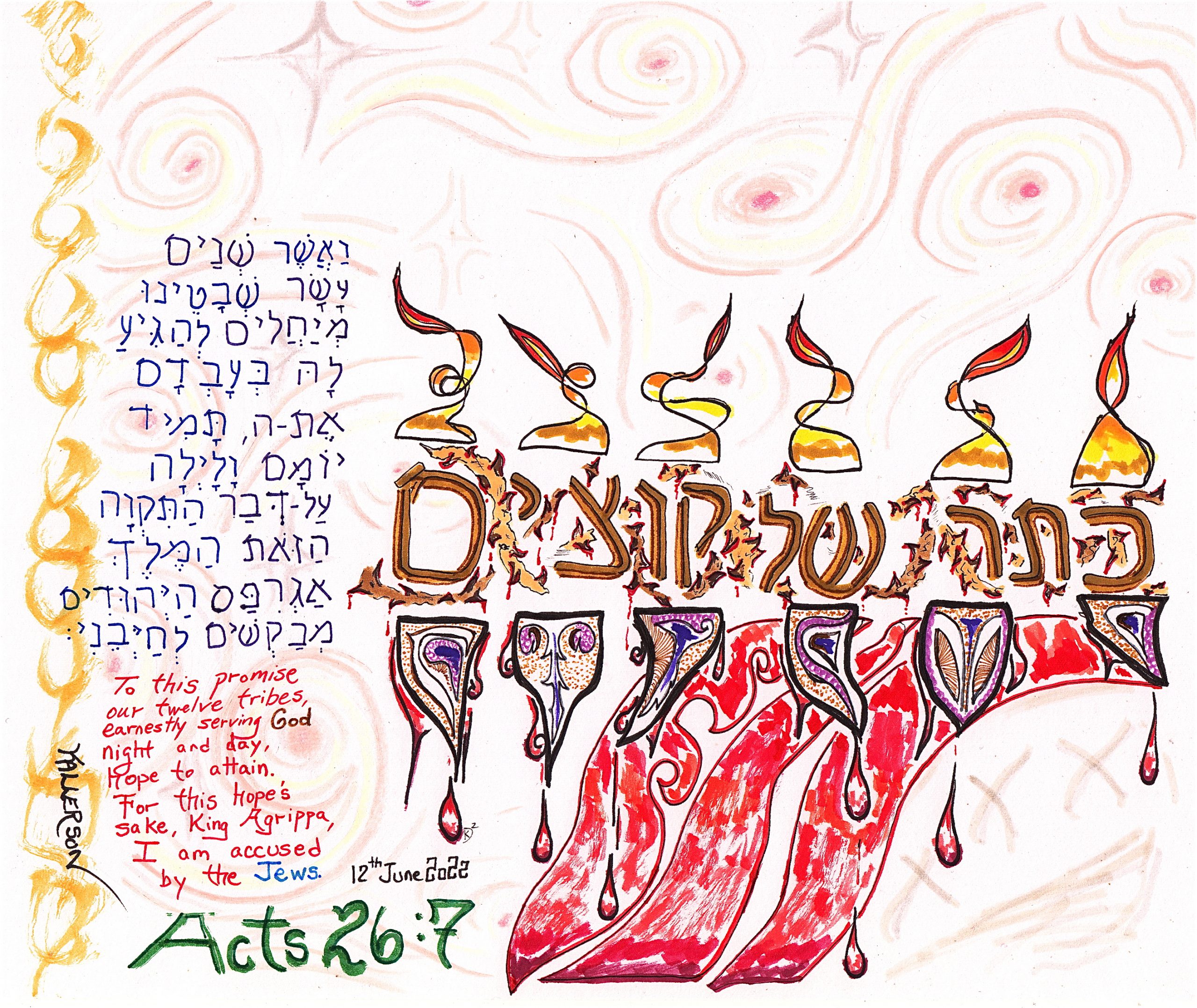
Artwork by Douglas Kallerson
Acts 26:7
For This Hope’s Sake
The person named King Agrippa (Agrippa II) in Acts 26 is the son of the elder King Agrippa who is recorded in Acts 12. It is Agrippa I who had James, the brother of John put to death with the sword (Acts 12:2). He is the same king who failed to give glory to God and thus met a gruesome end, being eaten by worms (Acts 12:23).
This makes Agrippa of Acts 26 the great-grandson of Herod I, also known as Herod the Great. Herod’s father was a descendant of Esau, meaning he was of Edomite origin, something people to this day have trouble with. His ancestors, however, had converted to Judaism.
Without going into all of the detail of this, it made him a Jew. Scripture outlines what is required for a person to convert and be considered as a Jew. When those requirements are met, they are accepted as such. Flavius Josephus records this in his writings. He says that about 129 BC John Hyrcanus –
“…subdued all the Idumeans; and permitted them to stay in that country, if they would circumcise their genitals, and make use of the laws of the Jews; and they were so desirous of living in the country of their forefathers, that they submitted to the use of circumcision, and of the rest of the Jewish ways of living; at which time therefore this befell them, that they were hereafter no other than Jews.”
This is both a historical testament to the fact, and it is something that is also biblically supported by the manner in which one was to be accepted into the assembly. This, however, doesn’t stop people from making unwarranted accusations against those who were converts, nor does it end the unceasing stream of bad theology that has developed within the church concerning the Edomites.
Text Verse: “‘I have loved you,’ says the Lord.
Yet you say, ‘In what way have You loved us?’
Was not Esau Jacob’s brother?”
Says the Lord.
‘Yet Jacob I have loved;
3 But Esau I have hated,
And laid waste his mountains and his heritage
For the jackals of the wilderness.’” Malachi 1:2, 3
Because of the words of Malachi, and other words taken out of context, many jump to the conclusion that Herod was an illegitimate figure within Israel. But that ignores the fact that his people had converted to Judaism and were reckoned as Jews.
If Herod was hated by the people, it was because of who he was as a person. And if God did not approve of Herod, it wasn’t because of his Edomite origin. It’s rather clear that God didn’t approve of the actions of the other Jews either, regardless of their ancestry.
What is the word of the Lord through Malachi saying concerning Esau? It’s important because in getting this wrong, ten thousand other little points of doctrine will be wrong as well. Pretty soon, you can start making up all kinds of nutty things simply because a couple of words are improperly analyzed.
The loving of Israel and the hating of Esau points us to the doctrine of Divine Election. It is a complicated doctrine that needs to be returned to and considered from time to time just so that we can be reminded of the love of God which is found in Jesus Christ our Lord. It is a love that extends to any and to all, but it can only be appropriated through an act of faith.
King Agrippa has a question for Paul, and it is one that Paul is ready to answer because he was trained in proper theology. How do we know this? It’s because we get our theology from what he says to us in his epistles. God selected him because of who he was and what he understood, as a Jew and as a Pharisee, concerning redemptive history.
His background made him the ideal person to convey to us those things we need to know in order to understand the marvel of what God has done for the people of the world. Such wonderful wisdom of God is to be found in His superior word. And so, let us turn to that precious word once again and… May God speak to us through His word today and may His glorious name ever be praised.
An Explanation of Predestination and Election
—————
Paul, your words concerning the promise made by God to our fathers were most convincing and it has me excited to know more. The day has hardly started and there is a part of Scripture’s recorded history that personally affects me and to which I have been, and continue to be, most curious.
In your earlier discourse, you said, “The Messiah was promised before Israel existed. Israel just happens to be the people through whom He would come.” During our short break to stretch our legs, I requested that a copy of the Scriptures be brought to this assembly so that you might shed light on its words for me.
Paul, you know that I am a Jew, but that my ancestral line also goes back to the Edomites. This makes things perplexing to me at times. I may not be very well versed in Scripture, but I know the story of how both Israel and Esau began. I have asked the court recorder to read that passage –
“This is the genealogy of Isaac, Abraham’s son. Abraham begot Isaac. 20 Isaac was forty years old when he took Rebekah as wife, the daughter of Bethuel the Syrian of Padan Aram, the sister of Laban the Syrian. 21 Now Isaac pleaded with the Lord for his wife, because she was barren; and the Lord granted his plea, and Rebekah his wife conceived. 22 But the children struggled together within her; and she said, ‘If all is well, why am I like this?’ So she went to inquire of the Lord.
23 And the Lord said to her:
‘Two nations are in your womb,
Two peoples shall be separated from your body;
One people shall be stronger than the other,
And the older shall serve the younger.’” Genesis 25:19-23
—————
So, Paul, can you shed any light on all of this for me? You believe that Jesus is the Messiah, and you are known to many as the Apostle to the Gentiles, and yet, it appears that God is showing favoritism. Is that a God that people should want to follow? Or is there a misunderstanding?
—————
O King, this is a beautiful passage from our history, and it is actually something I have written about to the church at Rome. I can tell you, as my beloved friend Peter discovered, that God shows no partiality (Acts 10:34), and I repeated this same thought to the congregation at Rome in my letter to them (Romans 2:1-11).
God does nothing arbitrarily nor vindictively. He is perfectly fair and just in all He does and there is no favoritism with Him.
—————
But Paul, explain to me what it means when the Lord said to Rebekah that one people shall be stronger than the other, and that the older would serve the younger. And then explain the words of Malachi that say that the Lord has loved Jacob, but He has hated Esau. I have heard that many times over the years.
How does this affect me? I am descended from both Esau and Jacob, and I am Jew by birth. Am I loved or am I hated? And what is it that makes it one way or the other to God?
—————
King Agrippa, there is a lot involved in what you are asking. What I suggest is that you get a copy of my letter to the Romans where I speak of exactly these things. In fact, I think I have a full copy of it here. Before the day ends, I shall give it to you. It is not that being of Israel by birth makes a person truly of Israel. Only when their actions align with what is expected of them are they truly of Israel.
What I must first do is explain to you the doctrine of election. I happen to have a portion of my letter to the Romans here in my pocket. I had my scribe, Tertius, make an extract of this for when I am asked exactly this question. Here is what I said to them –
“But it is not that the word of God has taken no effect. For they are not all Israel who are of Israel, 7 nor are they all children because they are the seed of Abraham; but, ‘In Isaac your seed shall be called.’ 8 That is, those who are the children of the flesh, these are not the children of God; but the children of the promise are counted as the seed. 9 For this is the word of promise: ‘At this time I will come and Sarah shall have a son.’
10 And not only this, but when Rebecca also had conceived by one man, even by our father Isaac 11 (for the children not yet being born, nor having done any good or evil, that the purpose of God according to election might stand, not of works but of Him who calls), 12 it was said to her, ‘The older shall serve the younger.’ 13 As it is written, ‘Jacob I have loved, but Esau I have hated.’” Romans 9:6-13
—————
Paul, I may be even more confused now than before I asked. Can you simplify what you are saying for me?
—————
O King, I will do my best to do so. I wrote of election, but that is something that is tied in with God’s predestination as well. In the same letter to the Romans, I wrote these words –
“For whom He foreknew, He also predestined to be conformed to the image of His Son, that He might be the firstborn among many brethren. 30 Moreover whom He predestined, these He also called; whom He called, these He also justified; and whom He justified, these He also glorified.” Romans 8:29, 30
O King you know that the word, proorizó, “predestined,” means “to mark out beforehand.” God has “predetermined” those who will be saved. These are the elect.
But what does it mean that they are predetermined? Does He actively choose each before creation as in, “I will make a Paul of Tarsus, and I will save him”? If this is so, does He then say, “I will make a Judas Iscariot and I will condemn him”?
Or perhaps God means, “I will make a path to salvation. This is the predetermined boundary, and any who accept that path will be saved.”? Or, maybe, is there some variation between these that God will use to save man?
When I spoke to you earlier today, I said to you, “Therefore, King Agrippa, I was not disobedient to the heavenly vision” (Acts 26:19). I myself believe that I had, and still have, free will.
I have said, O King, that those whom God “foreknew, He also predestined to be conformed to the image of His Son.” Those who are a part of God’s plans and purposes will be conformed. It is already done in God’s mind.
How this comes about is what I will explain to you. But so that you can more fully understand what is correct, I will also tell you of things that are incorrect. What I will say is based upon the fall of man, our first father Adam, and how God has worked from that event to determine His elect.
One teaching among our scholars says that election, or predestination, is logically prior to the decree to permit the fall of man. In other words, O King, even before sin entered into the picture, election was made for all people.
If one were to use a phrase to explain this, he might say double-predestination. This is because its effects actively go in two directions. This is held by many among us, O King. This is why there are so many judgmental egoists who feel God loves them and hates everyone else.
Their assumption is that God predestined humanity before He permitted the fall of man. What they think is that He actively elected some for salvation and actively elected others for condemnation. The fall hadn’t even happened, and yet God had made His choice.
In His act of creation, it would mean He purposefully created with the intent that His people would either be saved or condemned. That is their state, and they have no choice in it. A Jew may say, “I am the elect and saved because God loves me. Edomites are not elect, and they are damned. God hates them.”
What they believe is that God provides and applies salvation only for the elect. If that is so, then when Jesus came to provide salvation, what He did was limited only to them. You might call that, O King, limited atonement.
Such people will say, King Agrippa, that Christ’s atonement is limited only to those who were elected, and it applies – both potentially and actually – only to certain people. This is a noxious heresy, O King. It speaks of forced salvation to the saved, and purposeful condemnation to the unsaved.
To explain this in a simple manner, as you asked of me, we can think about the Garden of Eden where God placed man. God created both the garden and the man. But even before the man had done anything wrong, God has already chosen which of his descendants He will love and which He will hate.
It is only after this decision that Adam and his wife disobey. In this, the catastrophe of sin entered the world. Man was forced from the garden into a stream of existence of one generation leading to the next. However, that stream leads away from the garden to the abyss of hell – complete, total, and eternal separation from God.
But, during the course of time, God actively came along and initiated a process of salvation for those He chose to save even before any wrong had been committed. When He saves them, He gives them his Spirit and seals them for future glory.
They had no choice in it because the choice was made even before the fall. That is when they were saved. The work of Jesus may be a part of this process, but it is just an afterthought in the stream of events. As for the ones created for condemnation, whenever they are born, He actively withholds His saving of them, forcing them into hell because He chose them to be created that way.
—————
Paul! If this was true, that would mean God is an angry God who really hates some of His creation!
—————
It is true, O King. Those would be the non-elect. It would mean He hated them even before He created them. This begs the question though. If this was true, then why am I standing before you now? Why have I gone to all of the effort in my life to proclaim Christ? And why should I bother continuing to even talk to you now, answering your questions about Jesus?
If God has already chosen who will be saved, and His will cannot be thwarted, then all of my efforts mean nothing. If this was true, I would be better off doing anything but what I do! But this is a great lie, and a great misrepresentation of what God is doing.
And more, O King, this teaching ascribes evil to God because the evil that exists is not corrected by Him when it could have been, even by those who may have desired it through salvation. But God is neither the author of evil, nor will He allow it to continue forever.
People who teach this will use what the Lord says of Jacob and Esau in Malachi and incorrectly come to their conclusion. They misread what is said there and fail to consider everything we need to know.
You yourself, O King, have noted that you are descended from both Jews and Edomites. This teaching does nothing to answer the issue of election in regard to Jacob and Esau because it does not reflect what God has done in Christ.
—————
I could tell it smelled rotten, Paul. But if this is taught concerning election, and it is not correct, then what is?
—————
O King, I shall again refrain from telling you what is correct and continue to tell you what is incorrect. This will help you to see more clearly when the truth of what God has done is explained.
Another teaching is that the decree of election, meaning to call someone to salvation, comes logically after God’s decree to permit the fall. This is technically not double-predestination, but it is still tainted with falsity.
Teachers of this doctrine say that God created everything and then He permitted the fall of man. Since then, He has and will continue to elect some while simply passing by others. In this view, God provides and applies salvation only for the elect. He chooses who will be saved and they have no choice in the matter.
This teaching, like the first, says that the atonement of Jesus Christ is limited only to those who were elected, and it applies – both potentially and actually – only to certain people who will be saved. To the saved, it is forced salvation, and to the unsaved, there is a state of uncaring condemnation.
O King, I will take you back to the Garden of Eden to understand. In this thinking, God created the Garden and the man. After this, man disobeyed, and the catastrophe of sin entered into the world. It is at this time that God next decides who He will save and who He will simply ignore.
In the meantime, man is forced from the garden into a stream of existence, one generation leading to the next. But that stream leads away from the garden to the abyss of hell – complete and total separation from God.
During the course of time, as the people are born, God comes along and initiates the process of salvation for some. He gives them his Spirit and seals them for future glory whether they want it or not. The rest, He simply ignores. He does nothing to secure their salvation.
They are simply not a part of His plan. One might argue that this isn’t a hateful God, but that is incorrect. He is uncaring about those He didn’t elect, and to not care about their eternal state is an unloving act.
He made the choice for salvation or condemnation after the fall, but He also did so before He took any action to correct the matter at hand, which is the sin that now abides in man.
You can see that to them the cross of the Lord Jesus which I have told you about is simply an afterthought in God’s redemptive plans and purposes. In His mind, the saved were saved before His decree to correct their state. Like the first view I spoke to you of, O King, the work of Jesus may be a part of this process, but it is actually a secondary thought in the stream of events.
O King, there is an implicit problem with this view that brings it to the same heretical level as the first. God is all-knowing. The order of the occurrences as I stand here and present them to you are for our benefit and understanding, but they are not actually how God’s mind see things. He knows all things at all times. God would already know who was created for salvation or for condemnation.
In both views so far, God loves only the elect in terms of salvation. The others, He either actively hates or He just doesn’t care about them. This, by default, is a hateful act. This is not the God presented in Scripture, nor the God I continue to proclaim in my epistles to those churches I correspond with.
A problem with what these people teach is that God is love, as my friend John often notes (1 John 4:16). God loves everyone equally. There is no increase or decrease in His love for us from His perspective. But, King Agrippa, to pass over some while choosing others, especially after finally providing the means of salvation to the world, is actually no different than actively condemning them. This, like the other view I spoke about, presents an unloving God towards the non-elect.
This “passing by” someone, when He knew before creating them that He would “pass them by,” is more than uncaring. It shows a disdain for a certain portion of His creatures. Such teachers like to say that those who are not elect are “simply not a part of His plan,” and that may be true, but it is He – not the poor soul who might want to be – who determines it is so.
—————
Paul, that doesn’t sound at all like the God who saved Rahab the harlot, or who accepted Ruth from Moab, bringing them into our people.
—————
Indeed, it is not, O King! But in order to justify this, such teachers pick and choose verses from our Scriptures, taking them out of context. Entire doctrines which are, in fact, taught in Scripture – such as free will – are to be dismissed. By denying free will in the process of salvation, these people supposedly remove this stain from God, as they view Him.
But this is incorrect. Even my own writings, as my fellow apostle Peter will tell you, are twisted by various people to come to such erroneous conclusions (2 Peter 2:16).
Just like the first view I spoke about, O King, if this conclusion were correct, there would be no reason why I should even bother standing before you to tell you about Jesus. Why have I fought beasts in Ephesus (1 Corinthians 15:32) if this is true? What advantage was that to me?
Teachers of this will dispute that, but this is the logical result of what they teach. If God chose us for salvation apart from our will – and even before He has initiated the plan for man’s salvation – then honestly, what is the point, O King? Are God’s plans going to be thwarted by us somehow?
But such teachers (Watch out for such teachers, King Agrippa!) will cunningly say that if it was intended for all to be saved, then all would be saved – because God’s sovereign intentions must come about. Therefore, if it was not intended for all to be saved, then it was only intended for some, meaning the elect!
—————
But Paul, that sounds reasonable to me. How do you respond?
—————
King Agrippa, I submit to you that this is a fallacy of thinking known as a false dilemma. The atonement of Jesus is an offering, and it is – in fact – intended to save all, but it only applies salvation to those who believe.
Peter also teaches this. He says, “The Lord is not slack concerning His promise, as some count slackness, but is longsuffering toward us, not willing that any should perish but that all should come to repentance” (2 Peter 3:9).
These teachers wrongly assume, and therefore assert, that the atonement of Jesus has only one purpose, which is to secure the salvation of the elect. In other words, Jesus died so that we can be saved. Our people have thought this all along. That Messiah would come to save Israel. But that is not all He came to do.
Jesus’ sacrifice, as I wrote in my epistle to those in Rome, O King, (Romans 1:32), reveals the righteousness of God in judgment. God sent His Son to die in the place of man; if you turn down such a great salvation, then how great is judgment deserved! Even without the cross of Jesus, we are condemned (John 3:18). How much more just is God in judgment because of it!
The result of the idea of a limited atonement, King Agrippa, is that it denies that God really desires all to be saved. This is contrary to His omni-benevolence and also to what Peter wrote in his letter.
O King, to understand this view more clearly, I would like to deviate a bit in order to consider the concept of free will. My fellow apostle, John, tells us that Jesus said to a man named Nicodemus, “For God so loved the world that He gave His only begotten Son, that whoever believes in Him should not perish but have everlasting life” (John 3:16).
I have also written time and again to the churches about believing. To those in Rome, I said that the gospel “is the power of God to salvation for everyone who believes” (Romans 1:16). I have told those in Ephesus that when a person believes the gospel of his salvation, he is “sealed with the Holy Spirit of promise” (Ephesians 1:13). And so, King Agrippa, I would ask, “Do we freely choose Christ, or does God choose us apart from our will?”
—————
I will refrain from answering Paul. It seems that every time I do, you astound me with an insight I had never considered. So, please continue to speak while I enjoy this cluster of grapes.
—————
King Agrippa, I will explain two options to you. I will call them monergism and synergism.
**Monergism, or Unconditional Election, means that regeneration is completely the result of God’s work and man has no part or cooperation in it. It is salvation by irresistible grace leading to regeneration and then to faith.
In other words, O King, if thought through logically, a person would then be saved before he is saved. This falls in line with the two views of which I have already spoken.
To justify this, teachers say that a person is born again by the Spirit. After that, they then choose the offer of God in Christ, and then they are saved. In other words, being “born again” is not salvation, but rather an intermediate step on the road to salvation.
One could paraphrase that by saying, “Nobody has free will unto salvation, but God chooses a person to be saved, gives them free will to choose by being born again, and then that person uses the free will of choice to be saved.
—————
That sure sounds like a lot of bar-bar talk to me Paul.
—————
Indeed, King Agrippa, it is nonsensical hooey! Think of it, O King! If a person has free will to choose after being born again, and if he cannot use it to reject Christ, then it really isn’t free will! No, O King, that is “forced will.” It is convoluted and it involves very unclear thinking and a twisting of the intent of Scripture.
And more, O King, this view actually usurps God. If you have no choice in your salvation, then how do you know you are saved? Indeed, how can anyone make a claim that he is saved when he didn’t have anything to do with his salvation? O King, people who teach this would then be speaking for God by claiming salvation!
Of course, these teachers may cunningly answer with, “I believed after regeneration; therefore, I am saved.” But, O King, there are false gospels and people believe them. I will have a copy of my letter to the Galatians also set aside for you so that you can understand more fully.
When a person believes a false gospel, he has believed wrongly and yet claims he is saved. If a person finds out he is wrong, he will hopefully change his belief in order to be saved. So, when was he saved, O King? When he believed correctly!
But such teachers say they were saved by God’s predetermined will, even before they were created. If that is so, then why did they go through the times of falsely believing they were saved?
What exactly was God doing with them at that time? If He wasn’t doing something with them at that time, then they had to have been freely choosing to do what they were doing by wrongly believing. As this is so, then they had free will in the matter!
False gospels, King Agrippa, imply there is a true gospel, and the spirit of the antichrist which the Apostle John speaks of from time to time implies that there is a true Spirit. Belief, O King, must precede regeneration. And it does. This is what I and the other apostles teach. Faith in our Lord Jesus alone brings salvation. O King, I appeal to you to have faith in Jesus Christ today!
—————
Your words move me, Paul. Speak to me more. You said there is another view, synergism. Tell me about that.
—————
Indeed, O King, I shall. But first let me explain one more thing about monergism. Yes, it denies free will in fallen man, but free will is necessary for love because forced love isn’t love at all. And if you are forced to will, then you are not freely loving.
—————
I see that clearly, Paul. This monergism sounds like a lot of goo to me.
—————
Indeed, King Agrippa, it is! Now let me tell you what I and the other apostles teach.
**Synergism, or we may call it Conditional Election, means that we freely choose Christ and then are made alive. This is what Jesus said when I quoted him a moment ago (John 3:16). It is also what I have written which I told you about. Let me quote the entire thought I sent to the church at Ephesus –
“In Him you also trusted, after you heard the word of truth, the gospel of your salvation; in whom also, having believed, you were sealed with the Holy Spirit of promise, 14 who is the guarantee of our inheritance until the redemption of the purchased possession, to the praise of His glory.” Ephesians 1:13,14
A silly argument used against this is a twisting of other words of mine where I note we are dead in our trespasses and sins and that it is Jesus who restores us to life (Ephesians 2:1).
By twisting my words, O King, the argument is, “How can a dead person choose life?” I can just see someone someday saying, “You have as much power to awaken yourself from spiritual death as a corpse has the power to awaken himself from physical death” (RC Sproul, Tabletalk magazine).
That would be a fallacy, O King, known as a category mistake. It is true, humans are spiritually dead in their sins. But humans are not dead beings. God made man with the ability to reason, to choose, and to decline. In fact, this is exactly what the words of Genesis imply –
“Then the Lord God said, ‘Behold, the man has become like one of Us, to know good and evil. And now, lest he put out his hand and take also of the tree of life, and eat, and live forever…’” Genesis 3:22
Just because humans are depraved and incapable of saving themselves does not mean that they cannot see what is good and receive it. You, O King, have asked what is good in asking about the faith I possess. You have done this voluntarily, and you will make a choice based on the evidence I present.
People are known to strive towards what they perceive is good. And this is what Jesus came to do for us. He is as a beacon lighting our way back to God. Jesus said this Himself. The apostle John also speaks of this. (He really should write it down someday!). He will at times cite Jesus, saying –
“He who believes in Me, believes not in Me but in Him who sent Me. 45 And he who sees Me sees Him who sent Me. 46 I have come as a light into the world, that whoever believes in Me should not abide in darkness.” John 12:44-46
Christ is the Beacon, and man comes to God through Him. Nobody in his right mind should assume that he can restore himself to life. It didn’t work for our first parents, and it hasn’t worked for anyone else. Only Christ can do that, and it is why God sent Him. He has done all that we need for that to happen. We simply receive it, and He accomplishes the rest. Peter speaks of this synergistic model –
“There is also an antitype which now saves us—baptism (not the removal of the filth of the flesh, but the answer of a good conscience toward God), through the resurrection of Jesus Christ.” 1 Peter 3:21
Peter uses the word suneidésis, “conscience.” You know, O King, that it is a compound of sýn, meaning “together with” and eídō, meaning “to know or see.” It provides a look into the idea of synergism. It is a word I frequently have used in my own letters. It is “joint-knowing.” This is a part of the divine image in us, King Agrippa. We have a spiritual and moral conscience given by God so that we can know right from wrong. We are morally free agents.
In essence, Peter says that man uses this God-given capacity, acknowledges what God has done in Christ, and he is saved. As man is a moral free agent, and as his conscience must work out an acceptable faith in the work of Christ – a work which culminated in His resurrection – then it shows that man has free will.
It is in using that free will that we actively reason out our state before God. We can see that we are lost in a world of moral unrighteousness, and come into the Ark of Safety, which is the Person and work of Jesus Christ in order to be saved.
—————
Paul, are you telling me that the story of Noah and the ark is telling us about Jesus?
—————
Indeed, I am, as is the Apostle Peter. I can explain that to you someday if you wish. For now, please know that faith in Christ leads to the “baptism” which is the demand, or question, by which God answers – “Am I right before God?” The answer is, O King, “Yes.” It is Christ who allows this to occur.
King Agrippa, mixing categories, and rejecting core doctrines of the faith, leads to bad theology, such as monergism. For now, I will say to you that man is a soul/body unity. The spirit of man is dead, but the spirit of man is tied to the soul. When I wrote to the church at Corinth some time ago, I explained that the soul without a body is naked (2 Corinthians 5:1-3). The spirit of man is made alive when we call on Christ, even if the body later dies.
O King, this is eternal life! And it occurs the moment we believe. Adam’s spirit died, and we have all inherited that state. But faith in Christ now regenerates the spirit. As I said, King Agrippa, the spirit of antichrist which John speaks of confirms this. The spirit is not a separate entity. It is a reconnection of the soul to God.
—————
Your words are filled with great insights, Paul. Now, will you tell me the correct answer to the matter?
—————
O King, let me tell you of one more false teaching. Some might say that God’s election is based on His foreknowledge but not necessarily in accord with it. In other words, God’s decrees are conditional; He changes His mind.
Like the previous view, such thinking says that God created all and then permitted the fall. But then God provides salvation for all people. God knows who the elect are based on the foreseen faith of those who believe. Because of this faith, He applies salvation only to believers, but believers can lose their salvation. We might call this the doctrine of “Eternal Insecurity.”
Going back to Eden, King Agrippa, this doctrine says that God created the garden and the man. The man disobeyed God and the catastrophe of sin entered into the world. Man is forced from the garden into a stream of existence, one generation leading to the next. However, that stream leads away from the garden to the abyss of hell – complete and total separation from God.
God, however, offers the corrective measure for man – He sent His Son to die for sin. From that point, the testimony of the Son calls out, “Come to Me and be saved.” Some never hear the message and continue through life without Christ. Some respond and come to Him. Others like the existence they are living and have no care about where their end will be, or they simply fail to believe what they hear. They reject what God has offered.
For those who come to His Son, however, they can never know if they have upset God enough for Him to take away the salvation He has provided. They must keep doing things, or not doing things, in order to continue to be saved. If they fail in the doing, or not doing, God removes His salvation from them, and they are returned to the highway to hell.
But it is taught by the apostles that those who believe have entered God’s rest (Hebrews 4:3). To such teachers, though, that is only conditional. When I wrote to the Ephesians that the seal of His Holy Spirit is a guarantee, they say it is in name only. But a guarantee in name only is not a guarantee. As such, they say that what I have written about God, O King, cannot be trusted.
Jesus taught that hearing His word and believing in Him who sent Him results in 1) everlasting life, 2) that they will not come into judgment, and 3) that they have passed from death to life. But these teachers call Him a liar by teaching otherwise.
To them, one must earn his salvation through continued obedience. Thus, salvation is not by grace through faith. This is not what I have said in my epistles. Their teaching is a failed system of deceit that would come from a God who vacillates and changes. To them, His decrees are conditional.
To simply and logically refute this, we can know that there is actually no chronological order in the decrees of God. We put them in an understandable order for our benefit, but in God, there is no chronology.
As He exists outside of time, He does not think in time or in sequence. Rather, God knows everything immediately and intuitively. All thoughts in God are simultaneous, and so chronological thinking is excluded. However, there is an operational order in what God has done.
He has willed all things to occur in the temporal sequence of time. One thing happens and then another, O King. We know that God first created. Only after creation came the fall of man. Only after the fall did God then begin to explain His plan of redemption. That plan slowly unfolded in the stream of time, and it occurs for our benefit. But what God has decreed is eternal.
King Agrippa, if you get sick, a plan is made to bring you back to health. The doctor devises a treatment plan, and if you follow what has been prescribed, you will get well.
God provides salvation. Man accepts the prescription which has been filled out for him. The man is saved. The man is sealed with the Holy Spirit. The salvation is eternal. Each decree is eternal, none is taken out of the whole, but is in accord with the whole, and man is saved.
In understanding this, I will now tell you, O King, why this is correct. First, it makes sense from a philosophic standpoint. Second, it makes sense from a moral standpoint. And third, it is that which is in accord with Scripture. And, King Agrippa, it answers the question of why we fell in the first place.
It also answers where evil came from without ascribing it to God. Without this, one is forever searching for where evil came from. This is a question that many ask, but they can never find an answer to it because their belief about God leaves no room for it.
If God created everything in perfection, and if man fell, then their mistaken idea is that God must have blown it by creating a being that could fall. This is because if intent to sin is evil (as both the Tenth Commandment implies and which Jesus clearly taught), then Adam fell before the fall because he lusted after the fruit before he ate it. But such teachers know God didn’t create evil. And so, they have no answer to the question “Whence comes evil?”
It is obvious that what Adam did in the garden involved self-determination. That Adam sinned can be taken as an axiom. But was it 1) caused by another, meaning it was determined; 2) was it uncaused, meaning it is undetermined; or 3) was it caused by himself, meaning self-determined?
We know that God did not cause him to sin, and the serpent did not force him to sin. So, it was not determined.
As far as Adam himself, there was no lack in him concerning the matter at hand. What he possessed in himself as created by God was perfect. Though he did not possess the knowledge of good and evil, that was not an imperfection. A lack does not necessarily correlate to, or imply, imperfection.
Adam was given a command which he could obey. He simply did not. As there is no such thing as an uncaused action, the action was not undetermined. The answer to “Whence comes evil?” is that it was self-determined by Adam.
The correct thinking concerning this, O King, is that in order of decrees, God’s order to provide salvation came before His order to elect the people of the world – “I will send My Son to die, and then all who call on Him will be saved.” The death of Jesus provides unlimited atonement for everyone potentially, but only for God’s people who choose Christ actually.
God created all and then permitted the fall of man before election. He provides salvation for all people, but the elect of God are those who believe. God passes by those who do not believe based on their rejecting His offer of Jesus. It isn’t that He doesn’t care about them, King Agrippa, it is that they don’t care about Him.
God applies salvation only to believers who are eternally saved. This is what God offers. There is security, eternal security, in the arms of Christ. God loves all of the people of the world because He is love, as our beloved Apostle John reminds us (he really needs to write these things down!).
There is no hatred of the person willing to come to Him, and no active passing by people. He offers to all who hear the message, and the elect respond. He desires all to come to Him, O King, for His unmerited salvation and favor. This doesn’t mean there is good in us, it means we see the good in Him and we come to it.
Let’s go back to the garden again, O King. God creates the garden and the man. The man disobeys God, and the catastrophe of sin enters the world. God, at this time, reveals that He will provide salvation for man – before He elects anyone to that salvation.
This is the order which is revealed in the Genesis account. Man fell, God’s curse came, but even during the curse, He promises a Redeemer. After that, Adam demonstrates faith in the promise by naming his wife Khavah, or life. And because of that act, God covers the man and the woman – a picture of man’s atonement.
After expulsion from the garden, one generation leads to the next, with all people destined for total separation from God. Jesus said this when He spoke to Nicodemus –
“He who believes in Him is not condemned; but he who does not believe is condemned already, because he has not believed in the name of the only begotten Son of God.” John 3:18
But God offers the corrective measure for man – He first promises a Redeemer, and those who believe are rewarded for their faith, such as Abraham. Eventually, He sends His Son to die for sin. The Son calls out, “Come to Me and be saved.”
Some hear and respond, while others hear but have no care about where their end will be. Some reject Him out of disbelief. Some are never told the good news message because those who should be telling it say that God’s plans in salvation cannot be thwarted – and so it isn’t necessary to share the gospel. O King, condemnation is our default position. What we need is Jesus to change that.
For those who come to Him, they move from condemnation to salvation. They move from hell to heaven. They move from mortality to immortality. And O King, they are protected from their own failing because God has covenanted with them in Christ and God will never renege on His guarantee.
They are clothed in Christ’s perfection (Revelation 3:5) and they are no longer imputed sin (2 Corinthians 5:19). Their salvation is eternal, O King, because “the wages of sin is death” (Romans 6:23), but death comes through sin. If sin is not imputed, death no longer reigns.
You asked, O King, about Jacob and Esau. I tell you that God foresaw their futures and proclaimed what would happen, as it is with us. According to His wisdom, without regard to our merits, He bestows upon us life, time, and place.
Some have been created for noble purposes and some for ignoble purposes according to that placement. All who have the opportunity to hear the message are given the opportunity to respond to it.
All we need to do is look at the history of these people – the Israelites and the Edomites, whose destinies were stated in Genesis, who are named in Malachi, and who I wrote about in my letter to the Romans. After being subject to the Israelites, the Edomites were eventually assimilated into the Jewish society.
This same group, comprised of both cultures, will either accept Christ and enter into His kingdom, or they will reject Him and be cut off from God’s favor for rejecting Jesus. If the latter, which is exactly what Jesus prophesied would happen, they will come under the curses of the Law of Moses.
That will continue, King Agrippa, until the day prophesied when they will be restored and exalted among the nations. Our Scriptures, O King, as well as the words of Jesus, say that someday Israel will come to a saving knowledge of Jesus Christ. And when that occurs, it will include the Edomite people that were assimilated into, exiled with, and returned again as Israel.
For now, O King, there are Jews who have accepted Christ Jesus since the beginning; more continue to do so today. I am the apostle to the Gentiles, but I always go to the Jews first. They receive the same salvation based on the same promises that I proclaim to all of the nations from any line of the sons of Adam.
O King, if the word of the Lord to Rebekah were to have said, “Two babies are in your womb, and two children shall be separated from your body. One child will be stronger than the other, and the older shall serve the younger” then people might have some type of argument for a different view. But Scripture doesn’t say that. Instead, it says –
“Two nations are in your womb,
Two peoples shall be separated from your body;
One people shall be stronger than the other,
And the older shall serve the younger.”
O King, I have presented to you what Scripture says along with my own arguments that I believe to be true. My letters, and the words and letters of the other apostles, bear out what I convey to you now. You are descended from both Edom and Jacob, and you are presented with a choice concerning the Messiah of both.
God has set forth a plan for the redemption of man. He has sent His Son into the world as the fulfillment of that plan, and He has graciously offered Him to all men. Any who receive Him will be saved. King Agrippa, my appeal to you today is that you will believe unto the saving of your soul.
Closing Verse: “But you are not willing to come to Me that you may have life.” John 5:40
Next Week: Acts 26:8 Like words that are seemingly inedible… (Why Should It Be Thought Incredible)
The Lord has you exactly where He wants you. He has a good plan and purpose for you. But you must first believe by faith in what He has done. Once you do, then that plan can come about in you as it will in all of His redeemed. So, follow Him and trust Him and He will do marvelous things for you and through you.
God’s Grace, Our Choice
Now Isaac pleaded with the Lord for his wife
Because she was barren, and the Lord granted his plea
And Rebekah conceived bearing in her womb new life
But after a while in her womb there was difficulty
The children struggled together within her and she said
If all is well, why am I like this?
So, she went to inquire of the Lord and there she pled
Because she knew something was amiss
And the Lord said to her in a striking prophecy
Words that proved He is in control of all history
Two nations are in your womb as a mother
Two peoples shall be separated from your body
One people shall be stronger than the other
And the older shall serve the younger, you see.
And so, we have the doctrine of divine election
And we can see that God predestines all according to His will
In each person He understands their future selection
Of whether we will choose heaven, or if we will choose hell
He allows us the choice and yet in advance
He knows what we will do about His Son Jesus
But once the choice is made if, we have wisely used our chance
Then His grace is poured out on undeserving us
What a great and awesome Lord
Who came to save us from a certain pit of hell
And to understand His truth we have His word
And in it, of His grace and love and mercy it does tell
Thank You God for our Lord and Savior Jesus
Thank You for the saving grace He bestows on us
Hallelujah and Amen…