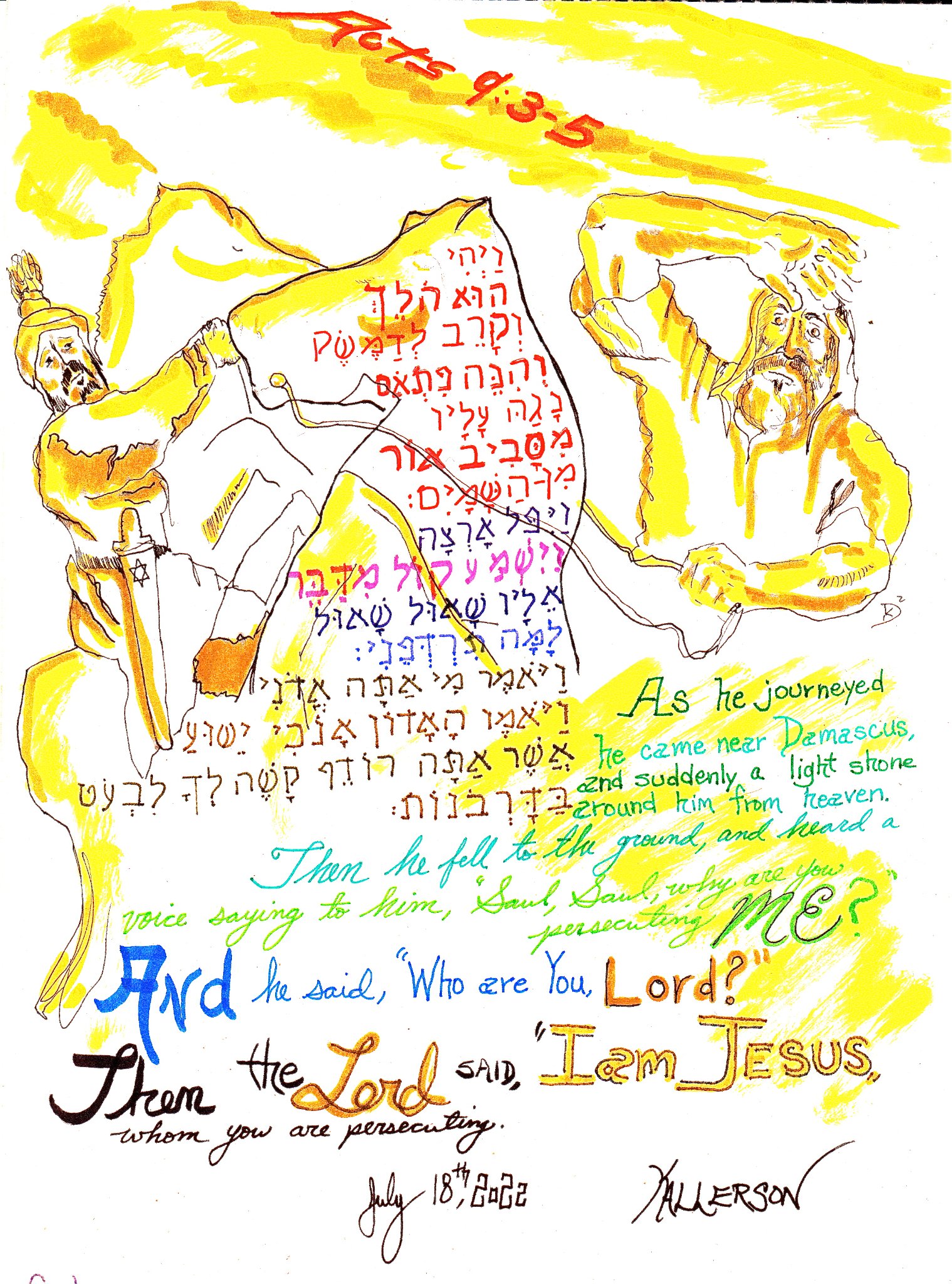
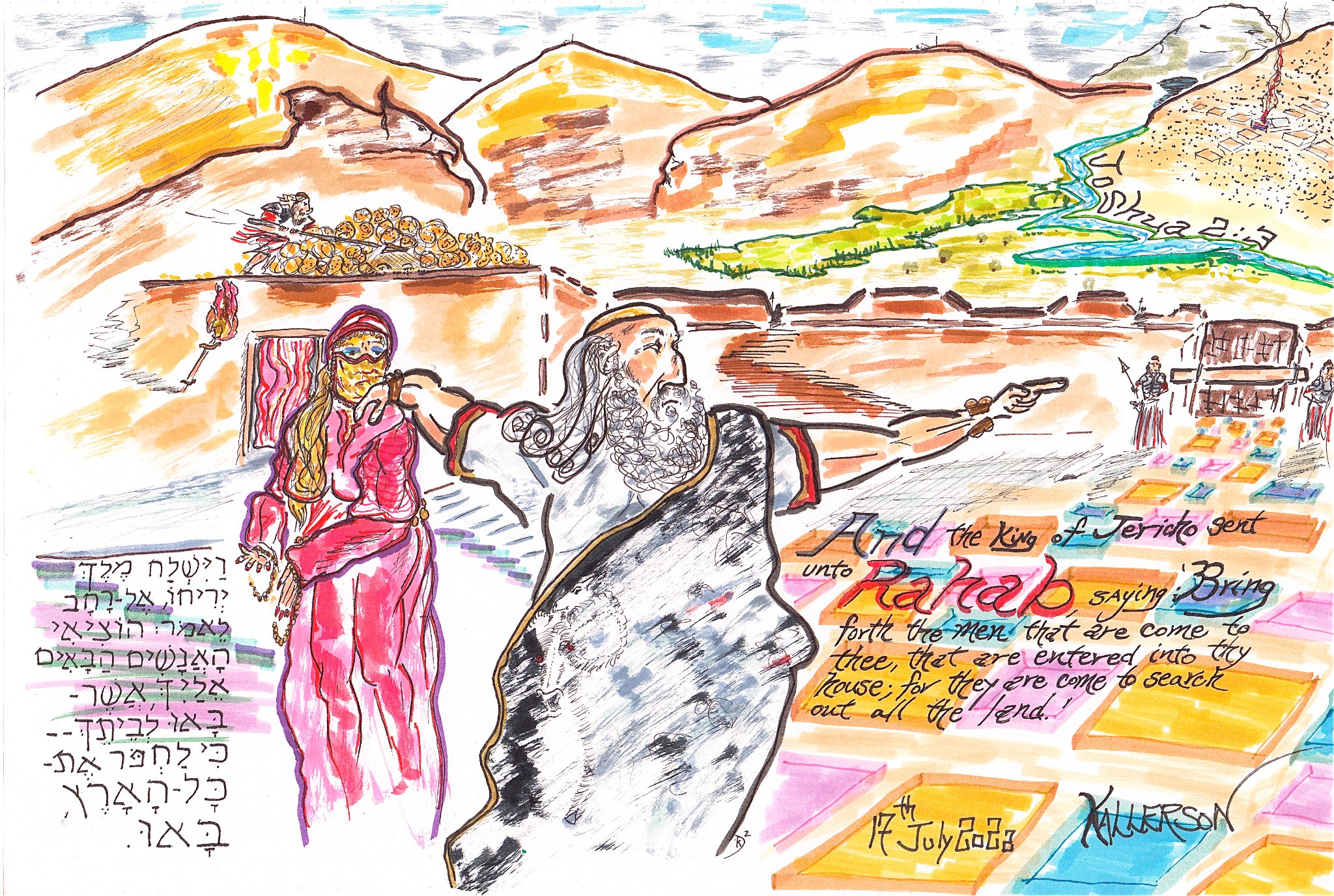
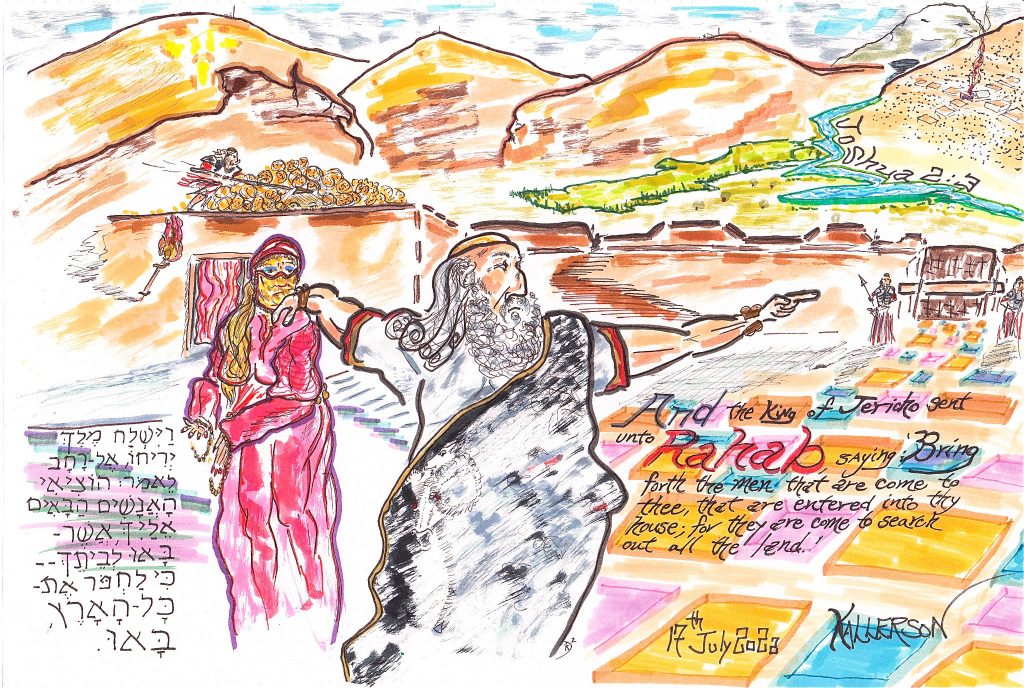
 Artwork by Doug Kallerson.
Joshua 2:1-11
A Harlot Named Rahab
Many years ago, I ran the wastewater plant that treated the water for all of the Gulf Gate area. The company provided all the water and wastewater services, including the big blue water tower just behind us, but I preferred the wastewater side of the job.
Running a plant is a lot like running your own body, just with a lot more volume. Stuff comes in, it has to be processed, and stuff goes out in a completely different condition. It is pretty much an all-natural process with the addition of several non-toxic chemicals.
When we eat, the minerals and vitamins contained in food are used by our bodies to make them work well. The treatment plants need iron and other things to be added in so that the “big stomach” doesn’t get upset. The plant needs air pumped through it to keep the microscopic bugs alive. The plant converts things from one form to another. It’s so much like how we function.
That includes when things get into the system that shouldn’t be in there as well. Things can upset our stomachs or even poison them. Well, this is true with the “big stomach” at the plant. One Saturday morning, I got a call from one of the operators, Jason, a really great guy.
He said, “Charlie, the plant is dead. We did 0.0% nitrification.” A dead plant is a bad thing for many reasons, but mostly because the untreated water still has to leave the plant. Those tanks have a very short time before they are full and flow downhill to where they finally rush out to Sarasota Bay. We had hours, at best, to fix things.
Text Verse: “By faith the harlot Rahab did not perish with those who did not believe, when she had received the spies with peace.” Hebrews 11:31
I got to the plant in a matter of minutes. We immediately turned one tank into a holding tank and started pumping every single drop of the “dead bug” out of the plant and into that holding tank. We then took a giant reserve of “live bug” from what is known as a digestor and pumped that back into the plant.
Within probably one to two hours, the plant was running as if it had never had a problem. This not only saved Sarasota Bay from becoming polluted with an unknown but highly toxic chemical (saving all the fish and other aquatic life out there), but it saved the company hundreds of thousands, or more, in fines.
The “dead bug” that we pumped to the temporary storage tank had to be loaded onto trucks and hauled to a special treatment center out of state. It was an immensely expensive process, but it had to be done. After analysis of the contents, it was determined that someone had poured highly toxic chemicals used in photography into the sewer system. Out of sight, out of mind, or so they thought.
If it wasn’t for the quick thinking of Jason who was working all alone on Saturday morning, Sarasota Bay would have received much of that toxicity, along with hundreds of thousands of gallons of untreated wastewater.
Today, we will meet a similarly quick-thinking lady. Life and death are on the line for her, and she knows it. But she wasn’t a top executive of a major company somewhere. She was just a prostitute. Who would think that someone like that would end up in the genealogy of the Savior of the world!
Great, great things such as this are to be found in His superior word. And so, let us turn to that precious word once again and… May God speak to us through His word today, and may His glorious name ever be praised.
I. Did Not Know (Liar, Liar, etc.) (verses 1-7)
Now Joshua the son of Nun sent out two men
As noted in the previous sermon, the words of verse 1:11 most likely follow chronologically after the account which is now given. There it said –
“Pass through the camp and command the people, saying, ‘Prepare provisions for yourselves, for within three days you will cross over this Jordan, to go in to possess the land which the Lord your God is giving you to possess.’” Joshua 1:11
As such, what is now to be detailed is an event that precedes the preparation of the people to enter Canaan, and the words “had sent,” instead of “sent” should be used. These two are sent out…
1 (con’t) from Acacia Grove to spy secretly,
min ha’shittim shnayim anashim merag’lim kheresh – “From the Acacia Groves two men reconnoiterers secretly.” The location is “the Shittim,” or translated, “the Acacia Groves.” Also, saying, “to spy secretly” is a redundancy.
The word is ragal, coming from regel, or foot. It is one who walks about, but it is to be taken in a specific way. In this case, it is to reconnoiter. But that is then defined with a new word to Scripture, kheresh, “secretly.” It is in this capacity that Joshua is…
1 (con’t) saying, “Go, view the land, especially Jericho.”
The word “especially” is not in the text, even if it is implied. It reads, “Go, see the land – and Jericho.” They were to do a general reconnoiter of the land, but also to ensure that they focused on Jericho. With that stated, it next says…
1 (con’t) So they went, and came to the house of a harlot named Rahab, and lodged there.
The Hebrew is more expressive: v’yeleku v’yavou beit ishah zonah rakhav, v’yishkevu shamah – “and they went, and they came to house woman – harlot – and named Rahab, and they lie down there.”
Here, the text identifies Rahab as a harlot, a word used consistently to speak of a whore or a prostitute. It is often used in Scripture to describe Israel in their whoring after false gods. However, the root of zonah, znh, is the same root used for a female who gives food and provisions; an innkeeper.
For this reason, rabbinic texts explain that this is what is being referred to. Even Josephus said that she kept an inn. And, thus, liberal teachers are quick to grab onto this and to identify her as having a noble background.
Unfortunately, if they would simply read the New Testament, they would not make such a blundering error. Our text verse today was from Hebrews 11:31. Both there and in James 2:25, she is identified as a harlot (a prostitute) using the Greek word porné. I assure you that porné does not mean an innkeeper. The same word is used to describe her as such in the Greek translation of the Old Testament as well.
Though the spelling of her name in Jesus’ genealogy in Matthew is different than that of Hebrews and James, it is certain that this is the same woman so clearly referenced in Joshua. It is the entire point of including her in the narrative and then in the genealogy.
This is a problem with consulting rabbinic literature. The rabbis didn’t like that a prostitute was in the genealogy of David, and thus in that of the coming Messiah, so they attempted to sugarcoat the obvious. This is not uncommon in their writings.
The apostles saw no such difficulty and understood that the very same fallen women, such as Rahab and Bathsheba, could be used as key participants in the unfolding narrative of redemption that would lead us to God’s Christ.
It should be noted that even reputable scholars, with all fudginess possible, attempt to repair her reputation. Adam Clarke went down innumerable avenues to patch-up Rahab’s image. In the end, he sums up his thoughts as to why he needed to do so –
“To all this may be added, that as our blessed Lord came through the line of this woman, it cannot be a matter of little consequence to know what moral character she sustained; as an inn-keeper she might be respectable, if not honorable; as a public prostitute she could be neither; and it is not very likely that the providence of God would have suffered a person of such a notoriously bad character to enter into the sacred line of his genealogy.”
Rather, it is expressly because she was a prostitute that the story is so glorious. A key point of this, at least from a moral perspective, is that God has accepted you. You may have been a prostitute, had an abortion, divorced your wife, secretly killed someone, been an alcoholic, or whatever. And yet, the beauty and even glory of God in Christ says, “Come. My grace is sufficient.”
Whatever your past was, in Christ, your future will never be the same. Come to Christ. This is the lesson of Rahab, and so far, we have only been introduced to her with a short description, “a woman – a prostitute.”
Her name, Rakhav, comes from the verb rakhav meaning to be or to grow wide or large. It is used in the Old Testament to indicate enlargement of an area, such as in a border, baldness on the head, the size of Sheol, and so on. It is also used to refer to enlarging the heart, opening the mouth, etc.
Thus, her name means Spacious or Enlarged. One must wonder what would prompt a name like this. As she is a prostitute, and as it appears her family was fully aware of this – as will be seen in the narrative – it may be that this was her lot all along, something not uncommon in many cultures.
As such, and solely as speculation by me, her name may have been given to her to reflect the work she would do, such as Isaiah prophesied concerning Israel when using this same root verb –
“Also behind the doors and their posts
You have set up your remembrance;
For you have uncovered yourself to those other than Me,
And have gone up to them;
You have enlarged [rakhav] your bed
And made a covenant with them;
You have loved their bed,
Where you saw their nudity.” Isaiah 57:8
Whatever the intent behind the name, and regardless of her profession, she will be a key figure in the history of Israel leading to the Messiah. For now…
2 And it was told the king of Jericho, saying,
As Jericho is a walled city, it had a ruling elder, here called a king because of the authority that he would have had over the populace. It was probably sentinels that guarded the gates who told the king.
People would be free to come in and go out of such a city, but it would be negligent to not tell the leader of any unusual foreigners that came around. The spies would only be two strangers coming in, probably unarmed. This would not be a reason to keep them out, but being Hebrews, it would at least be worthy of raising the matter to the king…
2 (con’t) “Behold, men have come here tonight
This would explain how they wound up meeting Rahab. As a prostitute, she would be hanging around the gates of the city in the evening to entice any travelers to spend the night at her place. It fits naturally into the narrative. As for the men, they were…
2 (con’t) from the children of Israel
One can only surmise that the two men told them this. Their accents would be unusual, but so would the accents of other people from all over the area. Having never heard anyone from Israel before, it would be unlikely they could be identified as such unless they were simply told it was so. This probably goes for the next words…
2 (con’t) to search out the country.”
lakhpor eth ha’erets – “to search out the land.” One can imagine it, “Hey guys, where are you coming from?” “We’re Israelis just checking things out. We’ve never been here before.” “OK! Good to have you, c’mon in.” It would be a common and innocuous greeting between them, but still one worth reporting…
3 So the king of Jericho sent to Rahab, saying,
He has already been identified as the king of Jericho. As such, it is implicit stress on the fact by saying, “the king of Jericho” rather than just “the king.” As such, the words are made more poignant, and thus the actions of Rahab, to whom the king’s words were directed, are brought forth as well. His words are…
3 (con’t) “Bring out the men who have come to you,
A verb is used in place of a noun: khotsii ha’anashim ha’baim elayik – “bring out the men, the comers unto you.” The king was apprised of the situation, he knew exactly who had come and who they had gone into. It is these two Israelis…
3 (con’t) who have entered your house,
asher bau l’betekh – “who have entered to your house.” Regardless of her type of business, to entertain a stranger meant the right to proper treatment and protection for those in the house.
Unless a refusal was made by Rahab, they would be bound by the honor found in Middle Eastern culture to ask her to deliver them rather than having the guards forcing themselves into her home. This is what provides her with the opportunity to take the action of hiding the Hebrew spies. In the meantime, those sent to her continue with…
3 (con’t) for they have come to search out all the country.”
The words expand upon the corresponding clause of verse 2 by adding in the word “all” to what is now said: ki lakhpor et kal ha’arets bau – “for to search out all the land they have come.”
As John Lange correctly states, “Notice the full circumstantiality of the king’s command.” The king has deduced that they are not merely tourists looking for a fun time, but they are men on a mission to determine the state of things for an invasion. One can see that even as they are speaking at the door, she is pointing out where the men can go and how to hide…
4 Then the woman took the two men and hid them.
The words curiously go from the plural to the singular: va’tiqah ha’ishah eth shene ha’anashim va’titspeno – “And took the woman two the men and hid him.” The Greek translation reads “them,” and without the later addition of the vowel points by the Masoretes, this could be read as them, but for some reason, the Masoretes carefully recorded it as “him.”
John Gill notes the Jew’s ridiculous take on this, saying, “hence the Jews, who take these two spies to be Caleb and Phinehas, say, that only Caleb was hid, and Phinehas, though he was before them, was not seen, being an angel.”
Ewald sees this as “the free discourse in which one passes from the plural to the singular.” The Pulpit Commentary explains this as each man being hidden in a separate place. But these notions hardly explain this. It is as if one of them is being singled out.
Despite that, one can see her pointing to the two and saying in a hush, “Go up on the roof. I’ll get rid of them.” They would have no choice but to trust her because the king’s men were standing there. It would make no sense for her to try to hide them, just to say to the king’s men, “They are on the roof.” Simply opening the door would have had exactly the same effect.
In reading the account, it makes one (meaning me) wonder if one of these two men didn’t become her future husband. It is wholly speculation, but they are identified in verse 6:23 as “young men.”
They are old enough to be sent out on a mission, but probably unmarried and are most likely in their mid to late teens. This completely dispels the Jewish idea that these are Caleb and Phinehas, one of whom is almost eighty at this point.
Rahab’s attitude and actions towards them, along with the curious change from plural to singular, reveal a quickly developed affinity that raises this idea in my mind.
4 (con’t) So she said, “Yes, the men came to me, but I did not know where they were from.
This is her first lie. It is already known where they are from as will be seen in verse 9. Having arrived at the point where a lie has been introduced, it must be noted that the comments by scholars on this go on and on.
They bring in the nature of God and of the terrible thing she has done by lying, carefully noting that a lie is always a sin. From there, they then go into the notion of forgiveness and mercy because of her faith, and so on.
It is true that lying is sin, but what is it that brings this about? The law. She is not under law. But she has a conscience. And so, either her conscience is seared, and she is corrupt, or she has weighed the matter out and she is working under a law of faith. Charles Ellicott wisely evaluates the matter –
“The Divine standard of sin and holiness never varies; but the standard of man’s conscience, even when faith is a dominant principle in the character, may vary to a very considerable degree. In Jesus Christ ‘all that believe are justified from all things;’ but ‘by the deeds of the law no one.’ Here, as elsewhere, the application of the law only brings the discovery of sin.”
Rather than focusing on something contrary to the Divine standard, the narrative focuses on exaltation of it through her words and actions that are grounded in faith. This is not unlike those who hid Jews during WWII. Even though the Bible says we are to be subject to the governing authority, there is often a time that such obedience must be disobeyed for a higher purpose. With that understood, Rahab continues…
5 And it happened as the gate was being shut, when it was dark, that the men went out.
The next lie. However, it is more than a simple lie, but also a fabrication. She is making stuff up on the fly to construct a convincing argument in order to hide the truth.
It is after dark, the gates are shut as the sun goes down, and they are only opened when those coming to it in either direction can be individually identified and authorized for passing through it. Thus, her words form a persuasive argument that is credible and would put her in jeopardy if it were not so. Hence, they have no reason to not believe it.
5 (con’t) Where the men went I do not know;
The third lie. She is fully aware of where they are, and the Bible doesn’t hide either the fact that she does know or that she lied. It simply conveys the details of the story, allowing us to come to our own conclusions about the matter.
While at the same time that her words are contrary to the Divine nature, the reason behind them and the actions which are joined to them are not.
Since this account was compiled, the same value judgments have been made continuously throughout human history. The number of people who took exactly the same path as Rahab during the holocaust alone is large. And those who did what they did are cited as heroes by people who would stand over Rahab and accuse her for being a little liar.
We live in a fallen world and there are times when judgments must be made that stand outside of the propriety of law. And yet, they will inevitably be the right choices when the larger situation is taken into consideration and when the person’s faith is properly directed. The evaluation of Rahab in Hebrews 11 and James 2 bears this out.
5 (con’t) pursue them quickly, for you may overtake them.”
The words are well thought out. She has already convincingly stated that they are not with her, having no discernible reason to lie and every reason to tell the truth. Adding these words intensifies the urgency to get about finding the miscreants. Some may call her conniving, but others would see her as quick thinking and resourceful.
6 (But she had brought them up to the roof
v’hi heelatam ha’gagah – “And she had caused them to ascend to the roof.” The meaning is that she told them to go up to the roof, and they went up. As noted earlier, this was probably as the king’s messengers came to the door. At that time, she pointed for them to go up, and so they went up.
The roofs of such houses were flat and were easily accessible because many things were done on top of them, from dinners and small parties, to accomplishing various types of work, and even for bathing or sleeping. It is probably after the messengers left that the next words came about…
6 (con’t) and hidden them with the stalks of flax,
The verb is imperfect: va’titmenem b’pishte ha’ets – “and hides them in flax, the wood.” These are stalks of flax that are said to grow to about three or more feet in length. After cutting, they would be set out in an array to dry, as seen in the next clause. This would be where the men could be easily hidden…
6 (con’t) which she had laid in order on the roof.)
ha’arukoth lah al ha’gag – “the arrayed to her upon the roof.” In other words, they had been laid out in an array upon the roof for drying. In this manner, they could get sun from all around and uniformly dry as they stood in these particular arrangements.
The roof would be the area where that was done. Eventually, the stalks would be worked and made into linen. She would have hidden them in these arrayed stalks until it was certain that nobody would be coming back to inspect the place, and until they could make their escape.
7 Then the men pursued them by the road to the Jordan,
v’ha’anashim rad’phu akharehem derek ha’yarden – “And the men pursued after them way the Jordan.” This would be the logical route to take. It would have been known that Israel was on the other side of the Jordan, and so to get to the Jordan as quickly as possible would be the most obvious thing to do. As it says…
7 (con’t) to the fords.
al ha’mab’roth – “upon the fords.” The word ma’avar signifies a passing through. It can be fords of a river or the passages through a mountain. As this is plural, it probably means that a group of soldiers went out and one or two of them stood upon each of the fords within reasonable distance of Jericho.
7 (con’t) And as soon as those who pursued them had gone out, they shut the gate.
Because of the way the words are laid out, a direct translation is difficult: “And the gate they shut after as which had gone out the pursuers after them.” It means just as the English translation says. Once those pursuing the men went out, the gates were shut.
Being nighttime, they were taking no chances of a sudden rush by the enemy, or anyone getting in or out that should not do so. Other than face masks and vaccines, the city had gone into lockdown
*Who are you and where are you from?
And why is your accent so odd?
Come inside and explain to me some
What is your people, and who is your God?
**We are Israel and just checking things out
You know, seeing what is up in this place
We’re searching the land to see what it’s all about
And it’s so nice to see your smiling face
*We have heard of you. Your life is in danger in this place
But I can hide you if anyone comes around
I want you to remember my face
I hope for mercy from you if it can be found
I will join with your people, please remember my face
After I have gotten you safely out of this place
II. For We Have Heard (verses 8-11)
8 Now before they lay down,
There is a stress in the words: v’hemah terem yishkavun – “and they before they (certainly) lay down.” It shows the imperative nature of what will come next.
With the messengers gone and the soldiers sent out of the city, things would have calmed down enough for the two men to lie down and sleep. But before they could do this, she ascended to the roof to converse with them…
8 (con’t) she came up to them on the roof,
v’hi aletah alehem al ha’gag – “and she ascended upon them, upon the roof.” Her words to come are filled with careful attention concerning the state of those in Canaan, the knowledge of the Lord and His care for Israel, and of her faith in the Lord’s capabilities.
9 and said to the men: “I know that the Lord has given you the land,
Rahab explicitly speaks out the name Yehovah: yadati ki nathan Yehovah lakem eth ha’arets – “I know for has given Yehovah to you the land.” She is both aware of this name and she understands His purposes for Israel. Her faith in the capability of the Lord is demonstrated in the words, “has given Yehovah to you the land.”
It is a done deal even though the actions that will cause it to come about have not yet even begun. She knows this. And more, all of the people know it as well…
9 (con’t) that the terror of you has fallen on us, and that all the inhabitants of the land are fainthearted because of you.
Here she uses the word mug, or melt – “and that have melted all dwelling the land from your presence.” This was the purpose of the Lord’s dealings with Pharaoh. Going through the plagues gradually was intended to slowly harden Pharaoh’s heart.
If He had gone in and done something beyond their imagination right at the beginning, Pharaoh may have just said, “Let them go!” But that is not what happened. The Lord started with simple plagues that were reproducible by Pharaoh’s own magicians.
He then brought more plagues that one might think would logically follow one after another. If you turn water into blood, you will bring out frogs. If the frogs all die, the bugs that the frogs eat will increase exponentially, from there, pestilence on the livestock will result. And so forth.
The Lord followed a set path to slowly harden the heart of Pharaoh. He would have been well educated and attributed these things to what he could naturally observe. By the time the greater plagues came, he would be hardened to the point where more hardening would be the inevitable result.
And this is exactly what the Lord intended. By multiplying His judgment, He would magnify His name. And in doing that, the nations would then hear and fear –
“And I will harden Pharaoh’s heart, and multiply My signs and My wonders in the land of Egypt. 4 But Pharaoh will not heed you, so that I may lay My hand on Egypt and bring My armies and My people, the children of Israel, out of the land of Egypt by great judgments. 5 And the Egyptians shall know that I am the Lord, when I stretch out My hand on Egypt and bring out the children of Israel from among them.” Exodus 7:3-5
The Egyptians would know all that happened, and the word from them as they traded with the nations would naturally carry right back to the homes of those who traded. By the time the greatest plague hit, the death of the firstborn of Egypt, Pharoah would want them gone and even drive them out.
But because of the hardness of his heart, he would relent and attempt to retrieve them. In that, the great and miraculous event that would finally destroy Pharaoh’s power would come…
10 For we have heard how the Lord dried up the water of the Red Sea for you when you came out of Egypt,
The story of the Red Sea crossing was forty years earlier, but it was well known and remembered by all who heard it. And the credit is given to Yehovah, and it is given on behalf of the people of Israel. The narrative was clearly and precisely remembered.
This was exactly the purpose of the Lord having multiplied His judgments upon Pharaoh. A swift, sudden, and decisive early judgment would have not led to the knowledge of the Lord by Rahab and all of the others throughout Canaan. But more, she says…
10 (con’t) and what you did to the two kings of the Amorites who were on the other side of the Jordan, Sihon and Og, whom you utterly destroyed.
This was very recent history, and it would have resounded with the people, calling to mind the tales of the past and both reaffirming them and adding to the terror of the present. And, again, this is exactly what Moses said would occur, beginning with Sihon –
“Rise, take your journey, and cross over the River Arnon. Look, I have given into your hand Sihon the Amorite, king of Heshbon, and his land. Begin to possess it, and engage him in battle. 25 This day I will begin to put the dread and fear of you upon the nations under the whole heaven, who shall hear the report of you, and shall tremble and be in anguish because of you.” Deuteronomy 2:24, 25
The conquest of Sihon was immediately followed up with the conquest upon Og. As such…
11 And as soon as we heard these things, our hearts melted;
The words “as soon as” are not in the Hebrew. It is short and specific: “And we hear and melted our hearts.” The tales of the Red Sea would have been known but not considered for many years, but with the sudden coming of Israel upon the land east of the Jordan, and of the victories over the great inhabitants there, there would be utter panic at what lay ahead. As such…
11 (con’t) neither did there remain any more courage in anyone because of you,
v’lo qamah od ruakh b’ish mip’nekem – “And no stood again spirit in man from before you.” The idea is that every man became completely dispirited and he could not get himself to regain his courage again. They simply remained terrified. Hence, we saw the reaction of the king of Jericho. Rahab next makes a sure statement of faith in what she now perfectly knows…
11 (con’t) for the Lord your God, He is God in heaven above and on earth beneath.
Rahab’s words are emphatic: ki Yehovah elohekem hu Elohim ba’sh’mayim mi maal v’al ha’aretz mi’takhat – “For Yehovah your God HE God in the heavens from above and upon the land from beneath.” They are practically the words of Moses, but most especially in these words from Deuteronomy 4:39 –
“Therefore know this day, and consider it in your heart, that the Lord Himself is God in heaven above and on the earth beneath; there is no other.”
Verses 9-11 can be summed up in the words of the Song of Moses from Exodus 15 –
“Then the chiefs of Edom will be dismayed;
The mighty men of Moab,
Trembling will take hold of them;
All the inhabitants of Canaan will melt away.
16 Fear and dread will fall on them;
By the greatness of Your arm
They will be as still as a stone,
Till Your people pass over, O Lord,
Till the people pass over
Whom You have purchased.” Exodus 15:15, 16
This is a logical point to end the words for today. Rahab has demonstrated faith in the capabilities of the Lord, even to the point that what she does aligns with what she believes. This brings in the obvious difficulty that is evidenced between the writings of Paul and those of James, something that we will look at in a moment…
With what will you come before the Lord?
What will you present for the sin of your soul?
What will bring you the great reward?
On what thing will you, your sins roll?
Shall you accomplish a great and noble deed?
Claiming it is worthy of His praise?
Shall giving up a wicked life or one of greed
Bring you honor, blessing, and eternal days?
Rather, come to your God in faith because of His grace
Come to Him with hands empty of any pride
By grace through faith alone will you see His smiling face
And through that alone will you in heaven reside
III. A Lesson in Faith
Paul says in Romans 3, “Therefore we conclude that a man is justified by faith apart from the deeds of the law” (Romans 3:28). He then goes on to say –
“What then shall we say that Abraham our father has found according to the flesh? 2 For if Abraham was justified by works, he has something to boast about, but not before God.” Romans 4:1, 2
A few verses later, he says, “But to him who does not work but believes on Him who justifies the ungodly, his faith is accounted for righteousness” (Romans 4:5).
Paul says this elsewhere as well, both directly and indirectly. And yet, James says, “You see then that a man is justified by works, and not by faith only” (James 2:24).
This is a problem, because preachers, teachers, and scholars then come up with impossible-to-reconcile solutions, such as, “Good works stem naturally from saving faith.” That is nonsense, and it is not ever taught in Scripture.
First, tell that to the guy on the cross next to Jesus. Secondly, the obvious question is, “What works?” Who decides what is sufficient work to say, “Yes, he is saved, and he is not.”? And thirdly, isn’t lying evidence of not doing what is right?
So, if a person does some good things and some things that aren’t good, like Rahab, then who decides that her works are acceptable for saving or not? It completely misses the intent of what Paul is saying, and it dismisses what James is saying.
In James 2, he gives only two examples of what works justify a person. The first was, astonishingly, that of Abraham, the exact same person that Paul says was justified by faith alone –
“Was not Abraham our father justified by works when he offered Isaac his son on the altar? 22 Do you see that faith was working together with his works, and by works faith was made perfect?” James 2:21, 22
His second example is, equally incredibly, Rahab –
“Likewise, was not Rahab the harlot also justified by works when she received the messengers and sent them out another way?” James 2:25
Is James saying that these two people were not justified by faith? If so, then he didn’t read the epistle to Hebrews. Because both of them are used as examples there for being people of faith. And more, both of them have exactly the same “works” cited as “works of faith” –
“By faith Abraham, when he was tested, offered up Isaac, and he who had received the promises offered up his only begotten son, 18 of whom it was said, ‘In Isaac your seed shall be called,’ 19 concluding that God was able to raise him up, even from the dead, from which he also received him in a figurative sense.” Hebrews 11:17-19
“By faith the harlot Rahab did not perish with those who did not believe, when she had received the spies with peace.” Hebrews 11:31 (our text verse)
So how can it be that works justified them? If their faith was behind the works, then it was faith that justified them. Their works were simply works of faith. It is true that their works were products of the faith, but that is not what justified them, their faith did.
So, the question remains, “What works?” What is it that will save the human and bring him before God justified and acceptable to Him? Jesus gave us the answer –
“Then they said to Him, ‘What shall we do, that we may work the works of God?’
29 Jesus answered and said to them, ‘This is the work of God, that you believe in Him whom He sent.’” John 6:28, 29
The “works” which justify are the works of Jesus Christ. Faith in Him may or may not lead to our own works, but it is He who did the works. It is He who fulfilled the law. It is He who died in fulfillment of the law, and it is He who rose again. And it is we – here it is, here are our works – who are to believe in Him.
It is entirely false that “good works stem naturally from saving faith,” because no “good works” are defined for us to do except for those things that are found for us to do that are recorded in Scripture. But if a person hears the gospel, accepts it, and is saved, unless he has the Bible – something almost unheard of in much of history and still for many of the people of the world – they cannot “do” what is expected of them from the word.
In the end, everything comes back to one thought for our justification: faith. And it is faith plus nothing. If you want to be pleasing to God, have faith. If you want to add to that, learn His word and apply its precepts to your life. And when you do good things, if they are done because of your faith in Christ, you will receive your reward. Have faith in that.
Closing Verse: “But that no one is justified by the law in the sight of God is evident, for ‘the just shall live by faith.’” Galatians 3:11
Next Week: Joshua 2:12-24 To the spies, Rahab these words does submit… (According to Your Words, So Be It) (4th Joshua Sermon)
The Lord has you exactly where He wants you. He has a good plan and purpose for you. It is He who has defeated the enemy and who now offers His people rest. So, follow Him and trust Him and He will do marvelous things for you and through you.
A Harlot Named Rahab
Now Joshua the son of Nun sent out two men from Acacia Grove
To spy secretly, saying, “Go, view the land, especially Jericho
So they went, and came to the house of a harlot named Rahab
And lodged there, thinking no one would know
And it was told the king of Jericho, saying
“Behold, men have come here tonight
From the children of Israel to search out the country
For sure, this just ain’t right
So the king of Jericho sent to Rahab, saying
“Bring out the men who have come to you
Who have entered your house
For they have come to search out all the country
———-such they came to do
Then the woman took the two men and hid them
So she said, “Yes, the men came to me
But I did not know where they were from
So I tell you plainly
“And it happened as the gate was being shut
When it was dark, that the men went out; their escape
———-they did make
Where the men went, I do not know
Pursue them quickly, for them you may overtake”
(But she had brought them up to the roof
And hidden them with the stalks of flax
Which she had laid in order on the roof
She carefully covered their tracks
Then the men pursued them by the road
To the Jordan, to the fords heading straight
And as soon as those who pursued them had gone out
They shut the gate
Now before they lay down, she came up to them on the roof
And said to the men: “I know that the LORD has
———-given you the land. Yes, I know it’s true
That the terror of you has fallen on us
And that all the inhabitants of the land are fainthearted
———-because of you
For we have heard how the LORD dried up the water
Of the Red Sea for you when you came out of Egypt, such
———-great wonders He has employed
And what you did to the two kings of the Amorites
Who were on the other side of the Jordan, Sihon and Og
———-whom you utterly destroyed
And as soon as we heard these things, our hearts melted
Neither did there remain any more courage in anyone
Because of you, for the LORD your God
He is God in heaven above and on earth beneath
———-He is the only One!
Lord God, turn our hearts to be obedient to Your word
Give us wisdom to be ever faithful to You
May we carefully heed each thing we have heard
Yes, Lord God may our hearts be faithful and true
And we shall be content and satisfied in You alone
We will follow You as we sing our songs of praise
Hallelujah to You; to us Your path You have shown
Hallelujah we shall sing to You for all of our days
Hallelujah and Amen…
Now Joshua the son of Nun sent out two men from Acacia Grove to spy secretly, saying, “Go, view the land, especially Jericho.”
So they went, and came to the house of a harlot named Rahab, and lodged there. 2 And it was told the king of Jericho, saying, “Behold, men have come here tonight from the children of Israel to search out the country.”
3 So the king of Jericho sent to Rahab, saying, “Bring out the men who have come to you, who have entered your house, for they have come to search out all the country.”
4 Then the woman took the two men and hid them. So she said, “Yes, the men came to me, but I did not know where they were from. 5 And it happened as the gate was being shut, when it was dark, that the men went out. Where the men went I do not know; pursue them quickly, for you may overtake them.” 6 (But she had brought them up to the roof and hidden them with the stalks of flax, which she had laid in order on the roof.) 7 Then the men pursued them by the road to the Jordan, to the fords. And as soon as those who pursued them had gone out, they shut the gate.
8 Now before they lay down, she came up to them on the roof, 9 and said to the men: “I know that the Lord has given you the land, that the terror of you has fallen on us, and that all the inhabitants of the land are fainthearted because of you. 10 For we have heard how the Lord dried up the water of the Red Sea for you when you came out of Egypt, and what you did to the two kings of the Amorites who were on the other side of the Jordan, Sihon and Og, whom you utterly destroyed. 11 And as soon as we heard these things, our hearts melted; neither did there remain any more courage in anyone because of you, for the Lord your God, He is God in heaven above and on earth beneath.