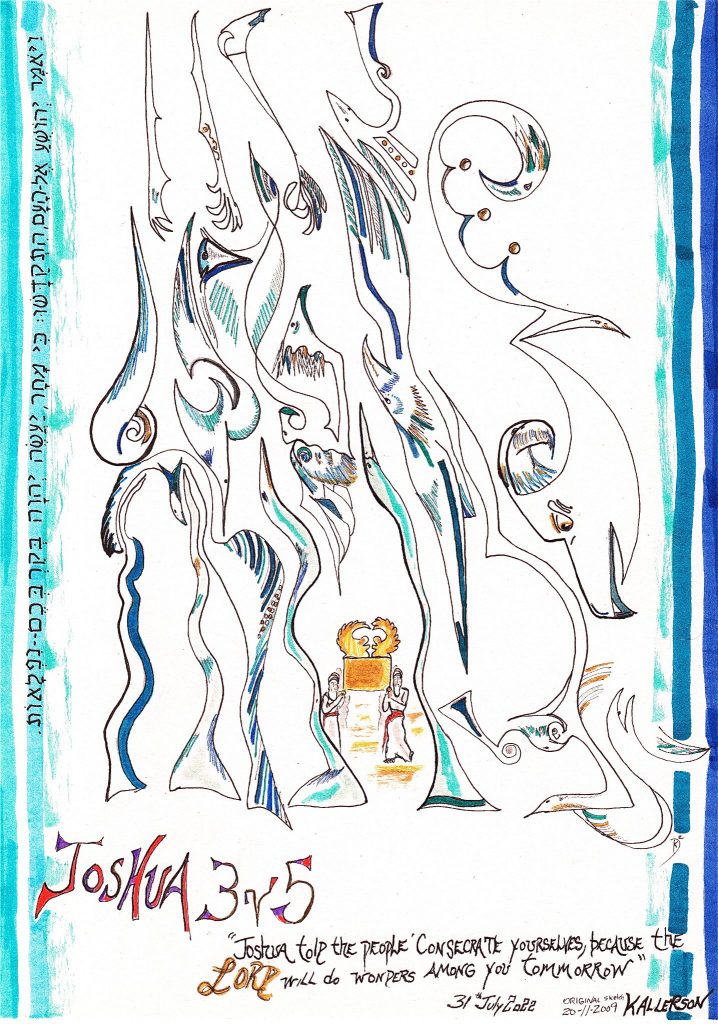
Artwork by Doug Kallerson.
Joshua 3:1-13
And the People Crossed Over
The structure of Joshua can be puzzling, and there are as many opinions on it as there are buttons on an elevator in a tall building. I have presented, and will continue to present, what I think is a reasonable explanation for what is going on.
In the first four chapters, it seems evident when looking at the big picture. There is a command/obedience to the command structure which can be seen in the following verses:
The command to begin:
“After the death of Moses the servant of the Lord, it came to pass that the Lord spoke to Joshua the son of Nun, Moses’ assistant, saying: 2 ‘Moses My servant is dead. Now therefore, arise, go over this Jordan, you and all this people, to the land which I am giving to them—the children of Israel.’” Joshua 1:1, 2
Joshua’s obedience:
“Then Joshua commanded the officers of the people, saying, 11 ‘Pass through the camp and command the people, saying, “Prepare provisions for yourselves, for within three days you will cross over this Jordan, to go in to possess the land which the Lord your God is giving you to possess.”’” Joshua 1:10, 11
Insert the story of the spies and Rahab which occurs prior to these events, and which sets the narrative in motion, followed by a continuance of the narrative with, “Then Joshua rose early in the morning; and they set out from Acacia Grove and came to the Jordan, he and all the children of Israel, and lodged there before they crossed over.” Joshua 3:1
The command to part the waters and cross:
“And the Lord said to Joshua, ‘This day I will begin to exalt you in the sight of all Israel, that they may know that, as I was with Moses, so I will be with you. 8 You shall command the priests who bear the ark of the covenant, saying, “When you have come to the edge of the water of the Jordan, you shall stand in the Jordan.”’” Joshua 3:7, 8
Joshua’s obedience:
“So Joshua said to the children of Israel, ‘Come here, and hear the words of the Lord your God.’” Joshua 3:9
The command to set up a memorial:
“And it came to pass, when all the people had completely crossed over the Jordan, that the Lord spoke to Joshua, saying: 2 ‘Take for yourselves twelve men from the people, one man from every tribe, 3 and command them, saying, “Take for yourselves twelve stones from here, out of the midst of the Jordan, from the place where the priests’ feet stood firm. You shall carry them over with you and leave them in the lodging place where you lodge tonight.”’” Joshua 4:1-3
Joshua’s obedience:
“Then Joshua called the twelve men whom he had appointed from the children of Israel, one man from every tribe; 5 and Joshua said to them: ‘Cross over before the ark of the Lord your God into the midst of the Jordan, and each one of you take up a stone on his shoulder, according to the number of the tribes of the children of Israel.’” Joshua 4:4, 5
The command to come up from the Jordan:
“Then the Lord spoke to Joshua, saying, 16 ‘Command the priests who bear the ark of the Testimony to come up from the Jordan.’” Joshua 4:15, 16
Joshua’s obedience:
“Joshua therefore commanded the priests, saying, ‘Come up from the Jordan.’” Joshua 4:17
Text Verse: “The entrance of Your words gives light;
It gives understanding to the simple.
131 I opened my mouth and panted,
For I longed for Your commandments.” Psalm 119:130, 131
In the verses we looked at, along with the command being given and Joshua obediently repeating it to the people, there is also a fulfillment of each command by the people. And so, in each instance, there is the word of the Lord, then the word of the Lord is repeated by the leader, and then there are the steps taken in obedience to the directive.
The point of this is to demonstrate that everything stated finds its fulfillment in the passage. There is intent in what is to be done, and there is the accomplishment of that intent. Mixed within what is said are several repetitions which get confusing unless the basic structure mentioned above is remembered. As long as it is, then no contradictions are seen.
And so, what is happening is an account is given, its completion is recorded, and then details are provided or re-provided to fill in blanks in the original account.
This was seen in Genesis, such as when the overall narrative of creation was given in Chapter 1, and then the details were filled in concerning the creation of man in Chapter 2. It is seen in the book of Ruth which belongs within the chronology of the book that precedes it, Judges.
In Joshua, there is a chronology being given, but there is also a backing up and a filling in of that chronology. Remember this pattern when you read the Bible and when you see the bigger view followed by the more detailed view, it sure will help you to not feel like things are out of whack. They aren’t.
We see movie directors do this all the time. They will show something at the beginning of the film, and then the rest of the film will build up to that event, which is actually the completion of the movie, or very close to the completion of it.
We think this is an inventive way to tell a story to keep us anticipating what will happen. Well, the Lord did the same thing for us thousands of years ago. In the end, the promise of a Deliverer at the beginning will eventually be fully revealed. The details along the way help us to more fully understand that early promise.
Great things such as this are to be found in His superior word. And so, let us turn to that precious word once again and… May God speak to us through His word today and may His glorious name ever be praised.
I. The Way by Which You Must Go (verses 1-6)
Then Joshua rose early in the morning;
If you remember from Chapter 1, the timeline is rather difficult to pin down and be dogmatic about. But these words now appear to fit into the timeline of verses 1:10, 11 –
“Then Joshua commanded the officers of the people, saying, 11 ‘Pass through the camp and command the people, saying, “Prepare provisions for yourselves, for within three days you will cross over this Jordan, to go in to possess the land which the Lord your God is giving you to possess.”’”
In other words, the spies were sent out first, they gathered their intel, and then they returned. From there, scholars argue as to whether the three-day period is from the movement to the Jordan or if it is after arrival at the Jordan.
It is hard to be dogmatic either way, but assuming that it is from the movement to the Jordan, it would then be put at the time the spies gave their information. Then Joshua gets up and tells the people, “Ok! It’s time to go to the Jordan.” After the completion of that move, they are at the Jordan, and now the three-day interval has expired.
The words, “within three days,” (literally “in until three days”) simply mean “any part of three days.” Joshua told the people to get up and move to the Jordan. In their move, they prepare provisions, move, and cross. This is all seen in the next words…
1 (con’t) and they set out from Acacia Grove and came to the Jordan,
If this is from the movement of the people, then this would read, “and they had set out…” It would be describing the movement of the three days. If the encampment is at the Jordan for three days, then “and they set out” would be correct. Again, I am assuming it is from the beginning of the movement.
Either way though, the people were noted as being at “the Shittim,” or “the Acacia Grove” in Numbers 25:1. It is also the last stop in the wanderings of Israel recorded in the exodus from Egypt in Numbers 33 –
“They camped by the Jordan, from Beth Jesimoth as far as the Abel Acacia Grove in the plains of Moab.” Numbers 33:49
It is at this location that they have remained, and where the law was completed as given through Moses. The name of this place was again stated in Joshua 2:1. It is from here that they will pick up and head to ha’yarden, or the Jordan, meaning “the Descender.” From the Acacia Grove to the Jordan is seen the last movement and stop of the exodus from Egypt. This movement is inclusive of…
1 (con’t) he and all the children of Israel,
The entire congregation of Israel is included. This means Joshua, the men of war, the women, children, etc. The only ones to not cross over would be those who had already received their inheritance east of Jordan and who would stay to start their lives there, but the men of war from those tribes are included in this crossing over now. With this recorded, it next says…
1 (con’t) and lodged there before they crossed over.
The word lodged, lun, signifies “to pass the night,” “dwell,” “abide,” and so on. Hence, it is why I would assume the three days is inclusive of the move, and not three days lodging at the shore of the Jordan. Others disagree as the word can mean a longer time of lodging. It is hard to be dogmatic. Either way…
2 So it was, after three days,
It doesn’t say “after three days,” but rather: v’hi miqseh sh’loshet yamim – “And from end three days.” Therefore, this would be the third day. It is at this time…
2 (con’t) that the officers went through the camp;
The people, encamped at the Jordan, are now to be instructed by the officers on the protocol to be followed as they cross through the Jordan. The instructions from the officers here are not the same as those given previously. As such, this is not at the beginning of the march from the Acacia Grove, but at the encampment near the river. The specific instructions for moving from here are seen next…
3 and they commanded the people, saying, “When you see
Rather than “When you see,” it more precisely reads kirothkem – “According to your seeing.” It’s not when they see the ark that they get up and start following it. Rather, it is “according to” their seeing it. The details of that are still ahead, but they have limitations set upon them about exactly when they can respond.
3 (con’t) the ark of the covenant of the Lord your God,
aron b’rith Yehovah elohekem – “ark covenant Yehovah your God.” The word “ark” signifies a hollow box. It is used to describe Joseph’s coffin in Genesis 50:26. The symbolism is that of Christ being the embodiment and fulfillment of the law. That has already been seen quite clearly in the instructions for, and construction of, it in Exodus.
It is known by various names – the ark, the ark of the witness, the ark of the covenant, the ark of the Lord, the ark of the covenant of the Lord, the ark of the covenant of the Lord your God, the ark of God, and so on.
In this case, the term used gives us a clear insight into the work of Christ. If we define it as a coffin, that can be seen – “ark (coffin) covenant of Yehovah your God.” Along with the ark, there are those who bear it. As it says…
3 (con’t) and the priests, the Levites, bearing it,
The term “the priests, the Levites” is another way of saying, “the priests who are also of the tribe of Levi.” The priests, who are of Levi, were to bear the ark as is stated in Deuteronomy 31:9. It is according to the people’s seeing the ark being borne by the Levitical priests that…
3 (con’t) then you shall set out from your place and go after it.
The ark is to go first, the people will see the ark at a set distance, and only then were they to arise from the place they lodged and go after it. That set distance is next explained…
4 Yet there shall be a space between you and it,
akh rakhoq yihyeh benekem u-beno – “Surely distance there shall be interval you (pl.) and interval it.” There is to remain a marked separation between the ark and the people. This is to be…
4 (con’t) about two thousand cubits by measure.
The wording is more precise: k’alpayim amah ba’midah – “according to two thousand cubits in the measure.” This is about three thousand feet, or about three-quarters of a mile. It is what is known as a Sabbath Day’s journey in Acts 1:12, which is based on this passage now. That is the distance a person could walk on the Sabbath without it being considered a violation of that day.
There are various suggestions as to the reason for this. The first is explicitly stated in the next words…
4 (con’t) Do not come near it, that you may know the way by which you must go,
al tiqrevu elav l’maan asher tedeu eth ha’derek asher teleku bah – “No do come near it to end purpose which you may know the way which you go in.” The main reason is that in seeing the ark, the people would know where they could pass through the river. The people would need to know when the ark arrived at the Jordan.
By being distanced from the ark, it would be more visible to all people. If the distance were less, it would be crowded out of sight. The ark is both showing the way and making the way at the same time. As such, the people would want to cross down river from the ark. The ark is first, where the waters first ceased. The people follow after that on dry ground while the waters had continued on down to the Salt Sea.
As such, the unguarded ark would be considered the van, or Leader, for all others, protecting them. In seeing where the ark was located, the people could look and know they will be safe from the waters. As long as the ark remained there, the multitudes could continue to pass through the Jordan, and they would know the way, not being on the wrong side of it. These were needed…
4 (con’t) for you have not passed this way before.”
The Hebrew bears an idiom: ki lo abartem ba’derek mit’mol shilshom – “for no you have passed in the way from yesterday, day before yesterday.” It is a way of saying, “This is not something you have done before.”
The intent of the words is, “There is one way. As you have never taken it before, you are given this opportunity without fear of getting lost.”
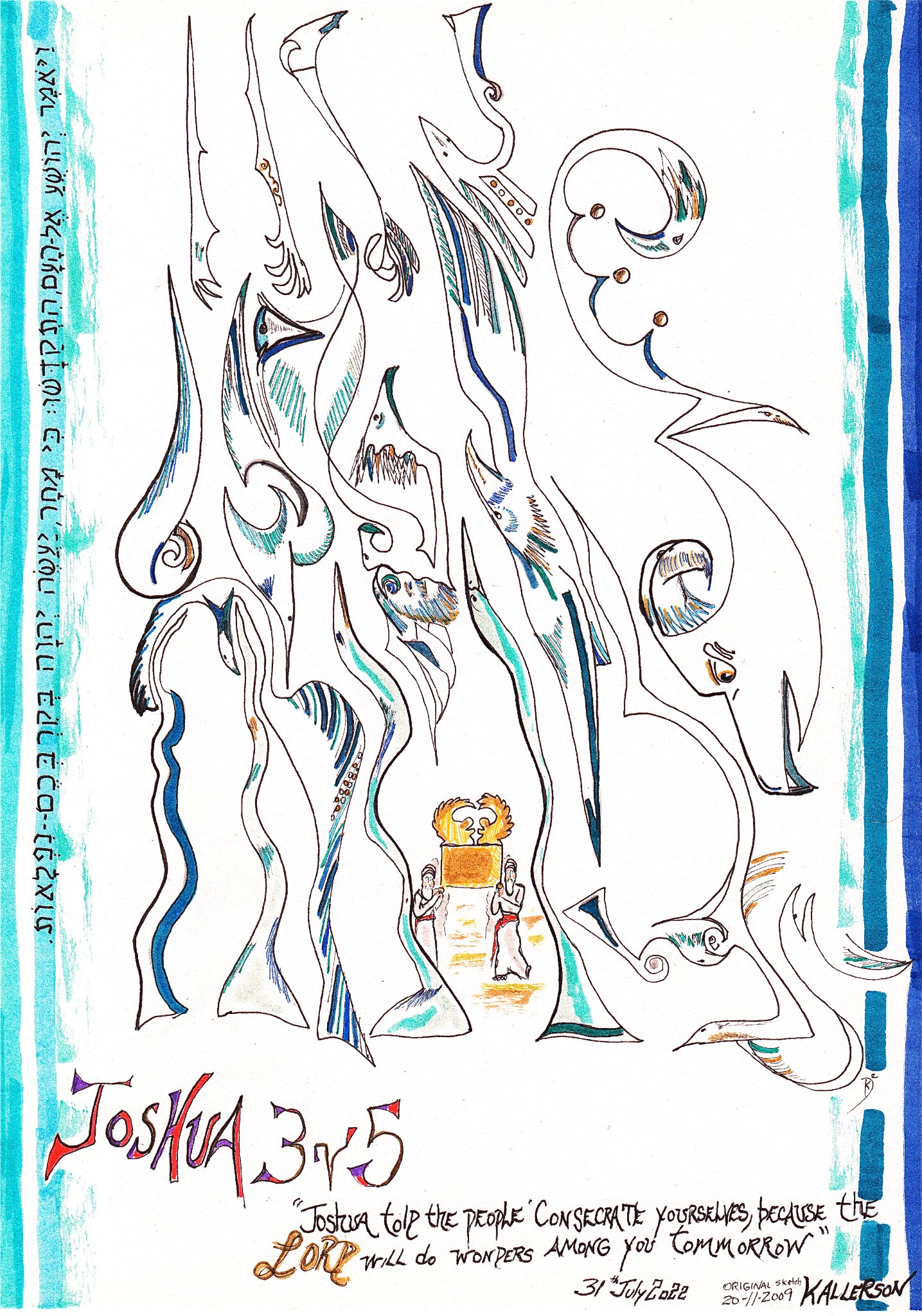
5 And Joshua said to the people, “Sanctify yourselves, for tomorrow the Lord will do wonders among you.”
The meaning here cannot be the same as in Exodus 19 where the people were to sanctify themselves for three days, wash their clothes, and refrain from going near their wives. None of that is stated, and there would not have been time for such external purifications.
Rather, what this appears to mean is that the people were to prepare themselves mentally, turn their hearts to the Lord, demonstrate faith in His promises, and the like. Without a right heart and attitude, the external rites that came at the giving of the law were ineffective in changing the people. Joshua is instructing them to sanctify themselves in a manner that will be effective.
6 Then Joshua spoke to the priests, saying, “Take up the ark of the covenant and cross over before the people.”
Joshua is typical of Christ, the Leader of the people. The Ark is typical of Christ, the embodiment of the law. The priests are typical of Christ as the One who fulfilled the sacrificial and priestly functions of the law which the priests performed. Each aspect of what is occurring finds its ultimate fulfillment in Him.
As instructed by Joshua, so the priests comply…
6 (con’t) So they took up the ark of the covenant and went before the people.
Christ is the One who goes before His people, pictured by their going before them now. With this understood, we now come to the next section where the Lord speaks to Joshua…
Sanctify yourselves before the Lord
Prepare your heart and He will receive you
Believe what is recorded in His word
Accept the gospel is what you must do
Christ led the way so that we could then pass through
In going first, He accomplished all things for us
And now God asks us to simply believe this is true
Yes, God has done it all in the giving of Jesus
And so, let us fix our eyes on Jesus our Lord
And let us follow Him, the One who has paved the way
He is the only path back to God according to His word
Let us follow Him in faith, not waiting another day
II. The Ark of the Covenant of the Lord (verses 7-13)
7 And the Lord said to Joshua, “This day I will begin to exalt you in the sight of all Israel,
The words now are given to provide Joshua with the assurance that he will, in fact, be considered the acceptable leader of the people. That has already been acknowledged, but it will be confirmed in their sight (literally: their eyes) now.
The promise now is explicitly stated as realized in Chapter 4 –
“On that day the Lord exalted Joshua in the sight of all Israel; and they feared him, as they had feared Moses, all the days of his life.” Joshua 4:14
This is the purpose. The Lord is exalting Joshua, the leader of His people…
7 (con’t) that they may know
The words bear a strong emphasis: asher yedeun – “that they may (certainly) know.” There will be no doubt in the minds of the people…
7 (con’t) that, as I was with Moses, so I will be with you.
Just as certain as they had become that the Lord was with Moses, so they would be assured that He was also with Joshua. There would be no need for them to second guess the matter, and there would be no attempts to usurp his authority as they had, at first, tried with Moses.
The words of John come to mind here –
“Then they reviled him and said, “You are His disciple, but we are Moses’ disciples. 29 We know that God spoke to Moses; as for this fellow, we do not know where He is from.’” John 9:28, 29
Israel rejected Jesus, and this continues today. Someday, they will see in Joshua, the type of which Christ is the Antitype. It is He who alone can lead them into the inheritance. They will be as certain about Him as they are that Moses was their lawgiver. But Moses and the law could not bring them in. Only in the death of the law, typified by Moses’ death, can this come about.
Charles Ellicott correctly notes –
“It is here stated that the passage of Jordan was to be to Joshua what the giving of the law at Sinai was to Moses, “that the people may hear when I speak with thee, and believe thee for ever” (Exodus 19:9). But the power which establishes Joshua is the work of the written instead of the spoken word.” Charles Ellicott
In both spoken word and in written word, it is the word of the Lord that was given to convince Israel. It is the ending of the law through Christ’s work, accompanied by the introduction of the New Covenant, that establishes Jesus as the true Leader of Israel.
But that is now only to be found in the written word. The law itself testifies to the Person and work of Christ (John 5:39 & 45), and it will take Israel accepting this fact for them to accept Christ as their Leader. Until the blinders are taken off and they look to the New Testament to understand the Old, this will not take place.
For now, the typology is quite clear for those who accept that these types are fulfilled in Jesus.
8 You shall command the priests who bear the ark of the covenant, saying,
The words are emphatic: v’atah t’saveh eth ha’kohanim – “And you, you shall command the priests.” The Lord is affirming Joshua’s responsibility to command the priests.
Assuming that the narrative is chronological here, the priests are already bearing the ark. Now that this is the case, and now that they are prepared to move forward, he will command them in the hearing of the people for the priests to do as they are now instructed.
As such, it is the Lord who will accomplish the miracle, it is Joshua who has been given the authority to direct that it will occur, and it is the priests who are to be obedient to the authority of Joshua to accomplish the task by performing the given order.
The priests bearing the ark are the material cause. Their entry into the Jordan is what makes the thing (like wood in a table) to be. The formal cause, the design, is the parting of the Jordan. The efficient cause, what brings it about, is the Lord’s presence working on behalf of Joshua. And the final cause, the purpose, is the exaltation of Joshua in the eyes of the people.
This continues to be seen in the next words…
8 (con’t) ‘When you have come to the edge of the water of the Jordan, you shall stand in the Jordan.’”
The words are very precise: k’boakem ad qetseh me ha’yarden ba’yarden taamodu – “according to your coming even to the extremity waters the Jordan – in the Jordan, you shall stand.” Verse 15 will clarify what this means. There it says that the Jordan overflows all its banks at this time.
And so, the meaning is, that where the water is overflowing the Jordan, they are to step into that water and the water will cease. What happens from that point is debated based on the words “in the midst” found in verse 17. How one explains those words will define how other verses are to be interpreted and translated.
For now, the Lord is behind the command. He is simply conveying the words to Joshua who is to then follow through with giving the command to the priests. It isn’t possible to not see the words of Jesus when the connection is made –
“For I have not spoken on My own authority; but the Father who sent Me gave Me a command, what I should say and what I should speak. 50 And I know that His command is everlasting life. Therefore, whatever I speak, just as the Father has told Me, so I speak.” John 12:49, 50
If one understands the nature of God working through Christ Jesus, it becomes clear what is going on. The goal is Canaan, typical of restoration with God. Joshua receives the command to then speak out what he has been told to say.
Likewise, Jesus gives the command, and the people are to hear and honor the Son. In so doing, they honor the Father. This is seen, quite clearly in the next verses…
9 So Joshua said to the children of Israel, “Come here, and hear the words of the Lord your God.”
The address is certainly to the leaders of the tribes who then represent all of the people. It is unlikely that this is a general calling for any and all to gather around him due to the immense size of the population. Assuming it is to the leaders, which appears even more likely based on verse 12, they would then pass the words on to all of the people.
Until this point, they had no idea how they were to cross through the Jordan. But hearing the Lord’s command through him to the priests, and knowing that it is the Lord who will accomplish this miracle, Joshua can also convey to them more of what to expect.
Without being apprised of the stopping of the waters in advance, his coming words would be motivational, but maybe not fully accepted. But by knowing that the Lord directed the first thing, they will know – without any doubt – that He will perform His words in what is next conveyed…
10 And Joshua said, “By this you shall know that the living God is among you,
Joshua confirms that it is the act of the ark going before them, and the waters being stopped up, by which the people will know that el khai, a Living God, is among them. The term is similar to Deuteronomy 5:26 which says elohim khayim. Which is more rightly translated as “the Living God.”
The Lord’s presence did not leave them when Moses died. He remains even though the succession of authority now continues on with Joshua. They are to be confident of that. And because of this fact, the next words will surely come to pass…
10 (con’t) and that He will without fail drive out from before you the Canaanites and the Hittites and the Hivites and the Perizzites and the Girgashites and the Amorites and the Jebusites:
The names are all in the singular – “the Canaanite, and the Hittite…” and so on. Each group is being contrasted to Israel. Each has gods that are dead, Israel has el khai, a Living God, among them. Understanding the symbolism of the ark representing Christ, it is a clear and unambiguous reference to His deity.
The stopping of the Jordan is how the people were to know that a Living God is among them and that His words concerning the enemies would be performed. With this said, Joshua continues…
11 Behold, the ark of the covenant of the Lord of all the earth is crossing over before you into the Jordan.
hineh aron ha’b’rit adon kal ha’arets over liph’nekem ba’yarden – “Behold, ark the covenant Lord all the earth crosses over before you in the Jordan.” Joshua is tying the Lord of all the earth to the presence of the ark as if they are one united entity.
This is seen more clearly in the punctuation of the word “covenant” in the Masoretic text. In it, there is a distinguishing accent that calls for the translation to say either, “the ark of the covenant, even the Lord of all the earth,” or “the ark of the covenant, the ark of the Lord of all the earth.”
Because of this, it is saying that His presence is in the ark. It then provides a marvelous picture of the dual nature of Christ, the God/Man.
In what Joshua is saying, he is noting that this Lord is the Lord not just where He is at as if He is the Lord of Israel while on this side of the Jordan and He will be the Lord of Israel while on the other side, but that He is the Lord of all the earth at all times.
Just because His presence is there with the ark, it doesn’t mean He isn’t also in control of all things. On the contrary, He is. This is well reflected in the words of Hebrews where the author ties Jesus in with His preeminence over all creation –
“But to the Son He says:
…
And:
‘You, Lord, in the beginning laid the foundation of the earth,
And the heavens are the work of Your hands.
11 They will perish, but You remain;
And they will all grow old like a garment;
12 Like a cloak You will fold them up,
And they will be changed.
But You are the same,
And Your years will not fail.’” Hebrews 1:8 & 10-12
For now, Joshua has particular instructions to convey to these leaders of the people…
12 Now therefore, take for yourselves twelve men from the tribes of Israel,
Twelve men were to be selected from the tribes of Israel for a special task. However, more specificity is next given…
12 (con’t) one man from every tribe.
ish ekhad ish ekhad la’shavet – “man one man one, to the tribe.” Each tribe was to be represented in what will be instructed, thus they are representative of all Israel. Their assignment will be detailed in Chapter 4. For now…
13 And it shall come to pass, as soon as the soles of the feet of the priests
The clauses are much differently aligned in the Hebrew, but we’ll work through it. For now: v’hayah k’noakh kapoth ragle ha’kohanim – “And it has happened, according to the resting soles feet the priests.”
In other words, there is no need for the priests to fear they may be swept into the river and taken downstream. Literally, as soon as the soles of their feet rest, the event will commence. It is the priests…
13 (con’t) who bear the ark of the Lord, the Lord of all the earth,
Two different words for “lord” are used. It says, “who bear the ark of Yehovah, Lord (Adon) of all the earth.” It is an expansion of what was said in verse 11, “ark the covenant [even] Lord all the earth.”
One can see that Joshua is tying the ark of the covenant in with Yehovah while at the same time he is saying that Yehovah is the Lord of all the earth. It is an anticipation of the incarnation, where the physical is merged with the spiritual.
Next, the first words belonged to the earlier clause where the soles of the feet of the priests…
13 (con’t) shall rest in the waters of the Jordan,
b’me ha’yarden – “in waters, the Jordan.” Water symbolizes life. The Jordan is the Descender. When the soles of the feet of the priests rest in the waters of the Jordan…
13 (con’t) that the waters of the Jordan shall be cut off,
Again, as in verse 7, there is a heavy stress in the words: me ha’yarden yikaretun – “waters the Jordan shall (certainly) be cut off.” The word translated as “cut off,” karath, is one often used in the cutting of a covenant.
When the soles of the feet of the priests rest in the waters of the Descender, the waters will be cut off. They are…
13 (con’t) the waters that come down from upstream,
A verb is being used in the place of a noun here: ha’mayim ha’yor’dim milmaelah – “the waters, the descenders, from to above.”
It is very precise in what is being conveyed – the waters, the descenders, from above will be cut off the moment that the soles of the feet of the priests rest in the waters of the Descender. They will no longer flow as they previously did…
*13 (fin) and they shall stand as a heap.”
v’yaamdu ned ekhad – “and they shall stand, heap one.” Joshua is conveying that this will happen before it occurs. Because of this, it is what is intended to magnify Joshua in the eyes of the people.
He conveys the word of the Lord, the word of the Lord from him is confirmed when it comes to pass, and thus Joshua is exalted in the eyes of the people.
Here, we must finish as there is too much in the Chapter to go through for one sermon. The final four verses will come with an explanation of what the chapter is conveying to us.
For now, we can remember the beginning of the sermon and feel confident that what is being conveyed is both reasonable and noncontradictory. There is much repetition and overlap in what is said, but that is how the early historical writings were given.
And, even without evaluating the verses today in detail as far as typology is concerned, we have seen enough to know that everything here is conveying information about Jesus. That is certain.
As this is so, it is telling us another part of the ongoing redemptive narrative, all of which is intended to convey to us what God is doing in Christ. If you don’t remember another thing about our words today, just remember this. Jesus. It is all about Jesus.
And so, before we close, let me tell you how you can have a close and personal relationship with God because of what Jesus has done, much of what is actually typologically seen in today’s verses…
Closing Verse: “The earth is the Lord’s, and all its fullness,
The world and those who dwell therein.
2 For He has founded it upon the seas,
And established it upon the waters.” Psalm 24:1
Next Week: Joshua 3:14-17 They will not have to paddle like Fido or Rover, but get across they will do… (And the People Crossed Over, Part II) (6th Joshua Sermon)
The Lord has you exactly where He wants you. He has a good plan and purpose for you. It is He who has defeated the enemy and who now offers His people rest. So, follow Him and trust Him and He will do marvelous things for you and through you.
And the People Crossed Over, Part I
Then Joshua rose early in the morning, the sun like a flame
And they set out from Acacia Grove and to the Jordan they came
He and all the children of Israel
And before they crossed over, they lodged there
So it was, after three days
That the officers went through the camp with news to share
And they commanded the people, saying
“When you see the ark of the covenant of the LORD your God
———-so to you, we submit
And the priests, the Levites, bearing it
Then you shall set out from your place and go after it
Yet there shall be a space between you and it
About two thousand cubits by measure, now you know the score
Do not come near it, that you may know the way
———-by which you must go
For you have not passed this way before
And Joshua said to the people, “Sanctify yourselves
———-this is what you are to do
For tomorrow the LORD will do wonders among you
Then Joshua spoke to the priests, saying
“Take up the ark of the covenant and cross over
———-before the people, so I instruct you
So they took up the ark of the covenant
And went before the people, as instructed to
And the LORD said to Joshua
“This day I will begin to exalt you in the sight of all Israel
That they may know that, as I was with Moses
So I will be with you. Yes, so to you I tell
You shall command the priests
Who bear the ark of the covenant, saying
‘When you have come to the edge of the water of the Jordan
You shall stand in the Jordan, so to you I am relaying
So Joshua said to the children of Israel with a commanding nod
“Come here, and hear the words of the LORD your God
And Joshua said, “By this you shall know that the living God
———-is among you
And that He will without fail drive out from before you
The Canaanites and the Hittites and the Hivites and the Perizzites
And the Girgashites and the Amorites and the Jebusites too
Behold, the ark of the covenant of the Lord of all the earth
Is crossing over before you into the Jordan, He of infinite worth
Now therefore, take for yourselves twelve men, as I describe
From the tribes of Israel, one man from every tribe
And it shall come to pass, as soon as the soles of the feet
Of the priests who bear the ark of the LORD
———-the Lord of all the earth, so I say
Shall rest in the waters of the Jordan
That the waters of the Jordan shall be cut off, it shall be that way
The waters that come down from upstream, so I convey
And they shall stand as a heap, it shall surely be this way
Lord God, turn our hearts to be obedient to Your word
Give us wisdom to be ever faithful to You
May we carefully heed each thing we have heard
Yes, Lord God may our hearts be faithful and true
And we shall be content and satisfied in You alone
We will follow You as we sing our songs of praise
Hallelujah to You; to us Your path You have shown
Hallelujah we shall sing to You for all of our days
Hallelujah and Amen…
Then Joshua rose early in the morning; and they set out from Acacia Grove and came to the Jordan, he and all the children of Israel, and lodged there before they crossed over. 2 So it was, after three days, that the officers went through the camp; 3 and they commanded the people, saying, “When you see the ark of the covenant of the Lord your God, and the priests, the Levites, bearing it, then you shall set out from your place and go after it. 4 Yet there shall be a space between you and it, about two thousand cubits by measure. Do not come near it, that you may know the way by which you must go, for you have not passed this way before.”
5 And Joshua said to the people, “Sanctify yourselves, for tomorrow the Lord will do wonders among you.” 6 Then Joshua spoke to the priests, saying, “Take up the ark of the covenant and cross over before the people.”
So they took up the ark of the covenant and went before the people.
7 And the Lord said to Joshua, “This day I will begin to exalt you in the sight of all Israel, that they may know that, as I was with Moses, so I will be with you. 8 You shall command the priests who bear the ark of the covenant, saying, ‘When you have come to the edge of the water of the Jordan, you shall stand in the Jordan.’ ”
9 So Joshua said to the children of Israel, “Come here, and hear the words of the Lord your God.” 10 And Joshua said, “By this you shall know that the living God is among you, and that He will without fail drive out from before you the Canaanites and the Hittites and the Hivites and the Perizzites and the Girgashites and the Amorites and the Jebusites: 11 Behold, the ark of the covenant of the Lord of all the earth is crossing over before you into the Jordan. 12 Now therefore, take for yourselves twelve men from the tribes of Israel, one man from every tribe. 13 And it shall come to pass, as soon as the soles of the feet of the priests who bear the ark of the Lord, the Lord of all the earth, shall rest in the waters of the Jordan, that the waters of the Jordan shall be cut off, the waters that come down from upstream, and they shall stand as a heap.”