Joshua 8:1-20
The Fall of Ai, Part I
The words in our verses today have some extremely complicated sections. So much so, they seem irreconcilable. John Lang, who almost always is a staunch literalist, says –
“Joshua 8:3 does not agree with Joshua 8:13, 14. Here it is said that 30,000 men are placed in the ambush; according to Joshua 8:12 they are only 5,000. Further, the 30,000 men were, according to this verse, sent out already on the evening before; in Joshua 8:13, on the contrary, the 5,000 betake themselves to their safe concealment first on the morning of the battle. These contradictory, statements taken from different sources cannot be reconciled…” John Lange
As always, the idea of “scribal error” or “different sources” is the easiest way to blow off something complicated like this. Cambridge, who almost always goes with one of those two choices, must have had a literalist make this portion of their commentary. Instead of blowing it off as an error, their commentary says –
“There is an apparent discrepancy between this statement and that in Joshua 8:10-12. But possibly (a) while 30000 were selected for the ambush, 5000 were actually employed when the decisive moment came; or (b) Joshua may have sent two distinct bodies of men, one of 30000, the other of 5000; or (c) as Bp Wordsworth suggests, on the day after the 30000 had taken up their position the 5000 may have been sent from Joshua’s own force to encourage and assure them.” Cambridge
It is great they said this, but it still doesn’t resolve the difficulties entirely. This is especially the case because what is seemingly irreconcilable is the location of the thirty thousand and the five thousand. Both are supposedly in the same area – west of Ai between Bethel and Ai. That really makes it hard to reconcile.
Text Verse: “So Solomon answered all her questions; there was nothing so difficult for the king that he could not explain it to her.” 1 Kings 10:3
I wish the Queen of Sheba had asked Solomon about this passage. That would have taken care of things for us. But, alas, there is no record of that. As for the main problem with the dilemma mentioned above, it is – as I see it – verse 9 –
“Joshua therefore sent them out; and they went to lie in ambush, and stayed between Bethel and Ai, on the west side of Ai; but Joshua lodged that night among the people.”
This is obviously the thirty thousand. Well, if this is so and verse 12 says, “So he took about five thousand men and set them in ambush between Bethel and Ai, on the west side of the city,” then both groups are on the same side of the city, even though the thirty thousand were supposed to be “behind the city” as is seen in verses 4 and 14.
I have a proposed solution to this which, though not accepted by the translation of the Masoretic text, is still a possible translation – though very unlikely. I would rather have “possible but unlikely” than any of the other options mentioned. I suggest that verse 9 should be divided differently and translated exactly as the Hebrew reads with my added clarifications –
“And sent them out [meaning the thirty thousand], Joshua, and they went unto the lurking place. And stayed [Joshua] between Bethel and between Ai from west. And lodged Joshua in the night the it in midst the people.”
In other words, “Joshua therefore sent them [the thirty thousand] out; and they went to lie in ambush. And they [meaning Joshua’s camp, not the thirty thousand] stayed between Bethel and Ai, on the west side of Ai, and Joshua lodged that night among the people [of the camp].
As I said, this would resolve the difficulties in the text and it is a possible, even if highly dubious, translation because the subject has changed without an identifiable change in the text. I would still prefer that to anything that is otherwise irreconcilable.
As we go through these extremely (and I mean highly extremely, plus fifty) difficult verses, try to remember this solution as it will resolve the other difficulties. Poor Sergio – I emailed him thinking that his evaluation would take about two minutes. He spent over an hour researching various texts. In the end, all he came up with is “grammatically it is possible.” Thank you, Sergio.
For now, we must get into these difficult verses. They give us more insights into the redemptive narrative. Great things are to be found in His superior word. And so, let us turn to that precious word once again and… May God speak to us through His word today, and may His glorious name ever be praised.
I. See I Have Commanded You (verses 1-8)
Now the Lord said to Joshua: “Do not be afraid, nor be dismayed;
al tira v’al tekhat – “no be afraid, and no be dismayed.” It is the same words of Joshua 1:9 –
“Have I not commanded you? Be strong and of good courage; do not be afraid, nor be dismayed, for the Lord your God is with you wherever you go.” Joshua 1:9
If you noticed, the Lord said, “for the Lord your God is with you wherever you go.” That was obviously conditional based on what He had just said in the previous verses –
“Only be strong and very courageous, that you may observe to do according to all the law which Moses My servant commanded you; do not turn from it to the right hand or to the left, that you may prosper wherever you go. 8 This Book of the Law shall not depart from your mouth, but you shall meditate in it day and night, that you may observe to do according to all that is written in it. For then you will make your way prosperous, and then you will have good success.” Joshua 1:7, 8
What Moses had said, very clearly, was –
“And He will deliver their kings into your hand, and you will destroy their name from under heaven; no one shall be able to stand against you until you have destroyed them. 25 You shall burn the carved images of their gods with fire; you shall not covet the silver or gold that is on them, nor take it for yourselves, lest you be snared by it; for it is an abomination to the Lord your God. 26 Nor shall you bring an abomination into your house, lest you be doomed to destruction like it. You shall utterly detest it and utterly abhor it, for it is an accursed thing.” Deuteronomy 7:24-26
&
“So none of the accursed things shall remain in your hand, that the Lord may turn from the fierceness of His anger and show you mercy, have compassion on you and multiply you, just as He swore to your fathers, 18 because you have listened to the voice of the Lord your God, to keep all His commandments which I command you today, to do what is right in the eyes of the Lord your God.” Deuteronomy 13:17, 18
The collective nature of Israel was highlighted in the offense committed by Achan. With him now removed, the Lord has returned to Joshua, and by extension, to all the people. Therefore…
1 (con’t) take all the people of war with you, and arise, go up to Ai.
The words kal am ha’milkhamah, or “all people the war,” appear to mean all of the warriors of Israel at this point. If so, all of the soldiers were to leave the main camp at Gilgal and head to the location of Ai. However, the coming verses show that during the battle the men of war will be divided into smaller forces as well.
If all the soldiers went, as the text indicates, it would be for them to see the battle progress and learn tactics. But more, it would be a response to what was said in the previous chapter –
“Now Joshua sent men from Jericho to Ai, which is beside Beth Aven, on the east side of Bethel, and spoke to them, saying, ‘Go up and spy out the country.” So the men went up and spied out Ai. 3 And they returned to Joshua and said to him, “Do not let all the people go up, but let about two or three thousand men go up and attack Ai. Do not weary all the people there, for the people of Ai are few.’” Joshua 7:2, 3
There was no note of consulting the Lord in that passage. Joshua merely accepted the words of the men who reconnoitered and sent a small force in. Now, the Lord has spoken, and His words contrast those of the men who reported to Joshua.
The habit of not consulting the Lord will again surface in the next chapter over an issue of great importance. At this time, the Lord says to send all the men of war, and so we can assume that they all went, even if they all did not engage in battle.
1 (con’t) See, I have given into your hand the king of Ai, his people, his city, and his land.
As was seen in the previous chapter, the name of the city is always prefixed by a definite article: ha’Ai or “the Ai,” meaning “the Ruins.” This location is going to be given wholly into the hand of Joshua, and its name will be a permanent testament to its state.
Remembering that it is east of Bethel, or “House of God,” it helps us to remember the typology. East is the place of exile and enmity with God. That will, someday, be a place of ruin forever and all that belonged to it will be given into the hands of the Lord.
2 And you shall do to Ai and its king as you did to Jericho and its king.
Just for precision, the words more closely say “to Ai and her king” and “to Jericho and her king.” The sense isn’t changed, but the city is treated as a single entity, like the mother of a family. This idea is fully expressed in 2 Samuel 20 –
“I am among the peaceable and faithful in Israel. You seek to destroy a city and a mother in Israel. Why would you swallow up the inheritance of the Lord?” 2 Samuel 20:19
The king is the leader of it. As such, the meaning is that every living person was to be kherem or anathematized. None were to be spared…
2 (con’t) Only its spoil and its cattle you shall take as booty for yourselves.
Simply for consistency, it should continue to read in the feminine: raq shelalah u-b’hemtah tabozu lakhem – “Only, her spoil and her cattle you (pl.) shall plunder to you (pl.).” The spoil of the mother city Ai, unlike Jericho which was as firstfruits to the Lord of all that was in Canaan, was to be taken by the people.
2 (con’t) Lay an ambush for the city behind it.”
sim lekha orev la’ir me’akharekha – “Set to you a lying in wait to the city from behind her.” The verb arav signifies to lie in wait. As such, it is generally translated as “ambush,” but that can be a noun or a verb depending on its use. The idea is that there is to be a contingent actively set, lying in wait, for the right time to attack.
Amazingly, there are those that question the appropriateness of this order, as if an ambush is an illegitimate form of taking a city. First, it is the Lord who issues the order as much for future instruction as for anything else. Employing appropriate battle tactics to win a war is something that must be learned.
But more, the very fact that the city is to be taken and all in it are to be put to death means that the manner in which it is taken is completely irrelevant. The saving of lives in battle is as much of a rule as is the destruction of the enemy. For the enemy, dead is dead, regardless of how it comes about. There is nothing deceitful or wrong with the instruction given.
3 So Joshua arose, and all the people of war, to go up against Ai;
In immediate obedience to the Lord’s word, as has been seen in the command/obedience pattern thus far, Joshua mustered the army for battle against Ai.
3 (con’t) and Joshua chose thirty thousand mighty men of valor and sent them away by night.
The number is given, the state of them is provided, and the time that the order is made is specified.
The number thirty thousand is simply a multiple of thirty. Thirty in the Bible “denotes in a higher degree the perfection of Divine order, as marking the right moment” (Bullinger).
Joshua has determined that a particular sized force of mighty men of valor were to be used for a particular task. This was done stealthily by night. Further…
4 And he commanded them, saying: “Behold, you shall lie in ambush against the city, behind the city.
reu atem or’vim la’ir me’akhare ha’ir – “Behold, you liers in wait to city from behind the city.” This is the set directive. The thirty thousand are to lie in wait facing the city but behind it. And more…
4 (con’t) Do not go very far from the city, but all of you be ready.
This is the force that will have a main and pivotal role in what transpires, and so they are to remain near and prepared. Being near, they will be able to see the sign that Joshua will give to begin their part of the battle. With that, Joshua tells them the rest of the plans.
5 Then I and all the people who are with me will approach the city;
Joshua notes that he will be a part of the attacking force. He is the one to lead it, and he will be the one to give the signal at the command of the Lord and at the appropriate time, as is indicated in verse 18.
5 (con’t) and it will come about, when they come out against us as at the first, that we shall flee before them.
The expectation is that those in the city will see the contingent with Joshua, they will feel confident in the outcome, and they will engage just as they previously did. When they do, they will see the same reaction as before and will assume they can beat the attackers all the way back to Destruction as happened in the first battle…
6 For they will come out after us till we have drawn them from the city,
The word translated as “drawn” is a forceful word, nathaq, signifying to tear away or break off. It was used in Joshua 4:18 when the priests lifted (tore away) their feet from the riverbed after standing in it while the people crossed over.
As for this account, this is the obvious thing to do. The inhabitants would leave the city in order to engage far enough away from it so that it would not be under siege. Once out, they would also assume that the results would be the same as with the first battle…
6 (con’t) for they will say, ‘They are fleeing before us as at the first.’
The words “They are” are inserted, and they are not correct. Joshua is speaking as if he were from Ai. It says: nasim l’phanenu ka’asher ba’rishonah – “They flee before us as which in the first.” The inhabitants will assume that Israel will cowardly flee before them, just as they had previously. Therefore, Joshua will allow them to believe exactly this…
6 (con’t) Therefore we will flee before them.
v’nasu liph’nehem – “And we flee to their face.” It will be exactly as they expect. When that happens, Ai will think they have the same result that they previously had. When they do…
7 Then you shall rise from the ambush and seize the city,
The thirty thousand who are set to lie in wait are the ones to come against the city itself. The word “seize” is not the intent. The word means to dispossess or disinherit. They will disinherit the city, taking it away from those who live there. And the reason is…
7 (con’t) for the Lord your God will deliver it into your hand.
u-n’thanah Yehovah elohekhem b’yadkhem – “and will give it, Yehovah your God, in your hand.” The matter is resolved. There will be no question that when they go to dispossess it, it will be dispossessed.
8 And it will be, when you have taken the city, that you shall set the city on fire
It more precisely reads, “according to your taking the city.” It specifically says in verse 27 that the spoil of the city was taken as booty. The number of men that would pour into such a small city would be able to slay, plunder, and take very quickly. A smaller force of five thousand could not do so.
Once the city was plundered it was set on fire. It could even be that a large, smoky fire was lit to show that the city was taken. From there, it was plundered, and finally, it was completely burnt after being plundered…
8 (con’t) According to the commandment of the Lord you shall do. See, I have commanded you.”
The words are in accord with verse 2 which the Lord commanded to Joshua. Now he repeats them as a command to the men who are to act in accord with that word.
We are ready for battle, so let us begin
Nothing can thwart us from the victory ahead
Surely in Christ, we shall win
Because for us, the Lord’s blood was shed
In Him is the victory, once and for all
In Him is the glory that lies ahead
He has recovered everything lost at the fall
Because for us, the Lord’s blood was shed
Let us go forth unto victory today
Never worrying about the battles ahead
Christ, the Lord has paved heaven’s way
Because for us, the Lord’s blood was shed
II. A Valley Lay Between Them and Ai (verses 9-14)
9 Joshua therefore sent them out; and they went to lie in ambush, and stayed between Bethel and Ai, on the west side of Ai;
In these words, a new word to Scripture is seen, maarav. It is the noun form of arav already seen in this chapter. It is the place of lying in wait, a lurking place. He directed this larger contingent to go to the place where they will lie in wait which is on the west side of Ai. As Ai is east of Bethel, it is then between Bethel and Ai.
This is the verse I mentioned in the opening comments that my translation may solve the dilemma that scholars have faced. I would hope it is correct. If so, then the whole narrative makes a lot more sense. If not, the text is extremely hard to pin down.
If my thought is right, there should be a period after “ambush,” and then the subject, “Joshua,” would again be the subject of the next clause, “And [Joshua] stayed between Bethel and Ai, on the west side of it.” As such, the word “but” in the next clause would be an incorrect translation…
9 (con’t) but Joshua lodged that night among the people.
va’yalen Yehoshua ba’laylah ha’hu b’tok ha’am – “And lodged Joshua in the night the it in midst the people.” Joshua stayed with the main body of people while those set to lie in wait went out to the lurking place. This larger body is currently between Bethel and Ai. That is, if my proposal is correct…
10 Then Joshua rose up early in the morning
va’yashkem Yehoshua ba’boqer – “And rose early Joshua in the morning. This is now the fourth and final time that these exact words are repeated in Joshua. The first time was to cross the Jordan (3:1), the next was to circle Jericho for the battle (6:12), the third was to determine who had violated the law of anathema (7:16), and now it is to prepare for the battle and taking of Ai.
10 (con’t) and mustered the people, and went up, he and the elders of Israel, before the people to Ai.
As it is the morning, the camp is readied for the battle. It literally says, he “visited” the people, meaning he reviewed the ranks, ensured all was ready, and so on. After that was accomplished, and with the leaders accompanying him, they went before the rest of the army to Ai. From there…
11 And all the people of war who were with him went up and drew near;
This is certainly the main army of Israel mentioned in verse 3, saying “and all people the war.” Here, it says, “and all the people the war who with him.” It is this force that is drawing near to Ai…
11 (con’t) and they came before the city and camped on the north side of Ai. Now a valley lay between them and Ai.
The main force camps on the north side of the city with a gai (a valley) between them and the city. The word indicates a gorge, coming from the word gevah, pride. That is because the sides are lifted up, being exalted above what lies between them. Now encamped there, it next says…
12 So he took about five thousand men and set them in ambush between Bethel and Ai, on the west side of the city.
Those who feel the numbers in verse 3 are in error say this is the same force as verse 3, but instead of being thirty thousand, they say it is actually only five thousand. But even the Greek translation says there are two forces, one of thirty thousand and one of five thousand. There are certainly two separate forces being described.
The number five thousand is a multiple of fifty. And so, it signifies “jubilee or deliverance. It … points to deliverance and rest following on as the result of the perfect consummation of time” (Bullinger).
The smaller force is the force intended to draw out the inhabitants of the city. These are set orev ben beith’el u-ben ha’Ai, or “liers in wait between Bethel and between the Ai” which is on the west side of Ai.
13 And when they had set the people, all the army that was on the north of the city,
va’yasimu ha’am eth kal ha’makhaneh asher mits’phon la’ir – “And set the people, all the camp which from north the city.” In other words, they are on the other side of the valley mentioned in verse 11 which is to the north of the city. This is where they have encamped.
13 (con’t) and its rear guard on the west of the city,
Most translations either say “rear guard,” or “the ambush.” But that is not what it says: v’eth aqevo mi’yam la’ir – “and his heel from west to the city.” The meaning is that the ending of the encampment (his heel) reached all the way to the west end of the city, across the valley.
The Douay-Rheims gives a good sense of this with, “so that the last of that multitude reached to the west side of the city.” With them there…
13 (con’t) Joshua went that night into the midst of the valley.
It is a different word for “valley” here: va’yelek Yehoshua ba’laylah ha’hu b’tok ha’emeq – “and went Joshua in the night the that in midst the depth.” The word is the same used in Joshua 7:26 when referring to the valley of Achor. It is a deep valley. Joshua has gone to an area further away in order to draw the warriors of the city out, luring them into the trap.
14 Now it happened, when the king of Ai saw it, that the men of the city hurried and rose early and went out against Israel to battle,
This must be that they went out of the city to the west. That will be seen in the next verse where Joshua acts as if they are beaten before these men. It was said in verse 12 that these men were set lying in wait between Bethel and Ai. It is those that the warriors of Ai will chase. But first, in rising and going out it says…
14 (con’t) he and all his people, at an appointed place before the plain.
What this means is that Israel is opposite the valley. They have sent out a force as a ruse for battle with a larger force than before. This was done in the sight of the king and men of Ai and so they think, “Now we have these guys, and we’ll easily wipe them out just as before.”
Therefore, he and his army went to a place they knew they could defeat the force liphne ha’aravah, or “before the plain.” The word aravah is from the verb arav which means to grow dark or become evening. This is identical with the verb arav signifying to give in pledge. Therefore, typologically, this would read “at an appointed place before the pledge.”
While the king is meeting at this spot, he doesn’t realize that the true intentions of Joshua have been hidden…
14 (con’t) But he did not know that there was an ambush against him behind the city.
v’hu lo yada ki orev lo m’akhare ha’ir – “and he no knew that liers in wait to him from behind the city.” This is now referring to the thirty thousand mentioned all the way back in verses 3 and 4. They were told to wait m’akhare ha’ir, “from behind the city.” Those same words are again mentioned now.
In Chapter 7, it said the city had a gate, singular. As Israel is encamped north, and the five thousand began from between Bethel and Ai, meaning west, I would assume the gate faced in one of those two directions and those in ambush would have been either to the east or south of the city.
Wherever they were located, it is “behind” the city as clearly indicated in the text. With them carefully hidden there and ready to pounce, Joshua begins his feint…
Who can defeat us with Christ as our Head?
We have nothing to fear as we continue on
Our sins are forgiven, placed on Him instead
He who knew no sin has taken them; they are long gone
Because of this, we have a new hope in us
The enemy cannot stand against us any longer
We have won the victory because of Jesus
Against Him, no foe can stand; He is stronger
Thank God for His wonderful workings for us
Praises to Him for all that He has done
He has restored us to Himself through Jesus
His only begotten Son
III. The Smoke of the City Ascended (verses 15-20)
15 And Joshua and all Israel made as if they were beaten before them, and fled by the way of the wilderness.
The words “made as if” have to be inferred: va’yinag’u Yehoshua v’kal Yisrael liphnehem – “and were stricken Joshua and all Israel before their faces.” It is as if they truly were stricken and so these five thousand took off on the way to the wilderness. And as before…
16 So all the people who were in Ai were called together to pursue them.
More precisely, it reads, “And were called all the people who in the city to pursue after them.” Every able-bodied man was called to join in the rout of Israel. This would add safety through numbers and also bring the battle to a close more quickly. With all of them now out of the city…
16 (con’t)And they pursued Joshua and were drawn away from the city.
Rather than “them” of the previous sentence, the focus is on Joshua. He is the leader and so he is the focus of the attention at this time.
Also, the same word used in verse 6, nathaq, is used again. Just as Joshua said would be the case, they were torn away from the city. They lost their stronghold because of it. Therefore…
17 There was not a man left in Ai or Bethel who did not go out after Israel. So they left the city open and pursued Israel.
The city had a gate that could be shut, but without men guarding it, there would be little to stop an onslaught of battle-readied warriors. But notice that it is not just those of Ai, but those of Bethel, that went out after them.
The distance between the two cities was not great. Depending on the city identified as Ai, it could be between 1.5 and 3 miles. This verse would also explain the death of the King of Bethel recorded in Joshua 12:16.
There is no record of Bethel being overthrown until Judges 1. So the king must have joined with the men of his city in this battle and been killed. With the cities emptied and pursing Joshua, it says…
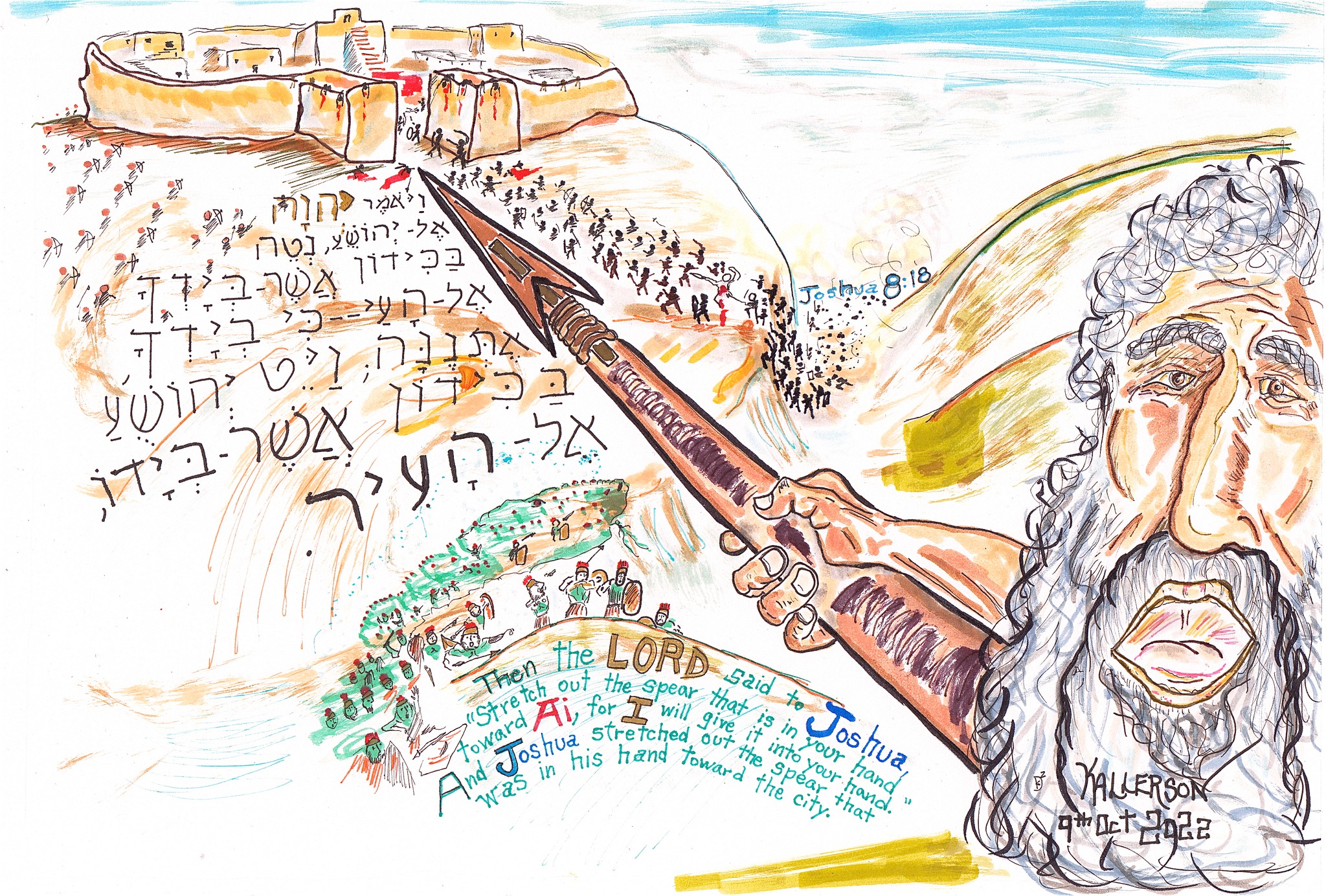
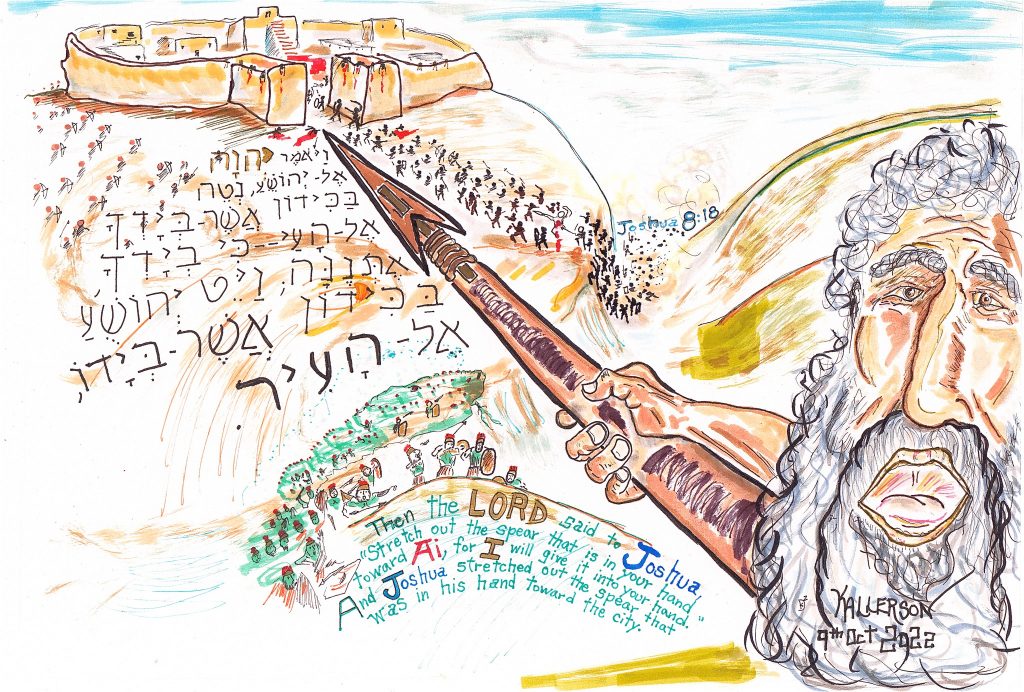
18 Then the Lord said to Joshua, “Stretch out the spear that is in your hand toward Ai, for I will give it into your hand.”
There is a new word here, kidon, or “javelin.” It says: neteh ba’kidon asher b’yad’kha – “stretch out in the javelin which in your hand.” It is probably a smaller spear that is used for thrusting. 1 Samuel 17 shows that it was worn between the soldiers’ shoulders, probably on the back. It could easily be grabbed in times of need. The word comes itself from the same as kid, signifying destruction, calamity, and so on.
Joshua was told to stretch it out somewhat like when Moses stood with the rod of God during the battle against Amalek in Exodus 17. It was to be a sign that the victory was assured.
18 (con’t) And Joshua stretched out the spear that was in his hand toward the city.
Again, we see the command/obedience to the command format of Joshua. What the Lord says, Joshua performs. He stretched out the javelin toward the city, and he will continue to do this until verse 26, which says –
“For Joshua did not draw back his hand, with which he stretched out the spear, until he had utterly destroyed all the inhabitants of Ai.”
It is probable that at this exact moment the retreating army would have come to a full stop in order to engage the enemy in battle. While this was going on, just at the sign of the javelin being held out, it says…
19 So those in ambush arose quickly out of their place;
v’ha’orev qam meherah mim’qomo – “And the liers in wait arose quickly from their place.” This is why they were told in verse 4, “Do not go very far from the city, but all of you be ready.” They were to be as close as possible to the city in order to be able to take it before those chasing them could turn back in hopes of an attack.
19 (con’t) they ran as soon as he had stretched out his hand,
va’yarusu kintot yado – “and they ran according to the stretching out his hand.” One can almost see it. Joshua stops, turns toward the city, raises his hand, and the people come flooding forward like a wave. With that in mind, the next words are filled with excitement…
19 (con’t) and they entered the city and took it, and hurried to set the city on fire.
It is one short and precise clause after another: va’yavou ha’ir va’yilk’duha vay’maharu va’yashitu eth ha’ir ba’esh – “And enter, and took it, and hastened, and burn the city in the fire.” The very wording makes the process seem like one quick action after another with nothing stopping the process once it started.
As noted, there was some sort of large fire set, but the entire city is not yet burned down. Before it is, the spoil will be taken along with any animals. Only then will it be fully burned to the ground.
20 And when the men of Ai looked behind them,
The words of this verse are as exciting and brief as the previous verse: va’yiphnu anshe ha’Ai akharekhem – “And turned men the Ai after them.” The sudden realization of what was transpiring must have been overwhelming. All of their families, all of their possessions, and all of their anticipations were suddenly gone from them…
20 (con’t) they saw, and behold, the smoke of the city ascended to heaven.
va’yiru v’hineh alah ashan ha’ir ha’shamaymah – “and see, behold, ascended smoke the city the heavens.” Not only was the city captured from them, but it was also literally being consumed while they looked. Even if by a miracle they could prevail over the sudden ambush, there would be nothing to return to. As such…
20 (con’t) So they had no power to flee this way or that way,
v’lo hayah ba’hem yadayim lanus henah v’henah – “and no was in them hand to flee hither and hither. Here, the hand signifies power. In saying “no hand” it means they were simply drained. In other words, they were suddenly left without any will in them at all to even move. They just stood there aghast at what had befallen them. At the same time…
*20 (fin) and the people who had fled to the wilderness turned back on the pursuers.
Instead of being many (pl.) as before, the people who had been pursuing Israel are now turned into one force: v’ha’am ha’nas ha’midbar nehpak el ha’rodeph – “And the people, the fleers the wilderness turned unto the pursuer (sg.).”
In other words, all of those who had pretended to be fleeing from the enemy simply turned and flooded over them as a single entity.
This is a good place to finish the verses. The tables have been turned on Ai and their destruction is at hand. But none of this would have been necessary if Israel had been obedient to the word set before them. When Achan transgressed, it was a corporate failing that cost the nation.
Likewise, when Israel was exiled, it was as a nation. In their exile, they were treated as a nation, even though they were dispersed throughout the entire world. The calamities of the law continued to fall on them throughout the years, wherever they were.
Today, Israel is still facing this same national state wherever they are. The people that hate the Jews in Israel pretty much also hate the Jews in the US. And even when Jews attempt to side against one another, they are still considered as Jews.
The only hope for them individually is to come to Christ, and the only hope for them as a nation is to come to Christ. They have a collective burden set upon them. But that doesn’t mean we don’t have a burden on us. If we are not in Christ, we most certainly do.
We have the burden of sin that stands over the collective body of humanity. None are exempt from this, and the only thing we can do to be freed from it is to come to Christ. Someday, Israel will do this, and someday all the remaining people of the world will be joined as one to this commonwealth.
For those who are not, there is only one fate. For Jew or Gentile, that is a total separation from God. The way to avoid this is to call on Christ. The lesson of Israel is a lesson for us. Israel will prevail over Ai, and in Christ, we will prevail over the ruins of humanity. They will be swept away. A better day lies ahead for those who call on Christ, so I would implore you to do that today.
Closing Verse: “Yet in all these things we are more than conquerors through Him who loved us. 38 For I am persuaded that neither death nor life, nor angels nor principalities nor powers, nor things present nor things to come, 39 nor height nor depth, nor any other created thing, shall be able to separate us from the love of God which is in Christ Jesus our Lord.” Romans 8:37-39
Next Week: Joshua 8:21-29 The enemy thinks they can win but they will die, it is true… (The Fall of Ai, Part II) (16th Joshua Sermon)
The Lord has you exactly where He wants you. He has a good plan and purpose for you. It is He who has defeated the enemy and who now offers His people rest. So, follow Him and trust Him and He will do marvelous things for you and through you.
The Fall of Ai, Part I
Now the LORD said to Joshua: “Do not be afraid
———-nor be dismayed
Take all the people of war with you, and arise, go up to Ai
See, I have given into your hand the king of Ai
His people, his city, and his land. To them you can say “Bye bye”
And you shall do to Ai and its king
As you did to Jericho and its king, as I submit
Only its spoil and its cattle you shall take as booty for yourselves
Lay an ambush for the city behind it
So Joshua arose, and all the people of war
To go up against Ai to fight
And Joshua chose thirty thousand mighty men of valor
And sent them away by night
And he commanded them, saying:
“Behold, you shall lie in ambush against the city, so hold steady
Behind the city
Do not go very far, but all of you be ready
Then I and all the people who are with me
Will approach the city; and it will come about
When they come out against us as at the first
That we shall flee before them, it’ll look like a rout
For they will come out after us
Till we have drawn them from the city
For they will say, ‘They are fleeing before us as at the first
Therefore we will flee before them; it won’t look pretty
Then you shall rise from the ambush and seize the city
———-so you are to understand
For the LORD your God will deliver it into your hand
And it will be, when you have taken the city
That you shall set the city on fire, so you shall do
According to the commandment of the LORD
See, I have commanded you”
Joshua therefore sent them out
And they went to lie in ambush, yes, out of sight
And stayed between Bethel and Ai, on the west side of Ai
But Joshua lodged among the people that night
Then Joshua rose up early in the morning and mustered
———-the people, by and by
And went up, he and the elders of Israel, before the people to Ai
And all the people of war who were with him
Went up and drew near; and they came before the city
And camped on the north side of Ai
Now between them and Ai lay a valley so pretty
So he took about five thousand men and set them in ambush
———-hard men and gritty
Between Bethel and Ai, on the west side of the city
And when they had set the people
All the army that was on the north of the city
And its rear guard on the city’s west side
Joshua went that night into the midst of the valley so pretty
Now it happened, when the king of Ai saw it
That the men of the city hurried and rose early and went out
———-against Israel to battle
He and all his people, at an appointed place before the plain
But he did not know that there was an ambush against him
———-behind the city; no one did tattle
And Joshua and all Israel made as if they were beaten before them
———-a great mess
And fled by the way of the wilderness
So all the people who were in Ai
Were called together to pursue them, soldiers hard and gritty
And they pursued Joshua
And were drawn away from the city
There was not a man left in Ai or Bethel who did not
———-go out after Israel
So they left the city open and pursued Israel, ‘cause things
———-were looking swell
Then the LORD said to Joshua
“Stretch out the spear that is in your hand toward Ai, show no pity
For I will give it into your hand”
And Joshua stretched out the spear that was in his hand
———-toward the city
So those in ambush arose quickly out of their place
They ran as soon as he had stretched out his hand
And they entered the city and took it
And hurried to set the city on fire just as planned
And when the men of Ai looked behind them
They saw, and behold, the smoke of the city ascended to heaven
———-from the attack
So they had no power to flee this way or that way
And the people who had fled to the wilderness, on the pursuers
———-they turned back
Lord God, turn our hearts to be obedient to Your word
Give us wisdom to be ever faithful to You
May we carefully heed each thing we have heard
Yes, Lord God may our hearts be faithful and true
And we shall be content and satisfied in You alone
We will follow You as we sing our songs of praise
Hallelujah to You; to us Your path You have shown
Hallelujah we shall sing to You for all of our days
Hallelujah and Amen…
Now the Lord said to Joshua: “Do not be afraid, nor be dismayed; take all the people of war with you, and arise, go up to Ai. See, I have given into your hand the king of Ai, his people, his city, and his land. 2 And you shall do to Ai and its king as you did to Jericho and its king. Only its spoil and its cattle you shall take as booty for yourselves. Lay an ambush for the city behind it.”
3 So Joshua arose, and all the people of war, to go up against Ai; and Joshua chose thirty thousand mighty men of valor and sent them away by night. 4 And he commanded them, saying: “Behold, you shall lie in ambush against the city, behind the city. Do not go very far from the city, but all of you be ready. 5 Then I and all the people who are with me will approach the city; and it will come about, when they come out against us as at the first, that we shall flee before them. 6 For they will come out after us till we have drawn them from the city, for they will say, ‘They are fleeing before us as at the first.’ Therefore we will flee before them. 7 Then you shall rise from the ambush and seize the city, for the Lord your God will deliver it into your hand. 8 And it will be, when you have taken the city, that you shall set the city on fire. According to the commandment of the Lord you shall do. See, I have commanded you.”
9 Joshua therefore sent them out; and they went to lie in ambush, and stayed between Bethel and Ai, on the west side of Ai; but Joshua lodged that night among the people. 10 Then Joshua rose up early in the morning and mustered the people, and went up, he and the elders of Israel, before the people to Ai. 11 And all the people of war who were with him went up and drew near; and they came before the city and camped on the north side of Ai. Now a valley lay between them and Ai. 12 So he took about five thousand men and set them in ambush between Bethel and Ai, on the west side of the city. 13 And when they had set the people, all the army that was on the north of the city, and its rear guard on the west of the city, Joshua went that night into the midst of the valley.
14 Now it happened, when the king of Ai saw it, that the men of the city hurried and rose early and went out against Israel to battle, he and all his people, at an appointed place before the plain. But he did not know that there was an ambush against him behind the city. 15 And Joshua and all Israel made as if they were beaten before them, and fled by the way of the wilderness. 16 So all the people who were in Ai were called together to pursue them. And they pursued Joshua and were drawn away from the city. 17 There was not a man left in Ai or Bethel who did not go out after Israel. So they left the city open and pursued Israel.
18 Then the Lord said to Joshua, “Stretch out the spear that is in your hand toward Ai, for I will give it into your hand.” And Joshua stretched out the spear that was in his hand toward the city. 19 So those in ambush arose quickly out of their place; they ran as soon as he had stretched out his hand, and they entered the city and took it, and hurried to set the city on fire. 20 And when the men of Ai looked behind them, they saw, and behold, the smoke of the city ascended to heaven. So they had no power to flee this way or that way, and the people who had fled to the wilderness turned back on the pursuers.