Artwork by Douglas Kallerson
Joshua 9:19-27
We Are Your Servants, Part II
Of the Gibeonites, Adam Clarke said, “Had they come to the Israelites, and simply submitted themselves without opposition and without fraud, they had certainly fared much better. Lying and hypocrisy always defeat their own purpose, and at best can succeed only for a short season. Truth and honesty never wear out.”
Again, as he summed up his commentary on chapter 9, he said –
- The Gibeonites told lies, in order to save their lives. No expediency can justify this, nor are we called to attempt it. The Gibeonites were heathens, and we can expect nothing better from them.
- They did not profit by their falsity: had they come in fairly, sought peace, and renounced their idolatry, they would have had life on honorable terms. As it was, they barely escaped with their lives, and were utterly deprived of their political liberty. Even the good that is sought by unlawful means has God’s curse on it.
- We need not be solicitous for the character of the Gibeonites here; they are neither our models, nor believers in the true God, and therefore pure religion is not concerned in their prevarication and falsity.
For someone whose commentary I so enjoy, he can get very far afield at times. He said, “Had they come to the Israelites, and simply submitted themselves without opposition and without fraud, they had certainly fared much better.”
Rather, they would have all been killed. This was the command of the Lord. The people were devoted to God, and they could not spare them. We already saw what happened when Achan broke the law of kherem.
Next, he said of their lying, “No expediency can justify this.” Actually, the saving of their lives did justify it, just as was the case with Rahab. After that, he said, “They did not profit by their falsity.” Actually, the result of their falsity was one hundred percent profit. They would have lost everything otherwise.
They did escape with their lives. And even if they did not possess all the rights of Israel, they were given the political liberty of Israel because they were granted protection under the covenant of Israel.
Finally, he said that the Gibeonites were not “believers in the true God.” Actually, they were. This is exactly why they came to Joshua, just as Rahab already had done.
Text Verse: “‘I create the fruit of the lips:
Peace, peace to him who is far off and to him who is near,’
Says the Lord,
‘And I will heal him.’
20 But the wicked are like the troubled sea,
When it cannot rest,
Whose waters cast up mire and dirt.
21 ‘There is no peace,”
Says my God, “for the wicked.’” Isaiah 57:19-21
The Lord offers peace to those who are far off, and he says there is no peace for the wicked. In last week’s passage, Joshua was said to have made shalom, or peace, with the Gibeonites. Did the Lord take a nap during the events that transpired, or are we being shown something else than what Adam Clarke has noted?
From the text itself, we can see that the Gibeonites profited off of their lies. That may have upset Israel, but the Gibeonites were not under the Law of Moses. They were, however, under the law of conscience. They weighed out their options, saw that only one may possibly preserve their lives, and they did what any rational person would do who was in a similar circumstance.
For Christians, this is not a note condoning lying, but neither are we under the law. Consider the Jews in Nazi Germany. They have been marked for extermination. If we hide one in our basement and then lie about it, we have evaluated the circumstance, made a moral decision, and weighed out the positives and negatives. Even if our lives are forfeit for what we have done, it is surely the proper course to take.
Try not to sit too high on your bench of supposed moral superiority. You may find out that when you fall, it will be a painful experience. It is right and proper to tell the truth, but it can be right and proper to not do so at times. It is certain that Corrie ten Boom and many like her would agree.
Seek the highest moral principle at all times, and the way you can know which is right is to study the word of God. In it, you will find the proper standard of all morality by which you can then rightly conduct your affairs.
For now, we will continue on with the story of the Gibeonites. It is a marvelous part of God’s superior word. And so, let us turn to that precious word once again, and… May God speak to us through His word today, and may His glorious name ever be praised.
I. Woodcutters and Water Carriers (verses 19-27)
19 Then all the rulers said to all the congregation,
The words of the rulers now are given in response to what was said in the final verse of the previous sermon –
“But the children of Israel did not attack them, because the rulers of the congregation had sworn to them by the Lord God of Israel. And all the congregation complained against the rulers.” Joshua 9:18
The people complained against the rulers because they were not allowed to attack and plunder the Gibeonites. In response, the rulers now speak to all the congregation, saying…
19 (con’t) “We have sworn to them by the Lord God of Israel;
anakhnu nishbanu lahem b’Yehovah elohe Yisrael – “We have sworn to them in Yehovah, God of Israel.” It is true that the Gibeonites entered into the covenant under false pretenses, but it is also true that Israel did not do their due diligence in searching out the matter before agreeing and entering into the covenant.
When they did search it out, it was already confirmed “in Yehovah, God of Israel.” It was thus binding upon them. The thought is reflected in a list of traits the Lord expects of His people found in Psalm 15. A couple of them are –
“In whose eyes a vile person is despised,
But he honors those who fear the Lord;
He who swears to his own hurt and does not change;
5 He who does not put out his money at usury,
Nor does he take a bribe against the innocent.
He who does these things shall never be moved.” Psalm 15:4, 5
The people feared the Lord in whose name the oath was made. This was true for both the Gibeonites and those of Israel. The people had sworn, even to their own hurt, and now they had to stand by their words. Because of this…
19 (con’t) now therefore, we may not touch them.
In this case, the general word naga, or touch, carries with it the sense of striking or harming them. They must keep their hands off them because of the covenant that had been cut. The fact that this is correct is validated hundreds of years later when Saul violated the terms of the covenant –
“Now there was a famine in the days of David for three years, year after year; and David inquired of the Lord. And the Lord answered, “It is because of Saul and his bloodthirsty house, because he killed the Gibeonites.” 2 Samuel 21:1
The words had been spoken, and Israel was bound to them. But this does not mean that they didn’t have other options at their disposal while still remaining faithful to their oath…
20 This we will do to them:
There is no profit that can be gained from the Gibeonites through their death and the plundering of their goods. That is established through the oath. However, they can be profited off through their lives, and so…
20 (con’t) We will let them live,
There is a strong emphasis through the use of an infinitive absolute verb: v’hakhayeh otam – “And letting live them.” This sets the parameters as required by the covenant. Without complying, the leaders knew there would be consequences…
20 (con’t) lest wrath be upon us because of the oath which we swore to them.”
v’lo yihyeh alenu qetseph al ha’shevuah asher nishbanu lahem – “And no become upon us wrath upon the oath which we swore to them.” They directly tie the Lord’s wrath to the cutting of the covenant. As noted, this is exactly what came upon Israel when Saul violated it many generations later.
As one can see, there is now a conflict between the precept of the law that demanded Israel kill every living person in Canaan and being obedient to the covenant that was made. Both are explicitly addressed in the law, and yet one precept now must trump the other (see Numbers 30:2 and Deuteronomy 20:16).
But this has already happened in the oath the two spies made with Rahab. That can be seen as nothing but a violation of the precept of the law, and yet, they were obligated to preserve her after the oath was made. For the Gibeonites, the covenant stands. However, nothing was said about any of the finer details. Israel will now use that to their advantage…
21 And the rulers said to them, “Let them live, but let them be woodcutters and water carriers for all the congregation, as the rulers had promised them.”
There is a particular emphasis in the words that even the English displays pretty well: yikhyu va’yihyu – “Let them live, and let them be…” It was the Gibeonites who came to Israel to make a covenant. Israel agreed, but the covenant itself was based on falsity.
Therefore, there was nothing to limit them beyond the basic words of the covenant. They were to be subjected to the lowest form of servile labor. In this, they use a proverbial expression first stated in Deuteronomy –
“All of you stand today before the Lord your God: your leaders and your tribes and your elders and your officers, all the men of Israel, 11 your little ones and your wives—also the stranger who is in your camp, from the one who cuts your wood to the one who draws your water— 12 that you may enter into covenant with the Lord your God, and into His oath, which the Lord your God makes with you today, 13 that He may establish you today as a people for Himself, and that He may be God to you, just as He has spoken to you, and just as He has sworn to your fathers, to Abraham, Isaac, and Jacob.” Deuteronomy 29:10-13
It will be seen later that this specifically includes a job tied to the service of the Lord. The designation for this service eventually became known as Nethinim, or those given to the service of the Temple. They are mentioned mostly in Ezra and Nehemiah, and some of those people are possibly descendants of these Gibeonites.
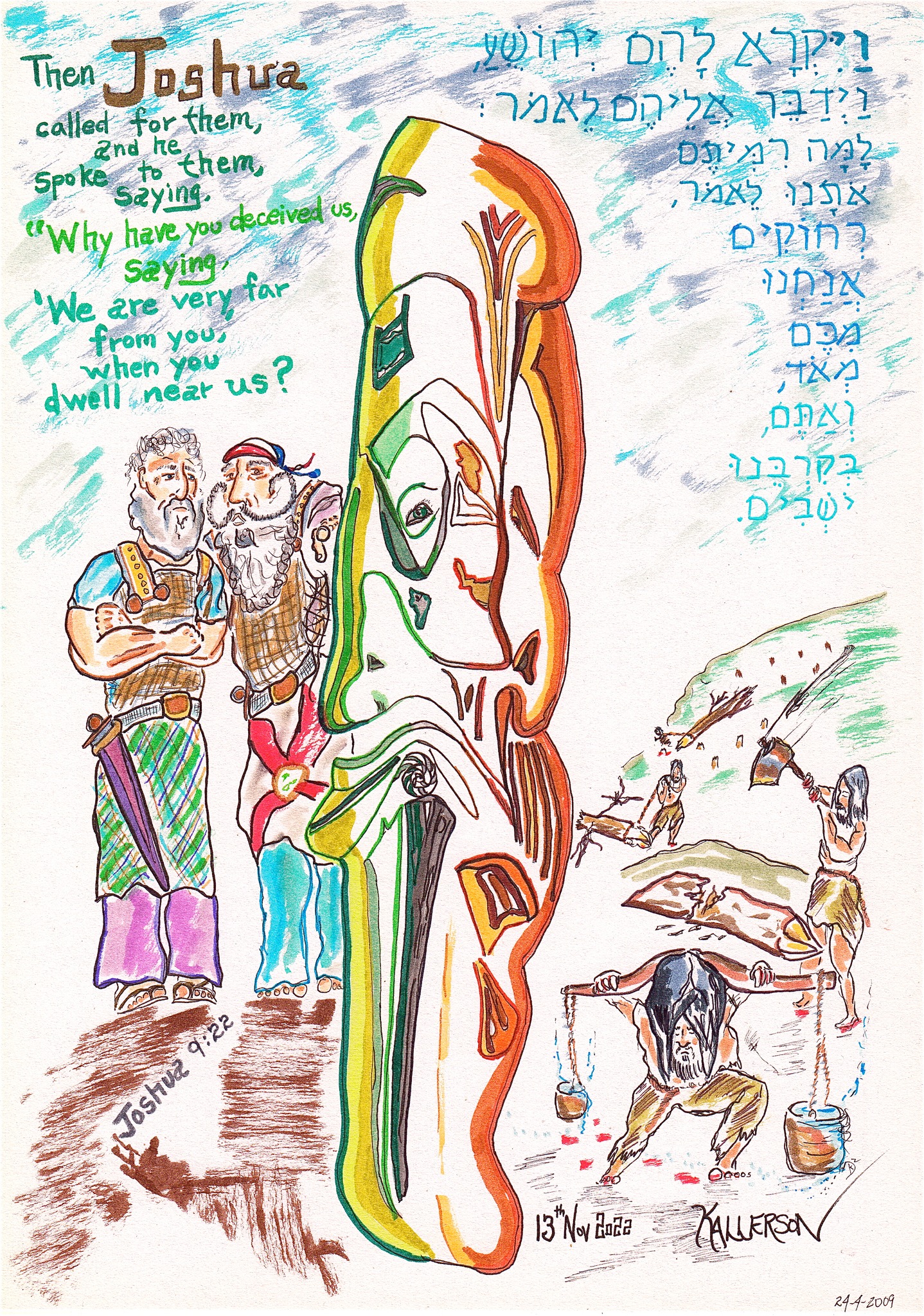
22 Then Joshua called for them, and he spoke to them, saying, “Why have you deceived us, saying, ‘We are very far from you,’ when you dwell near us?
Whether Joshua realizes it or not, the fingers are actually pointing in both directions at the same time – “Why have you deceived us?” It is true that the Gibeonites deceived Israel, but the reason for it is as obvious as the nose on one’s face. They wanted to live.
The Gibeonites could just as easily have said, “And why didn’t you do a better job of checking things out?” Joshua could have said, “We will send ambassadors with you to your people and consult with them first.” That would have resolved the matter immediately.
One can see that the Gibeonites knew, without a doubt, that Israel would hold fast to the covenant if it was made. This is what they were counting on, and that has been proven true. The subterfuge worked, the lie obtained its purpose, and Israel was limited in what it could do. But they were not completely hand-tied…
23 Now therefore, you are cursed,
v’atah arurim atem – “And now cursed you.” This is actually nothing new. These people descended from Canaan, the son of Ham and the grandson of Noah –
“Canaan begot Sidon his firstborn, and Heth; 16 the Jebusite, the Amorite, and the Girgashite; 17 the Hivite, the Arkite, and the Sinite; 18 the Arvadite, the Zemarite, and the Hamathite.” Genesis 10:15-18
Canaan, meaning him and all who issued from him, had been cursed by their ancestor Noah in Genesis 9 –
“So Noah awoke from his wine, and knew what his younger son had done to him. 25 Then he said:
‘Cursed be Canaan;
A servant of servants
He shall be to his brethren.’” Genesis 9:24, 25
From one curse to another, the Gibeonites were still blessed enough to have saved their lives through cunning. However…
23 (con’t) and none of you shall be freed from being slaves—
v’lo yikareth mikhem eved – “and no shall be cut (sg.) from you (pl.) servant.” This follows after the curse of Noah. They were slaves (servants – the word is the same), and they were to remain that way forever. With that stated, Joshua clarifies the words of verse 21…
23 (con’t) woodcutters and water carriers for the house of my God.”
Not only are they to be woodcutters and water carriers, but they are to do so l’beit elohay – “to house my God.” The meaning of this is actually twofold. First, they were to supply wood and water continuously for the maintenance of the tabernacle. This would be for burning of the sacrifices and offerings and for the required washings mandated by the law.
However, this surely would have also included service in the building of the temple at the time of Solomon –
“All the people who were left of the Hittites, Amorites, Perizzites, Hivites, and Jebusites, who were not of Israel— 8 that is, their descendants who were left in the land after them, whom the children of Israel did not destroy—from these Solomon raised forced labor, as it is to this day. 9 But Solomon did not make the children of Israel servants for his work. Some were men of war, captains of his officers, captains of his chariots, and his cavalry. 10 And others were chiefs of the officials of King Solomon: two hundred and fifty, who ruled over the people.” 2 Chronicles 8:7-10
One can see that the Gibeonites (Hivites) were not the only ones who were not destroyed by Israel. Rather, Israel generally failed to comply with the words of the law in utterly exterminating many people in the land.
Despite this, the forced labor went beyond the temple even to the building of Solomon’s house, the storage cities, and so on. With the burdensome mandate levied upon the Gibeonites by Joshua, they next respond as to why they chose this path…
24 So they answered Joshua and said,
Joshua is obviously speaking to the rulers of the people, and they together respond with the motivating issue behind their scheme…
24 (con’t) “Because your servants were clearly told that the Lord your God commanded His servant Moses to give you all the land, and to destroy all the inhabitants of the land from before you;
The words are emphatic: ki huged hugad la’avadekha – “for declaring it was declared to your servants.” They knew without any question that the law had been set forth and that all in Canaan were to be exterminated. But more, they note that it was a command from Yehovah through Moses…
24 (con’t) therefore we were very much afraid for our lives because of you, and have done this thing.
va’nira meod l’naphshotenu mipenekhem va’naaseh eth ha’davar ha’zeh – “And feared greatly to our souls from your presence and did the word, the this.” Of this, Cambridge incorrectly states, “Fear had been their sole motive in seeking an alliance with Israel. Theirs was not the faith, which had prompted Rahab to save the spies.” ather, fear is exactly what made Rahab do what she did –
“Now before they lay down, she came up to them on the roof, 9 and said to the men: ‘I know that the Lord has given you the land, that the terror of you has fallen on us, and that all the inhabitants of the land are fainthearted because of you.’” Joshua 2:8, 9
It was faith in the Lord that drove both Rahab and the Gibeonites to fear the Lord. If they didn’t believe in the Lord, they would have been like everyone else. But they believed the word concerning the Lord and they believed the word of the Lord spoken to Moses. Thus, they acted in faith which was spurred on by fear.
This is no different than Cornelius in Acts 10:2 who was “a devout man and one who feared God.” The Lord saw his faith, his fear, and his deeds. And so, He led him to Himself.
And again, Albert Barnes misses the scope of the matter, saying, “They sought for union with God’s people, not for its own sake, but to save their lives. Rahab’s motives were higher. … Hence, she was adopted into Israel; the Gibeonites remained forever bondsmen of Israel.”
This is not entirely correct. We don’t know what happened to the family of Rahab other than that they dwelt among Israel, just as the Gibeonites did (Joshua 6:25). Also, Ishmaiah the Gibeonite is specifically noted as a chief man among David’s warriors in 1 Chronicles 12:4. As for the Gibeonites at the time of Joshua…
25 And now, here we are, in your hands;
v’atah hinu b’yadekha – “And now behold us in your (sg.) hand.” They have placed themselves solely at the mercy of Joshua and his power – “in your hand.” They know their lives will be spared. This is all they could have hoped for. If their plan failed, they would have died, which is exactly what they knew lay ahead for them anyway. Anything beyond execution is, therefore, grace. And so…
25 (con’t) do with us as it seems good and right to do to us.”
The words are solely to Joshua in the singular: katov v’khayashar b’enekha la’asoth lanu aseh – “According to the good and according to the straight in your eyes to do to us, do.” He is the leader of Israel, he has made his judgment, and they have agreed without any protest at all, acknowledging that his determination is good – meaning it is fair – and that it is straight – meaning that it is in accord with the words of the covenant that was already cut.
26 So he did to them, and delivered them out of the hand of the children of Israel, so that they did not kill them.
Here is righteousness. It cannot be said that this is so much an act of mercy. Mercy would be if these people came and said, “We are Gibeonites and we submit ourselves to you. Please do not kill us,” and that was then followed by an agreement to not kill them. However, that would have been unrighteous mercy because they were already commanded to utterly kill the inhabitants.
Instead, it is the Gibeonites who acted with subterfuge and Israel cut the covenant without properly checking the necessary facts. Despite this, the covenant was cut. As such, Joshua is displaying righteousness in his upholding of the covenant. Along with that…
27 And that day Joshua made them woodcutters and water carriers for the congregation
It is more personal and precise: va’yitenem Yehoshua ba’yom ha’hu khot’ve etsim v’shoave mayim la’edah – “And gave them, Joshua, in the day, the it, hewers wood and drawers water to the congregation.” They have placed themselves in Joshua’s hand, and Joshua now gives them as a gift to the congregation.
This is justice. The people were denied the plunder of the cities, and the Gibeonites were given to the people to replace the failing of cutting the covenant which deprived the people of their spoil. The people would be happy, the Gibeonites would be alive, and Joshua has resolved the matter without violating the covenant that had been cut. Also…
*27 (fin) and for the altar of the Lord, in the place which He would choose, even to this day.
u-l’mizbakh Yehovah ad ha’yom ha’zeh el ha’maqom asher yivkhar – “and to altar Yehovah until the day, the this, to the place which He would choose.”
This is grace. Despite being a lowly job, it is a service to the Lord, and thus it is the highest service one could perform. It is reminiscent of the words of Psalm 84 –
“For a day in Your courts is better than a thousand.
I would rather be a doorkeeper in the house of my God
Than dwell in the tents of wickedness.
11 For the Lord God is a sun and shield;
The Lord will give grace and glory;
No good thing will He withhold
From those who walk uprightly.
12 O Lord of hosts,
Blessed is the man who trusts in You!” Psalm 84:10-12
Despite not being a part of the congregation, the Gibeonites were spared in order to serve the Lord’s people and the altar of the Lord. Hence, despite their situation, they fared better than those of other nations who had not yet even heard of the Lord. It is better to share in the Lord as a servant than to have no share in the Lord.
Better a slave of Christ than to be the richest king
To have Jesus is more wonderful than the finest gold
Sharing in His goodness, we shall forever sing
And revel in the greatest story ever told
Better to have Jesus than gems galore
To have all the world’s silver is to be rejected
Such things will never get a sinner through the Door
That will only happen when right faith is detected
If you possessed Satan’s signet ring
And you had all the world’s authority and power
Such things would not mean a thing
When finally came your dying hour
Rejoice in the Lord and rest in Jesus always
Only He can give life and bestow eternal days
II. Pictures of Christ
The first chapters of Joshua showed the process of Israel coming to Christ. Chapter 8 revealed the ending of the Old Covenant and the acceptance of the New in the account of building the altar at Mount Ebal. That is something still in Israel’s future.
The New Covenant was made not with the Gentiles, but with Israel. That is clearly stated in Jeremiah 31 –
“Behold, the days are coming, says the Lord, when I will make a new covenant with the house of Israel and with the house of Judah— 32 not according to the covenant that I made with their fathers in the day that I took them by the hand to lead them out of the land of Egypt, My covenant which they broke, though I was a husband to them, says the Lord. 33 But this is the covenant that I will make with the house of Israel after those days, says the Lord: I will put My law in their minds, and write it on their hearts; and I will be their God, and they shall be My people. 34 No more shall every man teach his neighbor, and every man his brother, saying, ‘Know the Lord,’ for they all shall know Me, from the least of them to the greatest of them, says the Lord. For I will forgive their iniquity, and their sin I will remember no more.” Jeremiah 31:31-34
That is clear and unambiguous. It is also addressed to the people of Israel long before the coming of Christ. Hence, it is impossible for it to be referring to anyone but Israel. That is confirmed in Hebrews 8:7-13, much of which is a direct citation from Jeremiah.
The author of Hebrews is addressing the Hebrew people, not the church, even if aspects of the letter apply to all believers. When Jesus established the New Covenant as recorded in the gospels, He did so in accordance with the words of Jeremiah, meaning, it was made with the house of Israel and the house of Judah.
Nothing He said could lead anyone to any other conclusion. And yet, Paul refers to the New Covenant in 1 and 2 Corinthians. First, he cites Jesus’ words from the gospels –
“For I received from the Lord that which I also delivered to you: that the Lord Jesus on the same night in which He was betrayed took bread; 24 and when He had given thanks, He broke it and said, ‘Take, eat; this is My body which is broken for you; do this in remembrance of Me.’ 25 In the same manner He also took the cup after supper, saying, ‘This cup is the new covenant in My blood. This do, as often as you drink it, in remembrance of Me.’
26 For as often as you eat this bread and drink this cup, you proclaim the Lord’s death till He comes.” 1 Corinthians 11:23-26
Next, he speaks of those who administer this New Covenant –
“And we have such trust through Christ toward God. 5 Not that we are sufficient of ourselves to think of anything as being from ourselves, but our sufficiency is from God, 6 who also made us sufficient as ministers of the new covenant, not of the letter but of the Spirit; for the letter kills, but the Spirit gives life.” 2 Corinthians 3:4-6
Paul is clearly writing to Gentiles as the Apostle to the Gentiles. But this doesn’t explain how Gentiles are included in the New Covenant if it was given to Israel and Judah. The account of the Gibeonites in this passage reveals how that occurs.
Obviously, there is a real account that is being dealt with, and so there is a lot that has to be stripped out of it to get to the basics. The reason this is so is that the Gibeonites were real people who really served Israel in their history. And so what happens includes details concerning their state as servants of Israel.
But the point is that they were brought into a covenant standing with Israel who is in a covenant (or a New Covenant) standing with the Lord. And so this account is presented.
If you noticed, there were lots of people groups mentioned as serving as laborers in Israel in the account from 2 Chronicles 8, including Hittites, Amorites, Perizzites, Hivites, and Jebusites. With the exception of the Canaanites, these same groups were mentioned in verse 1 of this chapter. There is no need to mention the Canaanites because other than the Perizzites, they are Canaanite people groups.
But it is the Gibeonites who are highlighted here in order to set the typology. All the people groups formed an alliance in order to fight against Israel, but the Gibeonites want to be allied with Israel.
In verse 4, we saw that the Gibeonites were as cunning against Israel as Israel had been against Ai. Israel defeated the law, overcoming it through Christ. Now, the Gibeonites (those who want to join Israel) act in cunning to join with them.
To do this, they have old sacks on their donkeys, old wineskins torn and mended, old and patched shoes, old garments, and bread that is dry and crumbly. In this state, in verse 6, it said that they went to Joshua and spoke to him and to all the men of Israel, noting they were from a land far away, and ask for a covenant to be made with them.
Although this isn’t true, it still reflects their state. If they were from Haijima, Japan, for all intents and purposes, they wouldn’t be any closer to Israel concerning their rights than being from Gibeon which is geographically just down the road a bit. They truly are far off from Israel, at least in that sense.
In verse 7, Joshua is not mentioned, just the men of Israel who respond with, “And said (pl.) man (sg.) Israel unto the Hivite (sg.).” As noted, the name probably means Tent Villager, but it is identical to khavah or “Life,” the name of Adam’s wife (Eve).
Abarim notes that the verb form khavah “means to lay out in order to live collectively, and describes investing one’s personal sovereignty into a living collective like a symbiont. It’s mostly translated as to prostrate, which is to submit oneself wholly and bodily to a collective or to the leader of that collective.” That is essentially what they are doing, submitting themselves to a collective. But more, they are doing it to find… life.
In the next verses, they speak to Joshua, noting they are his servants and have come because of the name of Yehovah and they had heard of His fame and of all He did in Egypt. Also what He had done to Sihon and Og. Israel had been brought out of bondage and the Gibeonites wanted to share in that.
It must be noted that Israel had been brought out of Egypt and into the law. Nothing was said by the Gibeonites about Israel crossing the Jordan as they did. In other words, the typology of crossing through Christ was supposedly unknown to them, even though they knew perfectly well that Israel had passed through the Jordan.
After this, and for a second time, the account focused on the bread, the wineskins, the garments and the sandals. It is then that we noted the contrast to Israel –
“And I have led you forty years in the wilderness. Your clothes have not worn out on you, and your sandals have not worn out on your feet. 6 You have not eaten bread, nor have you drunk wine or similar drink, that you may know that I am the Lord your God.” Deuteronomy 29:5, 6
That all occurred while Israel was under the law. The typology is obvious: these people were not under the law. No need to worry in this regard. Israel is under the New Covenant and these people are not under the law. In other words, typologically, these are not Judaizers trying to get Israel to return to the law.
To more fully understand that you could go back and review those verses in the Deuteronomy 29 sermon, but suffice it to say that Israel, while under the punishment of the law, lacked the things that would normally keep people alive and united – food, wine, and strong drink. And yet, they remained a people.
They are now united in Christ under the New Covenant. These Gibeonites are not law observers, they are not members of the New Covenant, and they are far off from Israel.
With that noted, Israel accepted that they were who they said they were, and they were willing to cut a covenant with them, even without inquiring of the Lord.
As such, it says Joshua made peace with them and cut a covenant with them to let them live. It also noted that the rulers swore to them. In typology, Joshua represents Jesus, and the elders represent the rulers. That can be established based on Jesus’ words of Matthew 19:28 –
“So Jesus said to them, ‘Assuredly I say to you, that in the regeneration, when the Son of Man sits on the throne of His glory, you who have followed Me will also sit on twelve thrones, judging the twelve tribes of Israel.’”
One who sits on a throne is a ruler. The apostles were in agreement concerning the conversion of Gentiles as noted in Acts 15 and elsewhere.
After the subterfuge was discovered, it said that Israel journeyed to their cities and four cities were named. I couldn’t identify anything in the names that gives additional typology, but the number four is the world number. Hence, it is surely indicating that there is Israel, and there is the agreement made with the world beyond Israel.
With that, the final verse from last week noted that Israel did not attack them because they had sworn by the Lord God of Israel. Because of this, the congregation complained against the rulers. That seems obvious enough. Israel wants it to be all about them, but there are others that are brought into the covenant relationship as well.
The verses for today show the actual response of Israel to the cunningness of the Gibeonites, but the point of those verses is that there was nothing they could do. The covenant had been cut and nothing could be done to them.
But what Israel saw as a loss turned out to be a benefit for them. They may not have been able to plunder their spoil, but they were able to use the productivity of these Gentiles for their benefit. This was to be literally true in Israel. And typologically it has been true as well.
It is the Gentiles who have done the work of expanding the kingdom, building the church, and searching out God’s word. Thus, Israel has benefitted, even if they were unhappy about the situation at first. The Gentiles were granted life through the covenant cut with Jesus, and they have been productive for the kingdom ever since.
In short, this story is given to reveal how the Gentiles ended up under the New Covenant even though that covenant was promised to the house of Israel and the house of Judah.
The name Gibeon, as we saw, means Hill Town or Hilly. But the name comes from gavia, which is derived from a root word conveying the sense of elevation or roundness, hence it means a cup or a bowl. When upside down, it looks like a hill.
I would surmise that they were chosen because the name is etymologically akin to the Aramaic word Gabbatha which means an elevated place, a knoll – hence a rounded area like a goblet.
Jesus submitted Himself to the Roman authority in order to establish the New Covenant in His blood. The Gibeonites submitted themselves to Joshua in order to enter into the covenant relationship that had been established with Israel.
And actual distance aside, they were as far from the nation of Israel as they could have been. Hence, there was the strong focus on the word far. It was used three times in the passage, and twice it was joined to the superlative meod, or very. That perfectly fits with Paul’s words of Ephesians –
“Therefore remember that you, once Gentiles in the flesh—who are called Uncircumcision by what is called the Circumcision made in the flesh by hands— 12 that at that time you were without Christ, being aliens from the commonwealth of Israel and strangers from the covenants of promise, having no hope and without God in the world. 13 But now in Christ Jesus you who once were far off have been brought near by the blood of Christ.” Ephesians 2:11-13
The Gibeonites submitted themselves to Joshua (verse 9:8) and it said in verse 15, “So made (sg.) with them, Joshua, peace and cut (sg.) to them covenant to live them.” It practically mirrors the words of Isaiah from our text verse –
“Peace, peace to him who is far off and to him who is near,’
Says the Lord,
‘And I will heal him.’” Isaiah 57:19
That is also exactingly stated by Paul in Ephesians 2, and that will be cited in our closing verse today. As far as the idea of being woodcutters and water bearers, that is not given in typology, but as a poetic idea of providing for the altar of the Lord. It is something we have all participated in if you think about it.
Christ died on the cross for our sins. If we can put ourselves into that picture, we can see that with our sins we actually helped cut the wood, that of His cross, our altar before God. And what do we do with the salvation that comes from it? Isaiah says –
“And in that day you will say:
‘O Lord, I will praise You;
Though You were angry with me,
Your anger is turned away, and You comfort me.
2 Behold, God is my salvation,
I will trust and not be afraid;
‘For Yah, the Lord, is my strength and song;
He also has become my salvation.’
3 Therefore with joy you will draw water [shaav]
From the wells of salvation.” Isaiah 12:1-3
Isaiah uses the same word to describe drawing of waters from the wells of salvation that is used of the Gibeonites drawing water for Israel. As noted, it is the Gentiles that have carried the banner of the church, and it is from those efforts that Israel will someday realize they need Jesus. When that comes about, the water from those wells will truly be used to minster to Israel.
The typology in the passage here, and of which I have failingly presented to you because of so much that has surely been missed, is given to show us several things. First and foremost, it is to again let us know that the church has not replaced Israel.
Rather the church is a body made up of both Jews and Gentiles and it is based on the New Covenant, the Christ Covenant. Israel as a nation today has not yet entered into that New Covenant, but we have been shown in the previous chapters that they will do so someday.
Until they do, there needed to be an explanation provided as to how the Gentiles are brought into this New Covenant, and thus into the commonwealth of Israel. This passage has addressed that. The Gibeonites were never under the law or the sustaining hand of Israel during their time of punishment under the law.
Further, Gentiles have been far off from the promises to Israel. There was no hope; rather, there was only the promise of being destroyed. But those Gentiles who come to Jesus in faith, just as the Gibeonites came to Joshua in faith, will be saved. They will be given life. The typology tells us this, even if I may have failed to present some of the finer points.
For you today, it is your duty to come to Christ, believe the gospel, and receive the salvation He offers to those who will.
Closing Verse: “For He Himself is our peace, who has made both one, and has broken down the middle wall of separation, 15 having abolished in His flesh the enmity, that is, the law of commandments contained in ordinances, so as to create in Himself one new man from the two, thus making peace, 16 and that He might reconcile them both to God in one body through the cross, thereby putting to death the enmity. 17 And He came and preached peace to you who were afar off and to those who were near. 18 For through Him we both have access by one Spirit to the Father.” Ephesians 2:14-18
Next Week: Joshua 10:1-15 The fighting will go on and on, until the battle is done… (The Battle for Gibeon, Part I) (20th Joshua Sermon)
The Lord has you exactly where He wants you. He has a good plan and purpose for you. It is He who has defeated the enemy and who now offers His people rest. So, follow Him and trust Him and He will do marvelous things for you and through you.
We Are Your Servants, Part II
Then all the rulers said to all the congregation
“We have sworn to them by the LORD God of Israel
Now therefore, we may not touch them
Shoot, darn, dangitall, and oh well
“This we will do to them:
We will let them live, no haw or hem
Lest wrath be upon us
Because of the oath which we swore to them”
And the rulers said to them, “Let them live
But let them woodcutters be
And water carriers for all the congregation
As the rulers had promised them after their trickery
Then Joshua called for them, and he spoke to them, saying
“Why have you deceived us
Saying ‘We are very far from you,’ when you dwell near us?
This is not so kosher and not “plus, plus, plus”
Now therefore, you are cursed
And none of you shall from being slaves be freed
Woodcutters and water carriers for the house of my God
Because of your sneaky deed
So they answered Joshua and said
“Because your servants were clearly told words not so grand
That the LORD your God commanded
His servant Moses to give you all the land
“And to destroy all the inhabitants of the land from before you
Therefore we were very much afraid; yes, our ears did ring
For our lives because of you
And so we have done this thing
“And now, here we are, in your hands, for us it is a plus
Do with us as it seems good and right to do to us”
So he did to them
And delivered them out of the hand
Of the children of Israel
So that they did not kill them as they planned
And that day Joshua made them woodcutters
And water carriers for the congregation, so it was that way
And for the altar of the LORD
In the place which He would choose, even to this day
Lord God, turn our hearts to be obedient to Your word
Give us wisdom to be ever faithful to You
May we carefully heed each thing we have heard
Yes, Lord God may our hearts be faithful and true
And we shall be content and satisfied in You alone
We will follow You as we sing our songs of praise
Hallelujah to You; to us Your path You have shown
Hallelujah we shall sing to You for all of our days
Hallelujah and Amen…