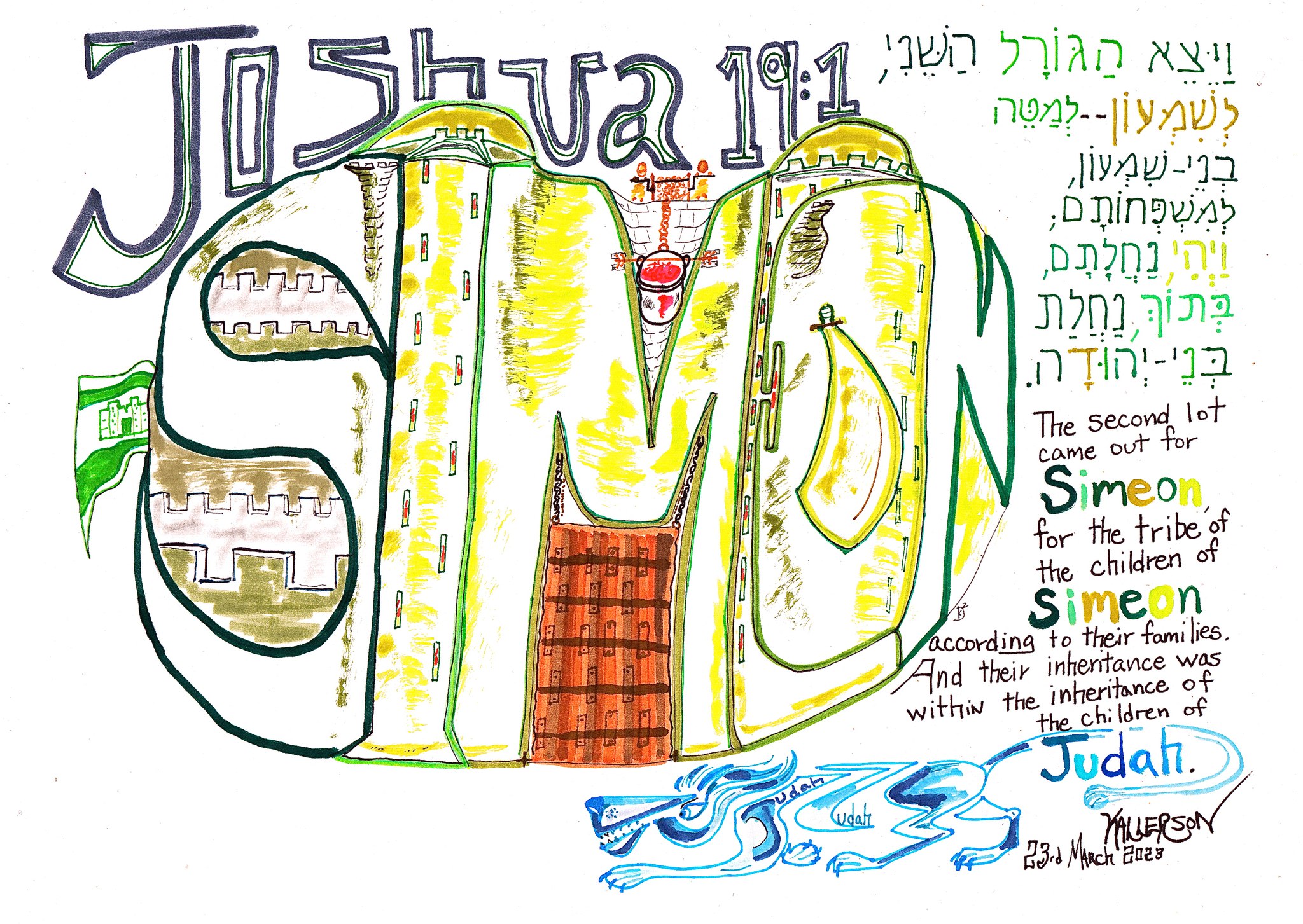
Artwork by Douglas Kallerson.
Joshua 19:1-9
The Inheritance of Simeon
It’s kind of hard to imagine an inheritance within an inheritance. I tried to think of something comparable to what is presented in these verses and couldn’t come up with anything. An inheritance, by default, seems to imply something that belongs to one exclusively.
A person can share his inheritance, but to have a permanent stake set aside within another’s inheritance while it still belongs to the first isn’t something that you would normally expect to see. On a spiritual level, this is possible though.
Jesus is said to have inherited a more excellent name than the angels. In coming to Jesus, we implicitly share in His name, and we are granted a part in the heavenly inheritance that He has earned.
But that is not what we are seeing in Joshua 19. Judah had an inheritance, that was too much for them, so Simeon is being given an inheritance within the inheritance of Judah. Henceforth, all of this land is going to be known as the land of Judah, even while Simeon is in the cities and villages granted to them.
What do you imagine is going on here? Why did God set an inheritance inside an inheritance, and what prompted it to occur? God already knows the end from the beginning, and so there had to be a purpose.
Text Verse: “He who has an ear, let him hear what the Spirit says to the churches.” Revelation 2:7
It’s fascinating to sit down on Monday morning, having no idea what the passage is conveying, and then trying to figure it out. I got started around 3:30am. The first verse went quickly. I couldn’t believe how fast! Well, until I looked at the clock and saw it was 4:45am and I still had more verses to go.
The same thing happened with verse 2. Hideko was walking out the door at 6:30am and I was still typing that verse. Later verses went more quickly so that I was done with them by about 11:30am. And then I sat. Thinking. And sat. Thinking.
The analysis of these verses didn’t come easily, but it is such a treasure because it explains things that are right in front of our noses concerning inheritances: what God has done in Christ, how it affects Israel, how it affects the church, etc.
It never gets old. The word just keeps giving us new and exciting details. Yes! Great things are to be found in His superior word. And so, let us turn to that precious word once again, and… May God speak to us through His word today, and may His glorious name ever be praised.
I. Too Much for Them (verses 1-9)
The second lot came out for Simeon, for the tribe of the children of Simeon according to their families.
Simeon was the second son of Jacob as well as the second son of his wife Leah. His name comes from shama, to hear. Thus, it means Hearing or He Who Hears.
Surprisingly, this is the first time that Simeon is seen in the book of Joshua. He will only be seen in this chapter for his land grant and in Chapter 21 when Levitical cities are included in his land grant. He will be mentioned very sparsely in the rest of the Old Testament.
In Chapter 18, the remaining land was to be surveyed and divided into seven parts and yet, without any explanation as to why, a portion was drawn out of Judah. Thus, it seems likely that it was decided before the surveyors went out that a portion would be taken out of Judah’s inheritance. Now, the lots are being cast…
1 (con’t) And their inheritance was within the inheritance of the children of Judah.
vayhi nakhalatham b’tok nakhalath bene Yehuda – “And was their inheritance in midst inheritance sons Judah.” The lot that was cast, and the resulting land allotment fulfills the prophecy of Jacob from Genesis 49 –
“Simeon and Levi are brothers;
Instruments of cruelty are in their dwelling place.
6 Let not my soul enter their council;
Let not my honor be united to their assembly;
For in their anger they slew a man,
And in their self-will they hamstrung an ox.
7 Cursed be their anger, for it is fierce;
And their wrath, for it is cruel!
I will divide them in Jacob
And scatter them in Israel.” Genesis 49:5-7
Simeon had marched with Reuben and Gad after leaving Sinai. They had encamped together on the south side of the tabernacle when it rested (Numbers 2). These two had separated from Simeon, taking their inheritance east of the Jordan.
A question arises here as to whether the lot itself designated the land for Simeon or if it simply designated Simeon to be the first to choose which lot they would choose. The text does not say. Either way, the result is that other than from Judah, Simeon will be separated from his brothers.
At the census in Numbers 26, after the wilderness wanderings, Simeon was found to be the smallest tribe of all. Their total number in Numbers 1 was 59,300. In Numbers 26, it was 22,200. Thus, his numbers dropped by 37,100.
That was the largest decrease of any tribe. This was probably because many of the tribe were killed in the matter of Peor in Numbers 25. It seems that Simeon was most associated with that. Thus, they were destroyed by sword and plague because of it, reducing their numbers greatly.
It would be a good reason for their assignment within Judah, the tribe with the greatest numbers. Judah could act as a defense and as a help for this smaller tribe, something that will be seen in Judges –
“Now after the death of Joshua it came to pass that the children of Israel asked the Lord, saying, ‘Who shall be first to go up for us against the Canaanites to fight against them?’
2 And the Lord said, ‘Judah shall go up. Indeed I have delivered the land into his hand.’
3 So Judah said to Simeon his brother, ‘Come up with me to my allotted territory, that we may fight against the Canaanites; and I will likewise go with you to your allotted territory.’ And Simeon went with him.” Judges 1:1-3
As this allotment fulfills Jacob’s prophecy, we could speculate that the lot was designated by the Lord to ensure that would happen. But it could be that because of their separation from Reuben who had chosen land east of the Jordan, and because Judah and Simeon were both sons of Leah, they simply chose to dwell together.
Adding in Levitical cities that will be designated in this area, there will be three of these sons of Leah dwelling together, Simeon, a portion of Levi, and Judah.
As for the cities to be designated, the first thirteen will be in the Negev, the south country. The second four will have two in the Negev and two in the Shephelah, or lowland. In the allotments recorded in Joshua 15, of which Simeon will now receive their portion, it is apparent that these cities are a far distance one from another –
In the Negev:
Lebaoth, Shilhim, Ain, and Rimmon (Joshua 15:32)
In the Shephelah:
Libnah, Ether, Ashan (Joshua 15:42)
Thus, even in the allotment within Judah, Simeon is further divided among Israel, more perfectly fulfilling the prophecy of Jacob. As for the cities Simeon is granted, they are next enumerated…
2 They had in their inheritance Beersheba (Sheba), Moladah,
The Hebrew here would at first seem to suggest three cities, but the total listing in verse 6 is thirteen, not fourteen cities: vayhi lahem b’nakhalatham b’ersheva v’sheva u-moladah – “And was to them, in their inheritance, Beersheba and Sheba, and Moladah.”
In Joshua 15:26, it lists Shema instead of Sheba before Moladah. Thus, it could be referring to that same location. But this would make fourteen cities, not thirteen. Also, neither Shema nor Sheba is mentioned in the listing of Simeon’s cities in 1 Chronicles 4.
For this reason, the word “and” before Sheba seems to indicate that Beersheba and Sheba are being identified as one city, not two – “Beersheba and Sheba.” As the listing specifically will read thirteen cities, this seems the most likely explanation.
Beersheba means Well of the Oath or Well of the Seven. The word beer signifies a well or a pit. A well is something dug out, not natural. The word sheva means seven. However, that comes from shava, to swear as in an oath. The dual name is derived from the account found in Genesis 21 –
“Then Abraham rebuked Abimelech because of a well of water which Abimelech’s servants had seized. 26 And Abimelech said, ‘I do not know who has done this thing; you did not tell me, nor had I heard of it until today.’ 27 So Abraham took sheep and oxen and gave them to Abimelech, and the two of them made a covenant. 28 And Abraham set seven ewe lambs of the flock by themselves.
29 Then Abimelech asked Abraham, ‘What is the meaning of these seven ewe lambs which you have set by themselves?’
30 And he said, ‘You will take these seven ewe lambs from my hand, that they may be my witness that I have dug this well.’ 31 Therefore he called that place Beersheba, because the two of them swore an oath there.” Genesis 21:25-31
This designation was repeated in Genesis 26 at the time of Isaac. There it gives a reasonable explanation for the name Sheba being affixed to Beersheba in this verse of Joshua –
“So he made them a feast, and they ate and drank. 31 Then they arose early in the morning and swore an oath with one another; and Isaac sent them away, and they departed from him in peace.
32 It came to pass the same day that Isaac’s servants came and told him about the well which they had dug, and said to him, ‘We have found water.’ 33 So he called it Shebah. Therefore the name of the city is Beersheba to this day.” Genesis 26:30-33
Therefore, the well named Shebah (Sheba) is included with the city, Beersheba. Again, Sheba simply means Seven, but it is also derived from shava and alternatively means Oath. The “h” added at the end of the name signifies a feminine form of the word.
Moladah comes from yalad, to bear, bring forth, or beget. The m prefix may indicate “from.” Thus, it means Place of Bringing Forth, or more simply Birthplace, or even Origin.
3 Hazar Shual, Balah, Ezem,
Khatsar shual means Village of the Fox. But this needs further explanation. The shual (fox) comes from shoal, the hollow of the hand, because these are burrowing animals, making their own hollow. The word is found in Isaiah 40:12, where it asks, “Who has measured the waters in the hollow [shoal] of His hand.” Hence, the meaning extends to Village of the Hollow of the Hand.
Balah probably comes from baleh, meaning worn out. Thus, it probably means Wearing Out, Worn Out, or Old.
Atsem comes from etsem or bone. Thus, it means Bone, Supporting, or Strength.
4 Eltolad, Bethul, Hormah,
Eltolad comes from el, God, and yalad, to bring forth or bear. Thus, it could mean Brought Forth of God, Born of God, Generated of God, Generation of God, etc.
Bethul is possibly derived from bethula, virgin, and el, god. Or it may be derived from beith, house, and el, god. Thus, it probably means Virgin of God or Abode of God.
Khar’mah means Anathema. James Strong defines it as Asylum.
5 Ziklag, Beth Marcaboth, Hazar Susah,
The name Tsiq’lag is a bit of a brain teaser. It appears to be derived first from tsuq. It means to pour out or melt, or to oppress or distress, such as to put pressure on someone to give up information or to lay siege to a city. It is used in Job 29 –
“When my steps were bathed with cream,
And the rock poured [tsuq] out rivers of oil for me!” Job 29:6
The second part is from log, a small amount poured into a hollow, like the hand. Thus, it could signify Measure of Pressure or Measure of Pouring.
Beith ha’markavoth means House of the Chariots.
Khatsar susah means Village of the Horse or Village of the Mare.
6 Beth Lebaoth, and Sharuhen:
Beith Levaoth means House of Lionesses.
Depending on the root, Sharukhen comes from two words. The first is sharah, to loosen, and thus figuratively, to dwell or abide. The second is khen, or grace. It signifies Abode of Grace.
6 (con’t) thirteen cities and their villages;
Depending on the scholar, this may be seen as a scribal error that should read fourteen. As noted earlier, some say that Sheba should either be Shema or that it is the same place as Beersheba, and so on.
But the record of Genesis 26, that everybody oddly ignores, seems to indicate that Sheba (Shebah) is merely the well that belongs to Beersheba. Hence, thirteen cities being designated appears to be correct. Along with those, the others are…
7 Ain, Rimmon, Ether, and Ashan: four cities and their villages;
Ayin means Fountain, Spring, or Eye.
Rimmon means Pomegranate. But the pomegranate symbolizes harvest ready fruit and so it can further mean Mature Mind or Harvest Ready.
Ether comes from athom, to multiply. And so it signifies Abundance. However, that can figuratively mean something like Deceitful as in the proverb where the word is used this way –
“Faithful are the wounds of a friend,
But the kisses of an enemy are deceitful [lit. many].” Proverbs 27:6
Ashan means Smoke.
8 and all the villages that were all around these cities
There are the main cities with their villages, and then there are lesser villages that extended beyond them, scattered through the countryside. These would all be accounted to Simeon. This grant with the villages extended…
8 (con’t) as far as Baalath Beer, Ramah of the South.
Baalath Beer means Lady of a Well or Well of a Lady. Ramath Negev means Height of the South. It is supposed to be another name for Baalath Beer.
8 (con’t) This was the inheritance of the tribe of the children of Simeon according to their families.
This sums up the listing from verses 1 through 8. It is the second allotment of the final seven, coming after Benjamin and before Zebulun. With that, the next words provide an explanation of why they are located in this area. But as was stated in the previous chapter, the account never fully explains how the lots were divided out in the seven final distributions…
9 The inheritance of the children of Simeon was included in the share of the children of Judah,
me’khevel bene Yehuda nakhalath bene Shim’on – “From cord sons Judah inheritance sons Simeon.” The khevel is a rope used as a measuring line. Hence, it speaks of the territory, share, or allotment that has been measured out. With that, the explanation of “why” without the “how it was determined” is next stated…
9 (con’t) for the share of the children of Judah was too much for them.
The area granted to Judah had a large number of cities, and cities are what the land grants are centered on, even if other factors were considered. Cities are connected to roads that are connected to highways. As such the amount of productivity and trade of the land is often directly connected to the cities.
In the case of Judah, they would not be harmed at all by having these cities go to Simeon. In fact, it would be a benefit to them for the cities to be filled…
9 (con’t) Therefore the children of Simeon had their inheritance within the inheritance of that people.
The text reads much more simply: “And inherited sons Simeon in midst their inheritance.” Simeon, He Who Hears, receives his inheritance within the borders of Judah, Praise. Without really telling us the “how was this decision made,” we are simply told that it occurred. The reason was Judah’s share was too much. What a thing! “Too much room. Ok, let’s invite He Who Hears.”
He who has an ear to hear
Let him hear what the Spirit says today
The words I speak will be perfectly clear
When he pays heed to what I say
There is the unfolding of a wonderful story
It is one that will include any who will hear
In heeding My word, there will be wonder and glory
This extends to anyone whether far off or near
The Spirit speaks in and through My word
And so the Spirit is still speaking today
Pay careful heed to all you have heard
Yes, be sure to listen to all that My word does say
II. This Is the Church
The boundaries of the various allotments have reflected the work of Christ and its effects on those who are saved. The cities within Simeon now reflect the status of the church that Christ came to establish.
Simeon means He Who Hears. To hear in Scripture means not only to hear audibly, but also to attend to, such as –
“I will raise up for them a Prophet like you from among their brethren, and will put My words in His mouth, and He shall speak to them all that I command Him. 19 And it shall be that whoever will not hear My words, which He speaks in My name, I will require it of him.” Deuteronomy 18:18, 19
In this case, Simeon is He Who Hears (attends to) the word. He has responded to the word of Christ. Simeon receives his inheritance within the inheritance of Judah. The boundaries were defined, and the pictures of Christ were laid out in Joshua 15:1-12.
It is within those typological anticipations of Christ that Simeon, He Who Hears, receives his allotment. Judah means Praise. Jesus is the Praise of God. The inheritance is then defined, beginning with Beersheba, Well of the Oath/Well of the Seven.
A well is something dug out. It reflects the profession of faith that a believer brings out. The water is there, but it must be released and obtained. That is the point of digging for the water. The words “and Sheba” or “and seven,” were affixed to that.
It isn’t just that the location is given, but the well itself is obtained. The Lord speaks forth the word of salvation. His word is its own oath, and it establishes what it speaks. In this case, it is Seven. That will be explained in a moment.
The next location is Moladah or Bringing Forth. From the profession of faith, the church is established in those who make that profession. That leads to Hazar Shual, Village of the Fox. Recall that shual, or fox, is derived from shoal, or hollow. The verse quoted from Isaiah 40:12 about the “hollow of His hand” explained the meaning.
This then takes us to the church as described in Revelation. In Revelation 1:16, it says that “He had in His right hand seven stars.” This is explained in Revelation 1:20 –
“The mystery of the seven stars which you saw in My right hand, and the seven golden lampstands: The seven stars are the angels of the seven churches, and the seven lampstands which you saw are the seven churches.”
The Greek literally reads, “which you saw upon [Greek: epi] my right hand.” It is as if the churches are in the hollow of His hand. The seven stars are emblematic of the seven leaders of the seven churches. They are the messengers of the Lord and anticipate the “Well of the Seven.”
Next is Balah, Wearing Out. It is the state of those in the church –
“Therefore we do not lose heart. Even though our outward man is perishing, yet the inward man is being renewed day by day.” 2 Corinthians 4:16
Despite this state, those in the church remain in a state of strength, reflected by Ezem (Atsem), Strength –
“…that you may walk worthy of the Lord, fully pleasing Him, being fruitful in every good work and increasing in the knowledge of God; 11 strengthened with all might, according to His glorious power, for all patience and longsuffering with joy.” Colossians 1:10, 11
Next is mentioned Eltolad, coming from yalad, to bring forth or bear. Thus, it means Brought Forth of God, Born of God, Generated of God, Generation of God, etc. It is reflective of numerous verses in the New Testament. One from Galatians says –
“And because you are sons, God has sent forth the Spirit of His Son into your hearts, crying out, “Abba, Father!” 7 Therefore you are no longer a slave but a son, and if a son, then an heir of God through Christ.” Galatians 4:6
That leads directly into the state of the church, reflected in the name Bethul or Virgin of God –
“For I am jealous for you with godly jealousy. For I have betrothed you to one husband, that I may present you as a chaste virgin [Bethul] to Christ.” 2 Corinthians 11:2
This Virgin of God, despite being in the world and affected by it, is also secure in Christ. He is our Sanctuary and Refuge. He is our place of Asylum, reflected by Khar’mah –
“Thus God, determining to show more abundantly to the heirs of promise the immutability of His counsel, confirmed it by an oath, 18 that by two immutable things, in which it is impossible for God to lie, we might have strong consolation, who have fled for refuge to lay hold of the hope set before us.” Hebrews 6:17, 18
Next came Ziklag, or Measure of Pouring. The measure, however, it not defined. It is simply a pouring out according to whatever measure. That is described by Paul in Titus 3:4-7 –
“But when the kindness and the love of God our Savior toward man appeared, 5 not by works of righteousness which we have done, but according to His mercy He saved us, through the washing of regeneration and renewing of the Holy Spirit, 6 whom He poured [Ziklag] out on us abundantly through Jesus Christ our Savior, 7 that having been justified by His grace we should become heirs according to the hope of eternal life.”
The next two cities came in the same verse as Ziklag and reflect essentially the same thought, Beth Marcaboth (House of the Chariots) and Hazar Susah (Village of the Horse). Both of these are used in Scripture to define warlike operations. They reflect power to wage battle and, at times, pride. These two together are well described by Paul –
“For though we walk in the flesh, we do not war according to the flesh. 4 For the weapons of our warfare are not carnal but mighty in God for pulling down strongholds, 5 casting down arguments and every high thing that exalts itself against the knowledge of God, bringing every thought into captivity to the obedience of Christ, 6 and being ready to punish all disobedience when your obedience is fulfilled.” 2 Corinthians 10:3-6
After that came Beth Lebaoth, House of Lionesses. The lion is a symbol of courage and strength. Again, Paul provides a suitable explanation for that –
“For this reason I bow my knees to the Father of our Lord Jesus Christ, 15 from whom the whole family in heaven and earth is named, 16 that He would grant you, according to the riches of His glory, to be strengthened [Beth Lebaoth] with might through His Spirit in the inner man.” Ephesians 3:14-16
So far, each city has described the state of the believer or how that has come about. The next city Sharuhen, or Sharukhen, does as well. As noted, it comes from two words signifying to dwell and grace. Hence, Abode of Grace. There is an abundance of verses to explain this, but Romans 6:14 will do –
“For sin shall not have dominion over you, for you are not under law but under grace [Sharuhen].” Romans 6:14
And that state of grace is explained by how it is obtained. Unlike a well which is dug, a spring or fountain is that which comes up naturally. The Spirit comes through a profession, but once He comes, He does so ceaselessly, represented by Ain, or Fountain –
“Jesus answered and said to her, ‘Whoever drinks of this water will thirst again, 14 but whoever drinks of the water that I shall give him will never thirst. But the water that I shall give him will become in him a fountain [Ain] of water springing up into everlasting life.’” John 4:13, 14
Once a person in the church is so prepared, he can (if he is willing) move ahead to maturity. That is the point of the filling of the Spirit, represented by the next city, Rimmon. It means Pomegranate, but the Pomegranate is defined by those at Abarim as Mature Mind or Harvest Ready. Paul then explains that in several ways, but simply stated from 1 Corinthians –
“Brethren, do not be children in understanding; however, in malice be babes, but in understanding be mature [Rimmon].” 1 Corinthians 14:20
The next city is Ether. It signifies Abundance. There is a lot concerning this word in the New Testament and none of it is what the Prosperity Gospel proclaims. Rather, the abundance God provides to those who are mature minded is available to the poorest beggar in Christ, such as –
“For if by the one man’s offense death reigned through the one, much more those who receive abundance [Ether] of grace and of the gift of righteousness will reign in life through the One, Jesus Christ.)” Romans 5:17
With that, the next city, Ashan, or Smoke, was named. Smoke reflects a presence, be it of God, or a burning city, something irritating in the eyes, and so on. But it is a fleeting presence. God makes Himself manifest in temporary ways (Isaiah 6:4). Cities that are burning are manifest until they are gone (Joshua 8:21). The irritation of the wicked is a temporary manifestation in the nostrils of the Lord (Isaiah 65:5).
“Therefore, if anyone is in Christ, he is a new creation; old things have passed away; behold, all things have become new.” 2 Corinthians 5:17
The life before knowing Christ was smoke. That which is found in Christ is eternal. John explains this precisely, saying –
“For all that is in the world—the lust of the flesh, the lust of the eyes, and the pride of life—is not of the Father but is of the world. 17 And the world is passing away, and the lust of it; but he who does the will of God abides forever.” 1 John 2:16,1 7
With that, the naming of the cities was complete, and yet more locations are implied with the words of verse 8. There it said, “as far as Baalath Beer, Ramah of the South.” This brings the narrative back to the thought of a well. It opened with Beersheba, and it is closing with Baalath Beer or Lady of a Well.
The lady that John writes to in his two shorter epistles is debated, but the context reveals that it is speaking of a body of believers –
“The Elder,
To the elect lady [Baalath Beer] and her children, whom I love in truth, and not only I, but also all those who have known the truth, 2 because of the truth which abides in us and will be with us forever:
3 Grace, mercy, and peace will be with you from God the Father and from the Lord Jesus Christ, the Son of the Father, in truth and love.” 1 John 2:1-3
The Well of the Lady consists of those who have professed Christ and become a part of the church of believers. This location, Baalath Beer, is then defined as Ramath Negev, Height of the South. But Negev is from a root signifying parched.
This then would reflect a nearness to God, symbolized by the Height in the parched world. The water of life provided by Christ is what brings them this nearness and it came by professing Him as the Lord (Yehovah) in the flesh.
The verses then close out by reiterating that this is the inheritance of He Who Hears in the inheritance of Praise. The New Covenant was established with the House of Israel and the House of Judah (Jeremiah 31:31), but it extends to any and all who hear the word and accept it by faith.
These cities tell the story: “This is the church.” It is the body of believers for whom Christ died. It is hidden away in a few otherwise obscure verses about a land allotment within another land allotment, but Scripture never really explains how it came about. If it had, it would not have been quite the mystery that would later be revealed.
In this passage, we can see that not only does God have every aspect of what He is doing meticulously and minutely detailed, such as the earlier Joshua sermons, and the manner in which Christ would accomplish those things, such as in the more recent sermons, but He is also giving us details of what those things mean for us as well when we are included in His body of believers.
What a treasure! Take care when you read the word. Think on what you are reading and read it repeatedly so that you will remember what you have read. Keep cataloging things, making mental notes of key words and phrases, and considering how things fit into the greater panorama of the word.
Everything fits, and everything has a purpose. Trust that. When you read passages like these in Joshua, don’t look at them as a laborious section to just get through, but enjoy the words, the names, the places, and so on. A story is being told!
And above all, keep remembering that every word in this precious and sacred word comes from the mind of God and for the benefit of those who will pay heed. Let us remember that it all anticipates the coming of Jesus and what has occurred since then.
And if Jesus has come, which indeed He has, then He is coming again. Let us be of mature minds growing in the knowledge of Him and His word from day to day. May it be so with each who loves His appearing.
Closing Verse: “…when you read, you may understand my knowledge in the mystery of Christ), 5 which in other ages was not made known to the sons of men, as it has now been revealed by the Spirit to His holy apostles and prophets: 6 that the Gentiles should be fellow heirs, of the same body, and partakers of His promise in Christ through the gospel.” Ephesians 3:4-6
Next Week: Matthew 1:21 Something different to bless each of us… (You Shall Call His Name JESUS) (Resurrection Day Sermon)
The Lord has you exactly where He wants you. He has a good plan and purpose for you. It is He who has defeated the enemy and who now offers His people rest. So, follow Him and trust Him and He will do marvelous things for you and through you.
The Inheritance of Simeon
The second lot came out for Simeon
For the tribe of the children of Simeon, by lot and not by chance
According to their families
And their inheritance was within the children of Judah’s
———-inheritance
They had in their inheritance Beersheba (Sheba), Moladah
Hazar Shual, Balah, Ezem
Eltolad, Bethul, Hormah
Ziklag, Beth Marcaboth, Hazar Susah, each of them
Beth Lebaoth, and Sharuhen: thirteen cities and their villages
Ain, Rimmon, Ether, and Ashan: four cities and their villages too
And all the villages that were all around these cities
As far as Baalath Beer, Ramah of the South, these they did accrue
This was the inheritance of the tribe of the children
Of Simeon according to their families, according to their men
The inheritance of the children of Simeon
Was included in the share of the children of Judah, not by chance
For the share of the children of Judah was too much for them
Therefore the children of Simeon had their inheritance within
that people’s inheritance
Lord God, turn our hearts to be obedient to Your word
Give us wisdom to be ever faithful to You
May we carefully heed each thing we have heard
Yes, Lord God may our hearts be faithful and true
And we shall be content and satisfied in You alone
We will follow You as we sing our songs of praise
Hallelujah to You; to us Your path You have shown
Hallelujah we shall sing to You for all of our days
Hallelujah and Amen…
The second lot came out for Simeon, for the tribe of the children of Simeon according to their families. And their inheritance was within the inheritance of the children of Judah. 2 They had in their inheritance Beersheba (Sheba), Moladah, 3 Hazar Shual, Balah, Ezem, 4 Eltolad, Bethul, Hormah, 5 Ziklag, Beth Marcaboth, Hazar Susah, 6 Beth Lebaoth, and Sharuhen: thirteen cities and their villages; 7 Ain, Rimmon, Ether, and Ashan: four cities and their villages; 8 and all the villages that were all around these cities as far as Baalath Beer, Ramah of the South. This was the inheritance of the tribe of the children of Simeon according to their families.
9 The inheritance of the children of Simeon was included in the share of the children of Judah, for the share of the children of Judah was too much for them. Therefore the children of Simeon had their inheritance within the inheritance of that people.