Acts 12:5

Downtown Montpelier, Vermont

Monday, 21 November 2022

Peter was therefore kept in prison, but constant prayer was offered to God for him by the church. Acts 12:5

Note: You can listen to today’s commentary courtesy of our friends at “Bible in Ten” podcast. (Click Here to listen)

You can also read this commentary, with music, courtesy of our friends at “Discern the Bible” on YouTube. (Click Here to listen), or at Rumble (Click Here to listen).

The previous verse referred to the arrest and incarceration of Peter, noting that it was intended that he should be brought forth before the people after the Passover. With that noted, it now says, “Peter was therefore kept in prison.”

An important conjunction is missing from the translation. Also, there is a necessary article before prison. It more appropriately reads, “Peter, therefore, indeed, was kept in the prison” (YLT).

As this was noted to be “during the Days of Unleavened Bread” (Acts 12:3), it could be that he was actually seized before the Passover, and the inserted word “during” would mean that it is that general timeframe, or it could be that it was on some day during the feast. As such, it could be from a couple of days to more than a week that Peter was held. Luke does not provide the specifics on this. Regardless of the duration, Luke next notes the attention of those in the church concerning his situation, saying, “but constant prayer was offered to God for him by the church.”

The words are very poorly translated. The word translated as “constant prayer” is an adverb that means “fervently.” The idea of continuance comes from an imperfect verb and a present participle. Thus, the entire thought should read, “and fervent prayer was being made by the assembly unto God for him” (YLT).

The sense is that the church was literally pouring out its heart in a continuous fashion for Peter. There were probably shifts of people that came together and wholeheartedly sought the face of the Lord for his deliverance. It is a beautiful note of the unity of the assembly and of the love they possessed for Peter. It also reveals that the church had no design to go in and bust Peter out of the pokey.

Rather, they prayed for the Lord’s hand to intercede in whatever fashion He determined, be it a miraculous release as had occurred in the past or to soften the heart of Herod and bring about a change in his designs. This fits well with Paul’s words in 2 Corinthians 1:9-11 –

“Yes, we had the sentence of death in ourselves, that we should not trust in ourselves but in God who raises the dead, 10 who delivered us from so great a death, and does deliver us; in whom we trust that He will still deliver us, 11 you also helping together in prayer for us, that thanks may be given by many persons on our behalf for the gift granted to us through many.”

Life application: The Bible always exalts the power of prayer, even if not all prayers are answered in the manner of the one who is praying. It is certain that God already knows exactly what is going to happen regarding whatever matter is lifted up to Him, but it still asks us to pray. Further, Paul’s words in 2 Corinthians 1 (above) clearly indicate that he believed that prayers change the outcome of events.

How can this be if God already knows the outcome? The answer is that He factors in the prayers of His people. Even if He already knows who will pray and who will not. This is not contradictory at all. He knows, we do not. An unspoken prayer is a prayer that will not be responded to. A spoken prayer will be responded to according to His will. And the outcome will be as God designed by taking the entire process according to His eternal counsel.

And this is the same thing as the salvation of an individual. Despite the Calvinist doctrine that God must regenerate a person in order to believe (which is nonsense) a person who does not have faith in God’s provision will not be saved. A person who does will be. Just as there is nothing contradictory in praying in order to affect God’s will, there is nothing contradictory in believing and being saved.

And yet, the same people who deny free will in salvation will pray for the lost, they will pray for healing, they will pray for blessing and favor, and they will pray for the other desires of their hearts. That… that is contradictory thinking.

We must act, both in believing God unto salvation and in praying to God for what we desire. And so, act!

O God, we are grateful to You for hearing our prayers and for responding according to Your infinite wisdom. How unimaginable it is that You would hear our prayers and respond to the faith we possess! You have all power and all knowledge. You are infinitely glorious. And yet You would look upon us and care for what we desire and attend to our faith. How truly great You are, O God. Amen.


Joshua 10:1-15 (The Battle for Gibeon, Part I)

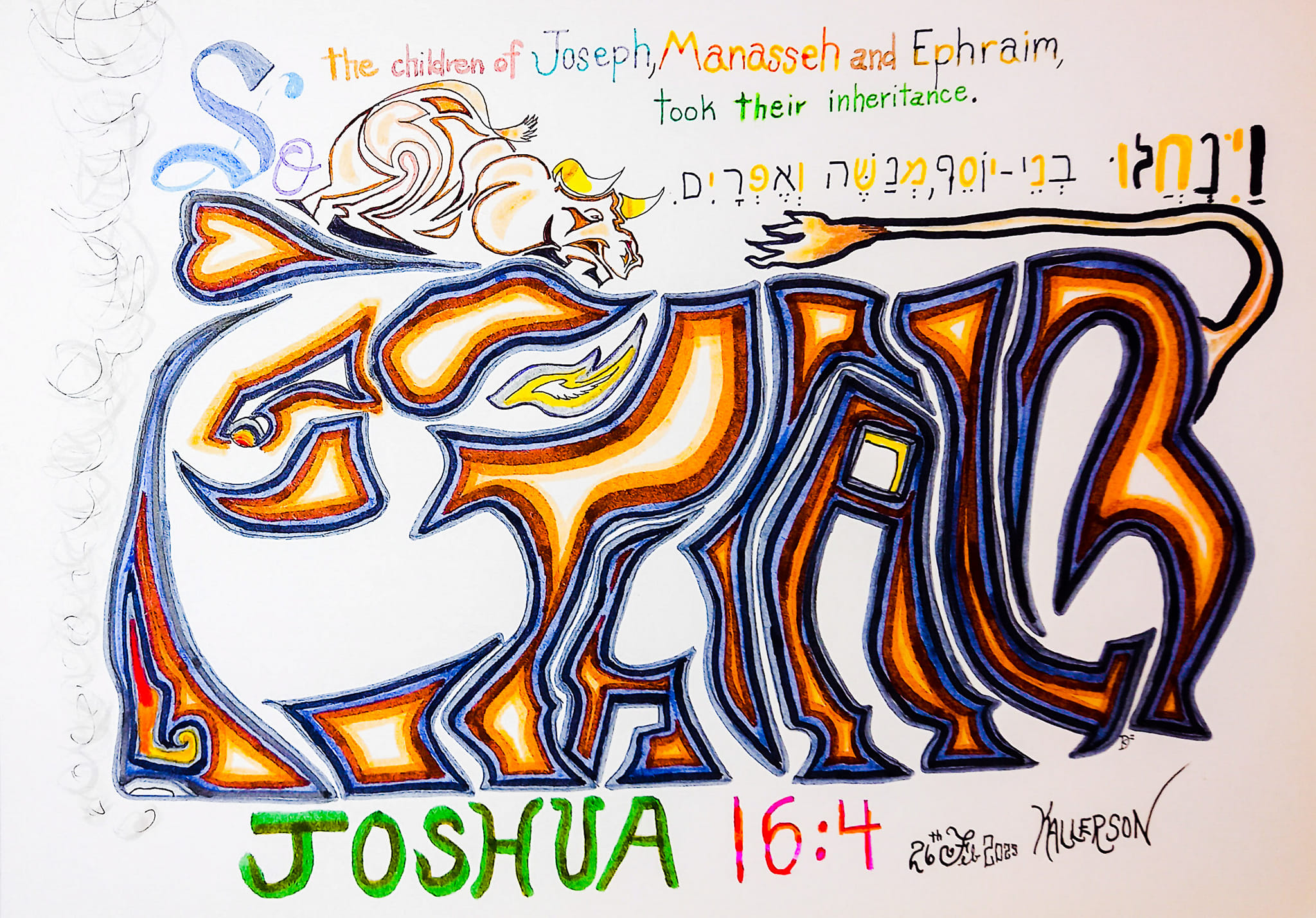
Artwork by Doug Kallerson

Joshua 10:1-15
The Battle for Gibeon, Part I

The passage before us in Joshua 10 is an exceedingly exciting set of verses. But you may not be overly excited about my evaluation of them. I have read the account many times and have had a presupposition about their meaning because I have trusted the words of the translators.

After setting those presuppositions aside, I have a completely different view of what these verses are saying. For those who don’t accept my evaluation, there will be the usual disappointment that comes from being steered away from the sensational, like when finding out that Nephilim are not the product of angels who sleep with human women. But that is so much more dramatic.

However, we must go where the text leads. I sent this to my good old friend who reads and understands Hebrew to look over my comments because I didn’t want to be wrong in the evaluation. He came back saying, “…if one completely removes the previous knowledge of this account, then yes, that’s the way to read it.” Thanks, Sergio.

The words of the Lord in Job help explain the sensational nature of the work of the Lord as described in the passage today. How is it that the Lord intervenes in this passage? We will find out. Job 38 gives us a hint…

Text Verse: “Have you entered the treasury of snow,
Or have you seen the treasury of hail,
23 Which I have reserved for the time of trouble,
For the day of battle and war?” Job 38:22, 23

A portion of our verses today is poetical. Thus, by its very nature, it is not necessarily to be taken as it may at first appear. Translating poetry is complicated. We saw that in the Song of Moses.

As for the Book of Jasher which is referenced in this passage, that takes us down another avenue of sensational teaching. It is a book mentioned only twice in Scripture. And, of course, there are teachers out there that claim they have the book of Jasher and will sell you a copy of it. Ooooh, ahhh!

The problem with that is that it is a forgery. But, but, but it is sensational, and so people would rather spend money on that than read the Bible. We see it all the time. The book of Enoch. The book of Jubilees. People will read any of these before the Bible.

It is a terrible waste of time, but sensation sells. Be wise, spend your time in the word, and be content that it is sensational enough in what it tells us because it tells us about Jesus. Such wonderful things are to be found in His superior word. And so, let us turn to that precious word once again and… May God speak to us through His word today, and may His glorious name ever be praised.

I. Not a Man Shall Stand Before You (verses 1-11)

Now it came to pass when Adoni-Zedek king of Jerusalem heard

With the destruction of both Jericho and Ai, along with the treaty made by the Gibeonites, there is a stir arising in the land. This will all be brought forth in the clauses and verses ahead, but the beginning of the matter rests with Adoni-Tsedeq melekh Yerushalaim, or Adoni-Zedek, king Jerusalem.

His name means Lord of Righteousness or My Lord is Righteous. The name Jerusalem is now introduced into Scripture. Despite its fame as a city, the meaning of the name is debated. It may mean Foundation of Peace, Rain of Peace, Teaching Peace, Possession of Peace, Vision of Peace, He Shall See Peace, In Awe of Peace, or some other variant. Any of these may be correct based on the surrounding context.

The name itself carries with it the sense of a plural word as it ends with a dual termination sound – Yerushalaim. That might signify that the city has two areas, an upper and a lower half. But that is debated as well. The complicated meaning of the name of the city is almost as great as is the historical fame of it.

The name Adoni-Zedek, Lord of Righteousness, is not unlike Melchizedek, or King of Righteousness, who reigned in this same place at the time of Abram. Thus, it may be an official title that was given to the king of the city like Pharaoh is given to the king of Egypt. Of this king, it next describes what he heard. It was…

1 (con’t) how Joshua had taken Ai and had utterly destroyed it—

ki lakhad Yehoshua eth ha’ai va’yakharimah – “that had taken Joshua the Ai and anathematized her.” It wasn’t just that Joshua had taken Ai and subdued it, making the people subject to Israel. Nor was it that they took Ai captive. Rather, the city was taken, and it was utterly devoted to the Lord, meaning every living being was destroyed. This was…

1 (con’t) as he had done to Jericho and its king, so he had done to Ai and its king—

ka’asher lirikho u-l’malkah ken asah la’ay u-l’malkah – “According to which to Jericho and to her king, thus he has done to Ai and to her king.” The highlight is on the act of anathema waged against the cities. In other words, it isn’t just that they devoted one city and then began to show mercy. Rather, they utterly destroyed Jericho, and then they utterly destroyed Ai.

But more, it says “and to her king” for both Jericho and Ai. It is the king of Jerusalem who is the subject of the verse. He fully understands that not only were the cities overrun and destroyed, but the kings of the cities were shown no mercy. He knows he will not be able to buy his way out of whatever pickle he finds himself in when Israel comes to his city. And more…

1 (con’t) and how the inhabitants of Gibeon had made peace with Israel and were among them,

v’ki hishlimu yosh’ve giv’on eth Yis’rael va’yihyu b’qir’bam – “And that had acquiesced inhabitants Gibeon toward Israel and were in their midst.” The word is shalam, signifying the completion of something. In this case, there was a state of enmity that is now becoming an alliance by covenant.

Gibeon, after having seen the total destruction of Jericho and Ai, had simply made peace without even attempting to defend themselves. They had voluntarily become totally subservient to Israel. This is especially problematic because Israel has a foothold in a strategic location in the heart of the land. The entire southern region of Canaan would be more exposed to the incursions of Israel. Hence, the king wanted to recapture this location if possible.

As a reminder, Jericho means Place of Fragrance. Ai means Heap of Ruins. Gibeon means Hilly or Hill Town. Concerning the events that took place among these three cities, it next says…

that they feared greatly,

The translation is correct: va’yir’u meod – “And they feared greatly.” Verse 1 spoke only of the king of Jerusalem. The text switches to the plural, they, here. This could be referring to him and his subjects within Jerusalem, but it may be anticipatory of the kings that will be mentioned in the next verse. Either way, there is a great fear of what had happened…

2 (con’t) because Gibeon was a great city, like one of the royal cities,

The word “royal” is an adjective, but the Hebrew has a noun: ki ir gedolah giv’on k’akhat are ha’mamlakha – “for city whopping, Gibeon, according to cities the kingdom.” Hence, I would speculate that Gibeon actually had its own king, but when they went to make the treaty with Israel, he abdicated his throne.

This would explain why it never mentions any leader when the covenant was cut in Chapter 9. It is possible they never had a king, but based on the listing of cities, each with its own king, in Joshua 12, it seems unlikely that they were without a formal leader. This seems especially so based on the next words…

2 (con’t) and because it was greater than Ai, and all its men were mighty.

v’ki hi gedolah min ha’ay v’kal anasheha giborim – “and for she whopping from the Ai and all her men – heroes.” Ai had its own king and men of war. If Gibeon was greater than Ai and its men are all described as great men, then it would logically follow that they also had a king. Again, this is personal speculation, but it would explain why the account continues as it does…

Therefore Adoni-Zedek king of Jerusalem sent to Hoham king of Hebron, Piram king of Jarmuth, Japhia king of Lachish, and Debir king of Eglon, saying,

Some of these names have various meanings, but essentially they are: 1) Hoham – whom Yehovah impels. Hebron – Alliance. 2) Piram – Indomitable. Jarmuth – Elevation. 3) Japhia – Illuminous. Lachish – Obstinate. 4) Debir – Place of the Word. Eglon – Heifer-like.

It should be remembered from Numbers and Deuteronomy that the great and tall people known as the Anakim dwelt in Hebron. They are also noted in Joshua 11 as being elsewhere. Hence, they would probably be a part of the alliance to be made.

Each of these four named cities was in the area eventually granted to Judah. It is to these kings that Adoni-Zedek said…

“Come up to me and help me, that we may attack Gibeon,

The planned attack is not against Joshua and Israel but against Gibeon. Throughout the book, Joshua will always be on the offensive against the nations it wars with. As for Gibeon, there are probably several reasons for attacking it.

First, it would set an example for any other Canaanite cities that they were not to make a treaty with Israel. Second, being strategically located, it would be good to have the area recaptured in order to regain command of the surrounding area.

And, third, it was probable that Gibeon would have been either disarmed or mostly disarmed by Israel once it was discovered that they were close by. As such, they could only lightly defend the city, but probably not much more than that. Each of these could be considered in the next words…

4 (con’t) for it has made peace with Joshua and with the children of Israel.”

Although Jerusalem is the city nearest to Gibeon, the loss of Gibeon would eventually be a threat to all of them. Therefore, to act quickly and decisively against Gibeon would be the desirable option to take.

By aligning with the other kings, it would also strengthen their ties into the future, making it more likely one would come to the aid of another if any was attacked by Israel. Obviously, this plan was well received as it next says…

Therefore the five kings of the Amorites,

It is singular, showing the united nature of the people: va’yeas’phu va’yaalu khameshet malkhe ha’emori – “And gathered together and went up five kings the Amorite.” It is five kings, but one people, even though they were not all Amorites.

Rather, they included Hittites, Jebusites, etc. But they are lumped together as being a part of “the Amorite.” To further unite them in thought, the next words include no definite articles in the Hebrew…

5 (con’t) the king of Jerusalem, the king of Hebron, the king of Jarmuth, the king of Lachish, and the king of Eglon, gathered together and went up,

Rather, it simply reads: “king Jerusalem, king Hebron, king Jarmuth, king Lachish, king Eglon.” It is five kings united as one…

5 (con’t) they and all their armies,

Rather than armies, it says: hem v’kal makhanehem – “they and all their camps.” The kings went forward to besiege the city and then to make war against it. Hence, they are called camps. They set up in an array in order to hem the city in. As it next says…

5 (con’t) and camped before Gibeon and made war against it.

It isn’t just that their armies went up and began a full-on assault. Rather, Gibeon is besieged and attacked according to a set plan, probably figuring that word could not make it to Joshua if they had them surrounded. However…

And the men of Gibeon sent to Joshua at the camp at Gilgal,

Despite being besieged, they were able to get word out to Joshua. Several possibilities exist. It could be the word was sent while the armies were gathering. If so, then the message was sent prior to the city being besieged (i.e. “had sent to Joshua”). Maybe some were working in the fields and saw the camps setting up. Maybe some broke through the lines at night. Whatever the case, the fact is that some of the men were able to get word to Joshua at Gilgal…

6 (con’t) saying, “Do not forsake your servants;

The words contain a jussive: al tereph yadekha m’avadekha – “Not [might you] relax your (sg.) hand from your (sg.) servants.” The words are spoken to Joshua, and they are certainly an appeal to the covenant that was cut, but without directly commanding anything. In essence, “You are (hopefully) not to relax your hand from your servants according to our agreement.” Instead…

6 (con’t) come up to us quickly, save us and help us,

There is a sort of play on the name of Joshua here: aleh elenu m’herah v’hovoshiah lanu – “Come up to us quickly and save us and help us.” The word translated as “save” is the word, yasha, from which Joshua’s name is derived. They are calling out for Joshua to be their savior and their helper in their time of need. The reason is…

6 (con’t) for all the kings of the Amorites who dwell in the mountains have gathered together against us.”

Again, it is singular – “all kings the Amorite.” They are contrasting themselves to the people group of Canaan and have indicated their alliance with Joshua. Also, the word “mountains” is singular. It is “the mountain.”

This is said even though some of the kings dwelt in the low country. Hence, “the mountain,” is certainly referring to Jerusalem as the main identity in the alliance. The kings of the Amorite who dwell in the mountain have gathered (or were gathering) together against Gibeon…

So Joshua ascended from Gilgal, he and all the people of war with him, and all the mighty men of valor.

The words at first seem to give two classes – va’yaal Yehoshua min ha’gilgal hu v’kal am ha’milkhamah imo v’kol gibore he’khayil – “And ascended Joshua from the Gilgal, he, and all people the war with him, and all mighty the valor.”

The structure of the words, however, is a way of the second clause describing those of the first clause, such as, “All the people of war, even all the mighty men of valor.” Joshua responded immediately according to the terms of the covenant that had been cut, and he set out with his best soldiers. And more…

And the Lord said to Joshua, “Do not fear them, for I have delivered them into your hand;

The word nathan, give, is used – “I have given them into your hand.” The enemy is as a present to Joshua, and so he is not to be afraid as he faces the foe in battle. And more…

8 (con’t) not a man of them shall stand before you.”

lo yaamod ish mehem b’phan’ekha – “No shall stand man from them in your (sg.) presence.” The meaning is that despite there being five kings with their combined forces, they will be so utterly defeated that all will either be killed or will flee away. But none shall be left to stand before him.

Joshua therefore came upon them suddenly, having marched all night from Gilgal.

The words are more precise, and they speak only of Joshua: “And came unto them Joshua suddenly (all the night ascended (sg.) from the Gilgal).” What was a march that took until the third day to be complete in verse 9:17 has been completed in a single night.

And more, it was an ascent all the way from Gilgal to Gibeon. In this, they would have been completely undetected as they approached the camps surrounding the city…

10 So the Lord routed them before Israel,

v’humem Yehovah liphne Yisrael – “And confused (sg.) them, Yehovah, before Israel.” It is the same word, hamam, that the Lord used when He promised just this in Exodus 23 –

“I will send My fear before you, I will cause confusion [hamam] among all the people to whom you come, and will make all your enemies turn their backs to you. 28 And I will send hornets before you, which shall drive out the Hivite, the Canaanite, and the Hittite from before you.” Exodus 23:27, 28

The word signifies to make a noise or move noisily, and thus to cause confusion. This is ascribed to the Lord, and it very well could be because of a thundering storm that came at the time of the battle. Whatever threw them into confusion, it is exactly what the promise from Exodus 23 said would happen. Also…

10 (con’t) killed them with a great slaughter at Gibeon,

The words are most forceful, and they give the credit to the Lord: va’yakem makah gedolah b’giv’on – “And struck (sg.) them blow whopping in Gibeon.”

The people were obviously unprepared for an external attack and had set up their forces for a siege on the city. When Joshua showed up, they were completely confused and decisively struck. From there they…

10 (con’t) chased them along the road that goes to Beth Horon,

Again, the action is credited to the Lord: va’yird’phem derek maaleh beith horon – “and chased (sg.) them way ascent Beth Horon.” Beth Horon means House of the Hollow and also House of Freedom. Even if it is Israel who was engaged in the battle, the Lord is who is spoken of.

It was His assurances of victory that impelled the men to march all night, to attack without sleep, and to sustain them throughout the day. The singular nature of the battle’s description next says…

10 (con’t) and struck them down as far as Azekah and Makkedah.

va’yakem ad azeqah v’ad maqedah – “and struck (sg.) them unto Azekah and unto Makkedah.” The action of the Lord will be more fully described in the next verse. For now, Azekah means “Tilled Over.” Makkedah means “Place of Shepherds.”

11 And it happened, as they fled before Israel and were on the descent of Beth Horon,

The translation is close enough. We are being given an exacting description of the events: who, where, and so on. The details are particular to give the reader the mental ability to follow along as if it is happening before his eyes. While these men are running down the slope in Beth Horon, it was…

11 (con’t) that the Lord cast down large hailstones from heaven on them as far as Azekah, and they died.

It says, “and Yehovah cast upon them stones whopping from the heavens until Azekah, and they died.” This cannot simply be a rockslide, but an actual atmospheric event that came from the skies.

If the previous confusion was caused by a storm and thundering, this would then fit well with hailstones coming down upon the people. The carnage from these was so great that…

11 (con’t) There were more who died from the hailstones than the children of Israel killed with the sword.

rabbim asher metu b’avne ha’barad m’asher hargu bene Yisrael b’kharev – “more who died in stones the hail from who killed sons Israel in the sword.” This word for hail, barad, hasn’t been noted since the time of the Exodus when the Lord sent hail upon Egypt.

It is the same word used in our text verse today where the Lord claims to use it in exactly this circumstance, meaning the day of battle and war. Throughout the Bible, the Lord uses the elements according to His wisdom and in order to demonstrate his greatness.

The Canaanites had various gods, including the god of the storm, Hadad. That is also the Hebrew word for “thunder.” The Bible does not ascribe deity to the storm, but it shows that God is above the storm, using it according to His purposes.

Hence, while the Canaanites were worshipping the elements, Yehovah is using the elements to gain victory over them and to gain glory for Himself. With that noted, the next account is given…

The Lord will fight the battle for you
Watch and behold the greatness of His splendid hand
All that is necessary to win the victory, He will do
Trust in Him and He will accomplish what He has planned

He will fight for you and bring the victory
Upon the enemy He will work out His plan
What He purposes will come about, you will see
When He responds to the voice of a Man

It will all be accomplished before the day’s end
And the enemy will be defeated on that day
Upon him the Lord many woes will send
At that time, “Hallelujah to our God” our voices will say

II. Then Joshua Spoke to the Lord (verses 12-15)

12 Then Joshua spoke to the Lord in the day when the Lord delivered up the Amorites before the children of Israel,

az y’daber Yehoshua Yehovah b’yom teth Yehovah eth ha’emori liph’ne bene Yisrael – “At that time, spoke Joshua, Yehovah, in day gave Yehovah the Amorite before sons Israel.” The word az is a demonstrative adverb signifying the beginning of something. Hence, what is said is at the beginning of the matter.

Using the word “then” here gives a false sense of the intent of the words. Rather, just when the battle was getting started, Joshua spoke. The reason this is important is because it sets the tone for the day of battle and of what will occur.

Also, as before, it says, “the Amorite.” The collective nature of the people is highlighted. They are the Renowned, and yet they are delivered to the children of Israel. In their being delivered, it is the Lord who gains renown for Himself. To increase the victory of the Lord, Joshua spoke to Him…

12 (con’t) and he said in the sight of Israel:

va’yomer l’ene Yisrael – “and he said to eyes Israel.” Rather than, “in the ears of Israel,” it says, “to the eyes of Israel.” This is key to understanding the nature of the words to come. It is the same expression used in Numbers 20:8 where Moses and Aaron were to speak to the rocks “to their eyes,” meaning the eyes of Israel.

They were to see the event based on the words. Joshua made a request of the Lord in the sight of Israel. Should the Lord accept his words as a request, it would be a sure sign to them that the Lord was fully satisfied with the people and willing to act on their behalf when they were living in accord with His will. As for his words, Joshua next says…

12 (con’t) “Sun, stand still over Gibeon;

The words here are poetical in nature and must be taken that way:  shemesh b’giv’on dom – “Sun, in Gibeon, be silent.” There is no article before sun or moon. Rather, the words are spoken to the sun and the moon as Moses and Aaron were to speak to the rock. But the rock was not going to respond. The Lord was.

Likewise, the sun and moon are not going to respond. The Lord will. The word is damam. Depending on the context, it means to wait (1 Samuel 14:9); to be still, such as lying on one’s bed and being still (Psalm 4:4); be silent (Psalm 31:7); to cease as in ending something (Psalm 35:5); to be cut off, such as in men of war being cut off (Jeremiah 50:30); and so on.

There is no reason to assume that Joshua is actually asking for the sun to stop where it is in the sky. Rather, it is a poetic wish for the sun to tarry in the sky until the task is complete. Psalm 19 notes that the voice of the heavens goes forth. This includes the sun –

“In them He has set a tabernacle for the sun,
Which is like a bridegroom coming out of his chamber,
And rejoices like a strong man to run its race.
Its rising is from one end of heaven,
And its circuit to the other end;
And there is nothing hidden from its heat.” Psalm 19:4-6

Instead of the sun speaking its voice as it runs its race, Joshua is asking it to be silent. As such, Joshua is certainly conveying to the Lord his great desire is that the sun would not go down before he had a chance to completely destroy his enemies.

This would then be a petition for his actions to complete the job in a timely manner, rather than for the sun to delay its actions. The poetic action is for the sun to belay its setting, but the actual action is for Joshua to complete the battle before the sun sets, as verse 13 will clearly indicate.

12 (con’t) And Moon, in the Valley of Aijalon.”

v’yareakh b’emeq Ayalon – “And moon in depth Aijalon.” The emeq is a deep valley. The name Aijalon comes from ayyal or deer. Hence, it signifies Place of the Deer. However, that comes from the same as ayil, or ram, which is derived from a word indicating strength. Hence, I would think Place of Strength is not out of line.

At this time, the moon is west. This is often the case when the sun rises, and the descending moon is to the west. This is certain because if the sun is over Gibeon at this point and the moon is over Aijalon, it means that the sun is still eastward, and the day is not yet half-spent. And more likely, it is just beginning.

The battle began early in the morning, and Joshua is poetically asking that he can accomplish the battle before the day ends. There is nothing here to suggest that he is asking for the day to stop, but that his mission will be accomplished before the day ends. With this, the poetic nature of the words continues…

13 So the sun stood still,

The verb is imperfect: va’yidom ha’shemesh – “And is silent the sun.” This is a poetic response to Joshua noting that the sun remained silent, not rushing to run its course while Joshua continued the battle…

13 (con’t) And the moon stopped,

Rather: v’yareakh amad – “And moon stood.” The word amad means to stand. It can mean stopped, such as when Leah stopped bearing children. But it can also mean to endure, as in continuing in a matter. These are clearly poetic words.

If we want a job done before nightfall, we might say, “I hope the sun stands long enough for us to complete this task.” Being poetic lines, this is surely all that this means. It does not mean that a great thing isn’t taking place, but we must allow the word to define what the great thing is, and it will…

13 (con’t) Till the people had revenge
Upon their enemies.

The verb translated as “had revenge” is imperfect – avenges. Also, the word nation is singular, thus contrasting Israel with the Amorite: ad yiqom go oy’vah – “Until avenges nation upon his enemies.” The sun did not go down until the task was complete.

To this point, there is nothing to ascribe the miraculous to the suspension of the sun and moon in the heavens. To understand, we could go back to the previous example. “It was great! The sun stood in the sky until our job was complete.” Even if that is not so miraculous, the earlier verses have spoken of the miraculous, and the account will continue to do so as well.

13 (con’t) Is this not written in the Book of Jasher?

ha’lo hi ketuvah al sepher ha’yashar – “Not it written upon scroll the Upright (One)?” The book of Jasher is noted twice in the Bible, here and in 2 Samuel 1:18. From the two uses, it appears likely that it is a poetical book of the heroic deeds of the people.

It very well may be the same book called “the Book of the Wars” in Numbers 21:14. The poetic verses cited in that passage are said to have been written there. At that time, we noted that it was probably a collection of songs or psalms that celebrated the great acts of the powerful deliverances the Lord’s people experienced through His personal action.

With the use of the name Jeshurun, or Upright, by Moses to describe Israel in Deuteronomy, it very well may be that the Book of the Wars was renamed the Book of the Upright One to indicate the wars of Israel under the Lord. It is all speculation, but it does fit with the ongoing narrative. Putting them side by side, one can see from the Hebrew that each is a play upon the name Israel –

Israel – Yisrael:  יִשְׂרָאֵל
Jeshurun – Yeshurun: יְשֻׁרוּן
The Upright (One) – ha’Yashar: הַיָּשָׁ֑ר

13 (con’t) So the sun stood still in the midst of heaven, and did not hasten to go down for about a whole day.

One will naturally translate the words as they presuppose the meaning to be. Until I studied them, I presupposed that this was a literal occurrence of the sun not moving for a whole day. But when evaluating Scripture, we must do our best to drop all presuppositions and simply read the words as they are given.

It does not necessarily say “stood still.” It does not necessarily say “midst.” It does not say “about.” And one must presuppose the word “whole.” It says: va’yaamod ha’shemesh ba’khatsi ha’shamayim v’lo az la’bo ke’yom tamim – “And stood the sun in the half of the heaven’s and no hasten to go, according to day complete.”

The word tamam signifies that which is blameless, complete, sound, without blemish, perfect, entire, and so on. The meaning is simply that the sun didn’t rush to its setting before things were done. It went at its usual pace, standing in the heavens as it would on any complete (perfect) day.

Also, notice the important words that have been excluded. This verse, which is the completion of the action, says nothing of the moon remaining in the sky. It does say earlier in the verse ad, or until, but that is referring to the completion of taking vengeance. It did stand, during the battle, even if it eventually slipped below the horizon. It was the sun that continued, and it remained until the requested action was complete. If both had stopped, it surely would have said so.

Going back to our example from before, the words can simply mean, “It was the perfect day. We completed everything before the sun rushed off and set, disappearing below the horizon.”

In this, we are talking in poetic fashion and demonstrating gratefulness that the job was complete. With that noted, the miraculous is seen in the next words and they tell us that it is not that the sun and the moon stopped. Rather…

14 And there has been no day like that, before it or after it, that the Lord heeded the voice of a man;

v’lo hayah ka’yom ha’hu l’panav v’akharav lishmoa Yehovah b’qol ish – “And no has been according to day, the it, before it or after it, to hearken Yehovah in voice man.” The meaning is that Joshua spoke, and his words were answered by the Lord in a manner that had not been done before or after that day.

What is the miracle? First, it is based upon the words of verse 12 which anticipate the battle. If Joshua said the words in the eyes of Israel, it means that he said them before the battle started.

He petitioned the Lord to allow the day to not end before the nation had avenged itself upon his enemy. As such, the battle was engaged, and to ensure that it would be successfully completed according to Joshua’s words the Lord personally intervened…

14 (con’t) for the Lord fought for Israel.

This is the miracle. The battle was engaged by men who had marched all night. They began the battle immediately, and as they were set to battle, Joshua had asked the Lord to allow the task to be complete before the sun went down.

In order for that to come about, the Lord personally engaged the enemies of Israel, confusing the people and casting down whopping hailstones upon them as was recorded in verses 10 & 11. The “heeding the voice of a man” is answered by the words ki Yehovah nilkham l’Yisrael – “for Yehovah fought to Israel.”

The word ki, or “for” is an explanatory conjunction. With that noted, it next says…

*15 (fin) Then Joshua returned, and all Israel with him, to the camp at Gilgal.

va’yashav Yehoshua v’kal Yisrael imo el ha’makhaneh ha’gilgalah – “And returned Joshua, and all Israel with him, to the camp, the Gilgal.” The words are a part of the quotation concerning the book of Jasher that began in verse 12, demonstrating that the sequence of events as I outlined is correct.

Verses 12-15 go back and speak of the events detailed in verses 9-11 that confirm the words of Joshua. The Lord fought the battle for Israel, something that had not happened in such a manner before that day or after it, at least until the time that the words were inscribed in the Book of Jasher.

We know this is correct concerning this verse because in verse 21 (in next week’s passage) the people will return to Makkedah, not Gilgal. The men then continued the conquest of these five kings and their cities after that and only then did they return to Gilgal, as is recorded in verse 43.

To assume anything else would be to assume that the sun did not set during the entire campaign over the five cities, something that would have taken an extended period of time, meaning days, weeks, or even months. It is also something contrary to the narrative itself based on the timeline provided in verses 28-43.

Rather, Joshua petitioned the Lord that the battle of that day would not be complete before the sun set, and to ensure that it was accomplished according to his desire, the Lord worked on behalf of Israel for it to come about.

That alone is miraculous because the words were spoken before the entire band of fighting men. Each could testify to what he saw, exactly as would have been the case if Moses and Aaron had obeyed the Lord’s word while at the Rock in Numbers 20.

Hearing my evaluation of these verses may leave you either a little miffed or a little disappointed if you want to accept that the sun actually stood still in the sky for an extended period of time. But it shouldn’t be so. The Lord is said to have brought the sun backward on the sundial of Ahaz ten degrees in Isaiah 38.

Other events in the Bible demonstrate the miraculous in nature, such as the parting of the Red Sea and the parting of the Jordan. Signs are given and prophecies are fulfilled, but this section of Joshua is a poetic look into the Lord’s response to a need stated by Joshua. Even if the sun moved as it always did, the miraculous is in the story, nonetheless.

An army traveling all night, engaging an enemy comprised of five kings and their armies, and who then defeats that enemy before the sunset, stands as its own miracle. It truly demonstrates that the Lord fought for Israel. I can only go where I believe the text leads, and that speaks of the Lord’s response to Joshua’s call as outlined in a body of poetry –

“At that time, spoke Joshua, Yehovah, in day gave Yehovah the Amorite before sons Israel and he said to eyes Israel:

‘Sun, in Gibeon, be silent.
And moon in depth Aijalon.’

And is silent the sun.
And moon stood.
Until avenges nation upon his enemies.

Not it written upon scroll the Upright (One)? And stood the sun in the half of the heaven’s and no hasten to go, according to day complete.

And no has been according to day the it, before it or after it, to hearken Yehovah in voice man, for Yehovah fought to Israel. And returned Joshua, and all Israel with Him, to the camp, the Gilgal.”

Notice the structure:

V.12 – At that time, spoke Joshua, Yehovah, in day gave Yehovah the Amorite before sons Israel and he said to eyes Israel.

V.13 Until avenges nation upon his [Israel’s] enemies.

V.15 – And no has been according to day, the it, before it or after it, to hearken Yehovah in voice man, for Yehovah fought to Israel.

The bracketing thoughts explain what the miracle was. And isn’t that enough? We needed a Savior, and the Lord has fought for us. He has brought about the victory. Do we need something more to satisfy our sensations? Rather, what the Lord did is so far beyond our comprehension that we have a literal eternity ahead of us to discover all it actually means.

Let us be thankful to the Lord that He has responded to the voice of a Man, and that He now responds to the voice of men. Christ spoke out our salvation, and now we simply need to speak out the word of faith. Thank God for Jesus Christ our Lord who has fought for us.

Closing Verse: “Lift up your heads, O you gates!
And be lifted up, you everlasting doors!
And the King of glory shall come in.
Who is this King of glory?
The Lord strong and mighty,
The Lord mighty in battle.” Psalm 24:7,8

Next Week: Joshua 10:16-27 The battle went on and on until it was through… (The Battle for Gibeon, Part II) (21st Joshua Sermon)

The Lord has you exactly where He wants you. He has a good plan and purpose for you. It is He who has defeated the enemy and who now offers His people rest. So, follow Him and trust Him and He will do marvelous things for you and through you.

The Battle for Gibeon, Part I

Now it came to pass
When Adoni-Zedek king of Jerusalem heard (his ears did ring)
How Joshua had taken Ai and had utterly destroyed it
As he had done to Jericho and its king

So he had done to Ai and its king
And how the inhabitants of Gibeon had made peace
With Israel and were among them
That they feared greatly their knee knocking wouldn’t cease

Because Gibeon was a great city
Like one of the royal cities all-righty
And because it was greater than Ai
And all its men were mighty

Therefore Adoni-Zedek king of Jerusalem
Sent to Hoham king of Hebron, words he was relaying
And Piram king of Jarmuth, Japhia king of Lachish
And Debir king of Eglon, saying

“Come up to me and help me
That we may attack Gibeon,” to them he did tell
For it has made peace with Joshua
And with the children of Israel

Therefore the five kings of the Amorites
The king of Jerusalem, the king of Hebron also
The king of Jarmuth, the king of Lachish
And the king of Eglon all joined the show

And gathered together and went up
They and all their armies, a mighty corps
And camped before Gibeon
And against it made war

And the men of Gibeon sent to Joshua at the camp at Gilgal
Saying, “Do not forsake your servants; come up to us quickly
———-(that would be a major plus)
Save us and help us, for all the kings of the Amorites
Who dwell in the mountains have gathered together against us”

So Joshua ascended from Gilgal
Up they did go
He and all the people of war with him
And all the mighty men of valor also

And the LORD said to Joshua
“Do not fear them, for I have delivered them into your hand
Not a man of them shall stand before you
Your victory will be grand

Joshua therefore came upon them suddenly, like a storming wall
Having marched all night from Gilgal

So the LORD routed them before Israel
Killed them with a great slaughter at Gibeon – oorah!
Chased them along the road that goes to Beth Horon
And struck them down as far as Azekah and Makkedah

And it happened, as they fled before Israel
And were on the descent of Beth Horon
That the LORD cast down large hailstones from heaven on them
As far as Azekah, and they died, death from a large stone

There were more who died from the hailstones, a great horde
Than the children of Israel killed with the sword

Then Joshua spoke to the LORD in the day
When the LORD delivered up the Amorite
Before the children of Israel
And he said in Israel’s sight:

“Sun, stand still over Gibeon
And Moon, in the Valley of Aijalon”

So the sun stood still
And the moon stopped
Till the people had revenge upon their enemies
Up they were chopped

Is this not written in the Book of Jasher?
So the sun in the midst of heaven stood still
And did not hasten to go down
For about a whole day, saving on the lighting bill

And there has been no day like that
Before it or after it, for sure we can tell
That the LORD heeded the voice of a man
For the LORD fought for Israel

Then Joshua returned, probably having a ball
And all Israel with him, to the camp at Gilgal

Lord God, turn our hearts to be obedient to Your word
Give us wisdom to be ever faithful to You
May we carefully heed each thing we have heard
Yes, Lord God may our hearts be faithful and true

And we shall be content and satisfied in You alone
We will follow You as we sing our songs of praise
Hallelujah to You; to us Your path You have shown
Hallelujah we shall sing to You for all of our days

Hallelujah and Amen…


Now it came to pass when Adoni-Zedek king of Jerusalem heard how Joshua had taken Ai and had utterly destroyed it—as he had done to Jericho and its king, so he had done to Ai and its king—and how the inhabitants of Gibeon had made peace with Israel and were among them, that they feared greatly, because Gibeon was a great city, like one of the royal cities, and because it was greater than Ai, and all its men were mighty. Therefore Adoni-Zedek king of Jerusalem sent to Hoham king of Hebron, Piram king of Jarmuth, Japhia king of Lachish, and Debir king of Eglon, saying, “Come up to me and help me, that we may attack Gibeon, for it has made peace with Joshua and with the children of Israel.” Therefore the five kings of the Amorites, the king of Jerusalem, the king of Hebron, the king of Jarmuth, the king of Lachish, and the king of Eglon, gathered together and went up, they and all their armies, and camped before Gibeon and made war against it.

And the men of Gibeon sent to Joshua at the camp at Gilgal, saying, “Do not forsake your servants; come up to us quickly, save us and help us, for all the kings of the Amorites who dwell in the mountains have gathered together against us.”

So Joshua ascended from Gilgal, he and all the people of war with him, and all the mighty men of valor. And the Lord said to Joshua, “Do not fear them, for I have delivered them into your hand; not a man of them shall stand before you.” Joshua therefore came upon them suddenly, having marched all night from Gilgal. 10 So the Lord routed them before Israel, killed them with a great slaughter at Gibeon, chased them along the road that goes to Beth Horon, and struck them down as far as Azekah and Makkedah. 11 And it happened, as they fled before Israel and were on the descent of Beth Horon, that the Lord cast down large hailstones from heaven on them as far as Azekah, and they died. There were more who died from the hailstones than the children of Israel killed with the sword.

12 Then Joshua spoke to the Lord in the day when the Lord delivered up the Amorites before the children of Israel, and he said in the sight of Israel:

“Sun, stand still over Gibeon;
And Moon, in the Valley of Aijalon.”
13 So the sun stood still,
And the moon stopped,
Till the people had revenge
Upon their enemies.

Is this not written in the Book of Jasher? So the sun stood still in the midst of heaven, and did not hasten to go down for about a whole day. 14 And there has been no day like that, before it or after it, that the Lord heeded the voice of a man; for the Lord fought for Israel.

15 Then Joshua returned, and all Israel with him, to the camp at Gilgal.


Acts 12:4

Big church close to Vermont capitol.

Sunday, 20 November 2022 

So when he had arrested him, he put him in prison, and delivered him to four squads of soldiers to keep him, intending to bring him before the people after Passover. Acts 12:4

Note: You can listen to today’s commentary courtesy of our friends at “Bible in Ten” podcast. (Click Here to listen)

You can also read this commentary, with music, courtesy of our friends at “Discern the Bible” on YouTube. (Click Here to listen), or at Rumble (Click Here to listen).

So far in the ongoing narrative, Peter has been seized by Herod during the Days of Unleavened Bread. With that noted, it now says, “So when he had arrested him.” The words here more appropriately should be translated, “So having arrested him.” There is motion in the words of Luke, one thought building upon the next. Herod had arrested Peter. With that action complete, it next says that “he put him in prison.”

The reason for this is coming in the next clause. All it said of James is that he was killed with the sword. Regardless of the events surrounding the killing of James, only his death by the sword is recorded. However, the fate of Peter is explained in greater detail. Luke masterfully builds up a sense of excitement with his words to lead the reader to each subsequent thought. Peter is now put in prison, and then it next says that Herod “delivered him to four squads of soldiers.”

Like the first clause, these words are from an aorist participle and more rightly should be translated, “having delivered him to four squads of soldiers.” Luke continues to carefully align his words to bring the reader right into the narrative. As for the large number of soldiers, this certainly seems like total overkill, but Luke is undoubtedly recording it for a particular purpose. To understand it, one must go back to Acts 5 –

“Then the high priest rose up, and all those who were with him (which is the sect of the Sadducees), and they were filled with indignation, 18 and laid their hands on the apostles and put them in the common prison. 19 But at night an angel of the Lord opened the prison doors and brought them out, and said, 20 ‘Go, stand in the temple and speak to the people all the words of this life.’
21 And when they heard that, they entered the temple early in the morning and taught. But the high priest and those with him came and called the council together, with all the elders of the children of Israel, and sent to the prison to have them brought.
22 But when the officers came and did not find them in the prison, they returned and reported, 23 saying, ‘Indeed we found the prison shut securely, and the guards standing outside before the doors; but when we opened them, we found no one inside!’ 24 Now when the high priest, the captain of the temple, and the chief priests heard these things, they wondered what the outcome would be. 25 So one came and told them, saying, ‘Look, the men whom you put in prison are standing in the temple and teaching the people!’” Acts 5:17-25

This certainly supports the theory that the leaders of Israel personally asked Herod to seize Peter and do away with him as he had done with James. Peter had been arrested and yet was freed from his incarceration. They may have accepted it was an angel who released the men, or they may have reasoned that they were somehow broken out at night.

Regardless of how they had escaped, they did. Because of that, when Herod seized Peter, the Jews probably said, “Be careful to guard this guy well. He is a slippery fellow and has escaped from our own dungeon.” This is all conjecture, but Luke’s careful attention to this detail supports the theory. Hence, Herod had a large contingent set aside “to keep him.”

Four squads, or four quaternions, of soldiers would be sixteen men. Hence, if the shifts were divided into four, there would always be four soldiers monitoring him. It is readily apparent that Peter was considered a particularly important prisoner to be watched because he was known to have escaped in the past.

Were this not so, Luke would have simply overlooked any mention of it at all. A prison is a place of incarceration that generally holds lots of people. It is also normally well-guarded. To assign four quaternions of soldiers to guard him, and for Luke to especially note this, is certainly exceptional. As for the reason for not dispatching Peter off to the next world immediately, it next says that Herod was “intending to bring him before the people.”

The words “to bring him before” are more precisely rendered, “to lead him up.” The idea is that he would be brought out of prison and “up” to the elevated place where a tribunal would be held and where the death sentence would occur in the presence of the people. And this was to occur “after Passover.”

These words also give a very good indication that the Jews were involved in the seizing of Peter. They had seized Jesus and they delivered Him up to Pilate for sentencing, probably thinking that he would wait and have a trial at some later point. This is based on the words of Matthew 26 –

“Then the chief priests, the scribes, and the elders of the people assembled at the palace of the high priest, who was called Caiaphas, and plotted to take Jesus by trickery and kill Him. But they said, ‘Not during the feast, lest there be an uproar among the people.’” Matthew 26:3-5

Pilate set about to have an immediate trial, even as the Passover and Feast of Unleavened Bread was getting started. And exactly what they said might occur came about. These leaders had to actively call out for Jesus’ crucifixion to stir the crowds against Him. This led to ten years of one problem after another as His followers kept claiming He was the fulfillment of all the symbolism of the feasts and thus the Messiah.

With this thought in mind, one can see that the leaders were almost certainly in cahoots with Herod, giving their recommendations on what to do with Peter. They did not want another problem to arise like that which had occurred with the killing of Jesus.

Life application: Luke is a careful chronicler of all that is taking place. But it must be remembered that God is the One who inspired the narrative to be recorded as it is. The careful attention to detail, all the way through Acts, is a testament to Israel’s rejection of Jesus as their Messiah. His rejection then explains the destruction of the nation along with their two thousand years of justly deserved exile.

However, the fact that they have been under the curses and punishment of the law, instead of God just destroying them and being done with them forever, gives clear and reasonable proof that He is not done with them as a people. The regathering of them into the land from which they were exiled is an openly visible proof that the Lord is set to do all that His prophetic words concerning Israel are said to be coming.

The idea of “replacement theology” is so utterly ridiculous when looked at from how things are in the world. God spoke, His word promises, and He will fulfill. There is absolutely no reason to think that the church has replaced Israel. Rather, there is every reason to be certain that it has not. And more, as this is so, and because Israel is once again restored as a people and a nation, it is a sure sign that the other prophecies concerning the coming of the end times must also be ready to find their fulfillment.

Let us live out our lives with this in mind. Let us not hold too tightly to this world. Some wonderful day, and it may be soon, the call will be made, and the church will be removed from the hour of trial that is set to come upon the whole world. Let us anticipate that moment more and more with each moment that passes!

Heavenly Father, we look to the coming of our Lord Jesus and our being gathered to Him. May that day be soon. And Lord, until that day, may we be about the business that You have set before Your people. May we be willing to share the good news with all that come into our lives. Help us in this, O God. Amen.


Acts 12:3

Capitol Building, Montpelier, Vermont

Saturday, 19 November 2022 

And because he saw that it pleased the Jews, he proceeded further to seize Peter also. Now it was during the Days of Unleavened Bread. Acts 12:3

Note: You can listen to today’s commentary courtesy of our friends at “Bible in Ten” podcast. (Click Here to listen)

You can also read this commentary, with music, courtesy of our friends at “Discern the Bible” on YouTube. (Click Here to listen), or at Rumble (Click Here to listen).

The previous verse noted the killing of James with the sword. Now, it continues, saying, “And because he saw that it pleased the Jews.” The meaning is clear. This doesn’t mean all the Jews collectively, but those who represented the nation. It is referring to the Jews who were in the powerful positions and whose favor would more fully establish his political relations with them, along with his own power within the realm. Because these leaders were happy that Agrippa had done away with one of the leading apostles, “he proceeded further to seize Peter also.”

The Greek is actually in the form of a Hebraism, saying, “he added to lay hold of Peter also.” It is a way of showing an increase in a proposition, whatever it may be. In this case, it is the proposition of eliminating the apostles for the sake of cementing political status and power.

The apostles had been a thorn in the side of the leadership for about ten years. Therefore, having the ruling governmental authority over them harass and destroy this group was a welcome occasion for the leading Jews. And because this pleased the Jews, while also solidifying his own position and power, Agrippa decided to continue with his attack against them. As Peter was a chief figure among them and one who had spoken boldly against the ruling council, he was probably personally called out by name by the Jews as the next suitable target. Ellicott agrees with this being a matter of politics, saying –

“This was throughout the ruling policy of the Herodian house. The persecution did not spring from any fanatic zeal against the new faith, but simply from motives of political expediency.”

Likewise, Cambridge further clarifies this relationship between the two by citing Josephus –

“This Josephus notices (Antiq. xix. 7. 3), for, comparing Agrippa with the Herod who ruled before him, he mentions that the latter ‘was more friendly to the Greeks than to the Jews,’ in which matter he says Agrippa ‘was not at all like him.’”

With the event explained, the timing of it is next provided, saying, “Now it was during the Days of Unleavened Bread.”

The meaning is that this is during the time of the Passover and the pilgrim feast of Unleavened Bread which accompanies it. Luke unites the two in one thought as he did in his gospel. This is evident because the Passover actually precedes and leads into Unleavened Bread. Notice, however, that Luke unites them using the commonly used terminology for both that had been adopted in Israel –

“Now the Feast of Unleavened Bread drew near, which is called Passover. And the chief priests and the scribes sought how they might kill Him, for they feared the people.
Then Satan entered Judas, surnamed Iscariot, who was numbered among the twelve. So he went his way and conferred with the chief priests and captains, how he might betray Him to them. And they were glad, and agreed to give him money. So he promised and sought opportunity to betray Him to them in the absence of the multitude.
Then came the Day of Unleavened Bread, when the Passover must be killed. And He sent Peter and John, saying, ‘Go and prepare the Passover for us, that we may eat.’” Luke 22:1-8

As it is now the time of the Passover, it would be especially pleasing to the Jews. They had crucified Jesus at this time, and it was certainly welcome that Peter had been seized at the same time of year. However, one can see the backroom dealing of the Jews and Agrippa in the words of the coming verse which will be analyzed in the next commentary.

Life application: Some people refuse to talk to others about religion and politics. Some will talk about religion but not politics, or vice versa. The fact is that Christians are obligated to speak out about Jesus in order to be considered faithful servants of the Lord. This doesn’t mean that all must be evangelists and stand on the street corner, but we should be willing to speak about Jesus when the occasion arises or when questioned about our faith.

But it is also true that we live in a world where earthly governments rule. It is the policy of some sects, such as the Roman Catholic Church, to participate in the running of governments, dictating to them what should and should not be done. It is the policy of some sects and cults to never engage in any political activity at all, not even voting. This is the policy of the cult known as the Jehovah’s Witnesses.

Both approaches are flawed. Governments that are led by religion will inevitably become religiously tyrannical. Governments that have no representation of faithful Christians will become wholly immoral and destructive against any who are spiritually aligned with Christ.

As this is so, it is incumbent on faithful Christians to engage in voting and even in running for political office. By doing so, their views can be expressed and protected. Paul was a Roman citizen and he appealed to his citizenship unashamedly. He attempted to convert public officials, kings, and others in governmental positions. These things are undeniable as revealed in Scripture. Therefore, it is to the benefit of both the general population and the working of the government in which one lives to be active in both religious and governmental affairs.

Have a right balance in your thinking concerning these things. And above all, do not listen to those who claim an ultra-piety that says, “I am not of this world.” In this, they rip the words of Jesus (John 15:19) out of any proper context in order to absolve themselves of any responsibility for the events of life.

Rather, Paul clearly shows – both in his actions and in his writings – that we are in this world, and we must conduct our affairs in this world, but that we also have a better hope than this world. We cannot deny either without having an unbalanced approach to the lives that we live – in the here and now and in the hope of the future that lies ahead.

Lord God, how good it is to know that even though we are in this world and have lives to lead, we also have a hope that transcends this earthly life. Our true hope is not in a leader, a bank account, a form of government, or a retirement that provides a false sense of safety and security. None of these things can ever come close to the glory that lies ahead when Christ comes for His people. How we long for that day, and may that day be soon! Amen.


Acts 12:2

Truss bridge on Vermont state line.

Friday, 18 November 2022

Then he killed James the brother of John with the sword. Acts 12:2

Note: You can listen to today’s commentary courtesy of our friends at “Bible in Ten” podcast. (Click Here to listen)

You can also read this commentary, with music, courtesy of our friends at “Discern the Bible” on YouTube. (Click Here to listen), or at Rumble (Click Here to listen).

Acts 12 opened with the note that Herod the king had stretched out his hand to harass some from the church. With that noted, it next says, “Then he killed James the brother of John.”

This is then James the son of Zebedee recorded in Matthew 4 –

“Going on from there, He saw two other brothers, James the son of Zebedee, and John his brother, in the boat with Zebedee their father, mending their nets. He called them, 22 and immediately they left the boat and their father, and followed Him.” Matthew 4:21, 22

He is known in early writings as James the Greater. James the Less is James, the son of Alpheus noted in Matthew 10:3 when the apostles were designated by name. The only mention of him in Acts outside of this verse is that he is noted among the apostles after the ascension of the Lord –

“And when they had entered, they went up into the upper room where they were staying: Peter, James, John, and Andrew; Philip and Thomas; Bartholomew and Matthew; James the son of Alphaeus and Simon the Zealot; and Judas the son of James.” Acts 1:13

No reason why he was selected to be killed is given, but it does show that he was prominent enough and outspoken enough to be noticed and brought forth. So, despite not having anything recorded concerning his apostolic work, it is certain he was faithful and productive. It is a good indication that Acts is structured around Peter and Paul for a reason. Even if the other apostles did a great deal of work, the ministries of Peter and Paul are given special attention, showing the shift from the Jewish people to the Gentiles. Of James, it notes that he was killed “with the sword.”

Because of this, it is certain that this was a Roman and civil execution. Like John the Baptist, there is an obvious political element to what occurred. Being death by a sword, it could be either decapitation or being thrust through. Either way, the description of his death comes down to two words. This is in complete contrast to Stephen who was given almost an entire chapter of the events surrounding his stoning.

As for his death, it appears that this is something hinted at by what Jesus said in Matthew 20 –

“Then the mother of Zebedee’s sons came to Him with her sons, kneeling down and asking something from Him.
21 And He said to her, ‘What do you wish?’
She said to Him, ‘Grant that these two sons of mine may sit, one on Your right hand and the other on the left, in Your kingdom.’
22 But Jesus answered and said, ‘You do not know what you ask. Are you able to drink the cup that I am about to drink, and be baptized with the baptism that I am baptized with?’
They said to Him, ‘We are able.’
23 So He said to them, ‘You will indeed drink My cup, and be baptized with the baptism that I am baptized with; but to sit on My right hand and on My left is not Mine to give, but it is for those for whom it is prepared by My Father.’” Matthew 20:20-23

James certainly participated in the sufferings of Christ. But more, in a sense, the request was granted. James is noted as the first apostle to be martyred now in Acts. It is known that John was the last surviving apostle. Thus, the two sons of Zebedee were granted two positions of honor in their lives and deaths as chosen apostles of Jesus.

Life application: If the mother of James was alive at this time, she may have questioned God’s goodness in allowing her son, who had done so much in his ministry, to be killed in such an ignoble way. Or she may have understood that this was an honorable death in the eyes of the Lord. As tragic as it may be for someone to lose a family member, we cannot impute wrongdoing to God when it occurs.

The fact is that we are all going to die. Paul goes further and says –

“But you have carefully followed my doctrine, manner of life, purpose, faith, longsuffering, love, perseverance, 11 persecutions, afflictions, which happened to me at Antioch, at Iconium, at Lystra—what persecutions I endured. And out of them all the Lord delivered me. 12 Yes, and all who desire to live godly in Christ Jesus will suffer persecution.” 2 Timothy 3:10-12

We have been told this, it is included in God’s word, and therefore, it should not be a surprise to anyone when a faithful, godly believer is persecuted in some manner. This doesn’t mean God is uncaring. It means that God is receiving glory through the right conduct of His people. It is also a sign to those who engage in the persecution that His judgment upon them will be just and deserved when it comes.

We need to consider our earthly bodies less and look to what is promised. Our time now is in a fallen world where we can expect things to occur that may seem bad from our perspective. But in seeing how they fit into what lies ahead, they are not really “bad.” What God does, and what He allows in our lives, will always lead to what is good. Trust this as you consider the events of the world around you. Look at all things from an eternal perspective and you will be much better off as you trudge through this life of difficulty, trial, and woe.

Lord God, help us to maintain an eternal perspective on things and not get too caught up in the temporary, transitory things that will have their end. We know that good is promised for us, and so whatever happens now must be leading us to the good that lies ahead. Thank You that we can know this and cling to it while we are here in this life of difficulty. Amen.