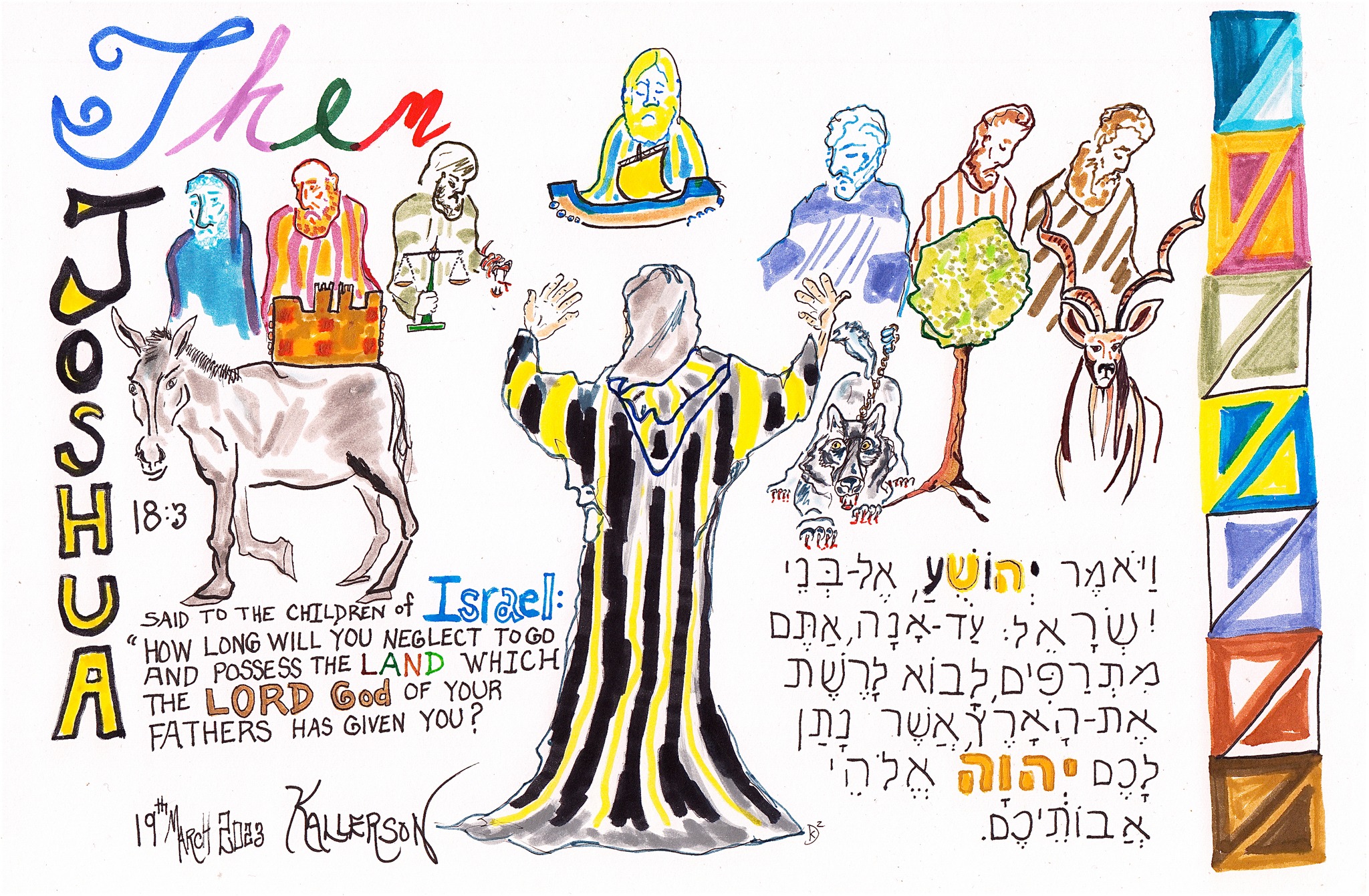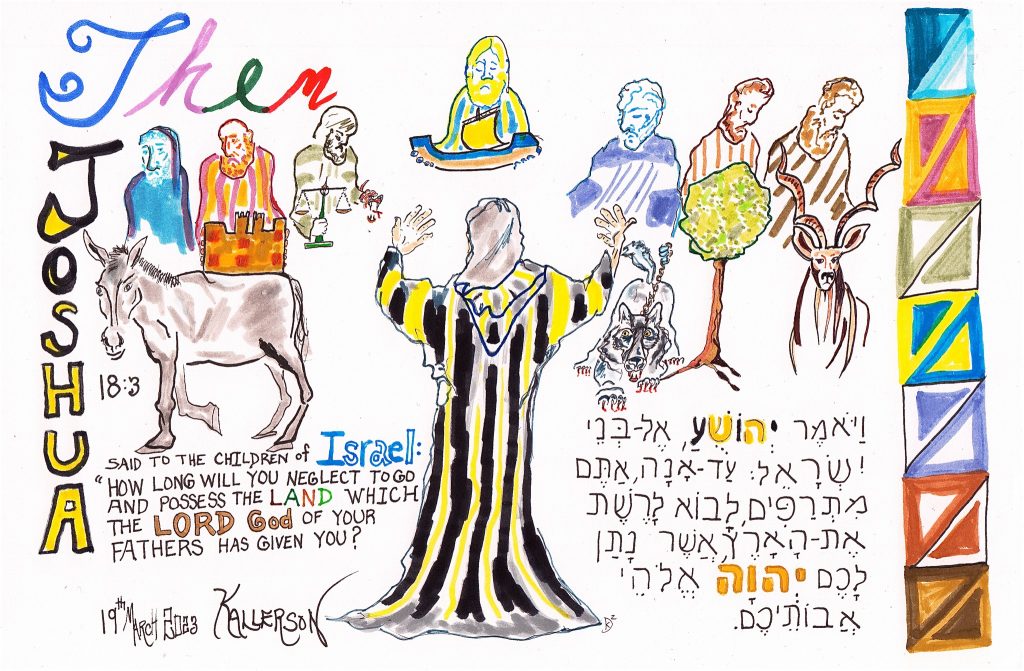
Artwork by Douglas Kallerson.
Joshua 18:1-10
Israel Assembled Together at Shiloh
People can be maddening. There are lots of ways they can be maddening: politically, poor driving, throwing stuff on the ground instead of simply putting it in the trash, and so on. People are often maddening.
Today, there is another way people can drive one another mad: when they are on the internet. Using this tool, people can hide away and eviscerate others without a care. They hide behind keyboards and say things they would never think of saying eye to eye.
This is as true with supposed Christians as anyone else. They can twist Scripture, sermonize, and so much more, all without having a clue about what the Bible actually says.
On the Monday I typed this sermon, I checked my email to see if there was anything pressing before beginning sermon prep. If there is ever an email from someone I haven’t seen before, I will usually at least open it and see what it says, even if I don’t answer it until later. The very first email I opened said –
“Hi, I came across your website, and from there I was taken to your Youtube channel. The LORD told me to contact you. Your ‘Jesus Freak’ head covering is offensive and disrespectful to the LORD; and, it is worldly. We serve a Holy GOD and those who want to work for Him are servants and not “freaks!” GOD expects us to bring our best and be our best, especially when we are ministering to others since we are the LORD’S representatives. You can afford more than a t-shirt. You should have at least a short or long sleeve dress shirt or a casual shirt; and, some dress pants or casual pants. Be the best representative that you can be. May GOD guide you!”
Trust me, this isn’t just going to be me whining about a nasty email. This will be tied in with the content of today’s sermon. Hold on and you will see.
Text Verse: “Him we preach, warning every man and teaching every man in all wisdom, that we may present every man perfect in Christ Jesus.” Colossians 1:28
It was actually quite propitious that this person emailed me on Monday morning. I at least got a sermon introduction for the passage out of the exchange. Weeee! It all works out sometimes.
As for the email itself, despite the obvious logical fallacies and the unclear thinking that goes along with them, there was nothing sent along from Scripture to support the inane conclusions that were made. Rather, I had to correct this person on several points, the most obvious of which is that the Lord never said a word, as in having spoken to this person. That is what the Bible is for.
But even if He did (which He didn’t) He wouldn’t say something contrary to the word He has given us. I reminded this person about 1 Timothy 2:11, 12, gave a couple of other pointers, and requested her not to email again.
Without addressing the points made, this person is filled with self, legalism, and really doesn’t care about the word. Like most people that want to destroy others, after they have attempted to do so, they then turn around and act as if they have done nothing wrong in the process. In fact, the person closed with a note of supposed encouragement. The attitude is like that of the adulteress in Proverbs 30:20.
Instead of saying things without knowledge or living without knowledge, we need to be fully equipped in all aspects of our lives, especially our spiritual lives. That will actually be seen in today’s passage, a great part of His superior word. And so, let us turn to that precious word once again, and… May God speak to us through His word today, and may His glorious name ever be praised.
I. Survey the Land (verses 1-7)
Now the whole congregation of the children of Israel assembled together at Shiloh,
v’yiqahalu kal adath bene Yisrael Shiloh – “And assembled whole congregation sons Israel, Shiloh.” The word translated as “assembled” is qahal. It signifies to gather as an assembly, being derived from the noun qahal, meaning an assembly.
The word translated as “congregation” is edah. It is referring to the main assembly of people. The nouns, edah and qahal were used in the books of Moses in a precise manner, but they are almost synonymous.
The Greek translation of this verse uses the words ecclesia (a called-out assembly) and sunagógé (the place, or people gathered together, normally in a religious manner), saying, “And an assembly (ecclesia) was held, all the congregation (sunagógé) of the sons of Israel in Shiloh.”
This is surely the sense of the Hebrew as well. The idea we should get from this first clause is that the congregation has been assembled around the main part of its religious life, meaning the tabernacle now located at Shiloh.
With the tribal lands having been settled for those tribes east of the Jordan along with Judah, Ephraim, and Manasseh west of the Jordan, and with the land relatively subdued in those areas, this is the first noted permanent move of the congregation as a whole.
The congregation has, until this point, been situated in Gilgal. However, that is along the Jordan almost tucked away in a corner of the land. This move is now made to centralize the focus of Israel’s religious and governmental life within the borders of Canaan. And so, the move is made from Gilgal to Shiloh.
Shiloh is about 25 miles north and just a bit east of Jerusalem and about 10 miles directly south of Shechem. It falls within the already delineated borders of the tribe of Ephraim.
The name Shiloh, as used here, is not speaking of the coming Messiah, even if a connection to Genesis 49:10 may be made. The name is derived from shalah, to be quiet or at ease, and thus its meaning is something akin to Tranquility.
It is a fitting name for the situation. Twice, in Joshua 11:23 and in 14:15, it specifically says that the land rested from war. Therefore, the move from Gilgal (Rolling Away/Liberty) to Shiloh (Tranquility) is made. That this is a religious assembly of the congregation is seen in the next words…
1 (con’t) and set up the tabernacle of meeting there.
va’yashkinu sham eth ohel moed – “And caused to dwell there Tent of Meeting.” There is a lack of precision in many translations here. It is not the “tabernacle of the congregation” (KJV) or the “tabernacle of meeting” (NKJV) or any other such variation. It states, “Tent of Meeting.”
To understand the difference, it says in Exodus 39:32, “Thus all the work of the tabernacle of the tent of meeting was finished.” There, two descriptions are given, mishkan ohel moed – “tabernacle, tent of meeting.”
The tabernacle is the dwelling place, and the tent is what covers the dwelling place. The two are noted separately and yet belonging one to the other. Here, the focus is on the tent that covers the tabernacle. It is the part of the edifice that the congregation would see from the outside. This is settled in Shiloh because…
1 (con’t) And the land was subdued before them.
v’ha’arets nikbash liphnehem – “And the land was subdued to their faces.” The word is kabash, meaning to subdue or bring into bondage. It can be used in a positive way signifying victory or subjugation by the subject, or a negative way with the exact same thought but reversed, meaning subjugation upon the subject.
Its first use in Scripture was in Genesis 1:28, and the parallel to that along with the work of Christ shouldn’t be missed –
“Then God blessed them, and God said to them, ‘Be fruitful and multiply; fill the earth and subdue it [kabash]; have dominion over the fish of the sea, over the birds of the air, and over every living thing that moves on the earth.’” Genesis 1:28
Man was given dominion over the earth, something that was never realized in its proper sense. Hence the story of Israel’s entry into Canaan is given as a typological example of what was spoken in Genesis. But Joshua is given as a typological anticipation of the more complete work of Christ. With that, the passage next says…
2 But there remained among the children of Israel seven tribes which had not yet received their inheritance.
The Hebrew is more precise: “And remained in Israel which not had divided their inheritance – seven tribes.” This then is the subject of the passage. Despite the land resting from war as well as the Tent of Meeting now dwelling in Tranquility, there is a state of tranquility lacking among the tribes.
As for the word translated as “tribe” here, it is shevet, and refers more to the governmental or political nature of the tribe. This will be used in verses 2, 4, and 7.
However, when the land is actually designated for each tribe, the word mateh, also translated as “tribe,” will be used. That speaks more of the genealogical or family nature of the tribe. For now, these seven political bodies need to be settled. Therefore…
3 Then Joshua said to the children of Israel: “How long will you neglect to go and possess the land which the Lord God of your fathers has given you?
The word “neglect” is raphah. It has a variety of significations, but one of them is to be idle or lazy. This is probably Joshua’s intent. In Exodus 5, when Israel was under the bondage of Egypt, they asked to be allowed to sacrifice to the Lord in the wilderness. In response to that, Pharaoh called them lazy or idle. This is probably the same sense that Joshua now uses.
The Lord brought them out from bondage, through the wilderness, and into the land. He had gone before them to subdue their enemies, even giving them rest, and yet they had not gone on to obtain their inheritances. Instead, they lolled around the Tent of Meeting in a semi-nomadic life. The land was before them and it needed to be subdued, and yet, they just kept on loafing their lives away. Hence, Joshua says…
4 Pick out from among you three men for each tribe, and I will send them;
More precisely it reads, “Give out to you, to tribe, three men to the tribe, and I will send them.” There is a lot of unnecessary speculation on these words. They are simple and direct.
And yet, one valid point of speculation is whether Joshua is speaking to the seven tribes noted in verse 2 or all of the tribes as indicated in the words of “the children of Israel” in verses 1 and 3. The answer is not given and so suggestions are that it is either 21 men (3 from each of the 7 tribes who have not yet received their land grant) or 36 men (3 from each of all 12 tribes).
It could even be that Levi was included because they will dwell in some of the cities, and it is the cities that are to be surveyed as noted in verse 9. If so, then the number would be 39 men. It is impossible to know, but these are several options.
I would go with all of the tribes because the whole congregation was addressed in the opening of the passage. Further, it would provide additional manpower to accomplish the task and it would provide a full sense of fairness and impartiality. From there…
4 (con’t) they shall rise and go through the land, survey it according to their inheritance, and come back to me.
Precisely, it reads: “and shall rise, and walk in the land and write it to mouth their inheritance and come to me.” With these words, one might argue that it is only speaking of the seven tribes because it refers to “their inheritance.”
But that is just the point. They have not yet received their inheritance. It is what the seven tribes will receive, and so it is still possible that all the tribes participated in the survey. It is not critical, or the word would have told us, but it is also good to think the matter out as to what is being said. They shall survey the land…
5 And they shall divide it into seven parts.
There is nothing said here of equality of size or number of cities. However, the cities – as will be seen – are the prime consideration of the divisions. But still, there had to be a consideration concerning the type of land, the quality of the land, the amount of arable land, the number of rivers or brooks or whether it was on the ocean or Sea of Galilee, etc.
This is pretty obvious when looking at the divisions on a map. Whatever they determined would be a suitable basis for division is what would then be brought back to Joshua. However, there is a curious thing about the next words…
5 (con’t) Judah shall remain in their territory on the south, and the house of Joseph shall remain in their territory on the north.
Yehuda yaamod al g’bulo mi’negev u-beith Yoseph yaamdu al g’bulam mi’tsaphon – “Judah shall stand upon his border from south, and House Joseph shall stand upon borders from north.” The meaning here is not referring to the land of Canaan as if Judah is the southernmost border and the House of Joseph comprises the northernmost border.
Rather, this is from the reference point of where the people are now in Shiloh. As that is within Ephraim, and Manasseh is north of Ephraim, Joshua is speaking of the present borders in relation to his current location.
As such, all of the other area that has not yet been designated as land belonging to the remaining tribes is to be divided into seven parts. This includes where Benjamin and Dan will eventually be which is between Ephraim and Judah.
The curious thing, however, is that when the seven divisions are made, one of them will be within the borders of Judah that have already been decided. Nothing is said of this, and yet, the next chapter will clearly indicate that it is so –
“The inheritance of the children of Simeon was included in the share of the children of Judah, for the share of the children of Judah was too much for them. Therefore the children of Simeon had their inheritance within the inheritance of that people.” Joshua 19:9
Therefore, it would appear that this determination must have been made prior to what is being said here. If the land is to be divided into seven parts (verses 5 & 6), and if that was what happened (verse 9), then the decision for this to have been done is already made, even if it has not been explicitly stated. Because of this, it is another good indication that all of the tribes were involved in the survey, not just the seven awaiting their lot.
6 You shall therefore survey the land in seven parts and bring the survey here to me,
Again, it is specific: “And you shall write the land, seven parts, and bring to me here.” There are to be seven divisions of the land, and yet one of the divisions is within Judah. One way the land could fall within Judah while having not been previously decided is if Judah were to have said during the surveying, “We have too much land, let’s measure out a portion from our inheritance.” Another would be based on the words of a scholar named Ritter –
“The result of this examination, which was unquestionably a more careful one than that made by the spies of Moses, was that the unsubdued territory was found to be too small for the wants of seven tribes, while that apportioned to Judah was seen to be disproportionately large. To remedy this difficulty a place was found for Benjamin between Judah and Ephraim, and the portion of Simeon was taken out of the southern portion of Judah, while both Judah and Ephraim had to give up some cities to Dan.” Ritter
That such a grievous error as Ritter suggests seems highly unlikely. However, the curious thing is that nothing is said either way about this in the survey itself. And yet, it is integral to the entire history of the people, and it will also fulfill a prophecy made by Jacob hundreds of years earlier –
“Simeon and Levi are brothers;
Instruments of cruelty are in their dwelling place.
6 Let not my soul enter their council;
Let not my honor be united to their assembly;
For in their anger they slew a man,
And in their self-will they hamstrung an ox.
7 Cursed be their anger, for it is fierce;
And their wrath, for it is cruel!
I will divide them in Jacob
And scatter them in Israel.” Genesis 49:5-7
Being the priestly tribe without a land inheritance, Levi is set aside to be scattered in Israel. Simeon’s designation within Judah will result in the same thing. They will essentially be assimilated into Judah and mostly not bear their own identity. The land is to be surveyed, including this odd and unstated addition…
6 (con’t) that I may cast lots for you here before the Lord our God.
The address is to all (you, pl.) but the word “lot” is singular: v’yariti la’khem goral poh liphne Yehovah elohenu – “And I shall cast to you a lot here before Yehovah your God.”
This is probably not speaking of a single stone, but rather it may be like using the word “blessing” in the singular even while talking to many, as is seen in Exodus 32:29. As such, the Lord’s decision is one, even if it is realized in seven parts just as the Lord’s blessing is one, falling on many.
It is an interesting way of expressing things. But it is not unlike what a preacher might say – “I have a word to speak before God for you.” It is one word, but it is received by each.
7 But the Levites have no part among you, for the priesthood of the Lord is their inheritance.
This is stated as a reason for dividing the remaining land among seven tribes. Obviously, Judah and “the house of Joseph” are already excluded based on verse 5. But to be clear on the remaining tribes, as one necessarily needs to be when dealing with possessions, Levi is again noted as being excluded from an inheritance.
The priesthood entitles them to the tithes and offerings along with the Levitical cities within the borders of the inheritances. As such, they have no need for a tribal inheritance. They will be reaping from the land vicariously through the efforts of the people. Those belong to the Lord, and they are to be distributed among them as outlined in Leviticus, Numbers, and Deuteronomy.
This sentiment was already seen in Chapters 13 and 14. Placing the three side by side will more fully help to see the precept –
Only to the tribe of Levi he had given no inheritance; the sacrifices of the Lord God of Israel made by fire are their inheritance, as He said to them. (13:14)
But to the tribe of Levi Moses had given no inheritance; the Lord God of Israel was their inheritance, as He had said to them. (13:33)
For Moses had given the inheritance of the two tribes and the half-tribe on the other side of the Jordan; but to the Levites he had given no inheritance among them. 4 For the children of Joseph were two tribes: Manasseh and Ephraim. And they gave no part to the Levites in the land, except cities to dwell in, with their common-lands for their livestock and their property. (14:3, 4)
But the Levites have no part among you, for the priesthood of the Lord is their inheritance. (18:7)
7 (con’t) And Gad, Reuben, and half the tribe of Manasseh have received their inheritance beyond the Jordan on the east, which Moses the servant of the Lord gave them.”
Like the exclusion of Levi, which included the reason for it, this must be noted to ensure that no later claims could arise by the named tribes. As seen in verse 2, the word used here is shevet. It is the political aspect of the tribe.
The precision of the wording is evident in which words are used to ensure that nothing can later bring the inheritances into question. During the time of Moses, the inheritance of those two and one-half tribes was granted, and their limits were fully determined.
The inheritance is waiting for you
But first, each part must be defined
Then each shall inherit what is due
After the borders have been aligned
According to the Lord’s decision, it shall be divided
All will be handled fairly in this way
Each will receive what He has decided
And the inheritance will be set on that day
Who can argue against His decision?
When the matter is established and done
He will determine it with perfect precision
When it is settled through the work of the Son
II. Joshua Divided the Land (verses 8-10)
8 Then the men arose to go away;
va’yaqumu ha’anashim va’yeleku – “and arose the men, and walked.” Joshua spoke and the men did as he directed. This is a preemptory statement to that which follows…
8 (con’t) and Joshua charged those who went to survey the land, saying,
vay’tsav Yehoshua eth ha’hol’khim likh’tov eth ha’arets lemor – “And commanded, Joshua, the walkers to write the land, saying.” Joshua repeats the command of verse 6 at the time of the men’s departure.
They were selected by the elders and given instructions as to what they were to do. But to ensure that nothing was missing or misrepresented when they were selected, Joshua personally charged them to conduct the survey.
8 (con’t) “Go, walk through the land, survey it, and come back to me,
l’ku v’hithhaleku ba’arets v’kithvu otah v’shuvu elay – “Walk. And walk in the land, and write her, and return unto me.” The meaning is obvious. They are to head out and continue throughout the entire land, meticulously writing out all they see and to then return. The purpose of this is so…
8 (con’t) that I may cast lots for you here before the Lord in Shiloh.”
As before, “lot” is singular, but the address is plural: “And here I will cast to you (pl.) lot before Yehovah in Shiloh.” The lot will be cast and the decisions that are rendered will be from the Lord.
9 So the men went, passed through the land, and wrote the survey in a book in seven parts by cities;
Here, the division is explicitly said to be by cities. Unless unstated, this is something that was not previously done. This then may be the reason for putting Simeon within the borders of Judah. The number of cities within Judah was quite large, but this still doesn’t explain why the narrative fails to mention it.
If this is the reason for it, then it would also be the reason for the instances where some cities within the borders of one tribe were given to other tribes.
Regardless of that, the exclusion of Judah and the house of Joseph in verse 5, along with the note concerning dividing the inheritance of these seven tribes into seven parts, just makes the matter more curious. But there is no note of complaint by Judah and so the matter was obviously resolved before the lot was cast.
9 (con’t) and they came to Joshua at the camp in Shiloh.
The Hebrew is more precise: “and they came in, unto Joshua, unto the camp, Shiloh.” Whether the survey was only in the lands not yet settled, or whether it included the cities of all of the tribes west of the Jordan, the task was complete, and the men went directly to Joshua with what they had recorded…
10 Then Joshua cast lots for them in Shiloh before the Lord,
As before, the word “lot” is singular. How this was done isn’t given any detail for us to consider, but what seems likely is that representatives of the seven tribes would have been there, and the survey of the land would have been there as well.
One by one they were matched up according to the lot, and that settled the matter from that time on. To speak against the lot would be to speak against the Lord who directs the lot. The matter was handled in a perfectly fair manner and in accord with the wisdom of the Lord.
*10 (fin) and there Joshua divided the land to the children of Israel according to their divisions.
Of this, John Gill incorrectly states –
“…the land that was divided into seven parts, he distributed to the seven tribes, as the lot came up for them, and then divided these several parts according to the families and households in each tribe.” Gill
Here, the term “divisions” is to be considered synonymous with “tribes.” The land divisions were by lot cast before the Lord. Thus, it was divided without regard to size of tribe or number of families within a tribe but according to His sovereign decision.
From there, the land would have been further divided by family, but this was probably a tribal matter. Nothing is said of Joshua being involved in the divisions by family. As the Lord’s representative though, Joshua is given the credit for being the one to divide the land, even if it was the Lord who determined the lot.
What is the mystery that has been hidden?
But which is now revealed in His saints
The knowledge of it was once forbidden
But now it is available to all without restraints
It is Christ in you, the hope of glory!
It is what God has done for each of us
The inclusion of both Jew and Gentile in the gospel story
Because of the work of the Lord Jesus
It is Him we preach for all to hear
Warning and teaching in all wisdom that God bestowed on us
That every man, whether far away or near
May be presented a perfect man in Christ Jesus
III. Spiritual Perfection
The narrative before us focuses on the seven unclaimed inheritances. The clear meaning is that there have been five inheritances already secured: Reuben, Gad, Manasseh, Ephraim, and Judah. Two of them make up the house of Joseph, but they are deemed as individual tribes.
Five is the number of grace; it is being given what you don’t deserve and it is Divine favor. But there is a lack. Seven tribes are needing their inheritance. Seven is the number of spiritual perfection. It can be deduced that this passage is referring to those who are saved by grace, but who have not attained spiritual perfection.
This would go along with the move from Gilgal to Shiloh. Gilgal, or Liberty, was where the Israelites camped when they came through the Jordan, the Descender. Since then, numerous pictures of the work of Christ described how that occurred.
No reason was given for the move to Shiloh, or Tranquility, just as no reason was given for selecting Gilgal after crossing through the Jordan. It is simply what occurred. We can, therefore, assume that the Lord wants us to see a new aspect of His workings for Israel in this move.
This seems more likely because verse 1 notes that the whole congregation assembled at Shiloh. It doesn’t only speak of the seven tribes but all of Israel. Thus, it seems to be an indication that though grace has been received, spiritual perfection is still lacking.
Shiloh is where the Tent of Meeting is set up. That is the part of the edifice seen from the outside. And so, it is a picture of Jesus in his humanity. Various interior aspects of the tabernacle reflect His deity. The land being subdued before them (verse 1) indicates that Jesus accomplished everything necessary for their salvation and ability to progress to spiritual perfection.
That was the word kabash, to subdue or bring into subjection. Despite that, there is the note (verse 2) of the lack in the seven tribes that must be corrected. The inheritance is theirs, the land is subdued, but the state of tranquility is lacking, represented by the move to Shiloh.
It is obvious that this is a self-inflicted wound by Joshua’s words of verse 3. They have idled away the time instead of moving forward. Again, this has to be an indictment on all of the tribes because the words are “to the children of Israel.” The seven are not singled out in this regard. It is one thing to receive grace, and it is another to do something with it.
Hence, a survey of the land (verse 4) is to be conducted. Nothing is definitively said concerning which tribes are to put forth three men each. Hence, I have argued that it would be all 13 of them. I would even include Levi in this because they will receive cities, even if they don’t receive an inheritance. They are a part of the whole congregation of the children of Israel.
That is total speculation on my part, but with Levi, there would be 39 men – the number of Old Testament books. Thus it would fit well with becoming spiritually perfect in Christ. You need to not only know the New Testament, but the Old Testament, just as Jesus indicates in John 5 when he says that the Scriptures, meaning the Old Testament Scriptures, testify of Him.
But this would also fit with what they are to do, which is to write out a survey of the land. It would be a full and detailed explanation of what is needed to go from grace to spiritual perfection. As such, Israel is being shown the manner in which that is to come about.
Verse 5 said that the writing should divide the land into seven parts. There are several ways in which the 27 books of the New Testament are divided: five major divisions, two major divisions, and so on. I would go with seven distinct divisions –*Though there are four gospels, one is unique from the other three. There are the synoptic gospels and then John. It is really 3+1. That is 2 divisions.
*Acts is unique. That is 3 divisions.
*Paul’s 13 epistles are all carefully set together. Even if they can be further subdivided, they are all one unit. That is 4.
*Hebrews is certainly written by Paul, but it is both unsigned and unique. That is 5.
*The other epistles are individual to some extent and can be subdivided, but they are close enough to also be in one category. That is 6.
*Revelation is unique. That is 7.
Verse 5 continued with the two major divisions from the perspective of Shiloh – Judah from the negev, or south, and the house of Joseph from the tsaphon, or north. Negev signifies parched. It is a land without water. Tsaphon signifies that which is hidden or treasured away.
It forms an all-encompassing statement of anyone from within the borders concerning salvation where one goes from being parched, first receiving the water of life, to being hidden in Christ. The names reflect the state of Christ. Judah is Christ, the Praise of God. Joseph reflects Christ, the One to Take Away (asaph) man’s reproach and He Who Adds (yasaph) him to the fold of God.
Verse 6 reiterated the need to survey the land in seven parts, thus indicating the need for spiritual perfection.
Verse 7 carefully explained why this was needed. Judah and the house of Joseph are excluded based on verse 5, but so are Levi and the other tribes west of Jordan. Again, it is to show that even though there are already inheritances, no distinction was made in verses 1 & 3. Rather, the need is for the whole congregation of the children of Israel.
Verse 8 twice repeated the thought of writing out the inheritance. In fact, it is mentioned five times in these few verses. Five, being the number of grace, perfectly fits with the contents of the New Testament. There is the law and there is grace. The law is given, and grace is then explained.
Verse 9 noted that this writing was in seven parts. The grace is defined in the spiritual perfection that is obtained from understanding and applying that which is revealed in the New Testament. Verse 9 then repeated the fact that Joshua was in Shiloh. He anticipates Jesus granting Tranquility (Shiloh), just as Jesus is the One who granted Liberty, (Gilgal).
Verse 10 notes the casting of the lots at Shiloh before the Lord and that it was Joshua who divided the land to the children of Israel. It is the Lord’s word, and it is Jesus who defines and expresses it. The state of spiritual perfection, the man “perfect in Christ,” as our text verse today said, is to be attained through this word.
Like the previous chapters of Joshua, this one also highlights the victories of the Lord. But it also brings forth the obvious need for us to apply those victories to our lives. Jesus did the work for man to be saved. We are to accept it and believe.
Jesus fulfilled the law. We are to live by the grace of Christ, not go reinserting what was hung on His cross. Jesus defines the borders of our salvation and the state of our lives within that salvation. We are to live in accord with that.
Jesus has bestowed grace upon us, but without knowing the details of what He has done, how can we become mature in Him? And so, that is defined in Scripture as well. The process of it was detailed in advance for us to see and understand.
Yes, these things really happened in Israel, but we can know 100% that they apply to Christ in typology. How else can it be explained that Simeon wound up in the territory of Judah without a full explanation of why unless God was purposefully withholding that information to provide us typological hints of greater truths?
As this is so, we can see from today’s passage that not only do we need to know who Jesus is, something that could simply be passed down by word of mouth, which is often the case even today, but we need to then become mature in our knowledge of Christ by knowing His word.
Salvation is great, and it is the defining moment in a believer’s life, but it is just the start. Without entering into the means of obtaining spiritual perfection, meaning an understanding of Scripture, our lives are left rudderless and unsure.
Our boat cannot ever be sunk in Christ, but it sure can go in odd directions without having the proper equipment to drive it along. As such, and as this passage is dealing with the New Testament, something that our sermons have never been solely focused on:
- How can you know what is being talked about in these sermons unless you know they are referring to Christ?
- How can you expect to mature if you don’t know what the sermons you are listening to are truly relaying to you, meaning their anticipation of Christ?
- You will stagnate in maturing in the Lord unless you listen to and study the Old and New Testaments.
Consider these things. And yet, even considering that we do not refer to the New Testament a lot in these Sunday sermons, I would challenge you to read your Bible – both Old and New Testaments.
Also, you should take up a daily New Testament commentary. There are a billion out there, the best of which is found at the Superior Word website, but others will help as long as they are theologically sound.
Lastly, I would challenge you to attend at least one New Testament Bible study each week. As they can be seen online, you don’t even need to attend a church. The best weekly Bible study on the planet can be seen streaming live at the Superior Word YouTube channel.
Others are out there as well and will suffice as long as they are based on a proper analysis of the word. But you really can’t know that unless you already have a good understanding of the word. Hence, read your Bible daily.
Don’t be like that person referenced at the beginning of the sermon. Be a wise, prudent, and understanding person who is focused on a right knowledge of the word. Don’t be legalistic and don’t be unduly judgmental. Instead, be ready and willing to be yourself while at the same time being like Jesus.
Do everything to the glory of God and you will do well. Amen.
Closing Verse: “For we all stumble in many things. If anyone does not stumble in word, he is a perfect man, able also to bridle the whole body. 3 Indeed, we put bits in horses’ mouths that they may obey us, and we turn their whole body. 4 Look also at ships: although they are so large and are driven by fierce winds, they are turned by a very small rudder wherever the pilot desires.” James 3:2-4
Next Week: Joshua 18:11-28 What type of land through the lottery did he win…? (The Inheritance of Benjamin) (37th Joshua Sermon)
The Lord has you exactly where He wants you. He has a good plan and purpose for you. It is He who has defeated the enemy and who now offers His people rest. So, follow Him and trust Him and He will do marvelous things for you and through you.
Israel Assembled Together at Shiloh
Now the whole congregation of the children of Israel
Assembled together at Shiloh, a meeting quite grand
And set up the tabernacle of meeting there
And before them was subdued the land
But there remained among the children of Israel
———-(and this not by chance)
Seven tribes which had not yet received their inheritance
Then Joshua said to the children of Israel:
“How long will you neglect, as you are inclined to do
To go and possess the land
Which the LORD God of your fathers has given you?
“Pick out from among you three men for each tribe
And I will send them; they shall rise and go through the land
Survey it according to their inheritance
And come back to me; do just as I have planned
“And they shall divide it into seven parts
Judah shall remain in their territory on the south
And the house of Joseph shall remain
In their territory on the north, according to the words of my mouth
“You shall therefore survey the land in seven parts
And bring the survey here to me
That I may cast lots for you
Here before the LORD our God, so shall it be
“But the Levites have no part among you, such is the word
For their inheritance is the priesthood of the LORD
“And Gad, Reuben, and half the tribe of Manasseh
Have received their inheritance, their just reward
Beyond the Jordan on the east
Which gave to them Moses the servant of the LORD
Then the men arose to go away
And Joshua charged those who went to survey the land, saying
———-so they would know
“Go, walk through the land, survey it, and come back to me
That I may cast lots for you here before the LORD in Shiloh”
So the men went, passed through the land
And wrote the survey in a book, all the places they did go
In seven parts by cities
And they came to Joshua at the camp in Shiloh
Then Joshua cast lots for them in Shiloh before the LORD
And there Joshua divided the land
To the children of Israel
According to their divisions, just as the Lord had planned
Lord God, turn our hearts to be obedient to Your word
Give us wisdom to be ever faithful to You
May we carefully heed each thing we have heard
Yes, Lord God may our hearts be faithful and true
And we shall be content and satisfied in You alone
We will follow You as we sing our songs of praise
Hallelujah to You; to us Your path You have shown
Hallelujah we shall sing to You for all of our days
Hallelujah and Amen…
Now the whole congregation of the children of Israel assembled together at Shiloh, and set up the tabernacle of meeting there. And the land was subdued before them. 2 But there remained among the children of Israel seven tribes which had not yet received their inheritance.
3 Then Joshua said to the children of Israel: “How long will you neglect to go and possess the land which the Lord God of your fathers has given you? 4 Pick out from among you three men for each tribe, and I will send them; they shall rise and go through the land, survey it according to their inheritance, and come back to me. 5 And they shall divide it into seven parts. Judah shall remain in their territory on the south, and the house of Joseph shall remain in their territory on the north. 6 You shall therefore survey the land in seven parts and bring the survey here to me, that I may cast lots for you here before the Lord our God. 7 But the Levites have no part among you, for the priesthood of the Lord is their inheritance. And Gad, Reuben, and half the tribe of Manasseh have received their inheritance beyond the Jordan on the east, which Moses the servant of the Lord gave them.”
8 Then the men arose to go away; and Joshua charged those who went to survey the land, saying, “Go, walk through the land, survey it, and come back to me, that I may cast lots for you here before the Lord in Shiloh.” 9 So the men went, passed through the land, and wrote the survey in a book in seven parts by cities; and they came to Joshua at the camp in Shiloh. 10 Then Joshua cast lots for them in Shiloh before the Lord, and there Joshua divided the land to the children of Israel according to their divisions.