Judges 2:1-10
The Weepers
My brother and I were talking many years ago about politics and the like. He said, “Liberty is not congenital.” I had no idea what that meant, but I agreed because I didn’t want to look stupid. Eventually, I found out that it means a condition or trait present at birth.
It is true. Liberty is not something that is passed on simply because you are born into it. In a single generation it can be lost. Each generation must work to maintain what they have and then carefully instruct the next generation to safeguard it as well.
The same is true with faith. It is not congenital. Nobody is born with faith, in the sense that they know who to worship, how to properly worship, and that you must have a heart for that worship. These things have to be learned through instruction.
And these things can be trained out of a person before they ever come to be. In other words, a person may ask his mom, “Mom, why are we here? How did we get here?” Mom, being ultra-atheist, explains, “It was because of a big bang. And then, we evolved from goo, went to the zoo, and eventually became me and you.”
Children brought up in such an environment can easily have any hope of faith in God taught out of them in advance of it ever arising. But it can also be overcome later in life.
Text Verse: “That which has been is what will be,
That which is done is what will be done,
And there is nothing new under the sun.” Ecclesiastes 1:9
Israel was given a charge by the Lord. They failed to heed that charge, and they suffered greatly because of it. But that was not the first time it happened. In fact, it happened over and over again for Israel. It has happened within the church as well.
Once great denominations are nothing more than cesspools of stinking sewer. Seminaries established to instruct in proper Christian theology don’t even accept Christianity as true anymore. Churches that start out teaching the word of God often wind up doing nothing more than bringing money in and blowing it on things that have nothing to do with the word of God or sharing the gospel.
Unless the fear of the Lord and proper worship of Him in spirit and in truth are taught, those things will fly away in a jiffy. Unless the word is held as sacred and precious, it will be anything but to those who enter into the doors of a church. These things are certain.
Very infrequently, someone may have a desire to open the Bible and discover its truths for living. Normally, it takes people already set and grounded in the word to call people back to what is right. That is what we will see in our passage today.
Such great lessons as this are to be found in His superior word. And so, let us turn to that precious word once again, and… May God speak to us through His word today, and may His glorious name ever be praised.
I. The People Lifted Up Their Voices and Wept (verses 1-10)
Then the Angel of the Lord
There is no article before angel. Rather: vayaal malakh Yehovah – “And came up messenger Yehovah.” The same term is used of Haggai (Haggai 1:3) and priests in Malachi 2:7. Other similar uses of messenger without the article are found in Isaiah 42:19 and Malachi 3:1. These are referring to people, not the Lord.
It is seen in Scripture that when an angel speaks, it is to individuals. When a messenger speaks, it is to multitudes. In this case, the messenger is speaking to multitudes. Thus, it is probable that this is a human messenger conveying the word of the Lord.
Having said that, the coming words are in the first person, and the messenger does not say something like, “Thus says Yehovah.” However, the instance in Malachi 2:7 says –
“For the lips of a priest should keep knowledge, And people should seek the law from his mouth; For he is the messenger of the LORD of hosts.”
A priest spoke on behalf of the Lord as His messenger. Therefore, this could simply be Phineas conveying the word of the Lord. Without the article included, this is a good supposition. Adding in the article gives a false sense of what is being said. Ironically, the translators leave out the article in the next clause….
1 (con’t) came up from Gilgal to Bochim,
Rather: min ha’gilgal el ha’bokhim – “from the Gilgal unto the weepers.” This messenger is coming from Gilgal, which was the location of the tabernacle of the Lord until it moved to Shiloh. Hence, the words now could have been recorded prior to or at the time of the move to Shiloh, which was first seen in Joshua 18:1. I believe this occurs at the time of Joshua 9. The reason for that will be seen as we continue.
As for the name here, it is not yet the name of the location. Rather, it is the state of the people. The word is prefixed by an article: ha’bokhim – the weepers. That anticipates the words of verse 4.
Gilgal comes from the word gilgal, meaning a wheel. It thus means A Circle, A Wheel, or, figuratively Liberty (as in a rolling away). Hence, it is The Liberty. The word bokhim is only seen here and in verse 5. It comes from bakah, weeping. Being plural, it means weepers. The place derives its name from the event.
1 (con’t) and said: “I led you up from Egypt;
The verb is imperfect: va’yomer aaleh etkhem mi’mitsrayim – “And said, I will bring you up from Egypt.” Due to the imperfect, this is a reference to the words of Exodus 3, which will be cited in the coming clauses.
The imperfect is being used to remind the people of what was recorded in the Scriptures. Thus, it appears to provide evidence that this is a priest acting as a messenger of the Lord rather than the Angel of the Lord. Egypt means Double Distress or Double Trouble. Next…
1 (con’t) and brought you to the land of which I swore to your fathers;
Again, the verb is imperfect: va’avi etkhem el ha’arets asher nishbati la’avotekhem – “And I will bring you unto the land which I swore to your fathers.” The entire sentiment is as if it is being remembered from Exodus 3 –
“Go and gather the elders of Israel together, and say to them, ‘The Lord God of your fathers, the God of Abraham, of Isaac, and of Jacob, appeared to me, saying, “I have surely visited you and seen what is done to you in Egypt; 17 and I have said I will bring you up out of the affliction of Egypt to the land of the Canaanites and the Hittites and the Amorites and the Perizzites and the Hivites and the Jebusites, to a land flowing with milk and honey.’” Exodus 3:16, 17
1 (con’t) and I said, ‘I will never break My covenant with you.
va’omar lo apher beriti itkhem l’olam – “And said, ‘No annul my covenant with you to forever.” The messenger uses the word parar, to break, make void, annul, etc. What is this referring to? Cambridge says –
“[I will never break my covenant] The allusion is not to the ‘oath sworn to the forefathers,’ but, as the phrases in the next verse shew, to the covenant at Sinai, Exodus 34:10 ff. For the expression cf. Deuteronomy 31:16; Deuteronomy 31:20 JE; Leviticus 26:44, Genesis 17:14 P; it is used rather frequently in the later prophetic style, e.g. Isaiah 24:5, Jeremiah 11:10, Ezekiel 44:7 etc.”
Of the Mosaic Covenant (Sinai), it says this in Hebrews –
“For on the one hand there is an annulling of the former commandment because of its weakness and unprofitableness, 19 for the law made nothing perfect; on the other hand, there is the bringing in of a better hope, through which we draw near to God.” Hebrews 7:18, 19
If this is referring to the Mosaic covenant, then either the Lord’s word isn’t true, or the word l’olam is referring to the end of the age rather than forever in the absolute sense. However, this promise was never made through the Mosaic Covenant. Cambridge is incorrect. It is referring either to what was said to Noah or Abraham –
“It shall be, when I bring a cloud over the earth, that the rainbow shall be seen in the cloud; 15 and I will remember My covenant which is between Me and you and every living creature of all flesh; the waters shall never again become a flood to destroy all flesh.” Genesis 9:14, 15
“And I will establish My covenant between Me and you and your descendants after you in their generations, for an everlasting covenant, to be God to you and your descendants after you. 8 Also I give to you and your descendants after you the land in which you are a stranger, all the land of Canaan, as an everlasting possession; and I will be their God.” Genesis 17:7, 8
As the covenant with Noah was to all people and over all the earth, that isn’t what is being referred to. However, the covenant to Abraham was made with the descendants of Abraham, and it included a land grant concerning Canaan. Thus, this is what the messenger is referring to.
This is confirmed by the Lord’s words to Israel in Leviticus 26 when referring to the Abrahamic Covenant –
“Yet for all that, when they are in the land of their enemies, I will not cast them away, nor shall I abhor them, to utterly destroy them and break [parar] My covenant with them;
for I am the Lord their God.” Leviticus 26:44
Only after saying this does the Lord appeal to the Mosaic Covenant –
“But for their sake I will remember the covenant of their ancestors, whom I brought out of the land of Egypt in the sight of the nations, that I might be their God:
I am the Lord.” Leviticus 26:45
The sequence of thought is –
- The Lord will lead the people up from Egypt.
- The Lord will bring the people into the land sworn to the fathers (Abraham, Isaac, and Jacob).
- The Lord will never break His covenant with the people, as noted concerning the Abrahamic covenant in Leviticus 26.
Therefore…
2 And you shall make no covenant with the inhabitants of this land;
The words are emphatic: v’atem lo tikretu berith l’yovosheve ha’arets ha’zoth – “And you, no shall cut covenant to inhabitants the land, the this.” Cambridge is correct that this is a precept of the Mosaic Covenant, but that covenant stems from the Abrahamic Covenant. However, it is not all-inclusive of it.
The land grant is a part of it, but it does not represent the totality of the covenant. Paul explains this in Galatians 3. The law is what provides the conditions for receiving the land promised under the Abrahamic Covenant, how to obtain and keep it, etc. Because of this, the Lord had commanded…
2 (con’t) you shall tear down their altars.’
There is a strong emphasis in the words: mizb’khotehem titosun – “their altars you shall (surely) tear down.” They were not given any choice in the matter but were emphatically instructed to take this action. The words are repeated from Exodus 34 –
“Take heed to yourself, lest you make a covenant with the inhabitants of the land where you are going, lest it be a snare in your midst. 13 But you shall [surely] destroy their altars, break their sacred pillars, and cut down their wooden images 14 (for you shall worship no other god, for the Lord, whose name is Jealous, is a jealous God), 15 lest you make a covenant with the inhabitants of the land, and they play the harlot with their gods and make sacrifice to their gods, and one of them invites you and you eat of his sacrifice, 16 and you take of his daughters for your sons, and his daughters play the harlot with their gods and make your sons play the harlot with their gods.” Exodus 34:12-16
2 (con’t) But you have not obeyed My voice.
v’lo sh’matem b’qoli – “And no have heard in my voice.” To hear is to obey. The words went into their ears, but they were not acted upon. Rather, the people failed to do as instructed. An infraction of the law has taken place. Specifically, they cut a covenant with the inhabitants of the land –
“Then the men of Israel took some of their provisions; but they did not ask counsel of the Lord. 15 So Joshua made peace with them, and made a covenant with them to let them live; and the rulers of the congregation swore to them.” Joshua 9:14, 15
During this time, the sanctuary was at Gilgal. The messenger of the Lord, probably Phineas, came with the word of the Lord to the people, repeating the precepts of the law that promised them life and prosperity in the land. They did not heed the words of the Lord. Therefore, the question is asked…
2 (con’t) Why have you done this?
It is the same question spoken to Eve in the Garden of Eden. The only difference is that here it is in the plural: mah zoth asitem – “What this you (all) have done?” The emphasis is on the first word, “What?” It is almost as if the Lord is incredulous. “You are just like your first mother, Eve. She refused to hear My words, and now you have followed suit!”
Just as Eve was deceived by the serpent, so Israel was deceived by the ruse of the Gibeonites. However, there is a difference between what happened with Adam and Eve in the Garden and what will happen to Israel in the Land of Promise…
3 Therefore I also said, ‘I will not drive them out before you;
v’gam amarti lo agaresh otam mipnekhem – “And also, I said, ‘No I will drive them from your faces.’” This was not explicitly stated in the law, even if it was inferred. For this reason, some translations make this a statement of determination by the Lord, such as the NKJV renders the words starting in verse 2, “You have not obeyed my voice. Therefore…” This may be the intent. However, it was also stated in Joshua’s farewell addresses to the leaders and to the people –
“Or else, if indeed you do go back, and cling to the remnant of these nations—these that remain among you—and make marriages with them, and go in to them and they to you, 13 know for certain that the Lord your God will no longer drive out these nations from before you. But they shall be snares and traps to you, and scourges on your sides and thorns in your eyes, until you perish from this good land which the Lord your God has given you.” Joshua 23:12, 13
“If you forsake the Lord and serve foreign gods, then He will turn and do you harm and consume you, after He has done you good.” Joshua 24:20
If this is, as I am convinced, something that occurred at the time of Joshua 9, then this is not a statement of determination but a warning. It would explain the reason why Joshua told the people they could not obey the Lord in his farewell address.
But think on this and on the contrast to what occurred in the garden where the same word, garash, is used –
“Then the Lord God said, ‘Behold, the man has become like one of Us, to know good and evil. And now, lest he put out his hand and take also of the tree of life, and eat, and live forever’— 23 therefore the Lord God sent him out of the garden of Eden to till the ground from which he was taken. 24 So He drove [garash] out the man; and He placed cherubim at the east of the garden of Eden, and a flaming sword which turned every way, to guard the way to the tree of life.” Genesis 3:22-24
Through disobedience, the man was driven out of Eden and away from the presence of the Lord. He would live in a land where thorns and thistles would be brought forth for him (Genesis 3:18).
However, in Canaan – a land completely filled with literal thorns and thistles – the enemy will not be driven out. Instead, they will remain and afflict the people, as it next says…
3 (con’t) but they shall be thorns in your side,
The words seem incomplete: v’hayu lakhem l’tsidim– “And they shall be to you to sides.” There is a wide variety of translations for the word “sides.” Some opinions are distress, snares, vanity, poverty, thorns, thorns in your sides, to trap you, enemies, adversaries, etc. The answer seems to be in Numbers 33:55 –
“But if you do not drive out the inhabitants of the land from before you, then it shall be that those whom you let remain shall be irritants in your eyes and thorns in your sides, and they shall harass you in the land where you dwell.”
The messenger is using a literary device, kind of like a portmanteau, by taking a familiar passage and combining two words into one. The word thorns is tsanim. The word sides is tsidim. There is a single letter difference between the two. By saying “to sides,” he is implying “to thorns in your sides” as is recorded in Numbers 33.
Therefore, they are in a land of literal thorns and a land of figurative thorns as well.
3 (con’t) and their gods shall be a snare to you.’”
v’lolehem yihyu lakhem l’moqesh – “and their gods shall be to you to snare.” This was explicitly stated by Moses –
“Also you shall destroy all the peoples whom the Lord your God delivers over to you; your eye shall have no pity on them; nor shall you serve their gods, for that will be a snare to you.” Deuteronomy 7:16
Canaan was to be as a symbolic return to the presence of the Lord for Israel. There was to be a close and personal relationship with Him. But just as in the Garden where the serpent deceived Adam and his wife, these gods would be a snare to the people in Canaan.
It is a repeat of what has already taken place. It is, as Solomon said in our text verse. “That which has been is what will be.” In this case, it is because man cannot pay attention and learn from the past. Adam was told of the consequences of eating the forbidden fruit – his point of law. He failed because he followed another god (himself – “You shall be like God…”), his spiritual connection to the Lord was severed, and he was expelled from Eden to the east.
Israel has been told the consequences of violating their law. They have failed, they will follow other gods, their spiritual connection to the Lord (the tabernacle/temple) will be severed, and they will be expelled out of Canaan to the east.
Despite this, the words of verse 1 still apply, “And said, ‘No annul my covenant with you to forever.’” Even if Israel falls under the curse of the Mosaic Covenant, the covenant to them because of the fathers (the Abrahamic Covenant) still stands.
This is repeated in Jeremiah 31 at the time that the Lord promises a New Covenant to Israel –
“Thus says the Lord,
Who gives the sun for a light by day,
The ordinances of the moon and the stars for a light by night,
Who disturbs the sea,
And its waves roar
(The Lord of hosts is His name):
36 ‘If those ordinances depart
From before Me, says the Lord,
Then the seed of Israel shall also cease
From being a nation before Me forever.’
37 Thus says the Lord:
‘If heaven above can be measured,
And the foundations of the earth searched out beneath,
I will also cast off all the seed of Israel
For all that they have done, says the Lord.’” Jeremiah 31:35-37
Some people will abscond with the blessings of Israel and apply them to the church. They will do this by misusing, verses from the New Testament. For example, Paul says this to us –
‘For you are all sons of God through faith in Christ Jesus. 27 For as many of you as were baptized into Christ have put on Christ. 28 There is neither Jew nor Greek, there is neither slave nor free, there is neither male nor female; for you are all one in Christ Jesus. 29 And if you are Christ’s, then you are Abraham’s seed, and heirs according to the promise.” Galatians 3:26-29
Those who hold to replacement theology will say that Israel is out and that the church is now spiritual Israel, having received the promise of the Abrahamic Covenant. The logic of this is that because we are Abraham’s seed, the promise now belongs to the church.
The problem with that is that the prophecies refer to the seed of Israel. That term is never used of the church. Further, the seed of Israel is equated to the nation of Israel. The nation of Israel is comprised of Jacob’s twelve sons by birth and Joseph’s two sons through adoption, not the church.
However, another counterargument is that Paul also said this in Galatians 3 –
“Now to Abraham and his Seed were the promises made. He does not say, ‘And to seeds,’ as of many, but as of one, ‘And to your Seed,’ who is Christ. 17 And this I say, that the law, which was four hundred and thirty years later, cannot annul the covenant that was confirmed before by God in Christ, that it should make the promise of no effect. 18 For if the inheritance is of the law, it is no longer of promise; but God gave it to Abraham by promise.” Galatians 3:16-18
The incorrect logic suggested here by replacement theology is that if Christ is the Seed, and the church is in Christ, then the transfer from Israel to the church has taken place. The problem with that is that the law is not Israel. The law was given to Israel. Likewise, the New Covenant was given to Israel –
“Behold, the days are coming, says the Lord, when I will make a new covenant with the house of Israel and with the house of Judah— 32 not according to the covenant that I made with their fathers in the day that I took them by the hand to lead them out of the land of Egypt, My covenant which they broke, though I was a husband to them, says the Lord. 33 But this is the covenant that I will make with the house of Israel after those days, says the Lord: I will put My law in their minds, and write it on their hearts; and I will be their God, and they shall be My people.” Jeremiah 31:31-34
It cannot be that the church is Israel because the New Covenant established the church, which did not exist when the covenant was made. Rather, it was made with Israel while Christ was still alive and in anticipation of His coming death –
“And He took bread, gave thanks and broke it, and gave it to them, saying, ‘This is My body which is given for you; do this in remembrance of Me.’
20 Likewise He also took the cup after supper, saying, ‘This cup is the new covenant in My blood, which is shed for you. 21 But behold, the hand of My betrayer is with Me on the table. 22 And truly the Son of Man goes as it has been determined, but woe to that man by whom He is betrayed!’” Luke 22:19-22
The Lord did not establish a covenant with an entity that did not yet exist except potentially. Rather, the church arose out of the New Covenant. That is explicitly stated in Hebrews 9 –
“And for this reason He is the Mediator of the new covenant, by means of death, for the redemption of the transgressions under the first covenant, that those who are called may receive the promise of the eternal inheritance.” Hebrews 9:15
The New Covenant was given for the redemption of the transgressions under the first covenant. The church was never under the Mosaic Covenant. For now, the verses continue with…
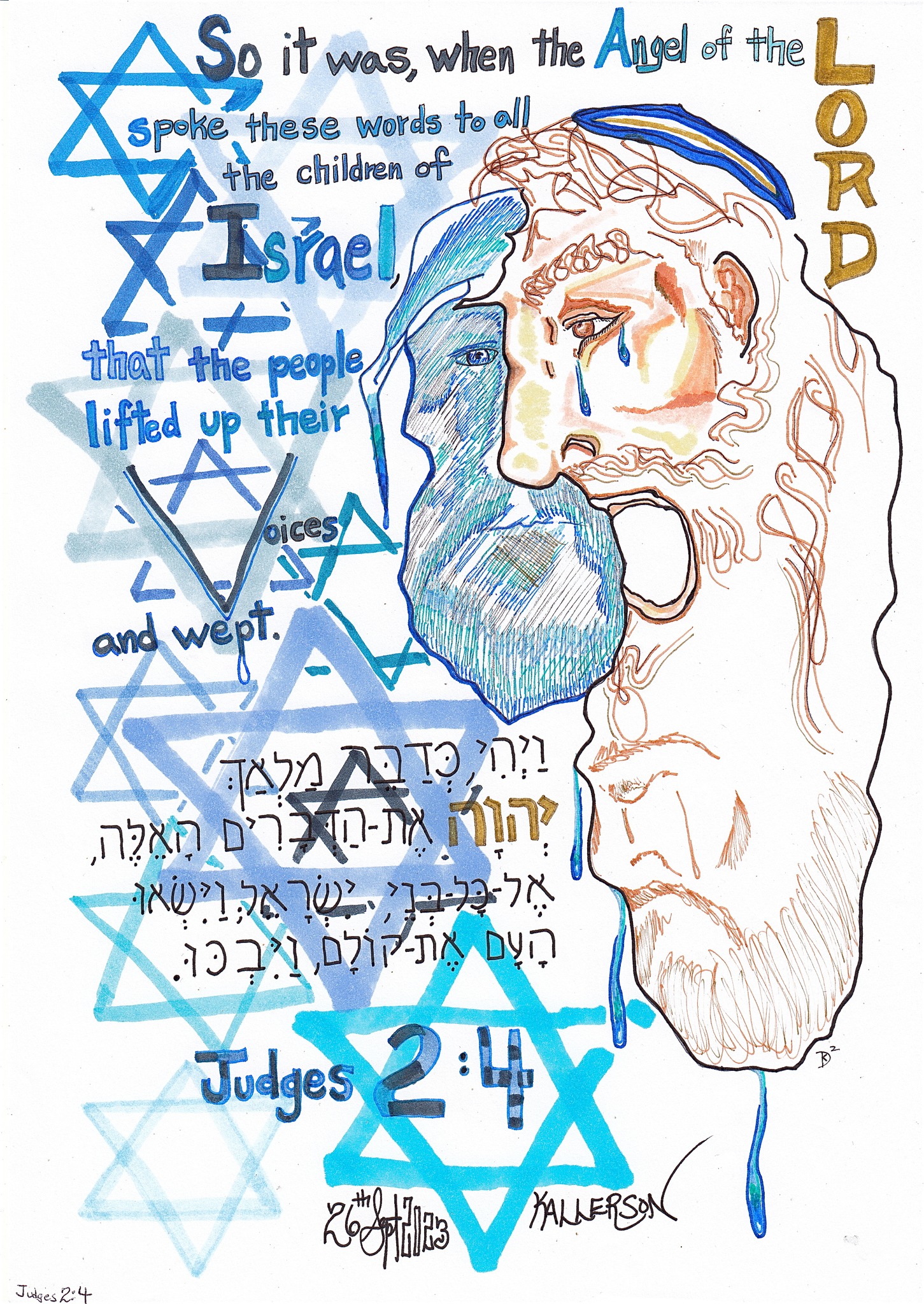
4 So it was, when the Angel of the Lord spoke these words to all the children of Israel, that the people lifted up their voices and wept.
Rather, it is a single voice that is raised: “And it was, according to speaking messenger Yehovah the words, the these, unto all sons Israel, and lifted the people their voice and wept.” The people speak with a united voice. This explains the name given to the location.
Using the word bakah, the words say: vayisu ha’am eth qolam vayivku – “and lifted the people their voice and wept.” There are many weepers lifting a united voice. Thus, ha’bokhim means the weepers.
These events now being recorded, but actually belonging at the time of Joshua, would explain why he was faithful in his time after the events of Joshua 9 with the Gibeonites. It would also explain why he was adamant to instruct Israel in his farewell addresses to the leaders and the people. It would further explain why he made a covenant before the Lord concerning this issue –
“So Joshua made a covenant with the people that day, and made for them a statute and an ordinance in Shechem.
26 Then Joshua wrote these words in the Book of the Law of God. And he took a large stone, and set it up there under the oak that was by the sanctuary of the Lord. 27 And Joshua said to all the people, ‘Behold, this stone shall be a witness to us, for it has heard all the words of the Lord which He spoke to us. It shall therefore be a witness to you, lest you deny your God.’ 28 So Joshua let the people depart, each to his own inheritance.” Joshua 24:25-28
And more, it would explain why this account is given right after the opening chapter of Judges. It sets the tone for everything that follows. Despite the lesson at Gibeon, despite the protestations of Joshua, and the covenant that was made, the failures that lie ahead are marked out by the example and the warnings that were so carefully presented during the life of Joshua.
5 Then they called the name of that place Bochim;
As noted in verse 1, the name of the place is derived from what occurred in verse 4: vayiqreu shem ha’maqom ha’hu bokhim – “and called name the place, the it, Weepers.”
The Concise Bible Dictionary goes one step further and states the obvious for us, saying, “Bochim symbolically is not simply ‘weepers,’ but ‘weepers over disobedience.’” That is correct.
Cambridge, as they usually do, tears things apart in an attempt to look smarter than they are. They say, “such a form as Bochim, active ptcp. plur., is very unusual in a place-name, and it has probably been adapted to suit the present occasion.”
They completely miss the point of what is being said. The name is to be a reminder to the people of the cost of disobedience which these people were weeping over. Therefore, it next says…
5 (con’t) and they sacrificed there to the Lord.
vayizb’khu sham l’Yehovah – “And sacrificed there to the Lord.” Either this was at Shiloh or it was at Gilgal. Those are the two locations where it was noted that the tabernacle was located in Joshua. As verse 1 said that the messenger of Yehovah came up from Gilgal, it appears that this is where the event occurred.
Therefore, the sacrifices were conducted at the tabernacle in order to atone for their wrongdoing and to restore a right and propitious relationship with the Lord. They had made a covenant with the people of Gibeon instead of destroying them and tearing down their altars. In their heartfelt repentance and sacrifices, the Israelites sought to be restored to the Lord. Next, it says…
6 And when Joshua had dismissed the people, the children of Israel went each to his own inheritance to possess the land.
vayshalakh Yehoshua eth ha’am vayelkhu bene Yisrael ish l’nakhalato la’resheth eth ha’arets – “And sent Joshua the people. And went sons Israel man to his inheritance to possess the land.” It is the same thought as that which closed Joshua 24 –
“And sent, Joshua, the people; man to his inheritance” (CG).
This supports the idea that the previous verses occurred at the time of Joshua 9. The narrative sums up the faithfulness of Joshua after the events at Gibeon.
No other such thing is recorded during the entire time of his leadership. The error was identified, the sacrifices were made, and the warning was heeded. The words in this verse are closing out the life of Joshua just as did the words of Joshua 24. That is why the next three verses are included in this narrative now…
7 So the people served the Lord all the days of Joshua,
The words here are identical to Joshua 24:31 with the exception of the first two words in the Hebrew –
Joshua 24:31 – And served Israel Yehovah all days Joshua.
Judges 2:7 – And served the people Yehovah all days Joshua.
7 (con’t) and all the days of the elders who outlived Joshua,
The words here are letter for letter identical to Joshua 24:31 with the exception the spelling of Joshua’s name –
Joshua 24:31 – יהושע
Judges 2:7 – יהושוע
Judges 2 adds in a vav, the sixth letter of the Hebrew aleph-beth. Out of over 200 references to Joshua, the only other time this vav is seen in Joshua’s name is in Deuteronomy 3:21. Six represents man, especially fallen man. In Joshua, he was being used a type of Christ. Here, he is being represented as a fallen man needing to sacrifice. It would explain the difference in spelling.
7 (con’t) who had seen all the great works of the Lord which He had done for Israel.
There is much more variation in the corresponding clause in Joshua 24:31 –
Joshua 24:31: and who had known all work Yehovah which He had done to Israel.
Judges 2:7: who had seen all work Yehovah, the great, which He had done to Israel.
There is an intimacy in what the people had known in Joshua. There is the visible experience in what the people had seen according to Judges. The work of the Lord is also noted as great in Judges.
8 Now Joshua the son of Nun, the servant of the Lord, died when he was one hundred and ten years old.
It is letter for letter identical to the corresponding clause of Joshua 24:29.
9 And they buried him within the border of his inheritance at Timnath Heres,
There is one significant difference in these words and the corresponding words of Joshua 24:30 –
Joshua 24:30 – “And they buried him in border his inheritance in Timnath Serakh.”
Judges 2:9 – “And they buried him in border his inheritance in Timnath Kheres.”
The words are the same letters, but the first and last are transposed:
Joshua 24:30 – סרח
Judges 2:9 – חרס
Timnath Serah means Extra Portion. Timnah Heres means Portion of the Sun. The name of the place in Joshua typologically referred to the full scope of Christ’s work as noted in Isaiah 49:6. His work includes not only Israel but the Gentiles as well, making the effect of it the Extra Portion.
In Judges, this typology is not needed and the name of the place is called Portion of the Sun. The earthly Joshua would find his portion in the Sun of Righteousness, who is Christ (Malachi 4:2).
9 (con’t) in the mountains of Ephraim, on the north side of Mount Gaash.
The words are identical to the corresponding clause in Joshua 24, with one exception –
Joshua 24:30: Which in Mount Ephraim from north to Mount Gaash.
Judges 2:9: In Mount Ephraim from north to Mount Gaash.
Noting these differences, we next read…
10 When all that generation had been gathered to their fathers,
v’gam kal ha’dor ha’hu neespu el avotav – “And also all the generation, the it, was gathered to its fathers.” This refers to verse 7, which spoke of those who outlived Joshua. At that time, when the last of that generation was gone…
10 (con’t) another generation arose after them
vayaqum dor akher akharehem – “And arose generation another after them.” The words are painfully ominous. After reading about the people serving the Lord, one can only wince at what he knows must be coming. It is the Bible’s way of introducing such things…
*10 (fin) who did not know the Lord nor the work which He had done for Israel.
More precisely, it reads, “which not did know Yehovah and also the work which He had done for Israel.” This explains the addition of the word “great” to the works of the Lord in verse 7. It reveals the contrast. His work was great, and yet the people did not remember His work. That sets the tone for what lies ahead.
Sons of God through faith in His promise
This is how the deal is sealed
One cannot be a doubting Thomas
And expect for his spirit to be healed
But if we trust in what God has done
If we hold fast to the promise
Believing in the word concerning His Son
He our fears will take and calm us
Then all good things will come to us
God will be pleased with the faith we possess
Yes, if we place our trust in the Lord Jesus
And Him as Lord we do confess
This is what God would ask of you
This is what He expects you to do
II. An Explanation of the Typology
Despite the detailed wording of these verses, the typology is brief and not overly complicated. I am confident that the story belongs chronologically at the time of Joshua 9, but it would have been inappropriate to the tenor of Joshua to include this in the book where he so poignantly pictures Christ.
However, it is included in Judges to show us the effects of the work of Christ after its completion.
A messenger came from the Gilgal, the Liberty, to the weepers. The messenger is not identified. He is simply a messenger of the Lord. He reminds the people of what the Lord had done. He speaks on behalf of the Lord in the first person. This unnamed messenger is typical of the Bible.
The Lord had said He would bring the people up from Egypt (Double Trouble). That typologically is bringing us out of the bondage of sin. Man is born in sin, and he cannot redeem himself. Thus, he is in double trouble.
He then said He would bring the people up to a land which He swore to their fathers. The land of Canaan is typical of being saved, something that the Lord said He would do for His people.
He also said that He would never break His covenant with them. It is typical of eternal salvation. Despite Israel’s rejection of Him, He has never broken this word to them. Likewise, despite our turning from Him, He will never break His word to us.
From there, He reminded the people that they were not to make covenants with the inhabitants of the land and they were to tear down their altars. However, Israel had not heeded His voice. Likewise, many of those saved by the Lord don’t heed the voice of His word.
And so, just like Eve in the Garden and just like Israel with the Gibeonites, the Lord would ask us, “What this you (all) have done?” Further, He notes that with this attitude, He will not drive out the enemies before the people.
If we don’t know the Bible, there is no way we can defeat the enemy. The Lord will not work through those who are disobedient and who do not apply His word to their lives. For example, it is one thing to claim the spiritual armor of Ephesians 6, and it is another to actually know what the words are speaking of and how to apply them.
Instead, the Lord tells them that the inhabitants will be “to your sides,” meaning thorns in their sides. We can trust in our own abilities, or we can rely on the Lord. Even the apostle Paul understood this –
“And lest I should be exalted above measure by the abundance of the revelations, a thorn in the flesh was given to me, a messenger of Satan to buffet me, lest I be exalted above measure. 8 Concerning this thing I pleaded with the Lord three times that it might depart from me. 9 And He said to me, “My grace is sufficient for you, for My strength is made perfect in weakness.” Therefore most gladly I will rather boast in my infirmities, that the power of Christ may rest upon me. 10 Therefore I take pleasure in infirmities, in reproaches, in needs, in persecutions, in distresses, for Christ’s sake. For when I am weak, then I am strong.” 2 Corinthians 12:7-10
The fiery darts of the wicked one (Ephesians 6:16) will not be overcome when we are not living rightly before the Lord and when we are not clearing out what is improper from our lives.
Next, it noted that all the people lifted their voices and wept. How many revivals in church history reflect what is stated here? Churches are dead, believers have left their first love, and then they come to their senses. It is the state of the church at any given time when their failure to adhere to the Lord becomes evident.
And more, it is the state of any person who truly understands his salvation or who remembers his salvation after turning back to the Lord. As for Israel, they called the place Weepers. However, as the Concise Bible Dictionary said it, these are weepers over disobedience.
Until we identify and acknowledge our failures before the Lord, we cannot properly turn to, or back to, Him. Upon realizing the error of their ways, the people made a sacrifice to the Lord. If it is a new believer, the sacrifice is accepting Jesus. If it is one turning back to the Lord, David gives the appropriate sacrifice –
“The sacrifices of God are a broken spirit,
A broken and a contrite heart—
These, O God, You will not despise.” Psalm 51:17
The last verses of the passage today were sufficiently explained in Joshua 24, but the differences were noted and explained. Our text verse noted that things continuously repeat. This is true in both the world and in the people of God.
We keep turning from the Lord, the Lord initiates the process of restoration, and for those who accept it, God forgives and heals. He accepts our faith because it is truly all we have to offer Him. Even loving God is an act of faith because we have not seen Him. We receive His word by faith, and we fall head over heels for Him by faith.
Let us remember the lesson of Israel, and instead of falling into disobedience, let us remain faithful to the Lord all our days. But let us also remember that when we fail Him, He has promised to never leave us or forsake us.
Israel has been kept through thousands of years of failure. And because of Jesus, we – His people – are in Christ. Therefore, He will keep us through each and every failure. Praises be for the love of God that is found in Jesus Christ our Lord.
Closing Verse: “Now may our Lord Jesus Christ Himself, and our God and Father, who has loved us and given us everlasting consolation and good hope by grace, 17 comfort your hearts and establish you in every good word and work.” 2 Thessalonians 2:16, 17
Next Week: Judges 2:11-15 This is what happens when people are not productive and get bored… (Evil in the Sight of the Lord) (6th Joshua Sermon)
The Lord has you exactly where He wants you. He has a good plan and purpose for you. It is He who judges His people according to their deeds. So, follow Him, live for Him, and trust Him, and He will do marvelous things for you and through you.
The Weepers
Then the Angel of the LORD came up from Gilgal to Bochim
———-and said:
“I led you up from Egypt and to the land brought you
Of which I swore to your fathers; and I said
‘I will never break My covenant with you, so it is true
And you shall make no covenant with the inhabitants of this land
You shall tear down their altars, but you were quite remiss
And you have not obeyed My voice
Why have you done this?
Therefore I also said
‘I will not drive them out before you, this I will not do
But they shall be thorns in your side
And their gods shall be a snare to you
So it was, when the Angel of the LORD
Spoke these words to all the children of Israel
That the people lifted up their voices and wept
They knew things would not go well
Then they called the name of that place Bochim
And they sacrificed there to the LORD, an offering from their hand
And when Joshua had dismissed the people, the children of Israel
Went each to his own inheritance to possess the land
So the people served the LORD all the days of Joshua
And all the days of the elders who outlived Joshua
———-during that whole spell
Who had seen all the great works of the LORD
Which He had done for Israel
Now Joshua the son of Nun
A man who was strong and bold
The servant of the LORD
Died when he was one hundred and ten years old
And they buried him within the border
Of his inheritance at Timnath Heres, where he did abide
In the mountains of Ephraim
On Mount Gaash’s north side
Then all that generation had been gathered to their fathers
Another generation arose (and it is a sad story to tell)
After them who did not know the LORD
Nor the work which He had done for Israel
Lord God, turn our hearts to be obedient to Your word
Give us wisdom to be ever faithful to You
May we carefully heed each thing we have heard
Yes, Lord God may our hearts be faithful and true
And we shall be content and satisfied in You alone
We will follow You as we sing our songs of praise
Hallelujah to You; to us Your path You have shown
Hallelujah we shall sing to You for all of our days
Hallelujah and Amen…
Then the Angel of the Lord came up from Gilgal to Bochim, and said: “I led you up from Egypt and brought you to the land of which I swore to your fathers; and I said, ‘I will never break My covenant with you. 2 And you shall make no covenant with the inhabitants of this land; you shall tear down their altars.’ But you have not obeyed My voice. Why have you done this? 3 Therefore I also said, ‘I will not drive them out before you; but they shall be thorns in your side, and their gods shall be a snare to you.’ ” 4 So it was, when the Angel of the Lord spoke these words to all the children of Israel, that the people lifted up their voices and wept.
5 Then they called the name of that place Bochim; and they sacrificed there to the Lord. 6 And when Joshua had dismissed the people, the children of Israel went each to his own inheritance to possess the land.
7 So the people served the Lord all the days of Joshua, and all the days of the elders who outlived Joshua, who had seen all the great works of the Lord which He had done for Israel. 8 Now Joshua the son of Nun, the servant of the Lord, died when he was one hundred and ten years old. 9 And they buried him within the border of his inheritance at Timnath Heres, in the mountains of Ephraim, on the north side of Mount Gaash. 10 When all that generation had been gathered to their fathers, another generation arose after them who did not know the Lord nor the work which He had done for Israel.