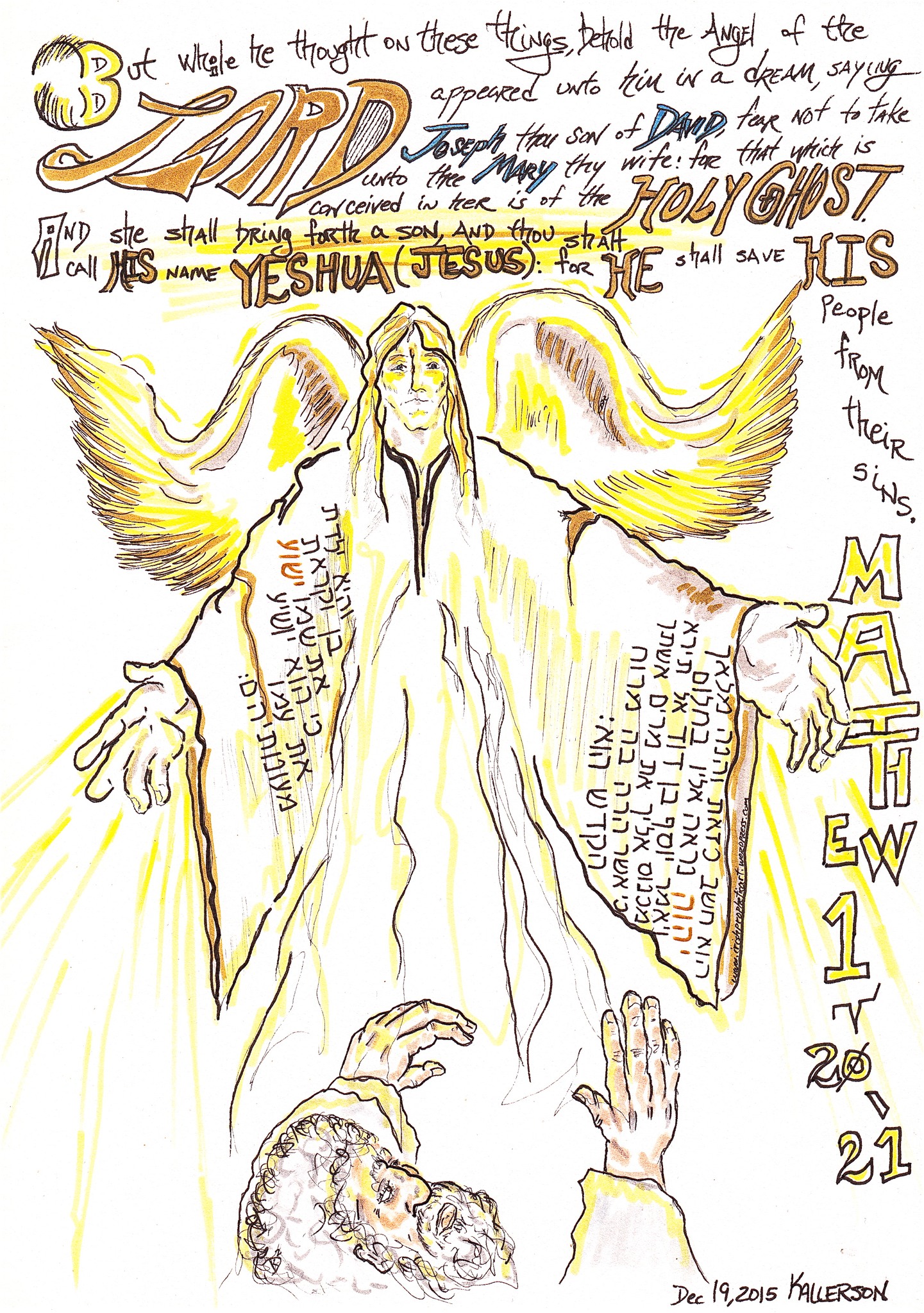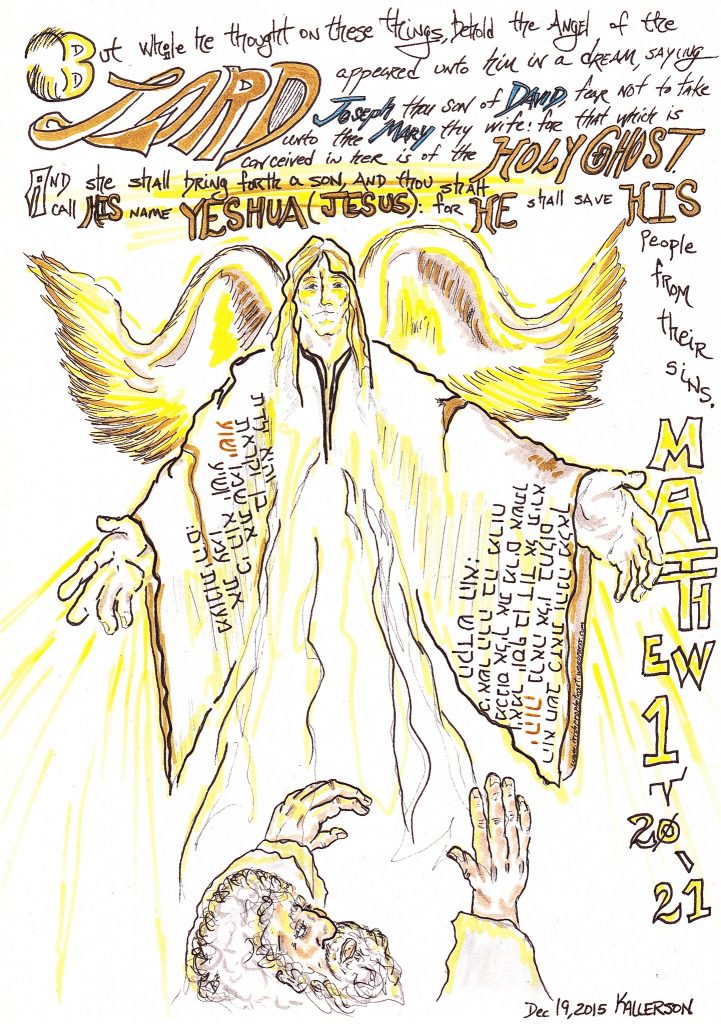
Artwork by Douglas Kallerson
Matthew 1:21
You Shall Call His Name JESUS
Read Matthew 1:18-25. The old saying “You can’t see the forest for the trees” is true of many things in our daily lives. And it is certainly true in the spiritual life of man as well.
All over the world, there are “trees” that have been planted by people throughout the ages. They have actually stolen away man’s ability to perceive what the root of the problem between God and man is. Every new religion introduced is like a tree that man may look at and say, “This is the answer.”
And every offshoot of every religion only further blocks the view of the main issue. People go from tree to tree – or even from branch to branch – looking at what they can do to be pleasing to God, but the main subject, the overall forest, is never considered.
The same is also true with the Bible. The Bible talks about salvation, and so we will also talk about it today. But what people think about salvation as defined in the Bible can be as far from the main issue as are the teachings of Buddha.
This doesn’t mean there is anything wrong with the contents of the Bible. Rather, it means that the focus is on a lesser point and it, therefore, misses the main point. To ensure that would not be the case with the announcement to Joseph of the coming of Jesus, the angel was clear, precise, and succinct in his words.
There is one main subject, a problem, that is addressed by the Bible that needs to be tended to. And there is one Man who came to tend to it.
Text Verse: “So when this corruptible has put on incorruption, and this mortal has put on immortality, then shall be brought to pass the saying that is written: ‘Death is swallowed up in victory.’
55 ‘O Death, where is your sting?
O Hades, where is your victory?’
56 The sting of death is sin, and the strength of sin is the law. 57 But thanks be to God, who gives us the victory through our Lord Jesus Christ.” 1 Corinthians 15:54-57
Paul’s words get to the heart of the issue and they tell what the effect of dealing with that issue is. If it isn’t dealt with, a completely different outcome will be the result. All of this is minutely explained in the Bible. We just need to make sure that the main issue isn’t obscured.
Once it is seen for what it is, then understanding the remedy for it is the most wonderful thing a person can ever grasp. We look at the cross and we know that Jesus died for us, but we may not appreciate the magnitude of the event.
God Himself was willing to deal with the problem so that we could be handed the blessing. The story of the crucifixion and resurrection of Jesus is the most important story in human history. It is so important that God has put the total focus of His word on this event.
And so, it is good for us to come together each year and highlight this most magnificent occurrence. There is passion, pain, and death involved, and there is a price that God did not need to pay. And yet, He voluntarily accomplished this through Jesus Christ in order to bring us back to Himself.
May we consider this and remember, with awe and appreciation, what occurred when Jesus was nailed to the cross of Calvary, when He was buried, and when He rose again. Let’s consider this most incredible event in all of human history.
The revealing of the majesty and perfection of God in Christ is to be found in His superior word. And so, let us turn to that precious word once again, and… May God speak to us through His word today, and may His glorious name ever be praised.
I. Conceived of the Holy Spirit
Does it seem odd that on Resurrection Day we would begin with the birth announcement of Jesus? But considering that the words in Matthew 1 are the first recorded words in the New Testament of one individual speaking to another, and considering that those words explain the nature of and reason for Jesus’ coming, it should no longer seem surprising.
Of His nature, the text is clear. The child in Mary’s womb was conceived of the Holy Spirit, meaning the Spirit of God. How the Spirit is presented in Scripture should lead a person to no other conclusion. The Holy Spirit is the Spirit of God. For example, it says in Genesis 1 –
“In the beginning God created the heavens and the earth. 2 The earth was without form, and void; and darkness was on the face of the deep. And the Spirit of God was hovering over the face of the waters.” Genesis 1:1, 2
The Spirit of God is who God is. But more, He is God made known in an expressible way. To get an understanding of this, we can evaluate the word translated as spirit. In Hebrew, it is ruakh. Being translated as “spirit,” one would think it is used specifically in reference to the spirit of a being, be it God, man, or animal.
But the word is variously translated. It means wind, breath, and spirit, and is also translated other ways depending on the context. The same is true with the Greek word pneuma. It is also translated as wind, breath, and spirit.
If one thinks of breath, that is an extension of the life of a person. A person without breath is dead. Wind is an extension of something else. There wouldn’t be wind unless something caused it to go forth. These physical expressions of the words ruakh and pneuma are given to help us understand what is being conveyed when we consider what the spirit of a being is.
A review of the phrase “my spirit” from the Old Testament gives us insights into what is being said concerning the spirit of man or of God. The spirit of man can be afflicted (Job 7:11), it can be entrusted to another (Psalm 31:5), it can seek out something (Isaiah 26:9), etc. Such descriptions are expressions of who the person is, what the person is feeling, and so on.
The same is true with God. In Genesis 1, the Spirit of God is God expressing Himself as He hovered over the face of the waters. The word translated as hovered comes from a root signifying “to brood.” It was as if God was fluttering over His creation, beginning to express Himself in it.
This would be the first note of what we term General Revelation in Scripture. This is a way of God expressing Himself in the creation so that we can understand things about Him, meaning what He is like.
In Genesis 6:3, the Lord said, “My Spirit shall not strive with man forever.” The words reveal an expression of God, telling us of His nature toward the wickedness of man. In 2 Samuel 23, it says –
“Now these are the last words of David.
Thus says David the son of Jesse;
Thus says the man raised up on high,
The anointed of the God of Jacob,
And the sweet psalmist of Israel:
2 ‘The Spirit of the Lord spoke by me,
And His word was on my tongue.’” 2 Samuel 23:1, 2
This means that the Spirit of the Lord was expressing Himself through David. It is an example of Special Revelation, a way of the Lord specially revealing Himself. It is something that cannot be known or deduced from General Revelation, but it must be imparted by God directly from Himself.
Thus, the term Holy Spirit is referring to the Spirit of God, but it is expressing the Spirit of God in a particular manner. The word qodesh, or holy, signifies sacredness and apartness.
A sanctuary is set apart as a place for the things of God. Holy people are to be set apart from what is common or profane. Thus, the Holy Spirit is the sacredness and apartness of God in relation to other things. For example, after David sinned, he wrote this –
“Create in me a clean heart, O God,
And renew a steadfast spirit within me.
11 Do not cast me away from Your presence,
And do not take Your Holy Spirit from me.” Psalm 51:10, 11
The Holy Spirit had been imparted to David, but because of his sin, he was concerned that God would remove Himself, meaning His Spirit, from him. As noted before, the Spirit of God is who God is. In asking for God to not take His Holy Spirit from him, David was asking Him to not remove the expression of His presence from him.
As God is omnipresent, He cannot actually be removed from David in the absolute sense. But it is the special presence and expression of Himself that had been imparted to David that he was concerned with.
Now we come full circle to the statement of the angel to Joseph, “that which is conceived in her is of the Holy Spirit.” The sacredness and apartness of God’s Spirit, this special presence of God, is the instrument of conception in the womb of Mary.
The word used to describe this is the verb gennaó. It means to beget; to procreate a descendant. It is the same word used 40 times in the genealogical listing from Matthew 1:2-16, one person begetting the next, beginning with Abraham and ending with Jesus.
In Matthew 1:20, we have something similar to, but far more intimate than what was said in Genesis 1:2. There, God was hovering over the waters, preparing to express Himself in the creation in a general way.
However, in Matthew 1:20, God’s Holy Spirit would actually beget a Child. This, then, is not General Revelation but Special Revelation. God is personally and intimately revealing Himself to the world in a unique way. Luke’s record of the account provides another point of view –
“The Holy Spirit will come upon you, and the power of the Highest will overshadow you; therefore, also, that Holy One who is to be born will be called the Son of God.” Luke 1:35
In understanding these things, we can then make several logical deductions concerning what is being said. It is the heart of what God is telling us in this word:
- Mary, the mother of Jesus, is a human being. As all things beget after their own kind (Genesis 1), then this Child is a human being.
- The Holy Spirit, the sacredness and apartness of God, is the Father of this Child. As all things beget after their own kind, then this Child is God.
These are obvious conclusions that can and must be made from what we are being told in the text. This coming Child, who had been prophesied since the very beginning of man’s need for Him, is to be God incarnate; the God/Man.
To say otherwise would be to ignore the very purpose of using the word gennaó 40 times in a row, from Abraham to Jesus. The 40th time, it said, “And Jacob begot Joseph the husband of Mary, of whom was born Jesus who is called Christ” (Matthew 1:16).
The wording plainly indicates that Jesus was born of Mary, but it in no way implies that He was begotten of Joseph. Rather, He is begotten of the Holy Spirit and of Mary. Despite the clear and unambiguous meaning of what is conveyed there, the nature of Jesus Christ, being the God/Man, is often denied as such.
But the record stands and it is verified in Matthew’s words which explain what the angel had told Joseph –
“So all this was done that it might be fulfilled which was spoken by the Lord through the prophet, saying: 23 ‘Behold, the virgin shall be with child, and bear a Son, and they shall call His name Immanuel,’ which is translated, ‘God with us.’” Matthew 1:22, 23
The type was given to direct us to the Antitype. Someone would be named Immanuel, indicating that the parents believed that God was with them and their people. However, the prophecy, anticipating the fulfillment in the Messiah, wasn’t merely indicating that God was with the people in a general way, but in a specific way.
These words are not being used as a name but as an explanation of the nature of Jesus, the One conceived of the Holy Spirit. God entered into a special relationship with His creation, meaning humanity, uniting with it. The magnitude and importance of this are then realized in what Jesus was born to do…
You are He who took me out of the womb
And You have been with me all the way
You shall deliver me from the tomb
Death will be defeated in that day
I was cast upon You from birth
And from my mother’s womb, You have been my God
To You, O King of infinite worth
The nations shall stream and the peoples applaud
You are enthroned in the praise of Israel
They cried to You and were delivered in that day
Now to the nations, this story we tell
That You, O God, have provided the way
II. He Will Save His People
The reason why we want to focus on the conception and birth of Jesus is to explain the life of Jesus. John said in his gospel narrative –
“And there are also many other things that Jesus did, which if they were written one by one, I suppose that even the world itself could not contain the books that would be written. Amen.” John 21:25
As John wrote an entire gospel about Jesus, and as he concluded his gospel with these words, we can conclude that Jesus did a great deal of things. But everything recorded about Jesus had to have an initial reason for it to be.
How would you explain what God was going to do in the Person of Jesus as that initial thought? We find the answer right in the text itself. After the angel explained that Jesus would be both God and human, he continued by saying He would be a male. “And she will bring forth a Son.”
Until this point, Joseph could not have known that. All he could have known was that Mary was pregnant and yet she claimed she was a virgin and that her Child would be the Son of God. Joseph obviously didn’t believe this, because the Bible says that he was minded to “put her away secretly.”
However, with the angel’s words to Joseph, the matter is now settled. He would be both a human male and the Son of God. And, as a summary of what He would come to do, the brief words of the angel continue, saying, “and you shall call His name JESUS, for He will save His people.”
The name is designated by God to reflect the nature of the Person. In Greek, the name is IESOUS, but the name would have been conveyed to Joseph in Hebrew, YESHUA.
This needs to be explained though. The Greek name Iesous is transliterated from the Hebrew Yehoshua or Joshua. That is derived from the divine name YHVH and yasha which means to save. Combined the name means The Lord is Salvation.
However, it is generally (but not universally) accepted that the shortened form of Yehoshua was what the angel spoke to Joseph, YESHUA. This simply means He Will Save. Thus, as often occurs in the Bible at the naming of a child, a pun is made: “and you shall call His name He Will Save, for He will save His people.”
An obvious question that arises is, “What do the words ‘His people’ signify?” It could be speaking of a person belonging to a group, such as, “Charlie is an American.” Or it could be referring to a group belonging to another, such as, “These are God’s people.” For example, the latter is used in Luke 1 –
“And you, child, will be called the prophet of the Highest;
For you will go before the face of the Lord to prepare His ways,
77 To give knowledge of salvation to His people
By the remission of their sins.” Luke 1:76, 77
The answer, based on a reading of the New Testament, must be the latter. For example, John says –
“He was in the world, and the world was made through Him, and the world did not know Him. 11 He came to His own, and His own did not receive Him. 12 But as many as received Him, to them He gave the right to become children of God, to those who believe in His name: 13 who were born, not of blood, nor of the will of the flesh, nor of the will of man, but of God.” John 1:10-13
These and other verses show us that “His people” is referring to those who belong to Him. As He is God, it is referring to any who are God’s through Him. Though this is inclusive of Israel, it is not limited to them. As Paul says –
“What if God, wanting to show His wrath and to make His power known, endured with much longsuffering the vessels of wrath prepared for destruction, 23 and that He might make known the riches of His glory on the vessels of mercy, which He had prepared beforehand for glory, 24 even us whom He called, not of the Jews only, but also of the Gentiles?
25 As He says also in Hosea:
‘I will call them My people, who were not My people,
And her beloved, who was not beloved.’
26 ‘And it shall come to pass in the place where it was said to them,
“You are not My people,”
There they shall be called sons of the living God.’” Romans 9:22-26
Unless Joseph was a true scholar of the words of Scripture, he probably would not have known such references as Paul cites, but it was revealed at various times in the Jewish Scriptures, such as Job’s inclusion in the Hebrew Old Testament even though he was a Gentile. Isaiah stated it even more explicitly –
“And now the Lord says,
Who formed Me from the womb to be His Servant,
To bring Jacob back to Him,
So that Israel is gathered to Him
(For I shall be glorious in the eyes of the Lord,
And My God shall be My strength),
6 Indeed He says,
‘It is too small a thing that You should be My Servant
To raise up the tribes of Jacob,
And to restore the preserved ones of Israel;
I will also give You as a light to the Gentiles,
That You should be My salvation to the ends of the earth.’” Isaiah 49:5, 6
Understanding these things, that Jesus is God incarnate and that He came to save His people, we are left with a final thought to consider from the words of the angel…
What a wonderful, marvelous thing that God has done
He has brought us back to Himself this day
Through the giving of Jesus, His only begotten Son
We have the smooth path; He has paved the way
In Him is found life and length of days
To Him we look and call out His name
To God, through Jesus, we shall give all our praise
He has removed our guilt and taken away our shame
Praise God all you saints of His, praise Him today!
Rejoice in the marvelous thing that He has done
God Himself has made the way
Through the precious gift of Jesus, His only begotten Son
III. From Their Sins
The idea of salvation can mean various things in Scripture. One can be saved from his enemies in battle, or saved from oppression, or from famine, violence, injustice, or death.
Because the Hebrew writings focus so much on salvation from such physical things as these, and because the writings are so heavily focused on the people of Israel, it would be only natural for them to assume that the Lord was going to send the Messiah to deliver them in such a manner.
But the underlying problem that Scripture focuses on, and which the many battles and trials of Israel only typologically represented, is the problem of sin. Standing back and taking a global look at Scripture, this becomes perfectly evident.
The first problem introduced in Scripture is sin. The reason for the destruction of the entire world apart from Noah and his family was sin. The introduction of the Law of Moses was to highlight sin.
Detailing the conquest of Canaan and the eradication of the inhabitants in the land was because of their sin. The record of the judges, kings of Israel, and the people continuously highlights their lives in relation to sin. The writings of the prophets regarding the state of the people time and again were to highlight their sin.
It is the primary issue found in Scripture when properly considered. If the angel came to Joseph and told him that the Child would save His people and stopped there, Joseph would probably have thought, “Israel is going to be freed from her enemies!”
Those who ruled over them, physically oppressed them, and of whom they were afraid in many ways, would have been on the mind of Joseph and anyone else within Israel.
The angel could not just say that this Child would save them. Rather, he had to explain what that meant, because a greater enemy stood against the people. The angel’s explanation comes in four words in the Greek which equate to three words in our translation – apo tōn hamartiōn autōn, “from their sins.”
The Child was sent to save His people from their sins. This is what God directed the angel to say –
“Joseph, son of David, do not be afraid to take to you Mary your wife, for that which is conceived in her is of the Holy Spirit. 21 And she will bring forth a Son, and you shall call His name Jesus, for He will save His people from their sins.” Matthew 1:20, 21
And that is all he said. If Joseph sat down and thought about the magnitude of those words, he would have been as amazed as we are today. God was entering into the stream of human existence in order to save His people from their sins.
The reason why this is such an incredible statement is because Israel was ostensibly saved from their sins. The Law of Moses provided for that. How could they need to be saved from their sins if the law, at least in part, was intended to save them?
To this day, observant Jews look at the law as fully capable of doing this. And, unfortunately, many people in supposed Christian churches believe this as well. If that was true, the record of Israel’s history would have been completely different.
In fact, there would have been no need for a Messiah. Israel, through the law, would have been the Messiah. The promises of the Law of Moses tell of the exaltation of Israel for obedience. Does one need a Messiah if already in a place of exaltation?
One only needs a Messiah to be saved. Who needs to be saved if sin is dealt with, the people are secure and free from oppression, and they have been accepted by God?
This was an ideal of the law that was never realized. Hence, Israel anticipated the coming of a Messiah. But their thoughts concerning Him and His coming were skewed. They failed to consider the first words concerning sin recorded in Scripture –
“And the Lord God commanded the man, saying, ‘Of every tree of the garden you may freely eat; 17 but of the tree of the knowledge of good and evil you shall not eat, for in the day that you eat of it you shall surely die.’” Genesis 2:16, 17
Sin results in death. Man sinned and thus he died. The spirit of the man was separated from God, spiritual death. Man’s separation from God led to physical death. If the Law of Moses could correct that, then people would no longer die. That is even explicitly stated in the law itself –
“You shall therefore keep My statutes and My judgments, which if a man does, he shall live by them: I am the Lord.” Leviticus 18:5
But every person in Israel who was there at the giving of the law died. And every person since that time also died. Thus, they needed salvation from sin that the law could not provide, at least not by themselves. It is this thought that highlights the enormity of what God in Christ would do.
Suppose someone under the law actually did what the law demanded, year after year, never sinning. He fulfilled every precept of the law on his own. Would that be sufficient to save Israel? No, he would only save himself.
The same is true if lots of people never sinned under the law: They would only be able to save themselves. And their lives under the law would only continue until they sinned, at which time, they would die. Thus, they wouldn’t have really saved themselves. Rather, they would have merely prolonged their existence.
But more, there is the problem of original sin. Suppose a person didn’t sin under the law for a long, long time. If he confusedly thought, I am tired of living under the law and so I am going to die by my own hand so that I don’t have to live under the law anymore, then he would obviously not continue to live.
But more, he would not come back to life free from the constraint of the law. This is because he did, in fact, have original sin. He may have lived a long time because he never broke the law, but he would remain dead (spiritually separated from God), because of the sin in him that occurred apart from the law.
Paul explains how this is by using the example of someone who was never under the law –
“Therefore, just as through one man sin entered the world, and death through sin, and thus death spread to all men, because all sinned— 13 (For until the law sin was in the world, but sin is not imputed when there is no law. 14 Nevertheless death reigned from Adam to Moses, even over those who had not sinned according to the likeness of the transgression of Adam, who is a type of Him who was to come.” Romans 5:12-14
So because of sin death reigned in all men until the time of Moses. With the introduction of the Mosaic Law, a provision for life was given, but if that life ended, the original sin in him still kept that person from restoration with God, and thus, from resurrecting.
All of this is tied up in the angel’s words that Jesus would save His people from their sins. We know this is so because it has already been established that “His people” is referring to those who are His through what He would accomplish, not merely the nation of Israel.
God Himself would have to enter into the stream of human existence in order to save His people. In this occurrence, the Child to be born would cut the line of sin that began in Adam. He would be born without sin.
As He was born to Mary, the espoused bride of Joseph, He was born under the law. Think on that for a moment! The law that He gave to Israel, and which no person under that law had been able to fulfill – attested to by their continued deaths – is the burden that He placed Himself under.
As He was born without sin, He could – like Adam – potentially live forever. Unlike Adam, however, he didn’t have one simple command to obey. Rather, He had the entire Mosaic Code to live out without erring, even once.
As long as He continued to do this, He would not die (meaning spiritual death leading to physical death) because, as Leviticus 18:5 noted, the man who did the things of the law would live. This was the task set before Him.
This, then, is the purpose of the gospels. They are not merely provided to show us what Jesus came to do, but what He did. They are a written testimony to the life of the sinless perfection of Jesus Christ. So confident was He in this that He told it to Israel –
“I am the good shepherd. The good shepherd gives His life for the sheep. 12 But a hireling, he who is not the shepherd, one who does not own the sheep, sees the wolf coming and leaves the sheep and flees; and the wolf catches the sheep and scatters them. 13 The hireling flees because he is a hireling and does not care about the sheep. 14 I am the good shepherd; and I know My sheep, and am known by My own. 15 As the Father knows Me, even so I know the Father; and I lay down My life for the sheep. 16 And other sheep I have which are not of this fold; them also I must bring, and they will hear My voice; and there will be one flock and one shepherd.
17 Therefore My Father loves Me, because I lay down My life that I may take it again. 18 No one takes it from Me, but I lay it down of Myself. I have power to lay it down, and I have power to take it again. This command I have received from My Father.” John 10:11-18
If Christ laid down His life knowing that He had the power to take it again, then He knew that He was in a state of sinless perfection. And more, He didn’t just say that He would lay down His life, but that He would do it for His sheep. The meaning is obvious: His death would be for rescuing their lives.
He was telling them that the Law of Moses, with its inability to save the people from death, was only a foreshadowing of what He came to do.
In His perfect life and subsequent death, the law would be considered fulfilled in Him. This could not be the case with a person who bore original sin. His eventual death would bear the stain of that original sin.
Jesus, on the other hand, died in sinless perfection, fulfilling the law. In this fulfillment, God – through Him – offers a New Covenant. What is behind this thought requires a thorough study of the book of Hebrews, but Chapter 7:11-28 gives the gist of it.
Within those verses, the most precise explanation is found in verses 11-19 –
“Therefore, if perfection were through the Levitical priesthood (for under it the people received the law), what further need was there that another priest should rise according to the order of Melchizedek, and not be called according to the order of Aaron? 12 For the priesthood being changed, of necessity there is also a change of the law. 13 For He of whom these things are spoken belongs to another tribe, from which no man has officiated at the altar.
14 For it is evident that our Lord arose from Judah, of which tribe Moses spoke nothing concerning priesthood. 15 And it is yet far more evident if, in the likeness of Melchizedek, there arises another priest 16 who has come, not according to the law of a fleshly commandment, but according to the power of an endless life. 17 For He testifies:
‘You are a priest forever
According to the order of Melchizedek.’
18 For on the one hand there is an annulling of the former commandment because of its weakness and unprofitableness, 19 for the law made nothing perfect; on the other hand, there is the bringing in of a better hope, through which we draw near to God.” Hebrews 7:11-19
This is the error in thinking possessed by observant Jews and those Gentiles who put themselves under the Law of Moses. They reject the only hope for rescue from sin. Sin is the problem. All of the other things we think we need deliverance from are merely a part of a fallen world.
We think we need rescue from enemies, from debt, from an abusive father, a tedious job, or whatever else is harming a hoped-for state of contentment. But it is sin, leading to death, that we need deliverance from. Without that, there can never be a state of contentment in our lives.
This is what God came to do when He united with humanity in the person of Jesus Christ. And this is what He offers to anyone who will accept the premise that He has done just that.
Entrance into the New Covenant is what brings freedom from sin, and it can only be obtained through Christ Jesus’ death, burial, and resurrection. It makes no sense to assume that God has made any other path to restore man to Himself. This is why Jesus said, “I am the way, the truth, and the life. No one comes to the Father except through Me” (John 14:6).
Sin! Sin is the problem. If sin is not addressed, then there can be no restoration. But God in Christ has made the way available for us. He Himself has dealt with the sin issue, and all He asks is for us to believe, as is stated in 1 Corinthians 15:3, 4 –
- Christ died for our sins according to the Scriptures.
- Christ was buried.
- Christ rose again the third day according to the Scriptures.
This is the message that we proclaim. God in Christ has done it. He alone prevailed over sin because He had no sin. And He offers His sinless perfection to anyone who will come to Him by faith. In Christ is:
- The gift of God. A gift cannot be earned.
- The grace of God. Grace is unmerited favor.
- The mercy of God. He withholds what we deserve because it has already been meted out in the crucifixion of Jesus.
In Jesus’ dying humanity, God poured out His wrath on all the sins of mankind.
Think of it! In the flood of Noah, the entire world was destroyed because of God’s wrath at sin. And yet, that outpouring was insufficient to do what the cross of Jesus Christ accomplished. An entire world full of people perished and yet the sin debt remained unpaid. But in the giving of Jesus, it is finished. The proof of that is an empty tomb and a risen Savior.
Thank God for Jesus Christ our Lord. May we submit to Him and be cleansed according to the promise of God that is realized in the Lord Jesus Christ. He has saved His people from their sins. Hallelujah and Amen.
Closing Verse: “Behold! The Lamb of God who takes away the sin of the world!” John 1:29
Next Week: Joshua 19:10-16 You will probably be amazed when the sermon is done… (The Inheritance of Zebulun) (39th Joshua Sermon)
The Lord has you exactly where He wants you. He has a good plan and purpose for you. It is He who has defeated the enemy and who now offers His people rest. So, follow Him and trust Him and He will do marvelous things for you and through you.
A Celebration of the Resurrection of Jesus Christ
This is the gospel which was preached to you
It is also the one you received and on which you stand
It is the gospel of salvation, providing life that’s new
And which will carry you to the promised Holy Land
What is delivered to you is what was before received
That Christ died for our sins according to God’s word
He was buried and He rose, and so we have believed
And many witnesses testify to this message you have heard
Now, if Christ is preached that He is risen from the dead
How can some among you say the resurrection isn’t true?
If there is no resurrection after Christ was crucified and bled
Then our faith as well as yours is certainly askew
And if so, we are found false witnesses of God
Because we have wrongly testified of this mighty deed
And our faith is futile, no heavenly streets we’ll trod
And we are still dead in our sins; fallen Adam’s seed
Even more, those who have fallen asleep in the Lord are gone
And we are the most pitiable creatures the world could ever look upon
But indeed, Christ is risen from the dead
He is the Firstfruits of those who have fallen asleep
And as death came through one man, Adam, our federal head
So Christ will make all alive; our souls He will keep
There is an order to the Resurrection call
Christ was first, the pattern for the rest when He comes
When He does, He will make a shout out to us all
And we will rise as if to the sound of heavenly battle drums
Then comes the time, when He delivers the kingdom to the Father
When all rule, authority, and power have come to an end
The last enemy to be destroyed is death, never more to bother
Then the Son will to the Father eternal rule extend
But you ask, “What will we be like after our time of sleep?
After we have been buried in corruption’s pit so deep?”
Our body is sown in dishonor, but it will be raised in glory
It is sown in weakness, but raised in power – the resurrection story
The first man Adam became a living being, it is true
The last Adam became a life-giving Spirit, life to me and you
And as was the man of dust, created so long ago
So are those likened unto him, also made of dust
And as is the Man, the Lord from heaven, you know
That we shall bear His image for eternity just as we’ve discussed
Flesh and blood cannot inherit the kingdom of God
Nor can corruption inherit that which is incorrupt
Be we shall all be changed, and so, heavenly streets we’ll trod
In the twinkling of an eye, the change will be abrupt
When the last trumpet sounds, we will be taken to glory
We shall all be changed, completion of the gospel story
Where O Death, O where is your sting?
When Christ our Savior, us to Himself does He bring
Where O Hades, O where is your victory?
When Christ translates His children to eternal glory
The sting of death is sin, and the strength of sin the law
But thanks be to God who gives us victory through our Lord
My beloved brethren be steadfast in all you’ve heard and saw
And cling confidently to God’s eternal word
Know for certain that your labor is not in vain
Be of good cheer, Christ is coming again
Hallelujah and Amen…