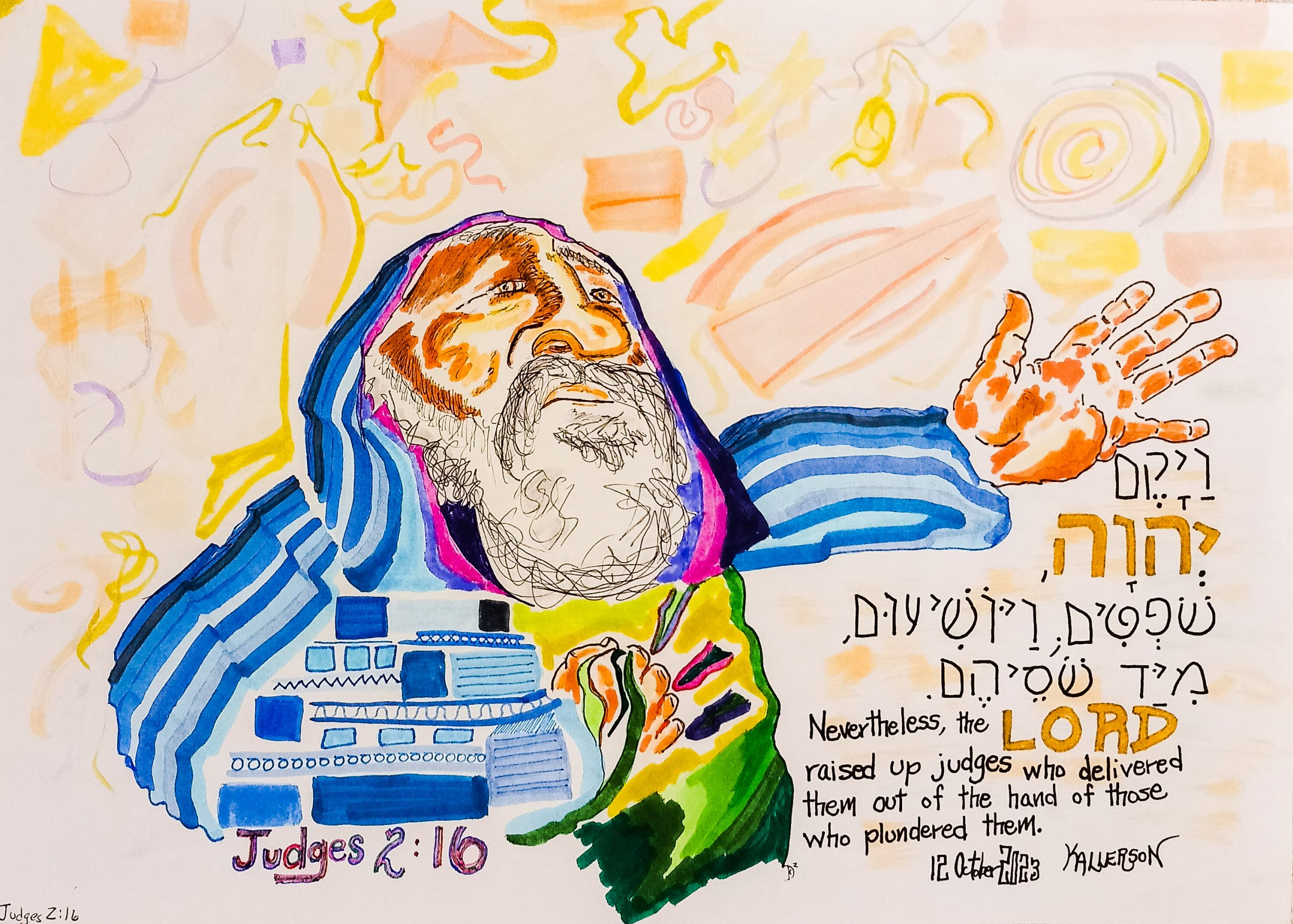
Artwork by Douglas Kallerson.
Judges 2:16-23
The Lord Was Moved to Pity
In past sermons, we have highlighted the literary form known as a chiasm. That is a device where a series of thoughts is presented in an order. There is then usually an anchor, a main verse, on which the chiasm turns.
After that anchor, the text turns around and says the same thing in reverse, repeating each previous thought as it goes. Such a device helps explain what is going on and why things are happening in the greater story being presented.
Another useful tool the Bible employs is called parallelism. This device uses successive verbal constructions in the text that are parallel, such as grammatical structure, meter, meaning, sound, etc.
The passage today uses parallelism between verses 16 & 17 and 18 & 19. The structure helps unlock the thought process being presented –
* 16 And raised up, Yehovah, judges.
** 16 And delivered them from hand their plunderers.
X
*** 17 And also unto judges no listen.
17 for harloted after gods other, and bowed down to them.
% 17 They turned quickly [rebellion] from the way which walked their fathers.
17 To listen commandments Yehovah. No did thus.
———————————————–
* 18 And for raised Yehovah to them judges. And was Yehovah with the judge.
** 18 And delivered them from hand their enemies all days the judge.
X For sighs, Yehovah, from their groaning from faces their oppressors and their pushers.
*** 19 And it was in dying the judge, they turn back and corrupted from their fathers [they didn’t listen]
19 To walk after gods other, to serve them, and to bow down to them.
% 19 No cast from their practices and from their way the stubborn [rebellion].
Text Verse: “As the deer pants for the water brooks,
So pants my soul for You, O God.
2 My soul thirsts for God, for the living God.
When shall I come and appear before God?” Psalm 42:1, 2
One can easily see the parallelism in the psalm once the device is explained. The as/so gives an immediate parallel thought. Likewise, thirsting for is set in parallel to coming and appearing. There is the desire in both.
There are more parallels in the surrounding verses in Joshua 2. For example, it says in verses 2:14 and 2:20, vayikhar aph Yehovah b’yisrael – “And burned nostril Yehovah in Israel.”
Following these similar words can help eliminate confusion, explaining what otherwise seems a giant heap of seemingly indiscernible thoughts that have no cohesion with one another.
Chapter 2 of Judges is like a bridge between the book of Joshua and what lies ahead in Judges. Things that appear to have been intentionally left out of Joshua are explained here. Things that will occur in Judges are first noted here. Paying heed to the connecting words and thoughts will help bring the narrative into focus.
As for Christological typology, there is not much revealed in our verses today. Despite this, they definitely show us the need for a Savior. Where Israel is shown to fail, we know that Jesus – the greater Israel – prevailed.
The Bible is making a point about the world’s need for a Messiah. Israel is being used to show us this. Such great truths are to be found in His superior word. And so, let us turn to that precious word once again, and… May God speak to us through His word today, and may His glorious name ever be praised.
I. The Lord Raised Up Judges (verses 16-19)
16 Nevertheless, the Lord raised up judges
vayaqum Yehovah shophtim – “And raised up, Yehovah, judges.” It is a key thought in the book as it sets the pattern for what will occur throughout it. As the people are humbled or as they depart from the Lord, Yehovah will raise up a judge who will attend to the particular matter that has arisen.
This is the first time that the word shophtim, or judges, is used in the book. The word comes from a primitive root meaning to judge. It has been seen in all of the books of the Bible so far, but this is the first time that it is used in the sense of a national hero filling the role designated by the Lord.
For example, it says in Deuteronomy 16 –
“You shall appoint judges and officers in all your gates, which the Lord your God gives you, according to your tribes, and they shall judge the people with just judgment.” Deuteronomy 16:18
That is not the type of judge referred to now in Judges. That was a person appointed by the people to handle matters of law within the community. Those referred to now are appointed by the Lord and are filled with the necessary endowments to meet the particular situation that has arisen within the land.
Unlike a king, they serve under the Lord without any power to make laws. Also, unlike a line of kings, there was no unbroken succession of judges. The Lord would raise up a hero, he would fulfill his time as the leader, and then someone else would eventually be selected as a judge to meet the next need of the people. Of them, Jamieson-Fausset-Brown correctly states that a judge…
“was usually accompanied by a special call, and the people seeing them endowed with extraordinary courage or strength, accepted them as delegates of Heaven, and submitted to their sway. Frequently they were appointed only for a particular district, and their authority extended no farther than over the people whose interests they were commissioned to protect. They were without pomp, equipage, or emoluments attached to the office. They had no power to make laws; for these were given by God; nor to explain them, for that was the province of the priests—but they were officially upholders of the law, defenders of religion, avengers of all crimes, particularly of idolatry and its attendant vices.”
In this role, and under the authority of the Lord, they are those…
16 (con’t) who delivered them out of the hand of those who plundered them.
Rather, it reads, “and delivered them from hand their plunderers.” This thought will occasionally be seen throughout the book. The nation will turn from the Lord, He will allow them to be plundered, and when they cry out to Him, he will send a judge to remedy their plight.
An immediate example of everything thus far described is seen in the first judge to be named in the next chapter –
“So the children of Israel did evil in the sight of the Lord. They forgot the Lord their God, and served the Baals and Asherahs. 8 Therefore the anger of the Lord was hot against Israel, and He sold them into the hand of Cushan-Rishathaim king of Mesopotamia; and the children of Israel served Cushan-Rishathaim eight years. 9 When the children of Israel cried out to the Lord, the Lord raised up a deliverer for the children of Israel, who delivered them: Othniel the son of Kenaz, Caleb’s younger brother. 10 The Spirit of the Lord came upon him, and he judged Israel. He went out to war, and the Lord delivered Cushan-Rishathaim king of Mesopotamia into his hand; and his hand prevailed over Cushan-Rishathaim. 11 So the land had rest for forty years. Then Othniel the son of Kenaz died.” Judges 3:7-11
Unfortunately, just as they failed to heed the Lord, they failed to heed their judges…
17 Yet they would not listen to their judges,
v’gam el shophtim lo shameu – “And also unto judges no listen.” The word “listen” signifies to hear and obey like it does when we say, “Go to your room! You didn’t listen to me.” The people may have heard, but they did not attend to what they heard…
17 (con’t) but they played the harlot with other gods,
ki zanu akhare elohim akherim – “for harloted after gods other.” Throughout Scripture, idolatry is considered as spiritual adultery. Israel was wed to the Lord, and they have turned from Him.
The judge was selected to bring the people’s attention back to the Lord and what He had done or would do for the people. Despite that, they constantly fell into idolatry, turning away from Him. In turning to other gods, it next says…
17 (con’t) and bowed down to them.
The words are in violation of the Ten Commandments – “You shall have no other gods before Me” (Exodus 20:3). Included in that thought, it also said, “you shall not bow down to them nor serve them” (Exodus 20:5). Rather than hearing and obeying…
17 (con’t) They turned quickly from the way in which their fathers walked, in obeying the commandments of the Lord;
The word “obeying” is the same word just used in the first clause, meaning to listen and obey. The judge was given as the representative of the Lord. He would instruct the people in the way of their fathers. The law would be presented as it had been in times past. And yet, no sooner had they heard, then they turned away, failing to obey.
17 (con’t) they did not do so.
lo asu ken – “no did thus.” These words set up what follows. In other words, this is a negative clause. The next verses will contain the word ki, meaning for or when, which reiterates the sequence of events just presented…
18 And when the Lord raised up judges for them,
Based on the negative clause that ended the last words, in this instance the word ki is more appropriately translated as “for” instead of “when.” It reads: v’ki heqim Yehovah lahem shophtim – “And for raised Yehovah to them judges.”
The word qum means to arise, stand up, stand, etc. However, it carries with it the thought of establishment, as in, “I will establish [qum] my covenant with you…” The Lord raises up [qum] the judge from the people, and He causes him to stand as his representative. In this capacity…
18 (con’t) the Lord was with the judge
Rather, it says, “and was Yehovah with the judge.” The judge that was established before the Lord had the Lord with him. It wasn’t just that the Lord put the guy in charge and let him run things. Instead, the judge represented the Lord, who is the Leader of the people. In this capacity, it says…
18 (con’t) and delivered them out of the hand of their enemies all the days of the judge;
The judge is the instrument by which the Lord accomplished the deliverance. Thus, it is not the judge who was to be credited for the deliverance. If one reads the narrative today, or if one talks about what occurred, this is often what is presented. “Samson delivered Israel from the Philistines.”
Rather, it should read, “The Lord delivered the Philistines by the hand of Samson.” This is the proper way of considering what is presented throughout the book of Judges. He is the One who selects, directs, and empowers the judge to act. This is based on the next words…
18 (con’t) for the Lord was moved to pity by their groaning
ki yinakhem Yehovah minaaqatam – “For sighs, Yehovah, from their groaning.” The word nakham is variously translated here: moved to mercy, repented, moved to pity, took pity, relented, etc. It comes from a primitive root signifying to sigh, as when one breathes heavily.
This word is used to describe the action of the Lord. And yet, elsewhere, it says –
“God is not a man, that He should lie,
Nor a son of man, that He should repent [nakham].
Has He said, and will He not do?” Numbers 23:19
One could say then that there is a contradiction in Scripture. Regardless of the translation, it says in Numbers that the Lord does not nakham and yet it says here in Judges 2 that He does nakham. The matter has to be considered by the limitation of language and what gets lost in translation.
Using the word nakham while applying it to the Lord is a literary device known as an anthropomorphism. It is taking human attributes and ascribing them to the Lord. God is Spirit, he doesn’t actually sigh, but there needs to be a way to describe what the Lord is doing and why He is doing it. In the Song of Moses, it says –
“For the Lord will judge His people
And have compassion [nakham] on His servants,
When He sees that their power is gone,
And there is no one remaining, bond or free.” Deuteronomy 32:36
The Lord had covenanted with Israel. He promised to protect them and to deliver them forever. However, He also promised that they would be judged and punished for their actions. He would not simply let them go about disgracing His name.
Therefore, a word is chosen to describe the action of the Lord that man can relate to, even if it cannot literally be applied to the Lord. If someone is given a giant bolder to break into little rocks, the conversation after a few hours may go like this –
“You are really getting at that old bolder.”
“Yes, he is feeling the pain of the sledgehammer today.”
The rock isn’t feeling anything, but we are ascribing to it a personality and human characteristic that makes the action understandable. Likewise, the Lord is effecting His purposes upon Israel while both keeping them as His people and yet while accomplishing His promised judgments upon them at the same time.
As time and human history is moving forward, the Lord is working through Israel to teach the world a lesson about how He deals with humanity in anticipation of the coming and returning of the Messiah. This lesson is being presented to us through the nation of Israel.
As for the Lord’s response to their groaning, it is…
18 (con’t) because of those who oppressed them and harassed them.
mipne lokhatsehem v’dokhaqehem – “from faces their oppressors and their pushers.” Both words are derived from roots meaning “to press.” The first, lakhats, is quite often translated as oppress. The other is a new and rare word, dakhaq, found only here and Joel 2 –
“Before them the people writhe in pain;
All faces are drained of color.
7 They run like mighty men,
They climb the wall like men of war;
Every one marches in formation,
And they do not break ranks.
8 They do not push [dakhaq] one another;
Every one marches in his own column.
Though they lunge between the weapons,
They are not cut down.” Joel 2:6-8
The idea is that the enemy pushes into Israel to oppress them, and they push out on Israel, thrusting them away. The Lord allows this to correct them, but He also ends it to preserve them. In this, they are a microcosm of what happened at the flood of Noah.
The Lord allowed the world to be destroyed because of their wickedness. And yet, the Lord saved the world of man through the flood by preserving Noah. Everything that occurs is to uphold His word, first to the world of man as stated in Genesis 3:15, and then to the nation of Israel as seen in Exodus 34:10-28.
Proper fellowship, service, and worship of the Lord is the aim of the redemptive narrative. That is ultimately found in our relationship with Jesus, the promised One. Each step in Scripture is to bring the world to this understanding.
As for Israel and their immediate relationship with the Lord, the narrative continues, saying…
19 And it came to pass, when the judge was dead, that they reverted
v’hayah b’moth ha’shophet yashuvu – “And it was in dying the judge they turn back.” What seems implied by this, and which is generally borne out by the rest of the book, is that the appointment of a judge was for his entire life.
The judge was given to lead the people in the way of their fathers. They were to follow his leading. However, this was based on his leadership, not based upon their allegiance to the Lord. As soon as the judge died, the people would turn back from the way he had led…
19 (con’t) and behaved more corruptly than their fathers,
v’hishkhitu m’avotam – “and corrupted from their fathers.” The meaning of “from” is obtained from the context. In this case, it means “more than their fathers.”
In other words, if their fathers were corrupt, they corrupted from (more than) them. Each judge would turn them back to the Lord’s way, but then each time the judge died, the people would become increasingly more corrupt than their ancestors…
19 (con’t) by following other gods, to serve them and bow down to them.
la’leketh akhare elohim akherim l’avedam u-l’hishtakhoth lakhem – “to walk after gods other, to serve them, and to bow down to them.” Instead of the serving and bowing down to Yehovah who delivered them and who kept His covenant promises with them, they would be faithfully unfaithful and turn to those gods that never did a thing for them. In this repetitive pattern…
19 (con’t) They did not cease from their own doings nor from their stubborn way.
lo hipilu mimaalehem u-mi’darkam ha’qashah – “No cast from their practices and from their way the hard.” The word qashah is translated in various ways, but it generally signifies hard or severe. In this case, one can look back to Exodus 32:9 where it is used in conjunction with the neck –
“And the Lord said to Moses, “I have seen this people, and indeed it is a stiff-necked people!” Exodus 32:9
The people who were called stiff-necked by the Lord at the time of Moses remained stubborn at the time of the Judges. In fact, increasingly more so. Therefore, there would be consequences.
The same terminology is used in these verses as was stated in the warning to the leaders of Israel in Joshua 23 –
“When you have transgressed the covenant of the Lord your God, which He commanded you, and have gone and served other gods, and bowed down to them, then the anger of the Lord will burn against you, and you shall perish quickly from the good land which He has given you.” Joshua 23:16
Those words of Joshua are now beginning to come true…
Who can find the end of God’s grace?
Who can say, “It goes this far, but no further does it go!”?
Can you this attribute of God erase?
The answer comes back as a resounding “No!”
What God has done is because of who He is
When He grants salvation, it is a gift – handed out to you
He will never take it back; He is not in that biz
His word stands firm because He is Faithful and True
Praise be to God who does not forget His word
But sends it forth as a testimony of His mercy and grace
To the ends of the earth, His message is heard
And those who come to Jesus, will see a smile upon His face
II. Through Them I May Test Israel (verses 20-23)
20 Then the anger of the Lord was hot against Israel;
vayikhar aph Yehovah b’yisrael – “And burned nostril Yehovah in Israel.” It is the natural and inevitable consequence of the people’s stubborn rebellion. The Lord fumes at their conduct and determines to take corrective measures because of it…
20 (con’t) and He said, “Because this nation has transgressed My covenant which I commanded their fathers,
More precisely, it reads as stated in Joshua 23 – “And said, because which crossed over the nation, the this, My covenant which I commanded their fathers.” The nation of Israel is in a covenant relationship with the Lord. Their fathers had agreed to it with their mouths, and the Lord subsequently gave the commandments of the covenant to them.
However, they crossed over that covenant, as if they had removed themselves from it. He had spoken the words of the agreement, expecting compliance, not just from the fathers, but from all subsequent generations. Here, the Lord notes Israel had crossed over…
20 (con’t) and has not heeded My voice,
v’lo shamu l’qoli – “and no listened to my voice.” As before, the word “listen” means to both hear and to obey. They had failed to do so. As such…
21 I also will no longer drive out before them any
gam ani lo osiph l’horish ish mipenehem – “Also I, no will add to dispossess man from their faces.” Of this, Keil incredibly says, “The Lord said, ‘Because this people has transgressed my covenant, … I also will no longer keep my covenant promise … and will no more drive out any of the remaining Canaanites before them.’”
There is never a time that the Lord will say, “I will no longer keep my covenant promise.” It is impossible for Him to violate His own word. Rather, this is exactly what He said to the people. He is simply fulfilling His covenant promises –
“But if you do not drive out the inhabitants of the land from before you, then it shall be that those whom you let remain shall be irritants in your eyes and thorns in your sides, and they shall harass you in the land where you dwell. 56 Moreover it shall be that I will do to you as I thought to do to them.” Numbers 33:55, 56
When the people respond in obedience to the word of the Lord, He keeps His covenant promises to be with them, bless them, prosper them, etc. When they fail to uphold their side of the covenant, He keeps His covenant promises to turn from them, to bring the curses of the covenant upon them, and to bring them to ruin.
It is Israel, not the Lord, who changes in relation to the covenant. To this day, much of the church has not figured this out, just like national Israel. Because of the people’s conduct, the Lord would not drive out even a man from before them…
21 (con’t) of the nations which Joshua left when he died,
Rather – “from the nations which Joshua left; and he died.” The meaning is derived from what was recorded in Chapter 1. The land was sufficiently subdued by Joshua for the people to receive their inheritance. It was their job to continue to wipe out the inhabitants after assuming their land grants.
However, they failed to do this, thus turning from the Lord. As such, the Lord says that He would no longer dispossess these people…
22 so that through them I may test Israel, whether they will keep the ways of the Lord, to walk in them as their fathers kept them, or not.”
The words are rather difficult, and so a paraphrase is needed to get what is being conveyed. However, even with paraphrasing the words, further explanation is needed.
First, it doesn’t say, “I may test.” The previous verses contain a quote from the Lord. However, these words probably are not a continuation of that. Instead, this appears to be an explanation from the chronicler as to what the quote means.
Second, a verb is being used as a noun to describe the hoped-for obedience of the people.
Literally, it reads, “To end purpose testing in them Israel, the keepers – they – way Yehovah, to walk in them, according to which listened their fathers, if not.”
By the Lord leaving the inhabitants in the land, Israel is being tested if they will be the keepers of the way (sg.) of the Lord or not. That is then defined as walking in them (pl.), meaning the commandments of the Lord, which are cumulatively seen as the way of the Lord, according to the manner which their fathers had walked.
The words are admittedly a bit confusing, but the intent is not impossible to determine despite a large amount of varying scholarly opinion. Testing Israel through the inhabitants is the stated purpose for the matter.
However, the reason here is in relation to keeping the ways of the Lord. On the other hand, the same word, nasah, is used again in Judges 3:1 where, on the surface, the test seems to be for an entirely different purpose. That will be seen in a minute. For now, the test is in relation to obedience. As such, it next says…
23 Therefore the Lord left those nations,
vayanakh Yehovah eth ha’goyim ha’eleh – “And rested Yehovah the nations the these.” The word translated as “left” is not the same as in verse 2:21. There, it was the word azav, to leave, but in the sense of giving up on it. The Bible says a man shall leave his father and mother, uniting to his wife. He forsakes what is past. Joshua’s death meant that he could no longer pursue them.
Here, the word is yanakh, to leave alone, lay down, etc. It comes from the same root as nuakh, to rest. He is removing His hand from them at the time, not coming after them as before. Instead, they would be laid up within the land, but not necessarily permanently.
It is the same word that will be used in Judges 3:1 –
“Now these are the nations which the Lord left [yanakh], that He might test Israel by them, that is, all who had not known any of the wars in Canaan 2 (this was only so that the generations of the children of Israel might be taught to know war, at least those who had not formerly known it), 3 namely, five lords of the Philistines, all the Canaanites, the Sidonians, and the Hivites who dwelt in Mount Lebanon, from Mount Baal Hermon to the entrance of Hamath.” Judges 3:1-3
These nations have been laid up according to the purpose of the Lord…
23 (con’t) without driving them out immediately;
l’bilti horisham makher – “to except dispossessing them quickly.” The word “quickly” explains the situation for now. Verse 2:21 seems to indicate the Lord would no longer drive out the nations at all. However, that was a reaction to the nation passing over the covenant. In a state of disobedience, they would not be driven out.
However, the words of Chapter 3 show that Israel will be tested and taught to know war through them. As Israel turned to the Lord in faithfulness, it could be expected that the Lord would be with them to learn war and to drive out the inhabitants. It is the driving out of the inhabitants that proves obedience. Therefore, the word “quickly” allows for this. Finally…
*23 (fin) nor did He deliver them into the hand of Joshua.
v’lo nathanam b’yad Yehoshua – “and no gave in hand Joshua.” This tells us that withholding the inhabitants at the time of Joshua was purposeful. This goes back to what was explained in Chapter 2.
It was argued that the timing of those events was when Israel made a covenant with the inhabitants of Gibeah. In doing so, they had not obeyed the voice of the Lord. They failed to check with Him prior to making that covenant.
An unfortunate part of going through this narrative is that many translators take the simple prefix meaning “and,” and they translate it as “but,” “therefore, “so,” “then,” “when,” “nevertheless,” etc. In doing this, they insert their presuppositions into the text. As such, it makes it much harder to determine what is actually going on.
For example, these paragraphs are not necessarily chronological. But by saying, “then,” the reader assumes they are. In saying “so” or “nevertheless,” it makes it seem like one thing is a consequence of the other. This may not be the case at all.
Looking at these verses word by word helps open up what is going on. I could be wrong about the placement of Joshua and the treaty with Gibeon being tied into these verses in Judges (that we looked at last week), but those things happened at some point during the life of Joshua.
As nothing else in the book of Joshua even hints at the failings of the people, apart from the account of Achan, it is a reasonable, and even likely, conclusion that the assumption is correct. This necessary connection was left out of Joshua to highlight him as a type of Christ.
On the other hand, including that account now is given to highlight the tender mercy of the Lord in relation to the stubborn nature of Israel. We cannot learn the lesson of the law, it being a tutor to lead us to our need for Jesus, unless we understand how the failures of Israel demonstrate this.
We have seen that in the first two chapters of Judges. That will continue in a new way now that we have crossed this bridge, meaning Chapter 2 of Judges. It’s exciting to think of what lies ahead in the rest of the book, but that doesn’t compare – in the slightest – to what lies ahead for those who have called on Jesus.
He is the Subject of the Bible. He is to be the Object of our affections. He is the Way to be reconciled to God. Jesus is the point and purpose of everything we encounter in this wonderful word. That may not be seen explicitly in passages such as the one today, but it is there, nonetheless. Everything is leading us to a greater understanding of our need for Him.
So be contemplative as you read the word. Consider what it says. Mull over what God is telling you about His Son. And be sure to thank Him often for His patience with you as you, like Israel, fail Him from time to time. Your trusting in, and obedience to, the Lord after your salvation is not unlike Israel’s.
The Lord has left us in a land that has been conquered, but in which there are still enemies, spiritual enemies, that will come against us. When we follow the Lord and His word, they are defeated. When we don’t, they are not. We are learning war through our testing in this land.
The land of Israel belonged to Israel. Heaven belongs to believers in Christ. But until the consummation of the redemptive plans of God, we remain in our battles, awaiting the culmination of what God has ultimately prepared for us – Israel in the millennium and the church in glory.
Like Israel, the Lord will never leave you. He has covenanted with you through the cross, and He will never fail to uphold His side of that deal. Hold fast to that wonderful news. God in Christ has brought us back to Himself, and that comes with a guarantee. Let us continue in the battle we face until the day that is consummated.
Closing Verse: “They did not destroy the peoples,
Concerning whom the Lord had commanded them,
35 But they mingled with the Gentiles
And learned their works;
36 They served their idols,
Which became a snare to them.” Psalm 106:34-36
Next Week: Judges 3:1-11 It’s really swell, he got the approval nudge… (Othniel, Israel’s First Judge) (8th Judges Sermon)
The Lord has you exactly where He wants you. He has a good plan and purpose for you. It is He who judges His people according to their deeds. So, follow Him, live for Him, and trust Him, and He will do marvelous things for you and through you.
The Lord Was Moved to Pity
Nevertheless, the LORD raised up judges who delivered them
Out of the hand of those who plundered them in every town
Yet they would not listen to their judges
But they played the harlot with other gods, and to them
———-bowed down
They turned quickly from the way
In which their fathers walked, so we know
In obeying the commandments of the LORD
They did not do so
And when the LORD raised up judges for them
The LORD was with the judge and delivered them
———-in country and city
Out of the hand of their enemies all the days of the judge
For the LORD was moved to pity
By their groaning because of those who oppressed them
And harassed them in every city, even Jerusalem
And it came to pass, when the judge was dead
That they reverted and more corruptly behaved
Than their fathers, by following other gods
To serve them and bow down to them, for other gods they slaved
They did not cease from their own doings from day to day
Nor from their stubborn way
Then the anger of the LORD was hot against Israel
And He said, “Because this nation has transgressed
My covenant which I commanded their fathers
And has not heeded My voice as I addressed
I also will no longer drive out before them
Any of the nations, so to you I tell
Which Joshua left when he died
So that through them I may test Israel
Whether they will keep the ways of the LORD, giving them a shot
To walk in them as their fathers kept them or not
Therefore the LORD
Left those nations, so we understand
Without driving them out immediately
Nor did He deliver them into Joshua’s hand
Lord God, turn our hearts to be obedient to Your word
Give us wisdom to be ever faithful to You
May we carefully heed each thing we have heard
Yes, Lord God may our hearts be faithful and true
And we shall be content and satisfied in You alone
We will follow You as we sing our songs of praise
Hallelujah to You; to us Your path You have shown
Hallelujah we shall sing to You for all of our days
Hallelujah and Amen…
16 Nevertheless, the Lord raised up judges who delivered them out of the hand of those who plundered them. 17 Yet they would not listen to their judges, but they played the harlot with other gods, and bowed down to them. They turned quickly from the way in which their fathers walked, in obeying the commandments of the Lord; they did not do so. 18 And when the Lord raised up judges for them, the Lord was with the judge and delivered them out of the hand of their enemies all the days of the judge; for the Lord was moved to pity by their groaning because of those who oppressed them and harassed them. 19 And it came to pass, when the judge was dead, that they reverted and behaved more corruptly than their fathers, by following other gods, to serve them and bow down to them. They did not cease from their own doings nor from their stubborn way.
20 Then the anger of the Lord was hot against Israel; and He said, “Because this nation has transgressed My covenant which I commanded their fathers, and has not heeded My voice, 21 I also will no longer drive out before them any of the nations which Joshua left when he died, 22 so that through them I may test Israel, whether they will keep the ways of the Lord, to walk in them as their fathers kept them, or not.” 23 Therefore the Lord left those nations, without driving them out immediately; nor did He deliver them into the hand of Joshua.