Judges 3:12-23
Ehud, Judge of Israel, Part I
The day before I typed this sermon, there was a spat between a Republican congressman and a former Trump campaign staff person, Lizzie Marbach. She tweeted, “There’s no hope for any of us outside of having faith in Jesus Christ alone.”
This is what the Bible proclaims. Jesus Himself stated it precisely in today’s text verse. A Jewish congressman, Max Miller responded, “God says that Jewish people are the chosen ones, but yet you say we have no hope. Thanks for your pearl of wisdom today.”
Feeling the need to respond, I tweeted, “Congressman @MaxMillerOH, not being flippant or argumentative, but out of the hope that you will want to know more about Jesus (Yeshua), I would ask you to consider your words and reflect, ‘Chosen for what?’ The point and purpose of Scripture and Israel is to reveal the Messiah.”
Lizzie Marbach is right. The only hope for any is faith in Jesus Christ alone. Scripture makes this 100% clear. Congressman Miller is also right. The Jews are the chosen people, but for a purpose beyond themselves. Scripture is not about the Jewish people, even if they play a prominent role in it.
Jesus. He is the Subject of Scripture and without Him, the hope of returning to the presence of God will not be realized…
Text Verse: “Jesus said to him, ‘I am the way, the truth, and the life. No one comes to the Father except through Me.’” John 14:6
As for the contents of the passage today, they read like a super spy thriller. Something I didn’t know about history, but which Charles Ellicott enlightened me to, is that this is not the only such incident in history. Maybe having read this very passage, someone else followed a similar plan of attack –
“The assassination is exactly similar to that of Henry III. of France, by the Dominican monk, Jacques Clement, who had provided himself with a commission from a friend of the king: ‘On Tuesday, Aug. 1, at 8 a.m.,’ says L’Estoile, ‘he was told that a monk desired to speak with him. The king ordered him to be admitted. The monk entered, having in his sleeve a knife, unsheathed. He made a profound reverence to the king, who had just got up, and had nothing but a dressing-gown on, and presented him despatches from the Comte de Brienne, saying that he had further orders to tell the king privately something of importance. Then the king ordered those who were present to retire, and began reading the letter. The monk, seeing his attention engaged, drew his knife from his sleeve, and drove it right into the king’s small gut, below the navel, so home that he left the knife in the hole.’—Guizot, ‘Hist. of France,’ iii. 479.” Charles Ellicott
An interesting passage about a king getting whacked in his own cool chamber is to be found in God’s superior word. And so, let us turn to that precious word once again, and… May God speak to us through His word today, and may His glorious name ever be praised.
I. The Corpulent King (verses 12-18)
12 And the children of Israel again did evil in the sight of the Lord.
Rather than “again,” it says: v’yosiphu bene Yisrael la’asoth ha’ra b’ene Yehovah – “And added sons Israel to do the evil in eyes Yehovah.” It’s not just that they again did evil, but they added to the evil that had been done. It is as if a divine counter is weighing out the evil each time it is added.
This is actually the case, though the effect of it won’t be realized for hundreds of years. This is what it says in Leviticus –
“I will scatter you among the nations and draw out a sword after you;
your land shall be desolate and your cities waste.
34 Then the land shall enjoy its sabbaths as long as it lies desolate and you are in your enemies’ land;
then the land shall rest and enjoy its sabbaths.
35 As long as it lies desolate it shall rest—
for the time it did not rest on your sabbaths when you dwelt in it.” Leviticus 26:33-35
At the time of Jeremiah, the first exile took place, lasting seventy years. The adding of “the evil” is something that requires correction. Eventually, exile from the land is necessary to allow the land to be free from the wickedness of Israel.
Using the article before “evil” shows the severity of the offense against the Lord. They flagrantly do their wicked deeds right before His eyes, making it a personal attack against Him. Therefore…
12 (con’t) So the Lord strengthened Eglon king of Moab against Israel,
Better: v’khazeq Yehovah eth Eglon melekh moav al Yisrael – “And strengthened Eglon king Moab upon Israel.” Using the word al, upon, gives the sense of downward motion. The action is against Israel, as if Eglon is sitting upon them, squishing them oppressively.
Eglon is spelled the same as the city named Eglon in Joshua 10. It means Heifer-like, coming from egel, calf. But that comes from agol – round or circular because of how a calf dances around in a circle.
Moab means From Father. It is the name given to the son born to the union of Lot with his firstborn daughter –
“The firstborn bore a son and called his name Moab; he is the father of the Moabites to this day.” Genesis 19:37
This king of Moab has been strengthened by the Lord to come down upon Israel…
12 (con’t) because they had done evil in the sight of the Lord.
al ki asu eth ha’ra b’ene Yehovah – “upon for did the evil in eyes Yehovah.” The clause uses al, upon, again. It also uses the same term, the evil, as the first clause. Eglon was brought upon Israel because they had brought upon evil in the Lord’s eyes.
The Lord’s actions are shown to be exactingly in response to Israel’s actions. There is nothing arbitrary, vindictive, or unfair in Him strengthening Eglon. It is because Israel is the Lord’s people that He has taken this action.
Eglon is not strengthened because he is the leader of the Lord’s people, but because he is the enemy of them and, thus, the correcting force to be used against them. In order for this to come about, it next says…
13 Then he gathered to himself the people of Ammon and Amalek,
vayeesoph elav eth bene amon va’amaleq – “And gathered unto him sons Ammon and Amalek. While Israel was adding “the evil” to their account, Eglon was gathering together his military strength.
Ammon means something like A People. They are close relations to the Moabites. They descend from the union between Lot and his younger daughter –
“And the younger, she also bore a son and called his name Ben-Ammi; he is the father of the people of Ammon to this day.” Genesis 19:38
Ben Ammi means Son of My People. This is shortened to Ammon, A People. Ammon lived in the area north of Moab east of the Jordan.
Amalek is derived from the word am, or people, and malaq, which means to nip or wring off the head of a bird with or without severing it from the body. Thus, they are The People Who Wring Off. They are those who are disconnected from the body and strive to disconnect the body.
Amalek consisted of clans descending from Edom that were spread throughout the area. They were the first to attack Israel after the Exodus, and the Lord swore war against them –
“Then the Lord said to Moses, ‘Write this for a memorial in the book and recount it in the hearing of Joshua, that I will utterly blot out the remembrance of Amalek from under heaven.’ 15 And Moses built an altar and called its name, The-Lord-Is-My-Banner; 16 for he said, ‘Because the Lord has sworn: the Lord will have war with Amalek from generation to generation.’” Exodus 17:14-16
Because these groups are descended from Lot and Esau (Edom), they are all considered close relatives to Israel, and yet, they are in a state of enmity with them. Together, these tribes…
13 (con’t) went and defeated Israel, and took possession of the City of Palms.
vayelek vayak eth Yisrael vayirshu eth ir ha’temarim – “and went and struck Israel and possessed City the Palms.” The tamar, or palm, is used in Scripture to signify uprightness. Thus, it is the City of Upright Ones.
According to Deuteronomy 34:3, ir ha’temarim, or City the Palms, is Jericho. However, Jericho was destroyed in Joshua 6 and will not be rebuilt until 1 Kings 16. Therefore, this is either referring to the extended area of Jericho or to another city with palms. The former seems likely. The area of Jericho is a large plain.
14 So the children of Israel served Eglon king of Moab eighteen years.
Eighteen is either 2×9 or 3×6. 2×9 indicates division matched with finality or judgment. 3×6 indicates divine perfection matched with the number of man destitute of God. Both fit the situation. Israel has the choice of serving the Lord or Eglon. In this case, they serve Eglon until the finality of their judgment.
Likewise, this is the Lord’s divinely set period for Israel while they are destitute of the Lord’s favor. Israel is being instructed on what it means to serve the Lord or to serve their enemies.
15 But when the children of Israel cried out to the Lord,
These are the same words as Judges 3:9 when referring to Othniel: vayizaqu bene Yisrael el Yehovah – “And cried out sons Israel unto Yehovah.” Eventually, the oppression of Eglon became too much for them. They remembered the Lord in their oppression, and they cried out to Him for relief. Therefore…
15 (con’t) the Lord raised up a deliverer for them:
vayaqem Yehovah la’hem moshia – “and raised Yehovah to them savior.” The words are close to what was said in verse 3:9. In their crying out to Him, the Lord sends a savior. This time, it is…
15 (con’t) Ehud the son of Gera, the Benjamite, a left-handed man.
The words are a paraphrase. More precisely: eth ehud ben gera benhay’mini ish iter yad yemino – “Ehud son Gera, son the right, man shut hand right.” There is a lot going on in these few words.
First, Ehud is spelled two ways in Scripture: Ehud and Ekhud. The Ehud in Judges is the former. His name is derived from yadah, to throw or cast. However, that then signifies Praise because one throws out the yad, the hand, when praising God.
For example, this is its first use in Scripture when referring to the birth of Judah to Leah –
“And she conceived again and bore a son, and said, ‘Now I will praise [yadah] the Lord.’ Therefore she called his name Judah [Yehudah – Praise]. Then she stopped bearing.” Genesis 39:35
Therefore, the name Ehud means something like I Shall Praise or One Who Praises. However, Strong’s connects it to the name Ohad, which comes from a root meaning Unity or United.
Next, Gera may come from gerah, a grain, as in 1/20th of a shekel, like a grain of silver. That comes from garar, to drag. Imagine dragging something across a plate of silver and thus forming a grain. It is the same root as the location named Gerar. Hence, the name is variously translated as Grain, Dragging, or Sojourning.
Further, he is then noted as benhay’mini or Son the Right, meaning Son of the Right Hand. It is a way of saying Benjamite that will be seen nine times in Scripture, but only four of those times will it include the article – the Right.
Lastly, the words use a phrase found only here and in Judges 20:16, “man shut hand right.” Thus, this either means he is 1) defective in his right hand, 2) lefthanded (this being an idiomatic expression), or 3) that he is ambidextrous.
It is probably an idiom, but he may be ambidextrous as seen in Judges 20:16 –
“Among all this people were seven hundred select men who were left-handed; every one could sling a stone at a hair’s breadth and not miss.”
It is unlikely that seven hundred men of Benjamin had defective right hands. Therefore, it may be an ironic trait common in Benjamin, Son of the Right Hand, to have lefthanded or ambidextrous offspring. Or it may be that they purposefully worked to improve their left hands as a play on their name – “Hey there is Lefty, the Son of the Right Hand.”
15 (con’t) By him the children of Israel sent tribute to Eglon king of Moab.
vayishlekhu bene Yisrael b’yado minkhah l’eglon melekh moav – “and sent sons Israel in his hand offering to Eglon, king Moab.” This may be a present in the usual sense or a gift of tribute levied upon them. The latter seems likely.
The word minkhah is euphemistically used to indicate tribute elsewhere, such as –
“Judah and Israel were as numerous as the sand by the sea in multitude, eating and drinking and rejoicing. 21 So Solomon reigned over all kingdoms from the River to the land of the Philistines, as far as the border of Egypt. They brought tribute and served Solomon all the days of his life.” 1 Kings 4:20, 21
One can see that Ehud is the one who has been selected to pay the sum to Eglon for Israel.
16 Now Ehud made himself a dagger
vayaas lo ehud kherev – “And made to him, Ehud, sword.” This is the key to the passage. Ehud has taken it upon himself to make the implement of the enemy’s doom. It is a brilliant strategy because of his ability to use his left hand. Of this kherev, or sword, it next says…
16 (con’t) (it was double-edged and a cubit in length)
v’lah shene peyoth gomed arekah – “and to her two mouths, gomed her length.” It is referring to the sword. It is double-edged, using the idiom of a mouth to describe it because the sword is a consuming instrument.
The word gomed is found only here in Scripture. Strong’s describes it saying, “From an unused root apparently meaning to grasp; properly, a span — cubit.” The Greek translation identifies it as a span. Thus, it would be a short knife similar to a stiletto. It would be straight and without any curves.
One can deduce from the passage that not only does it have two edges, but – despite the translation in the verses ahead – it also has no hilt. It is a surgical weapon specifically designed by Ehud for a particular purpose. His actions are premeditated and carefully planned.
As for the length, some Jewish interpreters say it is a short cubit. Instead of being from the elbow to the fingertips, it would be from the elbow to the knuckles. If so, it would be about 13 inches. This might properly explain the root meaning “to grasp.” Ending at the point of the knuckles would mean it ends at the spot where grasping takes place.
The only word associated with it in Scripture is another word found only once, gamadim, used in Ezekiel 27:11 –
“Men of Arvad with your army were on your walls all around,
And the men of Gammad [gamadim] were in your towers;
They hung their shields on your walls all around;
They made your beauty perfect.”
If the meaning of the root is correct, they are those who grasp short swords and thus are men of valor who fought in very close battle.
16 (con’t) and fastened it under his clothes on his right thigh.
vayakhgor otah mitakhat l’madav al yerek y’mino – “and girded her from under to his garment upon thigh his right.” The reason for the intricacy of the description is to reveal how he is able to bring such a sword into the presence of the king.
It is normally assumed that a person is right-handed. If Ehud was ambidextrous, he could conceal this by openly greeting others with his right hand, presenting the tribute with it, etc. Thus, it would be completely unexpected to have a sword hidden on his right thigh.
The word translated as garment, mad, signifies a measure or height. By implication, it is used to define a garment that fits the height of a person.
The yarek, or thigh, comes from a root meaning to be soft. Thus, it speaks of the thigh, loins, side, etc. It is the same word used to indicate the center shaft of the menorah of the tabernacle. With all of this intricate detail provided, it next says…
17 So he brought the tribute to Eglon king of Moab.
Vayaqrev eth ha’minkhah l’eglon melekh moav – “And brought near the offering to Eglon king Moab.” It doesn’t just say he brought it, but that Ehud brought the minkhah, his offering, near to Eglon.
There is no way of knowing if this was a regular thing, or if this is his first time doing so. Either way, he was allowed to approach the king personally and present the offering. As such, it seems there is a sense of the king knowing Ehud well enough to allow this, or that the king was trusting enough to allow him to approach.
As for the word qarav, or come near, it is used dozens of times in Exodus, Leviticus, and Numbers to indicate presenting a sacrifice or offering to the Lord. Ehud is coming near in the manner of an offering to the one in a greater position.
In this case, Ehud was aware of exactly what was necessary to accomplish his goal. It is a process that already included knowing the following about Eglon…
17 (con’t) (Now Eglon was a very fat man.)
v’eglon ish bari meod – “And Eglon man fat, very.” Using the word asteios, the Greek says that he was polished, urbane, handsome, fair, friendly, courteous, elegant, etc. This does not fit with the Hebrew. Rather, John Lange notes –
“In Egypt, where the translators lived, it was probably still a matter of present experience, that presentations of tribute and gifts to the rulers did not always meet with a gracious reception.” John Lange
That would help explain the unusual rendering of the word in the Greek. The Hebrew word bari clearly indicates fat, plump, plentiful, etc. Using this word, accompanied by the word meod, muchness, it signifies that he was exceedingly plump.
The Hebrew reading is what is being conveyed, as we will see in his impending doom. As for the offering by Ehud…
18 And when he had finished presenting the tribute, he sent away the people who had carried the tribute.
The words are dependent on the next verse to be fully understood. For now, it says, “And it was, according to which finished to bring near the offering, and sent the people bearing the offering.” The offering has been made, and the entire company has left the presence of Eglon. Of this presentation, Ellicott says –
“The tribute-bearers, headed by Ehud, would carry their offerings in long and pompous array, according to the fashion of the East, which always aims at making a present seem as large as possible (see Genesis 32:16). ‘Fifty persons often bear what one man could easily carry’ (Chardin, iii. 217).”
With the offering made, the company is on its way back, and Ehud resolves to take his predetermined action. It is a brilliant plan.
They have been in the presence of the king, be it three or fifty-three people. There was no hint of any threat to the king, something that would have surely taken place only when a multitude was present. Or so one would think…
Killed with Ehud’s double-edged sword
An ignoble way for life to end
But he was an enemy of the people of the Lord
And so, a jabbing thrust Ehud did send
Victory over the oppressing foe!
Down he went never to rise
Off to the pit the enemy did go
And Ehud will receive the victory prize
The story is giving us hints of glory ahead
Tidbits of detail leading us to know
That the enemy will someday be dead
Victory for the redeemed. A heavenly show
II. Down Goes Eglon (verses 19-23)
19 But he himself turned back
There is an emphasis in the words, translated by “he himself” to get the point across: v’hu shav – “And HE… turned back.” It specifically notes his turning back after having sent those who were with him.
This would take suspicion off of his mission. If he were to attack, one would assume it would be when others were with him to help. Thus, the guard of the king, and among his attendants, would be down. It would also keep the others from being included in his act, hopefully sparing them if he failed. And so, he alone turned back…
19 (con’t) from the stone images that were at Gilgal,
min ha’peselim asher eth ha’gilgal – “from the carved images which by the Gilgal.” Some translations here say, “stone quarries.” That is a later suggestion from the Aramaic translation and Rabbi Jarchi, probably to avoid any idea of there being idolatry in the land. That’s rather inane, considering that Israel got itself into this pickle because of idolatry.
It is unknown if this is the same Gilgal that was the first place of encampment after crossing the Jordan or some other place. Gilgal simply signifies a circle, generally of stones. There are many such circles still in Israel today. As has been seen numerous times in Joshua, the name metaphorically and typologically means Liberty.
As for why there are stone images there, it could be that Moab placed them there as a defiant act against Israel’s God. As the Moabites rule Israel, they would be showing their greatness over Him by placing their own images in this location. For this, or for some other reason, they are specifically mentioned.
But it may also be a pretext for why Ehud is returning to Eglon. That would be a possibility based on the next words…
19 (con’t) and said, “I have a secret message for you, O king.”
vayomer d’var seter li elekha ha’melekh – “and said, “Word secret to me unto you, the king.” Having returned from the carved images, he could be indicating that he received his secret message while there among them. That seems even more likely based on what he will say in the next verse.
Being a secret message, the king knows enough to not trust those around him to keep their mouths shut. Thus…
19 (con’t) He said, “Keep silence!” And all who attended him went out from him.
vayomer has va’yetsu me’alav kal ha’omedim alav – “And said, ‘Hush!’ And went out from him upon him the standers upon him.” If the message is secret, it would be as smart as conveying it in front of Adam Schiff to allow it to be heard by the king’s attendants. As a secret, it was matter that should be kept secret.
Ehud had come in publicly and presumably unarmed. Therefore, Eglon quieted Ehud and sent out the attendants first…
20 So Ehud came to him
v’ehud ba elav – “And Ehud came unto him.” The previous words were spoken either at a distance or in a loud voice. Now that the attention of the king is upon the message, and to ensure nobody outside could hear, Ehud is allowed to approach him. With that understood, a parenthetical explanation of the layout is next provided…
20 (con’t) (now he was sitting upstairs in his cool private chamber).
To set the king apart from the surroundings, it emphatically states, v’hu yoshev ba’aliyath hamqerah – “And HE, sitting in loft, the coolness.”
Two new words are used here. The first is aliyah. This is the feminine form of alah, or “to ascend.” Thus, it is an upper room, a loft, etc. The other word, meqerah, is found only here and in verse 24. It is a noun signifying coolness. John Lange, citing Thomas Shaw, says –
“Down to the present day many oriental houses have a smaller one annexed to them, which sometimes rises one story higher than the main building. In Arabic as in Hebrew this is called alijah, and serves for purposes of entire seclusion or rest. ‘There is a door of communication from it into the gallery of the house, besides another which opens immediately, from a privy stairs, down into the porch or street, without giving the least disturbance to the house.’”
Once he had approached Eglon, Ehud needs the king to arise in order to get about the business at hand…
20 (con’t) Then Ehud said, “I have a message from God for you.”
vayomer ehud d’var elohim li elekha – “And said Ehud, ‘Word God [or, more likely, gods] to me unto you.’” The reason I inserted “gods” as a possibility is because he has just returned from the carved images. It may be that by using “gods,” it would excite Eglon about a message from the gods of that area. This seems to be the reason for mentioning them in the first place.
The same word, elohim, refers to the true God and also to false gods. Therefore, the understanding of the word by Eglon is what drives the interpretation.
Ehud could be thinking of one thing while Eglon another. That isn’t the important aspect of the matter. To Eglon, what is important is that it is a divine message. Therefore, in accord with the plans of Ehud…
20 (con’t) So he arose from his seat.
vayaqum me’al ha’kise – “And arose from upon his throne.” Eglon, being a portly person, retained his respect for a divinely sent message. He may sit around all day without arising, but at the thought of being entertained with a word from the other side, he respectfully arose from his throne, exactly as Ehud anticipated…
21 Then Ehud reached with his left hand,
vayishlakh ehud eth yad s’molo – “And sent, Ehud, hand his left.” The word left, s’mol, may be derived from the word simlah, a wrapper or mantle. Thus, it would give the idea of being wrapped up and thus dark, as if it is enveloped.
The left in the Bible corresponds with the north, which also gives the sense of dark or hidden because in the northern hemisphere, the north receives less light in the winter. Therefore, the hidden hand is reaching for the hidden sword.
Without uttering a word, thus making this action the “word” (meaning the message) from elohim, he immediately reached down with his left hand. It would have been so unexpected, that Eglon probably wouldn’t have even reacted at this point. Then, with the skill of a Sicarii, it next says he…
21 (con’t) took the dagger from his right thigh,
vayiqah eth ha’kherev me’al yerek y’mino – “And took the sword from upon thigh his right.” His actions would have taken a second or less with someone practiced at the move. With that, the final part of the maneuver would still add almost no time at all. He reached down, grabbed the sword by the haft, pulled it out of its sheath…
21 (con’t) and thrust it into his belly.
vayithqaeha b’bitno – “And thrust her in his belly.” The word taqa signifies a thrust, blow, clap, etc. At times, it signifies to blow a trumpet, as in blasting out the sound. Ehud didn’t just stab him, but forcefully thrust the sword into him.
The beten, here translated as belly, often signifies the womb. It is from an unused root probably meaning to be hollow. Ehud targeted the midsection of Eglon with his sword and really drove the lady home, so much so that…
22 Even the hilt went in after the blade,
vayavo gam ha’nitsav – “And went in also the haft.” It is a word found only here in Scripture, nitstsav. It signifies “fixed.” It could not have had a hilt unless it was a really dinky one. The purpose of a hilt is to protect the wielder from cuts and to keep a sword from doing just what this one did. He didn’t need to be protected from cuts and this thing went all the way in…
22 (con’t) and the fat closed over the blade,
vayisgor ha’khelev bead ha’lahav – “And close the fat upon the flame.” The blade of the sword is called its flame here because of how it flashes as it strikes. But probably equally so, it is like the mouth (edge) of the sword in that it also consumes, being like fire.
In this case, Eglon’s fat covered over the blade…
22 (con’t) for he did not draw the dagger out of his belly;
ki lo shalaph ha’kherev mi’bitno – “for no drew the sword from his belly.” By this point, it would be very hard to pull it out. It had gone all the way in, including the haft. Trying to grab it through blood and fat would be almost impossible, plus…
22 (con’t) and his entrails came out.
vayetse ha’parshdonah – “And came out the parshdonah.” It is a word also found only here in Scripture, parshdonah. It is derived from parash, to make distinct or declare, and parad, to divide. Various suggestions have been made as to what this is referring to.
Keil notes that the subject to the verb is the blade. If so, then it is not referring to excrement (KJV, etc.) or the entrails (NKJV, etc.) Rather, it is the blade coming out, probably as translated by Darby, “between the legs,” or Keil, “the anus, podex.”
If the former, it was a downward thrust and the parshdonah is the open space (distinct) between the legs (divide). If the latter, the same is true, but ignominiously referring to his backside.
The latter actually seems more likely because it is unlikely Ehud would have seen the blade sticking out down below. However, if Eglon collapsed forward and fell on his face, the sword protruding out of the ol’ backside would be perfectly evident (ouch!).
A blade thirteen or so inches long could certainly have this effect. If the haft was not included in the earlier description giving the length of the sword, it could have come out several more inches. No matter what, it was a rather embarrassing and crummy way to check out of this life. With that happily effected by Ehud, it says…
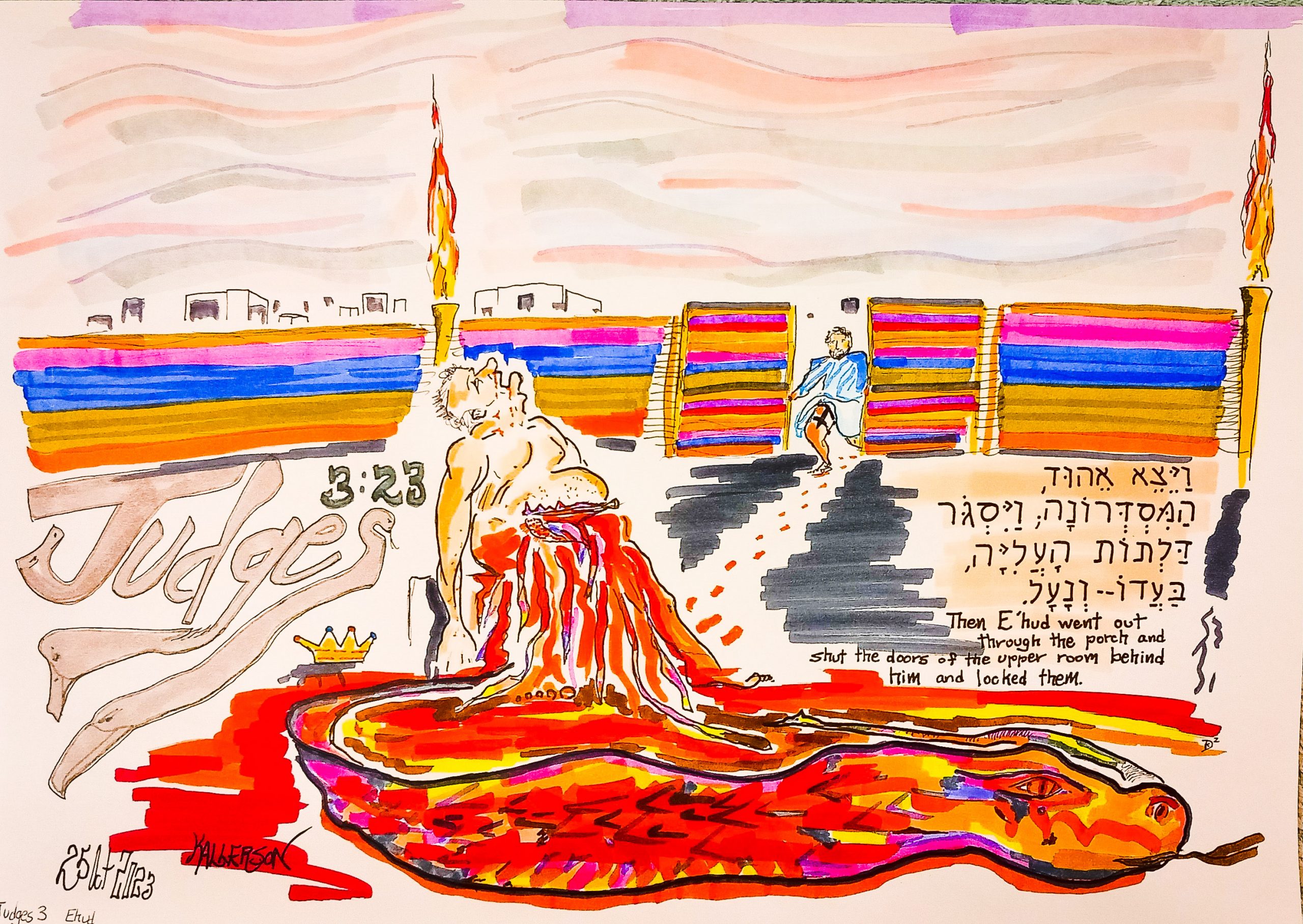
23 Then Ehud went out through the porch
vayetse ehud ha’misdronah – “And went out Ehud the misdronah.” It is another unique and difficult word, misdron. Because it is found only here, the meaning is as debated as that of the previous verse. It is generally accepted to come from seder, arrangement, or order. Thus, some say a porch or colonnade.
It is noted that because of the similarity of the words to the previous verse, the subject of both may actually be Eglon. If so, then the word parshdonah is also referring to a part of the house, not Eglon’s entrails or his backside. If so, the translation of the verb is “went” not “came” –
vayetse ha’parshdonah – “And went out [Ehud] the parshdonah [Eglon’s].”
vayetse ehud ha’misdronah – “And went out Ehud the misdronah [Eglon’s].”
Why it would say Ehud in the second instance and not the first throws a wrench in that, but it is still not impossible as Hebrew writing often includes a needed noun only in a second clause or sentence. If this is so, then it would mean there was probably a dividing room where the king sat and where the attendants would gather, the open space (distinct) between rooms (divide).
However, it does appear that the sword, not Eglon, is the subject of the previous clause. If so, then the rhyming nature of the words may simply be an alliterative tool to highlight the difference in what happened –
“The sword came out of Eglon’s parshdonah. Meanwhile, Ehud went out of Eglon’s misdronah.”
The words are highly complicated, and from the very earliest times, there has been little agreement on what they are saying. Thus, I have tried to present you with various options for maximum biblical happiness, something Eglon didn’t experience.
As for this clause, Ehud either exited through the same doors as the attendees earlier, or he went out through another side door. Upon his exiting, it says…
23 (con’t) and shut the doors of the upper room behind him and locked them.
vayisgor dalthoth ha’aliyah baado v’naal – “and shut doors the loft upon him and locked them.” This was to delay anyone from chasing Ehud. If he got away unnoticed, or even if they saw him and allowed him to leave, figuring his business was done and the king would call when they were needed, they would be delayed while patiently waiting at the door.
As for the word na’al, or lock, it is new to Scripture. It signifies both to lock and to furnish with shoes. As a door is shut and bolted, when a foot is shod, it is likewise shut off from the outside. Ehud shut the doors and secured them for his getaway.
While the corpse of the corpulent king is wallowing in its own blood behind closed doors, Ehud is making his way back to Israel. The exciting adventure into the life of Ehud will continue next week, the Lord willing.
For now, we must close with the thought that Jesus is the reason for this and every such story. There are already hints and clues as to why we are being told these events. If you go over the individual words this week, comparing them to earlier sermons, you will be able to get a portion of what is being conveyed.
When we get through the verses next week, we will be able to see the full typological picture of what the Lord is telling us. As a simple life lesson concerning what we have seen thus far, Israel failed to heed the word of the Lord, they departed from Him, and He sent a foe of Israel to afflict and oppress them to bring them back to Himself.
That has started to be realized with the selection and actions of Ehud. Also, Eglon was a human, just like the billions of humans who have existed on the earth since the beginning. He really lived, and he really died. His death was apart from the covenant people, and there is no indication that he was a believer or participant in God’s redemptive plans.
This means he died apart from salvation. God is working through human history to bring man back to Himself, but not all people will be saved. Only those whose trust is properly directed to the Lord will inherit what He has planned.
Since the coming of Jesus, this means faith in Him. Thus, all people have a choice, including Representative Max Miller mentioned earlier. And this includes you, too. We must submit ourselves to what God has offered, and His offering is the giving of Jesus Christ for our sins.
If we accept that premise, we will be saved. He is the incarnate Word, God united with human flesh, who came to fulfill the law and give His life in exchange for our sins based on that fulfillment. Let us be wise and accept this wonderful offer of grace.
Don’t wait. Eglon wasn’t expecting his sudden end, and we don’t know when ours will come. Be ready! Call on Jesus today.
Closing Verse: “I will praise You, O Lord my God, with all my heart,
And I will glorify Your name forevermore.” Psalm 86:12
Next Week: Judges 3:24-31 The story is good, yes a good one to tell, and this we will do… (Ehud, Judge of Israel, Part II) (10th Judges Sermon)
The Lord has you exactly where He wants you. He has a good plan and purpose for you. It is He who judges His people according to their deeds. So, follow Him, live for Him, and trust Him, and He will do marvelous things for you and through you.
Ehud, Judge of Israel, Part I
And the children of Israel again did evil in the sight of the LORD
So the LORD strengthened, according to His word
Eglon king of Moab against Israel
Because they had done evil in the sight of the LORD
Then he gathered to himself the people
Of Ammon and Amalek – this is not a digression
Went and defeated Israel
And the City of Palms he took as a possession
So the children of Israel served Eglon
King of Moab eighteen years
But when the children of Israel cried out to the LORD
The LORD raised up a deliverer for them: Ehud the son of Gera
———-a man with no fears
The Benjamite, a left-handed man, good for hiding the coming stab
By him the children of Israel sent tribute to Eglon king of Moab
Now Ehud made himself a dagger
(It was double-edged and a cubit in length), pretty nifty, Stan
And fastened it under his clothes on his right thigh
So he brought the tribute to Eglon king of Moab. (Now Eglon was
———-a very fat man)
And when he had finished presenting the tribute
He sent away the people who had carried the tribute, he did
———-that thing
But he himself turned back from the stone images that
———-were at Gilgal
And said, “I have a secret message for you, O king”
He said, “Keep silence!” And all who attended him went
———-out from him
So Ehud came to him (he was sitting in his cool private
———-chamber upstairs)
Then Ehud said, “I have a message from God for you”
So he arose from his seat, to learn of these affairs
Then Ehud reached with his left hand
(He had started the plan and was determined not to quit)
Took the dagger from his right thigh
And into his belly thrust it
Even the hilt went in after the blade
And the fat closed over the blade: gross, no doubt
For he did not draw the dagger out of his belly
And his entrails came out
Then Ehud went out through the porch, maybe thinking about
———-a vacation in Bethlehem
And shut the doors of the upper room behind him and locked them
Lord God, turn our hearts to be obedient to Your word
Give us wisdom to be ever faithful to You
May we carefully heed each thing we have heard
Yes, Lord God may our hearts be faithful and true
And we shall be content and satisfied in You alone
We will follow You as we sing our songs of praise
Hallelujah to You; to us Your path You have shown
Hallelujah we shall sing to You for all of our days
Hallelujah and Amen…
12 And the children of Israel again did evil in the sight of the Lord. So the Lord strengthened Eglon king of Moab against Israel, because they had done evil in the sight of the Lord. 13 Then he gathered to himself the people of Ammon and Amalek, went and defeated Israel, and took possession of the City of Palms. 14 So the children of Israel served Eglon king of Moab eighteen years.
15 But when the children of Israel cried out to the Lord, the Lord raised up a deliverer for them: Ehud the son of Gera, the Benjamite, a left-handed man. By him the children of Israel sent tribute to Eglon king of Moab. 16 Now Ehud made himself a dagger (it was double-edged and a cubit in length) and fastened it under his clothes on his right thigh. 17 So he brought the tribute to Eglon king of Moab. (Now Eglon was a very fat man.) 18 And when he had finished presenting the tribute, he sent away the people who had carried the tribute. 19 But he himself turned back from the stone images that were at Gilgal, and said, “I have a secret message for you, O king.”
He said, “Keep silence!” And all who attended him went out from him.
20 So Ehud came to him (now he was sitting upstairs in his cool private chamber). Then Ehud said, “I have a message from God for you.” So he arose from his seat. 21 Then Ehud reached with his left hand, took the dagger from his right thigh, and thrust it into his belly. 22 Even the hilt went in after the blade, and the fat closed over the blade, for he did not draw the dagger out of his belly; and his entrails came out. 23 Then Ehud went out through the porch and shut the doors of the upper room behind him and locked them.