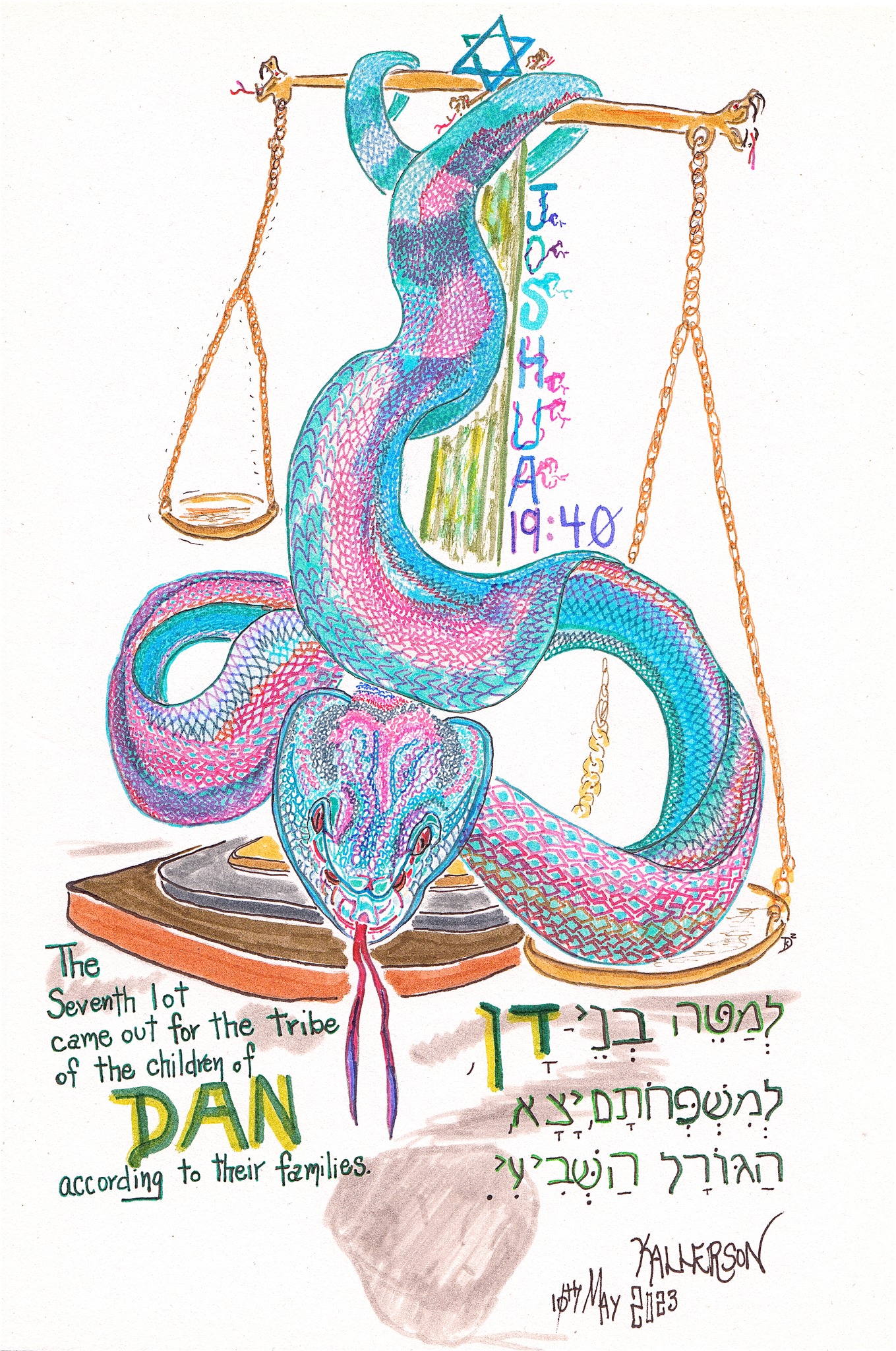
Artwork by Doug Kallerson
Joshua 19:40-51
The Inheritance of Dan and That of Joshua
Today’s passage details the final land allotment granted to the tribes of Israel. Along with this grant is a final note about a land grant given to Joshua. As you will see, this is not unlike what is occurring with the inheritance of Jesus.
The inheritances of those east of the Jordan signify those Jews who believed in the coming Messiah before Jesus came while the law was still in effect. We have seen tribal allotments that have detailed the life and work of Christ and its effects as realized in those He has saved.
We have seen how the Gentiles are included in this as detailed in the giving of Caleb’s inheritance. Those who are west of the Jordan reflect the salvation of national Israel at some future point, including Jesus’ rightful inheritance of that fact, represented in the passage from Joshua 17:14-18.
Through each step, the borders, the cities, and the other details have been presented have shown us typological representations of what Christ did, how He did it, and what it means for us. Our faith should be strengthened as we consider it all.
What He has done for us in the securing of our inheritance will be realized someday. We can have confidence in this. But if you think about it, because it is future, even though it is accomplished in God’s eyes, Jesus really hasn’t yet received His inheritance. That won’t happen until the plan of redemption is finished.
Text Verse: “God, who at various times and in various ways spoke in time past to the fathers by the prophets, 2 has in these last days spoken to us by His Son, whom He has appointed heir of all things, through whom also He made the worlds; 3 who being the brightness of His glory and the express image of His person, and upholding all things by the word of His power, when He had by Himself purged our sins, sat down at the right hand of the Majesty on high, 4 having become so much better than the angels, as He has by inheritance obtained a more excellent name than they.” Hebrews 1:1-4
The author of Hebrews goes on to say what that more excellent name is, the Son of God. His inheritance is an acknowledgment of that. But unless all people know that it is God in Christ who has obtained this name, the inheritance is not really fully realized.
He has earned the right to eternal life through His sinless perfection. He has earned the right to the throne of David through His victory. He has secured a people for Himself from both Jews and Gentiles. And someday, that will be realized when we stand before Him.
But there are those in the world who deny Him or who never knew Him. For God to receive the full measure of glory through the bestowal of the inheritance, it necessarily means that all humanity must know what God in Christ has done.
This is the purpose of the final judgment at the Great White Throne noted in Revelation 20:11. This is also hinted at in Isaiah 45:23, in Romans 14:11, and in Philippians 2:10. Every knee shall bow before the Lord (Yehovah) by bowing before the Lord (Jesus).
This will be the moment when the inheritance is finally and fully realized. We Christians will already be living in our final state, enjoying the inheritance God has prepared for us. And Jesus will be partaking of that as well.
However, someday the fullness of what He has inherited will be realized. After the Great White Throne will come the new heaven and the new earth. Everything that Jesus is due to inherit will be realized because He is the Son of God.
How wonderful it is that believers will share in this inheritance. God in Christ has perfected all things and poured out His grace upon those who will simply come to Him by faith. What a marvelous story of love and redemption.
It’s all to be found in His superior word. And so, let us turn to that precious word once again, and… May God speak to us through His word today, and may His glorious name ever be praised.
I. The Seventh Lot (verses 40-48)
The narrative will now complete the record of the seven tribal land inheritances which are being assigned according to the lot. The first was to Benjamin. After him was Simeon, then Zebulun, Issachar, Asher, and Naphtali. The seventh and final lot is now designated and detailed for the tribe of Dan…
40 The seventh lot came out for the tribe of the children of Dan according to their families.
Unlike the other tribes, the wording is reversed from the usual manner in which the lots are presented. Unfortunately, almost every translation ignores this when it should be highlighted: l’mateh bene dan l’misp’hotam yatsa ha’goral ha’sh’vii – “To tribe sons Dan to their families went out the lot, the seventh.”
The reason may be as simple as it being the last lot to be cast. Hence, instead of saying, “The seventh lot came out … according to their families,” it says, “To… their families the seventh lot went out.” Therefore, it is a way of closing out the lots by stating the number last.
Being the seventh lot, it is the number of spiritual perfection. Without this final lot, there would be only imperfection. But with the inclusion of Dan, it brings the matter of inheritances to their rightful state before the Lord.
As for Dan, he was Jacob’s fifth son and the first son of Rachel’s maidservant Bilhah. The lot drawn for him comes after Naphtali despite him being born earlier to Bilhah. As has already been seen, the sons of the maidservants are detailed after those of Jacob’s wives, Leah and Rachel. But why these two are out of birth order is not stated. Bullinger defines the number five, saying –
“Five is four plus one (4+1). We have had hitherto the three persons of the Godhead, and their manifestation in creation. Now we have a further revelation of a People called out from mankind, redeemed and saved, to walk with God from earth to heaven. Hence, Redemption follows creation. Inasmuch as in consequence of the fall of man creation came under the curse and was ‘made subject to vanity,’ therefore man and creation must be redeemed. Thus we have:
- Father
- Son
- Spirit
- Creation
- Redemption
These are the five great mysteries, and five is therefore the number of GRACE.”
The record of Dan’s birth is found in Genesis 30 –
“Now when Rachel saw that she bore Jacob no children, Rachel envied her sister, and said to Jacob, ‘Give me children, or else I die!’
2 And Jacob’s anger was aroused against Rachel, and he said, ‘Am I in the place of God, who has withheld from you the fruit of the womb?’
3 So she said, ‘Here is my maid Bilhah; go in to her, and she will bear a child on my knees, that I also may have children by her.’ 4 Then she gave him Bilhah her maid as wife, and Jacob went in to her. 5 And Bilhah conceived and bore Jacob a son. 6 Then Rachel said, ‘God has judged my case; and He has also heard my voice and given me a son.’ Therefore she called his name Dan.” Genesis 30:1-6
In her exclamation, Rachel makes a wordplay on the verb din, to judge. Therefore, the name Dan means Judge or Judging.
On the march from Sinai to Canaan, Dan, Asher, and Naphtali were stationed north of the tabernacle under the standard of Dan. In the order of marching, this was the final standard to break camp and move. As the leader of this group, they had the honor of taking up the rear guard . Dan was also the second most numerous tribe behind Judah in both of the censuses.
As for the parcel allotted to Dan, Keil gives a description for us –
“This fell to the west of Benjamin, between Judah and Ephraim, and was formed by Judah giving up some of its northern towns, and Ephraim some of its southern towns, to the Danites, so as to furnish them with a territory proportionate to their number. It was situated for the most part in the lowland (shephelah), including, however, the hill country between the Mediterranean and the mountains, and extended over a portion of the plain of Sharon, so that it belonged to one of the most fruitful portions of Palestine.” Keil
With this general description understood, the verses continue…
41 And the territory of their inheritance was Zorah, Eshtaol, Ir Shemesh,
Literally: tsar’ah v’eshtaol v’ir shemesh – “Zorah and Eshtaol and Ir Shemesh.” The boundaries of the parcel are not given because they were easily identified from the positioning of Dan in relation to the three adjoining tribes. Thus, only the cities are named.
The borders adjoin the three most powerful tribes, Judah on the south and Ephraim and Benjamin together covering the north and east. The Mediterranean Sea was to be the western border. They also were bordered by the location where the unconquered Philistines remained throughout Israel’s history.
Zorah comes from either tsirah, a collective word meaning hornets, or tsaraath, leprosy. Thus, it literally means either Hornet(s) or Leprosy. However, both are a type of affliction because the hornet is metaphorically used as an instrument of war, driving out the enemies. For example, this is seen in Exodus 23 –
“I will send My fear before you, I will cause confusion among all the people to whom you come, and will make all your enemies turn their backs to you. 28 And I will send hornets before you, which shall drive out the Hivite, the Canaanite, and the Hittite from before you.” Exodus 23:27, 28
Therefore, this location may be metaphorically named Afflictions or Afflicters. Zorah was found to be within Judah’s inheritance in Joshua 15:33. The same is true with the next city, Eshtaol, which is listed along with Zorah in the same verse.
Eshtaol is listed by Strong’s under the root shaal, to ask for or inquire. Thus, he defines it as Entreaty. However, without explanation, he also defines it as “to found” and thus, Establish.
Zorah and Eshtaol will become famous as the general location from which Samson will come –
“So the woman bore a son and called his name Samson; and the child grew, and the Lord blessed him. 25 And the Spirit of the Lord began to move upon him at Mahaneh Dan between Zorah and Eshtaol.” Judges 13:24, 25
Ir Shemesh comes from ir, a city, and shemesh, the sun. Thus, it is City of the Sun.
42 Shaalabbin, Aijalon, Jethlah,
Each name is prefixed by “and” in the Hebrew. Aijalon is noted as a Levitical city in Joshua 21.
The roots of Shaalabbin are shual, a fox, and bin (to discern). Shual comes from shoal, hollow of the hand or a handful because the fox is a burrowing animal. Abarim defines it as Sly Fox or Understanding by Ferreting.
However, it is certainly the same location known in Judges 1 and 1 Kings 4 as Shaalbim. Thus, most commentators call it Foxes or Place of Foxes. Despite that, the spelling is purposeful here and seems to indicate more than just a plural form of Fox.
Aijalon comes from ayyal or deer. It means Place of the Deer. However, that comes from the same as ayil, or ram, which is derived from a word indicating strength. Thus, as seen in Joshua 10, Place of Strength is not out of line.
Jethlah is found only here. It comes from talah, to hang as on a gibbet rather than a gallows. Strong’s defines it as It Will Hang.
43 Elon, Timnah, Ekron,
Each name is prefixed by the word “and” in the text. Elon means Oak. But that is also derived from ayil, a ram. That is then derived from ul, a word that gives the sense of strength. As such, the idea of an oak, like a ram, is that of strength.
Timnah (Heb: Thimnathah) means Allotted Portion.
Ekron comes from aqar, to pluck up or uproot. But that is from the same as eqer, an offshoot or descendant. Hence, the name could mean either Offshoot or Uprooted. These are followed by…
44 Eltekeh, Gibbethon, Baalath,
Again, each is prefixed by the word “and” in the original. Both Eltekeh and Gibbethon are listed as Levitical cities in Joshua 21.
Eltekeh is an interesting name. The first portion is from el, God (god). The second half may be from a root, tq’, not used in the Bible, but which is found in Arabic. It means fear or take heed. Thus, it would mean God is Dread or God-fearing.
However, it also may come from qo, a feminine word meaning to vomit. As such, it may mean God Vomits, God Vomits Her, etc.
Gibbethon is an intensive form of givah, a hill. Thus it means Mound, Height, or Lofty Place. But, as has been seen before, givah is connected in the New Testament to Gabbatha, the elevated knoll where Christ was judged before His crucifixion.
Baalath is derived from baal, lord or master. Being feminine, it would signify a lady of the house. For example, the word baalath is found in 1 Kings 17 –
“And it came to pass after these things, that the son of the woman, the mistress [baalath] of the house, fell sick; and his sickness was so sore, that there was no breath left in him.” 1 Kings 17:17 (KJV)
Thus, it signifies Lady or Mistress. Next…
45 Jehud, Bene Berak, Gath Rimmon,
Each name is prefixed by “and” in the Hebrew.
Jehud, or Yehud, is found only here. The Hebrew spelling is a shortened form of Yehuda, Judah. Thus, it means Praise, Praised, or Let Him (God) Be Praised.
Bene Berak comes from ben, son, and baraq, lightning. As bene is plural, it literally means Sons of Lightning. But lightning is used to describe the state of something as well, such as a gleaming or glittering sword. Thus, it can also mean Sons of Brightness.
Gath Rimmon comes from gath, winepress, and rimmon, pomegranate. But as has been previously seen, the pomegranate symbolizes harvest-ready fruit and so it can further mean Mature Mind or Harvest Ready. Thus, it can also be interpreted as Winepress of the Mature Mind or Winepress of the Harvest Ready. Gath Rimmon is noted as a Levitical city in Joshua 21.
46 Me Jarkon, and Rakkon, with the region near Joppa.
u-me ha’yarqon v’ha’raqon im ha’gevul mul yapho – “And Me the Jarkon, and the Rakkon, with the border against Joppa.”
Me-ha’Yarqon is found only here. It comes from mayim, waters, and yeraqon, mildew, paleness, lividness. That, in turn, comes from yereq, green. Thus, it is literally The Green Waters. But the idea extends to sickliness, such as in Jeremiah 30 –
“For thus says the Lord:
‘We have heard a voice of trembling,
Of fear, and not of peace.
6 Ask now, and see,
Whether a man is ever in labor with child?
So why do I see every man with his hands on his loins
Like a woman in labor,
And all faces turned pale [yeraqon]?
7 Alas! For that day is great,
So that none is like it;
And it is the time of Jacob’s trouble,
But he shall be saved out of it.” Jeremiah 30:5-7
Thus, it is no stretch to say this could mean Waters of the Sickness.
Ha’Rakkon is also only seen here. It comes from raqaq, to spit, or raq, thin. Translators define it as Thin Place, Green Place, or Place at the Shore. But it could also be The Spitting Place.
This area is said to be against (meaning in front of) Joppa or Yapho. That comes from yaphah, to be fair or beautiful. Hence, it means Beauty or Beautiful. With that, the words continue with…
47 And the border of the children of Dan went beyond these,
v’yetse gevul bene dan mehem – “And went out border sons Dan from them.” This could mean one of several things. One would be that there is a limitation based on the named cities, being not enough from them to support the tribe. One can think of a bunch of people within the borders of an area, so many are they that they overflow the borders.
Or it may mean that Dan was given the land, but it returned to the previous inhabitants, having gone out from the possession of Dan. Or it could mean that because of what is said in the next clause, the borders expanded because of the migration of Dan out of their allotted borders. No matter what, because of this, there was an insufficient amount of land for them…
47 (con’t) because the children of Dan went up to fight against Leshem and took it;
The word “because” would only make sense with the third option given in the previous clause. The Hebrew reads: va’yaalu bene dan va’yilakhamu im leshem va’yilk’du otah – “And went up sons Dan and warred with Leshem and struck her.” This is something that doesn’t occur until Judges 18 where the Danites from Zorah and Eshtaol went to the very north of the land, to Laish, and struck it.
This is near the area where the Jordan originates. Because it is so far north, the familiar phrase “from Dan to Beersheba” is seen in Scripture, signifying from the most northern city to the most southern, and thus it represents the entire land.
The name Leshem comes from leshem, a particular gemstone, possibly the jacinth or amber. It is one of the twelve stones noted in the breastplate of the high priest. Thus, it is Precious Stone. Next, it says…
47 (con’t) and they struck it with the edge of the sword, took possession of it, and dwelt in it.
va’yaku otah l’pi kherev va’yirshu otah va’yesh’vu bah – “And struck her to mouth sword and dispossessed her and dwelt in her.” Rather than remaining in their allotted possession and subduing it, the men from Zorah and Eshtaol passed through much of the land of Israel to get to Leshem, at which time they took the area and it became their possession, and…
47 (con’t) They called Leshem, Dan, after the name of Dan their father.
va’yiqreu l’leshem dan k’shem dan avihem – “And called to Leshem, Dan, according to name Dan their father.” Henceforth, this area retained this name. Even to this day, it is known as the area of Dan where the famous Tel Dan Nature Reserve is a popular spot for visitors.
The substance of the account is found in these verses –
“So the five men departed and went to Laish. They saw the people who were there, how they dwelt safely, in the manner of the Sidonians, quiet and secure. There were no rulers in the land who might put them to shame for anything. They were far from the Sidonians, and they had no ties with anyone. … So they took the things Micah had made, and the priest who had belonged to him, and went to Laish, to a people quiet and secure; and they struck them with the edge of the sword and burned the city with fire. 28 There was no deliverer, because it was far from Sidon, and they had no ties with anyone. It was in the valley that belongs to Beth Rehob. So they rebuilt the city and dwelt there. 29 And they called the name of the city Dan, after the name of Dan their father, who was born to Israel. However, the name of the city formerly was Laish.” Judges 18:7 & 27-29
And so, what we see here is a group of people who were unwilling to subdue the land they were granted and instead moved an extended distance from their tribal inheritance so that they could take an area where there were peaceful inhabitants that would be easy to destroy.
Reading the entire chapter where this account is recorded one sees several noticeable character flaws in this group of people. With that, the final verse of the inheritance is provided…
48 This is the inheritance of the tribe of the children of Dan according to their families, these cities with their villages.
zoth nakhalath mateh bene dan l’misp’hotam he’arim ha’eleh v’khatsrehen – “This inheritance tribe Dan to their families, their cities, the these, and their villages.” With this, the cities of Dan, along with some of its borders, have been defined. What is the Lord telling us with all these names?
I will declare the decree
Because the battle is won
The Lord has said to Me
You are My Son
Today I have begotten You
Let heaven and earth rejoice and dance
For You are Faithful and True
Ask, and I will give the nations as Your inheritance
Great is the victory of the Lord Jesus
Great are the mighty things He has done
God in Christ had redeemed us
An inheritance through the giving of the Son
II. Joshua’s Inheritance (verses 49-51)
49 When they had made an end of dividing the land as an inheritance according to their borders,
vay’kalu linkhol eth ha’arets ligvulotekha – “And ended to inheriting the land to her borders.” The meaning is that the entire land was divided and each tribe had received its allotted portion. Nothing was left unallocated, even if many areas were not yet subdued. It is only at this time that…
49 (con’t) the children of Israel gave an inheritance among them to Joshua the son of Nun.
va’yit’nu bene Yisrael nakhalah lihoshua bin nun b’tokam – “and gave, sons Israel, inheritance to Joshua son Nun in their midst.” The words convey the character of the man. He didn’t seek out his own interest, but rather ensured every tribe had received its land.
And more, his portion was neither taken by him nor demanded. Rather, he asked for it and it was given to him by the sons of Israel. That is seen in the next verse. Despite being a fearless leader in battle, he was modest and caring towards his people placing them ahead of himself.
50 According to the word of the Lord they gave him the city which he asked for,
al pi Yehovah nathenu lo eth ha’ir asher shaal – “Upon mouth Yehovah they gave to him the city which he asked.” Nothing is recorded of this in the books of Moses, but to say that the Lord didn’t say it would be an argument from silence.
However, it could be that the judgment came through the mediation of Eleazer the priest. Either way, the record says that Joshua asked for this and it was then granted by Israel at the word of the Lord. The city he asked for is next named…
50 (con’t) Timnath Serah in the mountains of Ephraim; and he built the city and dwelt in it.
timnath serakh b’har Ephraim va’yivneh eth ha’ir va’yeshev bah – “Timnath Serah in Mount Ephraim and built the city and dwelt in her.” Of the name Timnath Serakh, Timnath is derived from Timnah, Allotted Portion, and Serakh comes from the verb sarakh, signifying to go free without bonds. Thus, the name is translated as Extra Portion, Abundant Portion, etc.
In Judges 2:9, the first and last letters are transposed, calling the place Timnath Kheres, or Portion of the Sun.
This location is said to be in Mount Ephraim. As has been seen in previous sermons, a mountain (har) is a lot of something gathered. It is synonymous with a large but centralized group of people.
Ephraim means Twice Fruitful with a secondary meaning of Ashes.
As for the city, Timnah Serah, it is not uncommon for scholars to suggest that the city already existed and Joshua simply rebuilt it. But as it is first mentioned here, it is probable that Joshua both built the city and named it as well. With this noted, it next says…
51 These were the inheritances which Eleazar the priest, Joshua the son of Nun, and the heads of the fathers of the tribes of the children of Israel divided as an inheritance
More literally, the words read, “These the inheritances which Eleazar the priest, and Joshua the son of Nun, and the heads of the fathers to the tribes of the sons of Israel, caused to inherit…” (SLT).
This statement is given to show obedience to the command given by the Lord in Numbers 34:16-29 where Eleazar (Whom God Helps) and Joshua (The Lord is Salvation) the son of Nun (Increase) were to divide the land along with the leaders of the tribes who were designated by name at that time.
Thus, there is noted in these words faithful obedience to the command. This parceling out the inheritance is next said to have been conducted…
51 (con’t) by lot in Shiloh before the Lord, at the door of the tabernacle of meeting.
b’goral b’shiloh liphne Yehovah petakh ohel moed – “in lot in Shiloh before Yehovah, door Tent Meeting.” Shiloh means Tranquility. This is where the Tent of Meeting was set up as recorded in Joshua 18:1.
This is now the ending of the thought that was stated by Joshua to those sent to survey the land in Joshua 18:8 –
“Then the men arose to go away; and Joshua charged those who went to survey the land, saying, ‘Go, walk through the land, survey it, and come back to me, that I may cast lots for you here before the Lord in Shiloh.’”
With this noted the verse and the chapter end saying…
*51 (fin) So they made an end of dividing the country.
vay’kalu m’khaleq eth ha’arets – “And ended from dividing the land.” The land is divided, even if not totally subdued. The inheritances are set and were to remain unaffected by the years, through wars, or through intermarriages.
Each contingency for keeping these lands set and unchanged has been addressed, and all of it has been under the careful eye of the Lord who determined that it should be this way, even before He had called Israel out of Egypt.
If the lands continued to have the previous occupants dwelling in them, that would be the fault of those inheriting them, not the fault of the Lord who promised He would be with them and see them through the entire process of wiping those inhabitants out.
Likewise, our inheritances are set in Christ, but if we continue on living with those things that should be eradicated by us once the inheritance is received, it is our fault, not the Lord’s. And despite our failings, the surety of the inheritance remains.
The inheritance awaits so do not lose heart
We are accepted because of Jesus
If we stumble, let us make a new start
Press on because God has forgiven us
Nothing can separate us from the love of God
Which is in Christ Jesus our Lord
Let us be filled with thanks each step that we trod
Until that day when comes our heavenly reward
The inheritance awaits; the work is done
Not by us, but by Jesus Christ our Lord
Let us worship God through His Son
Until the day we obtain the heavenly reward
III. Pictures of Christ
As Dan’s lot is the seventh for the land yet to be divided, it brings the inheritance to a state of spiritual perfection. But more, as this process ends with Dan (Judge), the fifth son of Jacob, it signifies that the inheritance is completed on a note of grace.
The names look to the state of those in Christ as they await their inheritance and the result of Christ’s work for His people: spiritual perfection, expressed by the seventh lot. This comes as grace, expressed by Dan’s position as the fifth son born to Jacob.
Zorah, Afflictions, reflects the state of believers waiting to be glorified. Several verses indicate this, such as –
“Therefore we do not lose heart. Even though our outward man is perishing, yet the inward man is being renewed day by day. 17 For our light affliction, which is but for a moment, is working for us a far more exceeding and eternal weight of glory, 18 while we do not look at the things which are seen, but at the things which are not seen. For the things which are seen are temporary, but the things which are not seen are eternal.” 2 Corinthians 4:16-18
Eshtaol, Entreaty, looks to our life while afflicted in Christ. We entreat the Lord for relief from them such as what Paul did –
“Concerning this thing I pleaded with the Lord three times that it might depart from me. 9 And He said to me, ‘My grace is sufficient for you, for My strength is made perfect in weakness.’ Therefore most gladly I will rather boast in my infirmities, that the power of Christ may rest upon me.” 2 Corinthians 12:8, 9
Despite our inheritance being deemed in a state of spiritual perfection, we will still face things that seem contrary to that. And yet, His grace is sufficient to endure through them.
Ir Shemesh, City of the Sun, acknowledges that we anticipate Christ – the Sun of Righteousness of Malachi 4 – and His city with foundations, noted in Hebrews 11:10, awaits us because of what Christ has done to perfect us.
Shaalabbin, Understanding by Ferreting, is the faithful believer’s state as he searches out the wisdom of God from the word. It is how we grow in holiness as we await our final glorification and the Bema Seat judgment that lies ahead.
Aijalon, Place of Strength, is the place where the believer looks until that day, meaning to Christ Jesus. Jethlah, It Will Hang, speaks of where our sin hung, as Paul says –
“For He made Him who knew no sin to be sin for us, that we might become the righteousness of God in Him.” 2 Corinthians 5:21
That is the very act that made us spiritually perfect in God’s sight, and it is the place where God’s grace was communicated to His people.
Elon, Oak, indicating strength, reflects the act that brought us to our state of acceptance before God, meaning the work of Christ Jesus –
“For when we were still without strength, in due time Christ died for the ungodly. 7 For scarcely for a righteous man will one die; yet perhaps for a good man someone would even dare to die. 8 But God demonstrates His own love toward us, in that while we were still sinners, Christ died for us. 9 Much more then, having now been justified by His blood, we shall be saved from wrath through Him.” Romans 5:6-9
Timnah, Allotted Portion, speaks of our grant because of the work of Christ.
Ekron, Offshoot, speaks of the state of believers in Christ. We reflect Him before God, being offshoots of what He has done to perfect us.
Eltekeh, God-fearing, speaks for itself. Having come to Christ, we have demonstrated that this is our position in Him. This is reflected in the next name, Gibbethon, or Mound. It looks to the spot where Christ was judged (Gabbatha), and in turn, the place where our sin was judged by God in Him.
Because of that, believers are brought into the church, an organic body of believers represented by Baalath, Lady, the church being a feminine noun in the Bible. This is seen, for example, in 2 John where John writes to the church –
“The Elder,
To the elect lady and her children, whom I love in truth, and not only I, but also all those who have known the truth, 2 because of the truth which abides in us and will be with us forever.” 2 John 1:1, 2
Jehud, Praise, is an obvious connection to the expression of those in the church toward God because of Christ Jesus. Bene Berak, or Sons of Brightness, speaks of the radiance of those who are saved by God. Though we don’t possess it now, except in God’s eyes, it is what our future state will be when we are made like Him.
Gath Rimmon, Winepress of the Mature Mind, refers to the effects of Christ’s work in us. Everything that is contrary to holiness and godliness will be pressed out of us. To God, those in Christ, are already positionally in this state, even if it has not yet been actualized. The great day ahead is the day when it will be actualized. Until then, we must press on as best we can –
“Brethren, do not be children in understanding; however, in malice be babes, but in understanding be mature.” 1 Corinthians 14:20
As speculation, Me Jarkon, explained as Waters of the Sickness, look to what Christ did. By taking on human form, He drank such waters so that from Him we could receive the Water of Life. After that Rakkon, The Spitting Place, is where that was realized –
“Then the high priest tore his clothes and said, ‘What further need do we have of witnesses? 64 You have heard the blasphemy! What do you think?’
And they all condemned Him to be deserving of death.
65 Then some began to spit on Him, and to blindfold Him, and to beat Him, and to say to Him, ‘Prophesy!’ And the officers struck Him with the palms of their hands.” Mark 14:63-65
In the trial where Christ was condemned leading to His crucifixion, we find life. That is, surprisingly, realized in the words “with the border against Joppa.” Joppa means Beauty or Beautiful. It is what Christ offers because of the horror He endured. It thus reflects the state of those redeemed by Him.
With that, verse 47 noted that the border of Dan (Judge) went beyond these original borders. This spoke of the expansion of the land of Dan when the children of Dan went up to fight against Leshem, Precious Stone. That speaks of the stone rejected by men but chosen by God and precious, which Peter equates to Christ Jesus in 1 Peter 2.
Leshem was said to be taken with the “mouth of the sword.” Remembering from early Joshua sermons that the word sword is identical to Horeb, the mount of the law, the meaning is clear. Christ’s fulfillment of the law is what allows us to live in our current state, meaning in Christ. It is He who has judged sin in us through His cross, fulfilling the law in His death.
That is the seventh and final inheritance. Thus, it speaks of God’s spiritual perfection (7) residing in us through His grace (5) – reflected by Dan, the fifth son of Jacob.
With the inheritances secured and noted, the final verses relayed the inheritance of Joshua (The Lord is Salvation) the son of Nun (Increase). He had asked for Timnath Serah, Extra Portion. It speaks of the full scope of Christ’s work –
“Indeed He says,
‘It is too small a thing that You should be My Servant
To raise up the tribes of Jacob,
And to restore the preserved ones of Israel;
I will also give You as a light to the Gentiles,
That You should be My salvation to the ends of the earth.’” Isaiah 49:6
The work of Jesus is seen in Joshua, the Lord who is Salvation, the son of Nun, Increase. It resulted not only in the salvation of Israel, but of the Gentiles, making the effect of it the Extra Portion. Saying that it was in Mount Ephraim points to the effect of His work, the mountain being synonymous with a large but centralized group of people. It refers to the uniting of all believers, Jews and Gentiles, as one in Christ.
Ephraim (Twice Fruitful/Ashes) looks to Jesus. He is twice fruitful in the land of His affliction, prevailing over the law and thus becoming the Savior of Jew and Gentile as well as the church and national Israel. But His work also meant that sin was judged in Him, thus the ashes, signifying His afflictions.
With that, there was the note concerning the inheritances having been conducted by Eleazer (Whom God Helps) and Joshua the son of Nun, along with the fathers of the tribes being there to conduct the allotments before the Lord.
Everything is seen by these witnesses, testifying to the work of Christ on behalf of His people who have been granted their inheritances because of what Jesus has done. From there, the final words of the chapter noted that it was at Shiloh, Tranquility, before the Lord at the door of the tent of Meeting.
The whole thought looks to God in Christ and what He has done. He is the provider of God’s peace. He is the Lord who sent Jesus and who approved of His work, raising Him from the dead. He is the Door into the presence of God. And more, He is the Decider of the inheritance, reflected by the lot –
“The lot is cast into the lap,
But its every decision is from the Lord.” Proverbs 16:33
To sum up this section of Joshua, that of the inheritances including borders, cities, etc., it all anticipates the more perfect grant of God in our heavenly inheritance realized through the giving of His Son to bring us back to Himself.
Despite the need to speculate at times on the names of some of the people and places, the overall theme is perfectly clear and easily realized. Everything necessary to reconcile us to God and return us to His presence has been accomplished by Christ Jesus.
As our inheritance has been given to us, let us live as if we really believe it. Jesus has secured our inheritance! Let us not fret and fear that it may never come. It will.
Again, Jesus has secured our inheritance! Let us act out our belief by living holy lives now, awaiting that day when we will be brought before Him. God already sees us as perfected before Him, so let us live in this reality.
This is the beauty of what has been presented in this passage. God has accepted us. Thank God for Jesus Christ who has made that possible.
Closing Verse: “…giving thanks to the Father who has qualified us to be partakers of the inheritance of the saints in the light. 13 He has delivered us from the power of darkness and conveyed us into the kingdom of the Son of His love, 14 in whom we have redemption through His blood, the forgiveness of sins.” Colossians 1:12-14
Next Week: Joshua 20:1-9 The implications of the contents of this sermon are huge… (Cities of Refuge) (44th Joshua Sermon)
The Lord has you exactly where He wants you. He has a good plan and purpose for you. It is He who has defeated the enemy and who now offers His people rest. So, follow Him and trust Him and He will do marvelous things for you and through you.
The Inheritance of Dan and That of Joshua
The seventh lot came out for the tribe of the children of Dan
According to their families, as it is known
And the territory of their inheritance was Zorah, Eshtaol
———-Ir Shemesh
Shaalabbin, Aijalon, Jethlah, Elon, Timnah, and Ekron
Eltekeh, Gibbethon, Baalath, Jehud, Bene Berak
Gath Rimmon, Me Jarkon, and Rakkon, with the region
———-near Joppa, quite a bit
And the border of the children of Dan went beyond these
Because the children of Dan went up to fight against Leshem
———-and took it
And they struck it with the edge of the sword
Took possession of it, and dwelt in it – it was their reward
They called Leshem, Dan, after the name of Dan their father
This is the inheritance of the tribe of the children of Dan
According to their families, these cities with their villages
It became the land of that clan
When they had made an end of dividing the land
As an inheritance according to their borders, when that was done
The children of Israel gave an inheritance among them
To Joshua the son of Nun
According to the word of the LORD
They gave him the city for which he asked without a fit
Timnath Serah in the mountains of Ephraim
And he built the city and dwelt in it
These were the inheritances which Eleazar the priest
Joshua the son of Nun also
And the heads of the fathers of the tribes of the children of
———-Israel divided
As an inheritance by lot before the LORD in Shiloh
At the door of the tabernacle of meeting is where
So they made an end of dividing the country then and there
Lord God, turn our hearts to be obedient to Your word
Give us wisdom to be ever faithful to You
May we carefully heed each thing we have heard
Yes, Lord God may our hearts be faithful and true
And we shall be content and satisfied in You alone
We will follow You as we sing our songs of praise
Hallelujah to You; to us Your path You have shown
Hallelujah we shall sing to You for all of our days
Hallelujah and Amen…
40 The seventh lot came out for the tribe of the children of Dan according to their families. 41 And the territory of their inheritance was Zorah, Eshtaol, Ir Shemesh, 42 Shaalabbin, Aijalon, Jethlah, 43 Elon, Timnah, Ekron, 44 Eltekeh, Gibbethon, Baalath, 45 Jehud, Bene Berak, Gath Rimmon, 46 Me Jarkon, and Rakkon, with the region near Joppa. 47 And the border of the children of Dan went beyond these, because the children of Dan went up to fight against Leshem and took it; and they struck it with the edge of the sword, took possession of it, and dwelt in it. They called Leshem, Dan, after the name of Dan their father. 48 This is the inheritance of the tribe of the children of Dan according to their families, these cities with their villages.
49 When they had made an end of dividing the land as an inheritance according to their borders, the children of Israel gave an inheritance among them to Joshua the son of Nun. 50 According to the word of the Lord they gave him the city which he asked for, Timnath Serah in the mountains of Ephraim; and he built the city and dwelt in it.
51 These were the inheritances which Eleazar the priest, Joshua the son of Nun, and the heads of the fathers of the tribes of the children of Israel divided as an inheritance by lot in Shiloh before the Lord, at the door of the tabernacle of meeting. So they made an end of dividing the country.