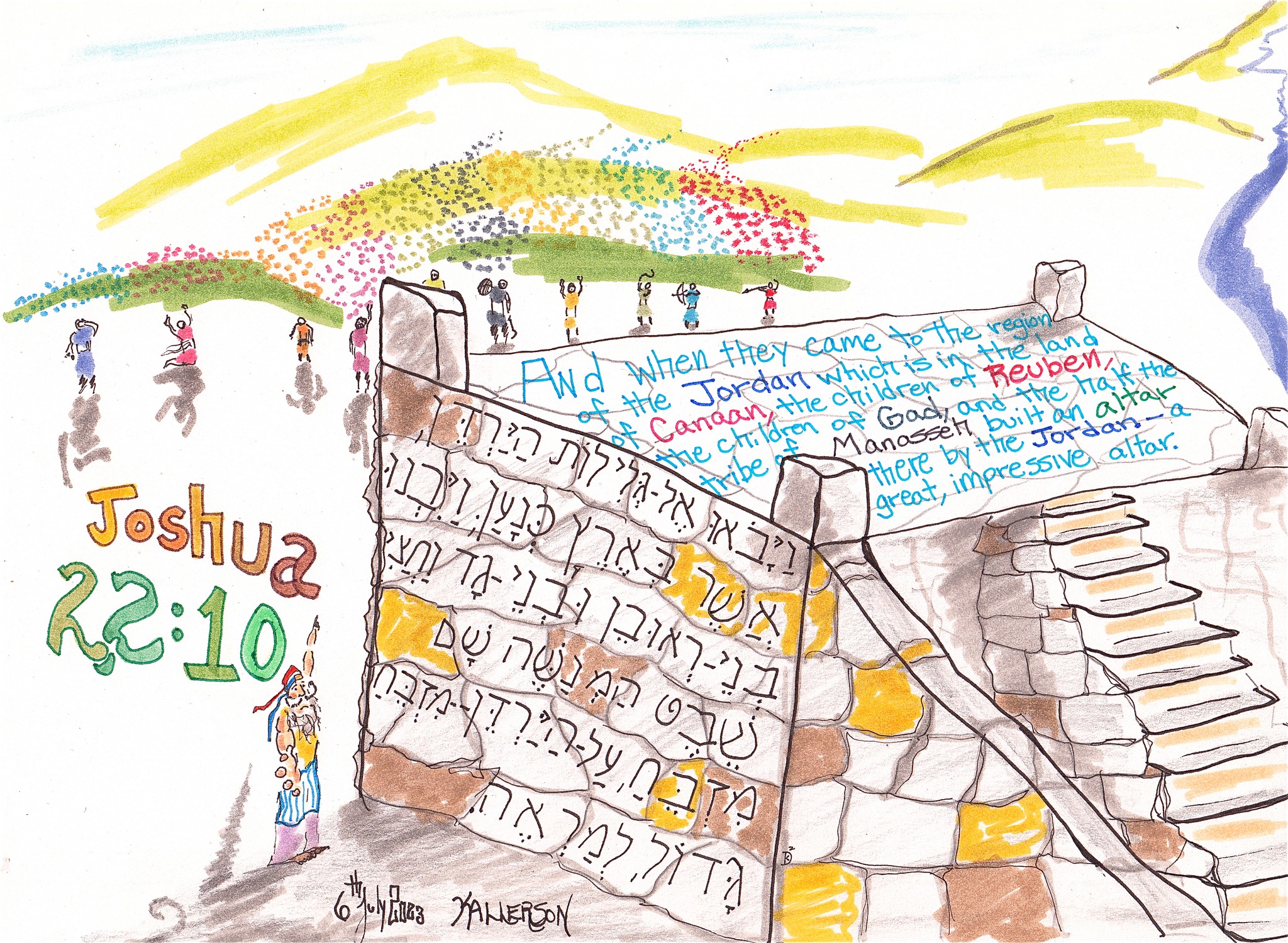
Artwork by Doug Kallerson
Joshua 22:10-20
The Lord God of gods, Part I
There is a whole lot going on concerning the structure of Joshua 22. Starting with verse 10, there is a chiasm that will continue through the last verse of the chapter. As a reminder, a chiasm is a literary device that begins with a thought, proceeds through a series of thoughts, it then normally will have an anchor or pivot verse on which the chiasm hinges, and then it will give the same basic thoughts as it has just stated in reverse order.
Chiasms are not limited to the words alone though. They can repeat numbers, directions of travel, thoughts, grammatical structures, and more. Anything that is repeatable within the text can be a part of a chiasm. As for the one in this passage, we can go over it together –
Joshua 22:10-34 – The LORD, God of gods.
A great misunderstanding. (11/22/07)
a 22:10 Impressive Altar
—–b 22:12 Preparation for war against tribes across Jordan
———-c 22:13 Phinehas sent
—————d 22:16-18 Turn away from following the LORD; He will be angry with us
——————–e 22:18 Discussion of rebellion
————————-f 22:19 The land is defiled by an unauthorized altar
——————————g 22:20 Wrath on Israel because of Achan’s trespass
———————————–x 22:22 – The LORD God of gods, the LORD God of gods
——————————g 22:23 “If because of trespass, let God require it of us”
————————-f 22:26-28 The land is not defiled; it is not an altar for sacrifice
——————–e 22:29 Denial of rebellion against the LORD
—————d 22:31 The LORD is among us; we are delivered from His hand
———-c 22:32 Phinehas returns
—–b 22:33 Cancellation of war preparation against tribes across Jordan
a 22:34 – Altar called “Witness”
As you can see, the thought develops to an anchor verse which is the highlight of the passage. This is not unusual. Rather, it is quite often the case. The entire flood of Noah, from Genesis 6 through Genesis 9, forms a chiasm that anchors on the words, “And God remembered Noah.”
The Bible is literally filled with chiasms. Entire websites have been developed to record them as they are found.
Text Verse: “For I know that the Lord is great,
And our Lord is above all gods.” Psalm 135:5
It’s a great feeling to find a chiasm, see if anyone else has discovered it, and then to be confident you are the first person to ever have known it existed. As Joshua was recorded almost 3500 years ago, that’s a long time for it to wait to be revealed.
As I said, there is a lot going on in Joshua. Another interesting pattern is found in Joshua 22. This deals with the naming of the tribes. The tribe of Manasseh, for example, is mentioned ten times in the chapter.
Five times, it is referred to with an article – the Manasseh. Why would that be? All three tribes east of the Jordan – Reuben, Gad, and the half-tribe of Manasseh – are mentioned repeatedly in the chapter. However, three times only Reuben and Gad are mentioned.
Also, as we saw last week, two different words for “tribe” are used in the chapter. The word mateh is used once in verse 1 when referring to the genealogical half-tribe of Manasseh. It is used once again when referring to the tribes west of the Jordan in verse 14. Every other use is the word shevet which speaks of the political aspect.
Here is the breakdown of those things relating to the tribes west of the Jordan. Of note is that when the article is used before Manasseh, a separation is being highlighted. When it is not used, an inclusiveness is indicated. The difference is subtle, but it is evident –
1 to the Reubenite, to the Gadite, and to half tribe (mateh) Manasseh
7 and to half tribe (shevet) the Manasseh
9 sons Reuben, and sons Gad, and half tribe (shevet) the Manasseh
10 sons Reuben, and sons Gad, and half tribe (shevet) the Manasseh
11 sons Reuben, sons Gad, and half tribe (shevet) the Manasseh
13 unto sons Reuben, and unto sons Gad, and unto half tribe (shevet) Manasseh
15 unto sons Reuben, and unto sons Gad, and unto half tribe (shevet) Manasseh
21 sons Reuben, and sons Gad, and half tribe (shevet) the Manasseh
25 sons Reuben and sons Gad
30 sons Reuben, and sons Gad, and sons of Manasseh
31 unto sons Reuben, and unto sons Gad, and unto sons of Manasseh
32 from sons Reuben and from sons Gad
33 sons Reuben and sons Gad
As you read the Bible, make mental notes of patterns. Eventually, things will start to jump out at you that will teach you about what is being conveyed. Pay attention and enjoy this precious word. After all, it is God’s superior word. And so, let us turn to that precious word once again, and… May God speak to us through His word today, and may His glorious name ever be praised.
I. A Great, Impressive Altar (verses 10-13)
In the previous passage, Joshua dismissed the tribes who were settled east of the Jordan. Upon their dismissal, the passage ended with these words –
“So the children of Reuben, the children of Gad, and half the tribe of Manasseh returned, and departed from the children of Israel at Shiloh, which is in the land of Canaan, to go to the country of Gilead, to the land of their possession, which they had obtained according to the word of the Lord by the hand of Moses.” Joshua 22:9
The events that are to take place here occur after that…
10 And when they came to the region of the Jordan which is in the land of Canaan,
More precisely, it reads: vayavou el g’liloth ha’yarden asher b’erets k’naan – “and went unto circles the Jordan which in land Canaan.” The men of these tribes departed from Joshua and came to the areas of the Jordan that are situated prior to crossing of the Jordan.
The word g’liloth signifies an area comprised within borders and thus a circuit. It comes from galal, to roll away. It is the same root word as Gilgal and Galilee, both of which signify Liberty, as if a burden is rolled off of someone. In this case, it is a feminine plural construct meaning circuits or regions, or more literally circles. We could define it as “Liberties.”
The Jordan means the Descender. Canaan signifies Humbled, Humiliated, or Subdued. Typology is being developed within the literal, historical story. Once in this location…
10 (con’t) the children of Reuben, the children of Gad, and half the tribe of Manasseh built an altar there by the Jordan—a great, impressive altar.
This is where the chiasm of this passage begins, referring to the impressive altar. The preposition means upon, above, or over: vayivnu bene reuben u-bene gad va’khatsi shevet ham’nasheh al ha’yarden mizbeakh gadol l’mareh – “and built sons Reuben, and sons Gad, and half-tribe the Manasseh upon the Jordan altar, whopping to sight.”
The word for tribe, shevet, speaks of the political aspect of the tribe rather than mateh, the genealogical aspect. The matter being addressed is a matter of the religious/political aspect of tribal matters. The genealogy of the people is less important in this matter than how the people are conducting themselves.
The battles to subdue Canaan have been completed. Thus, what they are doing is not unlike what Moses did after defeating Amalek –
“Then the Lord said to Moses, ‘Write this for a memorial in the book and recount it in the hearing of Joshua, that I will utterly blot out the remembrance of Amalek from under heaven.’ 15 And Moses built an altar and called its name, The-Lord-Is-My-Banner; 16 for he said, ‘Because the Lord has sworn: the Lord will have war with Amalek from generation to generation.’” Exodus 17:14-16
Moses built an altar as a testimony and a witness to what had happened and what was anticipated into the future. As for the names, Reuben means See a Son. Gad means Fortune. Manasseh means both To Forget and From a Debt.
An altar is a place where man meets with God. In this case, it specifically says they have built it upon (above, over) the Jordan. Most translations say near or by the Jordan. In fact, only Smith’s Literal Translation properly rendered the preposition. Not only is it upon the Jordan, but it is massive. As it says, “whopping to sight.”
The words of the previous clause “which is in the land of Canaan” signify that the altar itself is built in Canaan proper. However, some scholars disagree with that based on the words of the next verse…
11 Now the children of Israel heard someone say,
Though the intent is unchanged, it more literally, it reads, “And heard, sons Israel to say.” Word came back to the other tribes of Israel west of the Jordan what had been built.
11 (con’t) “Behold, the children of Reuben, the children of Gad, and half the tribe of Manasseh have built an altar
It is not “an altar,” but “the altar”: hineh banu bene reuben u-bene gad va’khatsi shevet ham’nasheh eth ha’mizbeakh – “Behold, have built sons Reuben, and sons Gad, and half-tribe the Manasseh the altar.”
The reason this is important is because it appears obvious to the other tribes that this specific altar is intended to replace the altar of the Lord. That will be seen more clearly in verse 22:28. With that now understood, the next wording is very precise but is also very argued over…
11 (con’t) on the frontier of the land of Canaan, in the region of the Jordan—on the children of Israel’s side.
The same preposition, el (in, into, toward) is used three times in this clause: el mul erets k’naan el g’liloth ha’yarden el ever bene Yisrael – “into front land Canaan, into circles the Jordan, into side sons Israel.” Some scholars demand that the words signify “over against,” and thus on the other side of the Jordan, but the wording does not seem to support this conclusion.
The same phrase, el mul, was seen in Joshua 8:33 where it said, “His half toward front [el mul] Mount Gerizim and his half toward front [el mul] Mount Ebal.” There, the meaning was that the people were standing in front of each mountain facing the ark.
Thus, the use here indicates the altar is in front of the land of Canaan as well. It is within its borders. This is more evidently supported by the thought expressed in verse 25. The purpose of building the altar is to validate a right that has already been granted.
Despite the scholarly disagreement, the use of the preposition al (above, on, over) in verse 10 tells us that regardless of which side of the Jordan it is actually on, it is to be taken as if it is resting above the Jordan. Considering that the Jordan is symbolic of Christ Jesus, this is the important thought to be considered. With that, it next says…
12 And when the children of Israel heard of it, the whole congregation of the children of Israel gathered together at Shiloh to go to war against them.
The chiasm continues here with the preparation for war. It says: vayishmeru bene Yisrael vayiqahlu kal adat bene Yisrael Shiloh la’aloth alehem la’tsavah – “And heard sons Israel, and assembled all congregation sons Israel, Shiloh, to arise against them to the war.”
There was to be one place of worship and for bringing sacrifices and offerings to the Lord. That was currently located in Shiloh, or Tranquility. This is explicitly stated in the law –
“You shall not at all do as we are doing here today—every man doing whatever is right in his own eyes— 9 for as yet you have not come to the rest and the inheritance which the Lord your God is giving you. 10 But when you cross over the Jordan and dwell in the land which the Lord your God is giving you to inherit, and He gives you rest from all your enemies round about, so that you dwell in safety, 11 then there will be the place where the Lord your God chooses to make His name abide. There you shall bring all that I command you: your burnt offerings, your sacrifices, your tithes, the heave offerings of your hand, and all your choice offerings which you vow to the Lord. 12 And you shall rejoice before the Lord your God, you and your sons and your daughters, your male and female servants, and the Levite who is within your gates, since he has no portion nor inheritance with you. 13 Take heed to yourself that you do not offer your burnt offerings in every place that you see; 14 but in the place which the Lord chooses, in one of your tribes, there you shall offer your burnt offerings, and there you shall do all that I command you.” Deuteronomy 12:8-14
As this is perceived to be a violation of that law, Israel has met at Shiloh, the place authorized for such offerings, and it is from here that the gathering determined to go against the tribes east of the Jordan. However, before they actually send out the armies, they determine to first send a delegation to determine the situation…
13 Then the children of Israel sent Phinehas the son of Eleazar the priest to the children of Reuben, to the children of Gad, and to half the tribe of Manasseh, into the land of Gilead,
This is the first time the article has been omitted from before the name of Manasseh since the first verse of the chapter: vayishlekhu bene Yisrael el bene Reuven v’el bene gad v’el khatsi shevet m’nasheh el erets ha’gil’ad eth pin’khas ben el’azar ha’kohen – “And sent sons Israel unto sons Reuben and unto sons Gad and unto half-tribe Manasseh, unto land the Gilead, Phinehas son Eleazer the priest.”
The omission of the article is because the other half-tribe of Manasseh is among the delegation being sent. That will be seen in the next verse. Hence, there is a sense of inclusiveness rather than division.
With the naming of Phinehas, another step in the unfolding chiasm is given. The name pin’khas, or Phinehas, means Mouth of Brass, and thus, Mouth of Judgment because brass signifies judgment. Eleazer means Whom God Helps.
This is the first mention of Phinehas in Joshua. As the son of the high priest, he is sent on behalf of the congregation. Even if Eleazar had other sons, Phinehas had proven himself zealous for the Lord in Numbers 25 when he ran a spear through the Israeli man and the Midianite woman who were in bed together. Because of his deed, the account said –
“Then the Lord spoke to Moses, saying: 11 ‘Phinehas the son of Eleazar, the son of Aaron the priest, has turned back My wrath from the children of Israel, because he was zealous with My zeal among them, so that I did not consume the children of Israel in My zeal. 12 Therefore say, ‘Behold, I give to him My covenant of peace; 13 and it shall be to him and his descendants after him a covenant of an everlasting priesthood, because he was zealous for his God, and made atonement for the children of Israel.’” Numbers 25:10-13
The Gilead means the Perpetual Fountain. Along with Phineas, others accompanied him…
What is this treachery that you have done?
What is this that you have committed against the Lord?
This is not acceptable, not from anyone
You have rebelled against His word
What is it that we can do to make things right?
How shall we deal with what’s been done?
Your transgressions are exposed in the light
Beside our God, there is to be none
Just wait! You have misunderstood what we have done
Our actions were accomplished with pure intent
We have put our trust in the Holy One
Let us explain what our actions have meant
II. Do Not Rebel Against the Lord (verses 14-20)
14 and with him ten rulers, one ruler each from the chief house of every tribe of Israel;
va’asarah n’siym imo nasi ekhad nasi ekhad l’beith av l’kol matoth Yisrael – “and ten leaders with him, leader one, leader one, to house father to all tribes Israel.” The nasiy’ signifies one who is lifted up. He is a leader and this would be the main leader in the tribe of each of the father’s houses.
These would be the leaders of the nine tribes and the half-tribe residing in Canaan.
Ten “signifies the perfection of Divine order … It implies that nothing is wanting; that the number and order are perfect; that the whole cycle is complete.” Bullinger
Phinehas cannot be considered an eleventh. Rather, it is ten plus one. He is not representing Levi but rather the spiritual leadership among the tribes. Also, the word for tribe is mateh, referring to the genealogical aspect of the tribes.
As seen in the last sermon, all of the uses of shevet pertain to the eastern half-tribe of Manasseh. One use of mateh (verse 1) also refers to the eastern half-tribe of Manasseh and the other, which is seen here, pertains to the ten tribes west of the Jordan.
This structure reveals the political nature of what is transpiring, but it also reveals that it is still a family matter concerning the tribes of Israel. This current use of mateh is referring to the family structure of the western tribes, and is further defined, saying…
14 (con’t) and each one was the head of the house of his father among the divisions of Israel.
A literal reading is, “and man head their fathers they to thousands of Israel.” This would be the highest official of the tribe who presided over all lesser divisions within the tribe as proposed by Jethro in Exodus 18 and to which Moses agreed to. Of these men…
15 Then they came to the children of Reuben, to the children of Gad, and to half the tribe of Manasseh, to the land of Gilead, and they spoke with them, saying,
The article before Manasseh is once again not used here. This is because Manasseh west of the Jordan is a part of the delegation. All of the twelve tribes are represented along with Phinehas the priest. Despite this, the political rather than the genealogical aspect of the half-tribe (shevet) of Manasseh is indicated.
Understanding these nuances, the dialogue between the sides begins with the words…
16 “Thus says the whole congregation of the Lord:
It is an amazing declaration: koh am’ru kol adat Yehovah – “Thus says whole congregation Yehovah.” They don’t say, “the whole congregation of Israel.” They are speaking to a part of Israel. But they now claim they are the entirety of the congregation of the Lord. This is based on the assumption that these being addressed have cut themselves off from the Lord through a treacherous act. As it says…
16 (con’t) ‘What treachery is this that you have committed against the God of Israel,
mah ha’maal ha’zeh asher mealtem b’elohe Yisrael – “What the transgressing, the this, which you have transgressed in God Israel.” The word maal signifies to transgress, act treacherously or unfaithfully, etc. It was first used in Leviticus. It could be considered a priestly word where one acts in a manner that violates the stipulations of a covenant.
It was used in Numbers 5 concerning a woman who defiled herself by being unfaithful to her husband. This is what is being ascribed to these two-and-one-half tribes now. They have supposedly spurned their God by building an unapproved altar which has caused them…
16 (con’t) to turn away this day from following the Lord,
This is a portion of the chiasm where they have turned away from the Lord: la’shuv ha’yom me’akhare Yehovah – “to turn back the day from after Yehovah.” The idea between the previous clause and this one is that these people have transgressed in (against) the God of Israel by turning back from following after the Lord. It is a very strong accusation of apostasy…
16 (con’t) in that you have built for yourselves an altar, that you might rebel this day against the Lord?
bivnotkhem la’khem mizbeakh limradkhem ha’yom b’Yehovah – “in your building to you altar to rebel you, the day, in Yehovah.” Here the word marad is used. It signifies the act of rebelling. The last time it was used was in Numbers 14, the chapter where the people rebelled against the Lord and were thus sentenced to perishing in the wilderness –
“If the Lord delights in us, then He will bring us into this land and give it to us, ‘a land which flows with milk and honey.’ 9 Only do not rebel [marad] against the Lord, nor fear the people of the land, for they are our bread; their protection has departed from them, and the Lord is with us. Do not fear them.” Numbers 14:8, 9
If the Lord was upset enough at the congregation to bring forty years of wilderness wandering upon the people until all the adults had perished, how could these people now think to escape His wrath? But more, another terrible incident is mentioned as a reminder…
17 Is the iniquity of Peor not enough for us,
The words read, “The little to us iniquity Peor?” It is as if the sins of the past were still hanging heavily upon the people and this would only make it worse. From what is said, one can assume Phinehas is speaking because he reminded them of the incident of Peor. The account began with these words –
“Now Israel remained in Acacia Grove, and the people began to commit harlotry with the women of Moab. 2 They invited the people to the sacrifices of their gods, and the people ate and bowed down to their gods. 3 So Israel was joined to Baal of Peor, and the anger of the Lord was aroused against Israel.” Numbers 25:1-3
Despite 24,000 people who worshiped Baal being killed, Phinehas knew the stain remained upon them…
17 (con’t) from which we are not cleansed till this day,
The words here are rather amazing coming from the son of the high priest: asher lo hitaharnu mimenu ad ha’yom ha’zeh – “which no purifying from until the day the this.” It is as if Phinehas fully comprehended the words of Hebrews 10 that would be written after the coming of Christ –
“For the law, having a shadow of the good things to come, and not the very image of the things, can never with these same sacrifices, which they offer continually year by year, make those who approach perfect. 2 For then would they not have ceased to be offered? For the worshipers, once purified, would have had no more consciousness of sins. 3 But in those sacrifices there is a reminder of sins every year. 4 For it is not possible that the blood of bulls and goats could take away sins.” Hebrews 10:1-4
Despite Israel having the annual Day of Atonement, there was no purification from what occurred, only a reminder of the guilt the nation bore. It is a most incredible statement to have been uttered at this early stage of the Law of Moses.
And not only had the sacrifices not purified them, the wrath that had been poured out on the people was only stayed because of the actions of Phinehas…
17 (con’t) although there was a plague in the congregation of the Lord,
It is not “a plague.” Rather: vayhi ha’negeph ba’adat Yehovah – “and was the plague in congregation Yehovah.” What occurred wasn’t arbitrary or happenstance. Rather, it was a targeted outpouring of the wrath of the Lord against the congregation.
Most of the same people that were alive at the time of the plague were still alive. The event wasn’t long ago and more turning from the Lord would again kindle His wrath.
And the idea of building an altar isn’t for the purpose of a single incidence of rebellion. Rather, an altar is something that is returned to again and again. Peor was a single offense. Imagine what continuous rebellion could result in.
18 but that you must turn away this day from following the Lord?
These words follow logically after the first clause of the previous verse with the other clauses being parenthetical. Also, in the words, the verb is imperfect and there is an emphasis concerning the addressee –
The little to us iniquity Peor? … And YOU are turning away this day from after Yehovah.
The statement smacks of total incredulity. “How could anyone forget what happened there? And yet, you have forgotten and you are set to make things infinitely worse for us…”
18 (con’t) And it shall be, if you rebel today against the Lord, that tomorrow He will be angry with the whole congregation of Israel.
This continues the chiasm with the discussion of rebellion: “And it is you rebelling the day in Yehovah and tomorrow unto all congregation Israel He will be angered.” It is not just that these men will be held responsible for the transgression, but the entire congregation will be affected.
The obvious meaning, without it having been said, is that war is brewing to stop the impending judgment of the Lord. With that understood, an offer of appeasement is made…
19 Nevertheless, if the land of your possession is unclean, then cross over to the land of the possession of the Lord,
Ellicott says, “This suggests that they might have built the altar in it [meaning the land] to sanctify it. But it would hardly be intelligible unless the altar was, as we supposed, on the eastern side.” But that doesn’t logically follow. The assumption is that the Lord sanctifies the land.
If the Lord dwells in Canaan, as is clearly the case because His tabernacle is there, then building an altar elsewhere would be pointless. The altar was certainly on the west side of the Jordan. But more importantly, the text reads that it was built above (upon, over) the Jordan. The Jordan itself is the focus of its location.
It wouldn’t make much sense to build an altar that wasn’t central to all of the people west of Jordan for their use if the purpose of the altar was to sanctify the land. But this altar isn’t centrally located at all.
It is the thought of the land being unclean that the delegation proposes. As this is so, instead of worrying about another altar, the tribes are invited to cross over to…
19 (con’t) where the Lord’s tabernacle stands, and take possession among us;
asher shakan sham mishkan Yehovah v’heakhzu b’tokenu – “where abides there tabernacle Yehovah and take possession in our midst.” The mishkan, or tabernacle, was mentioned many, many times in Exodus and Numbers. The last time it was mentioned was in Numbers 31:47 and it will only be mentioned here and in Joshua 22:19 & 29.
The mishkan is the actual dwelling place of the Lord. That word is derived from shakan, also used in the verse, which signifies “to dwell.” That mishkan is surrounded by the ohel, or tent. The entire edifice, including its surroundings, is known as the miqdash, or sanctuary. It is the tabernacle itself that Phineas refers to, the place where the Lord dwells.
He appeals to the two-and-one-half tribes to return to Canaan, where the tabernacle resides, and thus where Yehovah resides, and take possession there.
19 (con’t) but do not rebel against the Lord, nor rebel against us, by building yourselves an altar besides the altar of the Lord our God.
More precisely, it reads: “and not in Yehovah rebel, and with us not rebel, in your building to you altar from besides altar Yehovah our God.” If the people feel that the land in which they dwell is defiled, for whatever reason, then they should determine to not live there.
Building another altar won’t solve the matter and it is considered an act of rebellion against both the Lord and against the people of Israel. As this is so, then it could only lead to a state of war between the two. That is assured because another example from recent history is next introduced…
20 Did not Achan the son of Zerah commit a trespass in the accursed thing, and wrath fell on all the congregation of Israel?
Like the previous incident of Peor, this occurred just a few years before, not long after the people crossed the Jordan into Canaan. And Achan’s crime didn’t just bring punishment upon himself. Rather, the battle of Ai was lost and soldiers died because of it –
“So the Lord said to Joshua: “Get up! Why do you lie thus on your face? 11 Israel has sinned, and they have also transgressed My covenant which I commanded them. For they have even taken some of the accursed things, and have both stolen and deceived; and they have also put it among their own stuff. 12 Therefore the children of Israel could not stand before their enemies, but turned their backs before their enemies, because they have become doomed to destruction. Neither will I be with you anymore, unless you destroy the accursed from among you.” Joshua 7:10-12
In this, the matter had to be resolved before the Lord’s presence would be with them again. As such…
*20 (fin)And that man did not perish alone in his iniquity.’”
Once the perpetrator was identified, Achan, his family, and all he possessed were devoted to destruction. The point is that if these tribes do not turn from their act of rebellion, Israel will be forced to not only destroy them, but their families and all they possessed. Until that happened, the delegation believed that the Lord would not be with them.
As for the names, Achan means Serpent of Trouble. Zerah, coming from zarakh, signifies Rising of Light.
Concerning this passage, we have more to learn before we can discover why it is included in Joshua. We are being presented with typology concerning other things. And so, we have to get through the passage before that can be fully fleshed out and explained.
As for the historical context of what is being seen, these events actually occurred. As has been seen, quite a few of the historical sites in Joshua are known. The location of this altar is debated, but there is at least one known possibility for where it is.
The detail provided concerning the location and those who were involved in building it verifies its authenticity. If the story wasn’t true, there would be little value to it.
As for the moral nature of what is being said, there are several points worth considering. First, at the time of Joshua, it is evident that Israel was under sound leadership and Joshua was determined to have the people under him comply with the law.
Oddly, however, Joshua is not mentioned at all in the Hebrew text of this chapter. His name is included in the last verse of the Greek text. Either way, the lack of prominence of his name in the passage is notable.
Another point from a moral perspective is that if you are going to do something that affects others, it is always good to tell them what you are up to.
Next week, we will see the reason for the actions taken by the tribes east of the Jordan, but no explanation would have been needed if they had told the western tribes what they were doing in advance. To finish today, we can turn to the comments of Matthew Henry who says this –
“At first sight it seemed a design to set up an altar against the altar at Shiloh. God is jealous for his own institutions; we should be so too, and afraid of every thing that looks like, or leads to idolatry. Corruptions in religion are best dealt with at first. But their prudence in following up this zealous resolution is no less commendable. Many an unhappy strife would be prevented, or soon made up, by inquiries into the matter of the offence. The remembrance of great sins committed formerly, should engage us to stand on our guard against the beginnings of sin; for the way of sin is down-hill.”
He is right. Later in Israel’s history, they will not guard against such things nearly so carefully. That will eventually lead to ever-increasing sin and rebellion against the Lord. Eventually, there was no remedy and the punishments promised in the law came upon them.
Churches today are following the same unholy path. We are disregarding the warnings set forth in Scripture and ever-increasing wickedness is being introduced right into what should be the sacred meeting place of the saints. For those who practice such things, it cannot go well.
Let us be on guard and stand firm in our faith, grounded in the word, and acting faithfully to follow in the steps of the Lord who purchased us from the power of sin and the devil with His own precious blood.
Closing Verse: “They joined themselves also to Baal of Peor,
And ate sacrifices made to the dead.
29 Thus they provoked Him to anger with their deeds,
And the plague broke out among them.
30 Then Phinehas stood up and intervened,
And the plague was stopped.
31 And that was accounted to him for righteousness
To all generations forevermore.” Psalm 106:28-31
Next Week: Joshua 22:21-29 Despite the odds, this sermon we will get through… (The Lord God of gods, Part II) (52nd Joshua Sermon)
The Lord has you exactly where He wants you. He has a good plan and purpose for you. It is He who has defeated the enemy and who now offers His people rest. So, follow Him and trust Him and He will do marvelous things for you and through you.
The Lord God of Gods, Part I
And when they came to the region of the Jordan
Which is in the land of Canaan, on that date
The children of Reuben, the children of Gad, and half the tribe
———-of Manasseh
Built an altar there by the Jordan—an altar impressive and great
Now the children of Israel heard someone say
“Behold, the children of Reuben, the children of Gad, and
———-of Manasseh half the tribe
Have built an altar on the frontier of the land of Canaan
In the region of the Jordan—on the children of Israel’s side”
And when the children of Israel heard of it
The whole congregation without haw or hem
Of the children of Israel
Gathered together at Shiloh to go to war against them
Then the children of Israel sent Phinehas the son of Eleazar the priest
To the children of Reuben, to the children of Gad, and to half
———-the tribe of Manasseh with words to tell
Into the land of Gilead
And with him ten rulers, one ruler each from the chief house
———-of every tribe of Israel
And each one was the head of the house as well
Of his father among the divisions of Israel
Then they came to the children of Reuben, to the children of Gad
———-and to half the tribe of Manasseh
To the land of Gilead, and they spoke with them, saying
“Thus says the whole congregation of the LORD:
These words they were then conveying
‘What treachery is this that you have committed
Against the God of Israel
To turn away this day from following the LORD
What is the meaning, please open your mouth and tell
‘In that you have built for yourselves an altar
That you might rebel this day against the LORD in this way?
Is the iniquity of Peor not enough for us
From which we are not cleansed till this day?
‘Although there was a plague in the congregation of the LORD
But that you must turn away this day from following the LORD
———-as well?
And it shall be, if you rebel today against the LORD
That tomorrow He will be angry with the whole congregation
———-of Israel
‘Nevertheless, if the land of your possession is unclean
Then cross over to the land of the possession of the LORD
Where the LORD’s tabernacle stands
And take possession among us according to our word
‘But do not rebel against the LORD
Nor rebel against us; this action is so odd
By building yourselves an altar besides
The altar of the LORD our God
‘Did not Achan the son of Zerah
Commit a trespass in the accursed thing in his obliquity
And wrath fell on all the congregation of Israel?
And that man did not perish alone in his iniquity.’”
Lord God, turn our hearts to be obedient to Your word
Give us wisdom to be ever faithful to You
May we carefully heed each thing we have heard
Yes, Lord God may our hearts be faithful and true
And we shall be content and satisfied in You alone
We will follow You as we sing our songs of praise
Hallelujah to You; to us Your path You have shown
Hallelujah we shall sing to You for all of our days
Hallelujah and Amen…
10 And when they came to the region of the Jordan which is in the land of Canaan, the children of Reuben, the children of Gad, and half the tribe of Manasseh built an altar there by the Jordan—a great, impressive altar. 11 Now the children of Israel heard someone say, “Behold, the children of Reuben, the children of Gad, and half the tribe of Manasseh have built an altar on the frontier of the land of Canaan, in the region of the Jordan—on the children of Israel’s side.” 12 And when the children of Israel heard of it, the whole congregation of the children of Israel gathered together at Shiloh to go to war against them.
13 Then the children of Israel sent Phinehas the son of Eleazar the priest to the children of Reuben, to the children of Gad, and to half the tribe of Manasseh, into the land of Gilead, 14 and with him ten rulers, one ruler each from the chief house of every tribe of Israel; and each one was the head of the house of his father among the divisions of Israel. 15 Then they came to the children of Reuben, to the children of Gad, and to half the tribe of Manasseh, to the land of Gilead, and they spoke with them, saying, 16 “Thus says the whole congregation of the Lord: ‘What treachery is this that you have committed against the God of Israel, to turn away this day from following the Lord, in that you have built for yourselves an altar, that you might rebel this day against the Lord? 17 Is the iniquity of Peor not enough for us, from which we are not cleansed till this day, although there was a plague in the congregation of the Lord, 18 but that you must turn away this day from following the Lord? And it shall be, if you rebel today against the Lord, that tomorrow He will be angry with the whole congregation of Israel. 19 Nevertheless, if the land of your possession is unclean, then cross over to the land of the possession of the Lord, where the Lord’s tabernacle stands, and take possession among us; but do not rebel against the Lord, nor rebel against us, by building yourselves an altar besides the altar of the Lord our God. 20 Did not Achan the son of Zerah commit a trespass in the accursed thing, and wrath fell on all the congregation of Israel? And that man did not perish alone in his iniquity.’”