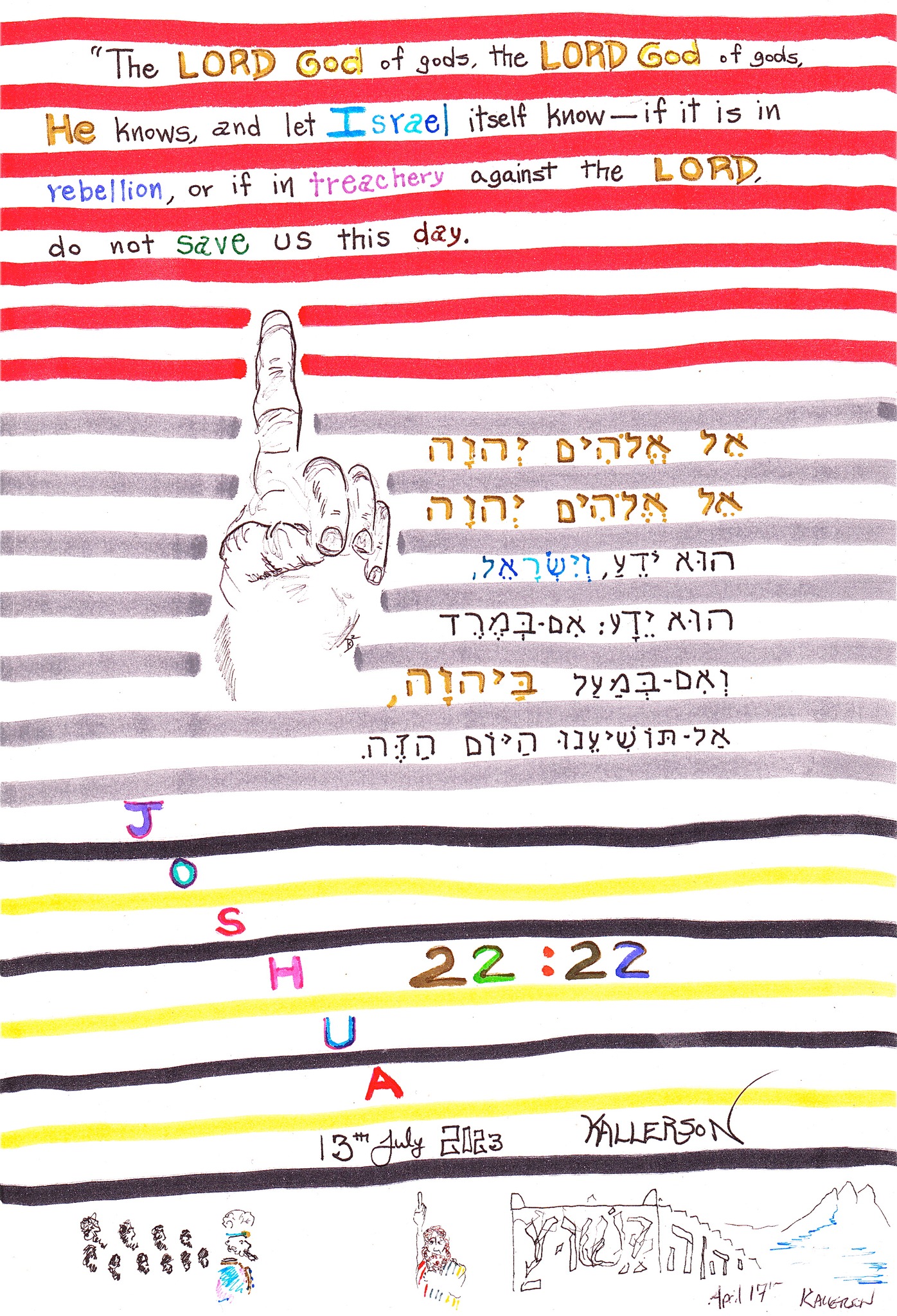
Artwork by Douglas Kallerson.
Joshua 22:21-29
The Lord God of gods, Part II
Our passage today will anticipate Christ. If it didn’t, it would be out of line with any other passage we have looked at from Joshua. We’ll see hints of this as we go along, but when we get to the end of the chapter, we will see what the overall typology is telling us.
However, there are also lessons concerning our own lives. The verses here speak to us about the importance of communication, reconciliation, and unity within Israel. Since we are a part of the commonwealth of Israel, the same should be true for the body of Christ.
As we saw in the last passage, when the western tribes of Israel heard about the altar, they assumed that the eastern tribes were rebelling against God by setting up a false altar. They gathered an army to prepare for war against their fellow Israelites.
But before rushing into battle, they sent a delegation led by Phinehas the priest, to investigate. After lodging their complaint against the eastern tribes, here we will see how those tribes explain building the altar.
Text Verse: “So then, my beloved brethren, let every man be swift to hear, slow to speak, slow to wrath; 20 for the wrath of man does not produce the righteousness of God.” James 1:19, 20
The tribes that gathered at Shiloh in preparation for war were restrained, allowing things to play out with the delegation. The eastern tribes were slow to speak, allowing the delegation to state its complaint before responding. In the passage today, the western tribes will be swift to hear.
Nothing is recorded concerning them speaking while those from east of the Jordan are allowed to finish with their response.
We can learn from this. I know I can. I find it hard to keep from interrupting when I disagree with someone. If you don’t already know this, ask any member of my family or anyone I do mission work with each week. I’m not the patient “listen and be silent” sort. Hat’s off to you if you are.
As for this passage in Joshua, the entire episode between the tribes could have been avoided if the western tribes had simply communicated their intentions. At the same time, they probably never imagined that the actions they were taking would get the other tribes in such a huff, so the blame can only go so far. Sending the delegation was the right thing to do.
As you read the Bible, think about things like this. There is an endless stream of lessons we can derive from just thinking about the circumstances of whatever passage we read. Above all, however, think about how the passage is pointing to Jesus.
God selected these words for more than just a quick life application about keeping quiet while others talk. He selected them because they are relevant to the greater plan of redemption laid out in the Bible. This is certain.
Such great things as this are to be found in His superior word. And so, let us turn to that precious word once again, and… May God speak to us through His word today, and may His glorious name ever be praised.
I. A Border Between Us and You (verses 21-25)
In the Joshua 22:10-20 sermon, Phinehas and ten rulers from each tribe of Israel that settled in Canaan came to the eastern tribes and questioned them concerning the altar they had built. They reminded those tribes east of the Jordan about the matter of Peor, the trespass of Achan, and the tragedy those events brought upon Israel. Now, those of the eastern tribes will respond concerning their actions…
21 Then the children of Reuben, the children of Gad, and half the tribe of Manasseh answered
If you remember, the structure of the passage was provided concerning the use of the word shevet or mateh being used to translate the word “tribe.” Also, we saw a list of times the definite article was used before mentioning the half-tribe of Manasseh.
In this case, the word is shevet, the political aspect of the tribe. Also, there is an article before Manasseh –half tribe the Manasseh. Thus, there is a sense of separation being conveyed by these people in their response to the accusations…
21 (con’t) and said to the heads of the divisions of Israel:
Rather than said, it reads, spoke: vaydaberu eth rashe alpe Yisrael – “and spoke to heads thousands Israel.” Their words are a statement without any participation from their audience. It will be a declaration of innocence. Further, their words are especially highlighted in Scripture because they are a key part of the special literary device that is found in this passage…
22 “The Lord God of gods, the Lord God of gods,
The words form the center of the chiasm. They are not complicated and yet they are widely translated: El Elohim Yehovah El Elohim Yehovah. A few examples –
The God of gods — Jehovah, the God of gods – Jehovah (YLT)
The Lord the most mighty God, the Lord the most mighty God (DR)
The Mighty One, God, Jehovah, the Mighty One, God, Jehovah (ASV)
The LORD is the greatest God! (CEV)
God, God, the LORD, God, God, the LORD (JPS Tanakh)
El means God, coming from ayil, a ram. That comes from ul, the body, but by implication “to be strong.” Thus, it signifies might or strength. Elohim is a majestic plural of El that refers to God while indicating a fulness within Him. It can also be a plural, gods, when referring to other gods. The Tetragrammaton, YHVH (יהוה), is the divine name – Yehovah.
As it is two standard nouns followed by a proper noun, and as it is probably referring only to the true God, not other gods in relation to Him, I think the sense is – God! Even God – Yehovah! The repetition is given as a strong emphatic proclamation.
The first use of each word helps explain the magnificence of the title. El was first seen in Genesis 14:18 –
“Then Melchizedek king of Salem brought out bread and wine; he was the priest of God [el] Most High. 19 And he blessed him and said:
‘Blessed be Abram of God [el] Most High,
Possessor of heaven and earth;
20 And blessed be God [el] Most High,
Who has delivered your enemies into your hand.’” Genesis 14:18-20
He is the God of strength and power who can deliver one from all enemies because He possesses all power and authority in heaven and on earth. It is a claim made by Jesus in Matthew 28:18, “All authority has been given to Me in heaven and on earth.” To have all authority is to possess what that authority extends over.
Next, Elohim, was first seen in the first sentence of the Bible –
“In the beginning God [elohim] created the heavens and the earth.” Genesis 1:1
He is the Creator God who is before all things and by whom all things exist and thus also subsist. These are qualities ascribed to Jesus by the apostles –
“In the beginning was the Word, and the Word was with God, and the Word was God.” John 1:1
“And *he* is before all, and all things subsist together by him.” Colossians 1:17 (Darby)
The divine name of God, YHVH (יהוה), or Yehovah, was first seen in Genesis 2 –
“This is the history of the heavens and the earth when they were created, in the day that the Lord [YHVH] God made the earth and the heavens, 5 before any plant of the field was in the earth and before any herb of the field had grown. For the Lord [YHVH] God had not caused it to rain on the earth, and there was no man to till the ground; 6 but a mist went up from the earth and watered the whole face of the ground.
7 And the Lord [YHVH] God formed man of the dust of the ground, and breathed into his nostrils the breath of life; and man became a living being.” Genesis 2:4-7
Among countless other aspects indicated by this name, He is the personal God who interacts with His creation, who shaped man in His image, and who possesses the breath of life within Himself. Numerous verses of the New Testament convey to us that this is Jesus. John sums it up nicely –
“That which was from the beginning, which we have heard, which we have seen with our eyes, which we have looked upon, and our hands have handled, concerning the Word of life— 2 the life was manifested, and we have seen, and bear witness, and declare to you that eternal life which was with the Father and was manifested to us.” 1 John 1:1, 2
It is to this majestic God that the eastern tribes appeal, saying…
22 (con’t) He knows, and let Israel itself know—
The highly emphatic nature of the words continues here: hu yodea v’Yisrael hu yeda – “HE knows, and Israel – HE shall know.” They are making the strongest defense utterable concerning the matter at hand. The Lord is already aware of their intentions concerning the matter, and Israel will realize (the verb is imperfect) it as well.
From there, they call for proper discernment on the matter at hand because an action is required by their accusers…
22 (con’t) if it is in rebellion, or if in treachery against the Lord,
They take the words of their accusers and restate them, thus highlighting the gravity of the matter: im b’mered v’im b’maal b’Yehovah – “if in rebellion and if in transgression in Yehovah.”
These words form the main clause of the conditional statement. In them, their accusers had used the verb forms of the words rebel and transgress several times in their address. Those of the eastern tribes now use the noun form, stating that if they are found to be in the state of rebellion or transgression, they should not be delivered.
Having come with the highly emphatic and solemn pronouncement of the titles and name of God, nothing could be more convicting or acquitting. Either there is absolute guilt or there is absolute innocence in what they have done.
22 (con’t) do not save us this day.
al toshienu ha’yom ha’zeh – “not do save us the day, the this.” The words are parenthetical to elicit the highest degree of consideration by their accusers. And more, they continue with the challenge to exercise discernment, saying…
23 If we have built ourselves an altar to turn from following the Lord,
More precisely, “to build to us altar to turn from after Yehovah.” It is a part of the conditional statement. If we have built this altar for a purpose that will mean departing from following after the Lord, we should not be saved. Also…
23 (con’t) or if to offer on it burnt offerings or grain offerings,
It says, “and if to ascend on it burnt-offering and present-offering,” These words define how they could turn from following the Lord.
The offerings were to be made by the priests at the sanctuary currently located in Shiloh. This is said in direct response to the accusation against them in verse 16, “in that you have built for yourselves an altar, that you might rebel this day against the Lord?”
The olah, or burnt offerings, are those that are wholly burnt up to the Lord. The minkhah, or present-offerings, are normally bloodless and voluntary. They are gifts presented, such as grain offerings. Also…
23 (con’t) or if to offer peace offerings on it,
More precisely, “and if to make on it sacrifices-peace.” The shelamim or peace offerings are a sacrifice for fellowship between two parties where both partake of the sacrifice. As such, some is given to the priest as the Lord’s portion and some is returned to the offeror as his portion.
If this is not the Lord’s altar for offerings, then it is, by default, an acknowledgment of other gods and that these various sacrifices and offerings are being offered to them for appeasement, petitioning, and fellowship. This could not be allowed to stand. Further, the men of the eastern tribes acknowledge that if this was their intent…
23 (con’t) let the Lord Himself require an account.
The words are emphatic: Yehovah hu yebaqesh – “Yehovah – HE will seek.” The meaning is that the Lord Himself would intervene and require an accounting for their apostasy. They know this, and so it would be the epitome of stupidity to do what they have been accused of.
When laid out as the thought is presented, the sense is clear –
Protasis: If it is in rebellion, or if in treachery against the Lord:
Emphatic parenthesis: (do not save us this day!)
Protasis continued: …if we have built ourselves an altar to turn from following the Lord, or if to offer on it burnt offerings or grain offerings, or if to offer peace offerings on it…
Apodosis: …let the Lord Himself require an account.
On the other hand…
24 But in fact we have done it for fear, for a reason, saying,
Rather, “And if not, from anxiety from word we have done this, saying.” In other words, if the Lord doesn’t find anything wrong in their intentions, then there must be another reason that they have built the altar. The very thing that brought them to build the altar is just the opposite of what they have been accused of.
In this, a new word, deagah, is introduced. It is a noun signifying the state of anxiety. As for what would cause this state of anxiety, they explain that with their next words…
24 (con’t) ‘In time to come your descendants may speak to our descendants, saying, “What have you to do with the Lord God of Israel?
Literally: “Tomorrow may speak your sons to our sons saying, ‘What to you and to Yehovah, God of Israel?’” The meaning is that at some point in the indefinite future, maybe even tomorrow itself, the ten tribes in Canaan will say to the eastern tribes, “What relationship exists between you and the Lord, the God of Israel?”
It is as if the eastern tribes are not really a part of those who have fellowship with the Lord. As such, they are outsiders and do not deserve the benefits of partaking in the covenant promises. Their thoughts are not without validity. This is seen in their continued explanation…
25 For the Lord has made the Jordan a border between you and us, you children of Reuben and children of Gad.
It is of note that the half-tribe of Manasseh is excluded from their words. Like much of the discourse so far, the wording is very precise. It reads, “And border gave Yehovah between us and between you, sons Reuben and sons Gad – the Jordan.”
The state of anxiety is that at some point in time, those in Canaan will say, “If you were really a part of us, you would be living on this side of the Jordan. Therefore, the Lord Himself has divided us, separating you from us. Therefore…”
25 (con’t) You have no part in the Lord.”
ein lakhem kheleq b’Yehovah – “Naught to you portion in Yehovah.” The border that exists between the tribes is evidence that those tribes were purposefully separated from the Lord.
This then is the purpose for having built the altar on the west side of the Jordan. If the Jordan was supposedly a border that excluded them from a portion in the Lord, then why is their altar built on the western side, above the Jordan? The claim was made within Canaan proper and the altar testifies to it.
Without that, the claim would stand…
25 (con’t) So your descendants would make our descendants cease fearing the Lord.’
v’hishbitu benekhem eth banenu l’bilti yero eth Yehovah – “And caused your sons our sons to cease fearing Yehovah.” The idea being expressed is that of fellowshipping, worshiping, and all other interactions – both internal and external – in relation to the Lord.
The division of the land is noted explicitly in the books of Moses. However, those in Canaan could make the argument that the worship of the Lord is reserved for them alone. In Numbers 34, it says –
“Then the Lord spoke to Moses, saying, 2 ‘Command the children of Israel, and say to them: “When you come into the land of Canaan, this is the land that shall fall to you as an inheritance—the land of Canaan to its boundaries. … This shall be your land with its surrounding boundaries.”’” Numbers 34:1, 2 & 12
Within those verses the borders were carefully defined. After that, it then said –
“Then Moses commanded the children of Israel, saying: ‘This is the land which you shall inherit by lot, which the Lord has commanded to give to the nine tribes and to the half-tribe. 14 For the tribe of the children of Reuben according to the house of their fathers, and the tribe of the children of Gad according to the house of their fathers, have received their inheritance; and the half-tribe of Manasseh has received its inheritance. 15 The two tribes and the half-tribe have received their inheritance on this side of the Jordan, across from Jericho eastward, toward the sunrise.’” Numbers 34:13-15
Therefore, using, or rather, misusing the words of Moses, the western tribes could unjustly say that the eastern tribes were excluded from the inheritance of the Lord…
How could we turn away
From following the Lord Jesus?
It is He who our sin debt did pay
Such a marvelous thing He has done for us
And how could another turn us back
And tell us we have no part in Him?
That would be the worst kind of attack
Such a thought is dark and grim
He is our God, and to Him, we shall cling
Forever and ever it shall be so
Jesus Christ our Lord and King
No other god shall we ever know
II. You Have No Part in the Lord (verses 26-29)
26 Therefore we said, ‘Let us now prepare to build ourselves an altar,
The word translated as “now” has less to do with time as it does to suggest something. We may say, “Now, look here.” We aren’t saying, “Look here at this time.” Rather, it is an interjection, “Hey, look here.” That is the sense of what is being said.
The wording, as before, continues to be very detailed, “And we say, ‘Make, pray, to us to build the altar.’” By using the definite article, it is then set in contrast to verse 23 –
“to build to us altar to turn from after Yehovah.”
“to us to build the altar.”
They are not building “an altar” for ritual purposes to turn from following the Lord. Rather, they have a particular purpose for it that excludes such a notion. Thus, they are building “the altar…”
26 (con’t) not for burnt offering nor for sacrifice,
lo l’olah v’lo l’zavakh – “not to burnt-offering and not to sacrifice.” The whole burnt offering would be for appeasement and the sacrifice would be for atonement, fellowship, etc. The altar is not intended for such things as this. Rather, they explain, saying…
27 but that it may be a witness
It is emphatic: ki ed hu – “for witness IT.” This is why it is called “the altar.” It has a specific purpose that has nothing to do with “an altar” that would replace the altar of the Lord. Rather, it is to be a witness…
27 (con’t) between you and us and our generations after us,
It is much more precise: “between us, and between you, and between our generations after us.” The altar stands between each principal entity as a witness…
27 (con’t) that we may perform the service of the Lord before Him
la’avod eth avodath Yehovah l’phanav – “to serve service Yehovah to His face.” The meaning is that they fully intend to serve the Lord at the location where the tabernacle is located, not where this altar is located. The altar stood only as a witness to this fact. As for serving before the Lord at the tabernacle, that was to be…
27 (con’t) with our burnt offerings, with our sacrifices, and with our peace offerings;
Instead, it reads: “in our burnt offerings, and in our sacrifices, and in our peace offerings.” Rather than the previous verse where the purpose of the altar was explained, this is a listing of the things that the people offer on the altar.
It is in the presentation of these things that they would perform the service of the Lord. To ensure that they would never be deprived of this right, they built the altar so…
27 (con’t) that your descendants may not say to our descendants in time to come, “You have no part in the Lord.”’
This now fully explains the state of anxiety that prompted them to build the altar in the first place. At some future point (lit: tomorrow), they may be kept from their portion in the Lord. They had considered this as a possibility, they had pondered how they could ensure this would never be the case, and thus they built the altar as a witness to keep it from ever being considered…
28 Therefore we said that it will be, when they say this to us or to our generations in time to come,
Rather than “or,” it says “and.” In other words, they are assuming that this is something that will happen quickly. They will be considered as being excluded from the portion of the Lord and it will become the customary way of dealing with them: “And we say, and it will become, for they say unto us, and unto our generations tomorrow…”
28 (con’t) that we may say, ‘Here is the replica of the altar of the Lord which our fathers made,
The words leave out any definite articles: “And we said, ‘See, replica altar Yehovah which made our fathers.’” There is one altar of the Lord and this is a replica of it. As it is on the western side of the Jordan, it was built to witness to those within Canaan that those east of the Jordan worshiped the Lord just as they did.
As Yehovah’s altar could not have been replicated in such an exacting manner if they hadn’t seen it, then this was clear evidence that they had always been followers of the Lord, they were entitled to fellowship at the Lord’s altar, and they were to participate in full communion with those of Israel west of the Jordan.
And to ensure that its purpose was perfectly understood, they once again repeat the same sentiment already stated in various ways…
28 (con’t) though not for burnt offerings nor for sacrifices; but it is a witness between you and us.’
It is an exacting repetition of the words of verses 26 and 27. The words are singular and there is an emphatic pronouncement: “not to burnt offering and not to sacrifice; for witness IT between us and between you.”
Being a repetition, the entire thought provides its own extra emphasis. They are innocent of the charges against them and they adamantly repudiate them while also explaining what the purpose of the altar is. With that, they continue their protestations, saying…
29 Far be it from us that we should rebel against the Lord,
The words are a denial of rebellion and are a direct part of the chiasm: khalilah lanu mimenu limrod Yehovah – “Profane thing to us from rebelling in Yehovah.” The idea itself is utterly repugnant to them. It would be something that was defiling in and of itself and it would be a mark of rebellion against the Lord. That is then further explained with the words…
29 (con’t) and turn from following the Lord this day,
The logical progression of rebellion is that one will first turn away in thought and then in reality. Their consciences are clear because their thoughts were pure in regard to this matter. They are adamant that their intention was not…
29 (con’t) to build an altar for burnt offerings, for grain offerings, or for sacrifices,
Again, the words are singular, offering and sacrifice. It is a description of the purpose of the altar, not a list of the things that will be offered on it. Thus, it is an acknowledgment that there is one valid altar on which those things can be accomplished, their replica is not that altar. That is expressly stated with their next words…
*29 (fin) besides the altar of the Lord our God which is before His tabernacle.”
milbad mizbakh Yehovah elohenu asher liphne mishkano – “beside altar Yehovah our God which to face His tabernacle.” The meaning of their words is clear. There is one altar to the Lord. No other is acceptable and they acknowledge this.
Their replica was solely for the purpose of proving, and thus maintaining, their rights if they were ever questioned by those who lived on the western side of the Jordan.
Remembering that the altar was a typological representation of Jesus, as were all of the sacrifices and offerings made upon it, the symbolism is clear. These tribes have acknowledged that there is one way, and one way alone, to be right with God and that is through faith in Jesus Christ.
He is the true Altar, He is the ultimate fulfillment of the burnt offering, the gifts presented, the sacrifices, and everything associated with each of these things. God is showing us in real historical events what He expects of us.
There were innumerable events that happened within the history of Israel that were just as important to the general population as what we are seeing in Joshua 22. But God only chose events that would explain to us what He wants us to see in regard to Jesus.
We cannot build our own path back to God. We cannot obtain any other suitable sacrifice for atonement. No other offering except Christ, or one done in Christ, can be considered a pleasing aroma to God. There is no fellowship with God except as it is connected with faith in Jesus.
These things are to be taken as axiomatic because this is how the Bible has revealed them to us. To God, everything concerning our relationship with Him is nothing but Jesus and it is Jesus plus nothing. Everything that happens between God and us occurs only because of Jesus.
We have to remember this. The eastern tribes of Israel only had the law, but that law, in its entirety, points to Jesus. In acknowledging the precepts of the law, they were implicitly but expressly anticipating Jesus. This is why God has placed this account into His word.
There are only five verses left in the account and we will finish them up next week. One never knows though, there may be five more sermons before we finish things up. You’ll just have to wait and see J. Until then, remember these words about Jesus.
He and He alone is to be considered our Altar of Meeting before God. Any other representation of Him is to be for our identification with Him. For example, a cross is an identification with the Lord, a reminder of what He has done. It should never be considered as a source of power or of idolatry.
The same is true with a building where the church meets. That is not the church. It is simply a place to gather and remind us that we are the church. Unfortunately, we get these things out of whack and what should serve a lesser purpose begins to take our attention away, coopting what should be our greater focus.
So, let us fix our eyes on Jesus as we continue down life’s path. If we do that, things sure will go better for us. And let us be ever grateful to God for His goodness to us in sending Jesus to direct that path all our days. Yes, let us thank God for Jesus.
Closing Verse: “Therefore the king asked advice, made two calves of gold, and said to the people, ‘It is too much for you to go up to Jerusalem. Here are your gods, O Israel, which brought you up from the land of Egypt!’ 29 And he set up one in Bethel, and the other he put in Dan. 30 Now this thing became a sin, for the people went to worship before the one as far as Dan.” 1 Kings 12:28-30
Next Week: Joshua 22:30-34 He is the one that every true believer applauds, as sure as can be… (The Lord God of Gods, Part III) (53rd Joshua Sermon)
The Lord has you exactly where He wants you. He has a good plan and purpose for you. It is He who has defeated the enemy and who now offers His people rest. So, follow Him and trust Him and He will do marvelous things for you and through you.
The Lord God of Gods, Part II
Then the children of Reuben, the children of Gad, and half the tribe
———-of Manasseh
Answered and said to the heads of the divisions of Israel
“The LORD God of gods, the LORD God of gods
He knows, and let Israel itself know as we now tell
“If it is in rebellion, or if in treachery against the LORD
Do not save us this day
If we have built ourselves an altar to turn from following
———-the LORD
Or if to offer on it burnt offerings or grain offerings, acting
———-in that way
“Or if to offer peace offerings on it
Let the LORD Himself require an account
But in fact we have done it for fear, for a reason, saying
Please let us now our thoughts recount
‘In time to come your descendants may speak
To our descendants, saying
“What have you to do with the LORD God of Israel?”
If such they are relaying
“For the LORD has made the Jordan a border between you and us
You children of Reuben and children of Gad
You have no part in the LORD
So your descendants would make our descendants cease fearing
———-the LORD. That would be really bad
“Therefore we said, ‘Let us now prepare to build ourselves an altar
Not for burnt offering nor for sacrifice
But that it may be a witness between you and us
And our generations after us, this was our advice
“That we may perform the service of the LORD before Him
With our burnt offerings, with our sacrifices, and with our
———-peace offerings too
That your descendants may not say to our descendants
———-in time to come
‘You have no part in the LORD, beat it now… shoo!’
“Therefore we said that it will be
When they say this to us or to our generations in time to come
That we may say, ‘Here is the replica of the altar of the LORD
Which our fathers made; stop acting dumb’
“Though not for burnt offerings nor for sacrifices is it
But it is a witness between you and us, so we admit
“Far be it from us that we should rebel against the LORD
And turn from following the LORD this day
To build an altar for burnt offerings, for grain offerings
———-or for sacrifices
Besides the altar of the LORD our God which is before
———-His tabernacle. No way!
Lord God, turn our hearts to be obedient to Your word
Give us wisdom to be ever faithful to You
May we carefully heed each thing we have heard
Yes, Lord God may our hearts be faithful and true
And we shall be content and satisfied in You alone
We will follow You as we sing our songs of praise
Hallelujah to You; to us Your path You have shown
Hallelujah we shall sing to You for all of our days
Hallelujah and Amen…
21 Then the children of Reuben, the children of Gad, and half the tribe of Manasseh answered and said to the heads of the divisions of Israel: 22 “The Lord God of gods, the Lord God of gods, He knows, and let Israel itself know—if it is in rebellion, or if in treachery against the Lord, do not save us this day. 23 If we have built ourselves an altar to turn from following the Lord, or if to offer on it burnt offerings or grain offerings, or if to offer peace offerings on it, let the Lord Himself require an account. 24 But in fact we have done it for fear, for a reason, saying, ‘In time to come your descendants may speak to our descendants, saying, “What have you to do with the Lord God of Israel? 25 For the Lord has made the Jordan a border between you and us, you children of Reuben and children of Gad. You have no part in the Lord.” So your descendants would make our descendants cease fearing the Lord.’ 26 Therefore we said, ‘Let us now prepare to build ourselves an altar, not for burnt offering nor for sacrifice, 27 but that it may be a witness between you and us and our generations after us, that we may perform the service of the Lord before Him with our burnt offerings, with our sacrifices, and with our peace offerings; that your descendants may not say to our descendants in time to come, “You have no part in the Lord.” ’ 28 Therefore we said that it will be, when they say this to us or to our generations in time to come, that we may say, ‘Here is the replica of the altar of the Lord which our fathers made, though not for burnt offerings nor for sacrifices; but it is a witness between you and us.’ 29 Far be it from us that we should rebel against the Lord, and turn from following the Lord this day, to build an altar for burnt offerings, for grain offerings, or for sacrifices, besides the altar of the Lord our God which is before His tabernacle.”