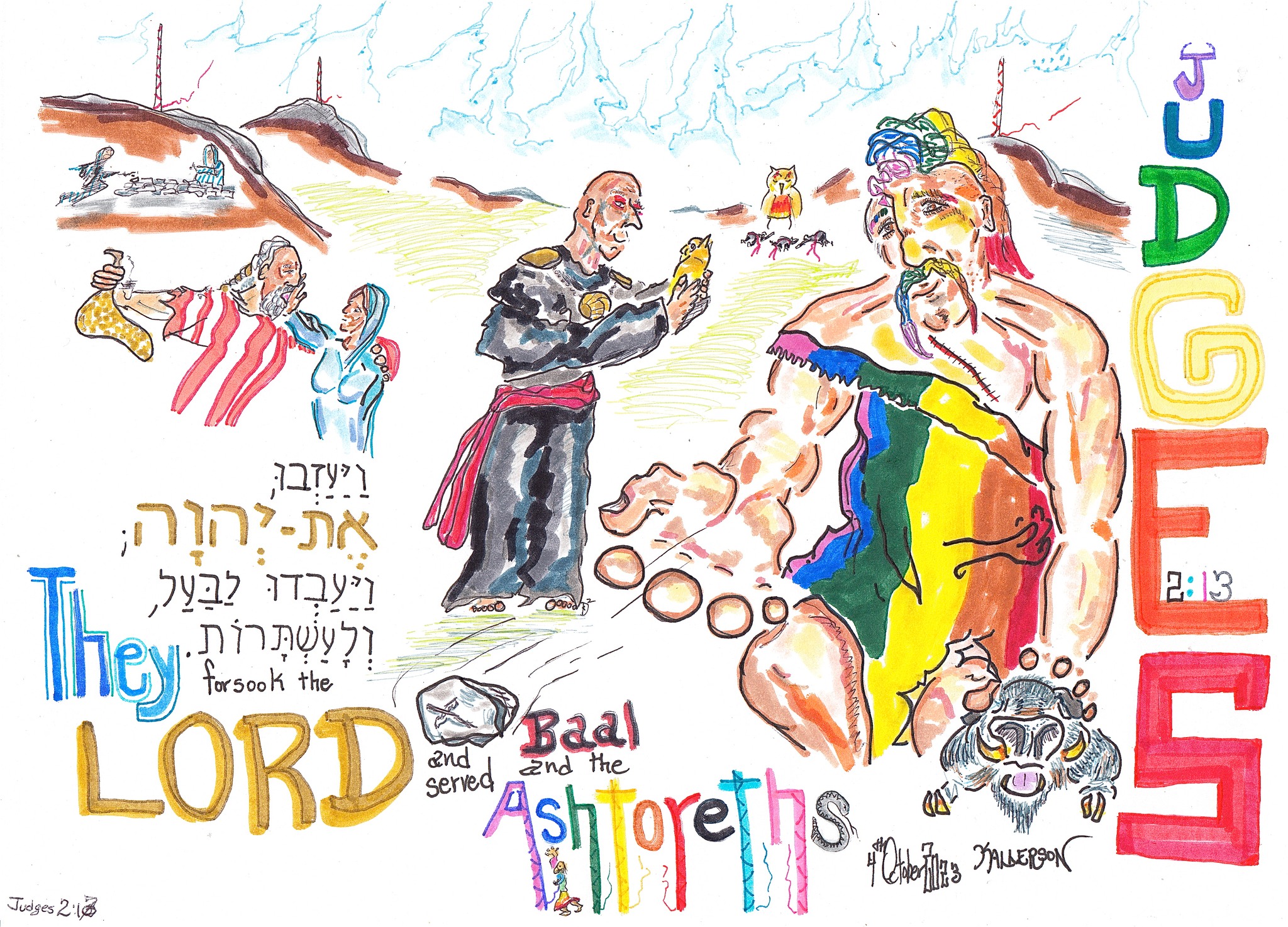
Artwork by Douglas Kallerson.
Judges 2:11-15
Evil in the Sight of the Lord
A key point in Israel’s history is noted in the words of verse 12, “the Lord brought Israel out of the land of Egypt.” It is mentioned repeatedly throughout the law, the historical books, the Psalms, and in the prophets.
Over and over, the words are brought back into the redemptive narrative to remind Israel of where they were and how they got out of that state. Stephen reminded the people of it in Acts 7. Almost as often as it is mentioned, there is an accompanying note about Israel’s rebellion.
“The Lord did this for you, but you turned away despite that.” In the case of Stephen, he reminded them of what the Lord had done, and then he reminded Israel of their rejection of Moses who gave them the law of the Lord. Instead of obedience to Him, they fashioned a golden calf, sacrificed to idols, and rejoiced in the work of their own hands.
Likewise, the author of Hebrews mentions this incident while citing the promise of the Lord that there would be a New Covenant to replace the one that continuously resulted in disobedience and failure…
Text Verse: “For if that first covenant had been faultless, then no place would have been sought for a second. 8 Because finding fault with them, He says: “Behold, the days are coming, says the Lord, when I will make a new covenant with the house of Israel and with the house of Judah— 9 not according to the covenant that I made with their fathers in the day when I took them by the hand to lead them out of the land of Egypt; because they did not continue in My covenant, and I disregarded them, says the Lord.” Hebrews 8:7-9
The author of Hebrews didn’t just pull his words out of thin air. Rather, he was citing the prophet Jeremiah, a prophet under the Mosaic Covenant. The New Covenant, therefore, isn’t just a nutty idea proposed by a wandering rabbi named Jesus without any merit at all.
Rather, it is the word of the Lord to the people of Israel that what they had been living under, meaning the Old Covenant, was not the end of the story. It is, instead, a steppingstone on the way to something far, far better. And this is a good thing not only for Israel but for the whole world. Israel is just the immediate proof of that.
Where there was a failure to continue holding fast to the Lord in the Mosaic covenant, leading to being disregarded by Him, there is victory in the New Covenant, leading to being reconciled to God once and forever. The book of Judges is an integral part of understanding this, and our verses today are a necessary portion for understanding why.
The ongoing lesson of Scripture is that God is working, even through our disobedience, to bring full, final, and forever reconciliation between Himself and us. It is a marvelous lesson, and it is to be found in His superior word. And so, let us turn to that precious word once again, and… May God speak to us through His word today, and may His glorious name ever be praised.
I. As the Lord Had Sworn to Them (verses 11-15)
What is presented in these verses, beginning with verse 11 and going through the rest of the chapter, is a summary of the rest of the book of Judges. Joshua and his generation are dead and buried. From there, the deeds of the quickly apostatizing nation are highlighted. This was seen as the previous verses closed out –
“So the people served the Lord all the days of Joshua, and all the days of the elders who outlived Joshua, who had seen all the great works of the Lord which He had done for Israel. 8 Now Joshua the son of Nun, the servant of the Lord, died when he was one hundred and ten years old. 9 And they buried him within the border of his inheritance at Timnath Heres, in the mountains of Ephraim, on the north side of Mount Gaash. 10 When all that generation had been gathered to their fathers, another generation arose after them who did not know the Lord nor the work which He had done for Israel.” Judges 2:7-10
The inevitable result of not driving out the inhabitants of the land, as noted in Chapter 1, is now seen…
11 Then the children of Israel did evil in the sight of the Lord,
More precisely, it reads: vayaasu bene Yisrael eth ha’ra b’ene Yehovah – “And did sons Israel the evil in eyes Yehovah.” Saying “the evil” adds its own stress to the words.
It is a phrase commonly used in Deuteronomy. This is the first of eight times it will be seen in Judges, and it will continue throughout the Old Testament, especially in the books of Kings and Chronicles.
For example, the word ra, or evil, is used nineteen times in Judges, but eight times it includes the article, ha’ra, the evil, when referring to the people’s conduct before the Lord. Each time, it says the evil was done b’ene Yehovah, or “in the eyes of Yehovah.” Thus, the offense is personal in the relationship between the people and the Lord.
What is interesting is that in Judges, the use of the article, ha, is always said in relation to the conduct of the sons of Israel, meaning the people collectively. However, later, when kings rule the land, that same term will usually refer to the conduct of the king, he being the one to do “the evil.”
One can see the contrast. During the time of the Judges, the Lord is the ultimate leader of the people. It is the judge, the Lord’s temporarily appointed leader, who is called to bring the people back from doing “the evil.” Once the kingdom is established, it is the king himself who causes the people to err or who brings them back to the Lord.
As for this instance of doing “the evil,” it is…
11 (con’t) and served the Baals;
vayaavdu ha’baalim – “and served the Baalim.” The word baal simply means a master, owner, lord, etc. Among other things, for example, it can refer to a husband in relation to a wife, the owner of a piece of property, a master of assemblies, or the captain of the guard.
In this verse, it is used in the sense of gods. They can be general gods, such as worshiping the sun or stars, or they can be the names of specific gods, such as Baal-Zebub, Baal-Berith, etc. This type of worship was specifically warned against by Moses in Deuteronomy 4:15-31 (and elsewhere). In those verses, he says –
“When you beget children and grandchildren and have grown old in the land, and act corruptly and make a carved image in the form of anything, and do evil [ha’ra: the evil] in the sight of the Lord your God to provoke Him to anger, 26 I call heaven and earth to witness against you this day, that you will soon utterly perish from the land which you cross over the Jordan to possess; you will not prolong your days in it, but will be utterly destroyed.” Deuteronomy 4:25, 26
John Lange gives a good sense of the meaning of baal –
“Baal (בַּעַל), as deity, is for the nation, what as master he is in the house, and as lord in the city. He represents and impersonates the people’s life and energies. Hence, there is one general Baal, as well as many Baalim. The different cities and tribes had their individual Baalim, who were not always named after their cities, but frequently from the various characteristics for which they were adored. The case is analogous to that of Zeus, who by reason of his various attributes, was variously named and worshipped in Greece.”
Serving the Baals is what describes the evil committed in the sight of the Lord. This is especially so because in serving the Baals it means something else also takes place…
12 and they forsook the Lord God of their fathers,
Israel has proved itself to be a nation of liars. This is exactly what they ardently claimed would never happen –
“So the people answered and said: ‘Far be it from us that we should forsake the Lord to serve other gods; 17 for the Lord our God is He who brought us and our fathers up out of the land of Egypt, from the house of bondage, who did those great signs in our sight, and preserved us in all the way that we went and among all the people through whom we passed.’” Joshua 24:16, 17
The words are also closely connected to the words of Moses in Deuteronomy 29 which speak of the time when Israel falls under the curses of the law. This is rather ominous, considering that these words come just after the record of the death of Joshua. Here is what Deuteronomy said –
“Because they have forsaken the covenant of the Lord God of their fathers, which He made with them when He brought them out of the land of Egypt.” Deuteronomy 29:25
This thought here falls exactingly in line with the words of Jesus –
“No servant can serve two masters; for either he will hate the one and love the other, or else he will be loyal to the one and despise the other. You cannot serve God and mammon.” Luke 16:13
Some translations capitalize Mammon, personifying it. As it is set in contrast to the true God, that appears proper. The same idea is seen here in Judges. The people’s attention was directed to the Baals of the land, and their hearts were thus torn away from Yehovah elohe avotam, Yehovah God of their fathers…
12 (con’t) who had brought them out of the land of Egypt;
Rather, the words are personal, using a verb as a noun: ha’motsi otam me’erts mitsrayim – “the Bringer Out you from land Egypt.” The Lord is set in direct contrast to the Baals. They had done nothing for the people; He had brought them out of Egypt.
As Egypt is a picture of bondage, the parallel to Jesus in the New Covenant cannot be overlooked. He brought Israel out of bondage to the law. However, as it is by law that the knowledge of sin comes about, He didn’t just bring Israel out of the bondage to sin, but all men, even those not under the Law of Moses.
This is because Adam was a man under law. In his disobedience to the law, his transgression spread to all men. Paul explains this in Romans 5, explicitly stating it in verse 12 –
“Therefore, just as through one man sin entered the world, and death through sin, and thus death spread to all men, because all sinned—”
The Law of Moses only highlighted the work of sin through law, but it could not remove sin from man because the offense of Adam had already been committed. However, Jesus was born under the law but not bearing Adam’s sin. Thus, He was able to not only be the Bringer Out from Adam’s transgression but also from the transgressions committed under the Law of Moses for Israel.
What we are seeing in Judges is a typological representation of the greater work of Jesus Christ. Let us not be like Israel who was brought out…
12 (con’t) and they followed other gods
vayel’ku akhare elohim akherim – “and walked after gods other.” The words continue to follow the thought of Deuteronomy 29:26, “And they walked and served gods other.”
Israel was called by the Lord, was delivered from the bondage of Egypt to serve Him, and the people were given the law to direct them in how to serve Him. In observing the law, they would be kept from serving other gods.
This was the intent of the law. It wasn’t just, “Here is what you are to do to actively serve the Lord,” but it was also, “Here is what you are not to do in order to properly serve the Lord.” Hence, the law included Moses’ words of Deuteronomy 4, cited earlier.
“Israel, you are to do this and not do that. In performing according to this word, you will do well.” However, they did what they were not to do by walking after other gods. In doing that, they also failed to do the other things they should have done. This is the natural result of serving other gods…
12 (con’t) from among the gods of the people who were all around them,
Rather than “the gods” and “people,” it is both less and more specific, saying, “from gods the peoples who around them.” It is as if Israel simply followed gods in a willy-nilly manner, bumbling around to whatever god they could latch onto from whatever people group happened to be nearby.
This thought also follows from Deuteronomy 29, “gods that no they did know and no He had given to them.” This walking after these various gods is then explained saying…
12 (con’t) and they bowed down to them;
It is an exact repeat from Deuteronomy 29:26: vayishtakhavu la’hem – “and bowed down to them.” The people didn’t just follow after these gods, but they subordinated themselves to them and worshiped them, as the act of bowing down implies. This is one generation after the people were brought into the land.
In other words, some of the people alive at this time were young men and women who actually saw the Jordan stop flowing and who then crossed over into the Promised Land. They had been partakers of the manna until that day, and yet, they were unable or unwilling to ensure that what their eyes had beheld was properly communicated to their own children…
12 (con’t) and they provoked the Lord to anger.
vayakisu eth Yehovah – “And enraged Yehovah.” The word kaas means to be vexed or angry. In this case, it is the actions of the people that caused the Lord to become angry. This was exactly what Moses warned of in the verses already cited from Deuteronomy 4 –
“When you beget children and grandchildren and have grown old in the land, and act corruptly and make a carved image in the form of anything, and do evil [ha’ra: the evil] in the sight of the Lord your God to provoke [kaas] Him to anger…” Deuteronomy 4:25
Though Israel’s history at this point is not yet that far along, the inevitable result of their actions is spelled out in the continued words of Deuteronomy 29 –
“Then the anger of the Lord was aroused against this land, to bring on it every curse that is written in this book.” Deuteronomy 29:27
This shows the longsuffering of the Lord. Israel almost immediately turned away from Him. And yet, it would be many hundreds of years and generations of falling away before they were first exiled. Still, from that first generation after entering Canaan…
13 They forsook the Lord and served Baal and the Ashtoreths.
Rather, it is singular and the action is directed: vayaazvu eth Yehovah vayaavdu la’baal v’la’ashtaroth – “And forsook Yehovah and served to the Baal and to the Ashtoreths.” Instead of serving l’Yehovah, or “to Yehovah,” they are serving “to the Baal” and “to the Ashtoreths,” trading the glory of the Lord for what He had created or for what man has devised.
What we cannot miss is that they have not only given allegiance to other gods but that they have failed to give honor to the Lord. That is seen, for example, in Deuteronomy 32 –
“They have corrupted themselves;
They are not His children,
Because of their blemish:
A perverse and crooked generation.
6 Do you thus deal with the Lord [l’Yehovah],
O foolish and unwise people?
Is He not your Father, who bought you?
Has He not made you and established you?” Deuteronomy 32: 5, 6
In serving other gods, they are dealing falsely with the Lord. It is reflected in the name Israel – He Strives with God. Israel strives with God (for God) or he strives with God (against God). Either way, Israel strives with God. So it is when they worship the Lord or when they worship other gods. Within just one generation, Israel was striving against God…
14 And the anger of the Lord was hot against Israel.
v’yikhar aph Yehovah b’Yisrael – “And burned nostril Yehovah in Israel.” This is what Deuteronomy 29:27 said would be the case, “And burned nostril Yehovah in the land.” In order to correct their deficient thinking and aberrant conduct, it next says…
14 (con’t) So He delivered them into the hands of plunderers who despoiled them;
So far, God’s judgment on Israel has followed according to the words of Deuteronomy. The exception to that is that the words Baal and Ashtaroth have been substituted for the heavenly host –
“And take heed, lest you lift your eyes to heaven, and when you see the sun, the moon, and the stars, all the host of heaven, you feel driven to worship them and serve them, which the Lord your God has given to all the peoples under the whole heaven as a heritage.” Deuteronomy 4:19
“They forsook the Lord and served Baal and the Ashtoreths.” Judges 2:13
The male singular, Baal, with the feminine plural, Ashtoreths, is notable. Baal is probably speaking of the sun, which would then encompass all lesser Baals, of which there were many and which are derived from it. Ashtoreths is probably referring to the moon-goddess Astharte of the Canaanites and any other associated female deities. This is speculation, but it would explain the matter.
Thus, Moses’ words concerning the sun, moon, stars, etc., have been realized in these false gods. Here, however, a new thought is introduced. It is the consequence of their actions. The words speak of a singular hand of many enemies: vayitnem b’yad shosim vayashosu otam – “And gave them in hand plunderers and plundered them.”
There are two new words here. The first is the noun shasah, plunderer. The second is the verb shasas, to plunder, from which the noun is derived.
They had accumulated all of the wealth of those they had conquered. They had also gained the wealth of those they subdued but failed to exterminate, as noted in Judges 1. However, along with having them under tribute, Israel began to mingle with them and serve their gods while simultaneously forsaking the Lord.
Therefore, what they had gained from the Lord’s care for them, they lost because of their neglect of Him. But more than just plundering, it next says…
14 (con’t) and He sold them into the hands of their enemies all around,
Again, it is one hand of many enemies – “And He sold them in hand their enemies from around.” The idea of the Lord selling Israel is not that He has made a profit off them. Rather, it is that He simply handed them over to their enemies as if they were property to be disposed of. “Here, I don’t want this anymore. Do what you will with it.”
Moses spoke of exactly this in the Song of Moses –
“For they are a nation void of counsel,
Nor is there any understanding in them.
29 Oh, that they were wise, that they understood this,
That they would consider their latter end!
30 How could one chase a thousand,
And two put ten thousand to flight,
Unless their Rock had sold them,
And the Lord had surrendered them?” Deuteronomy 32:28-30
But because the term “sold” is used, it must carry more meaning than the word “gave” seen in the previous clause. There, the Lord opened His hands and gave Israel into the hands of the plunderers. But this was because of their actions. Therefore, the selling must be what they did as well. This is seen in Isaiah 52 in reference to Jerusalem, the city that represents the Lord’s people –
“For thus says the Lord:
‘You have sold yourselves for nothing,
And you shall be redeemed without money.’” Isaiah 52:3
The truth of the matter is that Israel sold themselves to their enemies. Because of their actions, the Lord allowed it to happen. Thus, it can be said that the Lord sold them…
14 (con’t) so that they could no longer stand before their enemies.
v’lo yaklu od la’amod liphne oyvehem – “And no able again to stand to faces their enemies.” This is a specific curse stated in the law in both Leviticus 26 and Deuteronomy 28 –
“I will set My face against you, and you shall be defeated by your enemies [liphne oyvehem: to faces your enemies].
Those who hate you shall reign over you, and you shall flee when no one pursues you.” Leviticus 26:17
Instead of being able to stand against the faces of their enemy in battle, they would be defeated before them, unable to face off with them. And remember, this all began within the first generation after the death of Joshua.
15 Wherever they went out, the hand of the Lord was against them for calamity,
b’kol asher yatsu yad Yehovah haytah bam l’ra’ah – “In all where went out, hand Yehovah in them to evil.” In other words, not only was the power (the hand) of the Lord not with them, it was actively fighting against them, frustrating their efforts.
This is certainly not only referring to the previous two verses concerning being plundered and unable to face their enemies, but in industry, agriculture, contentment at home, and so forth.
As noted earlier, these verses are an opening summary to what is contained in the rest of the time of the Judges, which also encompasses the book of Ruth chronologically. In it, there will be strife, drought, oppression, inter-tribal warfare, and so forth.
This is exactly the opposite of what is promised in the blessings noted in the law when Israel was obedient –
“You shall not make idols for yourselves;
neither a carved image nor a sacred pillar shall you rear up for yourselves;
nor shall you set up an engraved stone in your land, to bow down to it;
for I am the Lord your God.
2 You shall keep My Sabbaths and reverence My sanctuary:
I am the Lord.
3 ‘If you walk in My statutes and keep My commandments, and perform them,
4 then I will give you rain in its season, the land shall yield its produce, and the trees of the field shall yield their fruit.
5 Your threshing shall last till the time of vintage, and the vintage shall last till the time of sowing;
you shall eat your bread to the full, and dwell in your land safely.
6 I will give peace in the land, and you shall lie down, and none will make you afraid;
I will rid the land of evil beasts,
and the sword will not go through your land.
7 You will chase your enemies, and they shall fall by the sword before you.
8 Five of you shall chase a hundred, and a hundred of you shall put ten thousand to flight;
your enemies shall fall by the sword before you.
9 ‘For I will look on you favorably and make you fruitful, multiply you and confirm My covenant with you.
10 You shall eat the old harvest, and clear out the old because of the new.
11 I will set My tabernacle among you, and My soul shall not abhor you.
12 I will walk among you and be your God, and you shall be My people.
13 I am the Lord your God, who brought you out of the land of Egypt, that you should not be their slaves;
I have broken the bands of your yoke and made you walk upright.” Leviticus 26:1-13
Israel failed at the “You shall not’s,” the “You shall’s,” and the “If you’s” of the opening verses of Leviticus 26. And so, instead of the many blessings they could have received, they immediately began to fall under the penalty of the curses…
15 (con’t) as the Lord had said,
Rather: ka’asher dibber Yehovah – “according to which spoke Yehovah.” The Lord didn’t say. Instead, He spoke His commands, and that was that. The words are not conditional, nor do they allow for the input of the people. Further…
15 (con’t) and as the Lord had sworn to them.
“And according to which swore Yehovah to them.” This is in accord with all of the words of Leviticus 26:14-43 and the other words of cursing throughout the law. Israel failed to heed, they turned from the Lord, and they were hemmed in, crushed, oppressed, and greatly chastised by the Lord…
*15 (fin) And they were greatly distressed.
The word translated as distressed is rare: vayetser lahem meod – “and distressed to them very.” The only other time the word yatsar, or distressed, has been seen was in Genesis 32 –
“Then the messengers returned to Jacob, saying, ‘We came to your brother Esau, and he also is coming to meet you, and four hundred men are with him.” 7 So Jacob was greatly afraid and distressed; and he divided the people that were with him, and the flocks and herds and camels, into two companies. 8 And he said, “If Esau comes to the one company and attacks it, then the other company which is left will escape.’” Genesis 32:6-8
Jacob actually thought he had met his end and began to divide up the family in hopes of saving some of them. It was a time of great uncertainty, but also of prayer, petition, and reminding the Lord of His promises. This is just what the chastening of the Lord is intended to bring about for Israel now and throughout their history.
The corrective measure for the stubborn heart and the stiff neck is the heavy hand of the Lord. That is what Israel faced because of their careless attitude towards Him.
The god of self will fail you every time
Just as Baal and the Ashtoreths will
When one is under law, there is multiplied crime
And that, my friend, is a very bitter pill
But in Christ Jesus there is grace
There is reconciliation for the wayward soul
Through Him is granted one’s heavenly place
Because He alone has it all under control
You must choose what God or gods you will serve
Only one path will lead to restoration and life
Choose the grace of Christ; this you shall observe
Through Him alone is ended the enmity and strife
II. Which by Nature Are Not Gods
During the analysis of these verses, I mentioned the work of Christ in relation to the law, noting that the law is a type of bondage intended to highlight the sin nature in man. That is not a small point of theology merely to be tucked away and referred to only during a sermon on tithing.
Rather, it is the key and central point of all of God’s dealing with man in Scripture. It began with the first words ever spoken by the Lord to His creature –
“The Lord God planted a garden eastward in Eden, and there He put the man whom He had formed. 9 And out of the ground the Lord God made every tree grow that is pleasant to the sight and good for food. The tree of life was also in the midst of the garden, and the tree of the knowledge of good and evil.”
…
“Then the Lord God took the man and put him in the garden of Eden to tend and keep it. 16 And the Lord God commanded the man, saying, ‘Of every tree of the garden you may freely eat; 17 but of the tree of the knowledge of good and evil you shall not eat, for in the day that you eat of it you shall surely die.’” Genesis 2:8, 9 & 15-17
With those words, law was established. With the violation of the law, sin entered the stream of human existence. Later, when the law was given through Moses, a standard for right conduct was set, but sin was already present in man. Therefore, the law was unable to take away sin in fallen man. Instead, it only magnified it.
In Galatians 4, Paul says this to those who had been saved through acceptance of the gospel –
“Now I say that the heir, as long as he is a child, does not differ at all from a slave, though he is master of all, 2 but is under guardians and stewards until the time appointed by the father. 3 Even so we, when we were children, were in bondage under the elements of the world. 4 But when the fullness of the time had come, God sent forth His Son, born of a woman, born under the law, 5 to redeem those who were under the law, that we might receive the adoption as sons.
6 And because you are sons, God has sent forth the Spirit of His Son into your hearts, crying out, ‘Abba, Father!’ 7 Therefore you are no longer a slave but a son, and if a son, then an heir of God through Christ.
8 But then, indeed, when you did not know God, you served those which by nature are not gods. 9 But now after you have known God, or rather are known by God, how is it that you turn again to the weak and beggarly elements, to which you desire again to be in bondage? 10 You observe days and months and seasons and years. 11 I am afraid for you, lest I have labored for you in vain.” Galatians 4:1-11
Paul explained the work of Christ in relation to those under the law. However, apart from any Jews that may have come to the Lord through Paul’s ministry, the church at Galatia was a Gentile church.
Paul’s point was that Judaizers had come in and infected their thinking. They were never under the law, and yet they were observing the law that Christ had fulfilled. They had set aside grace and were placing themselves back under bondage.
But what does Paul say in verse 8? “But then, indeed, when you did not know God, you served those which by nature are not gods.” That sounds just like Israel in Judges 2. They are serving those which by nature are not gods. They are nothing at all.
For the Galatians, there was no knowledge of the true God, let alone how to serve Him properly. Like people from any pagan culture, some may have known there was a God who created all things, but they only had that knowledge from general revelation. They had no specific knowledge of Him as the Jews did.
In an attempt to either be reconciled to the God they were sure existed, or to appease the “gods” they thought controlled their lives and destiny, they served idols. They became slaves to these false gods. They were under a type of bondage to them in that they felt obligated to them through sacrifices, rites, gifts, etc.
When they heard and received the gospel of God’s grace in Christ, they were freed from these things. They were no longer under bondage but liberated to serve the true God as sons with the promise of a full inheritance.
Paul showed the Galatians where they had been, where they were in Christ, and where they were heading because of the lies of the Judaizers. He is making a logical defense against the insertion of the Law of Moses into their lives by carefully showing them these things.
And so, Paul directly questioned the Galatians in verse 9. The word “But” implies a contrast. They did not know God, and at that time, they “served those which by nature are not gods.” In contrast to this state, he then says, “But now after you have known God…”
The word translated as “known” is not the same as in the previous verse. Instead of ignorance, they had now obtained knowledge concerning God. And yet, to qualify the thought, he then says, “…or rather are known by God.”
God has testified that He knows those who are His. Paul’s qualification of his first words is because it is God who “has sent forth the Spirit of His Son into” their hearts. God has known them and testified to the fact that they are His by the giving of the Spirit.
Because of this, they moved from bondage to freedom. Next, to show the utterly absurd nature of what they were doing by accepting the premise of the Judaizers and inserting the law into their lives, he then asks, “How is it that you turn again to the weak and beggarly elements…?”
Paul is incredulous that they would give up on the marvel of being reconciled to God through the grace of Jesus Christ and turn to the law. The law couldn’t save a single Jew in all of history. It only showed them how sinful their sin was and that they needed something else.
He spoke about the dilemma of being under the law in Romans 7 –
“For I delight in the law of God according to the inward man. 23 But I see another law in my members, warring against the law of my mind, and bringing me into captivity to the law of sin which is in my members. 24 O wretched man that I am! Who will deliver me from this body of death? 25 I thank God—through Jesus Christ our Lord!” Romans 7:22-25
It is this type of dilemma that caused Paul to call the law and its accompanying precepts “weak and beggarly elements.” It was ineffective in bringing salvation. In fact, even if someone delighted in the law, all it could do was make him miserable.
Further, the more they delighted in it, the more misery it would produce! But Paul notes that by turning to the law, it appeared that they “desire again to be in bondage.”
He, in a sense, says, “Wasn’t freedom in Christ enough? Wasn’t the reception of the Spirit sufficient? Did you find bondage that wonderful?” Paul is stunned at the situation! If he were alive today, he would continue to be stunned.
This pernicious infection is still seen in God’s people in one form or another 2000 years later. Countless souls have said, “Christ’s work isn’t enough!” In so doing, they disgrace that great and exalted Name and the work He so faithfully accomplished.
Israel continuously rejected the Lord who gave them the law in order to serve other gods. Israel rejected the Lord who fulfilled the law, instead pursuing the god of self-righteousness.
And both Jews and Gentiles continue to work at destroying the grace of God that is found in Jesus Christ to this day by imposing the law on those who are unschooled in what the meaning of the word “grace” is.
One can join with Israel the nation of today, having not yet come to Christ, and stand under the condemnation of the law or he can stand with the Israel of God and be freed from condemnation through the grace of the Lord.
As a point of doctrine, this does not mean that a Gentile becomes a Jew when saved. What it does mean is that he joins the commonwealth of Israel and of those Jews – of the stock of Israel – who have followed the truth of the gospel. What we need is grace, not more law. And that is how the Bible ends when John proclaims, “The grace of our Lord Jesus Christ be with you all. Amen.”
The time of the Judges is a time under the law. It is a cyclical time of rebellion and restoration as the people swerved away from or back to the Lord based on that law. We live in the time of grace. In grace, there is no condemnation or fear, only fellowship and reconciliation.
Let us learn the lesson of Israel by learning the lesson of the law versus grace. To this day, Israel the nation is still stuck under the first, and they are in bondage to it. For those who come to Christ, there is freedom and sonship. Choose wisely. Choose Jesus.
Closing Verse: “And as many as walk according to this rule, peace and mercy be upon them, and upon the Israel of God.” Galatians 6:16
Next Week: Judges 2:16-23 What brought it about wasn’t pretty… (The Lord Was Moved to Pity) (7th Judges Sermon)
The Lord has you exactly where He wants you. He has a good plan and purpose for you. It is He who judges His people according to their deeds. So, follow Him, live for Him, and trust Him, and He will do marvelous things for you and through you.
Evil in the Sight of the Lord
Then the children of Israel did evil
In the sight of the LORD, yes committing many bothers
And served the Baals
And they forsook the LORD God of their fathers
Who had brought them out of the land of Egypt
And they followed other gods, worshipping with clangor
From among the gods of the people who were all around them
And they bowed down to them; and they provoked the LORD
———-to anger
They forsook the LORD and served Baal and the Ashtoreths
And the anger of the LORD was hot against Israel
So He delivered them into the hands
Of plunderers who despoiled them, a sad story to tell
And He sold them into the hands
Of their enemies all around
So that they could no longer stand
Before their enemies, but retreated from their ground
Wherever they went out
The hand of the LORD was against them for calamity
As the LORD had said, and as the LORD had sworn to them
And they were greatly distressed from the lack of amity
Lord God, turn our hearts to be obedient to Your word
Give us wisdom to be ever faithful to You
May we carefully heed each thing we have heard
Yes, Lord God may our hearts be faithful and true
And we shall be content and satisfied in You alone
We will follow You as we sing our songs of praise
Hallelujah to You; to us Your path You have shown
Hallelujah we shall sing to You for all of our days
Hallelujah and Amen…
11 Then the children of Israel did evil in the sight of the Lord, and served the Baals; 12 and they forsook the Lord God of their fathers, who had brought them out of the land of Egypt; and they followed other gods from among the gods of the people who were all around them, and they bowed down to them; and they provoked the Lord to anger. 13 They forsook the Lord and served Baal and the Ashtoreths. 14 And the anger of the Lord was hot against Israel. So He delivered them into the hands of plunderers who despoiled them; and He sold them into the hands of their enemies all around, so that they could no longer stand before their enemies. 15 Wherever they went out, the hand of the Lord was against them for calamity, as the Lord had said, and as the Lord had sworn to them. And they were greatly distressed.