Artwork by Douglas Kallerson.
Judges 9:46-57
Abimelech, King of Shechem, Part IV
(Typed 29 January 2024) Every story we have read in the Bible, from creation through Gideon is history. These things have actually occurred in the world and later in the history of Israel. Further, these things point to real events that will happen in the future history of Israel.
And yet, there is a spiritual element involved as well. Therefore, there are times that the actual historical events and the spiritual applications will overlap. In the sermon today, you will see an example of this.
The explanation covers thirty-six verses. I don’t even attempt to explain every detail of them, lest we have a sermon four hours long. However, enough detail is provided to give you a snapshot of both the historical events and the spiritual applications that are anticipated as well.
I must say that there is speculation involved in several of the conclusions that are presented. For example, Daniel 11 is cited several times. Those references are based on assumptions concerning the structure of Daniel 11, meaning that not all of the verses are necessarily chronological as Daniel presents them.
And more, there is overlap between Daniel’s words, those of Jesus, Paul, and John in Revelation that must be inferred as to how things will play out in the end times.
Text Verse: “Let no one deceive you by any means; for that Day will not come unless the falling away comes first, and the man of sin is revealed, the son of perdition, 4 who opposes and exalts himself above all that is called God or that is worshiped, so that he sits as God in the temple of God, showing himself that he is God.” 2 Thessalonians 2:3, 4
What is seen today is based on how Abimelech was typologically presented in the Judges 9:16-21 sermon, “…he anticipates the rejection of Christ. Ultimately, he can be identified with the person noted by Jesus.” To confirm that, John 5:43 was cited.
Like Christ, who is the embodiment of the law, the Antichrist is the ultimate expression of those who reject Christ. Each person who does is reflected in Abimelech. The coming of the Antichrist will be the final step in that ongoing rejection. John details that for us in 1 John 2:18-23 –
“Little children, it is the last hour; and as you have heard that the Antichrist is coming, even now many antichrists have come, by which we know that it is the last hour. 19 They went out from us, but they were not of us; for if they had been of us, they would have continued with us; but they went out that they might be made manifest, that none of them were of us.
20 But you have an anointing from the Holy One, and you know all things. 21 I have not written to you because you do not know the truth, but because you know it, and that no lie is of the truth.
22 Who is a liar but he who denies that Jesus is the Christ? He is antichrist who denies the Father and the Son. 23 Whoever denies the Son does not have the Father either; he who acknowledges the Son has the Father also.”
The Bible is clear, and the words of Scripture are all-inclusive. If you have rejected Jesus, you are of the devil. Of them, a person who denies the deity of Jesus is explicitly said to be an antichrist. Keep this in mind as we go through the verses today.
When you see Abimelech named, you can think of any such person. At the same time, you can specifically think of the coming Antichrist. There is overlap. But this spirit of the Antichrist will someday be removed from the world.
Remember that I have speculated at times on various things. So look to the overall picture and forgive anything that I have failed to properly square up with what God intends to reveal.
Marvelous things are to be found in His superior word. And so, let us turn to that precious word once again, and… May God speak to us through His word today, and may His glorious name ever be praised.
I. God Repaid the Wickedness of Abimelech (verses 46-57)
46 Now when all the men of the tower of Shechem had heard that,
vayishmu kal baale migdal sh’khem – “And heard, all masters Tower Shechem.” The words are based on the events described in the previous verses. Abimelech had come against Shechem. Gaal had gone out to fight against them and was routed. The next day Abimelech laid in wait against the city, and as the people went out of it, Abimelech rose against them and attacked.
In verse 25, it said that Abimelech fought against the city all that day, took it, and killed the people in it. After that, he demolished it and sowed the city with salt. Now, all of the men of the tower have heard about these events.
The location and timing of this is uncertain, but the text says nothing like “the next day.” In fact, this is probably the same day as verses 42-45. Because of this, what is described here may be a different location, but near Shechem, or what is being said is in Shechem and the events are an explanatory part of what occurred during the destruction noted in those verses.
Either way, these people have heard about the attack, and instead of fighting…
46 (cont’) they entered the stronghold of the temple of the god Berith.
vayavou el ts’riakh beith el b’rith – “and entered into citadel, house god Berith.” Here is a new and very difficult word, ts’riakh, translated as citadel. It is from tsarakh, to cry or roar. Thus, Strong’s see the connection between the two words as clearness of vision. As such, he takes this as a high place, a citadel.
Others take it as an underground chamber or some other type of stronghold. This word is only found here three times and once more in 1 Samuel 13:6 –
“When the men of Israel saw that they were in danger (for the people were distressed), then the people hid in caves, in thickets, in rocks, in holes [ts’riakh], and in pits.”
With this verse, the translations vary greatly and the context doesn’t help a great deal. Suffice it to say that it is a secure place big enough for a great number of people. Thus, citadel seems to be logical. In this case, it is in the citadel of god Berith, or god of the covenant.
This is probably the same house (temple) as that of Baal-Berith seen in Judges 9:4. Some scholars disagree, but it seems likely. Either way, these people have retreated into some secure location associated with the god Berith, hoping to be safe from the army of Abimelech.
47 And it was told Abimelech that all the men of the tower of Shechem were gathered together.
vayugad la’avimelekh ki hiqabtsu kal baale migdal sh’khem – “And declared to Abimelech that gathered all masters tower Shechem.” The term masters, rather than men, is used here. Its last use was in verse 9:39 when the masters of Shechem went out with Gaal against Abimelech.
Of those, some may have retreated during the battle while some may not have gone out with Gaal. The point is that these are a part of the original group who had allied with Abimelech starting in verse 2 and who Jotham had cursed in his parable. That ended with the words –
“and if not — fire cometh out from Abimelech and devoureth the masters of Shechem and the house of Millo, and fire cometh out from the masters of Shechem and from the house of Millo, and devoureth Abimelech.” Judges 9:20 (YLT)
Thus, the words of Jotham are being fulfilled in this account. These masters are holed up in the citadel and Abimelech is made aware of it…
48 Then Abimelech went up to Mount Zalmon, he and all the people who were with him.
va’yaal avimelekh har tsalmon hu v’khal ha’am asher ito – “And ascended, Abimelech, Mount Zalmon, he and all the people who with him.” Here is a new location, har tsalmon, or Mount Zalmon. As seen, the har, or mount, is a lot of something gathered. It is synonymous with a large but centralized group of people.
Zalmon is derived from tselem, image. The on (vav–nun) at the end either localizes or personifies the word. Thus, it means Place of the Image or Man of the Image. Abarim quaintly translates it as Image Guy. Others take the name from tsel, shade, and translate the name as Shady, seeing the mountain as one that has trees and thus appears dark or shady.
48 (con’t) And Abimelech took an ax in his hand
vayiqakh avimelekh eth ha’qardumoth b’yado – “And took Abimelech the axes in his hand.” It is a new word, qardom, translated as axe. It is possibly from the verb qadam, meaning to meet (in the sense of striking upon). That is a form of qedem, meaning both east and aforetime.
The unusual use of the plural probably means that the axe in his hand is representative of all the axes to be used. He took the axe(s)…
48 (con’t) and cut down a bough from the trees, and took it and laid it on his shoulder;
vayikroth sokath etsim vayisaeha vayasem al shikhmo – “and cut branch trees, and lifted upon his shoulder.” Again, another new word found only in this verse and the next one is used, sok. It is from suk a fence or hedge. Thus, it is a branch, as something interleaved.
After cutting off his branch, he laid it on his shoulder. The word karath, means to cut off or down. It is the same word used in the cutting of a covenant. Once this was done…
48 (con’t) then he said to the people who were with him, “What you have seen me do, make haste and do as I have done.”
vayomer el ha’am asher imo mah r’ithem asiti makharu asu kamoni – “and said unto the people who with him, ‘What seen done, hurry – do as I.’” The men with him were to likewise get a branch and bring it along. Abimelech has a plan…
49 So each of the people likewise cut down his own bough and followed Abimelech,
Vayikhr’thu gam kal ha’am ish sokhoh vayelkhu akhare avimelekh – “And cut, also, all the people, man his branch. And went after Abimelech.” In response to the word of Abimelech, those with him followed suit. From there they…
49 (con’t) put them against the stronghold, and set the stronghold on fire above them,
vayasimu al hatsriah vayatsithu alehem eth hatsriah ba’esh – “and set upon the citadel, and kindled upon them the citadel in the fire.” The word al signifies above, over, or upon. Some translate this as against, over, on, on top of, etc. If it is over or on, the citadel would be a place that was low, like a vault, and the fire is set over them, suffocating them.
Or, as fire burns upward, it could be a large structure in which the people gathered, the branches being laid upon (against) it and then lit, the people inside would be trapped as the flames engulfed the structure. Whichever is correct, the result says…
49 (con’t) so that all the people of the tower of Shechem died, about a thousand men and women.
vayamuthu gam kal anshe migdal sh’khem k’eleph ish v’ishah – “And died also all men Tower Shechem according to one thousand man and woman.” Here, the word anshe, men, not baale, masters, is used. This, then, is inclusive of the masters and the women.
It is the fulfillment of the words of Jotham against these people where fire came from Abimelech and devoured the masters of Shechem.
50 Then Abimelech went to Thebez, and he encamped against Thebez and took it.
vayelekh avimelekh el tevets vayikhan b’tevets vayikdah – “And went, Abimelech, unto Thebez, and camped in Thebez, and seized her.” The name is Tevets. It is either from yavats, to be bright, or buts, fine white linen. That comes from buts, to bleach, and thus whiteness. Therefore, it means Brightness, White Linen, Whiteness, or something akin to this.
Abimelech went to this location, camped there, and seized it. The reason for this is seen in the next verse. Despite seizing the city, however…
51 But there was a strong tower in the city, and all the men and women—all the people of the city—
The NKJV has changed the order and wording so that the main point is lost: u-migdal oz hayah b’thok ha’ir vayanusu shamah kal ha’anashim v’hanashim v’khol baale ha’ir – “And tower, strong, was in midst the city. And fled there all the men and the women and all masters the city.”
There are three categories: the men, the women, and the masters. This is the last use of baale in the chapter. This explains why Abimelech has come against Thebez. They are those who had aligned with him, but then enmity arose between the two parties. Eventually they had submitted to Gaal. Now Abimelech has come to war against them. Of these men, it next says they…
51 (con’t) fled there and shut themselves in; then they went up to the top of the tower.
vayisgru baadam vayaalu al gag ha’migdal – “And shut behind them. And ascended upon roof the tower.” The people were in an elevated defensive position. This would make it vulnerable to a long siege, but if an attack took place, depending on their weapons, they could have a chance of prevailing over the attackers. Abimelech was not prepared for a siege. Therefore…
52 So Abimelech came as far as the tower and fought against it; and he drew near the door of the tower to burn it with fire.
vayavo avimelekh ad ha’migdal vayilakhem bo vayigash ad petakh ha’migdal l’sharpho ba’esh – “And came, Abimelech, unto the tower, and fought against it. And drew unto door the tower to burn it in the fire.” In his attack, clearly the best option would be to burn the door.
The rest of the tower would have been stone and would take a long time to break through. Therefore, to burn through the door would be the quickest and best option. Setting archers around the tower to distract those on top, men could run in, set wood in a pile, and run out. When a large enough pile was ready, one could rush forward with a torch, toss it in, and run away.
It appears Abimelech wanted to be the one to light the pile…
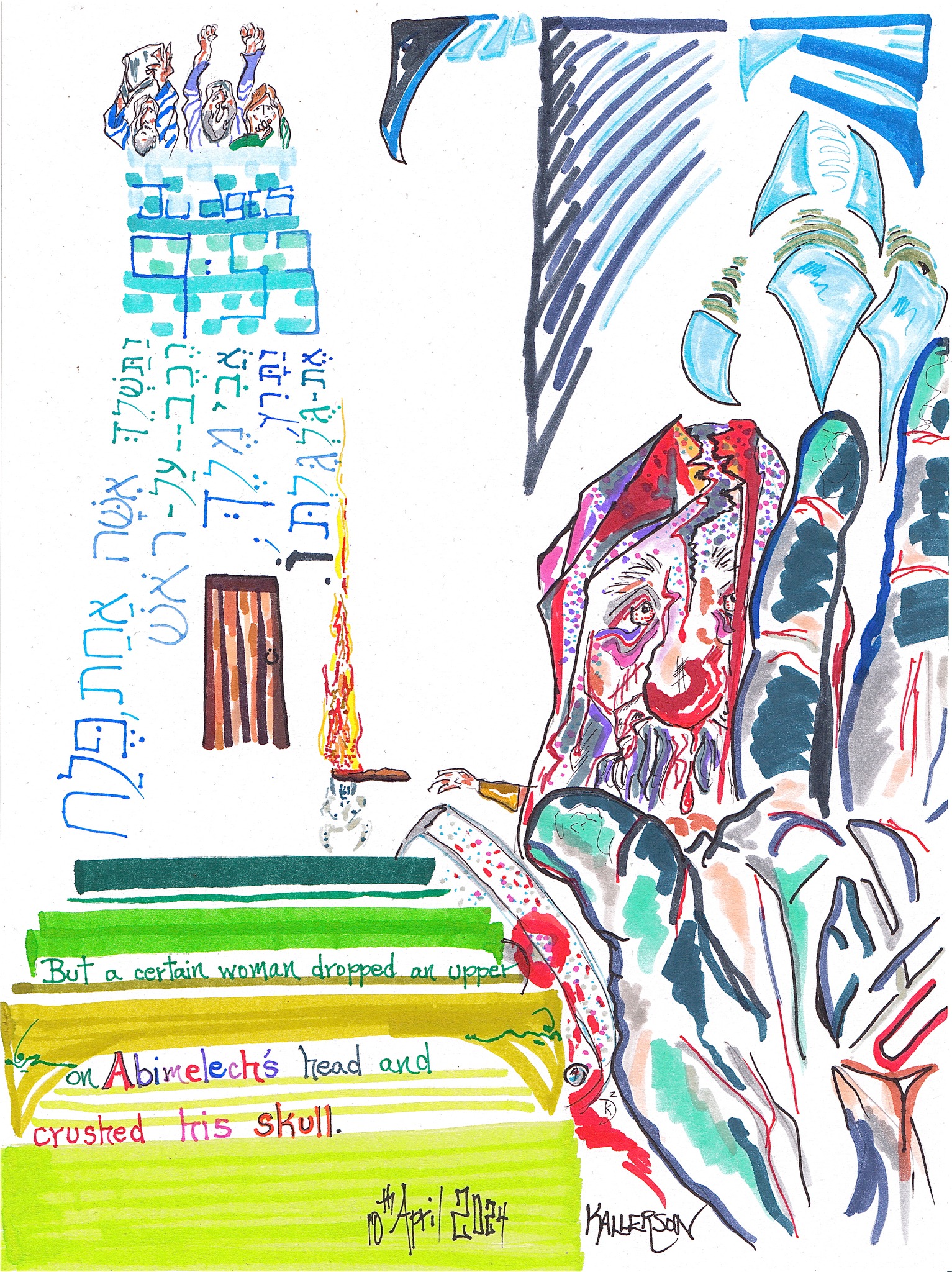
53 But a certain woman dropped an upper millstone
vatashlekh ishah akhath pelakh rekhev – “And cast, woman one, piece rider.” The word is shalakh. The lady cast the stone outwards toward where Abimelech was applying fire to the door. As for the stone, it says “piece rider.” The first word is new, pelakh, a slice or piece, from the verb palakh, to split or slice.
The second word is rekhev. It signifies a vehicle, like a chariot. In this case, it is a rider, the upper millstone that rides upon the lower millstone and which then crushes the grain to make bread. Taking this piece of a rider, the lady has something else to crush…
53 (con’t) on Abimelech’s head and crushed his skull.
al rosh avimelekh vatarits eth gulgalto – “upon head Abimelech and crushed his skull.” Like a Satsuma plum under the foot of an elephant, Abimelech’s skull didn’t stand a chance. It was crushed by the weight and force of the stone. The word gulgoleth, skull, is where the name Golgotha, Place of the Skull, is derived from. With his skull crushed, but with enough life and sense left in him to talk…
54 Then he called quickly to the young man, his armorbearer,
vayiqra m’herah el ha’naar nose kelav – “And called, quickly, unto the youth, lifter his articles.” The word armorbearer is a paraphrase, even if correct. A soldier would have someone young and not skilled in battle carry his things and do menial jobs for him. In a battle, this person would often be the one to finish off anyone his master had wounded in battle, following him and using a sword or spear for the task.
54 (con’t) and said to him, “Draw your sword and kill me, lest men say of me, ‘A woman killed him.’” So his young man thrust him through, and he died.
vayomer lo sh’loph kharbkha u-motheni pen yomru li ishah haragath’hu vayidq’rehu naaro vayamoth – “and said to him, ‘Draw your sword and kill me, lest saying of me, “Woman killed him.’” And pierced him, his young man, and dies.”
The embarrassment of such a matter was so great that it encompasses the final words of Abimelech. Instead of spurring his men on to victory, calling out to the Lord, or some other worthy declaration, he is concerned about how people would view him if he was killed by a woman.
However, the sentiment is not unlike the satisfaction Deborah felt when Jael killed Sisera. Sisera, the great commander and foe of Israel was slain by a tent woman. As for Abimelech, exactly what he didn’t want is what transpired. Generations later, at the time of David, the record of his death is recounted in 2 Samuel 11:18-21–
“Then Joab sent and told David all the things concerning the war, 19 and charged the messenger, saying, ‘When you have finished telling the matters of the war to the king, 20 if it happens that the king’s wrath rises, and he says to you: “Why did you approach so near to the city when you fought? Did you not know that they would shoot from the wall? 21 Who struck Abimelech the son of Jerubbesheth? Was it not a woman who cast a piece of a millstone on him from the wall, so that he died in Thebez? Why did you go near the wall?’—then you shall say, ‘Your servant Uriah the Hittite is dead also.”’’”
Another connection to his death is made in the demise of Saul, the first person truly considered king over Israel when he, being wounded in battle, asked his own armorbearer to thrust him through. Unfortunately, the boy was too afraid and Saul had to dispatch himself to Sheol.
55 And when the men of Israel saw that Abimelech was dead, they departed, every man to his place.
vayiru ish Yisrael ki meth avimelekh vayelkhu ish limqomo – “And saw men Israel that dead Abimelech, and went man to his place.” With the leader dead, the impetus to continue the battle was ended. There would be no point in taking the tower as there was nothing left of their hopes in serving under Abimelech as king. Thus, they simply abandoned the fight and went home.
56 Thus God repaid the wickedness of Abimelech, which he had done to his father by killing his seventy brothers.
vayeshev elohim eth raath avimelekh asher asah l’abiv l’harog eth shivim ekhav – “And returned, God, evil Abimelech which did to his father, to kill seventy his brothers.” The expression that one’s evil is returned upon his head is seen in the next verse. It is also found in 1 Samuel 25 where the evil of Nabal is said to be returned upon his head.
However, that is left out here because the casting of the stone on Abimelech’s head was not evil. It was positive retribution. The fact that he died is sufficient to show that the evil was returned to him. Ellicott, however, identifies the irony expressed in these words, saying, “The murderer of his brothers ‘on one stone’ is slain by a stone flung on his head.”
God, the overseer of the stream of time and existence, determined that there should be recompense for what Abimelech had done. Thus, the words of prophecy were given to Jotham and they were fulfilled accordingly in the demise of Abimelech. Likewise…
57 And all the evil of the men of Shechem God returned on their own heads,
v’eth kal raath anshe sh’khem heshiv elohim b’rosham – “And all evil, men Shechem, returned God in their heads.” Here, the idiom is fully expressed. The men of Shechem committed evil and God returned evil on their heads for what they had done in supporting the killing of the house of Jerubbaal…
*57 (fin) and on them came the curse of Jotham the son of Jerubbaal.
vatavo alehem qilalath yotham ben yerubaal – “and came upon them curse Jotham, son Jerubbaal.” This confirms that the words of Jotham were words of prophecy, given to proclaim what the outcome of their wickedness would be. Just as it was proclaimed, so it came to pass.
The meanings of the names are: Shechem, (Having a Sense of) Responsibility. Jotham, Yehovah is Upright. Jerubbaal, Let Baal Strive. As for the name Jerubbaal, rather than Gideon, it alone is mentioned in this chapter nine times. Nine, according to Bullinger, nine is the number of finality and judgment.
Forces are at work in this fallen world
And they will continue until the end
Eventually, God’s plan will be fully unfurled
And the human heart will no longer need to mend
Until that day, Satan is hard at work
Infecting minds and troubling souls
But there will be an end to that insufferable jerk
When have been completed all redemption’s goals
Don’t be caught up in the strong delusion
Instead, fix your eyes on Jesus before it’s too late
Someday, maybe soon, there will be complete confusion
Get right with the Lord and avoid a terrible fate
II. Explaining the Typology
Chapter 9 of Judges is long and filled with a load of detail. The first half, verses 1-21, were previously explained as the final seven years of the time of the tribulation. Jotham pronounced his parable and curse over the people and ran away, dwelling at Beer.
At the time designated by God, the tribulation period, the final seven years of Daniel’s seventy sevens, will be ushered in. As noted in the explanation of the first half of the chapter, Abimelech pictures those who reject Christ, but that is ultimately fulfilled in the Antichrist.
The purpose of the seventy sevens was stated in Daniel 9:24 –
“Seventy weeks are determined
For your people and for your holy city,
To finish the transgression,
To make an end of sins,
To make reconciliation for iniquity,
To bring in everlasting righteousness,
To seal up vision and prophecy,
And to anoint the Most Holy.”
As Christ accomplished those things for Israel, their rejection of Him meant exile. They are like Abimelech, having given themselves their own name, “My Father is King.” If the Lord isn’t their father, that means – by default – that the devil is. Jesus said this to them in John 8:44, “You are of your father, the devil.”
It is the reason why Jesus said this to the church in Revelation –
“I know your works, tribulation, and poverty (but you are rich); and I know the blasphemy of those who say they are Jews and are not, but are a synagogue of Satan.” Revelation 2:9
He repeats this idea in Revelation 3:9. Those Jews who reject Christ are not true Jews. Paul conveys that same thought in Romans 2. They do not belong to Christ, and therefore, they do not belong to God. The Antichrist is the ultimate fulfillment of this attitude. In his destruction, this apostate state among the Jews will end.
The rejection of God’s plan is emblematic of the killing of the seventy sons of Jerubbaal. Only the youngest, Jotham, was left. He represents the final seven years of the plan. But even during the tribulation, this rejection will continue.
Abimelech was “kinged” in Shechem. However, verse 22 began with, “And wrestled, Abimelech, over Israel three years.” Keil defined this period as a form of “tyrannical despotism,” something that seems likely under the Antichrist.
This three-year period could point to the midpoint of the tribulation period as three and one half is more than three years, but it probably just points to the meaning of the number three, Divine Perfection. There is a time when God’s plans will meet the perfect time for completion.
At that time, God will send an evil spirit to cause the final events of the tribulation period to come about. The Antichrist will do the things foretold by Jesus and Paul and the people will realize he is not their Messiah at all.
The purpose of this was stated in verse 24, “To go violence seventy sons, Jerubbaal.” In other words, the purpose of the seventy sevens was obliterated in the selection of the Antichrist. Therefore, he must be removed for the final matter of reconciliation to be settled.
But this goes beyond the ending of the Antichrist. Jotham’s prophecy noted that the ending of those who allied with him was to come upon them as well. That was stated again in verse 24. This period extends beyond just Jews, though. The treaty of the Antichrist deals with Israel and the nations.
Hence, verse 25 noted the ambush on the tops of the mountains. As a mountain is synonymous with a large but centralized group of people, being plural it means that various groups of people are being referred to, as one would expect in the end times battles.
In verse 26, Gaal, the son of Ebed was introduced. Gaal means Loathing, Son of Slave. His name seems to be derived from the account. He then typifies the spirit of ill-will sent between Abimelech and the masters of Shechem.
He represents the state of loathing that arises in those who remained under the law (Slave) and their supposed Messiah. As I said in that verse, “They have rejected Abimelech and have now aligned with Gaal.”
They know this guy is not their Messiah, and they see that the temple has not brought about their salvation. Hence, the curious words of verse 28 said –
“Who is Abimelech, and who is Shechem, that we should serve him? Is he not the son of Jerubbaal, and is not Zebul his officer?”
Gaal, this state of loathing, notes that the Antichrist is nobody, that Shechem, (Having a Sense of) Responsibility (living by the law), is nothing, and Habitation (the temple) is its overseer. The Jews completely abandon these things. Abimelech is identified as a son, even if illegitimate, with Jerubbaal (Let Baal Strive).
Not realizing that Jesus has already prevailed, these Jews reject the entire plan God has set forth for their restoration as detailed in Daniel. Instead, Gaal said, “Serve men Hamor, father Shechem! And why we serve him – we?”
In this, he uses the word anshe, men, instead of baale, masters. As seen in previous sermons, Hamor, Red One, pictures Adam, the man made from the red soil of the earth, which the name Adam implies. Adam (ruddy) comes from adom, to be red.
What is being said is that these end-times Jews have rejected the Lord Jesus, they now reject the thought of the temple and the law saving them, and so they have returned to man as their god. Man must save himself, period. No law, no Savior, etc.
Man is his own beginning, god, and end purpose. It is the inevitable state man faces without understanding God and what He has done in Christ.
Next, Zebul, Habitation, meaning the temple and its rites, notifies Abimelech of the people’s rejection of him, even “adversarying” the city against him. Looking ahead at their thoughts, one can see what is on their minds, “This guy is not our Messiah! We reject the entire notion of what he stands for and everything associated with him, including this temple.”
Gaal (Loathing), the spirit of ill-will has risen up to fulfill the parable and curse of Jotham. Without going through every detail, what is recorded of the battle is given to show this. Ultimately, what it says in Daniel 11:41 is what that is pointing to –
“He will also invade the beautiful land, and many will fall…”
Despite innumerable translations botching that verse, it doesn’t say “many countries.” It is simply speaking of the people in the land. The evil spirit between the coming Antichrist and the people who once followed him will be for their doom.
In verse 37, it mentioned the Soothsayers’ Oak. The only reason I can think of why this is mentioned is because within Israel, even today, there are still people who practice witchcraft, divination, and so forth.
The temple will be set aside for those who want to go that route, but Israel, being Israel, will allow whatever people want to do to continue to flourish, just as they always have. Very rarely in their history is it noted that good kings arose and removed other gods, divination, and other such things from their land.
At this time, however, the great insurrection against the Antichrist will be quashed. Gaal (Loathing) and his brothers will be cast out. Also, it said Abimelech dwelt at Arumah, High, Elevated, or Exalted. This may refer to what it says in Daniel 11 –
“Then the king shall do according to his own will: he shall exalt [rum] and magnify himself above every god, shall speak blasphemies against the God of gods, and shall prosper till the wrath has been accomplished; for what has been determined shall be done.” Daniel 11:36
Paul also refers to this in 2 Thessalonians 2. The final verses about Shechem being destroyed and the city being sowed with salt seems to be referring to the final ending of the sacrifices and offerings of the temple as detailed in Daniel 9:27.
Despite that accomplishment by Abimelech, the narrative continued with those who gathered together in the tower of Shechem who still needed to be dealt with. In order to destroy them, it says he went up to Mount Zalmon.
As noted, Zalmon comes from tselem, image. Abarim defined it as Image Guy. That coincides with what it says in Revelation 13 –
“He was granted power to give breath to the image of the beast, that the image of the beast should both speak and cause as many as would not worship the image of the beast to be killed.” Revelation 13:15
Mount Zalmon refers to those people who have aligned with the Antichrist. In taking “axes in his hand,” coming from a word, qadam, associated with aforetime (qedem), it appears to be telling us that the Antichrist will acknowledge a god from times past. If so, that is explained in Daniel 11:39 –
“Thus he shall act against the strongest fortresses with a foreign god, which he shall acknowledge.”
The final battle mentioned is that of Thebez or Brightness. It is where Abimelech finally meets his end. Paul refers to the end of the Antichrist in 2 Thessalonians 2 –
“And then the lawless one will be revealed, whom the Lord will consume with the breath of His mouth and destroy with the brightness of His coming.” 2 Thessalonians 2:8
Understanding that the Antichrist is simply the embodiment of the rejection of Christ that has existed since His coming, saying that Abimelech is killed is saying that all rejection of Christ will end at that time. The actual demise of the Antichrist is that he will be cast alive into the Lake of Fire.
The ignoble way that Abimelech was ended, meaning by the hand of a woman with a piece of a millstone, is a way of showing how “rejection of the gospel” will die an ignoble death.
Golgotha, the place of the skull, is where his defeat lies. However, the actual end of Abimelech came with a sword. The law itself is what condemns and brings an end to those who reject Christ. Jesus alone fulfilled it, and He did so at the place of the skull.
Only through coming to Him can such a fate be avoided for the people of the world. This is the lesson of Abimelech. A rejection of what Christ has done is a rejection of who He is. When we share the gospel, it includes the words “Christ died for our sins.”
It is by law that we have the knowledge of sin. It is in the breaking of law that we become sinners. John tells us that if we say that we have not sinned, we make God a liar, and His word is not in us.
Let us accept the gospel, acknowledge that God is truthful and that we have sinned. In this, we can then receive His mercy by believing that Jesus has paid our sin debt. This is what God asks of you today.
Closing Verse: “And he shall plant the tents of his palace between the seas and the glorious holy mountain; yet he shall come to his end, and no one will help him.” Daniel 11:45
Next Week: Judges 10:1-5 Hola! No need to fear, so this sermon will tell… (Tola and Jair, Judges of Israel) (31st Judges sermon)
The Lord has you exactly where He wants you. He has a good plan and purpose for you. It is He who judges His people according to their deeds. So, follow Him, live for Him, and trust Him, and He will do marvelous things for you and through you.
Abimelech, King of Shechem, Part IV
Now when all the men
Of the tower of Shechem had heard that, thinking it was neat
They entered the stronghold
Of the temple of the god Berith
And it was told Abimelech
That all the men of the tower of Shechem were gathered together
Then Abimelech went up to Mount Zalmon
He and all the people who were with him (what do you
———-suppose was the weather?)
And Abimelech took an ax in his hand and cut down
———-a bough from the trees
And took it and laid it on his shoulder, probably the right one
Then he said to the people who were with him
“What you have seen me do, make haste and do as I have done
So each of the people likewise cut down his own bough
And followed Abimelech, put them against the stronghold
And set the stronghold on fire above them
So that all the people of the tower of Shechem died, about
———-a thousand men and women we are told
Then Abimelech went to Thebez, the guy just wouldn’t quit
And he encamped against Thebez and took it
But there was a strong tower in the city
And all the men and women—all the people of the city
Fled there and shut themselves in
Then they went up to the top of the tower, maybe holding
———-a planning committee
So Abimelech came as far as the tower
And fought against it, even though it was higher
And he drew near the door of the tower
To burn it with fire
But a certain woman dropped an upper millstone, aiming
———-for the cull
On Abimelech’s head and crushed his skull
Then he called quickly to the young man, his armorbearer
And said to him, “Draw your sword and kill me
———-my reputation would be fried!
Lest men say of me, ‘A woman killed him’
So his young man thrust him through, and he died
And when the men of Israel saw that Abimelech was dead
They departed, every man to his place, according to their druthers
Thus God repaid the wickedness of Abimelech
Which he had done to his father by killing his seventy brothers
And all the evil of the men of Shechem
God returned on their own heads, leading to their fall
And on them came the curse
Of Jotham the son of Jerubbaal
Lord God, turn our hearts to be obedient to Your word
Give us wisdom to be ever faithful to You
May we carefully heed each thing we have heard
Yes, Lord God may our hearts be faithful and true
And we shall be content and satisfied in You alone
We will follow You as we sing our songs of praise
Hallelujah to You; to us Your path You have shown
Hallelujah we shall sing to You for all of our days
Hallelujah and Amen…
46 Now when all the men of the tower of Shechem had heard that, they entered the stronghold of the temple of the god Berith. 47 And it was told Abimelech that all the men of the tower of Shechem were gathered together. 48 Then Abimelech went up to Mount Zalmon, he and all the people who were with him. And Abimelech took an ax in his hand and cut down a bough from the trees, and took it and laid it on his shoulder; then he said to the people who were with him, “What you have seen me do, make haste and do as I have done.” 49 So each of the people likewise cut down his own bough and followed Abimelech, put them against the stronghold, and set the stronghold on fire above them, so that all the people of the tower of Shechem died, about a thousand men and women.
50 Then Abimelech went to Thebez, and he encamped against Thebez and took it. 51 But there was a strong tower in the city, and all the men and women—all the people of the city—fled there and shut themselves in; then they went up to the top of the tower. 52 So Abimelech came as far as the tower and fought against it; and he drew near the door of the tower to burn it with fire. 53 But a certain woman dropped an upper millstone on Abimelech’s head and crushed his skull. 54 Then he called quickly to the young man, his armorbearer, and said to him, “Draw your sword and kill me, lest men say of me, ‘A woman killed him.’” So his young man thrust him through, and he died. 55 And when the men of Israel saw that Abimelech was dead, they departed, every man to his place.
56 Thus God repaid the wickedness of Abimelech, which he had done to his father by killing his seventy brothers. 57 And all the evil of the men of Shechem God returned on their own heads, and on them came the curse of Jotham the son of Jerubbaal.