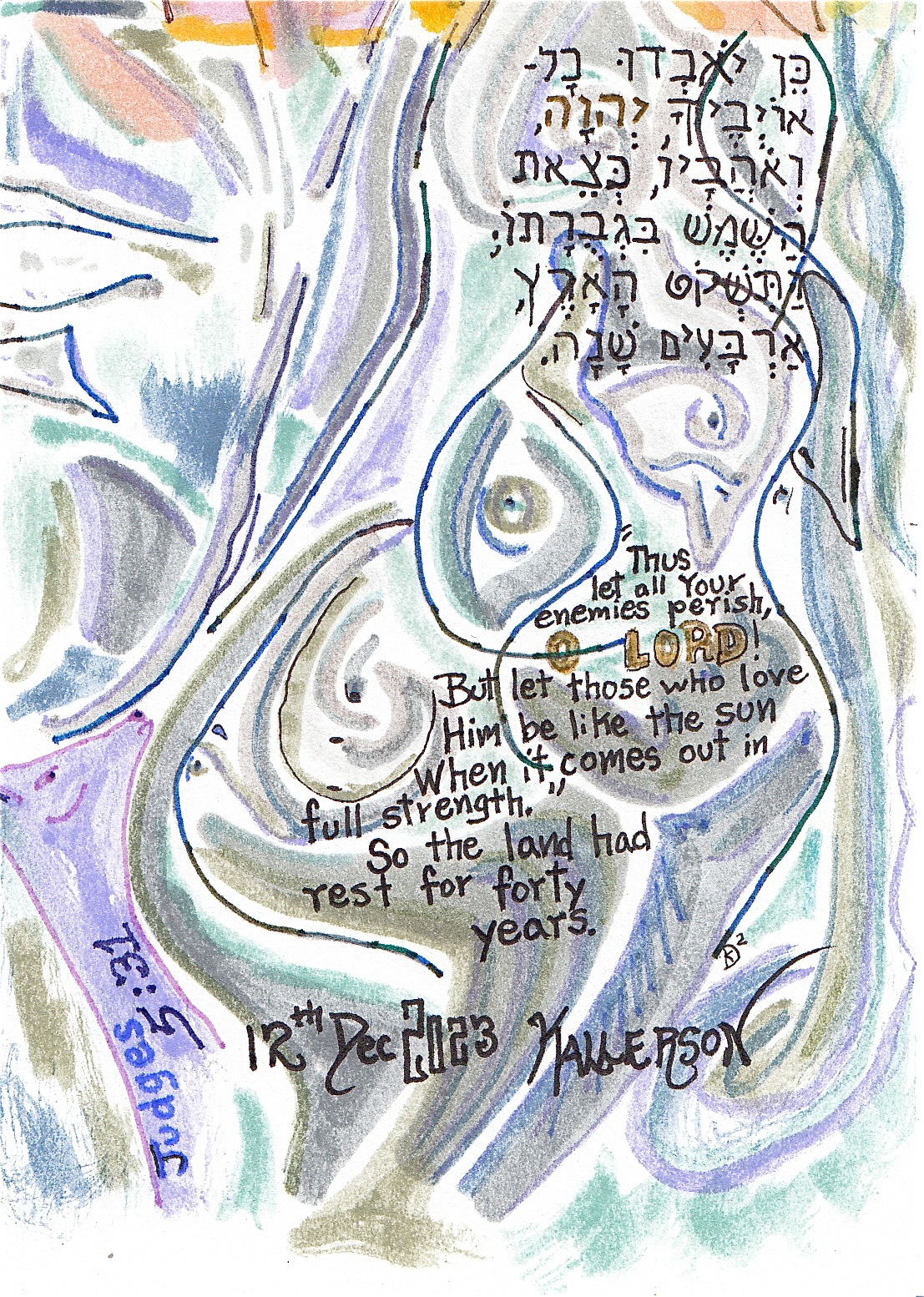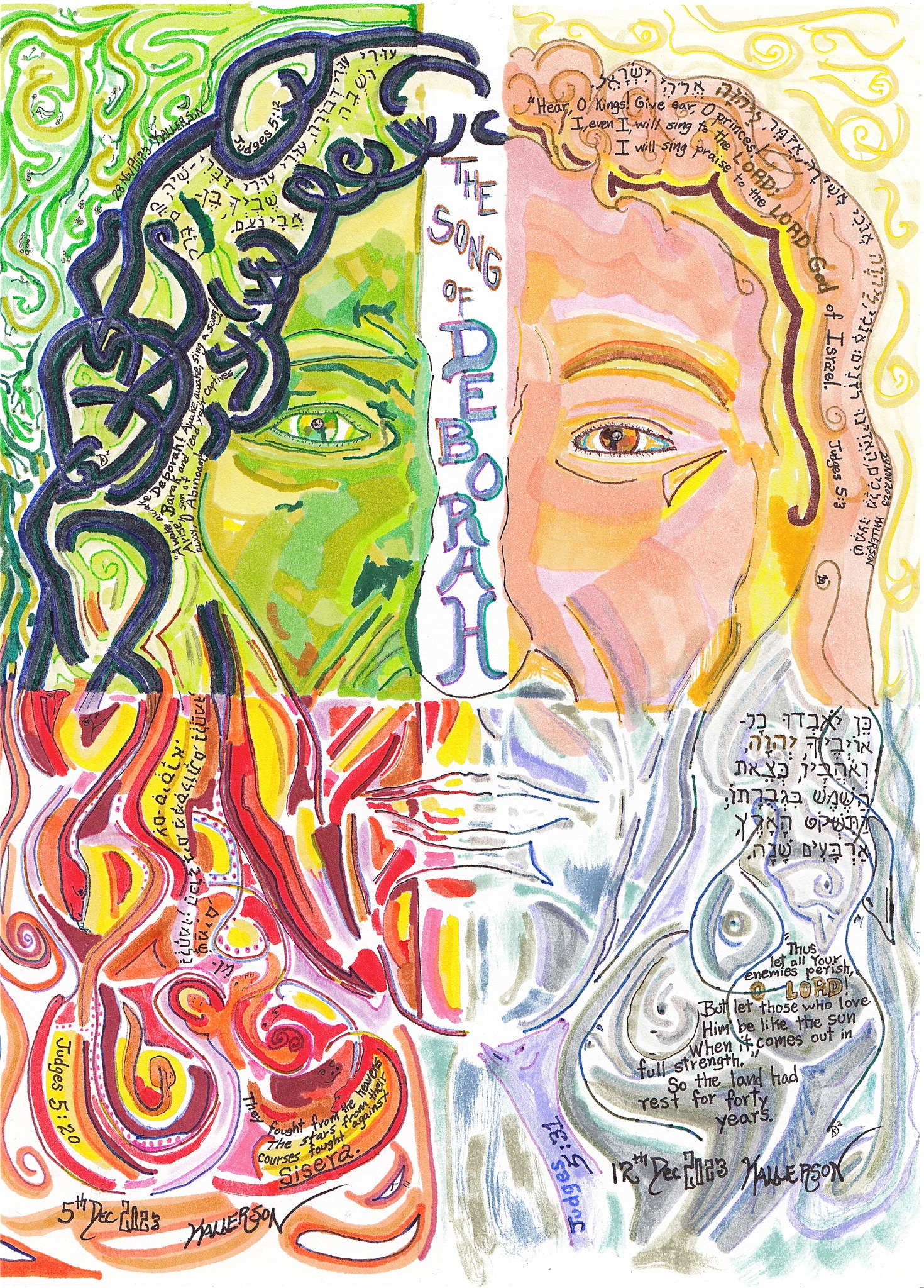
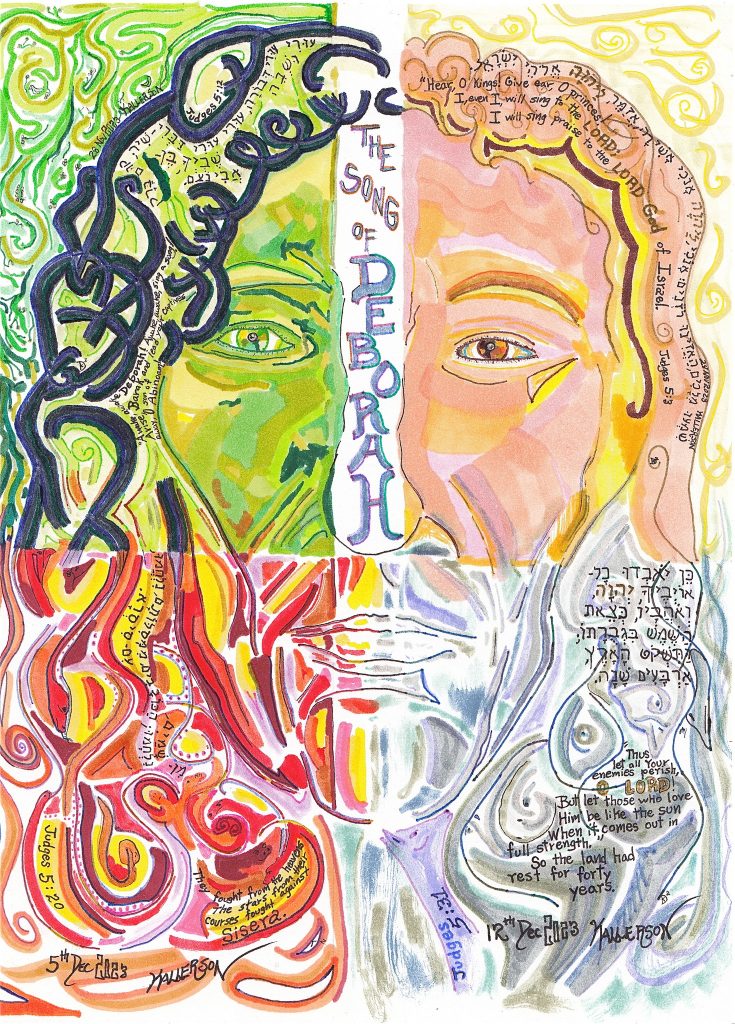
Artwork by Douglas Kallerson.
Judges 5:24-31
The Song of Deborah, Part IV
A question that I am commonly asked is, “Which translation is the best one to use?” It shows that the person is truly caring about knowing and understanding what is right and good. Unfortunately, there is no sufficient answer to that question.
There are translations that I would never recommend. There are others that are interesting, but not very literal. Some are so literal that they are hard to read without an accompanying explanation. Others are geared toward a particular group, like children’s Bibles, that speak in a particular way, even if they are not especially literal.
When I translate a verse for a sermon or commentary, I give the most literal possible rendering. That is because it has already been given with an understandable translation, the NKJV – unless otherwise noted – for sermons and commentaries.
There are some words in the original languages that are hard to pin down as to their exact meaning. Or they may have several meanings, just like some English words do. In the Song of Deborah and other poetic passages, another layer of translation is necessary to get the sense as well.
In fact, it may be that a less literal rendering, while matching the secondary layer, may be the better choice for translating. For example, in Judges 5:25, it says “She brought out cream in a lordly bowl.” In the Hebrew, there is an alliteration that is sadly missed. Hence, something like, “brought buttermilk,” “came with curd,” or “carried cream” actually gives a sense of the intended alliteration.
The point is that the only way to properly convey the original is to give the original. But that would mean we all would need to be proficient in Hebrew, something totally unnecessary.
Text Verse: “…according to the eternal purpose which He accomplished in Christ Jesus our Lord, 12 in whom we have boldness and access with confidence through faith in Him.” Ephesians 3:11, 12
Paul speaks of confidence through faith in Christ. We should not be so dogmatic in choosing a particular translation that we forget that we are to have confidence in Christ. In Judges 4, Sisera was seen to represent misplaced confidence or even pride.
Instead of having our priorities out of whack as to where we will place our confidence (I’m talking to translational snobs here), we should be confident in Jesus and the overall message of Scripture. All the rest of what we do is to bolster that, be it in deeper prayer, researching translations, learning the original languages, etc.
Let us not get sidetracked and have our eyes torn away from the main object of our faith, Jesus. Sound doctrine is important. A good translation is too. These can be determined with time and effort, but the basics should be understood so that we don’t get lost in our walk toward glory.
Eyes on Jesus! That is the most basic and important point of all. It is a truth that is clearly presented in His superior word. And so, let us turn to that precious word once again, and… May God speak to us through His word today, and may His glorious name ever be praised.
I. She Pounded Sisera (verses 24-27)
In the last verse, there was a curse pronounced upon those who failed to attend to the call –
Curse Meroz said messenger Yehovah,
Cursing curse her inhabitants,
For no came to help Yehovah,
To help Yehovah in the mighties.
That curse upon Meroz of Israel is now responded to with a great blessing upon an individual Gentile woman…
24 “Most blessed among women is Jael,
The wife of Heber the Kenite;
Blessed is she among women in tents.
t’borakh minashim yael eshet khever ha’qeni minashim ba’ohel t’borakh
Blessed from women Jael.
The expression “from women” indicates a superlative as in “more than.” If there is a group of women all sitting together, and one is especially gorgeous, someone might say, “From all of them, she is the most beautiful.” This is the sense of the phrase.
In this case, the group is not yet further defined. Thus, at least at this moment, it speaks of all women. Yael is blessed more than, or above, all other women.
This then is set in contrast to the words about Meroz: “Cursing curse her inhabitants.” Where they are cursed with a curse, Jael is blessed above all others. It is an expression not unlike that later spoken to Mary by her relative, Elizabeth –
“Then she spoke out with a loud voice and said, ‘Blessed are you among women, and blessed is the fruit of your womb!’” Luke 1:42
As for Jael, to ensure that the proper Jael is identified, the next words are given…
Wife Heber the Kenite.
These words confirm the imprecation called down upon Meroz. Yael is the wife of Heber the Kenite, a non-Israelite. And yet, she acted, responding to the need of the nation. While Meroz was providing refuge to the enemy, Jael was living out her name.
As noted when she was introduced, the name means Mountain Goat. But in a deeper sense, it conveys the idea of One Who Gets Somewhere Because of a Practical Skill. Jael had a practical skill, hammering tent pegs. In applying that skill, she has gotten somewhere.
She has the adoration of Deborah and indeed all of Israel. To this day, she is remembered in the word of God in the exact opposite manner as Meroz. With that, the fuller definition of how she is blessed is next stated…
From women in the tent, blessed.
The same word begins and ends the three clauses. Also, in the first and second clause, there is a poetic connection between the name Yael and the words “in the tent” (ba’ohel). The words are pleasing to the ear while calling to mind the idea of the greatly blessed nature of the heroine –
Blessed from women Yael
From women ba’ohel, blessed.
This final clause ensures that the “from women” is restricted to a certain category, meaning “in the tent.” That way, it will not later cause a contradiction or confusion when the words to Mary are spoken. Yael is blessed from women in the tent; Mary is blessed among all women, without any qualifiers.
However, the word “tent” is also used to describe the human body, such as in the words of Paul –
“For we know that if our earthly house, this tent, is destroyed, we have a building from God, a house not made with hands, eternal in the heavens.” 2 Corinthians 5:1
Peter uses the same expression in his second epistle. Therefore, it could be argued that Jael is blessed above women who literally dwelt in tents, but she is also blessed above women dwelling in “human tents.”
As noted, the words are set in contrast to the previous verse about Meroz. They were cursed with a curse while Jael is blessed with a blessing. The words form an a/b/a pattern with a pleasingly poetic internal structure: t’borakh minashim yael eshet khever ha’qeni minashim ba’ohel t’borakh –
(a) Blessed from women Jael,
(b) Wife Heber the Kenite,
(a) From women in the tent, blessed.
Next to lavish further praises upon Jael, Deborah takes time to explain what it was that made her the great heroine of the nation…
25 He asked for water, she gave milk;
She brought out cream in a lordly bowl.
mayim shaal khalav nathatnah b’sephel adirim hiqrivah khemah
The words are masculine and feminine, explaining who did what, but as long as the subject is understood, there is no need to say he and she. Such specific identifiers are not used by Deborah. To represent the abruptness of the words, I have left them out.
Water asked; milk gave.
The words take us back to Judges 4 –
“Then he said to her, ‘Please give me a little water to drink, for I am thirsty.’ So she opened a jug of milk, gave him a drink, and covered him. 20 And he said to her, ‘Stand at the door of the tent, and if any man comes and inquires of you, and says, “Is there any man here?” you shall say, “No.”’” Judges 4:19, 20
Sisera was parched. He needed water, and so he asked. But going a step further to accommodate him, she brought him milk. Next, to highlight the superlative nature of the milk and the honorable way it was presented, Deborah says…
In bowl majesties, came curd.
The same word used in verse 5:13 to describe the people, adirim, or majesties, is used to describe the bowl. Some translations paraphrase the word to explain the meaning, saying something like “a bowl fit for nobles” or “a princely bowl.”
Even in the tent of nomads, there would be expensive things that would be brought out for the most special of occasions or for the most honorable of guests. That is the sense here. A new word is introduced, sephel, a bowl.
It comes from an unused root, meaning to depress, and so it is a basin, as if it is deepened out. It will be seen only here and in Judges 6:38, where Gideon will wring out a fleece into a sephel, or bowl. This one is not just any bowl, but one of majesties.
Jael has brought forth the bowl with curd. Curd signifies milk that is in a partially solid or solid state, such as in thick cream or even butter. It, along with honey, is expressly stated to be what Messiah will be nourished on –
“Therefore the Lord Himself will give you a sign: Behold, the virgin shall conceive and bear a Son, and shall call His name Immanuel. 15 Curds and honey He shall eat, that He may know to refuse the evil and choose the good.” Isaiah 7:14, 15
It would be both refreshing and nourishing. But because Sisera was already exhausted from his flight, the curds would help make him sleepy as well. The words help explain the comfort Sisera would have felt leading to confidence that he could trust Jael enough to nap before continuing his flight.
The clauses form an overall a/b pattern with internal thoughts that are short, abrupt, and lead the mind to anticipate what must then follow: mayim shaal khalav nathatnah b’sephel adirim hiqrivah khemah –
(a) Water asked; milk gave,
(b) In bowl majesties, came curd.
With the mental tension produced by the words, the thoughts of the reader are impelled forward, anticipating what is coming…
26 She stretched her hand to the tent peg,
Her right hand to the workmen’s hammer;
She pounded Sisera, she pierced his head,
She split and struck through his temple.
There is as much verbal energy in the words as there was physical energy used by Jael. One can actually sense the action as the words unfold: yadah la’yathed tishlakhnah viminah l’halmuth amelim v’halmah sisra makhaqah rosho u-makhatsah v’khalpha raqato
I have tried to retain the alliteration and action of the words while still maintaining the original sense they convey. Sisera is peacefully napping, having filled himself from a bowl of majesties chock-full of curd. As he lay there, secure and comfortable…
Her hand to the peg stretched.
With her hands, she had brought forth the princely bowl of curd. With them, she stretches out for other implements she is intimately familiar with. First, she uses her (left) hand, reaching for the peg. Next…
And her right to hammer workmen.
The word “hand” is left out, but it is again implied. By doing this, Deborah maintains a desired brevity to highlight each movement –
Her (left) hand to the peg stretched,
And her right (hand) to hammer laborers.
The word translated as “hammer” is found only here, halmuth. It is derived from the verb halam, to hammer, that was seen in verse 5:22 when referring to the hammering of the horses’ hooves. It will again be used in the next clause.
To retain the alliteration and consistency, I have translated it as hammer and hammered. The intent is to maintain Deborah’s special use of alliteration.
Also, another new word is introduced, amel. It comes from the verb amal, to labor or toil. Thus, it means to labor or suffer. As such, it is a laborer. Being plural, it signifies the laborers’ hammer.
With that, the alliteration referred to is seen next…
And hammered Sisera – smashed his head.
With the hammer, she hammered and smashed. It is another word found only here, makhaq. It comes from a primitive root signifying to crush. Because the coming words form an alliteration, smashed gives the necessary meaning and sound.
And more, the Hebrew is onomatopoetic. One can hear the sound reflected in her words, makhaqah rosho – smashed his head. Adam Clarke takes this as one action, whacking him with a hammer, followed by another action, nailing his head to the ground.
There is no need for that. It is probably one action being described in two ways which is highlighted by an alliteration. The needed alliterative pairing to this is next seen…
And smushed; and slid through his temple.
The previous word was makhaq. This is makhats – to dash asunder, crush, etc. Deborah, taking every opportunity to highlight the marvelous handiwork of Jael, says she smashed and she smushed. Sisera’s head was perfectly pulverized as she profusely pounded. And because of her action, the peg is said to khalaph, or pass through, his temple. To maintain a background “s” sound, “slid through” simply and yet sumptuously successfully satisfies.
As in the comments of Chapter 4, the actions of Jael are bafflingly considered as immoral or completely inappropriate by many scholars. They chide her for her work of assassination and say that nothing morally justifies her actions.
That is ridiculously absurd when considering the absolute delight in which Deborah, the Lord’s appointed judge, heaps praise upon her actions through the use of the superlative words.
The brevity, alliteration, and onomatopoetic nature of what she says resounds with implied accolades heaped upon Jael. It is an a/a b/b pattern with beautiful internal structure: yadah la’yathed tishlakhnah viminah l’halmuth amelim v’halmah sisra makhaqah rosho u-makhatsah v’khalpha raqato –
(a) Her hand to the peg stretched,
(a) And her right to hammer laborers,
(b) And hammered Sisera – smashed his head,
(b) And smushed; and slid through his temple.
With all of the violent action attributed to Jael, the heroine of the battle, the reaction to what she had done is next described…
27 At her feet he sank, he fell, he lay still;
At her feet he sank, he fell;
Where he sank, there he fell dead.
Scholars take this as something other than what it says. For example, John Lange says, “The smitten chieftain draws himself together, he seeks to rise, and falls back. Twice more he writhes convulsively, and dies.”
Similarly, John Gill says, “Perhaps at her first approach to him, and attempt to drive the nail, or at the blow she gave, he rose up, but she had done the business so effectually at the first stroke, that he dropped at once, and laid down his head again.”
Consider the facts previously stated, he was fast asleep. Her adeptness with the hammer and peg, would have killed him in a single moment. The rest of this is simply for effect: ben ragleha kara naphal shakav ben ragleha kara naphal ba’asher kara sham naphal shadud
Between her feet curled, fallen, lain.
The three verbs are all in the perfect aspect, accomplished and complete. The words “between her feet” mean that he was right where she was squatting to pound out his brains. Once she hammered the peg through his head, there he lay. The next word, kara, comes from a primitive root signifying to bend the knee.
He was already lying down. He didn’t sink or crouch. Rather, he was either already in a fetal position while sleeping, or the muscles in his knees contracted, pulling in when his brains got blasted. The scene is being described after he was terminated.
The next word, naphal, means to fall. In this case, saying fallen may lead to the wrong impression, such as that he had fallen. Instead, it means he lay there fallen. To ensure that this is understood, Deborah next says shakav, a verb meaning to lie down. In this case, it is stated in the perfect aspect – lain.
With that, and for maximum effect, Deborah repeats much of the first clause…
Between her feet curled, fallen.
It is as if Deborah is rejoicing over the gruesome scene. The enemy and oppressor has been subdued and eliminated. And then, once again she repeats two of the previous words to make sure that we understand the poetic nature of the occurrence.
Sisera never had a chance to struggle. Jael took advantage of the situation and subdued him with a bowl of curd. The cleanup operation was to pound out his brains…
In which curled, there fallen, pulverized.
Right where he was curled up, signified by the locator “in which,” is where his body lay fallen. And more, Deborah uses the word shadad, a word that comes from a root signifying to be burly. Thus, figuratively, it refers to being powerful. In this case, it was a pointedly, poignantly, and perfectly powerful pulverization.
The clauses are complementary and repetitive, giving a marvelous sense of the outcome of Jael’s cunning work. They reveal an a/a/a pattern: ben ragleha kara naphal shakav ben ragleha kara naphal ba’asher kara sham naphal shadud –
(a) Between her feet curled, fallen, lain.
(a) Between her feet curled, fallen.
(a) In which curled, there fallen, pulverized.
With the death of Sisera, the poem turns to the sad words of a mother who will never see her son again…
In whom have you your trust placed
And where is your confidence located
There is one path to God that has been traced
All others are ways that God has hated
Have confidence in what He has decided
In the giving of His Son for reconciliation
All other avenues are to be derided
But in Christ there is hope-filled anticipation
To have misplaced confidence is an unhappy trust
To be filled with pride will only lead to sadness
Trust in Jesus, that is a must
And with it then comes eternal gladness
II. The Sun in His Strength (verses 28-31)
28 “The mother of Sisera looked through the window,
And cried out through the lattice,
‘Why is his chariot so long in coming?
Why tarries the clatter of his chariots?’
bead ha’khalon nishq’phah vatyabev em sisra bead ha’eshnav madua boshesh rikhbo la’vo madua ekheru paame markvothav
Through the window looked and shrilled.
The word translated as looked is from a root signifying to lean out. Hence, by implication, it means to look. One can see a woman (the verb is feminine) leaning out of a window. While doing so, she cries out in a shrill voice.
Then, a word found only here, yavav is used. It comes from a primitive root meaning to bawl. In this case, and because she doesn’t know her son is dead, she is simply shrilling. She is hopefully, but hesitantly affirming her confidence that everything is ok. The next words tell us who this is…
Mother Sisera through the lattice.
Here is yet another new word, eshnav. It refers to a lattice. The lattice is opened and she is leaning out through the open window and lattice, gazing into the distance and asking what any mother whose son has gone off to battle would be asking at this point…
Why delayed his chariot to come?
The word translated as delayed gives the sense of being ashamed. One can think of a battle going on too long. That would be an embarrassment. If the army was defeated, the soldiers that lived would be embarrassed and delay their return. Her anxiety over the delay of his chariot is evident.
Why tarried cadences his chariots?
Another word concerning delay is used, akhar. It means to remain behind. Thus, figuratively to tarry or procrastinate. She is obviously tense about the delay of the sound (paam) of the chariots.
That word, paam, signifies a stroke, beat, or repeating event, as in set times during the year. The cadences of the chariots as drawn by the horses makes such a repetitive sound. She is asking why that sound has tarried.
The words precisely speak of a mother tensely awaiting the return of her son from battle. They form an a/a b/b pattern: bead ha’khalon nishq’phah vatyabev em sisra bead ha’eshnav madua boshesh rikhbo la’vo madua ekheru paame markvothav –
(a) Through the window looked and shrilled.
(a) Mother Sisera through the lattice.
(b) Why delayed his chariot to come?
(b) Why tarried cadences his chariots?
With her tense emotional state, and to give full assurance that all is ok, it next says…
29 Her wisest ladies answered her,
Yes, she answered herself,
The words are difficult but understandable: khakhmoth sarotheha taanenah aph hi tashiv amareha lah
Wise, her princesses, answer.
After her longingly looking out the window and shrilling about the return of Sisera, and in order to comfort her anxiety, the wise princesses give her encouraging words. As she listens, she takes in the words and…
Yea, she returns her sayings to herself.
The words are extremely difficult. It could be she assumes that one of the ladies said something she can cling to, thus returning that lady’s answers to herself. Or she may not have heard anything that encouraged her, and so she comes up with her own comforting words, returning them to herself.
I would guess it is the former. She heard something that she then said, “Yes, that is certainly it.” She then repeats it to herself. That answer to herself comprises her last words, which are coming up in the next verse. The irony is that the counsel of the wisest of her ladies will eventually be proven incorrect.
It is a mournful a/b pattern for anyone who has a heart for a forlorn mother who awaits her son’s return: khakhmoth sarotheha taanenah aph hi tashiv amareha lah –
(a) Wise, her princesses, answer,
(b) Yea, she returns her sayings to herself.
With that, the words of hope to comfort Sisera’s mother are given…
30 ‘Are they not finding and dividing the spoil:
To every man a girl or two;
For Sisera, plunder of dyed garments,
Plunder of garments embroidered and dyed,
Two pieces of dyed embroidery for the neck of the looter?’
There needs to be a lot of mental addition to the words. They are short and direct. My translation may be hopeful as the words are complicated: halo yimtesu y’khalqu shalal rakham rakhamathayim l’rosh gever sh’lal ts’vaim l’sisra sh’lal ts’vaim riqmah tseva riqmathayim l’tsav’ere shalal
Nay! Finding and dividing spoil.
It could be the opening of a statement or a question: “Are not” or “Nay.” I went with a statement, as if she is brushing off her previous fears. “Why are they tarrying? Nay! They are out finding and dividing the spoil! They will come back filled with plunder!”
Damsel. Damsels to every man.
She starts with the female captive but then doubles it. There will be so many dead soldiers that the women will be unprotected and easy prey. Every soldier will come home with a couple of captives.
The word rakham, damsel, literally means compassion or mercy. In this case, however, it extends to what the compassionate spoil implies, a female. From there, the list continues…
Spoil colors to Sisera.
The word is a noun signifying dye or dyed stuff. Thus, to keep it a single noun, colors is sufficient. However, the mind must fill in the rest. To then explain what the colors are, she continues with her hopeful list of booty…
Spoil colors embroidery color.
Here is another new word, riqmah. It signifies variegated stuff and thus colored embroidery. Her son’s army is choosing their newest fashions from the dead army of Israel. Yes! They will all look marvelous upon their victorious return. The colors will also be highlighted in how they are worn or in how much is gathered…
Embroideries to necks, spoil
It is a most obscure set of words, ending with a noun. What it may be signifying is that there will be so much spoil that the men are laden down with the colored embroidery as it is heaped upon their necks.
Or it could mean that the spoil taken, meaning the damsels, would have colorful embroideries adorning their necks. I would go with that. Thus, it would be a return to the original spoil that she contemplated, meaning damsels of the earlier clause.
Either way, Sisera’s mother is content to console herself, being happily hopeful of having a hearty hello for her hero as he returns with so much plunder.
The first clause introduces what is coming. That is then categorized and also expanded upon. It then ends with a return to the original plunder, the women. Thus, a/b/c/c/d is the pattern: halo yimtesu y’khalqu shalal rakham rakhamathayim l’rosh gever sh’lal ts’vaim l’sisra sh’lal ts’vaim riqmah tseva riqmathayim l’tsav’ere shalal –
(a) Nay! Finding and dividing spoil:
(b) Damsel. Damsels to every man.
(c) Spoil colors to Sisera,
(c) Spoil colors embroidery color.
(d) Embroideries to necks, spoil.
With her hopeful ponderings complete, Deborah shows little pity towards the soon-to-be mournful mom. Rather, she exalts in the marvelous victory of the Lord over the enemies of His people…
31 “Thus let all Your enemies perish, O Lord!
But let those who love Him be like the sun
When it comes out in full strength.”
So the land had rest for forty years.
ken yovdu kal oyvekha Yehovah v’ohavav k’tseth ha’shemesh bigvuratho vatishqot ha’arets arbaiim shanah
Thus: Perish all Your enemies, Yehovah!
This clause certainly includes everything that has been recorded concerning the enemy: their total defeat to the last man, the ignoble way in which Sisera was crushed, etc.
However, the sudden spontaneity and bursting forth of these words is surely intended to be a mocking conclusion to the prideful thoughts of Sisera’s mother. She fully supported her son’s decision to go into battle and eradicate Israel.
Her anticipation of his glorious return and the plunder she would see heaped upon the army excited her. The thought of helpless damsels brought captive, bereaved of fathers, is turned upside down. Instead, she is bereaved of her mighty son. This is what Deborah’s words most poignantly refer to. As for those not His enemies, they are defined with the next words…
And loving Him: According to coming out the sun in his strength.
The verb is plural. Thus “those loving Him” is understood. If one is not loving Yehovah, he is – by default – an enemy of Him. Therefore, all who love Him are included in these final words of her poem. They are the righteous before God.
The sun in his strength speaks of the midday sun. It is the hottest and brightest time when the sun stands in radiant glory over the earth. Her words are reflective of the words of Matthew 13 –
“Then the righteous will shine forth as the sun in the kingdom of their Father. He who has ears to hear, let him hear!” Matthew 13:43
But the righteousness Jesus refers to must come from somewhere apart from the people themselves. What He is saying is in that day the people of the Lord will be like the Lord. That was given in prophecy by Malachi, just as the final words of the Old Testament were set to close out –
“But to you who fear My name
The Sun [shemesh] of Righteousness shall arise
With healing in His wings;
And you shall go out
And grow fat like stall-fed calves.” Malachi 4:2
Jesus is the Sun of righteousness. His people will shine forth as that sun, bearing His righteousness. Thus, Deborah’s poetic words, like the typology of Chapter 4, anticipate the coming of Christ and His kingdom. For those of the church, it will be realized at the rapture. For Israel, that will be realized after the tribulation during the millennium.
Ultimately, the words anticipate the time when all evil will be swept away and the peaceful rule of the Messiah will last forever after. No person, in any dispensation, is reconciled to God apart from Jesus Christ. This is the message being conveyed.
The Song of Deborah has poetically and beautifully expressed this truth. With that, the final words of the chapter are affixed to this verse…
And rested the land forty years.
It is letter for letter the same as the corresponding words found in Judges 3:11 at the time of Othniel.
Forty is defined by Bullinger as “a period of probation, trial, and chastisement—(not judgment, like the number 9, which stands in connection with the punishment of enemies, but the chastisement of sons, and of a covenant people).”
And more, because “it relates to enlarged dominion, or to renewed or extended rule, then it does so in virtue of its factors 4 and 10.”
Four, “is the number of things that have a beginning, of things that are made, of material things, and matter itself. It is the number of material completeness. Hence it is the world number, and especially the ‘city’ number.”
Ten signifies “Completeness of order, marking the entire round of anything, is, therefore, the ever-present signification of the number ten. It implies that nothing is wanting; that the number and order are perfect; that the whole cycle is complete.”
The period of forty years is given to express the wholeness of the victory of Christ over His enemies. Those who are His have both a state and a duration of time that is impossible for us to properly imagine. That day is coming, and the key to participating in it is found in Jesus.
As for the words of this verse, they comprise a contrasting a/a pattern with a closing thought for the narrative: ken yovdu kal oyvekha Yehovah v’ohavav k’tseth ha’shemesh bigvuratho vatishqot ha’arets arbaiim shanah –
(a) Thus: Perish all Your enemies, Yehovah!
(a) And loving Him: According to coming out the sun in his strength.
And rested the land forty years.
The Song of Deborah is a marvel of beauty and intricacy. It has introduced many rare or unique words to Scripture, and it has brought forth an amazing array of literary structures to tantalize us. But beyond that, it has presented the thoughts of Chapter 4 to us in a new way that only more perfectly highlights the workings of God in Christ.
Deborah anticipates the New Testament. Jael anticipates the body of believers who have accepted that word and who are thus granted the righteousness of Christ. For now, that is the church. In the future, it will be those of Israel along with all others who have come to accept that Jesus is God’s Messiah to bring fallen humanity back to Himself.
The final restoration of all men comes only through Jesus. As Jesus is the incarnate Lord fully revealed in the New Testament, it is He who even the saints of old sought out as their distant hope. Whether it was those like Job under government or those under law like David, they knew Him as Yehovah. Now, we have a fuller understanding of what that means. Yehovah has revealed Himself in the Person of Jesus.
Sisera, representing misplaced trust or pride, is a sad picture of most of the world, even innumerable souls within the physical church. Instead of trusting Christ, people turn to the law. If the law could save, there would have been no need for Jesus.
But the Lord united with human flesh, bridging the infinite – and thus impossible – gap between God and man. This was the final and ultimate anticipation of Deborah and those with her, even if they didn’t fully understand it at the time. The battle they faced was a look into the greater battle that was fought and won by the hand of the Lord.
Let us remember this and hold fast to Him. It is the Lord who ultimately has won the battle, even if He is using imperfect warriors like us in the process. May our trust be in Him and remain in Him alone. All hail the name of Jesus, who has done such great things for us.
Closing Verse: “For we are the circumcision, who worship God in the Spirit, rejoice in Christ Jesus, and have no confidence in the flesh.” Ephesians 3:3
Next Week: John 10:22 A sermon that will fill you with theological exhilaration… (The Feast of Dedication) (Annual Christmas Sermon)
The Lord has you exactly where He wants you. He has a good plan and purpose for you. It is He who judges His people according to their deeds. So, follow Him, live for Him, and trust Him, and He will do marvelous things for you and through you.
The Song of Deborah, Part IV
24 Blessed from women Jael.
Wife Heber the Kenite.
From women in the tent, blessed.
25 Water asked; milk gave,
In bowl majesties, came curd.
26 Her hand to the peg stretched,
And her right to hammer laborers,
And hammered Sisera – smashed his head,
And smushed; and slid through his temple.
27 Between her feet curled, fallen, lain.
Between her feet curled, fallen.
In which curled, there fallen, pulverized.
28 Through the window looked and shrilled.
Mother Sisera through the lattice.
Why delayed his chariot to come?
Why tarried cadences his chariots?
29 Wise, her princesses, answer,
Yea, she returns her sayings to herself.
30 Nay! Finding and dividing spoil:
Damsel. Damsels to every man.
Spoil colors to Sisera,
Spoil colors embroidery color.
Embroideries to necks, spoil.
31Thus: Perish all Your enemies, Yehovah!
And loving Him: According to coming out the sun in his strength.
And rested the land forty years.
Lord God, turn our hearts to be obedient to Your word
Give us wisdom to be ever faithful to You
May we carefully heed each thing we have heard
Yes, Lord God may our hearts be faithful and true
And we shall be content and satisfied in You alone
We will follow You as we sing our songs of praise
Hallelujah to You; to us Your path You have shown
Hallelujah we shall sing to You for all of our days
Hallelujah and Amen…
24 “Most blessed among women is Jael,
The wife of Heber the Kenite;
Blessed is she among women in tents.
25 He asked for water, she gave milk;
She brought out cream in a lordly bowl.
26 She stretched her hand to the tent peg,
Her right hand to the workmen’s hammer;
She pounded Sisera, she pierced his head,
She split and struck through his temple.
27 At her feet he sank, he fell, he lay still;
At her feet he sank, he fell;
Where he sank, there he fell dead.
28 “The mother of Sisera looked through the window,
And cried out through the lattice,
‘Why is his chariot so long in coming?
Why tarries the clatter of his chariots?’
29 Her wisest ladies answered her,
Yes, she answered herself,
30 ‘Are they not finding and dividing the spoil:
To every man a girl or two;
For Sisera, plunder of dyed garments,
Plunder of garments embroidered and dyed,
Two pieces of dyed embroidery for the neck of the looter?’
31 “Thus let all Your enemies perish, O Lord!
But let those who love Him be like the sun
When it comes out in full strength.”
So the land had rest for forty years.