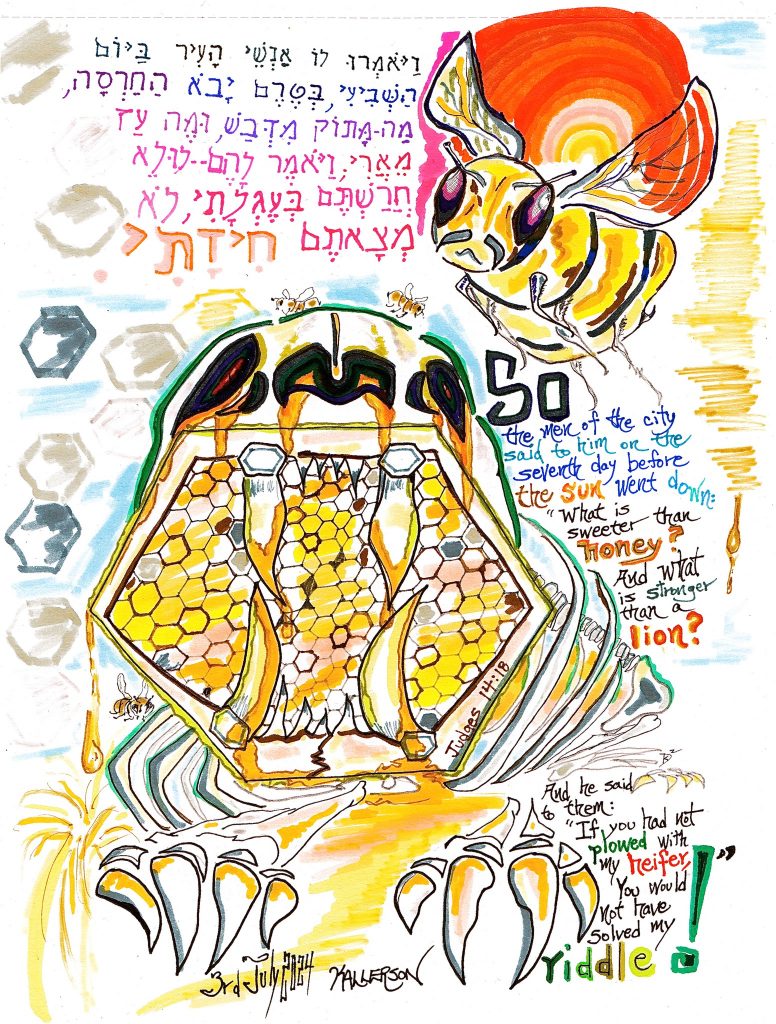
Artwork by Douglas Kallerson.
Judges 14:15-20
Samson, Judge of Israel, Part IV
(Typed 15 April 2024) Judges 14 is a thrilling chapter, even without understanding any of the typology. The verses are exciting and filled with action and intrigue. It was also a difficult chapter for me to evaluate and consider.
There are unusual words, difficulties in the sequence of events, and complicated concepts to be carefully contemplated and then communicated. But even the surface text can leave a person scratching his head. What is Samson doing with a Philistine girl in the first place?
He was selected as a Nazirite, and choosing a Philistine wife would be unexpected. This is evidenced by his parent’s reaction to his decision. You would think he would know that such a union would only bring grief. And then, without even knowing her intimately, he went and spilled the beans concerning his riddle.
It’s hard to figure what would prompt him to blab out the answer. Maybe if he had the words of Micah, which were penned much later, things would have been different…
Text Verse: “Do not trust in a friend;
Do not put your confidence in a companion;
Guard the doors of your mouth
From her who lies in your bosom.” Micah 7:5
There is a time for speaking and a time for keeping our mouths closed. Samson obviously hadn’t learned that and it caused him a lot of extra work to reconcile the promise he made. Maybe it was youthful immaturity.
Despite this, the Lord used him to work against the Philistines, and he also used the story of Samson’s life to anticipate events in redemptive history. God has a plan. He is slowly and methodically working it out, and we are given snapshots into what He is doing in stories like the life of Samson.
This is the beauty of the word. It is a wonderful source of joy, wisdom, and hope. For those who know Jesus, we can rest in that and know that what the Bible says about the future will come to pass. It is also a book of promised restoration for those who have not yet called out to Him.
We know that God is faithful by seeing how He has treated His own unfaithful people, Israel. What wonderful treasure this word is. Let’s get into it. Great things are to be found in His superior word. And so, let us turn to that precious word once again, and… May God speak to us through His word today, and may His glorious name ever be praised.
I. Sweeter Than Honey; Stronger Than a Lion (verses 15-20)
15 But it came to pass on the seventh day that they said to Samson’s wife,
vayhi ba’yom hashvii vayomru l’esheth shimshon– “And is, in day the seventh, and says to wife Samson.” The words seem inconsistent with the surrounding narrative. In verse 14, it mentioned that they could not explain the riddle on the third day. In verse 17, it says she wept on him for seven days.
Because of this, some translations change seventh to fourth. Some say this is referring to the seventh day of the week, meaning the Sabbath. However, two different thoughts are being communicated that will align at the appropriate time.
As for the words of this verse, this is the day in which the riddle must be solved. If it is not, each of the thirty men selected to participate in the wedding feast must provide Samson with the promised sets of clothing. Seven is the number of spiritual perfection.
15 (con’t) “Entice your husband, that he may explain the riddle to us, or else we will burn you and your father’s house with fire.
The words contain a jussive: pati eth ishekh v’yaged lanu eth ha’khidah pen nisroph othakh v’eth beith avikh ba’esh – “Allure your husband, and declares to us the riddle. Lest burns you and house your father in the fire.” The jussive commands that he declare the meaning of the riddle through her actions. If she doesn’t, she will pay for it.
As for the word translated as allure, it is pathah. It signifies to be spacious, wide, or open. In this sense, one can see the intent. She is to make herself roomy in a moral sense, opening herself in an attempt to allure him into giving up the riddle’s meaning. A literal translation would be “Open to your husband.”
To fail to obtain the answer will result in her and her father’s house, meaning the whole family, being burned.
15 (con’t) Have you invited us in order to take what is ours? Is that not so?”
The words are complicated: halyarshenu q’rathem lanu halo – “To disinherit us, called us, not?” There is a reflexive stem on the word translated as disinherit that gives the sense of “In order to take our possessions (make us poor), have you not called us?”
The word yaresh means to take possession of, inherit, disinherit, and so forth. It is a word commonly used in the Pentateuch and Joshua to indicate Israel disinheriting the Canaanites in order to inherit their land.
16 Then Samson’s wife wept on him,
It simply says and, not then: vatevakh esheth Shimshon alav – “And weeps, wife Samson, upon him.” The words here are not chronological. They are based upon the final words of verse 14 –
14: “And no enabled to declare the riddle three days.”
16: “And weeps, wife Samson, upon him.”
Verse 15 provided tension in the story as it continues, leading up to where the two accounts merge. The narrative is providing its own riddle to our minds so that we can join in with the tension that is being expressed.
16 (con’t) and said, “You only hate me! You do not love me! You have posed a riddle to the sons of my people, but you have not explained it to me.”
vatomer raq s’nethani v’lo ahavtani hakhidah hadta livne ami v’li lo higadtah – “And says, ‘Only, hated me and no loved me. The riddle riddled to sons my people, and to me not declared.’” Oh! The poor deprived young lady.
The words explain the details that have come about after the first three days. The Philistines came and threatened her, so now she is making herself roomy, opening herself to him as they commanded in verse 15. One can just see the crocodile tears…
16 (con’t)And he said to her, “Look, I have not explained it to my father or my mother; so should I explain it to you?”
vayomer lah hineh l’avi u-l’imi lo higadti v’lakh agid – “And says to her, ‘Behold, to my father and to my mother not declared. And to you declaring?’” He has a riddle that no one has been able to crack. But more, he has kept its explanation from even his parents whom he has known his entire life. Why, then, would he explain it to her?
17 Now she had wept on him the seven days while their feast lasted.
vatevekh alav shivath ha’yamim asher hayah lahem ha’mishteh – “And weeps upon him seven the days which were to them the banquet.” The words here return the two thoughts into one narrative –
“And is, in day the seventh, and says to wife Samson. ‘Allure your husband, and declares to us the riddle. Lest burns you and house your father in the fire.’”
“And weeps upon him seven the days which were to them the banquet.”
She wept on him from the third day, implying that they had come to her and then told her to find out the meaning of the riddle because they couldn’t figure it out. Saying seven days, however, may mean either that she wanted to know from the first day what the meaning was, which seems completely in line with her character, or it could mean “the rest of the time of the seven days,” not necessarily from the first day.
Either way, her advances, up until the seventh day were ineffective. By the seventh day, the thirty men were so distressed that they went further in their threats to include the lives of her family…
17 (con’t) And is on the seventh day that he told her, because she pressed him so much. Then she explained the riddle to the sons of her people.
vayhi bayom hashvii vayaged lah ki hetsiqathhu vataged ha’khidah livne ammah – “And is in the day seventh, and declares to her for compressed him. And declares the riddle to sons her people.” Here we have a contrasting thought forming a pun. On the seventh day, the Philistines told her to make herself roomy. She did this by compressing him. The word is tsuq, coming from a primitive root meaning to compress.
In making herself roomy, her incessant moaning and pitiful tears pressed on him until he was squished and frustrated. With his defenses completely destroyed, he explained the riddle.
He probably waited long enough that he thought it was safe to tell her the meaning. However, with the answer in her possession, off she went to blabber it to the Philistines. His timing wasn’t good enough…
18 So the men of the city said to him on the seventh day before the sun went down:
vayomru lo anshe ha’ir bayom ha’sh’vii beterem yavo ha’kharsah – “And says to him, men the city, in the day the seventh in yet goes the sun-ward.” Notice, it curiously says that it is the men of the city, not necessarily the attendants, who respond.
The word translated as sun, kheres, is rare. It is seen only four times in Scripture. It was used in Deuteronomy 28:27 when describing an affliction of the skin. It was seen in Judges 8:13 when describing the sun. It is connected to the word kharsuth, a potsherd. That word is found only in Jeremiah 19:2 when referring to the Potsherd, or Eastern, gate.
The word itself comes from an unused root meaning to scrape. One would use a potsherd to scrape, and a potsherd is often broken in the shape of the sun. Hence, the words are connected in this way.
The new day begins at the setting of the sun. Therefore, because the sun has not yet descended, there is yet time to solve the riddle…
18 (con’t) “What is sweeter than honey?
And what is stronger than a lion?”
mah mathoq midvash u-meh az meari – “What sweeter from honey? And what stronger from lion?” Their response is in the same form as his riddle, being in two lines of three beats each. The word from is used comparatively. They take his riddle and return a response in the form of a question of comparison.
“From the eating came food.
And from strong came sweet.”
“What sweeter from honey?
And what stronger from lion?’
With their words, the riddle is solved, and the onus now falls to Samson to meet his obligation. However, he is displeased with their conduct and tells them as much –
18 (con’t) And he said to them:
“If you had not plowed with my heifer,
You would not have solved my riddle!”
Not to be outdone with word play, Samson’s response is again two lines of three beats each: vayomer lahem lule kharashtem b’eglathi lo metsatem khidati – “And says to them, ‘If not plowed in my heifer, no found my riddle.’” Samson calls her his eglah, or heifer. It is the feminine form of egel, a calf. This is derived from agol, round, probably because the calf is known to leap around in a frisking manner.
A heifer plows where it is directed by her master. However, they had used his heifer to plow in his field, opening up what was concealed. Because of this, it next says…
19 Then the Spirit of the Lord came upon him mightily,
vatishlakh alav ruakh Yehovah – “And surges upon him, Spirit Yehovah.” It is letter for letter the same as Judges 14:6 when the lion had come roaring against him, and the Lord’s Spirit surged on him…
19 (con’t) and he went down to Ashkelon and killed thirty of their men, took their apparel, and gave the changes of clothing to those who had explained the riddle.
vayered ashq’lon vayak mehem sh’loshim ish vayiqakh eth halitsotham vayiten ha’khaliphoth l’magide ha’khidah – “and descends Ashkelon, and strikes from them thirty man, and takes their strippings, and gives the changes to declarings the riddle.”
Rather than kill those who were his attendees, he thought it fair to pay the debt and be done with the matter. However, he was not inclined to pay the debt himself or ask one of his own people to do so. Therefore, he went to one of the five main cities of the Philistines to obtain what he needed.
The name Ashkelon comes from shaqal, to weigh, as in weighing money. The -on (vav-nun) at the end localizes it. Hence, it is Weighing Place or Market. Samson went there to shop, but despite being the Market, he wasn’t there to spend money. Rather, he killed thirty men and took their possessions.
The word is new and rare, khalitsah. It signifies “that which is stripped off.” It will only be seen again in 2 Samuel 2. After killing them, he stripped them, leaving them naked.
Ashkelon was far enough from Timnah for his deed not to be detected right away. What may be is that he went to either a temple for a feast or found another wedding gathering. At such a time, there would be enough men with expensive garments to fill his need. After completing his obligation, it next says…
19 (con’t) So his anger was aroused, and he went back up to his father’s house.
vayikhar apo vayaal beith avihu – “And burns his nostril, and ascends house his father.” Cambridge says, “The anger ought to precede rather than follow the exploit; but the writer probably did not trouble about logical sequence in his narrative of marvels.”
That is not the intent here. Rather, he was certainly miffed at them plowing with his heifer. Despite that, he was bound to pay his wager in regard to the riddle. It was only after he had met his obligation and presented them with their promised garments that he became truly sore.
He had to go through many hours of walking to Ashkelon, plenty of time and energy in obtaining the garments, a long walk back to Timnah, and then the embarrassment of handing over his efforts to those who should have been handing him thirty sets of garments.
This is what made his nostrils burn with fury. In that unagreeable mood, he turned and ascended back to his parents’ home. With him gone, another great humiliation takes place…
*20 (fin) And Samson’s wife was given to his companion, who had been his best man.
Rather: vathi esheth Shimshon l’mereehu asher reah lo – “And is, wife Samson, to his companion who tended to him.” The word ra’ah is a verb that signifies to tend a flock. As such, this was one who tended to him. This very well may be the best man, or friend of the bridegroom who is noted in John 3:29.
It will be evident in the next chapter that Samson still thought of himself as married to this woman despite departing from her. However, her father thought that Samson had abandoned her, so he passed her on to the next-ranking person in the marriage ceremony. In this instance, therefore, the friend of the bridegroom has become the bridegroom.
Who can defeat us with Christ as our Head?
We have nothing to fear as we continue on
Our sins are forgiven, placed on Him instead
He who knew no sin has taken them; they are long gone
Because of this, we have a new hope in us
The enemy cannot stand against us any longer
We have won the victory because of Jesus
Against Him, no foe can stand because He is stronger
Thank God for His wonderful workings for us
Praises to Him for all that He has done
All has been accomplished through Jesus
All praise and glory to God’s only begotten Son
II. Pictures of Christ
In verse 1, Samson (Place of the Sun) descended Timnah-ward (towards Allotted Portion), where he saw a woman, a daughter of the Philistines (Weakeners).
Timnah speaks of one’s allotted portion because of the work of Christ. As the narrative continuously says Timnah-ward, it is an account that only anticipates an allotted portion.
As seen in Chapter 13, the Philistines anticipate those who weaken others spiritually. The mission of Samson is to destroy those who afflict Israel. Jesus came to defeat those who spiritually afflict the people of God through law observance and works-based salvation.
In verse 2, Samson told his parents that he wanted them to get the woman as a wife for him. They weren’t hip with this (verse 3), asking him to find a wife from his own brethren or his own people instead of from the foreskinned Philistines. The foreskinned Philistines (Weakeners) picture teachers of false doctrines in an unconverted state. As Stephen said to Israel –
“You stiff-necked and uncircumcised in heart and ears! You always resist the Holy Spirit; as your fathers did, so do you.” Acts 7:51
It is a sentiment proclaimed by Jeremiah in the Old Testament –
“Circumcise yourselves to the Lord,
And take away the foreskins of your hearts,
You men of Judah and inhabitants of Jerusalem,
Lest My fury come forth like fire,
And burn so that no one can quench it,
Because of the evil of your doings.” Jeremiah 4:4
Samson came back and told his parents to get her for “she levelled in my eyes.” This woman is the right one for him, despite her state as a Philistine. Verse 4 explicitly said why she was right, “…for from Yehovah, she.”
A rare feminine noun, ta’anah, was used to say that this was the Lord’s opportunity to move against the Weakeners. The woman is specifically picturing the apostasia, the state of apostasy of Israel, also a feminine noun. This is explicitly stated by Jeremiah in the Greek translation –
“Thine apostasy [apostasia] shall correct thee, and thy wickedness shall reprove thee: know then, and see, that thy forsaking me bitter to thee, saith the Lord thy God; and I have taken no pleasure in thee, saith the Lord thy God.” Jeremiah 2:19 (LXX)
The Lord will work through Israel’s apostate state to destroy the Weakeners and return Israel to Himself. This is speaking of the time after Christ’s coming, but before Israel accepts him. That is clearly seen in the words, “and in the time, the it, Philistines ruling in Israel.”
Israel is ruled by the Weakeners. They stand in a state of uncircumcision before the Lord. Christ came to end this.
Verse 5 noted that Samson descended with his father and mother Timnah-ward, coming to the vineyards Timnah-ward. As noted, vineyards represent the cultural side of humanity. The meaning is that they are in the cultural side of Israel near the Allotted Portion. The tenor of the words is that those who will be Christ’s are at hand, even if they are not there yet.
It is in this area that it said, “And behold! Whelp lions roaring to meet him.” The Hebrew words are k’phir arayoth. The roots indicate atonement and to gather. This lion is a picture of Christ’s atoning work, used to gather His people.
That is seen in the next clauses of verse 6, where the Spirit of the Lord rushed [tsalakh] upon him, and he tore apart the lion as if it were a kid [g’di], even though he had nothing in his hand [yad]. The word g’di comes from a root ultimately meaning to cut off. It gives the sense of finality or a matter being decided (cut off).
The thought is perfectly expressed in these words –
“Yet it pleased the Lord to bruise Him;
He has put Him to grief.
When You make His soul an offering for sin,
He shall see His seed, He shall prolong His days,
And the pleasure of the Lord shall prosper [tsalakh] in His hand [yad].” Isaiah 53:10
The Lord alone surged in Christ’s hand (the authority) when He cut off sin, providing atonement sufficient to gather His people.
Then verse 7 noted that Samson went down to Timnah and the woman pleased him well. Israel’s state of apostasy is going to be the very instrument that the Lord uses to correct them, just as Jeremiah 2:19 said. This is apparent because verse 8 said, “And returns, from days, to take her.”
There is a time when the Lord will use Israel’s apostate state to destroy the Weakeners, the uncircumcision of Israel. On his way down, Samson veered off the path in order to see the fallen body of the lion. Once there, it says, “And behold! Congregation bees in body the lion, and honey.”
Using a different word g’viyah (body) instead of the word mappeleth (fallen body) that was just used, it notes that there is a congregation of bees in the body and honey. It is the Bible, a congregation of words and books (formalizations just as Deborah was the Formalizer who represented the New Testament) filled with abundance and sweetness (words of prophecy about Jesus).
From there, Samson (Place of the Lord) “dominates unto his palms, and walks, walking and eating.” It pictures the possession of the word to sustain Him in this endeavor. Giving it to his parents (verse 9) and not telling them where it came from is an indication that Israel will be provided with the Word, even if they don’t realize its Source.
Remember that the father, Manoah, Rest, looks to the rest provided by Christ and the woman, the anticipation of Christ, looks to the coming of Christ as the Seed of the woman. Words of sweetness are there in Scripture to tell of Jesus.
This is actually something that one can see on YouTube today. Messianic believers in Israel will go up to Jews and read them Isaiah 53 and ask who it is speaking of. They inevitably say, “Jesus,” not realizing it is in their own Scriptures.
Verse 10 noted that his father went down to the woman, and Samson made a banquet (mishteh – a drink feast) as the selected were accustomed to doing. This is a feast for a bride, even if in an apostate state.
Verse 11 noted, without any antecedent, that in seeing him, they took thirty companions to be with him. Bullinger notes, “THIRTY being 3 x 10, denotes in a higher degree the perfection of Divine order, as marking the right moment.”
The right time for the wedding has come. Understanding that, Samson prepared to riddle his riddle. Promising his attendants (verse 12) thirty sadin, wraps which envelop, and thirty khaliphoth b’gadim, changes garments, coming from a root signifying treachery.
The challenge is that an answer to the riddle is to come within the seven days of the feast, the number of spiritual perfection. If they fail to solve it (verse 13), they will have to give to Samson thirty like sets. Accepting the riddle, Samson pronounces it in verse 14, “From the eating came food. And from strong came sweet.” The food is what Christ spoke of in John’s gospel –
“Do not labor for the food [okhel – Sar Shalom NT] which perishes, but for the food which endures to everlasting life, which the Son of Man will give you, because God the Father has set His seal on Him.” John 6:27
The sweet is the word of prophecy –
“Then I took the little book out of the angel’s hand and ate it, and it was as sweet as honey [mathoq – Sar Shalom NT] in my mouth. But when I had eaten it, my stomach became bitter. 11 And he said to me, “You must prophesy again about many peoples, nations, tongues, and kings.” Revelation 10:10, 11
It then noted that they could not explain the riddle for three days, the number of Divine fulness of which Bullinger notes, “It signifies and represents the Holy Spirit as taking of the things of Christ and making them real and solid in our experience. It is only by the Spirit that we realise spiritual things.”
Israel, without the Spirit, cannot understand the meaning and purpose of the coming of Christ Jesus.
Verse 15 seemed out of order, noting the seventh day they approached Samson’s wife and told her to allure him in order to declare the riddle. The word was pathah, to make spacious. The state of apostasy in Israel will expand in the end times in their attempt to obtain the inheritance.
That is seen in the words, “To disinherit us, called us, not?” As noted, the words give the sense of “In order to take our possession (make us poor), have you not called us?”
The Weakeners accuse the woman, Israel’s state of apostasy, of being the reason for losing their inheritance. But an inheritance, whatever they think they possess, without Jesus, is no inheritance worth having.
Verse 16 noted the woman’s moaning over not being given the answer to the riddle, accusing Samson of hating her. But she, this state of apostasy, is the means by which the Lord plans to take vengeance on the Weakeners, meaning those who work to weaken others spiritually.
Eventually, on the seventh day (verse 17), she wore him down and he explained the riddle to her, whereupon she immediately went and told the sons of her people. Therefore, before the sun, literally “the Scraper,” went down (verse 18), the men of the city presented him with the explanation.
The word used to describe the sun in that verse is from an unused root meaning to scrape. It is as if time has scraped by, and at the last minute, the explanation is presented.
The negative in Samson’s life is a positive for these men. They have used the state of apostasy in Israel to lead them to the understanding of the mystery of Christ. Because of this, Samson then said, “If not plowed in my heifer, no found my riddle.”
The heifer was used in Genesis 15:9 and Deuteronomy 21 as a type of Christ. In Deuteronomy 21, it was a means of covering over innocent blood. Samson notes that in plowing with his heifer, they have uncovered his riddle.
Therefore, verse 19 said the Spirit of Yehovah came upon Him, he went down to Ashkelon (Weighing Place/Market), and he killed thirty of the men there to give changes of clothing to those who explained the riddle.
These people, who had supposedly done a bad thing, are rewarded for their ingenuity. It is not unlike the parable of the unjust steward in Luke 16. The price for their understanding has been weighed out, signified by Ashkelon, at the right moment (thirty).
Only after he had given them their garments does it say that his anger was aroused and that he returned to his father’s house. The reason for his anger being aroused appears to be that his wife is still in a state of apostasy, not because of what these men had done.
After that, verse 20 provided the closing note saying that she is given to his companion. The state of apostasy remains, and this intended bride is given to another. It is a note that the destruction of the Weakeners must go on. That will continue in the coming chapters.
We can clearly see the first coming of Christ for His bride, apostate Israel, the clarity of Scripture that tells of Him, the inability of Israel to see that He is their Messiah, and how Israel is continually given over to the Weakeners, the false teachers, because of their apostate state.
In His first coming, only those who seemed to be cheating by going to the word to discover the identity of the Messiah were rewarded for what they did. From this first picture, the rest of Samson’s life will be used to lay out much of redemptive history.
The verses are complete for today. The lesson that we can cling to is that Jesus accomplished the work necessary to restore us to God. These pictures of the past reassure us of what we know about Him, and it is through this knowledge of Him, when rightly understood, that we find reconciliation with God.
Israel still hasn’t figured this out yet. They remain in a state of uncircumcision (Romans 2:25) before the Lord because of this. But someday, that will change. Until that time comes, each person has an individual choice to call on Him and get right with Him.
Do not delay. Time is rushing by, and both our lives and the dispensation we now live in will soon be over. Therefore, be wise and come to the Lord. Then live for Him. This is what God expects of you if you desire reconciliation with Him.
Closing Verse: “Which of the prophets did your fathers not persecute? And they killed those who foretold the coming of the Just One, of whom you now have become the betrayers and murderers, 53 who have received the law by the direction of angels and have not kept it.” Acts 7:52, 53
Next Week: Judges 15:1-15 With Samson, we’re not yet done, isn’t it swell – man o live! (Samson, Judge of Israel, Part V) (43rd Judges Sermon)
The Lord has you exactly where He wants you. He has a good plan and purpose for you. It is He who judges His people according to their deeds. So, follow Him, live for Him, and trust Him, and He will do marvelous things for you and through you.
Samson, Judge of Israel, Part IV
Now for three days they could not explain the riddle
But it came to pass on the seventh day that they said
———-to Samson’s wife
“Entice your husband, that he may explain the riddle to us
Or else we will burn you and your father’s house with fire
———-so will end your life!
Have you invited us in order to take what is ours?
Is that not so? Our affection for you sours
Then Samson’s wife wept on him, and said
“You only hate me! You do not love me!
You have posed a riddle to the sons of my people
But you have not explained it to me – how can this be!
And he said to her, “Look, I have not explained it to my father
——-or my mother
So should I explain it to you, or to another?
Now she had wept on him the seven days
While their feast lasted, a sentimental touch
And it happened on the seventh day
That he told her, because she pressed him so much
Then she explained the riddle to the sons of her people
So the men of the city, yes in that town
Said to him on the seventh day
Before the sun went down:
“What is sweeter than honey? Is it so?
And what is stronger than a lion?” We want to know
And he said to them:
“If you had not plowed with my heifer
You rotten guys
You would not have solved my riddle!
Not with a million tries
Then the Spirit of the LORD came upon him mightily
And he went down to Ashkelon and killed thirty of their men
———-and their apparel he took
And gave the changes of clothing
To those who had explained the riddle (a page out of
———-the Samson handbook
So his anger was aroused
And he went back up to his father’s house
And Samson’s wife was given to his companion
Who had been his best man, what a crummy louse!
Lord God, turn our hearts to be obedient to Your word
Give us wisdom to be ever faithful to You
May we carefully heed each thing we have heard
Yes, Lord God may our hearts be faithful and true
And we shall be content and satisfied in You alone
We will follow You as we sing our songs of praise
Hallelujah to You; to us Your path You have shown
Hallelujah we shall sing to You for all of our days
Hallelujah and Amen…
15 But it came to pass on the seventh day that they said to Samson’s wife, “Entice your husband, that he may explain the riddle to us, or else we will burn you and your father’s house with fire. Have you invited us in order to take what is ours? Is that not so?”
16 Then Samson’s wife wept on him, and said, “You only hate me! You do not love me! You have posed a riddle to the sons of my people, but you have not explained it to me.”
And he said to her, “Look, I have not explained it to my father or my mother; so should I explain it to you?” 17 Now she had wept on him the seven days while their feast lasted. And it happened on the seventh day that he told her, because she pressed him so much. Then she explained the riddle to the sons of her people. 18 So the men of the city said to him on the seventh day before the sun went down:
“What is sweeter than honey?
And what is stronger than a lion?”
And he said to them:
“If you had not plowed with my heifer,
You would not have solved my riddle!”
19 Then the Spirit of the Lord came upon him mightily, and he went down to Ashkelon and killed thirty of their men, took their apparel, and gave the changes of clothing to those who had explained the riddle. So his anger was aroused, and he went back up to his father’s house. 20 And Samson’s wife was given to his companion, who had been his best man.