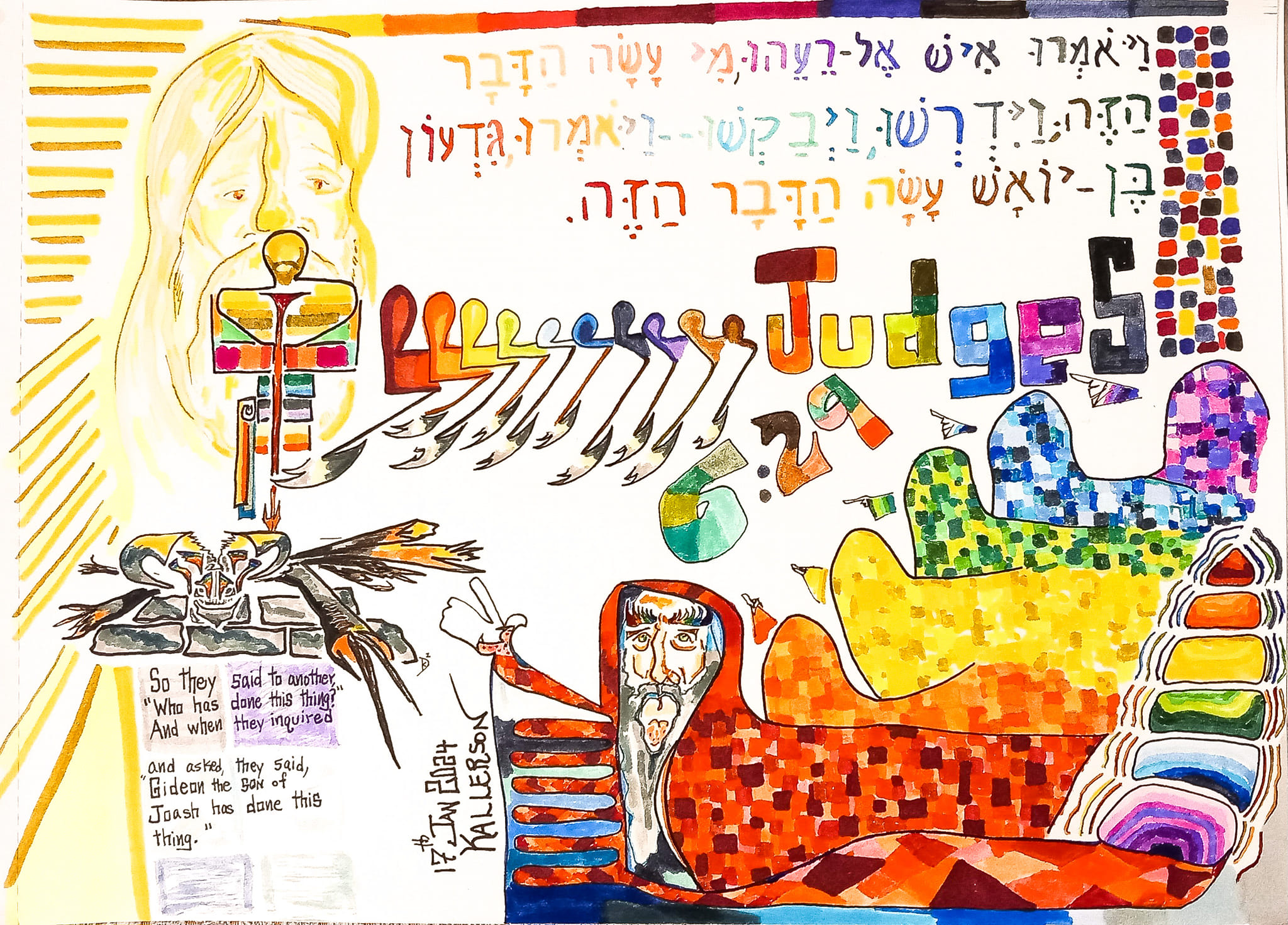
Artwork by Douglas Kallerson.
Judges 6:25-32
Gideon, Judge of Israel, Part III
(Typed 13 November 2023) While clicking through YouTube looking for something to watch as Hideko got dinner ready, a video of N.T. Wright came up. He was being interviewed about his thoughts on the modern state of Israel.
He dismissed it as having any future significance in the redemptive narrative. A very brief analysis of his view is provided by Michael G. Vanlaningham –
“Wright presents four arguments to support his interpretation. First, it is essential, he says, to understand that there is no discrete future for Israel ‘as a whole’ because she has been superseded by Jesus Christ, her Messiah. Wright claims that Paul’s theology begins ‘“with the realization that what the creator/covenant god was supposed to do for Israel at the end of history, this god had done for Jesus in the middle of history.’ God has brought all of His covenant purposes for Israel to fruition in Israel’s representative, the Messiah Jesus.”
- T. Wright bases his argument on Paul’s words in 2 Corinthians 1:20, which say, “For all the promises of God in Him are Yes, and in Him Amen, to the glory of God through us.”
It is true that Jesus is the fulfillment of Scripture. Therefore, the promises of God which were made to the people of God are realized in Him.
N.T. Wright’s view, however, does not accurately explain the entire panorama of what has happened and what will happen. He committed the fallacy of a category mistake. Just because Jesus did everything necessary for Israel’s salvation, etc., it does not mean that everything concerning Israel’s future in the redemptive narrative is complete.
He also committed a false dilemma fallacy. In essence, he says, “Because Jesus is the Messiah who has fulfilled all the promises of God, there is no longer any need for Israel in the redemptive narrative.” He proposes two options, one of which is fulfilled. Therefore, the other must no longer apply.
His thinking is incorrect. Those are not the only two options on the table. Just because Jesus is the fulfillment of all of the messianic promises of God, it does not mean that the promises to Israel are terminated. Israel was promised a Messiah. Israel was not promised to be the Messiah.
Through his faulty logic, he concludes that the church has replaced Israel and that there is no such thing as the rapture, a millennial rule from Jerusalem, etc. He has failed to understand what God is doing because – among other things – he has failed to understand the binding nature of the Mosaic Covenant upon Israel.
Any reasonable theologian will agree that what came upon Israel in the Roman exile is because of their rejection of Christ. But the Mosaic Covenant is what led to that exile, or there would have been no exile.
Otherwise, all the other nations on earth should have been given the same punishments as Israel, punishments which are spelled out in Leviticus 26, and which presuppose a second exile. But only Israel was given the law, and only Israel receives the punishments detailed in it.
As for our verses today, they will typologically reveal (once again) the incorrect nature of replacement theology. Unless one understands what is being pictured, and it is as obvious as the nose on Jimmy Durante’s face once it is explained, all kinds of aberrant ideas about Israel are sure to arise.
Text Verse: “‘To whom then will you liken Me,
Or to whom shall I be equal?’ says the Holy One.
26 Lift up your eyes on high,
And see who has created these things,
Who brings out their host by number;
He calls them all by name,
By the greatness of His might
And the strength of His power;
Not one is missing.” Isaiah 40:25, 26
If Israel was exiled based on the curses of the law, then that exile must – by default – mean that there is still a purpose for Israel. There is no timeframe given in the law, as interpreted by replacement theologians, for this punishment to end. Thus, the nation is otherwise ostensibly set to endure eternal earthly curses.
However, in properly following the dispensational model, the Bible tells us EXACTLY when the curses of the law will end for them. And more, it tells us exactly how that ending will happen. What is revealed in these typological passages simply confirms this.
By properly handling Scripture, including both the clear text and the underlying typology, one thing is for sure: N.T. Wright is proven to be Now Totally Wrong J. A nice British accent may make for a trusty-sounding James Bond. However, it doesn’t make for sound theology.
That has to come through proper study of Scripture. In this, his nifty accent doesn’t help him one iota. For best enjoyment in this area, stick with Bond. He is way more exciting and, unlike N.T. Wright’s theology, you already know that James Bond is just make-believe .
What is coming upon the nation of Israel in the future? It’s all to be found in His superior word. And so, let us turn to that precious word once again, and… May God speak to us through His word today, and may His glorious name ever be praised.
I. He Did It by Night (verses 25-27)
25 Now it came to pass the same night
vayhi ba’laylah ha’hu – “And it was in the night, the it.” This means on the night that Gideon had built the altar and called it “The Lord is Peace.” With that accomplished, and in the nighttime…
25 (con’t) that the Lord said to him, “Take your father’s young bull,
vayomer lo Yehovah qakh eth par ha’shor asher l’avikha – “And said to him, Yehovah, ‘Take bullock the ox which to your father.’” The par, or bullock, comes from parar, to break asunder, cast off, cause to cease, disannul, etc. For example, it can mean to break a covenant, defeat bad counsel, dissolve the earth, etc.
The shor, or ox, comes from shur, to travel or journey. That comes from a primitive root meaning to turn, such as in traveling about as a merchant. It is also connected to shir, to sing. The connection is a strolling minstrelsy. In these words, one can already see typology developing.
25 (con’t) the second bull of seven years old,
u-par ha’sheni sheva shanim – “and ox the second, seven years.” The KJV/NKJV make it sound as if it is speaking of the same bull. To ensure this is understood, the KJV says, “even the second bull.” The NKJV just ignores it and implies that it is the same bull.
They do this because nothing is later said of the first bull. However, there is no need for this. The Hebrew doesn’t give any such qualifier. Further, this bull is specifically referred to again as “the second.” Therefore, it implies two bulls. You can’t have a second without a first.
Thus, it should be translated as if two bulls are being referred to. Without telling why two are selected, we can assume the labor of the first was used to help accomplish the tearing down that is to take place.
There is a second bull belonging to Gideon’s father, that was born seven years earlier that was used in the household. It takes us back to verse 1 –
“Then the children of Israel did evil in the sight of the Lord. So the Lord delivered them into the hand of Midian for seven years.”
The bull was born at the beginning of the seven years of affliction that had come upon Israel by the hand of the Lord through Midian. This specific ox is to be used for a particular purpose. For now…
25 (con’t) and tear down the altar of Baal that your father has,
Rather than “of Baal” it says: v’harasta eth mizbakh asher l’avikha – “and break down altar the baal which to your father.” Each time baal is mentioned in this passage, it will be prefixed with the definite article. It is a particular baal that was being served. Possibly the sun, but maybe some other.
Baal signifies a heathen god. It is derived from the noun baal, signifying a master or owner, which is from the verb baal, meaning to marry or lord over. It is as if there is a covenant relationship between the baal and those serving it. They have subordinated themselves to the baal. Gideon has been instructed to destroy the baal, signifying the breaking of this covenant relationship…
25 (con’t) and cut down the wooden image that is beside it;
Rather than beside, it says, upon: v’eth ha’asherah asher alav tikroth – “and the Asherah which upon cut down.” Asherahs are based on a nature goddess companion of Baal found in Phoenicia, Assyria, Canaan, etc. They are represented by large wooden pillars or images set up in honor of Ashteroth. Examples can be seen in Judges 2.
The word translated as cut down is karath, the same word used in the cutting of a covenant. By destroying the altar and cutting down the Asherah, one gets the sense of the cutting off of a covenant that had once been cut.
The name Asherah is probably of foreign origin, but to a Hebrew audience, it is clearly identified with ashar, to go straight, to go on, to advance. That is normally translated, however, as happy or blessed. This is because by going straight, one stays on the proper path.
Israel has not gone straight. Thus, they are not in a happy place but rather the place of judgment. This unfortunate state came about because they failed to heed the word of the Lord through Moses –
“But thus you shall deal with them: you shall destroy their altars, and break down their sacred pillars, and cut down their wooden images, and burn their carved images with fire.” Deuteronomy 7:5
Instead of doing what they were instructed, Israel joined the pagan practices of the nations, with whom they interacted, and they served gods other than the Lord. Gideon has been commissioned to end this by tearing these things down. In their place…
26 and build an altar to the Lord your God on top of this rock
u-banita mizbeakh l’Yehovah elohekha al rosh ha’maoz ha’zeh: “and build altar to Yehovah your God upon top the strength, the this.” Here is a new word, maoz, a place of safety or protection. It can be a fortress, a force, metaphorically a helmet, the Lord, etc. It is derived from the verb uz, to take or seek refuge, or the verb azaz, to strengthen or be strong. For example –
“For thou hast been a strength [maoz] to the poor, a strength to the needy in his distress, a refuge from the storm, a shadow from the heat, when the blast of the terrible ones is as a storm against the wall.” Isaiah 25:4 (KJV)
Gideon is replacing the object of idolatry with an altar of strength to the Lord…
26 (con’t) in the proper arrangement,
The words are complicated: ba’maarakha – “in the arrangement.” The word is maarakhah – an arrangement, coming from arak, to arrange or set in order, as in a battle array or setting forth the rows of bread before the Lord in the tabernacle.
This may indicate the proper means of building such an altar as specified by the Lord, or it more likely means arranging what is used for the offering. In other words, the Asherah is cut down, then cut up. Finally. it is arranged for burning. From there, the offering is burnt. Once that is complete…
26 (con’t) and take the second bull and offer a burnt sacrifice with the wood of the image which you shall cut down.”
v’laqakhta eth ha’par ha’sheni v’haalita olah ba’atse ha’asherah asher tikroth – “And take the bullock, the second, and ascend whole burnt offering in wood the Asherah which you shall cut down.” Either there is one bull that was originally specified, which means taking the word “and” and changing it to “even,” which is not unheard of, but unlikely, or only the second bull is identified to be used as a whole burnt offering.
Because of the specificity of the wording, the latter surely seems to be the case. Ellicott says –
“The Jews point out the peculiar features of this burnt offering: (1) It was not at Shiloh; (2) it was not offered by a priest; (3) it was offered at night; and (4) the fire was kindled with the unhallowed materials of an idol.”
These things are irrelevant because the Lord has commanded them to be done in this way. As such, His word is justification for what takes place. Therefore…
27 So Gideon took ten men from among his servants and did as the Lord had said to him.
Rather than “said,” it says, “spoke”: vayiqakh gidon asarah anashim meavadav vayaas kaasher dibber elav Yehovah – “And took, Gideon, ten men from his servants and does according to which spoke unto him, Yehovah.” The Lord spoke forth His command, and Gideon did according to the spoken word.
Of the number ten, Bullinger says, “Completeness of order, marking the entire round of anything, is, therefore, the ever-present signification of the number ten. It implies that nothing is wanting; that the number and order are perfect; that the whole cycle is complete.”
27 (con’t) But because he feared his father’s household and the men of the city too much to do it by day, he did it by night.
vayhi kaasher yare eth beith aviv v’eth anshe ha’ir measoth yomam vayaas laylah – “And was according to which feared house his father and men the city from doing by day, and did night.”
It is doubtful he feared the consequences of what would take place, but that his efforts would be interrupted or thwarted. The consequences would come sooner or later, once the matter was discovered.
The obvious meaning is that his father’s house, along with the city inhabitants, would be highly peeved at him tearing down their place of worship.
An offering has been made
But it was rejected long ago
Instead, Israel made a trade
Their glory for wind, a passing blow
But despite this, the offering stands
It is there for the people, Israel
It comes through faith, not commands
And it is fully sufficient as well
Nothing more does Israel need
Than to acknowledge their Lord Jesus
To Him alone they will someday plead
And God will respond, as He did for us
II. Shall Strive In Him the Baal (verses 28-32)
28 And when the men of the city arose early in the morning, there was the altar of Baal, torn down;
vayashkimu anshe ha’ir ba’boqer v’hineh nuthats mizbakh ha’baal – “And arising men the city in the morning, and behold!, broken down altar the baal.” Though this is speculation, the specific mention of rising early may indicate that the men specifically went to this altar as a form of sun worship. No matter what, the destruction of the idolatrous altar was revealed by the daylight. And more…
28 (con’t) and the wooden image that was beside it was cut down, and the second bull was being offered on the altar which had been built.
v’ha’asherah asher alav korathah v’eth ha’par ha’sheni hoalah al ha’mizbeakh ha’banui – “And the Asherah which upon it was cut down and the bullock, the second, ascended upon the altar that was built.” The words meticulously reveal full compliance with the Lord’s spoken word.
Of the unusual specificity, Cambridge asks, “There must be some special meaning in this description, the second. Can it refer to his place in the team, the young bullock being the leader, the first, and the seven-year-old the wheeler, the second?”
Instead of tearing apart the text as they normally do, they take it that the wording is so curious that it must be original. Therefore, they attempted to stretch their minds for a reason.
Even if their conclusion is given in the form of an interrogative, it is evident that there must be a particular reason for such specificity in the text. Ellicott further notes –
“It has been supposed that Gideon offered both bullocks, the first as a burnt offering for his family, and the second for the nation. Nothing, however, is said of the fate of the young bullock; and, apart from express direction, Gideon may have hesitated to offer to the Lord a sacrifice which may have been devoted to Baal.”
Why anyone would suppose that the first bull was offered is beyond the pale. The wording is so precise that it does not allow for such speculation. However, Ellicott is right that it would be a violation of the spoken word of the Lord to have offered it. It can firmly be concluded that typology is being conveyed.
29 So they said to one another, “Who has done this thing?”
vayomer ish el reehu mi asah ha’davar ha’zeh – “And said man unto his fellow, ‘Who did the word, the this?’” The word davar, or word, carries whatever meaning is associated with what is occurring. At this time, it is a matter that is being inquired about.
They see three things: The altar broken down, the Asherah cut down, and a new altar that was used to burn the second bull upon the wood of the Asherah. This is the matter at hand. Therefore, a search is made…
29 (con’t) And when they had inquired and asked, they said, “Gideon the son of Joash has done this thing.”
The aspect of the verbs implies a search followed by a conclusion: vayidr’shu vaybaqshu vayomru gidon ben yoash asah ha’davar ha’zeh – “And inquiring and seeking, and said, ‘Gideon, son Joash, did the word, the this.”
Gideon, Cutter Off, son of Joash, Yehovah has bestowed, is identified as the culprit. The Cutter lived up to his name. He cut down and destroyed the objects of false worship that arose in place of the Lord. Therefore…
30 Then the men of the city said to Joash, “Bring out your son, that he may die,
The words carry a jussive, an implied command: vayomru anshe ha’ir el yoash hotse eth binkha v’yamoth – “And said men the city unto Joash, ‘Bring out your son, and he dies.’” They have proclaimed a death sentence on Gideon because of what he did…
30 (con’t) because he has torn down the altar of Baal, and because he has cut down the wooden image that was beside it.”
ki natats eth mizbakh ha’baal v’ki karath ha’asherah asher alav – “For broken down altar the baal, and for cut down the Asherah which upon it.” This is their justification for executing Gideon! They rejected the Lord, broke the covenant relationship, and turned their backs to Him through false worship.
Gideon stood against this. And yet, they would stand against him and his allegiance to the Lord, having him executed. It is almost impossible to imagine, and yet it is what is happening in both Israel and the church today. The words throughout the next verse are exceptionally strong and emphatic…
31 But Joash said to all who stood against him, “Would you plead for Baal?
Using a paragogic nun as a form of stress, Gideon’s father speaks: vayomer yoash l’kol asher amdu alav ha’atem t’rivun la’baal – “And said Joash to all who stood upon him, ‘The you (surely) striving to the baal?” Imagine the people standing completely over Joash, looking down on him, angrily demanding his son die.
In return, he asks them to think through what they are doing. The absurdity of their actions was more than he could take. Thus, he continues…
31 (con’t) Would you save him?
He again speaks emphatically and uses another paragogic nun: im atem tovoshiun oto – “If YOU would (surely) save him?” Gideon had just broken down the altar. He then used the wood from the Asherah to offer a whole burnt offering to God. And he couldn’t stand on his own?
The obvious difference between the baal and Yehovah is brought forth. In words similar to the text verse today, the Lord, through Isaiah, resoundingly proclaims –
“To whom will you liken Me, and make Me equal
And compare Me, that we should be alike?
6 They lavish gold out of the bag,
And weigh silver on the scales;
They hire a goldsmith, and he makes it a god;
They prostrate themselves, yes, they worship.
7 They bear it on the shoulder, they carry it
And set it in its place, and it stands;
From its place it shall not move.
Though one cries out to it, yet it cannot answer
Nor save him out of his trouble.” Isaiah 46:5-7
This is why the Lord commanded that no image of Him should be made. He is the incomprehensible God that is not to be compared with anything man could fashion. Therefore, Joash proclaims…
31 (con’t) Let the one who would plead for him be put to death by morning!
asher yariv lo yumath ad ha’boqer – “Whom strives to him dying until morning!” The person who would strive for the baal would be executed at the rising of the sun, just when he was to be on his knees worshipping his false god, be it the sun or some lesser god derived from sun worship.
This may mean “until this morning” if they are waiting for the actual sunrise, or it may mean “until the next morning” if he is giving the baal a day to avenge itself.
Either way, Joash has set the red line for the people to consider. With it drawn, he turns the thought of striving for the baal on its head, saying…
31 (con’t) If he is a god, let him plead for himself, because his altar has been torn down!”
He uses a jussive as a challenge to the baal along with highly emphatic words, certainly as a taunt: im elohim hu yarev lo ki natats eth mizb’kho – “If god HE, shall strive to him, for has broken down his altar.”
The altar of the baal, along with the Asherah which supposedly has power, should wake the baal up and make him angry. In his anger, he can then take the necessary action to defend himself.
If he doesn’t, then he is no god at all. Unlike the temple in Jerusalem, where it was prophesied in advance what would happen to it in each catastrophe it faced, the altar of the baal had no such word. Therefore, it would be assumed that it would either last forever or be avenged by him for any desecration.
The temple of the Lord was different. Instead of merely standing for the Lord, it stood as a testament to either the faithfulness or faithlessness of Israel to the covenant administered there –
“But if you or your sons at all turn from following Me, and do not keep My commandments and My statutes which I have set before you, but go and serve other gods and worship them, 7 then I will cut off Israel from the land which I have given them; and this house which I have consecrated for My name I will cast out of My sight. Israel will be a proverb and a byword among all peoples. 8 And as for this house, which is exalted, everyone who passes by it will be astonished and will hiss, and say, ‘Why has the Lord done thus to this land and to this house?’ 9 Then they will answer, ‘Because they forsook the Lord their God, who brought their fathers out of the land of Egypt, and have embraced other gods, and worshiped them and served them; therefore the Lord has brought all this calamity on them.’” 1 Kings 9:6-9
Without any such word, because the altar to the baal was made by man without any sanction by the false god it deified, Joash insisted that anyone who strove for it should be executed.
32 Therefore on that day he called him Jerubbaal,
The name is a play on the word yarev, to strive, that Joash thrice pronounced: va’yiqra lo bayom ha’hu yerubaal – “And called to him in day, the it, Jerubbaal.” The verb is impersonal. Thus it means that people in general, not Joash, called Gideon this name on that day. It is like saying, “On that day, he got called Jerubbaal.”
The name is based on the event, Baal Strives or Let Baal Strive. That would be based on another jussive spoken next by Joash…
*32 (fin) saying, “Let Baal plead against him, because he has torn down his altar.”
lemor yarev bo ha’ baal ki natats eth misb’kho – “saying, ‘shall strive in him the baal, for has broken down his altar.’” The point of the words and the giving of the name is that the baal cannot contend with Gideon. If he could, they would have called Gideon Contender with Baal.
But that would imply that the baal could contend. Gideon broke down the altar, and neither the altar nor the baal could respond. The victory over the baal is complete. The Lord, through Gideon, has prevailed.
The bull is offered to our God
Just as the Lord spoke to us
Through it comes the approval nod
As we call out to Him through Jesus
Seven years of hell on earth
Have come upon us to this day
What we need is the new birth
And to follow in His only Way
Jesus! We have finally seen our need
And so to Him we will bow the knee
No more with the baal shall we plead
Only our Messiah can set us free
III. Pictures of Christ
It would be possible to combine the typology together with what is coming in the rest of the chapter, but there would be too much lost.
What we have in this section began with Gideon being tasked by the Lord the night of the same day as when the Lord appeared to Him and gave him his commission to save Israel from the Midianites. As it said, “And it was in the night, the it; and said to him, Yehovah…”
It was seen previously that Gideon anticipates the gospel. It is now being prepared to be brought to Israel. As we saw, it was validated as the good news and that which establishes the peace of the Lord – Yehovah Shalom.
When will it finally and fully come to Israel? Yes, you, in the 22nd row. Yes, that is correct, during the tribulation period. And what is that period called by Paul in 1 Thessalonians? Very good. A+. The night –
“For you yourselves know perfectly that the day of the Lord so comes as a thief in the night. 3 For when they say, ‘Peace and safety!’ then sudden destruction comes upon them, as labor pains upon a pregnant woman. And they shall not escape. 4 But you, brethren, are not in darkness, so that this Day should overtake you as a thief. 5 You are all sons of light and sons of the day. We are not of the night nor of darkness. 6 Therefore let us not sleep, as others do, but let us watch and be sober. 7 For those who sleep, sleep at night, and those who get drunk are drunk at night.” 1 Thessalonians 5:2-7
He is told to take the “bullock the ox which to your father.” It is referring to the Law of Moses that Israel repeatedly violated since it was first given. The ox is given to reveal that it is time to disannul that covenant.
That has actually already happened in Christ’s coming, but Israel rejected Him. Thus, they are still bound to the Mosaic Covenant. Only in the future will they realize the disannulment of the law through the work of Christ. –
“In that He says, ‘A new covenant,’ He has made the first obsolete. Now what is becoming obsolete and growing old is ready to vanish away.” Hebrews 8:13
The author of Hebrews is writing to the Hebrew people collectively about their future. There is a point in time that the law, which is annulled in Christ, will be obsolete for them, and it will pass away.
That first bull was also called a shor, or ox. As noted, that comes from shur, to travel or journey. The connection is that the Mosaic Covenant has been a journey upon which Israel has traveled, wending its way toward Christ –
“Therefore the law was our tutor to bring us to Christ, that we might be justified by faith.” Galatians 3:24
There was also a specific reference to a second bull – “and the ox the second, seven years.” This means that this ox came to be at the same time the tribulation period (the oppression of Midian) began. That was seen in Judges 6:2. It is another covenant that Israel placed itself under –
“Then he shall confirm a covenant with many for one week;
But in the middle of the week
He shall bring an end to sacrifice and offering.
And on the wing of abominations shall be one who makes desolate,
Even until the consummation, which is determined,
Is poured out on the desolate.” Daniel 9:27
To fully understand the timeline of the future tribulation period, you can go back and watch the Superior Word 2 Thessalonians 2:8, 9 Bible study entitled And Then… The timeline is clearly laid out concerning the order of the coming end times events.
This covenant is made with the Antichrist. Hence, the focus from this point on concerns this second bull. However, it was logically deduced that the purpose of the first bull was to assist in the tearing down of the altar of the baal.
The law itself anticipates its own ending, as has been seen previously. In the process of it ending, it will be used to bring down the covenant with the Antichrist. In other words, in the ending of the law, Israel will accept the gospel. At that time, the second covenant, the one with the Antichrist, will be ended as well.
Still in verse 25, each time baal is mentioned, it is prefixed by the definite article. It is a specific reference to the idolatry of Israel, believing in their own deeds before God rather than in the gospel of Jesus. Their deeds under the law had become their object of worship. Ultimately, this is “the baal” that must be ended.
In cutting down the Asherah which is upon the altar, it is signifying that Israel, through the gospel, will finally take the straight path that leads to a state of happiness and blessedness (ashar, from which Asherah is derived).
Once the task was happily effected, Gideon was to (verse 26) “build an altar to Yehovah your God upon the strength [maoz], the this.” The altar anticipates Christ, this is seen in a marvelous pun from Isaiah, where the coming of Jesus is hinted at –
“The Lord is their strength,
And He is the saving [yeshuah – salvations] refuge [maoz] of His anointed [mashiakh = Messiah].” Psalm 28:8
Literally: “Yehovah strength to them and Strength salvations His Anointed, HE.”
Still in verse 26, the arranging of the altar is noted. The arrangement anticipates the placing of all of one’s works on the altar of sacrifice before the Lord, who alone provides salvation. Israel is to give up on the errant path and come to Christ.
When that happens, the second bull, the covenant with the Antichrist, will be annulled. Thus, both the Law of Moses and the seven-year covenant end at the same time, exactly as proper dispensationalism has revealed.
The symbolism is seen in the deeds of idolatrous self (the law) being burnt under the seven-year-old bull (the seven-year peace treaty). Listen again to what Ellicott said. It is exactly what lies ahead for Israel –
“The Jews point out the peculiar features of this burnt offering: (1) It was not at Shiloh; (2) it was not offered by a priest; (3) it was offered at night; and (4) the fire was kindled with the unhallowed materials of an idol.”
Rather, it is offered upon Jesus, the true High Priest, during the tribulation period, and it is the ending of Israel’s unhallowed conduct.
Verse 27 saw Gideon, the gospel, taking ten men of his servants. In this, it “implies that nothing is wanting; that the number and order are perfect; that the whole cycle is complete.”
Everything necessary for Israel’s salvation is tied up in the transmission and reception of the gospel. And again in verse 27, it said that they did this at night. It is a stress all by itself. Israel will come to Christ during the tribulation period.
The actions were complete by the morning (verse 28). What is true for each person who comes to Christ will also be true for national Israel –
“…each one’s work will become clear; for the Day will declare it, because it will be revealed by fire.” 1 Corinthians 3:13
Verse 28 noted that the work of Gideon was completed and that the people saw the results of it. Therefore, verse 29 referred to the people questioning who had done it. A search was made, “inquiring and seeking,” and the response was, “Gideon, son Joash, did the word, the this.”
The gospel of Christ, son Yehovah has Bestowed, accomplished the word. What a marvelous testimony to the future reception of the gospel by Israel. Christ, the incarnate Word of God, will be seen for who He is in the reception of the Good News that tells of Him.
Obviously, when the leaders of Israel call out to Jesus, it does not mean that all of Israel will have done so. It is the leadership that must receive Him in order for the nation to be saved. Some will hear and protest. Hence the words of verse 30 about bringing out the son (the gospel of Jesus) so that he should die.
They initially buck against what has been done until they too understand the implication of the gospel. That is seen in these verses in the back-and-forth exchange between the people and Joash. The leaders will come back and essentially say what Peter said to the Judaizers two millennia earlier –
“Now therefore, why do you test God by putting a yoke on the neck of the disciples which neither our fathers nor we were able to bear? 11 But we believe that through the grace of the Lord Jesus Christ we shall be saved in the same manner as they.” Acts 15:10, 11
The use of emphatics, paragogic nuns, and successive jussives shows the incredible nature of what lies ahead for Israel. “What, are you kidding?” The law has been a weight around the neck of Israel since the beginning. It only brought them trouble. And yet, there will be those who want to cling to it as if it is their salvation.
But Joash, Yehovah has Bestowed, in verse 31 says, “The you (surely) striving to the baal?” In essence, “You would strive for the law instead of the gospel? That’s crazy!” He then said, “If YOU would (surely) save him?” In other words, “Can you perfectly meet the demands of the law? Can you stand righteous before God as Jesus did? Can you become Israel’s Messiah?”
Therefore, still in verse 31, Joash says, “Whom strives to him (meaning for the law) dying until morning.” Stated more clearly, “When the tribulation period is over, judgment is coming. If you want to trust in yourself, good luck, buddy boy.”
He then said, “If god HE, shall strive to him, for has broken down his altar.” If the law is your god, the Lord would defend its continuance. But He has sent Jesus to fulfill and end the law. That is God’s testimony.
The altar of the law stood as a testament to either the faithfulness or faithlessness of Israel to the covenant administered there. In the tribulation period, it will be defiled by the Antichrist. This shows God’s approval was not with the law. Rather, it is with Jesus. The word testifies to this. Israel has simply been blinded to the fact.
With that, verse 32 told that Gideon was called by the name Jerubbaal, Let Baal Strive. The law failed to strive against Jesus. Thus, He prevailed over it. The law has no power against Him because the law is not where the power of God is. Rather, our closing verse will explain where it lies.
As you can see, the analysis of N.T. Wright is proven, once again, to be Now Totally Wrong. The typology presented has clearly shown this.
Even without the typology, Scripture clearly reveals what the typology presented also shows. God is presenting us portions of the history of Israel and is essentially asking us to question why he chose these stories. Each name, each location, and each event is given to lead us to a better understanding of what will come about in the future.
Keep reading the Bible. The more you do, the more it will reveal to you what is on God’s mind. Jesus has, indeed, fulfilled everything necessary for Israel’s salvation. But this does not mean that Israel is out. It means that the promises to them will only be fulfilled when they accept what Jesus has done for them.
One of the errors of replacement theology is that it mistakenly categorizes biblical issues, conflating some things that should not be conflated, and rejecting core principles that should not be ignored.
Hold fast to the understanding that God is not done yet with Israel. His covenant faithfulness towards them tells us that He also will never be done with you when you come to Him through Jesus Christ. This is the faithfulness of God to His people, unfaithful or otherwise. Thank God for His grace and mercy as is revealed in the giving of Jesus. Hallelujah and amen.
Closing Verse: “For I am not ashamed of the gospel of Christ, for it is the power of God to salvation for everyone who believes, for the Jew first and also for the Greek. 17 For in it the righteousness of God is revealed from faith to faith; as it is written, ‘The just shall live by faith.’” Romans 1:16, 17
Next Week: Judges 6:33-40 It’s fun. It’s so swell. We get Jay to help some more... (Gideon, Judge of Israel, Part IV) (21st Judges Sermon)
The Lord has you exactly where He wants you. He has a good plan and purpose for you. It is He who judges His people according to their deeds. So, follow Him, live for Him, and trust Him, and He will do marvelous things for you and through you.
Gideon, Judge of Israel, Part III
Now it came to pass the same night
That the LORD said to him, “Take your father’s young bull
———-the second bull of seven years old
And tear down the altar of Baal that your father has
And cut down the wooden image that is beside it, so you
———-have been told
And build an altar to the LORD your God
On top of this rock, in the proper arrangement too
And take the second bull and offer a burnt sacrifice
With the wood of the image which you shall cut down
———-so you shall do
So Gideon took ten men from among his servants
And did as the LORD had said to him, doing it just right
But because he feared his father’s household
And the men of the city too much to do it by day, he did it by night
And when the men of the city arose early in the morning
There was the altar of Baal, torn down. No more offerings
———-to it would be proffered
And the wooden image that was beside it was cut down
And on the altar which had been built the second bull
———-was being offered
So they said to one another
“Who has done this thing? This makes our ears ring!
And when they had inquired and asked
They said, “Gideon the son of Joash has done this thing
Then the men of the city said to Joash
“Bring out your son, that he may die, we will not acquit
Because he has torn down the altar of Baal
And because he has cut down the wooden image that was beside it
But Joash said to all who stood against him
“Would you plead for Baal? Would you save him? I give
———-you this warning…
Let the one who would plead for him
Be put to death by morning!
“If he is a god, let him plead for himself
Because his altar has been torn down!” (I know he will falter)
Therefore on that day he called him Jerubbaal, saying
“Let Baal plead against him, because he has torn down his altar
Lord God, turn our hearts to be obedient to Your word
Give us wisdom to be ever faithful to You
May we carefully heed each thing we have heard
Yes, Lord God may our hearts be faithful and true
And we shall be content and satisfied in You alone
We will follow You as we sing our songs of praise
Hallelujah to You; to us Your path You have shown
Hallelujah we shall sing to You for all of our days
Hallelujah and Amen…
25 Now it came to pass the same night that the Lord said to him, “Take your father’s young bull, the second bull of seven years old, and tear down the altar of Baal that your father has, and cut down the wooden image that is beside it; 26 and build an altar to the Lord your God on top of this rock in the proper arrangement, and take the second bull and offer a burnt sacrifice with the wood of the image which you shall cut down.” 27 So Gideon took ten men from among his servants and did as the Lord had said to him. But because he feared his father’s household and the men of the city too much to do it by day, he did it by night.
28 And when the men of the city arose early in the morning, there was the altar of Baal, torn down; and the wooden image that was beside it was cut down, and the second bull was being offered on the altar which had been built. 29 So they said to one another, “Who has done this thing?” And when they had inquired and asked, they said, “Gideon the son of Joash has done this thing.” 30 Then the men of the city said to Joash, “Bring out your son, that he may die, because he has torn down the altar of Baal, and because he has cut down the wooden image that was beside it.”
31 But Joash said to all who stood against him, “Would you plead for Baal? Would you save him? Let the one who would plead for him be put to death by morning! If he is a god, let him plead for himself, because his altar has been torn down!” 32 Therefore on that day he called him Jerubbaal, saying, “Let Baal plead against him, because he has torn down his altar.”