Artwork by Douglas Kallerson
Judges 21:1-19
No King in Israel, Part X
(Typed 29 Jul 2024) The narrative in Judges 21 brings in a point of doctrine that seems to escape a surprisingly large portion of the church. It is such a critical point to understand, that in misunderstanding the precept, it has brought in some of the nuttiest thinking imaginable to various denominations, sects, and cults.
Benjamin has been reduced from a number of 26,700 fighting men, plus women, children, and the aged, to only 600 men. So, does the tribe of Benjamin still exist after the battle? It would be hard to find a single person who would say, “No, Benjamin no longer exists.”
Until those 600 died, Benjamin would still be a tribe. But what if the number was only 120? Would Benjamin still exist? Again, the answer is affirmative. But what if there were only 17, 8, or 2? The answer would remain the same. Even if only one man of Benjamin survived, the tribe would still be considered a tribe.
This is understood in the world today. A couple of times in my life, I have heard of someone thought to be the last remaining person of a particular tribe of people, like the Eskimos, for example. When that person dies, that particular tribe dies out. Until then, the tribe remains.
Text Verse: “…though I also might have confidence in the flesh. If anyone else thinks he may have confidence in the flesh, I more so: 5 circumcised the eighth day, of the stock of Israel, of the tribe of Benjamin, a Hebrew of the Hebrews; concerning the law, a Pharisee; 6 concerning zeal, persecuting the church; concerning the righteousness which is in the law, blameless.” Philippians 3:4-6
The apostle Paul was of the tribe of Benjamin. So, applying the logic, did the tribe of Benjamin exist at the time of Paul? Obviously! Even if Paul was the only Benjamite left (which he wasn’t), the tribe would still exist until he died.
In Luke 2:36, a woman of Asher, Anna, the daughter of Phanuel, is named. Thus, Asher remained. In fact, after the exile of the ten northern tribes of Israel by Sennacherib, King of Assyria, members of almost every tribe in Israel are mentioned. In other words, even though the majority of the tribe was exiled and their land inheritance was lost, there were still people from those tribes residing in the southern area of Judah.
That fact continued on through the time of the apostles. In Acts 26:7, Paul said, “To this promise our twelve tribes, earnestly serving God night and day, hope to attain. For this hope’s sake, King Agrippa, I am accused by the Jews.” Likewise, the book of James is written to “the twelve tribes which are scattered abroad.”
Despite the exile, there were no “lost tribes.” And yet, denominations, sects, and cults within the supposed Christian church claim that they comprise the gathered lost tribes of Israel. This is true of British Israelism, the Worldwide Church of God, the Mormons, Jehovah’s Witnesses (in one respect), and others.
They all claim something that they are not, and they base it on a faulty understanding of Scripture. Benjamin did not die out at the time of Judges, despite what took place in Judges 20. And none of the tribes of Israel died out at the exile of the ten northern tribes.
They continued on through the time of Jesus and the apostles, and they are being regathered to the land of Israel today. A good life lesson for the church would be to stop co-opting things belonging to Israel to which it has no right.
If one wonders why there is so much disunity in the church today, it is because people fail to read the Bible, and even when they do, they take much of it out of its proper context. Do not do this! Great and reliable truths such as this are to be found in His superior word. And so, let us turn to that precious word once again, and… May God speak to us through His word today, and may His glorious name ever be praised.
I. What Shall We Do? (verses 1-7)
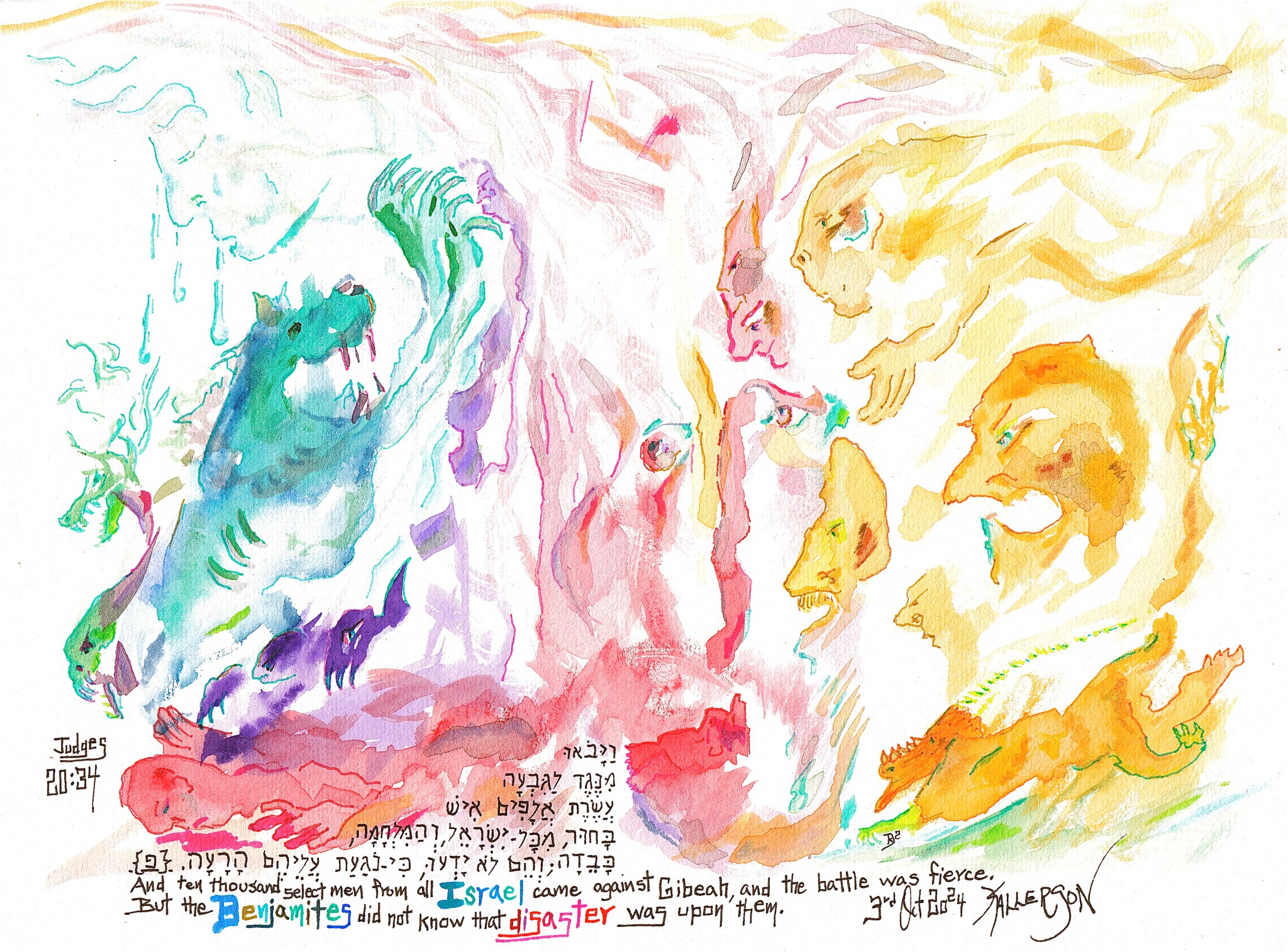
Chapter 20 ended with the total defeat of the army of Benjamin and the complete destruction of the tribe and all its people. The only exception was noted in the final verses, saying –
“But six hundred men turned and fled toward the wilderness to the rock of Rimmon, and they stayed at the rock of Rimmon for four months. 48 And the men of Israel turned back against the children of Benjamin, and struck them down with the edge of the sword—from every city, men and beasts, all who were found. They also set fire to all the cities they came to.” Judges 20:47, 48
With that remembered, we now enter into the contents of the final chapter of the book of Judges…
Now the men of Israel had sworn an oath at Mizpah, saying,
v’ish Yisrael nishba bamitspah l’mor – “And man, Israel, sworn in the Mizpah, to say.” In this chapter, it is apparent that there are two oaths that had previously been made by the congregation at Mizpah but which had not been recorded. These oaths form the underlying structure of what will be recorded throughout the chapter. The first of these two oaths is noted next…
1 (con’t) “None of us shall give his daughter to Benjamin as a wife.”
ish mimenu lo yiten bito l’binyamin l’ishah – “Man from us not gives his daughter to Benjamin to wife.” The oath was fortunately not one of kharem, the total devotion of the tribe to God. If that were the case, the six hundred at the Rock of Rimmon would have been hunted down and killed as well.
However, the people made an oath that Benjamin was cut off from marriage rights among the tribes of Israel, at least at this time. Of this practice, John Lange provides an explanation –
“They abrogated the connubium (the right of intermarriage) with the tribe. They determined to treat Benjamin as a heathen people, or as heathen nations, in the absence of special treaties (ἐπιγαμία [epigamia]), were accustomed to look upon each other. There were instances of heathen tribes who did not at all intermix. Such cases were found among Germanic tribes also, until Christianity had fully conquered them. It was the church that brought East-Goths and West-Goths, Anglo-Saxons and Britons, Franks and Romans, to look upon each other as tribes of one Israel. Very great, therefore, must have been the indignation of the collective Israel, when they thus, as it were, cast Benjamin out of their marriage covenant.”
The oath was made, and it could not be taken back. As such, it has left Israel with a problem because they had killed all of the women and children of Benjamin. This left these six hundred men without any ability to continue the existence of the tribe beyond themselves.
Israel means He Strives with God. The Mizpah means The Watchtower. Benjamin means Son of the Right Hand.
2 Then the people came to the house of God, and remained there before God till evening. They lifted up their voices and wept bitterly,
vayavo ha’am beith el vayeshvu sham ad ha’erev liphne ha’elohim vayisu qolam vayivku b’khi gadol – “And comes, the people, Bethel. And sit there until the evening to faces the God. And lift their voice and weep, ululation whopping.” Here, it says, “the people.” Thus, it is inclusive of soldiers, men, women, and children.
The people came out collectively to Bethel and spent the entire day there before the God, meaning the One True God, among those who are in a right relationship with Him. Of this, the meaning is that the ark was still there after the battle as it was in Judges 20:27. This time before the Lord was one of mourning and sadness.
First, the verb is bakah, to weep. That is enhanced by the next word, the noun b’khi, a weeping. Such a weeping, when it involves an entire congregation, has a lot of noise and emotion. Thus, the word ululation fits perfectly. It has a particular onomatopoetic quality that matches the Mideastern weeping expressed here: ululululululu. Along with this ululating, there are deep searchings of heart and questions to God…
3 and said, “O Lord God of Israel, why has this come to pass in Israel,
Rather: vayomru lamah Yehovah elohe Yisrael hay’thah zoth b’Yisrael – “And say, ‘Why, Yehovah God Israel, came this in Israel?’” Of these words, Adam Clarke incorrectly says –
“This was a very impertinent question. They knew well enough how it came to pass. It was right that the men of Gibeah should be punished, and it was right that they who vindicated them should share in that punishment; but they carried their revenge too far, they endeavored to exterminate both man and beast.” Adam Clarke
However, they did exactly as the law stipulated. They eradicated the evil from Israel. There was nothing unjust in their actions and there was nothing rude in the question. The Lord directed the battles, He oversaw the events, and He knew what the outcome would be. The question isn’t why the battle took place or came out as it did. Instead, the question involves national integrity…
3 (con’t) that today there should be one tribe missing in Israel?”
The words are a sloppy paraphrase: l’hipaqed hayom miYisrael sheveth ekhad – “To visit the day from Israel tribe one?” The word is paqad, to visit. It is one of the most widely applied words in the Bible and each instance has to be considered from the context to understand the word’s signification.
In this case, the visitation means in judgment leading to near eradication. It cannot mean “one tribe missing in Israel” because the one tribe still exists, even if in a completely degraded and seemingly hopeless, cut-off state. Benjamin was visited, and the concern is that he will check out of the tribal enumeration at some point in the future.
The triple repetition of the name Israel in this one verse stresses the matter in a unique and forceful way that reveals the utter astonishment and confusion in the minds of the people. They were a unified whole, being the twelve sons of Israel. But more than that, this unity was under the headship of the Lord.
The covenant cut with them, and the promises made to them were of a national nature, inclusive of all the tribes. If Benjamin were to be lost entirely, how would that affect the covenant promises and their national identity? This is what is on their minds.
The Lord had covenanted with the twelve tribes at Sinai in Exodus 24. Later in Leviticus 26, He affirmed that they would be kept as a people, noting that even in the distant future, He would be their God –
“But for their sake I will remember the covenant of their ancestors, whom I brought out of the land of Egypt in the sight of the nations, that I might be their God:
I am the Lord.” Leviticus 26:45
The sorrow and confusion among the people would be great. How could the words of the covenant be true if Benjamin was set to perish? Therefore, the people come before the Lord in hope of a resolution…
4 So it was, on the next morning, that the people rose early and built an altar there, and offered burnt offerings and peace offerings.
vayhi mimakhorath vayashkimu ha’am vayivnu sham mizbeakh vayaalu oloth ushlamim – “And is, from morrow, and arose early the people, and build there altar, and ascend burnt offerings and peace offerings.” These words show, with all certainty, that the translation of some versions as house of God instead of Bethel is incorrect.
If Israel had appeared before the house of God in Shiloh, they would not need to build an altar. Rather, the ark had been brought to Bethel (meaning House of God) while the rest of the tabernacle remained at Shiloh. Therefore, the people built an altar according to the Law of the Altar found in Exodus 20:24-26.
Once it was built, then the offerings could be presented. The burnt offerings are those wholly burnt to Yehovah as a sign of complete submission or dedication to Him. The peace offerings had a sacred portion removed for the Lord according to the written law, and the rest was eaten by the people.
As such, the burnt offerings are for restoration from sin, and the peace offerings are a sign of renewed fellowship based on that restoration. After these were offered in the presence of the Lord, the second oath that had been made but was not previously recorded is detailed…
5 The children of Israel said, “Who is there among all the tribes of Israel who did not come up with the assembly to the Lord?”
vayomru b’ne Yisrael mi asher lo alah vaqahal mikal shivte Yisrael el Yehovah – “And say, sons Israel, ‘Who which not ascended in the assembly from all tribes Israel unto Yehovah.’” A head count was taken in order for Israel to fulfill an oath that was previously made. This timing of this assembly had to have been at the time of Judges 20:1-3. That is the only time that Mizpah is mentioned in the narrative until this chapter. But that is what is next referred to…
5 (con’t) For they had made a great oath concerning anyone who had not come up to the Lord at Mizpah, saying, “He shall surely be put to death.”
ki hashvuah ha’g’dolah hay’thah laasher lo alah el Yehovah hamitspah l’mor moth yumath – “For the oath, the whopping, made to which not ascended unto Yehovah the Mizpah to say, ‘Dying shall die.” When the assembly was called, it was a matter of national concern. Benjamin had to be dealt with. Any who did not come up would thus be considered as allying with Benjamin. Therefore, as was done to Benjamin was to be done to them.
That vow was put on hold while the matter of Benjamin was dealt with. One can see that verse 5 follows chronologically after verses 6 & 7, but it is placed here to reveal the genesis of the process that would lead to the restoration of the tribe of Benjamin. As such, verses 6 & 7 should be considered parenthetical. One can see this if verses 5 & 6 are reversed –
4 So it was, on the next morning, that the people rose early and built an altar there, and offered burnt offerings and peace offerings. 6 And the children of Israel grieved for Benjamin their brother, and said, “One tribe is cut off from Israel today. 7 What shall we do for wives for those who remain, seeing we have sworn by the Lord that we will not give them our daughters as wives?” 5 The children of Israel said, “Who is there among all the tribes of Israel who did not come up with the assembly to the Lord?” For they had made a great oath concerning anyone who had not come up to the Lord at Mizpah, saying, “He shall surely be put to death.” 8 And they said, “What one is there from the tribes of Israel who did not come up to Mizpah to the Lord?” And, in fact, no one had come to the camp from Jabesh Gilead to the assembly.
6 And the children of Israel grieved for Benjamin their brother,
vayinakhamu b’ne Yisrael el Binyamin akhiv – “And sigh, sons Israel, unto Benjamin his brother.” The word nakham is variously translated in this verse as repent, lament, grieve, felt sorry, etc. It comes from a primitive root signifying to sigh, as when one breathes heavily. One can see the people with their heads down, worn out from their ululating and simply sighing in anguish. It appears as if there is no hope for Benjamin, and thus, they continue with mournful words…
6 (con’t) and said, “One tribe is cut off from Israel today.
vayomru hayom shevet ekhad miYisrael – “And say, ‘Hewn, the day, tribe one from Israel.’” The words show that the earlier translation of the NKJV that the tribe was missing is incorrect. The tribe exists, but it is hewn away from Israel, cut off from any discernible future because of their weakened state and the oath concerning wives…
7 What shall we do for wives for those who remain, seeing we have sworn by the Lord that we will not give them our daughters as wives?”
mah naaseh lahem lanotarim l’nashim vaanakhnu nishbanu b’Yehovah l’bilti teth lahem mibnotenu l’nashim – “What do to them, to the remainings, to wives? And we sworn in Yehovah to exception give to them from our daughters to wives.” Benjamin exists, but only as “the remainings.” They are a shadowy remnant of the tribe. And with the oath sworn “in Yehovah,” those who gathered could not go back on their word. And more, this was “to exception.”
It was a united and universal proclamation that their daughters were not to be given to Benjamin as wives. However, as it is said, necessity is the mother of invention. There is a need, and a lightbulb of inspiration comes on in the minds of the people. It is where verse 5 logically follows chronologically –
“The children of Israel said, “Who is there among all the tribes of Israel who did not come up with the assembly to the Lord?” For they had made a great oath concerning anyone who had not come up to the Lord at Mizpah, saying, “He shall surely be put to death.”
Four hundred young virgins for six hundred men
It ain’t enough to give to all
So, you’ll need to plan again
Before you have that six hundred couple wedding ball
But it will come about for sure
Because there is no lack in the Lord’s plan
Trust in Him, He has the cure
To take care of every man
The Lord is faithful, and it will come to pass
And a good end will be the result
For every man, a lovely lass
Because His plan is without fault
II. Four Hundred Young Virgins (verses 8-14)
8 And they said, “What one is there from the tribes of Israel who did not come up to Mizpah to the Lord?” And, in fact, no one had come to the camp from Jabesh Gilead to the assembly.
vayomru mi ekhad mishivte Yisrael asher lo alah el Yehovah hamitspah v’hineh lo ba ish el hamakhaneh miyavesh gilad el haqahal – “And say, ‘Who one from tribes Israel, which no ascended unto Yehovah the Mizpah.’ And behold! No came man unto the camp from Jabesh Gilead unto the assembly.”
Two stones can be overturned at one time. The people have made an oath that anyone who didn’t come up to the assembly was to be put to death. However, this was not a kherem, or total devotion to the Lord. If it was, it would include the entire family along with all of their possessions. Rather, it was a call for the fighting men to assemble, as is evidenced in Judges 20.
And more, as these men didn’t come out, they did not participate in the oath concerning the giving of daughters. As such, they will relinquish their lives while implicitly giving their daughters.
The name Jabesh (Yavesh) comes from the verb yavesh, to be dry, dried up, or withered. It is used in the drying up of a river, land, bones, etc. It is also used of the withering of grass. Thus, Jabesh Gilead means something like Dry (Drying) Perpetual Fountain or Withered (Withering) Perpetual Fountain. Its location is east of the Jordan in the tribal allotment of Manasseh.
9 For when the people were counted, indeed, not one of the inhabitants of Jabesh Gilead was there.
vayithpaqed ha’am v’hineh ein sham ish miyovoshve yavesh gilad – “And visits the people. And Behold! Naught there man from inhabitings Jabesh Gilead.” To visit here means to review them for a full census as you would when counting an army. In this action, they found that, sure enough, Jabesh Gilead failed to come up and prepare for the battle against Benjamin.
As such, it is as if they had allied with Benjamin against Israel. This will become a part of the solution to the dilemma faced by the collective nation…
10 So the congregation sent out there twelve thousand of their most valiant men,
vayishl’khu sham ha’edah shnem asar eleph ish mibne hekhayil – “And send there, the congregation, two ten thousand man from sons the valor.” The Latin Vulgate says ten thousand. This was probably to avoid a difficulty based on the assumption that there were one thousand drawn off from each tribe.
If so, with Levi and Benjamin excluded, it would leave ten or eleven tribes depending on whether Joseph was reckoned as one or if Ephraim and Manasseh were counted separately. But nothing is said of a set number from each tribe. It appears that they simply mustered twelve thousand out of the whole for the battle ahead.
The number is derived from twelve, perfection of government or governmental perfection, and ten, completeness of order where the whole cycle is complete.
10 (con’t) and commanded them, saying, “Go and strike the inhabitants of Jabesh Gilead with the edge of the sword, including the women and children.
vaytsavu otham l’mor l’khu v’hikithem eth yoshve yavesh gilad l’pi kherev v’hanashim v’hataph – “And command them, to say, ‘Walk and struck inhabitings Jabesh Gilead to mouth sword, and the woman, and the children.’” There was to be a complete eradication of those in the city by the kherev, or sword. However, one exception is to be made, which is implicitly stated next…
11 And this is the thing that you shall do: You shall utterly destroy every male, and every woman who has known a man intimately.”
v’zeh hadavar asher taasu kal zakhar v’khal ishah yodaath mishkav zakhar takharimu – “And this the word which doing: All male and all woman knowing bed male – anathematize.” Because of what happened with Midian before entering Canaan, there was no need for the explicit command to retain the living females. This is the same generation that heard the words of Moses –
“And Moses said to them: ‘Have you kept all the women alive? 16 Look, these women caused the children of Israel, through the counsel of Balaam, to trespass against the Lord in the incident of Peor, and there was a plague among the congregation of the Lord. 17 Now therefore, kill every male among the little ones, and kill every woman who has known a man intimately. 18 But keep alive for yourselves all the young girls who have not known a man intimately.’” Numbers 31:15-20
The kherem, or anathematized, of the inhabitants was similar to an offering to the Lord. The virgins are to be excepted so they can be presented as an offering to Benjamin, a tribe of the Lord’s people…
12 So they found among the inhabitants of Jabesh Gilead four hundred young virgins who had not known a man intimately;
vayimtsu miyovoshve yavesh gilad arba meoth naarah v’thulah asher lo yad’ah ish l’mishkav zakhar – “And find, from inhabitings Jabesh Gilead, four hundred damsel, virgin, who not known man to bed male.” The number of dead is unimportant to the narrative and so it is excluded. However, the number of virgins is significant and is thus given.
It is a derivative of four, the number of creation and the world (and city) number, and ten which was just explained. It is also a derivative of forty and ten. Forty is described by Bullinger –
“It is the product of 5 and 8, and points to the action of grace (5), leading to and ending in revival and renewal (8). This is certainly the case where forty relates to a period of evident probation. But where it relates to enlarged dominion, or to renewed or extended rule, then it does so in virtue of its factors 4 and 10, and in harmony with their signification.”
12 (con’t) and they brought them to the camp at Shiloh, which is in the land of Canaan.
If this is referring to the virgins, as seems natural, there is a gender discord because the pronoun is masculine: vayaviu otham el hamakhaneh Shiloh asher b’erets k’naan – “And bring them [masc. pl.] unto the camp, Shiloh, which in land Canaan.” That this is referring to the virgins is more definitively supported by the words of verse 22, which will be seen when we get there.
The main camp of Israel is in Shiloh. With the war ending, that is where Phineas and the ark would return. The girls would be brought there until they were given in marriage to one of the Benjamites.
Shiloh means Tranquility. Canaan signifies Humbled, Humiliated, or even Subdued.
13 Then the whole congregation sent word to the children of Benjamin who were at the rock of Rimmon, and announced peace to them.
vayishl’khu kal ha’edah vaydabru el b’ne vinyamin asher b’sela rimon vayiqr’u lahem shalom – “And send, all the congregation, and word unto sons Benjamin who in Sela Rimmon. And call to them, ‘Peace!’” This means that the representative elders of each tribe went as a delegation to meet Benjamin, or a messenger went, carrying the words of approval from all the elders.
The time of warfare is over and a guarantee of Shalom, Peace, is granted to the remnant of the tribe.
Rimmon means Pomegranate. But the pomegranate symbolizes harvest-ready fruit, so it can further mean Mature Mind or Harvest Ready. The type of rock is a sela, or craggy rock. That word comes from a root signifying to be lofty.
14 So Benjamin came back at that time, and they gave them the women whom they had saved alive of the women of Jabesh Gilead;
vayashav Binyamin baeth hahi vayitnu lahem hanashim asher khiyu minshei yavesh gilad – “And returns, Benjamin, in the time, the it. And give, to them, the women who lived from women Jabesh Gilead.” The offer of peace would not be considered a ruse. If Israel wanted four hundred from Benjamin dead, they would have simply sent the army and wiped them out.
Rather, it was understood as a binding offer of peace. As a bonus for the process of reconciliation, the damsels kept at Shiloh would be presented to the men. From this, it would be understood that a full state of harmony between the tribes was reestablished…
14 (con’t) and yet they had not found enough for them.
The words are intentionally sparse to highlight the lack: v’lo matsu lahem ken – “And not found to them thus.” Despite having obtained four hundred virgins, they realized they had not found enough wives for all six hundred of the men of Benjamin. As such, there is a lack that will leave two hundred unmarried, so there needs to be another way of obtaining wives for those still without. In the short term…
No tribe will be rubbed out of Israel
The Lord has covenanted with them forever
And of the faithfulness of the Lord, we can tell
Because He will never fail – no, not ever
The Lord’s promises are sure and true
They can be relied upon without any doubt
When they apply personally to me or you
Trust them, you are dealing with the Lord’s clout
When He says that you are saved
Why would you ever question it is so?
The road to glory He has paved
Through faith in Christ, that’s all you need to know
III. A Yearly Festival of the Lord (verses 15-19)
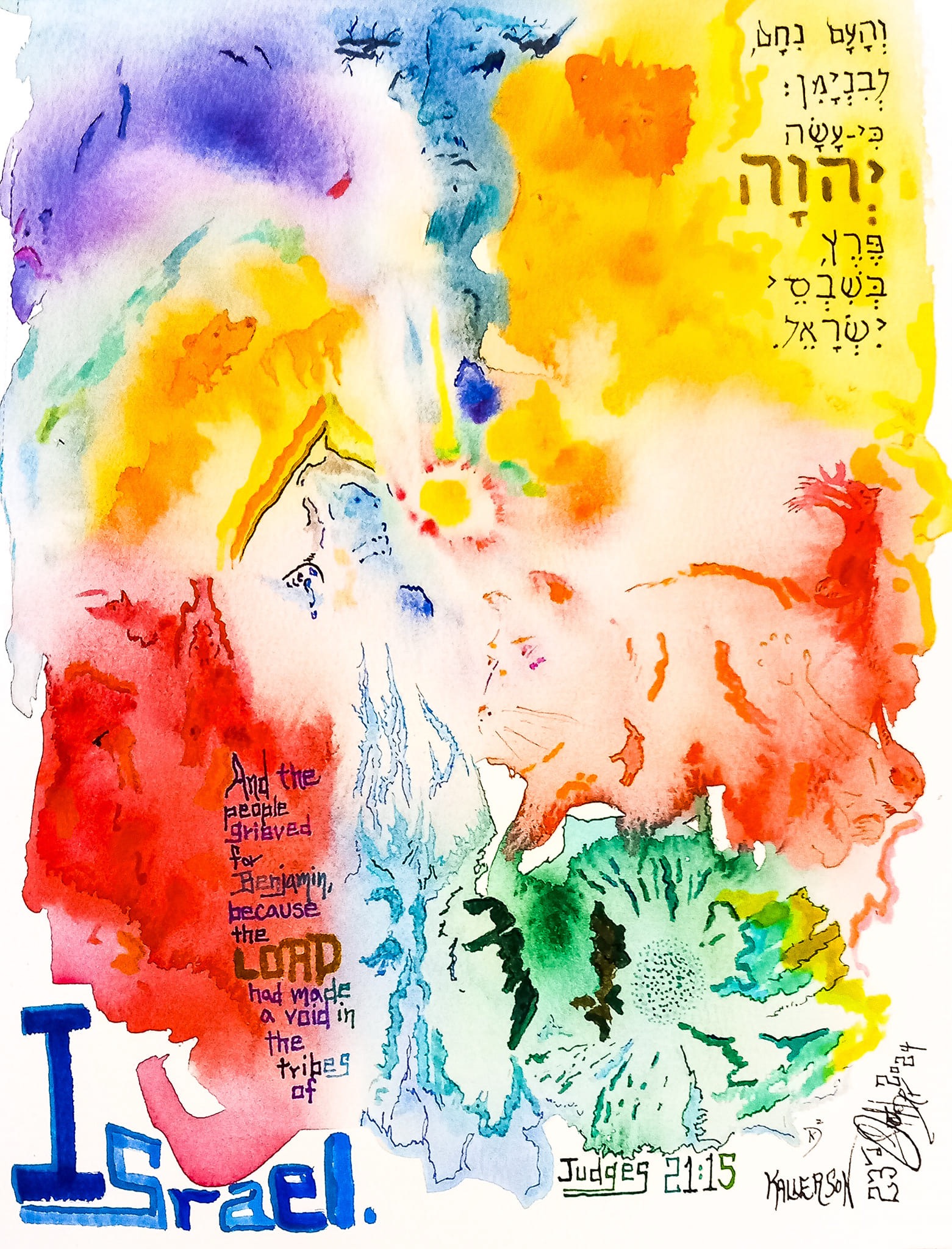
15 And the people grieved for Benjamin, because the Lord had made a void in the tribes of Israel.
Rather: v’haam nikham l’vinyamin ki asah Yehovah perets b’shivte Yisrael – “And the people sighed to Benjamin. For made, Yehovah, breach in tribes Israel.” One can see the people, once they realized that there were more men of Benjamin than available women they had gathered for them, looking in the eyes of the other two hundred, looking away, and sighing.
It is not so much a void in Israel, but a breach. It is as if a dam has cracked, and a certain amount of one of the tribes is being lost downstream. Even if the dam can be repaired, the lost water cannot be retrieved. This is the thought on the minds of the people.
16 Then the elders of the congregation said, “What shall we do for wives for those who remain, since the women of Benjamin have been destroyed?”
This is probably not a question at all, but an assertion: vayomru ziqne ha’edah mah naaseh lanotarim l’nashim ki nishm’dah mibinyamin ishah – “And say, elders the congregation, ‘What do to the remainings to wives, for destroyed from Benjamin women.’” There is a conundrum. It is apparent that they had promised wives to the men in their offer of peace. However, the supply did not meet the demand.
As such, they state where women can be obtained from and how it will be done. All the women of Benjamin were dead, and the virgins of Jabesh Gilead, the only group who did not show up as mandated, were insufficient. It appears impossible, but a solution is available…
17 And they said, “There must be an inheritance for the survivors of Benjamin, that a tribe may not be destroyed from Israel.
The words are difficult and widely debated: vayomru y’rushath p’leitah l’vinyamin v’lo yimakheh shevet miyisrael – “And say, ‘Possession deliverance to Benjamin. And not rubbed tribe from Israel.’” No matter how they are translated, they require insertions or an explanation to be understood.
The words could be as the NKJV indicates, an adamant assertion that there must be more women or the tribe will perish. But this would assume that they honestly believe the tribe could be lost over two hundred men lacking wives. That seems unlikely.
Ellicott and Keil tie the possession to the land itself, “i.e., the tribe-land of Benjamin shall remain an independent possession for the Benjaminites who have escaped the massacre, so that a tribe may not be destroyed out of Israel” (Keil). Thus, they needed to find wives for the men. But that has nothing to do with the context.
And more, the land was given by the Lord to Benjamin. The other tribes of Israel had no right to withhold it or grant it. Cambridge naturally says the text is corrupt, which is their default setting.
Rather than this being an adamant assertion that there must be more women or the tribe will perish, it seems more likely that this is an adamant assurance by the leaders that the tribe will not be rubbed out. “There will be women (a possession) for those of Benjamin who were delivered (a deliverance), and no tribe will be rubbed from Israel. Stop weeping!”
Lange agrees with this, and it makes the most sense based on simple logic, the progression of thought, and the minimally provided Hebrew. Understanding this, it next says…
18 However, we cannot give them wives from our daughters,
The conjunction is simply “and,” but “however” would rightly explain the thought based on the emphatic “we” that follows: v’anakhnu lo nukhal latheth lahem nashim mibnothnu – “And we, not able to give to them wives from our daughters.’”
The congregation has vowed that they will not give women to Benjamin. This was understood and cannot be violated. Anyone who gave a daughter to a Benjamite would face the consequences. This was said to confirm the oath and ensure the vow’s validity. The reason for it is again reiterated and expanded upon…
18 (con’t) for the children of Israel have sworn an oath, saying, ‘Cursed be the one who gives a wife to Benjamin.’”
ki nishbu v’ne Yisrael l’mor arur nothen ishah l’vinyamin – “For sworn, sons Israel, to say, ‘Cursed giving wife to Benjamin.” All in the congregation made an oath. The details were specific. Anyone giving a wife to Benjamin would be in violation of the oath, and a curse would be upon such a person. Despite this…
19 Then they said, “In fact, there is a yearly feast of the Lord in Shiloh,
The name of the location here and verse 21 is spelled without an “h” ending: vayomru hineh khag Yehovah b’shilo miyamim yamimah – “And say, “Behold! Feast Yehovah in Shilo from days, days-ward.” This confirms the thought that the previous words were an adamant assertion to alleviate the woes of those who were mourning. In other words, “Stop weeping! We have a plan, and here are the details. It is true that nobody can give away a daughter to Benjamin, but that is not necessary to repair this breach.”
The term “from days” is rightly paraphrased as “yearly.” There were three annual feasts. The next one was coming in the days ahead (days-ward), and a solution to the problem rested there. The ingenious cunning of the plan will be laid out with intricate detail…
*19 (fin) which is north of Bethel, on the east side of the highway that goes up from Bethel to Shechem, and south of Lebonah.”
asher mitsphonah l’beith el mizr’khah ha’shemesh limsilah ha’olah mibeith el sh’khmah u-minegev lilvonah – “which from north-ward to Bethel from ascension-ward, the sun, to highway – the ascending – from Bethel Shechem-ward, and from south to Lebonah.’” Of the words, Ellicott rightly says, “This elaborate description of the site of Shiloh, a place which is so often mentioned elsewhere without any addition, is extremely curious.”
Some scholars say the words are a gloss. Others say the elders were being very precise so that Benjamin would know exactly where Shiloh was, but that makes no sense at all. If this is where the annual pilgrim feasts were, everyone would know exactly where Shiloh was.
Instead, it appears that these words are an explanatory parenthesis by the author, not a description by the elders. The location of the Ark of the Covenant had changed by the time Samuel (if he is the chronicler) compiled the narrative. Therefore, he is describing, under inspiration, the layout of the land for the reader.
Tsaphonah means northward, coming from tsaphon, north. North is the hidden direction in the northern hemisphere, where the sun moves toward or away from it, depending on the time of year. Thus, the word signifies Concealed.
Mizrakhah signifies eastward, coming from zarakh, to rise or come forth.
Shechem means the neck between the shoulders. Thus, it literally means Shoulder or Back. But that comes from shakam, to start or rise early, so it gives the sense of (Having a Sense of) Responsibility, as in Personal Interest.
The south, negev, signifies Parched.
Lebonah is found only here in Scripture. It comes from the verb laven, to be white and to make bricks. Thus, it literally means White or Frankincense (which is white), but the word laven has consistently been used in Scripture to describe works, as in man’s works, because bricks turn white when they are fired, but bricks are the work of men’s hands.
That is the end of our review today. We covered a lot of verses and a great deal of information, but it is time to stop and finish both the chapter and the book of Judges next week. A key lesson that can be discovered in so many commentaries on verses like these is that the Bible is to be taken literally and in its proper context.
We are not to appropriate things from Scripture or apply them to ourselves if we do not know what the subject matter is dealing with.
Obviously, in typology, we may find useful applications in our lives. Despite this, in a clear reading of the Bible, we can easily see that the church has not replaced Israel, and those in the church are not “spiritual Israel” or the ten (supposedly) lost tribes of Israel.
And more, we need more than our subjective opinion that the text has been manipulated, added to, or is missing something. Unless there is objective evidence of this, we should never make such claims. Just because we don’t understand what is going on doesn’t mean the content is in question.
It may just mean we have no idea what is being conveyed for one of various reasons. Next week, we will go over the typology of the chapter. When we do, if the typology matches the narrative, then all of the commentaries that say the text is in question are wrong.
Rather, we should give the word the benefit of the doubt, trusting that it is reliable. Only with valid evidence that there is a question should we then search out that avenue. Let us hold fast to the word and cherish it as the most valuable treasure, because it is!
Closing Verse: “Bless God in the congregations,
The Lord, from the fountain of Israel.
27 There is little Benjamin, their leader,
The princes of Judah and their company,
The princes of Zebulun and the princes of Naphtali.” Psalm 68:26, 27
Next Week: Judges 21:20-25 What a great story it has been to tell, like a slice of heaven… (No King in Israel, Part XI) (58th and Final Judges Sermon)
The Lord has you exactly where He wants you. He has a good plan and purpose for you. It is He who judges His people according to their deeds. So, follow Him, live for Him, and trust Him, and He will do marvelous things for you and through you.
No King in Israel, Part X
Now the men of Israel
Had sworn an oath at Mizpah, saying during this time of strife
“None of us shall give his daughter
To Benjamin as a wife
Then the people came to the house of God
And remained before God till evening there
They lifted up their voices and wept bitterly
And said, “O LORD God of Israel” in their prayer
Why has this in Israel come to pass? Do tell
That today there should be one tribe missing in Israel?
So it was, on the next morning
That the people rose early to make their profferings
And built an altar there
And offered burnt offerings and peace offerings
The children of Israel said
“Who is there among all the tribes of Israel, speak the word
Who did not come up
With the assembly to the LORD?
For they had made a great oath concerning anyone
Who had not come up, speaking their shibboleth
To the LORD at Mizpah, saying
“He shall surely be put to death
And the children of Israel
Grieved for Benjamin their brother
And said, “One tribe is cut off from Israel today
As a son taken from his mother
What shall we do for wives
For those who remain, who kept their lives
Seeing we have sworn by the LORD
That we will not give them our daughters as wives?
And they said, “What one is there
From the tribes of Israel
Who did not come up to Mizpah to the LORD?
Speak up! Do tell!
And, in fact, no one had come (and they should be trembly!)
To the camp from Jabesh Gilead to the assembly
For when the people were counted during this affair
Indeed, not one of the inhabitants of Jabesh Gilead was there
So the congregation sent out there twelve thousand
Of their most valiant men, and commanded them, saying
“Go and strike the inhabitants of Jabesh Gilead
With the edge of the sword, including the women and children
———-so they were relaying
And this is the thing that you shall do:
You shall utterly destroy every male
And every woman who has known a man intimately
Yes, every such female
So they found among the inhabitants of Jabesh Gilead
Four hundred young virgins who had not known a man intimately
And they brought them to the camp at Shiloh
Which is in the land of Canaan, north of the Salt Sea
Then the whole congregation sent word
To the children of Benjamin
Who were at the rock of Rimmon
And announced peace to them
So Benjamin came back at that time
And they gave them the women whom they had saved alive
Of the women of Jabesh Gilead
And yet they had not found enough for them
———- (Still missing 40 x 5)
And the people grieved for Benjamin for a spell
Because the LORD had made a void in the tribes of Israel
Then the elders of the congregation said
“What shall we do for wives to be deployed
For those who remain
Since the women of Benjamin have been destroyed?
And they said
“There must be an inheritance, so we tell
For the survivors of Benjamin
That a tribe may not be destroyed from Israel
However, we cannot give them wives from our daughters
For the children of Israel (to their chagrin)
Have sworn an oath, saying
‘Cursed be the one who gives a wife to Benjamin
Then they said, “In fact, there is a yearly feast of the LORD
In Shiloh, which is north of Bethel, oorah!
On the east side of the highway that goes up
From Bethel to Shechem, and south of Lebonah
Lord God, turn our hearts to be obedient to Your word
Give us wisdom to be ever faithful to You
May we carefully heed each thing we have heard
Yes, Lord God may our hearts be faithful and true
And we shall be content and satisfied in You alone
We will follow You as we sing our songs of praise
Hallelujah to You; to us Your path You have shown
Hallelujah we shall sing to You for all of our days
Hallelujah and Amen…
Now the men of Israel had sworn an oath at Mizpah, saying, “None of us shall give his daughter to Benjamin as a wife.” 2 Then the people came to the house of God, and remained there before God till evening. They lifted up their voices and wept bitterly, 3 and said, “O Lord God of Israel, why has this come to pass in Israel, that today there should be one tribe missing in Israel?”
4 So it was, on the next morning, that the people rose early and built an altar there, and offered burnt offerings and peace offerings. 5 The children of Israel said, “Who is there among all the tribes of Israel who did not come up with the assembly to the Lord?” For they had made a great oath concerning anyone who had not come up to the Lord at Mizpah, saying, “He shall surely be put to death.” 6 And the children of Israel grieved for Benjamin their brother, and said, “One tribe is cut off from Israel today. 7 What shall we do for wives for those who remain, seeing we have sworn by the Lord that we will not give them our daughters as wives?”
8 And they said, “What one is there from the tribes of Israel who did not come up to Mizpah to the Lord?” And, in fact, no one had come to the camp from Jabesh Gilead to the assembly. 9 For when the people were counted, indeed, not one of the inhabitants of Jabesh Gilead was there. 10 So the congregation sent out there twelve thousand of their most valiant men, and commanded them, saying, “Go and strike the inhabitants of Jabesh Gilead with the edge of the sword, including the women and children. 11 And this is the thing that you shall do: You shall utterly destroy every male, and every woman who has known a man intimately.” 12 So they found among the inhabitants of Jabesh Gilead four hundred young virgins who had not known a man intimately; and they brought them to the camp at Shiloh, which is in the land of Canaan.
13 Then the whole congregation sent word to the children of Benjamin who were at the rock of Rimmon, and announced peace to them. 14 So Benjamin came back at that time, and they gave them the women whom they had saved alive of the women of Jabesh Gilead; and yet they had not found enough for them.
15 And the people grieved for Benjamin, because the Lord had made a void in the tribes of Israel.
16 Then the elders of the congregation said, “What shall we do for wives for those who remain, since the women of Benjamin have been destroyed?” 17 And they said, “There must be an inheritance for the survivors of Benjamin, that a tribe may not be destroyed from Israel. 18 However, we cannot give them wives from our daughters, for the children of Israel have sworn an oath, saying, ‘Cursed be the one who gives a wife to Benjamin.’ ” 19 Then they said, “In fact, there is a yearly feast of the Lord in Shiloh, which is north of Bethel, on the east side of the highway that goes up from Bethel to Shechem, and south of Lebonah.”