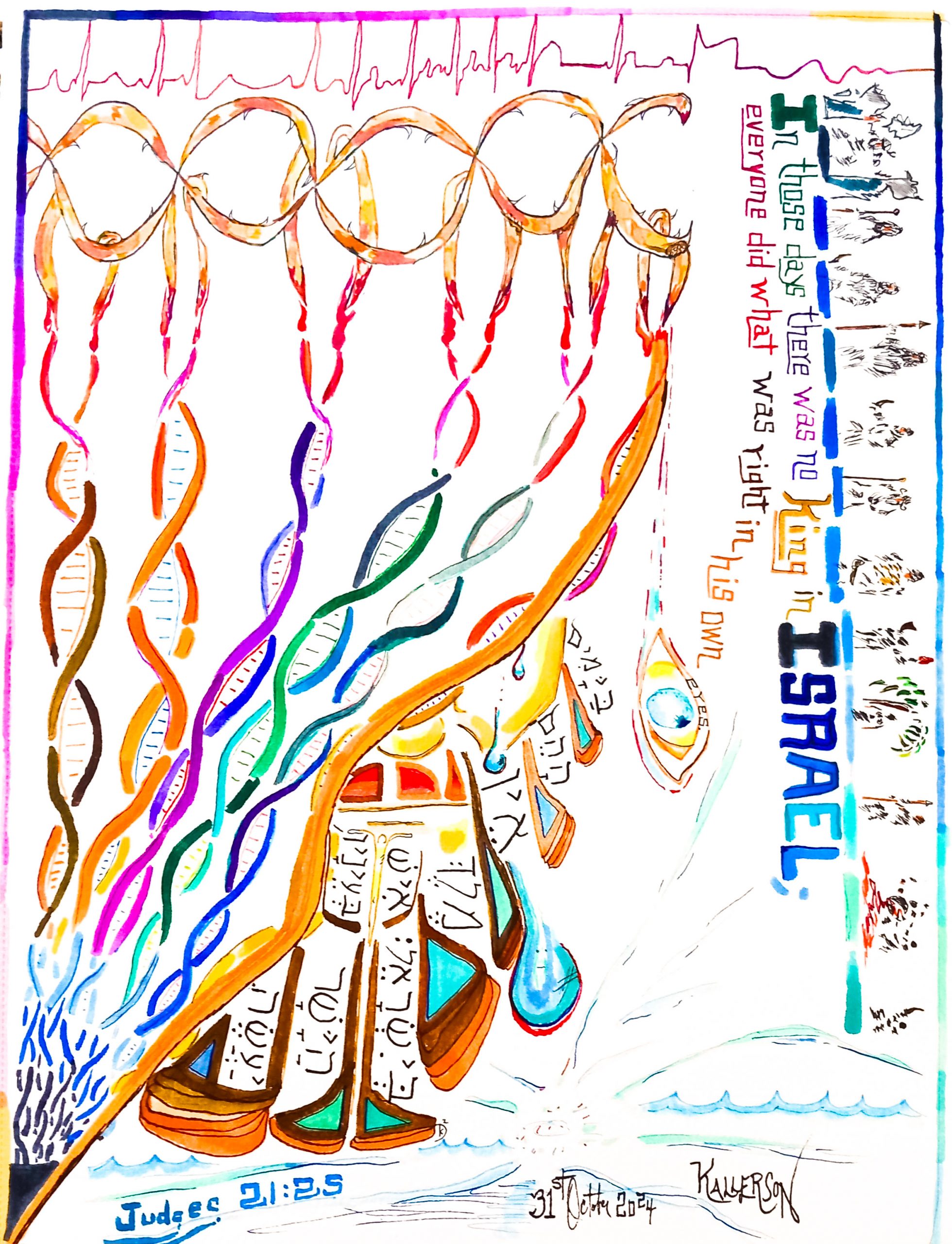
Artwork by Douglas Kallerson.
Judges 21:20-25
No King in Israel, Part XI
(Typed 5 August 2024) While typing the Judges sermons, Sergio was also going through Judges and Ruth. One morning, he messaged me with the Mr. Exploding Head emoji and some great insights he pulled out of his personal study –
Judges ends with:
– Mourning for Benjamin, no wives/descendants
– Plan for survival: marry daughters of Shilo
– Last verse: “There was no king in Israel”
Book of Ruth:
– Naomi mourns loss of husbands/descendants
– Plan for survival with Boaz; Ruth births Obed
– Last verse: “and to Obed was born Jesse, and to Jesse, David.” — KING DAVID!
It is a marvelous pattern that exists between the two, and it was a nice catch that I have not seen elsewhere presented. It provides another of several reasons why Ruth, despite occurring during the time of the Judges, is maintained as its own book, separate from and placed after Judges.
God is slowly and methodically presenting us with the developing theme of redemption in Israel as it applies beyond their borders, even encompassing the entire world. In the book of Judges, it says that there was no king in Israel but everyone did what was right in his own eyes.
It would not make sense to put Ruth within the pages of Judges for that reason. In Israel, during the time of the judges, there was no king. In Israel after Christ departed, there has been no king. But a king was anticipated in Judges, and a King is anticipated in Israel’s future.
Everything is going forward, but we can look back in order to see what lies ahead. It is amazing what God has done for us in the pages of Scripture.
Text Verse: “O Israel, you have sinned from the days of Gibeah;
There they stood.
The battle in Gibeah against the children of iniquity
Did not overtake them.” Hosea 10:9
Hurricane Debby arrived while I was typing this sermon on August 5. Despite not being a big hurricane, Sarasota received an inordinate amount of rain. Our backyard was flooded from the high tides and our garage was flooded from the precipitation.
And more, it rained and stormed so much from midnight on that I got almost no sleep at all. In the morning, sermon typing began. When I finished typing, the rains had stopped and the garage was still full of water. Some things are just more important than others.
Today, we will close out the book of Judges. I personally would not have imagined the amount of intricate detail contained in the book when we started. The dispensational model of history is on full display, the rapture is alluded to a few times, and the consummation of all things is clearly seen in several of the stories. God has taken real events and real people’s lives from thousands of years ago and revealed to us truths using human history.
Some of those pictures are future to us now, including those found in the final chapter of Judges. The subject matter is Israel, but the idea of Israel makes no sense without her Messiah, their King. Yes, there is currently no king in Israel, even if Israel has a King. That is destined to change some wonderful day.
What an astonishing and marvelous thing God has presented to us through these types and pictures! Such great things are to be found in His superior word. And so, let us turn to that precious word once again, and… May God speak to us through His word today, and may His glorious name ever be praised.
I. From the Whirlings (verses 20-25)
20 Therefore they instructed the children of Benjamin,
The written Hebrew does not correspond to the oral reading: vaysav eth b’ne vinyamin – “And commands [sg.], sons Benjamin.” The written has the word “command” as spoken by one, “he commands.” The oral has it as spoken by all, “they command.” There is usually no reason to deviate from the written unless there is confusion on the part of the Jewish scribes.
The surrounding verses are all in the plural, so they make this plural as well. However, verse 20:28 noted that Phinehas was at Bethel. He, as the high priest, could very well be the final word on the matter. It said in verse 21:2 that the people came up to Bethel. The next verses indicated the people petitioned the Lord.
As such, there was the implicit understanding that this was all being done with the guidance of the Lord. Thus, it was likely that either the Lord directly, or Phinehas on behalf of the Lord, gave this command.
20 (con’t) saying, “Go, lie in wait in the vineyards,
l’mor l’khu v’aravtem bak’ramiym – “to say, ‘Walk and lurk in the vineyards.’” The command was for these two hundred Benjamites to go to the area of Shiloh where the annual feast was and hide themselves in the vineyards. Whether this was a feast of Israel or a local feast only, these times of celebrations were when the vineyards were in full leaf. Thus, it would make it easy to hide without being noticed.
In Scripture, vineyards represent the cultural side of humanity. There are various vineyards that represent various cultures.
21 and watch; and just when the daughters of Shiloh come out to perform their dances,
There is a gender discord in the words. Also, as in verse 19, the name of the location is spelled without an “h” ending: urithem v’hineh im yetsu b’noth shilo lakhul bamkholoth – “And seen, and behold, if come [masc. pl.] daughters Shilo to whirl in the dances.” The word translated as “come” is masculine even though it refers to the dancing daughters.
The men hiding in the vineyards were to watch for women who whirled while dancing. The women were called the daughters of Shilo. This could mean they were only young women from that location, or if this was a pilgrim feast for the nation, it could extend to women from all over Israel who were staying there during the feast.
21 (con’t) then come out from the vineyards, and every man catch a wife for himself from the daughters of Shiloh; then go to the land of Benjamin.
Each of the verbs in this clause are in the perfect aspect: vitsathem min hakramim vakhataphtem lakhem ish ishto mibnoth shilo vahalakhtem erets Binyamin – “and came from the vineyards, and seized to them man, his wife, from daughters Shilo. And walked land Benjamin.” The women were out dancing without male supervision, totally unsuspecting that there were so many men lying in wait.
Because of this, it could not be thought that the men of Israel gave their daughters to the men of Benjamin. Thus, they would be released from any penalty of the oath. The general scholarly opinion is that this is deceitful and inappropriate.
However, if it was the Lord or Phineas who authorized this plan in the previous verse, that argument does not hold up. It is probably the reason why the singular was written in the first place. The verbs being in the perfect aspect make this a done deal.
Also, there is a new word to Scripture here, only found elsewhere in Psalm 10:9, khataph. It signifies to clutch, thus, to seize as a prisoner. The men were instructed to grab a girl and not let go. From there, they were to escape with her to the land of Benjamin…
22 Then it shall be, when their fathers or their brothers come to us to complain,
Again, there are gender discords in the words: vahayah ki yavou avotham o akhehem larov elenu – “And is when come their [masc. pl.] fathers, or their [masc. pl.] brothers, to contend unto us.” Nothing is noted about the complaints of the mothers. It would be natural that the men or brothers would complain as well as the mothers. The women had been taken away by the men of Benjamin. But that appears to be the only reason why they might complain, as is seen in the next words…
22 (con’t) that we will say to them, ‘Be kind to them for our sakes, because we did not take a wife for any of them in the war; for it is not as though you have given the women to them at this time, making yourselves guilty of your oath.’”
The words are very obscure and highly debated. Various manuscripts have modified them in an attempt to make sense. Also, depending on the reference, there appears to be another gender discord: v’amarnu alehem khanunu otham ki lo laqakhnu ish ishto bamilkhamah ki lo atem nathatem lahem kaeth tesamu – “and we said unto them, ‘Favor us, them [masc. pl.], for not we took man his wife in the war, for not you gave to them, according to the time trespassed.’”
The normal reading would be that the word “them” refers to the women, but it is again in the masculine, “Do us a favor concerning them.”
It could be referring to the men of Benjamin, but even then, the words remain complicated. Regardless, the complaint referred to is not that the daughters have been stolen away, and they miss them in the usual sense. The complaint is because the women have been given to Benjamin contrary to the oath, making the community guilty.
But this plan is not a violation of the vow for anyone whose daughter was seized. As such, there is no culpability on the part of the fathers or brothers. And yet, there has been a resolution to the dilemma of the wifeless men.
The words “according to the time trespassed” seem to mean that, at this time, there is no trespass on the part of these men of Israel. Having said that, the structure of the words is extremely unusual. So much so that Clarke leaves it up to the reader to decide what he prefers –
“It is an obscure sentence; and the reader, if not pleased with what is laid down, may endeavor to satisfy himself with others which he may find in different versions and commentators.” Adam Clarke
His words bear a sentiment I cannot agree with. We must work to determine meaning, not pick and choose.
23 And the children of Benjamin did so; they took enough wives for their number from those who danced, whom they caught.
vayaasu khen b’ne vinyamin vayisu nashim l’misparam min hamkhol’loth asher gazalu – “And do thus, sons Benjamin. And lift women, to their number, from the whirlings whom they plucked.” The words are somewhat poetically forceful. The women were lifted. This gives the sense of them being in a group where each man of Benjamin sees the one he likes and lifts her out as his own.
There would have been two hundred snatched away according to the number of those in Benjamin still needing wives. They were taken “from the whirlings,” meaning those who came out to dance. And they were, gazal, plucked, a word often used to indicate being kidnapped, robbed, or seized away.
23 (con’t) Then they went and returned to their inheritance, and they rebuilt the cities and dwelt in them.
vayelkhu vayashuvu el nakhalatam vayivnu eth hearim vayeshvu bahem – “And walk, and return unto their inheritance. And build the cities, and dwell in them.” It is a later description of what occurred, showing that this was compiled and recorded later, probably by Samuel. Benjamin retained his inheritance. As they grew in number, they would have expanded and continued to rebuild in the land given to them by the Lord.
24 So the children of Israel departed from there at that time, every man to his tribe and family; they went out from there, every man to his inheritance.
vayith’halkhu misham b’ne Yisrael baeth ha’hi ish l’shivto ul’mishpakhto vayesu misham ish l’nakhalatho – “And walk, from there, sons Israel in the time, the it. Man to his tribe and to his family. And go from there, man to his inheritance.” The words end the formal narrative. Benjamin was spared and rescued. The matter of wives for them was settled, so the people of Israel departed and headed home.
The repetition provides its own emphasis concerning the situation:
*And walk (dispersing), from there (Shiloh), sons Israel (all men of all tribes) in the time, the it. Man to his tribe (Judah, for example) and to his family (within the tribe).
*And go from there, man to his inheritance (the land granted by the Lord and which was then divided accordingly).
Saying that each man went to his inheritance is a way of indicating that the tribal inheritances remained intact. Despite almost losing one tribe, the nation remained according to the set design of the Lord. And this occurred, despite the fact that…
25 In those days there was no king in Israel;
The words are letter-for-letter identical to Judges 17:6: bayamim ha’hem ein melekh b’Yisrael – “In the days, the those, naught king in Israel.” Until there was a king, there was no king. To write that this was in the days when there was no king acknowledges that there was a king when the narrative is being presented.
The words imply that a king would rectify the situation. And this is just what the author (compiler or whatever) next presents…
*25 (fin) everyone did what was right in his own eyes.
ish ha’yashar b’enav yaaseh – “Man the straight in his eyes does.” As there was no king in Israel, everyone saw his own path as the straight one, and then took it. Thus ends Chapter 21 and the book of Judges.
Be strong and of good courage; I am with you
Fear not and be not dismayed
Others may depart, but I am faithful and true
It is I who have all your debts paid
I will bring you into the inheritance
And there I will place you forever
Of Me failing, there is not a chance
Nothing can the bond between us sever
Be strong and of good courage, trust in Me
Fear not and be not dismayed; I am with you
The word I have spoken, so shall it be
I am the Lord your God, faithful and true
II. Pictures of Christ
Verse 1 noted that Israel (He Strives With God) had sworn an oath at Mizpah (Watchtower) that no one would give his daughter to Benjamin as a wife. In Chapter 20, Benjamin pictured those with a messianic hope, even if it was wrongly directed. Mizpah signifies the Lord is watching over the process of what transpires.
To not give a daughter signifies to cut off such a person because there is no one to continue his name. No wife means no continuance. But with the war over, the people have realized that there are those who are of Israel but who have no chance of continuation. Therefore the nation made a great ululation before the God, meaning the true God.
In Verse 3, one tribe in Israel was visited, meaning it was judged. It tells us that messianic law observers will receive their judgment in the tribulation period. Most will be cut off. Israel had come against their false doctrine in Chapter 20, leaving only six hundred.
Six is the number of man, especially fallen man. Ten implies that nothing is wanting and the whole cycle is complete. In order to restore this tribe in Israel, two separate plans are devised. The first plan begins in verse 5, where it is asked who among the tribes did not come up to the battle against Benjamin. Anyone who didn’t had essentially aligned himself with Benjamin. Such were to be cut off.
Israel grieved for Benjamin because they had no future (verse 6). They had their inheritance, but without wives, there could be no continuance. Verse 7 also noted that they were a mere remnant from Benjamin.
To correct this, it was noted that no one had come up to Mizpah to the Lord from Jabesh Gilead. The meaning is Dry Perpetual Fountain. It was seen in Judges 11 that Gilead, without the article, speaks of Israel, the fountain.
To grasp the meaning, one must think of Israel as the means of providing the Fountain, regardless of whether individuals are included in its transmission or not (Ephesians 2:12). The Spirit is the Mode by which one is included.
Right now, Gentiles are brought into the commonwealth of Israel along with Jews. However, not all Jews nor all Gentiles receive it. Israel is Perpetual Fountain, not The Perpetual Fountain (meaning the Holy Spirit). The use or lack of use of the article tells us this.
Understanding this, Dry Perpetual Fountain would reflect those who have no means of providing the Fountain. There is no possible connection to the Spirit, and that individual is foreign to Israel. These are those who have rejected the Lord in the tribulation and took the mark of the beast. They are to be eliminated.
As such, verse 10 says that twelve thousand valiant men were sent to wipe them out. It is the number of perfection of government or governmental perfection. Ten implies that nothing is wanting, and the whole cycle is complete. It tells us that the millennial government is set and ready to be put in place. The thought is reflected in Matthew 25 –
“When the Son of Man comes in His glory, and all the holy angels with Him, then He will sit on the throne of His glory. 32 All the nations will be gathered before Him, and He will separate them one from another, as a shepherd divides his sheep from the goats.” Matthew 25:31, 32
Those who are to be killed will be slain with the mouth of the kherev, sword. That has consistently pictured the law given at Horeb. In this case, it is emblematic of Jesus, who fulfilled the law and whom they had rejected –
“And the rest were killed with the sword which proceeded from the mouth of Him who sat on the horse. And all the birds were filled with their flesh.” Revelation 19:21
Four hundred virgins are spared (40×10). It is derived in two ways, both of which match the tribulation and the beginning of the millennium –
“It is the product of 5 and 8, and points to the action of grace (5), leading to and ending in revival and renewal (8). This is certainly the case where forty relates to a period of evident probation. But where it relates to enlarged dominion, or to renewed or extended rule, then it does so in virtue of its factors 4 and 10, and in harmony with their signification.”
These virgins (implying purity) were brought to Shiloh (Tranquility) in the land of Canaan (Humbled). It signifies they have entered God’s rest, having been humbled before Him through the work of Christ.
With them at Shiloh, in verse 13, terms of peace were announced to Benjamin at the Rock of Rimmon. The Son of the Right Hand is accepted because of Christ and their new understanding of Him as the true Messiah. This is seen in the name Sela Rimmon – Lofty of the Mature Mind.
Verse 14 said these men came back and were given the women from Jabesh Gilead. That is explained in the words of Ezekiel 47 –
“‘Thus you shall divide this land among yourselves according to the tribes of Israel. 22 It shall be that you will divide it by lot as an inheritance for yourselves, and for the strangers who dwell among you and who bear children among you. They shall be to you as native-born among the children of Israel; they shall have an inheritance with you among the tribes of Israel. 23 And it shall be that in whatever tribe the stranger dwells, there you shall give him his inheritance,’ says the Lord God.” Ezekiel 47:21-23
Those of the Dry Fountain are brought into a permanent and right relationship with Israel with full rights in the land. Despite this there is a lack of two hundred women, the number of Insufficiency. The number is never stated, but it is implied. As such, the insufficiency applies to these men of Israel.
Despite the insufficiency, a plan was formed, which was in the form of an adamant assertion that there would be no lack in Israel, even if daughters could not be given to these men. They could not do so based on the oath noted in verse 18 that any who gave their daughter to Benjamin would be cursed.
As such, verse 19 noted the coming feast in Shilo. In that verse and twice more in 21, the location is given without the hay (h) ending. Like Geba in Chapter 20, the change in spelling has meaning.
Hay is the fifth letter of the Aleph Beth, the number of grace. It also is used when referring to a connection to the Spirit. Its meaning is Look, Reveal, and Breath. Each is something connected with the Spirit. As such, it is a confirming note that there will be people born in the millennium who do not originally have the Spirit. In any age, one receives the Spirit through faith. There are several verses in the Old Testament that confirm this.
After noting Shilo, the narrator then took the unusual step of explaining its location. Everything about the name Shilo, like its name having no hay (h), demonstrates a lack of connection to God, “which from north-ward to Bethel from ascension-ward, the sun, to highway – the ascending – from Bethel Shechem-ward, and from south to Lebonah.”
Northward, tsaphonah signifies Concealed, thus “Concealed to the House of God.”
Ascension-ward [mizrakhah, from zarakh, to arise] the sun [shemesh] signifies the time prior to Jesus’ coming, thus the time of the law –
“But to you who fear My name
The Sun [shemesh] of Righteousness shall arise [zarakh]
With healing in His wings.” Malachi 4:2
Shechem means the neck between the shoulders. Thus, it literally means Shoulder or Back. But that comes from shakam, to start or rise early, and so it gives the sense of (Having a Sense of) Responsibility, as in Personal Interest. As seen elsewhere, it speaks of the personal interest and responsibility of those under the law.
The south, negev, signifies Parched. It speaks of the time before the giving of the Spirit.
Lebonah means White or Frankincense (which is white), but the word laven has consistently been used in Scripture to describe works, as in man’s works, because bricks turn white when they are fired, but bricks are the work of men’s hands.
The entire verse speaks of being separate from the grace that is finally revealed to Israel at the end of the tribulation period.
The words “Walk and lurk in the vineyards” speak of cultures. As has been seen many times before in Scripture, vineyards represent the cultural side of humanity. There are various vineyards that represent various cultures. As the Jewish culture of today is a group of many cultures gathered together, the words could not be more appropriate.
In verse 21, the gender discord was noted. Such a gender discord, however, was first seen in verse 12. Speaking of the four hundred virgins, it said –
“And bring them [masc. pl.] unto the camp, Shiloh, which in land Canaan.”
Next, in verse 21, it said –
“And seen, and behold, if come [masc. pl.] daughters Shilo to whirl in the dances.”
When the women are seen, verse 21 said that every man was to seize a wife for himself from the vineyards and go to the land of Benjamin. The verbs were in the perfect aspect. It is a done deal when that takes place.
In verse 22, the highly complicated words contained another gender discord. In the Hebrew, the words are obscure and so there are many texts that have diverted from them –
‘Favor us, them [masc. pl.], for not we took man his wife in the war, for not you gave to them, according to the time trespassed.’”
If looked at from the perspective of the end times, they become clear. The daughters were not taken by these men during the time when they were warring against the Lord through false belief. Nor were they given by those who did believe. “According to the time trespassed” describes the state of the men before Christ appeared and cleared up their faulty doctrine.
The gender discords are speaking of people groups. In the Bible, people groups are always referred to in the masculine, such as goyim, Gentiles, or anashim, peoples. It explains why those gender discords are listed. They are referring to those bodies or groups whom they represent.
In the first four hundred women of verse 12, the men were given the daughters of Jabesh Gilead, Dry Fountain, and thus Gentiles, as noted in Ezekiel 47 cited earlier. In the two hundred additional women, they are obtaining daughters from those born in the millennium from the regathered peoples of Israel.
One can see the true believers in Israel saying, “We vow to not intermarry with anyone who is not a believer in the Lord Jesus. Those who followed false messiahs would be excluded from this covenant. But here, we are presented with ways in which those who make it through the millennium will be able to continue even if such vows were made.
Verse 23 noted that the two hundred Benjamites went, returned to their inheritance, rebuilt the cities, and dwelt in them. It is an appropriate statement in general for after the tribulation. There will be an inheritance for those who survive the ordeal, and they will rebuild and dwell in their cities.
Verse 24 likewise said that all of the children of Israel returned to their inheritances. The two descriptors said –
And walk (dispersing), from there (Shiloh), sons Israel (all men of all tribes) in the time, the it. Man to his tribe (Judah, for example) and to his family (within the tribe).
And go from there, man to his inheritance (the land granted by the Lord, which was then divided accordingly).
This provides the reason for the reexplanation of the tribal inheritances detailed in Ezekiel 48, which refers to the millennial dispensation.
Finally, verse 25 ended with the same thought that ended Judges 17:6, “In the days, the those, naught king in Israel. Man the straight in his eyes does.”
These two verses are bookends that anticipate the time when Israel would reject Jesus as their King even until the end of the tribulation period. That is clearly depicted in their own proclamation to Pilate on the day Christ was crucified –
“When Pilate therefore heard that saying, he brought Jesus out and sat down in the judgment seat in a place that is called The Pavement, but in Hebrew, Gabbatha. 14 Now it was the Preparation Day of the Passover, and about the sixth hour. And he said to the Jews, ‘Behold your King!’
15 But they cried out, “Away with Him, away with Him! Crucify Him!’
Pilate said to them, ‘Shall I crucify your King?’
The chief priests answered, ‘We have no king but Caesar!’
16 Then he delivered Him to them to be crucified. Then they took Jesus and led Him away.” John 19:13-16
During all this time, Israel has done whatever it wanted. They rejected Moses from the beginning, paying mere lip service to the word of the Lord given through him. Then they rejected the One that Moses clearly wrote about, both explicitly and implicitly.
Further, the Law of Moses continues on in the writings that follow his time of service. In Judges alone, there have been an incredible number of pictures of Jesus, His work, the redemptive plan He laid out, etc.
It would be presumptuous to assume that all of the pictures I have presented in Judges have been interpreted correctly, but it is clear from the overall context of the Bible what is being presented, that the details – even if some were wrongly interpreted – are swallowed up in the surety of the overall pictures.
Among the pictures have been wonderful insights into core doctrines of Scripture, such as the deity of Christ, salvation by grace alone, seeking justification through works of the law only separate us further from God, dispensationalism, and so forth.
Along with those, many other useful doctrines have been presented to clear up the muddy waters of bad theology. There were several references to the rapture that solidified the surety of that teaching. Further, the timing of the rapture, being pre-tribulation, is clarified.
The fact that Israel of the past is the same group of people we see in the world today is also confirmed, demonstrating to us that the church has not replaced it, but is an extension of it. Gentiles are grafted into the commonwealth of Israel, but they remain Gentiles just as Jews remain Jews.
These and so many other points of doctrine have been carefully detailed in these ancient, difficult, and picturesque stories that have excited the minds of believers for thousands of years. In the order of biblical books, Ruth comes next. That has already been analyzed, and so soon we will begin 1 Samuel.
First, though, we will take a short diversion and head to a new book (or two) for a few weeks to see what is detailed elsewhere. No matter where we are in the Bible, however, we are sure to come across interesting secrets, find hidden treasures, and above all, see the Person of Jesus Christ being presented to us in a vast array of ways.
Everything about this word is centered on Him and what He has done and continues to do for His people. Let us never fail to pick up the Bible daily and search out its marvelous contents, looking for Him as we do.
I look for you, my Precious Lord
But then again, I lose my sight.
And even though I might get lost
I know you never leave my side.
I look for you in my every-days,
In so many moments, so many times.
I know that You are always there,
Yet, I can’t see You with my eyes.
To hear You, Lord it’s not an easy task.
My ears might never hear your voice.
But I know, Lord, that You are here,
Right inside my very soul.
I look for You in Your Word.
I look for You in my heart,
And I know Jesus through the cross,
Through transformation of my life.
So help me, Lord, to comprehend;
that to see You, Lord
is to know your grace.
That to hear You, Lord
is to know Your Word,
and through the faith
Is to be Yours.
So help me Jesus
to hear your voice,
not with my ears
but with my soul.
Help me to see
not with my eyes
but with your Spirit
inside my heart.
Izabela Bednara
Closing Verse: “Then say to them, ‘Thus says the Lord God: Surely I will take the children of Israel from among the nations, wherever they have gone, and will gather them from every side and bring them into their own land; 22 and I will make them one nation in the land, on the mountains of Israel; and one king shall be king over them all; they shall no longer be two nations, nor shall they ever be divided into two kingdoms again.” Ezekiel 37:21, 22
Next Week: Malachi 1:1-3 What a picture the Lord did draw… (Jacob and Esau) (1st Malachi Sermon)
The Lord has you exactly where He wants you. He has a good plan and purpose for you. It is He who judges His people according to their deeds. So, follow Him, live for Him, and trust Him, and He will do marvelous things for you and through you.
No King in Israel, Part XI
Therefore they instructed the children of Benjamin, saying
“Go, lie in wait in the vineyards for your chances
And watch; and just when the daughters of Shiloh
Come out to perform their dances
Then come out from the vineyards
And every man catch a wife for himself (we know you’re all-in)
From the daughters of Shiloh
Then go to the land of Benjamin
Then it shall be, when their fathers or their brothers
Come to us to complain, that we will say to them, for shor
‘Be kind to them for our sakes
Because we did not take a wife for any of them in the war
For it is not as though you have given
The women to them at this time
Making yourselves guilty of your oath
Thus, things will be fine
And the children of Benjamin did so
They took enough wives for their number
From those who danced, whom they caught
They acted and did not slumber
Then they went and returned to their inheritance
And they rebuilt the cities and dwelt in them
———-living out their second chance
So the children of Israel departed from there at that time
Every man to his tribe and family
They went out from there
Every man to his inheritance and his own territory
In those days there was no king in Israel
Everyone did what was right in his own eyes
———-so the word does tell
Lord God, turn our hearts to be obedient to Your word
Give us wisdom to be ever faithful to You
May we carefully heed each thing we have heard
Yes, Lord God may our hearts be faithful and true
And Lord God, thank you for this wonderful book
Judges! What a marvel to have studied it
Into every detail possible we took a look
And to You our thanks and praise we now submit!
Hallelujah to Christ our Lord!
Hallelujah for Judges, a marvelous part of Your superior word!
Hallelujah and Amen!
Indeed, Hallelujah and Amen…
20 Therefore they instructed the children of Benjamin, saying, “Go, lie in wait in the vineyards, 21 and watch; and just when the daughters of Shiloh come out to perform their dances, then come out from the vineyards, and every man catch a wife for himself from the daughters of Shiloh; then go to the land of Benjamin. 22 Then it shall be, when their fathers or their brothers come to us to complain, that we will say to them, ‘Be kind to them for our sakes, because we did not take a wife for any of them in the war; for it is not as though you have given the women to them at this time, making yourselves guilty of your oath.’ ”
23 And the children of Benjamin did so; they took enough wives for their number from those who danced, whom they caught. Then they went and returned to their inheritance, and they rebuilt the cities and dwelt in them. 24 So the children of Israel departed from there at that time, every man to his tribe and family; they went out from there, every man to his inheritance.
25 In those days there was no king in Israel; everyone did what was right in his own eyes.