Judges 9:22-45
Abimelech, King of Shechem, Part III
(Typed 22 January 2024) In our verses today, Charles Ellicott comments on the change of verbiage in verse 22 from earlier verses, saying, “Had reigned.—The verb is here sûr, not malak, as in Judges 9:6; but whether the change of word is meant to be significant we cannot say.”
The change in the verb is significant and meaningful. I was surprised to read that Ellicott seems unsure because he often argues over the morphology of individual words, noting the significance of various changes in them.
Because God is the author of Scripture, every single detail of it has meaning. This includes things we might not normally look at, such as how many times things are mentioned, variant spellings, and so forth. There is always some hidden treat that we can discover if we look closely enough and contemplate what is being presented.
There is also a point where we must move on and continue our journey through Scripture. As for the various words that are used and if they are relevant, Solomon gives us a thought to consider –
Text Verse: “Every word of God is pure;
He is a shield to those who put their trust in Him.
6 Do not add to His words,
Lest He rebuke you, and you be found a liar.” Proverbs 30:5, 6
The word translated as pure is tsaraph. It means to smelt, refine, and test. The Lord, in His infinite wisdom, has given us a word that indicates His word is as if it has gone through the refiner’s fire and is thus pure.
It is exquisitely placed before us as the most precious jewel, completely unblemished and perfectly sculpted for us to contemplate. The finest gems are inlaid in the most precious metals that have been refined to absolute purity.
Consider this as you read the word. What you are reading is communication from the absolutely perfect Creator to us. Despite it being transmitted through fallible man, God has cared for His word sufficiently to ensure that what we have is just what we need.
We have more verses to get through than usual today. Many of them are not at all complicated. The author simply provides the needed background in the story so that we can see where the narrative trekked to reach the conclusion.
For today, please just enjoy the verses and don’t get overwhelmed with all the info. This is the word of God and we should revel in it as the verses unfold. For sure, He will be pleased with us when we are pleased with what He has given to us.
Great things are to be found in His superior word. And so, let us turn to that precious word once again, and… May God speak to us through His word today, and may His glorious name ever be praised.
I. Who Is Abimelech and Who Is Shechem? (verses 22-29)
The previous passage detailed Abimelech’s plot to reign as king over the people. He convinced them to reject the seventy sons of Jerubbaal and anoint him king. The people agreed, had the seventy sons killed, and made Abimelech king.
From there, Jotham gave his parable of the trees and what would come upon the people because of what they had done. He ended the parable with a question as to the propriety of their actions. If they were acceptable and good, then that is one thing –
“But if not, let fire come from Abimelech and devour the men of Shechem and Beth Millo; and let fire come from the men of Shechem and from Beth Millo and devour Abimelech!” Judges 9:20
Jotham then ran away and fled, going to Beer to dwell, away from the face of Abimelech. The narrative next turns to the time of Abimelech’s rule…
22 After Abimelech had reigned
vayasar avimelekh – “And wrestles, Abimelech.” Here is a word found only in this verse and in Hosea 12:4, sur. It comes from a primitive root meaning vanquish. By implication, it signifies to rule. Thus, causatively, it means to crown. Hence, it means “to make princes.”
It is connected with the word sarah, to persist, exert power, etc. Strong’s adds in the thought, “have power (as a prince).” That word is only found twice in Scripture as well. The first is in Genesis 32:28 –
And He said, “Your name shall no longer be called Jacob, but Israel; for you have struggled [sarah] with God and with men, and have prevailed.”
The second use of both of these words is found in Hosea 12 –
“The Lord also brings a charge against Judah,
And will punish Jacob according to his ways;
According to his deeds He will recompense him.
3 He took his brother by the heel in the womb,
And in his strength he struggled [sarah] with God.
4 Yes, he struggled [sur] with the Angel and prevailed;
He wept, and sought favor from Him.
He found Him in Bethel,
And there He spoke to us—
5 That is, the Lord God of hosts.
The Lord is His memorable name.” Hosea 12:2-5
Based on the meaning of this word, some define the name Israel as Prince of God. However, the context of Genesis 32 is clear. It is based on the thought of struggling with God. Therefore, it means He Strives with God.
This can be striving with God, for God, or it can be striving with God, against God. Either way, Israel strives with God. In the case of Abimelech (My Father is King), he is wrestling with the people and he is striving against God. I translated it as wrestles to separate his time from that of a king or a military leader. At this time, it is said…
22 (con’t) over Israel three years,
al Yisrael shalosh shanim – “over Israel three years.” Despite the localized nature of Abimelech’s reign in the area of Shechem, the text clearly identifies Abimelech as wrestling over Israel. Thus, that is the intent to be drawn, nothing less.
The unusual word used to define this period seems to almost indicate a form of “tyrannical despotism” (Keil). He was kinged by Shechem in verse 9:6. However, his time over Israel is neither a reign (malakh) as a king nor rule (mashal) as a military leader. Rather, it is as one who struggles with the people.
As for the number three, Bullinger says it signifies Divine Perfection. Further, he says, “…the number three points us to what is real, essential, perfect, substantial, complete, and Divine.” It was after these three years of his wrestling over Israel that…
23 God sent a spirit of ill will between Abimelech and the men of Shechem;
vayishlakh elohim ruakh raah ben avimelekh u-ben baale sh’khem– “And sends, elohim, spirit evil between Abimelech and between masters Shechem.” There is no contentment or harmony between them. God uses this to cause this evil spirit to arise between them.
These words are used to describe the actions found in the rest of the chapter. They are an initial summary which will be carefully fleshed out, revealing how Israel will cast off this unholy rule and explaining the demise of Abimelech.
As previously seen, the name Shechem means (Having a Sense of) Responsibility. Also, note that the term baale, masters, is used in this passage. It is as if the men are being identified as being aligned with baal in contrast to the house of Jerubbaal. As for the evil spirit, it was sent…
23 (con’t) and the men of Shechem dealt treacherously with Abimelech,
vayivg’du baale sh’khem ba’avimelekh – “And deals covertly masters Shechem in Abimelech.” Though nobody translates it as I have, the word is bagad. It comes from a primitive root meaning to cover. Therefore, it signifies to deal deceitfully, treacherously, etc.
As such, it gives the sense of acting covertly. In this, one can think of CIA covert ops overthrowing a leader to attain their goals. Thus are the men of Shechem dealing with Abimelech. This was so…
24 that the crime done to the seventy sons of Jerubbaal might be settled
Rather, the words are short and abrupt: la’vo khamas shivim b’ne yerubaal – “To go violence seventy sons, Jerubbaal.” The word bo means to come in or out, to come, to go in or out, or to go. In this case, it is probably signifying to go out.
Violence had been done against the sons of Jerubbaal and it needed to be expunged from Israel. This is the process that will accomplish just that, according to the evil spirit sent from elohim. Jerubbaal means Let Baal Strive.
As a side note to the matter, the word khamas is used here. It is the Hebrew word closely associated with the Arabic name used concerning the miscreants in Gaza, Hamas. In Arabic, it signifies enthusiasm, but in Hebrew it means violence. The Hebrew perfectly describes them in our modern world. As for this process from elohim, its purpose continues, saying…
24 (con’t) and their blood be laid on Abimelech their brother, who killed them,
v’damam la’sum al avimelekh akhikhem asher harag otham – “and their blood to set upon Abimelech who killed them.” This is the stated purpose of the evil spirit from elohim. First, it is to rightfully avenge what had happened to the seventy sons of Jerubbaal.
They were given as sons to Jerubbaal by the Lord, and yet Abimelech had killed them all in order to reign in Israel. This could not be allowed to stand. And more, because Abimelech was supported by the men of Shechem, the purpose extends to those who supported what he had done…
24 (con’t) and on the men of Shechem, who aided him in the killing of his brothers.
The words are more expressive: v’al baale sh’khem asher hizqu eth yadav la’harog eth ekhav – “and upon masters Shechem who strengthened his hand to killing his brothers.” It wasn’t just that they aided him through verbal approval. Rather, they financially supported him, throwing their allegiance behind what he would do, thus strengthening his hand.
Of this process by which elohim sent an evil spirit between them, Keil says, “‘An evil spirit’ is not merely ‘an evil disposition,’ but an evil demon, which produced discord and strife.” There is no reason to assume this. Instead, John Lange says, “for the undeviating law by which sin punishes itself, is grounded in the very nature of the Deity.”
This seems far more likely. Wickedness tends to produce its own destruction. Because Abimelech was a wicked man with wicked intentions, and because those who strengthened his hand did so with evil intent, there was sure to be no harmony between them.
The pattern has repeated itself throughout human history. Because treachery was the basis of their actions, the general rule of self-implosion was almost inevitable. Therefore…
25 And the men of Shechem set men in ambush against him on the tops of the mountains,
vayasimu lo baale sh’khem m’arvim al rashe he’harim – “And sets to him, masters Shechem, ambushing upon tops the mountains.” This begins the explanation of how the evil spirit arose between Abimelech and the people. There is a lack of peace within the land.
As for the words “to him,” although this could mean they were after Abimelech personally, it doesn’t necessarily have to mean that. Rather it could signify ambushes against his authority. He is disadvantaged by the events that occur.
John Lange takes it as meaning that their ambushes are intended to make the people think it is Abimelech ordering the crimes. This would be an explanation of the covert ops mentioned in verse 23, being an attempt to make him look even worse than he is. Whichever way, this is seen in the next words…
25 (con’t) and they robbed all who passed by them along that way;
Rather: vayigzlu eth kal asher yeavor alehem ba’derekh – “And seizes all passing upon them in the way.” The word is gazal, to tear away, seize, rob, etc. It comes from a primitive root signifying to pluck off. As such, it may mean rob, but it also may mean to seize a person by force, which is how the Peshitta translates it.
In Judges 21, it will be used to describe the seizing of young maidens who are carried away to be the brides of the remnant of Benjamin. Whether the people are robbed or seized as plunder, it is something that would affect the reign of Abimelech, hence…
25 (con’t) and it was told Abimelech.
vayugad la’avimelekh – “And declares to Abimelech.” The word nagad means to make conspicuous. If he is a king, good or bad, he couldn’t stand by and have his people robbed, thus depriving him of money he could tax. And he couldn’t have his people being seized, thus depriving him of his subjects. One can see the play on words from verse 23 and this verse –
“And dealt covertly [bagad] masters Shechem in Abimelech.”
“And declared [nagad] to Abimelech.”
26 Now Gaal the son of Ebed came with his brothers and went over to Shechem;
va’yavo gaal ben eved v’ekhav vayaavru biskhem – “And goes, Gaal son Ebed and his brothers, and crosses over in Shechem.” Without any prior introduction, Gaal, son of Ebed, appears in the narrative.
The name is derived from the noun gaal, to loathe or abhor. Thus, it means Loathing, Abhorrence, etc. Ebed means Slave or Servant. Not much can be deduced about him and it is unknown from the text if he is an Israelite or a Canaanite.
This person is said to have crossed over in Shechem. The word might imply that he was on the other side of the Jordan, but not necessarily. It can mean to pass through, pass by, etc. He was somewhere and came through Shechem…
26 (con’t) and the men of Shechem put their confidence in him.
vayivtkhu bo baale sh’khem – “and trusts in him masters Shechem.” Those who had at first put their hand in with Abimelech have now put their trust in Gaal. Therefore…
27 So they went out into the fields, and gathered grapes from their vineyards and trod them, and made merry.
Both sentences of the verse are filled with imperfect verbs: vayetsu ha’sadeh vayivtsru eth karmehem vayidr’ku vayaasu hilulim – “And goes out the field, and clips their vineyards, and treads, and makes praises.” Here is the second and last use of hillul, praises, in Scripture. The first use was –
“And in the year, the fourth, shall be all his fruit holy, praises to Yehovah” Leviticus 19:24 (CG).
The idea in Leviticus is that the fruit would be offered as praises to Yehovah. Likewise, these men who are now aligned with Gaal have clipped their vines, brought in the fruit to the winepress, trodden it, and are using it to offer praises.
They have rejected Abimelech and have aligned with Gaal. The praises are either to him directly, or to their god in praise of granting them Gaal as their leader. If the latter, that would be seen in the next words…
27 (con’t) And they went into the house of their god, and ate and drank, and cursed Abimelech.
vayavou beith elohehem vayokhlu vayishtu vayqalu eth avimelekh – “and goes in house their god, and eats, and drinks, and trivializes Abimelech.” The word qalal comes from a primitive root signifying to make light. Thus, they have trivialized Abimelech, making him small in their eyes.
Whoever is the object of their praise, be it Gaal directly or Baal-Berith who has provided the new leadership, they have traded any praises of Abimelech for reviling. This is explained in the next words…
28 Then Gaal the son of Ebed said, “Who is Abimelech,
vayomer gaal ben eved mi avimelekh – “And says, Gaal son Ebed, ‘Who Abimelech?’” The words are stated contemptuously as if Abimelech was a nobody. They are not unlike the words of Nabal concerning David –
“Then Nabal answered David’s servants, and said, ‘Who is David, and who is the son of Jesse? There are many servants nowadays who break away each one from his master. 11 Shall I then take my bread and my water and my meat that I have killed for my shearers, and give it to men when I do not know where they are from?’” 1 Samuel 25:10, 11
28 (con’t) and who is Shechem, that we should serve him?
u-mi sh’khem ki naavdenu – “And who Shechem, that we serve him?” The words are curious, no doubt. Some take it to mean that Shechem is being used synonymously for Abimelech’s rule. But a who is a person, not a thing. The answer appears to be found in the next clauses…
28 (con’t) Is he not the son of Jerubbaal,
halo ben yerubaal – “Not son Jerubbaal?” Gaal continues his contemptuous words. There is the noted Jerubbaal, and then there is his son. “It’s not the son who accomplished the victory for Israel. It was Jerubbaal! What are we doing serving this guy?”
28 (con’t) and is not Zebul his officer?
u-zevul p’qido – “and Zebul his overseer?” Again, a name is introduced without any previous introduction or reason. The name Zebul comes from the verb zevul, to dwell. It is connected to the noun zaval, habitation. Thus, it means something like Habitation. He is mentioned six times in the narrative and nowhere else.
28 (con’t) Serve the men of Hamor the father of Shechem; but why should we serve him?
The designation now goes from baale, masters, to anshe, men: ivdu eth anshe khamor avi sh’khem u-madua naavdenu anakhnu – “Serve men Hamor, father Shechem! And why we serve him – we?” Gaal has called Abimelech the son of Jerubbaal. Now, he mentions Hamor, the father of Shechem.
What he seems to be doing is saying, “Why would we serve the son when we can serve the father?” It would explain the words about serving Shechem in the first clause. In other words, it would be like someone in the Civil War saying, “Who is Davis (the leader) and who is Richmond (the place)? Serve Lincoln (the leader) and Washington (the place)!”
Even though Richmond isn’t the son of Washington, you can see that he is going from the lesser to the greater. As for Hamor, it is identical to khamor, donkey, but that is derived from khamar, to be red. The name means Donkey, but that is because the donkey, and thus the name, literally means Red One.
The last words of the verse, “And why we serve him – we?” form a phrase filled with contempt. “Here is this nobody. He’s just a son of the great Jerubbaal. What are people like us (WE!) doing serving him?” As such…
29 If only this people were under my authority!
u-mi yiten eth ha’am ha’zeh b’yadi– “And who gives the people, the this, in my hand?” In verse 2, Abimelech spurred the people of Shechem to make him the ruler. Now, Gaal is doing something similar.
The people of Shechem had strengthened Abimelech’s hand. Now that the evil spirit from elohim was fomenting strife between them, Gaal is calling for them to be placed under his authority. This appears to be the reason why Zebul was introduced. He is the overseer of the city. Therefore, if Gaal was placed over the city…
29 (con’t) Then I would remove Abimelech.”
The verb is cohortative: v’asirah eth avimelekh – “And I remove Abimelech.” With the people of Shechem under his authority, he promises, as if it is an imperative, to remove Abimelech from being over them. It is implied that the people agreed to this because it says…
29 (con’t) So he said to Abimelech, “Increase your army and come out!”
vayomer la’avimelekh rabeh tsvaakha vatseah – “And says to Abimelech, ‘Multiply your army and come out!’” The words “And says to Abimelech” could mean one of a couple things. Gaal may have said it indirectly through a messenger. But what seems likely is that the words were not really to Abimelech. Instead, they are uttered as a boastful or drunken person might. Abimelech yelled out for any and all to hear.
No matter what, his words are in the form of an imperative. “Get yourself ready. War is coming, so come out!”
Power and control will mean nothing on the day
When we must stand before the judgment of God
No person will be able to say
I am worthy, so give me the approval nod
What is it for a man to gain the whole world
But to then lose his soul?
When the deeds of our lives are unfurled
What will be found upon our scroll?
Love the Lord your God, yes, love Him always
He alone is worthy to receive such as this
Give to Him the glory He is do for all your days
In this, you will find joy and eternal bliss
II. Where Indeed Is Your Mouth Now? (verses 30-45)
30 When Zebul, the ruler of the city, heard the words of Gaal the son of Ebed, his anger was aroused.
vayishma zevul sar ha’ir eth divre gaal ben aved vayikhar apo – “And hears Zebul, governor the city, words Gaal son Ebed, and burns his nostril.” Again, there are various possibilities concerning these words. It could be that Zebul was there with the men as they partied and trivialized Abimelech.
If so, it was only fun until Gaal challenged his position as the head of the city, at which time he took personal offense. Or it could be that the words made their way to Zebul from someone who heard them firsthand. Either way, once he heard the words, he was severely torqued off, as if smoke fumed out of his nostrils…
31 And he sent messengers to Abimelech secretly,
It is a complicated clause: vayishlakh malakhim el avimelekh b’tarmah – “And sends messengers unto Abimelech in deceit.” A new word is introduced here, tormah. It will be seen six times, always meaning deceit or deception.
However, that meaning is unsuitable here, unless the deceit is that he agreed to the words of Gaal as he spoke them. If so, then the deceit is not against Abimelech, but Gaal. If not, it may be that it is a proper noun, “in Tarmah.” If this is the case, then the name of the location where Abimelech was would be Deception.
31 (con’t) saying, “Take note! Gaal the son of Ebed and his brothers have come to Shechem;
l’mor hineh gaal ben eved v’ekhav baim sh’khemah – “to say, ‘Behold, Gaal son Ebed, and his brothers coming Shechem-ward.’” The words seem to imply that Abimelech already knew who Gaal was. Zebul is warning that Gaal and his brothers had come unto Shechem. Then, upon their arrival…
31 (con’t) and here they are, fortifying the city against you.
v’hinam tsarim eth ha’ir alekha – “And behold, adversarying the city against you.” The word is tsur, to confine, bind, besiege, etc. It comes from a primitive root meaning to cramp. As such, it is normally translated with the idea of a city being besieged by cramping the people inside.
In this case, the action is outward from the city against Abimelech. Thus, I have coined a new word and say they are adversarying the city. This would then be in line with Exodus 23:22 –
“But if you indeed obey His voice and do all that I speak, then I will be an enemy to your enemies and an adversary [tsar] to your adversaries [tsar].”
Whether this is a valid thought or not, the point is that the city is being prepared, either the people representing the city, or the city itself…
32 Now therefore, get up by night, you and the people who are with you, and lie in wait in the field.
His words are emphatic: v’atah qum laylah atah v’ha’am asher itakh v’erov ba’sadeh – “And now arise, night, you and the people who with you, and lie in wait in the field.” It is the same word translated as ambush in verse 25. This time, however, it is not merely setting up an ambush, but they are also lying in wait to attack.
The curious thing is that Zebul is directing Abimelech, his superior, to do this. It is contrary to the propriety of the situation for him to do so without some further explanation as to why. However, none is provided. Despite that, he continues with his minute directions…
33 And it shall be, as soon as the sun is up in the morning, that you shall rise early and rush upon the city;
v’hayah ba’boqer kizroakh ha’shemesh tashkim uphashatta al ha’ir – “And is, in the morning, according to rising the sun, rising early and deployed upon the city.” As seen, this is not simply an ambush. Rather, the people lie in wait. Some will charge the city at the rising of the sun while others will be set for an ambush when needed.
Of these words, John Gill says, “For being with his forces advanced near to it by a march in the night, he would be able by sunrising to attack the city before the inhabitants were up to defend it, and so surprise them.”
That completely dismisses the next words and logic itself. If the people were not up yet, the gates would be shut and bolted. Instead of an attack, it would be a besieging attack. Some posted guards may be speared or shot, but from that point on, it would be a battle against a barricaded city. That isn’t what Zebul next says…
33 (con’t) and when he and the people who are with him come out against you, you may then do to them as you find opportunity.”
v’hineh hu v’ha’am asher ito yotsim elekha v’asitha lo ka’asher timtsa yadekha – “And behold, he, and the people who with him coming out towards you. And do to him according to which finding your hand.” Zebul is confident that the rush upon the city would elicit a response. The people in the city would come out to battle against them.
34 So Abimelech and all the people who were with him rose by night, and lay in wait against Shechem in four companies.
vayaqum avimelekh v’kal ha’am asher imo laylah v’erervu al sh’khem arbaah rashim – “And arises, Abimelech, and all the people who with him, night, and lies in wait upon Shechem, four heads.” Just as instructed, so Abimelech did. With him were enough people to be divided under four heads. Thus, there is to be both a frontal assault and ambushes against those who come out.
The number four “is the number of things that have a beginning, of things that are made, of material things, and matter itself. It is the number of material completeness. Hence it is the world number, and especially the ‘city’ number” (Bullinger).
35 When Gaal the son of Ebed went out and stood in the entrance to the city gate,
vayetse gaal ben eved vayaamod pethakh shaar ha’ir – “And goes out, Gaal son Ebed, and stands opening gate the city.” The gate of the city is where judging takes place, business is transacted, and so forth. He has come here, probably thinking that he should be the one to lead the city, even though Zebul possessed that right.
However, once Gaal was there, indicating that the gates of the city had been opened for the day…
35 (con’t) Abimelech and the people who were with him rose from lying in wait.
vayaqum avimelekh v’ha’am asher ito min ha’marav – “and arises, Abimelech, and the people with him from the lying in wait.” With the gates open, and with Gaal standing in them, indicating someone was there to conduct business, it was then time for Abimelech to initiate the proposed action…
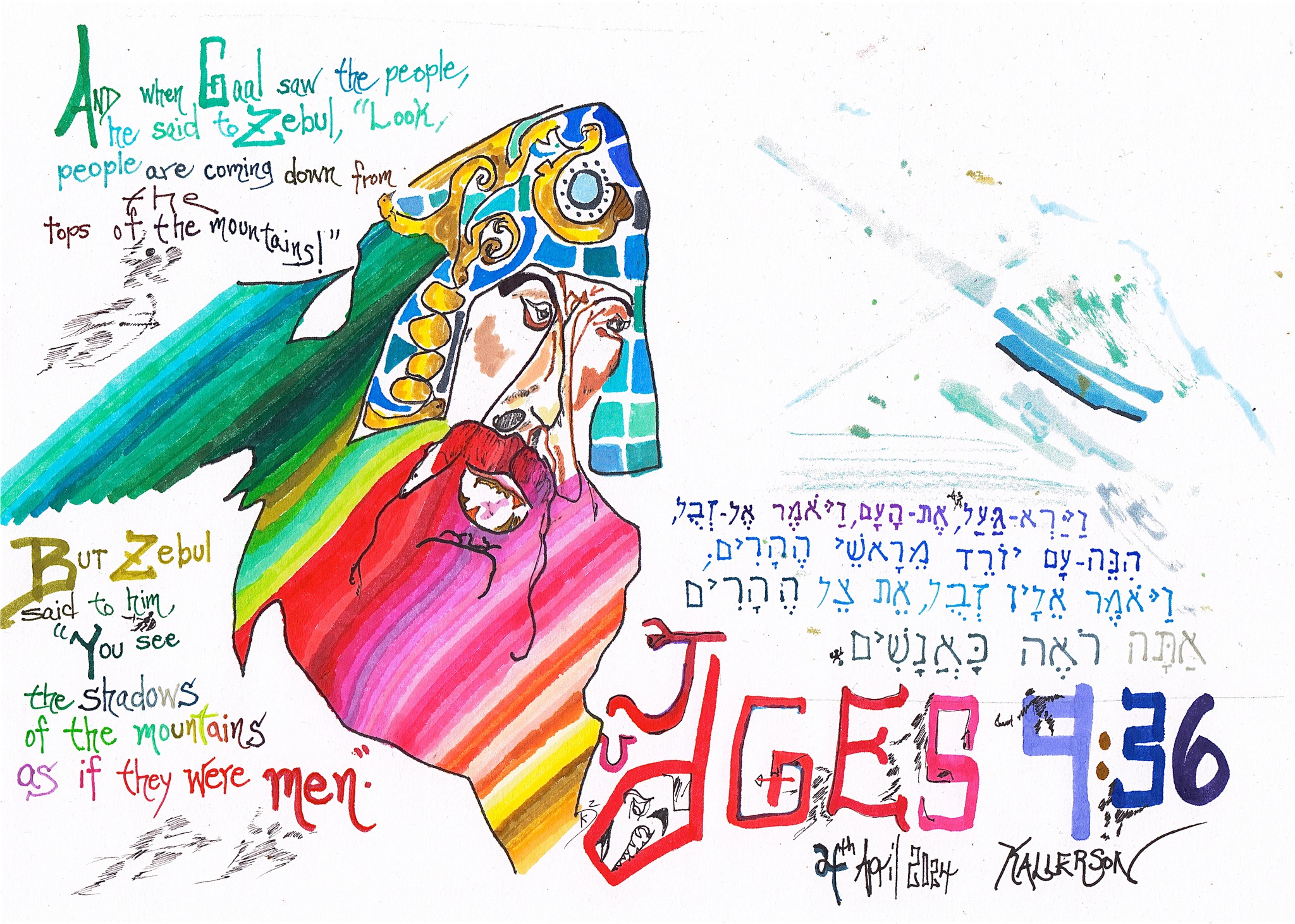
36 And when Gaal saw the people, he said to Zebul, “Look, people are coming down from the tops of the mountains!”
vayar gaal eth ha’am vayomer el zevul hineh am yored merashe he’harim – “And sees, Gaal, the people, and says unto Zebul, ‘Behold, people descending from heads the mountains.’” Gaal was standing at the gate looking out. There is no reason at all for him to suspect an attack. This is simply a person looking at the skyline as anyone would do early in the morning at the gate of the city.
However, his eyes catch the movement of Abimelech and his men. Despite this, Zebul treats Gaal with the same contempt as Gaal had directed toward him…
36 (con’t) But Zebul said to him, “You see the shadows of the mountains as if they were men.”
vayomer elav zevul eth tsel he’harim atah roeh ka’anashim – “And says unto him, Zebul, ‘Shadow the mountains you see, according to men.’” Zebul mockingly jests at Gaal as if he were an uneducated doof. It is obvious that they are people, but Zebul is clearly having fun with the moment. On the other hand…
37 So Gaal spoke again and said, “See, people are coming down from the center of the land,
vayoseph od gaal l’daber vayomer hineh am yordim me’im tabur ha’arets – “And adds again, Gaal, to speak, and says, ‘Behold, people, descenders, from with center the land.” Here is a new and rare word, tabur, translated as center.
It is from an unused root meaning to pile up. Thus, it signifies accumulated. By implication, then, it is a navel or a summit. As such, it is the middle. It will only be seen again in Ezekiel 38 –
“You will say, ‘I will go up against a land of unwalled villages; I will go to a peaceful people, who dwell safely, all of them dwelling without walls, and having neither bars nor gates’— 12 to take plunder and to take booty, to stretch out your hand against the waste places that are again inhabited, and against a people gathered from the nations, who have acquired livestock and goods, who dwell in the midst [tabbur] of the land.’: Ezekiel 38:11, 12
Gaal is now certain of what he sees and proclaims it again…
37 (con’t) and another company is coming from the Diviners’ Terebinth Tree.”
v’rosh ekhad ba mi’derekh elon m’onim – “and head one coming from way Oak Soothsayers’.” Seeing that there is a rush upon the city from the center, the natural thing to do is scan the entire visible panorama. In doing so, he sees a second group coming from an area known as Soothsayers’ Oak. It was probably a giant spreading oak that people thought was suitable for practicing divination or witchcraft.
38 Then Zebul said to him, “Where indeed is your mouth now, with which you said, ‘Who is Abimelech, that we should serve him?’
vayomer elav zevul ayeh epho pikha asher tomar mi avimelekh ki naavdenu – “And says unto him, Zebul, ‘Where here your mouth which you said, “Who Abimelech that we serve him?”’” It is a derogatory interrogatory: “Where’s your big mouth now? It’s time to put up or shut up. You questioned Abimelech’s authority. Well, here’s your chance to do something about it.”
38 (con’t) Are not these the people whom you despised? Go out, if you will, and fight with them now.”
halo zeh ha’am asher maastah bo tse na atah v’hilakhem bo – “Not this the people who you rejected in him? Go out, I pray, now, and fight in him.” The meaning is that when he rejected Abimelech, he rejected those who are now with him.
Therefore, stating it as an imperative, Zebul tells Gaal to go out to fight Abimelech and those with him. And more, he adds in the taunting, na, or I pray. It is a jab like, “Well, if you’re man enough.” It leaves little room for Gaal to do anything but go.
39 So Gaal went out, leading the men of Shechem, and fought with Abimelech.
The words return to baale, masters, once again: vayetse gaal liphne baale sh’khem vayilakhem ba’avimelekh – “And goes out, Gaal, to faces masters Shechem, and fights in Abimelech.” With little choice except to face total disgrace, Gaal went out before the masters of Shechem to face his fate…
40 And Abimelech chased him, and he fled from him; and many fell wounded, to the very entrance of the gate.
The words are exciting as the imperfect verbs come rolling forth: vayirdphehu avimelekh vayanas mipanav vayiphlu khalalim rabim ad petakh ha’shaar – “And pursues him, Abimelech, and flees from his face, and falls pierced many, unto entrance the gate.” It is a total rout of the forces of Gaal. His people retreated and were cut down all the way to the entrance of the city itself. With that job tidied up, it next says…
41 Then Abimelech dwelt at Arumah, and Zebul drove out Gaal and his brothers,
vayeshev avimelekh barumah vaygaresh zevul eth gaal v’eth ekhav – “And dwells Abimelech in the Arumah, and dispossesses, Zebul, Gaal and his brothers.” The name Arumah is found only here. It comes from rum, to be high. Thus, it means Height or Elevated, or even Exalted. If the latter, it can be positive or negative. For example, speaking of the antichrist, Daniel 11 says –
“Then the king shall do according to his own will: he shall exalt [rum] and magnify himself above every god, shall speak blasphemies against the God of gods, and shall prosper till the wrath has been accomplished; for what has been determined shall be done.” Daniel 11:36
By stopping at the gate of Shechem, it is apparent that Abimelech left the matter of the city and Gaal to Zebul the city manager. From there Zebul took appropriate action to eject Gaal…
41 (con’t) so that they would not dwell in Shechem.
mi’sheveth bishkhem – “from dwelling in Shechem.” Gaal is expelled from the city, and that seems like the end of the matter. However, it is the masters of Shechem that rebelled against Abimelech. Thus, any remaining would have to be dealt with. Therefore…
42 And it came about on the next day that the people went out into the field, and they told Abimelech.
v’hi mimakorath vayetse ha’am ha’sadeh vayagidu la’avimelekh – “And is from morrow, and goes out the people the field, and declares to Abimelech.” With Abimelech gone from the gates of Shechem, and with Gaal and his brothers expelled from the city, the people went back to the field as people need to do.
However, they were the ones who had allied with Gaal and against Abimelech. As soon as they are seen in the field, on the very next day, he sets forth to act…
43 So he took his people, divided them into three companies, and lay in wait in the field.
vayiqakh et ha’am vayekhetsem lishloshah rashim vayeerov ba’sadeh – “And takes the people, and divides them to three heads, and lays in wait in the field.” This time, the division of his people is under three heads. Bullinger notes that “the number three points us to what is real, essential, perfect, substantial, complete, and Divine.” In other words, Divine Perfection. With his companies arrayed…
43 (con’t) And he looked, and there were the people, coming out of the city; and he rose against them and attacked them.
vayar v’hineh ha’am yotse min ha’ir vayaqam alehem vayakem – “And sees, and behold, the people going from the city. And arises against them, and strikes them.” Again, as before, Abimelech was able to destroy those left in the city. This time, it would have been easier because they were completely unsuspecting.
44 Then Abimelech and the company that was with him rushed forward and stood at the entrance of the gate of the city;
Rather than then, it says and. This explains what was just said: va’avimelekh v’kharashim asher imo pashtu vayaamdu petakh shaar ha’ir – “And Abimelech, and the companies that with him deploys and stands entrance gate the city.” There was a rush towards the gate. This would keep any from retreating inside, and it would allow them to keep the entrance open if those inside tried to shut the gates.
44 (con’t) and the other two companies rushed upon all who were in the fields and killed them.
ushne kharashim pashtu al kal asher ba’sadeh va’yakum – “And two companies deployed upon all who in the field, and strikes them.” With the city secured, one company remained with Abimelech. The other two deployed into the field and struck all who were there.
45 So Abimelech fought against the city all that day; he took the city and killed the people who were in it;
va’avimelekh nilkham ba’ir kol hayom ha’hu vayilkod eth ha’ir v’eth ha’am asher bah – “And Abimelech fought in the city, all the day, the it. And captures the city and the people in her killed.” By securing the gate, they were able to gain access into the city, seize it, and kill everyone in it in one day. With that complete…
*45 (fin) and he demolished the city and sowed it with salt.
vayitots eth ha’ir vayizraeha melakh – “And tears down the city, and sow her, salt.” By salting the city, it means that he considers the city irretrievably destroyed, no longer to be useful. And that, in perpetuity. Shechem, (Having a Sense of) Responsibility was to no longer be considered as such.
Biblically, salt is a sign of covenant faithfulness, incorruptibility, and perpetuity.
With that, we will close today. It was a lot of verses and information to take in. We will complete the passage and explain it in the next sermon. For now, we can look to the actions of Abimelech and know that this is the fate of those who conspire and kill.
Eventually, the very thing done to obtain power is what often leads to the demise of the doer. It is as if the divine hand of justice reaches down and fills their lives with the trouble they have brought upon others.
It isn’t always this way. But even those who have lived like this and died in peace still have to face the Judge of all mankind. How much better it would be for people to let go of such things and exalt the Lord by coming to Jesus!
In doing so, people can at least expect a joyous reunion with God when their day to stand before Him comes. Let us consider this and place Christ Jesus in the appropriate place in our lives. All of the power, money, and fame in the world ultimately means nothing when our days are through.
Live for the Lord! It will make an eternal difference in how things go for our souls.
Closing Verse: “I will bless the Lord at all times;
His praise shall continually be in my mouth.
2 My soul shall make its boast in the Lord;
The humble shall hear of it and be glad.
3 Oh, magnify the Lord with me,
And let us exalt His name together.” Psalm 34:1-3
Next Week: Judges 9:22-45 He’s headed to heck. That’s his trek’m, this is for shore… (Abimelech, King of Shechem, Part IV) (30th Judges sermon)
The Lord has you exactly where He wants you. He has a good plan and purpose for you. It is He who judges His people according to their deeds. So, follow Him, live for Him, and trust Him, and He will do marvelous things for you and through you.
Abimelech, King of Shechem, Part III
After Abimelech had reigned over Israel three years
God sent a spirit of ill will, like when getting a bad check
Between Abimelech and the men of Shechem
And the men of Shechem dealt treacherously with Abimelech
That the crime done to the seventy sons of Jerubbaal
Might be settled and their blood be laid on their brother Abimelech
Who killed them, and on the men of Shechem
Who aided him in the killing of his brothers, chopping at the neck
And the men of Shechem set men in ambush
Against him on the tops of the mountains, each a roughneck
And they robbed all who passed by them along that way
And it was told Abimelech
Now Gaal the son of Ebed came
With his brothers and went over to Shechem
And the men of Shechem
Put their confidence in him
So they went out into the fields, and gathered grapes
From their vineyards and trod them, and made merry
And they went into the house of their god
And ate and drank, and cursed Abimelech with words pretty scary
Then Gaal the son of Ebed said
“Who is Abimelech, and who is Shechem, that him we
———-should serve? Please observe…
Is he not the son of Jerubbaal, and is not Zebul his officer?
Serve the men of Hamor the father of Shechem; but him, why
———-should we serve?
If only this people were under my authority!
Then I would remove Abimelech, no doubt!
So he said to Abimelech
“Increase your army and come out!”
When Zebul, the ruler of the city (where he was housed)
Heard the words of Gaal the son of Ebed, his anger was aroused
And he sent messengers to Abimelech secretly, saying
“Take note! Gaal the son of Ebed and his brothers (yes, it is true)
Have come to Shechem; and here they are
Fortifying the city against you
Now therefore, get up by night, you and the people who
———-are with you
And lie in wait in the field; this you are to do
And it shall be, as soon as the sun is up in the morning
That you shall rise early and rush upon the city
And when he and the people who are with him come out
———-against you
You may then do to them as you find opportu-nity
So Abimelech and all the people
Who were with him rose by night
And lay in wait against Shechem
In four companies, hiding out of sight
When Gaal the son of Ebed went out
And stood in the entrance to the city gate
Abimelech and the people who were with him
Rose from lying in wait
And when Gaal saw the people, he said to Zebul
“Look, people are coming down from the tops of the mountains!
———-fer sher
But Zebul said to him
“You see the shadows of the mountains as if they men were
So Gaal spoke again and said
“See, people are coming down, take a look and see
From the center of the land, and another company is coming
From the Diviners’ Terebinth Tree
Then Zebul said to him, “Where indeed is your mouth now
With which you said, ‘Who is Abimelech? Really… wow!
That we should serve him?’ Are not these the people
———-whom you despised?
Go out, if you will, and fight with them now
So Gaal went out, what the heck
Leading the men of Shechem, and fought with Abimelech
And Abimelech chased him, and he fled from him
———-he wouldn’t wait
And many fell wounded, to the very entrance of the gate
Then Abimelech dwelt at Arumah, and Zebul drove out Gaal
———-and his brothers too
So that they would not dwell in Shechem, something they
———-wouldn’t do
And it came about on the next day (but still night in Quebec)
That the people went out into the field, and they told Abimelech
So he took his people, divided them into three companies
And lay in wait in the field, waiting to react
And he looked, and there were the people, coming out of the city
And he rose against them and them he attacked
Then Abimelech and the company that was with him
Rushed forward and stood at the entrance of the gate of the city
And the other two companies rushed upon all
Who were in the fields and killed them, showing no pity
So Abimelech fought against the city all that day
He took the city and killed the people who were in it
And he demolished the city and sowed it with salt
A brutal guy indeed, we must admit
Lord God, turn our hearts to be obedient to Your word
Give us wisdom to be ever faithful to You
May we carefully heed each thing we have heard
Yes, Lord God may our hearts be faithful and true
And we shall be content and satisfied in You alone
We will follow You as we sing our songs of praise
Hallelujah to You; to us Your path You have shown
Hallelujah we shall sing to You for all of our days
Hallelujah and Amen…
22 After Abimelech had reigned over Israel three years, 23 God sent a spirit of ill will between Abimelech and the men of Shechem; and the men of Shechem dealt treacherously with Abimelech, 24 that the crime done to the seventy sons of Jerubbaal might be settled and their blood be laid on Abimelech their brother, who killed them, and on the men of Shechem, who aided him in the killing of his brothers. 25 And the men of Shechem set men in ambush against him on the tops of the mountains, and they robbed all who passed by them along that way; and it was told Abimelech.
26 Now Gaal the son of Ebed came with his brothers and went over to Shechem; and the men of Shechem put their confidence in him. 27 So they went out into the fields, and gathered grapes from their vineyards and trod them, and made merry. And they went into the house of their god, and ate and drank, and cursed Abimelech. 28 Then Gaal the son of Ebed said, “Who is Abimelech, and who is Shechem, that we should serve him? Is he not the son of Jerubbaal, and is not Zebul his officer? Serve the men of Hamor the father of Shechem; but why should we serve him? 29 If only this people were under my authority! Then I would remove Abimelech.” So he said to Abimelech, “Increase your army and come out!”
30 When Zebul, the ruler of the city, heard the words of Gaal the son of Ebed, his anger was aroused. 31 And he sent messengers to Abimelech secretly, saying, “Take note! Gaal the son of Ebed and his brothers have come to Shechem; and here they are, fortifying the city against you. 32 Now therefore, get up by night, you and the people who are with you, and lie in wait in the field. 33 And it shall be, as soon as the sun is up in the morning, that you shall rise early and rush upon the city; and when he and the people who are with him come out against you, you may then do to them as you find opportunity.”
34 So Abimelech and all the people who were with him rose by night, and lay in wait against Shechem in four companies. 35 When Gaal the son of Ebed went out and stood in the entrance to the city gate, Abimelech and the people who were with him rose from lying in wait. 36 And when Gaal saw the people, he said to Zebul, “Look, people are coming down from the tops of the mountains!”
But Zebul said to him, “You see the shadows of the mountains as if they were men.”
37 So Gaal spoke again and said, “See, people are coming down from the center of the land, and another company is coming from the Diviners’ Terebinth Tree.”
38 Then Zebul said to him, “Where indeed is your mouth now, with which you said, ‘Who is Abimelech, that we should serve him?’ Are not these the people whom you despised? Go out, if you will, and fight with them now.”
39 So Gaal went out, leading the men of Shechem, and fought with Abimelech. 40 And Abimelech chased him, and he fled from him; and many fell wounded, to the very entrance of the gate. 41 Then Abimelech dwelt at Arumah, and Zebul drove out Gaal and his brothers, so that they would not dwell in Shechem.
42 And it came about on the next day that the people went out into the field, and they told Abimelech. 43 So he took his people, divided them into three companies, and lay in wait in the field. And he looked, and there were the people, coming out of the city; and he rose against them and attacked them. 44 Then Abimelech and the company that was with him rushed forward and stood at the entrance of the gate of the city; and the other two companies rushed upon all who were in the fields and killed them. 45 So Abimelech fought against the city all that day; he took the city and killed the people who were in it; and he demolished the city and sowed it with salt.