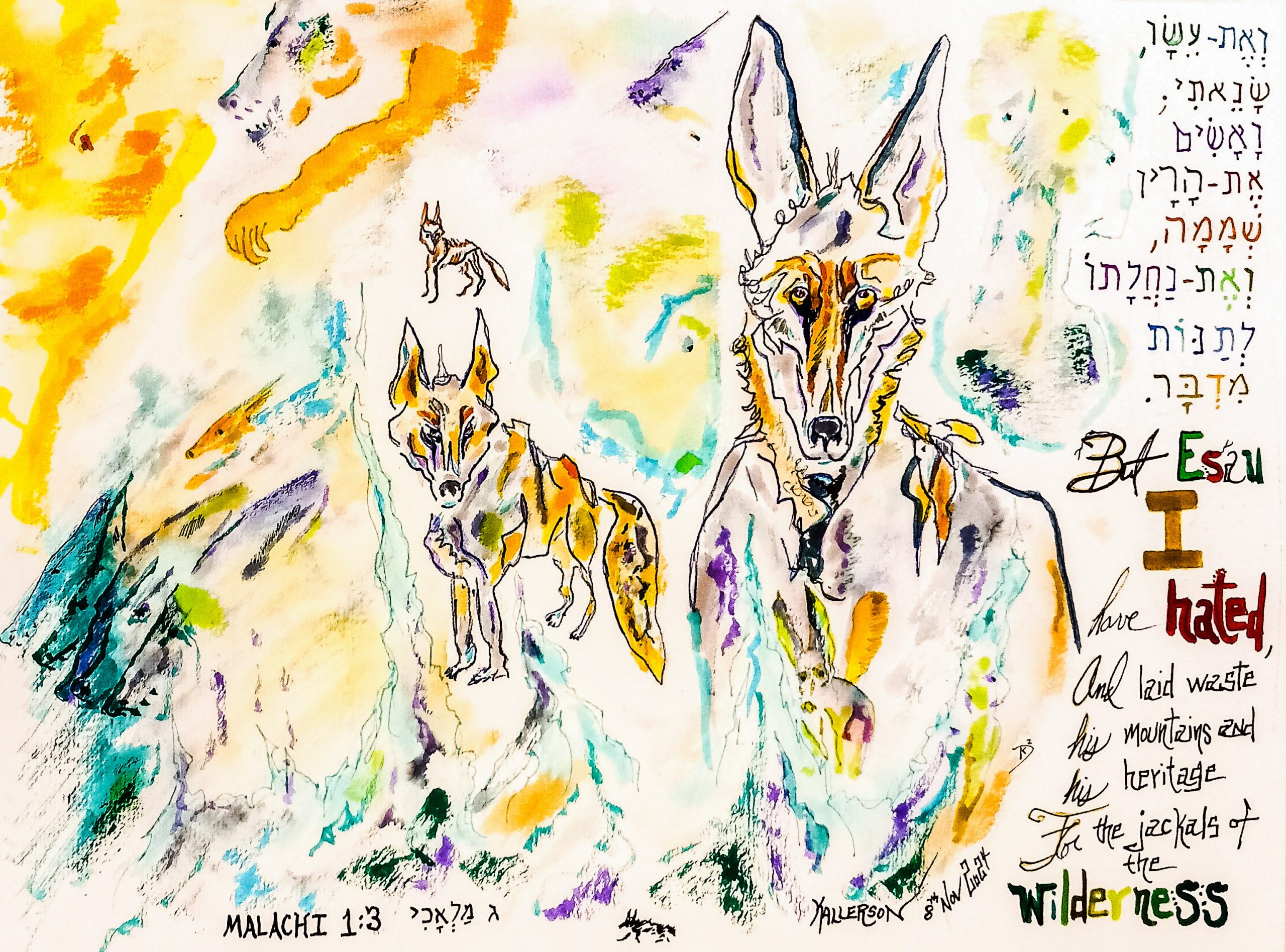
Artwork by Douglas Kallerson.
Malachi 1:1-3
Jacob and Esau
(Typed 12 Aug 2024) Being a preacher, there is a lot of interaction with others about spiritual matters, especially so through emails because of the way this church is set up. There are many repeating questions that take a lot of care to properly and wisely respond to.
One of the common sentiments that comes up concerns whether God is mad at someone. Maybe He doesn’t love that person anymore, or worse, maybe God hates him because things have gone from bad to worse without any seeming reason why.
Reading the first few verses of Malachi may bolster that notion. God loves Jacob, but He hates Esau. Maybe this is just how God works, and He never really loved me. This is why it’s necessary to go through the Bible methodically and carefully.
If God loves Jacob (who is Israel), what kind of love is it when all they have faced is grief for the past two thousand years? Or maybe God loved Israel in the past but hates them now? Maybe He wants them destroyed, just like Edom. Lots of people claim that, even people in the church.
If so, then maybe God did love me, but now He hates me! It is all so hard to understand. What is God telling me with all of these terrible times I am facing? And how can I tell when the Bible is so big and confusing?
Text Verse: “Moab is My washpot;
Over Edom I will cast My shoe;
Over Philistia I will triumph.” Psalm 108:9
Malachi is a short book that makes many claims about how the Lord interacts with Israel and how Israel responds. But this is not unusual because He is the same unchanging Lord who dealt with Israel eons earlier.
There is nothing inconsistent in Him as He deals with people. And yet, He does deal with different people differently. Is that inconsistent, or is it simply His right to determine how things will turn out? There were people in Israel who lost sons, but the Lord returned some of them to life, for example, through Elijah and Elisha.
But He didn’t do this for everybody. Is that unfair, or is that the Lord’s prerogative? Jesus raised a widow’s son, Jairus’ daughter, and Lazarus. However, lots of other people in Israel died, and He didn’t raise them.
Someone may say, “My son was out boating, and he was killed when the boat ran into a mile-marker. Why did God allow this to happen?” Would it be fair if God said, “Nobody can ever go out and enjoy the water because someone might get hurt?”
In response, people would say, “Can’t we decide on our own what we do?” But when they do what they want to do, and someone gets hurt or dies, suddenly, it becomes God’s fault. We want our choice, whether smart or not, but we never expect that our choice will lead to disaster.
That is not a wise way of considering our lives. God allows us to choose things, even things that may cause us harm. We have to work, but the Tower of Siloam may fall down on those who are working in it. Or some really bad people may fly an airliner full of people into a building and cause it to fall.
People fly to various places. People go up elevators in buildings. Bad people live in a fallen world, and they intend harm to others. Engines malfunction, mistakes are made, and diseases are a deadly part of life on Earth.
Let us not question the goodness of God when we don’t have all the information available to us. Regardless of the tragedies that we face in our lives, the Bible is a book of hope that those things will someday be behind for those who have come to Jesus.
If you want to know if God is good or not, look to the cross. The answer shouts out to those who understand its significance.
It’s all to be found in His superior word. And so, let us turn to that precious word once again, and… May God speak to us through His word today, and may His glorious name ever be praised.
I. The Book of Malachi, an Introduction.
The book of Malachi is the thirty-ninth and final book of the standard Christian Bible’s Old Testament. In the Christian canon of the Old Testament, there are generally considered five major divisions: the Pentateuch, the Historical books, the Wisdom books, the Major Prophets, and the Minor Prophets. Malachi is the twelfth and final book of the Minor Prophets.
In the Jewish canon, there are three major sections: the Torah (the Pentateuch), the Nevi’im (the Prophets), and the Ketuvim (the Writings). Within the Prophets are two divisions, the Former Prophets and the Latter Prophets (also known as the Twelve). Malachi is the final book of the Nevi’im (the Prophets) in both categories.
Within the New Testament, a few divisions of the Hebrew Scriptures are given. One is found in Luke 24, the Law of Moses, the Prophets, and the Psalms –
“These are the words which I spoke to you while I was still with you, that all things must be fulfilled which were written in the Law of Moses and the Prophets and the Psalms concerning Me.” 45 And He opened their understanding, that they might comprehend the Scriptures.” Luke 24:44, 45
Malachi, being the thirty-ninth and last book of the Old Testament, closes out the writings of the law. An interesting parallel between punishment and the law is thus made. In Deuteronomy 25:1-3, it says –
“If there is a dispute between men, and they come to court, that the judges may judge them, and they justify the righteous and condemn the wicked, 2 then it shall be, if the wicked man deserves to be beaten, that the judge will cause him to lie down and be beaten in his presence, according to his guilt, with a certain number of blows. 3 Forty blows he may give him and no more, lest he should exceed this and beat him with many blows above these, and your brother be humiliated in your sight.” Deuteronomy 25:1-3
The Jewish practice was to never administer more than thirty-nine blows so that the law would never be violated. That is seen in 2 Corinthians 11:24, where Paul says, “From the Jews five times I received forty stripes minus one.”
As the law is a type of bondage because by law is the knowledge of sin (see John 8:33, Galatians 4:24, 25, etc.), the thirty-nine books of the law can be equated to a type of chastisement. Malachi completes this process. It is thus an exciting anticipation of the coming of the Messiah, who would take the burden of law off man and replace it with God’s grace.
As far as when the book was written, there is scholarly dispute, and no precise dating for the book is given. External evidence about the prophet, his ministry, or surrounding historical events is not available.
Despite that, the words of Malachi point to it being written in the same general timeframe as the books of Ezra and Nehemiah. For example, in Malachi 1:8, the word pekhah, governor, is used. Though it was used before the Babylonian exile, it is a word of Persian origin used in Ezra, Nehemiah, and Haggai when referring to those appointed over Judah. Malachi also uses it in this context.
Also, the Lord’s words through Malachi come at a time of temple worship. Therefore, the temple of Zerubbabel, which dates to 515 BC, had to be standing. His words rebuke the people for their failing conduct concerning the temple and its sacrifices. This is a strong clue that the temple had been standing for some time.
Additionally, the words focus on some of the same issues found in Ezra and Nehemiah. Although these are failings that permeated Israel throughout its history, when taken in light of the first two points, it shows that the post-exilic nation was facing these failings consistently during this period.
The Main Purpose: In the first verse of the book, Malachi is stated to be the word of the Lord through Malachi. In it, the people are warned of their need to turn back to the Lord before the advent of the promised Messiah. It is the final warning from the Lord before His coming.
After Malachi, there are approximately four hundred years of no recorded prophetic utterances from the Lord. This is known as the Intertestamental Period. The next word from the Lord would be to Zachariah, the father of John the Baptist. John would be the one to prepare the way for the coming of the Messiah, as prophesied in the final words from Malachi –
“Behold, I will send you Elijah the prophet
Before the coming of the great and dreadful day of the Lord.
6 And he will turn
The hearts of the fathers to the children,
And the hearts of the children to their fathers,
Lest I come and strike the earth with a curse.” Malachi 4:5, 6
The layout and form of the book is a prophetic oracle which is didactic in nature, teaching a lesson based on a disputation. There is an assertion, then an objection, and finally a rebuttal. The Bible Project provides the following details –
“The book is designed as a series of disputes or arguments. Most sections begin with God saying something or making a claim or an accusation. This is followed by Israel disagreeing or questioning God’s statement. Finally, God will respond and offer the last word. This pattern repeats itself six times. In the first three disputes (chs. 1-2), God exposes Israel’s corruption, while in the final three (ch. 3), he confronts their corruption. The overall impression you get from reading these disputes is that the exile didn’t fundamentally change anything in the people. Their hearts are as hard as ever.”
The author of the book is Malachi. However, the name is the possessive form of the word malakh, messenger. Thus, malakhi means My Messenger. It is argued by some, therefore, that this is a title and not a name.
This is especially so because the name is not used anywhere else in Scripture. However, the term malakhi, My messenger, is used in Exodus 23:23, 32:34; Isaiah 42:19; and Malachi 3:1. Because of this, it has been argued without evidence that the author is Ezra.
As Malachi is the 39th book of the Old Testament, it is worthwhile to determine its significance from a numerical standpoint. It is derived from 3 x 13. Of the number three, Bullinger says –
“The number three, therefore, must be taken as the number of Divine fulness. It signifies and represents the Holy Spirit as taking of the things of Christ and making them real and solid in our experience. It is only by the Spirit that we realise spiritual things. Without Him and His gracious operation, all is surface work: all is what a plane figure is to a solid.”
Of thirteen, Bullinger says, “every occurrence of the number thirteen, and likewise of every multiple of it, stamps that with which it stands in connection with rebellion, apostasy, defection, corruption, disintegration, revolution, or some kindred idea.”
The two numbers beautifully define the last, and thus summary, words of the Old Testament. The final book of the law completes the divine fulness of the period of law, a time exactingly marked with what defines the number thirteen.
As for the contents of Malachi, the book is comprised of 4 chapters totaling 55 verses. Malachi is cited in the New Testament gospels and by Peter and Paul. Jesus cites the words of Malachi in Matthew 11:10.
With this brief summary of the book complete, we can now begin to analyze it word by word, searching out what is on the mind of the Lord as He utters His final words to Israel before the time when His words begin to flow once again in the New Testament…
Predestined by the Lord, but what does that mean?
Is it all decided for us without a choice?
What truths from the Bible about it can we glean?
Are we on a set path without any voice?
What about the Edomite who joins to Israel?
Was he forced by God apart from his will?
And what about a person who receives Jesus? Do tell!
Does forcing one’s destiny give God a thrill?
Free to will or not, that is the question
And it is not impossible to discern which is true
To figure it out, I have a suggestion
Read your Bible (and in context!) is what you should do
II. And Esau, I Hate (verses 1-3)
The burden
masa – “A lifting” The noun masa is derived from the word nasa, to lift. Thus, it is a lifting. For that reason, most translations say burden, which figuratively describes the thing lifted, it being heavy or a burden.
Others translate this as an oracle or prophecy, as a word that is lifted up. This is a paraphrase of the thought. Smith’s Literal Translation says, “The lifting up of the word…” That verbally describes the matter, but – ironically – it is not literal.
Jerome says, “The word massa is never placed in the title, save when the vision is heavy and full of burden and toil.” Because of this, some scholars translate the word as a “sentence.” Lange adds to this thought and says –
“The connection in the first verse with word shows that it means something more, or it would have been superfluous. Eleven times in Isaiah …, in Ezekiel 12:10; Hab. 1:1; Zech. 9:1; 12:1, it is followed by a prophecy of a threatening nature.”
Though a sense of weight is certainly what is being conveyed, it does not necessarily mean something threatening, even if a warning is implied. For example, the introductory words of Proverbs 30 note “the lifting” of the words of Agur
Also, the introductory words of Proverbs 31 note a “lifting” of the words of King Lemuel. The word is used in 1 Chronicles 15 when referring to “the singing” of the Levites. It is a lifting to the Lord.
That this lifting is not necessarily to be taken as threatening will be especially noted a bit later. As for the word itself, this is the last use of masa in Scripture, as will be many of the uses of words in the book, simply because Malachi closes out the Old Testament canon.
Therefore, unless there is a particular reason to highlight a word, noting that it is the last use of it will not again be highlighted. This lifting now being noted is…
1 (con’t) of the word of the Lord
devar Y’hovah – “word Yehovah.” The fact that this is the word of Yehovah is immediately mentioned by the prophet. The davar, word, here signifies an utterance. It is the word of Yehovah. The first time the davar, word, of Yehovah is specifically noted in this manner is in Genesis 15:1 –
“After these things the word of the Lord [davar Y’hovah] came to Abram in a vision, saying, ‘Do not be afraid, Abram. I am your shield, your exceedingly great reward.’”
The Lord was personally intervening through His word to the chosen man of God, Abraham. It is to Abraham that the promise of blessing was made and it was to his descendants after him that this promise would continue. This was specifically through the son of promise, Isaac, then to his son Jacob, and then to the twelve tribes that descended from him.
This davar, word, of Yehovah to and through this covenant people is the first connection back to the book of Genesis. As for the divine name Yehovah, the first use of it was in Genesis 2:4 –
“This is the history of the heavens and the earth when they were created, in the day that the Lord God [Y’hovah elohim] made the earth and the heavens.”
This is the second connection of the book back to Genesis. The God, Yehovah, who formed the heavens and the earth, is the same God who is monitoring the redemptive narrative that is currently being expressed to and through a particular people in this book. It is the Creator God and Covenant Lord who is the Source of the words that are conveyed…
1 (con’t) to Israel
el Yisrael – “unto Israel.” The word of the Lord is given unto Israel. It does not say al Yisrael, (“upon Israel” meaning “against Israel”), as if they are such egregious offenders that they can immediately expect punishment for their ways. Instead, the words are direct but conciliatory while being mixed with warning.
Thus, the idea presented earlier, that this is a heavy burden of threatening, is not completely accurate. The words may be a burden, but they are words that are also mixed with an appeal for reason and watchful care.
As for the name, Israel is a line of people who descend from a man, Jacob, born of Isaac, and who was first called Israel in Genesis 32:28. It is the third connection to Genesis. From him came the twelve tribes of Israel, collectively known as Israel.
The name Israel is never applied to the church. Rather, a distinction is always made between the people of Israel and the Gentiles, including by Paul, the Apostle to the Gentiles.
And yet, there is a joining of the Gentiles into the commonwealth of Israel, meaning the common blessings promised to Israel, as noted in Ephesians 2:12. Understanding the difference is important because the words of Malachi are written to the nation of Israel under the Old (Mosaic) Covenant.
The Gentiles of the world were never under the Old Covenant. The Old Covenant is fulfilled and ended through the work of Christ (Ephesians 2:15, Colossians 2:14, and Hebrews 7:18, 8:13, and 10:9). As such, the words of Malachi, including verses constantly cited by pastors and preachers from Malachi 3:8-10 are not intended for the church.
The words of this book are given from the Lord…
1 (con’t) by Malachi.
b’yad malakhi – “in hand Malachi.” The words “in hand” mean that the Lord spoke through this person and he conveyed them under His authority as the Lord’s representative to the people of Israel. This is seen, for example, when the Lord spoke to Pharaoh b’yad Mosheh, “in hand Moses.”
This happens elsewhere, such as in Jeremiah 37:2, where it speaks of the words of the Lord, which He spoke b’yad yirm’yahu, “in hand Jeremiah.” Because of this, one would think that Malachi would be the name of the individual.
If not, it might be assumed that the Lord would say “His messenger” instead of “My messenger.” But there is a problem with this. There are no verbs in the verse. Without a verb to identify whether it is first person or third person, the matter cannot be sufficiently determined.
It simply says, “A lifting – word Yehovah unto Israel in hand Malachi.” Whether a name or a title, the lifting of the word of Yehovah begins with…
2 “I have loved you,” says the Lord.
As will be the case with much of the book of Malachi, the verbs are in the perfect aspect: ahavti etkhem amar Y’hovah – “‘I loved you,’ said Yehovah.” Of all the things the Lord could have begun with to start the final book of the Old Testament, it is a remarkable statement.
Yehovah is speaking to Israel. His words are an assertion. Beginning at some point, Israel was loved, has been loved, and is loved. The word ahev, love, comes from a primitive root signifying to have affection for. It is a claim that the doting attention of Yehovah has been upon Israel.
Also, as will be the case each time the prophet notes the word of the Lord, it is in the perfect aspect. The Lord “said.” In essence, “The Lord has spoken, and I am conveying to you what He said.”
Despite His assertion, an immediate objection from the object of His affection is presented…
2 (con’t) “Yet you say, ‘In what way have You loved us?’
v’amartem bamah ahavtanu – “And said, ‘In how loved us?’” One can see Israel, just like any of us when things aren’t going perfectly, questioning God’s love. Our spouse dies, and we question how God can love us. We lose our home, and we question how God can love us. We have an extremely bad day and we again question God’s love for us.
The people of Israel, swallowed up in self-misery over whatever is going on in their lives, question the Lord’s love for them. Although this is the Lord saying these things as if Israel were speaking, it is because He hears Israel moaning, and He returns their moaning back to them through the prophet.
But there had to be a basis for the people complaining that the Lord didn’t love them. First, one cannot love or hate unless he exists. To say that the Lord doesn’t love you implies that He exists.
Also, existence does not necessarily lead to ability. A rock exists, but it cannot love. Further, there must be an acknowledgment of some sort of connection between two entities for love to exist. My wife is Hideko. She loves me (well, most of the time). However, if I had never heard of her and she had never heard of me, I couldn’t say, “Hideko loves me.”
The Lord has established a baseline. He exists, Israel exists, both have the capacity to understand this, and both are aware of each other. He has claimed He loves Israel. Israel has heard this –
“The Lord did not set His love on you nor choose you because you were more in number than any other people, for you were the least of all peoples; 8 but because the Lord loves you, and because He would keep the oath which He swore to your fathers, the Lord has brought you out with a mighty hand, and redeemed you from the house of bondage, from the hand of Pharaoh king of Egypt.” Deuteronomy 7:7, 8
Israel knew this and had heard it proclaimed. But that was not based upon a group of people suffering affliction under the hand of an oppressor. Such a situation had played out innumerable times elsewhere. Rather, that love already existed in the fathers. Later in Deuteronomy Moses refines what this means –
“The Lord delighted only in your fathers, to love them; and He chose their descendants after them, you above all peoples, as it is this day. 16 Therefore circumcise the foreskin of your heart, and be stiff-necked no longer. 17 For the Lord your God is God of gods and Lord of lords, the great God, mighty and awesome, who shows no partiality nor takes a bribe. 18 He administers justice for the fatherless and the widow, and loves the stranger, giving him food and clothing. 19 Therefore love the stranger, for you were strangers in the land of Egypt. 20 You shall fear the Lord your God; you shall serve Him, and to Him you shall hold fast, and take oaths in His name. 21 He is your praise, and He is your God, who has done for you these great and awesome things which your eyes have seen. 22 Your fathers went down to Egypt with seventy persons, and now the Lord your God has made you as the stars of heaven in multitude.” Deuteronomy 10:15-22
Thus, the words ahavti etkhem, I loved you, are another link back to Genesis. The Lord selected the fathers to love them. That attentive love continued on from one generation to the next, but only in a particular line, as evidenced by the next words…
2 (con’t) Was not Esau Jacob’s brother?”
halo akh esav l’yaaqov – “Not brother, Esau, to Jacob?” This begins Yehovah’s rebuttal to the objection. Esau is Jacob’s twin older brother. The record of their birth is found in Genesis 25 –
“Now Isaac pleaded with the Lord for his wife, because she was barren; and the Lord granted his plea, and Rebekah his wife conceived. 22 But the children struggled together within her; and she said, ‘If all is well, why am I like this?’ So she went to inquire of the Lord.
23 And the Lord said to her:
‘Two nations are in your womb,
Two peoples shall be separated from your body;
One people shall be stronger than the other,
And the older shall serve the younger.’
24 So when her days were fulfilled for her to give birth, indeed there were twins in her womb. 25 And the first came out red. He was like a hairy garment all over; so they called his name Esau. 26 Afterward his brother came out, and his hand took hold of Esau’s heel; so his name was called Jacob. Isaac was sixty years old when she bore them.” Genesis 25:21-26
The story of the twins was well known to Israel. It was a matter of historical record, and the two people groups continued to exist at the time of Malachi’s prophecy. Despite that, both nations were destroyed by the Babylonians. Yehovah is using Edom as a lesson for Israel to learn from. As it next says…
2 (con’t) Says the Lord.
n’um Y’hovah – “Utterance Yehovah.” The word n’um signifies an utterance. It is an authoritative spoken expression, often in the form of a prophecy. In the case of the Lord, it is an utterance that bears all of the weight and authority of Yehovah.
He is declaring that Esau was, in fact, Jacob’s brother in order to establish how Israel can know that He loves them. They both had the same grandfather, Abraham. They were conceived at the same time. And yet, even before they were born, Yehovah had selected and preferred Jacob above his older brother.
And more, the state of those two brothers, as realized in their descendants, was completely different. To continue making His argument in that respect, Yehovah, through His prophet, says…
2 (con’t) “Yet Jacob I have loved;
Rather: va’ohav et yaaqov – “And I love Jacob.’” The verb is imperfect. Yehovah loves and continues to love Jacob. Nothing has changed in this relationship, even if many evils had fallen or continued to fall upon them. These were, according to all of the prophetic writings, self-inflicted wounds.
And yet, despite all of their failures and resulting judgments, God still loved Israel, symbolized by Jacob, the man, the younger twin to Esau. On the other hand…
3 But Esau I have hated,
v’eth esav saneti – “And Esau, I hate.” The words are often twisted to mean something not intended. Esau here stands for the descendants of Esau. This does not mean that God hated Esau the twin of Jacob. That will become perfectly clear in the next clause.
The use of Jacob and Esau instead of Israel and Edom is intended to remind His audience of the fact that these two were brothers. One would think that they would both be treated in the same way, but that is not the case. Jacob was given the divine promise of the land of Canaan.
The Lord watched over them, established His covenant with them, brought them in, dwelt among them, etc. Esau did not receive this.
As for the word hate, Keil almost bizarrely says –
“The verbs אהב, to love, and שׂנא, to hate, must not be weakened down into loving more and loving less, to avoid the danger of falling into the doctrine of predestination. שׂנא, to hate, is the opposite of love. And this meaning must be retained here; only we must bear in mind, that with God anything arbitrary is inconceivable, and that no explanation is given here of the reasons which determined the actions of God.” Keil
The problems with this are several. First, the doctrine of predestination is stated by Paul to be a reality, being mentioned four times (Romans 8:29, 30, and Ephesians 1:5 & 1:11). How predestination is defined may be argued, but that it is a valid doctrine is evident from Paul’s writings.
Second, there is nothing arbitrary in degrees of love and hate. Examples of this permeate Scripture in both humans and in how God deals with the objects of His affection.
Third, it is also obvious from Scripture that God did not love every person in Israel, nor did He hate every person from Edom. And it is the nations, descending from these two, that are being addressed. Rather, as in English, there are varying degrees of what hate means. For example –“And she will yet again conceive and bear a son, and she will say that Jehovah heard that I am hated, and he will give to me this also; and she will call his name Simeon.” Genesis 29:33
The word hate is being used comparatively. This continues in the New Testament with verses like Luke 14:26. Such is the same with the descendants of Jacob and Esau. If he hated Esau and all of his descendants, this would not have been included in the Law of Moses –
“You shall not abhor an Edomite, for he is your brother. You shall not abhor an Egyptian, because you were an alien in his land. 8 The children of the third generation born to them may enter the assembly of the Lord.” Deuteronomy 23:7, 8
If they were brought into the nation of Israel, they would be of Israel. If the Lord loves Israel, then He loves those who descend from Edom who are of Israel.
Finally, to completely support this notion, we can turn to what happened to the nation of Edom. The name Idumea is the Greek form of the word Edom. They continued to exist as a people long after the time of Malachi.
Of them, the Jewish historian Flavius Josephus says in about 129 BC John Hyrcanus –
“…subdued all the Idumeans; and permitted them to stay in that country, if they would circumcise their genitals, and make use of the laws of the Jews; and they were so desirous of living in the country of their forefathers, that they submitted to the use of circumcision, and of the rest of the Jewish ways of living; at which time therefore this befell them, that they were hereafter no other than Jews.” Antiquities, Book 13 Chapter 9 Section 1
What this means is that the Edomites were brought into the nation of Israel, becoming Jews. This is no different than an Arab or a Japanese person today converting to Judaism. They become a part of the Jewish people.
Whether their origins are remembered and held against them by other supposedly pure-blooded Jews or not is irrelevant. They are now Jews. For example, Herod was an Idumean, meaning an Edomite, and yet he ruled Israel. Though still remembered for his ancestral connection, just as a Russian Jew is today, He was a Jew, nonetheless.
This is a historically established fact. But what happened to the Jews after the rejection of Jesus? They were destroyed as a nation and exiled around the world. This would have included all those of Edom who were assimilated into the Jewish nation.
As such, those same people, supposedly hated by Yehovah, are a part of the people still loved by Him today. They have been returned to their ancestral land for the completion of the redemptive narrative.
When the Bible speaks of Edom (or Moab, Philistia, etc.) in yet-future prophecy, it is not referring to the actual descendants of these people but those who live in the lands now occupied by them. In other words, the Sunni Arabs fill those lands. As such, the future prophecies of Edom, for example, are speaking of them.
Unfortunately, this has almost entirely escaped the attention of prophecy buffs and most scholars. Therefore, a great deal of confusion concerning peoples and nations has resulted. A good way of getting this quickly and simply is found in Ezekiel 38 –
“Persia, Ethiopia, and Libya are with them, all of them with shield and helmet; 6 Gomer and all its troops; the house of Togarmah from the far north and all its troops—many people are with you.” Ezekiel 38: 5, 6
&
“Sheba, Dedan, the merchants of Tarshish, and all their young lions will say to you, ‘Have you come to take plunder? Have you gathered your army to take booty, to carry away silver and gold, to take away livestock and goods, to take great plunder?” Ezekiel 38:13
The battle being described in Ezekiel 38 is future to us now. And yet, some of these nations exist while others do not. Persia is Iran. Gomer, Togarmah, Sheba, Dedan, and Tarshish no longer exist as nations, and yet the places still exist with different names.
Lastly, Ethiopia and Libya are identifiable with the general locations that existed eons ago. Most of these names go back to Genesis, showing that they were established by certain people groups which are still identifiable thousands of years later. Others are only identifiable by the location which was originally established by one people group or another.
Next to continue His thoughts concerning the descendants of Esau, Yehovah says…
*3 (fin) And laid waste his mountains and his heritage
For the jackals of the wilderness.”
vaasim eth harav sh’mamah v’eth nakhalato l’thanoth midbar –
“And set his mountains – a devastation.
And his inheritance to jackals wilderness.”
Here we have another connection back to the book of Genesis. Esau was first identified with a particular location, Seir, as recorded in Genesis 32 –
“Then Jacob sent messengers before him to Esau his brother in the land of Seir, the country of Edom.” Genesis 32:3
Genesis 36 gives the genealogical record of Esau, who is Edom. Later, the Lord confirms Esau’s ownership of the land –
“And command the people, saying, ‘You are about to pass through the territory of your brethren, the descendants of Esau, who live in Seir; and they will be afraid of you. Therefore watch yourselves carefully. 5 Do not meddle with them, for I will not give you any of their land, no, not so much as one footstep, because I have given Mount Seir to Esau as a possession. 6 You shall buy food from them with money, that you may eat; and you shall also buy water from them with money, that you may drink.’” Deuteronomy 2:4-6
Despite having given Mount Seir, meaning the land of Edom, to Esau, the Lord has the right to end that. And yet, the land is still known to Him as Edom. To this day, despite being a part of the nation of Jordan, the Bible still refers to it as Edom in its future prophecies.
At the time of the descendants of Esau possessing it, however, the Lord noted that it was laid waste and was a place for the howling of the jackals. As for the tannah, here called a jackal, it is an unusual form of a word that is found only elsewhere in Lamentations 4:3.
Several older versions, such as the KJV, erroneously call these dragons, implying a reptile. This is incorrect. In Lamentations, it says that they offer their breasts to nurse their young. Reptiles do not have mammary glands and do not nurse their young.
The word is the feminine of tan, a jackal. As such, it is specifically referring to the female jackal. The reason for specifying the female is certainly the same as that in Lamentations, where the milk of the female jackal is contrasted to the painful thirst of the children of Israel during its siege.
Edom has no home. His land is given over to the female jackal who has it as a home to raise her young.
With that, the verses are done for the day. The words of the last Old Testament book make connections all the way back to the first book of the Bible. And more, they are intricately connected to so much else within Scripture.
The Bible is an intricate tapestry of information that deals with real events that have taken place in history. They center on a particular group of people in a particular land as it awaits the coming of their promised Messiah.
And yet, Scripture also deals with peoples and places at the furthest parts of the earth as they interact with the Creator of the universe through the coming of His Christ.
The Bible is not a word far out of reach. Rather it is intimate and interactive. But it will have no meaning or a very wrong sense for those who do not carefully read it and prayerfully contemplate it. We have entered into Malachi in order to see what it details.
May we carefully continue to look at every minute detail while at the same time considering it from a larger perspective as it interacts with all of the rest of the Bible. In doing so, it will help unlock truths found in Scripture that will then allow us to understand what it is God is telling us about His wonderful works among Israel and in the giving of His Son for all the people of the earth.
Closing Verse: “Egypt shall be a desolation,
And Edom a desolate wilderness,
Because of violence against the people of Judah,
For they have shed innocent blood in their land.
20 But Judah shall abide forever,
And Jerusalem from generation to generation.
21 For I will acquit them of the guilt of bloodshed, whom I had not acquitted;
For the Lord dwells in Zion.” Joel 3:19-21
Next Week: Malachi 1:4-8 If you don’t treat the Lord with respect, you will be a goner… (Where Is My Honor) (2nd Malachi Sermon)
The Lord has you exactly where He wants you. He has a good plan and purpose for you. It is He who judges His people according to their deeds. So, follow Him, live for Him, and trust Him, and He will do marvelous things for you and through you.
Malachi 1:1-3
A lifting – word Yehovah unto Israel in hand Malachi.
2 “‘I loved you,’ said Yehovah.
And said, ‘In how loved us?’
‘Not brother, Esau, to Jacob?’
Utterance Yehovah.
‘And I love Jacob.
3 And Esau, I hate,
And set his mountains – a devastation.
And his inheritance to jackals wilderness.’”
The burden of the word of the Lord to Israel by Malachi.
2 “I have loved you,” says the Lord.
“Yet you say, ‘In what way have You loved us?’
Was not Esau Jacob’s brother?”
Says the Lord.
“Yet Jacob I have loved;
3 But Esau I have hated,
And laid waste his mountains and his heritage
For the jackals of the wilderness.”