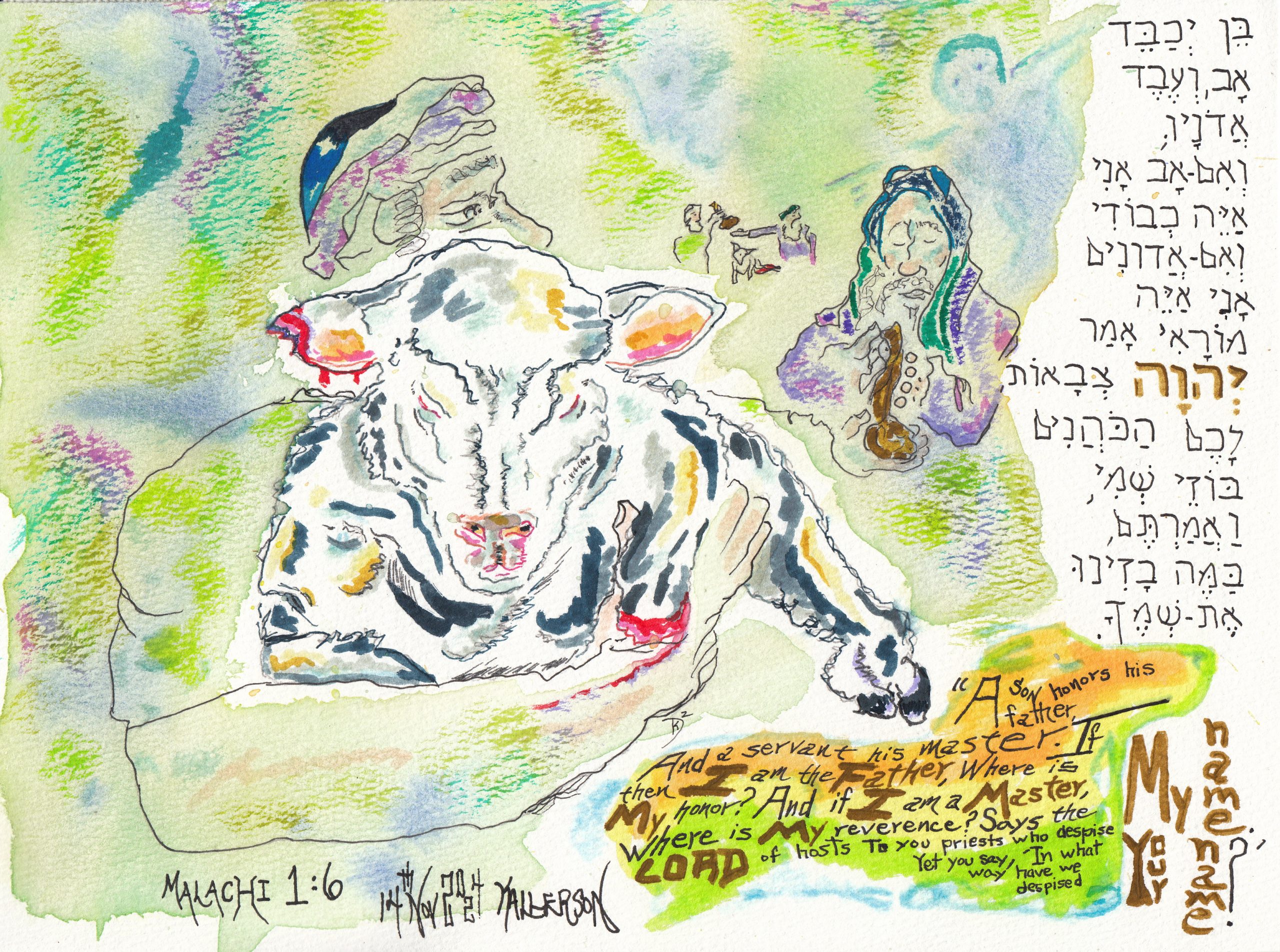
Artwork by Douglas Kallerson.
Malachi 1:4-8
Where Is My Honor?
(Typed 19 Aug 2024) The clock didn’t work on sermon typing morning. Therefore, I didn’t get up until about 4:15. Because of this on a normal sermon typing day, I would be pretty late in getting finished – even more late than usual.
However, an analysis of the style of presentation of the Lord’s word in Malachi doesn’t require as much difficult contemplation as in the other books we have gone through. So, even for a regular sermon typing day, I was done quite early.
The prophetic words still bear the weight and authority of the word of the Lord. They are to be evaluated carefully, considered prayerfully, and contemplated in a manner that will lead us to a more perfect understanding of the nature of the Lord.
They reveal to us His covenant-keeping nature, His directive hand in human affairs, and His expectations for those who are His people (whether they actually are or simply claim to be).
In these verses, the Lord uses Esau, the people, and Edom, their land, as examples of His hand against those who are prideful and arrogant towards His decisions. But His own people who stand before Him are not exempt from His directive hand of attention, both in a positive and a negative way.
Text Verse: “For this reason many are weak and sick among you, and many sleep. 31 For if we would judge ourselves, we would not be judged. 32 But when we are judged, we are chastened by the Lord, that we may not be condemned with the world.” 1 Corinthians 11:30-32
The idea of the Lord’s chastening is found throughout Scripture. In Deuteronomy 8:5, He says to Israel, “You should know in your heart that as a man chastens his son, so the Lord your God chastens you.” The words are singular, “You, Israel.”
That premise remains true for them to this day. Israel is an adopted son to the Lord. A son is chastened when He does wrong, and Israel has done wrong continuously. Their greatest wrong was rejecting Christ Jesus when He came.
And yet, instead of destroying them as a nation, the Lord has chastened them for two millennia. This doesn’t mean that all in Israel have been saved. Rather, only those who have received Jesus have been saved. However, as a corporate body, they have continued.
Those in the church are now sons of God through adoption. When we stray, we will receive chastening in an attempt to correct our conduct. However, it should be taken as an axiom that not all in the church are saved. There is the true church of believers, among whom are many who have never believed.
As long as we process such thoughts properly, our doctrine on matters of salvation will be aligned with Scripture. We may assume that Israel gets some sort of exception to God’s plan of salvation through Christ, but that would be erroneous.
Or we might get the idea that because we are born into a Christian home, we, too, are Christians. Pay attention to what the Bible says. In failing to do so, an eternity of difference may be ahead for yourself or others.
Such truths as this are to be found in His superior word. And so, let us turn to that precious word once again, and… May God speak to us through His word today, and may His glorious name ever be praised.
I. The Territory of Wickedness (verses 4, 5)
4 Even though Edom has said,
The words at first appear to be gender confused: ki tomar edom – For says (fem. sg.) Edom.” The words are those of the land (Edom). Even if Edom the man is a masculine entity, the land (the inheritance of verse 3), which stands as the subject, is feminine as if she is a mother of the inhabitants. As such, it is as if the land is calling out on behalf of her people. Concerning Edom’s words…
4 (con’t) “We have been impoverished,
But we will return and build the desolate places,”
rushashnu v’nashuv v’nivneh khoravoth – “Demolished! And return, and build wastelands.” Here is a word found just twice in Scripture, rashash. It signifies to beat down and thus to demolish. Impoverished would be the result of the action, not the action itself.
As for their words, they are the response to the destruction of the land of Edom by the Lord –
3 “And Esau, I hate,
And set his mountains – a devastation.
And his inheritance to jackals wilderness.”
4 “For says Edom,
‘Demolished! And return, and build wastelands.”
The Lord states that He is ultimately the Force behind the destruction of Esau’s land. It was seen previously that the Lord gave the land of Seir to Esau and his descendants –
“And command the people, saying, ‘You are about to pass through the territory of your brethren, the descendants of Esau, who live in Seir; and they will be afraid of you. Therefore watch yourselves carefully. 5 Do not meddle with them, for I will not give you any of their land, no, not so much as one footstep, because I have given Mount Seir to Esau as a possession. 6 You shall buy food from them with money, that you may eat; and you shall also buy water from them with money, that you may drink.’” Deuteronomy 2:4-6
If the Lord gave, it was His right to dispense with it as He chose. Edom was devastated, and the people were exiled. This was the Lord’s doing. But as an act of defiance against His judgment, Edom proudly boasted, “Yeah, it’s demolished, but we will prevail! We will return to our land, and we will reestablish it from the wastelands that have arisen in place of our home.”
Because of this, the Lord continues with His own proclamation against their boastful words…
4 (con’t) Thus says the Lord of hosts:
“They may build, but I will throw down;
koh amar Y’hovah ts’vaoth hemah yivnu vaani eheros –
“Thus said Yehovah Sabaoth:
‘They build, and I raze.’”
Here, the title Yehovah Sabaoth is introduced into the book of Micah. It will be used eight times in this chapter and twenty-four times in the book. It is derived from the verb tsava, to mass as an army or servants. Thus, Lord of Hosts expresses the idea well.
The words were in the singular, speaking of Edom as a single entity. Now, they go to the plural and refer to the people who comprise Edom.
Yehovah doesn’t dispute the fact that the people will return. In fact, the words presuppose it. They will build. Only something that is built can be razed. Edom had no prophecies of a permanent inheritance as Israel did. They had no prophecies that they had a future as a people for a set purpose, such as bringing forth the Messiah.
Yehovah had given the land to them. Now He had taken it away. Their attempts to regain and reestablish the land would be frustrated. The Pulpit Commentary notes –
“I will throw down. Edom never recovered its power; it became the prey of the Persians, the Nabatheans, the Jews under the Maccabees, the Macedonians, the Romans; and finally the Mohammedan conquest effected its utter ruin.”
The words here are similar to what transpired in the kingdom of Israel –
“The Lord sent a word against Jacob,
And it has fallen on Israel.
9 All the people will know—
Ephraim and the inhabitant of Samaria—
Who say in pride and arrogance of heart:
10 ‘The bricks have fallen down,
But we will rebuild with hewn stones;
The sycamores are cut down,
But we will replace them with cedars.’
11 Therefore the Lord shall set up
The adversaries of Rezin against him,
And spur his enemies on,
12 The Syrians before and the Philistines behind;
And they shall devour Israel with an open mouth.
For all this His anger is not turned away,
But His hand is stretched out still.” Isaiah 9:8-12
The Lord pronounced judgment against the northern kingdom of Israel. They were crushed and exiled according to the word of the Lord against their conduct. But in their arrogant pride, they claimed they would possess the land and build it. Without a word from the Lord for it to be so, it was not to come about.
To this day, there is the same ongoing problem in the land of Israel. The West Bank area is contested land. That will not change until the time the Lord determines it. Thousands of years later, the overpowering influence of the Lord’s decisions remains.
As for Edom, despite claiming they would rebuild, the Lord said He would also raze. As such…
4 (con’t) They shall be called the Territory of Wickedness,
The words continue in the plural: v’qaru lahem g’vul rishah – “And called to them Territory Wickedness.” In Numbers 20:23, it says, g’vul erets edom, “border land Edom.” A border defines what lies inside of it. In the case of the people’s efforts to be reestablished against the will of the Lord, they will be called g’vul rishah – “Territory Wickedness.”
The words are based upon the defiance of the people against the will of the Lord. It is an act of wickedness, and thus, the territory is defined by their act.
The short book of Obadiah was written as a prophecy against Edom. As Jacob was being destroyed for rebellion against the Lord, Edom rejoiced over it and assisted in the ruin of the people. But Edom was a brother to Jacob. This was a great offense to the Lord, and their misdeeds would be remembered by Him.
“For the day of the Lord upon all the nations is near;
As you have done, it shall be done to you;
Your reprisal shall return upon your own head.
16 For as you drank on My holy mountain,
So shall all the nations drink continually;
Yes, they shall drink, and swallow,
And they shall be as though they had never been.” Obadiah 1:15, 16
Therefore, the curse is pronounced against them…
4 (con’t) And the people against whom the Lord will have indignation forever.
v’haam asher zaam Y’hovah ad olam – “And ‘the people whom frothed Yehovah until vanishment.’” The word zaam signifies to foam at the mouth. Thus, one can easily get the sense. It is as if Yehovah’s mouth has frothed at them in anger and fury.
This anger was directed at those of Edom who presumed to stay and rebel against Him through their prideful resistance to His will. They were the object of His disfavor and raging anger. As a nation, they would never cease to be the object of His wrath. However, as individuals, this is not necessarily the case, nor can it be inferred.
This is the opposite of how many in the church consider Israel today. They accept the nation of Israel as a legitimate entity because God prophesied that they would be reestablished. However, they then equate this favor to all Jews, as if every one of them is accepted by God because they are in the land God promised them.
The idea is perverse. The abominations carried out within Israel by many today are like Sodom and Gomorrah. The Lord neither approves of them nor their actions. The Lord’s favor or enmity toward a national entity does not logically follow to all of its citizens.
As for Israel and the lesson they are being taught through Edom…
5 Your eyes shall see,
v’enekhem tirenah – “And your eyes see.” He is speaking to the people of Israel in the plural. They will see what the Lord has done to Edom, just as He prophesied. As such…
5 (con’t) And you shall say,
‘The Lord is magnified beyond the border of Israel.’
Rather: v’atem tomru yigdal Y’hovah me’al ligvul Yisrael –
“And you say,
‘Magnified, Yehovah, from upon to border Israel.’”
The border of Edom is being contrasted with the border of Israel. The words “from upon to border” do not mean “beyond the border.” Rather, they are speaking of Israel’s state –
“And called to them Territory Wickedness.”
“Magnified, Yehovah, from upon to border Israel.”
While the land of Edom was frustrated in the peoples’ attempts to reestablish themselves in their land, having its name instead called Wickedness, Israel was reestablished, retaining its name and national identity. In this, Israel magnified Yehovah’s name because the contrast was so evident.
In other words, this is not merely a contest between people groups. A distinction is being set forth concerning who those people groups are directed by. This can be seen, for example, in 2 Chronicles 25 –
“Now it was so, after Amaziah came from the slaughter of the Edomites, that he brought the gods of the people of Seir, set them up to be his gods, and bowed down before them and burned incense to them. 15 Therefore the anger of the Lord was aroused against Amaziah, and He sent him a prophet who said to him, ‘Why have you sought the gods of the people, which could not rescue their own people from your hand?’” 2 Chronicles 25:14, 15
Amaziah had foolishly rejected the Lord through his actions. What good were Edom’s gods if they couldn’t prevail in battle against Israel?
The ultimate point of everything that Scripture details is the glorification of Yehovah Elohim, the Lord God. He is the Creator, the Establisher of Israel, and the only true God. Even if Edom and Israel appear to be the subjects of the discourse at times, it is ultimately the Lord, His power, and His directive hand that is being highlighted.
Though nothing explicit is stated here, it is still an implicit reference to Genesis, where the Lord God spoke the universe into existence and directed the line of humanity according to His purposes, such as calling Abraham, selecting Isaac, and choosing Jacob, who is Israel.
That same Directive Force is being highlighted well over a millennia later, and it returns us to the thought of Genesis 25, where Yehovah said to Rebekah that two nations were in her womb and that the two peoples would be separated from her body.
However, despite this promise of the Lord that Israel would see these things and magnify His name, that was not yet the case. That is seen in the words of the next verse…
What is this you have brought before Me?
What makes you think your offering is ok?
The “Jesus” you proclaim is one of apostasy
He is a defective “savior.” You have followed the wrong way
My Son is pure and holy. He is undefiled
In Him there is no blemish or defect
Through Him alone, I would have on you smiled
But through any other, you I will surely reject
Be sure the offering is right – Jesus!
Open the Bible and there He is on full display
When You get it right, you will get your A+
So call on Him, and believe the true gospel today!
II. The Table of the LORD Is Contemptible (verses 6-8)
6 “A son honors his father,
And a servant his master.
As with verse 2, Yehovah begins this section with another assertion. This will be followed by an objection from Israel which will then receive a rebuttal from Yehovah. However, this directed assertion is to the priests in particular. It begins with a statement of how things normally are.
ben y’khaved av v’eved adonav –
“Son honors father,
And servant his master.”
In normal human conduct, a son treats his father with respect, complies with his wishes, does as he is directed, and so forth. The same is true with how a servant likewise is expected to treat his master.
The father is the one who raised the son, fed him, protected him, provided for his needs, etc. A servant is housed, fed, and his needs are tended to according to the hand of his master. These things are expected to result in honoring the father or master.
Yehovah had done these things for Israel since their inception. Despite this, there was not a reciprocation from them…
6 (con’t) If then I am the Father,
Where is My honor?
The words bear emphasis: v’im av ani ayeh kh’vodi –
“And if Father, I –
Where My honor?”
The “if” is not a question. Even without a verb, the mood is conditional and yet adamant. “I am a father to you. As such, where is the honor I am to be given as is the case with any normal human conduct?”
The Father/son relationship between Yehovah and Israel was clearly set forth in His words to Pharaoh –
“Then you shall say to Pharaoh, ‘Thus says the Lord: “Israel is My son, My firstborn. 23 So I say to you, let My son go that he may serve Me. But if you refuse to let him go, indeed I will kill your son, your firstborn.”’” Exodus 4:22, 23
But this is not just Israel as a nation only. Rather, the idea of sonship extends to individuals –
“You are the children of the Lord your God; you shall not cut yourselves nor shave the front of your head for the dead. 2 For you are a holy people to the Lord your God, and the Lord has chosen you to be a people for Himself, a special treasure above all the peoples who are on the face of the earth.” Deuteronomy 14:1, 2
As this is the case, the Lord wants to know why He is not treated with the respect due to a Father. And more…
6 (con’t) And if I am a Master,
Where is My reverence?
Not one out of the almost sixty versions I checked translates these words correctly: v’im adonim ani ayeh morai –
“And if Lords, I –
Where My fear?”
The word Lords, adonim, is plural while the emphatic “I” is singular. This is the only time in Scripture this occurs when Yehovah refers to Himself. The job of translators is to translate, letting the chips fall where they may. This, unfortunately, is not always the case.
Not translating it in the plural does a disservice to the Lord who gave the word to the priests of Israel and to us. We are the recipients of the word. But as Sergio noted when I told him about this error, “It’s the herd mentality. I bet that’s why so many translators make the same mistakes.”
This cannot be speaking of the priests as lords of Israel. The same emphatic I that follows the previous clause eliminates any such attempt to finagle that scenario. The Pulpit Commentary considers this to be a majestic plural, like the word elohim. But there is nothing to suggest this and no precedent for it elsewhere. Rather, John Gill says –
“…the word is in the plural number, and may be understood of Jehovah, Father, Son, and Spirit; though the first Person [I] seems rather designed, who stands in this relation to Christ, as Mediator; to the angels, his ministering spirits; to the ministers of the Gospel, and to all the saints; and indeed to all men, and particularly to the Israelites; as appeared by the special laws and commands he enjoined them, and by his special government, protection, and care of them.”
It is hard to think of any better reason for this enigma, especially when Yehovah says this in Malachi 3:1 –
“‘Behold, I send My messenger,
And he will prepare the way before Me.
And the Lord, whom you seek,
Will suddenly come to His temple,
Even the Messenger of the covenant,
In whom you delight.
Behold, He is coming,’
Says the Lord of hosts.”
Obviously, this is looking back on what is presented with a knowledge of the coming of Christ, who is the Lord. But still, only five other times is ha’adon, the Lord, used. They are all in Isaiah, and they each clearly refer to the Lord God of Hosts, Yehovah Sabaoth. That is again seen right here in the next words…
6 (con’t) Says the Lord of hosts
To you priests who despise My name.
amar Y’hovah ts’vaoth lakhem ha’kohanim boze shemi – “Said Yehovah Sabaoth to you, the priests, disesteeming My name.” The assertion is specifically said to be from Yehovah Sabaoth, and it is directed at the priests of the Mosaic Covenant. The ultimate assertion is that they disesteem His name.
As the mediators between the people and Yehovah, what they do will be a reflection of how they consider Him. Therefore, the Lord finds their actions wholly inappropriate. No father deserved such treatment from a son, and no lord would allow it from a servant.
But with complete disrespect for their God, whom they were called to serve on behalf of the people, they ignorantly question Him with their objection…
6 (con’t) Yet you say, ‘In what way have we despised Your name?’
vaamartem bameh vazinu eth sh’mekha – “And said, ‘In what we disesteemed Your name?’” They ridiculously claim that they are completely unaware of their crimes against the Lord. And yet, they are the stewards of the word of the Lord and the administrators of the covenant as set forth in the word.
Their actions in the service of the Lord were inappropriate and they either knew it or they should have known it. Either way, the Lord, through Malachi, speaks His mind…
7 “You offer defiled food on My altar,
The words form the rebuttal to the objection, and yet they also form the next assertion that will be objected to: magishim al mizb’khi lekhem m’goal – “Approaching upon My altar bread defiled.” The word lekhem, bread, does not literally mean bread. At times, bread stands for any food, but to show a precedent for this –
“They shall be holy to their God and not profane the name of their God, because they present the offerings by fire to the LORD, the food [lekhem] of their God; so they shall be holy.” Leviticus 21:6
As for the word gaal, defiled, it is not used in the books of Moses regarding food. However, it is expressed in this manner in Daniel –
“But Daniel purposed in his heart that he would not defile [gaal] himself with the portion of the king’s delicacies, nor with the wine which he drank; therefore he requested of the chief of the eunuchs that he might not defile [gaal] himself.” Daniel 1:8
The thought here is not unlike that in the narrative of Cain and Abel –
“Now Abel was a keeper of sheep, but Cain was a tiller of the ground. 3 And in the process of time it came to pass that Cain brought an offering of the fruit of the ground to the Lord. 4 Abel also brought of the firstborn of his flock and of their fat. And the Lord respected Abel and his offering, 5 but He did not respect Cain and his offering. And Cain was very angry, and his countenance fell.” Genesis 4:2-5
Hebrews 11 explicitly tells us that Abel’s offering was one of faith. It wasn’t the type of offering but the heart behind the offering that made it acceptable. In the case of the priests, their offerings may have been the right type, but it will be seen they are in the wrong condition.
Such actions by the priests indicated that their conduct was not of faith. If they believed the Lord would see, they would not offer as they did. Thus, an implicit reference to the priests’ conduct being like that of Cain’s is being highlighted.
As the Old Testament is closing out, the same attitude of the first recorded person to be born to Adam is reflected in the priests of Israel. Despite this, the priests object…
7 (con’t) But say, ‘In what way have we defiled You?’
vaamartem bameh gealnukha – “And said, ‘In what defiled You?’” The obvious connection of the defiling of the altar to the Lord must be highlighted –
“Approaching upon My altar bread defiled.”
“In what defiled You?”
To defile the altar with that which is defiled is to defile Yehovah, who receives those offerings from the altar. Such a comparative analogy is provided by Jesus –
“Fools and blind! For which is greater, the gift or the altar that sanctifies the gift? 20 Therefore he who swears by the altar, swears by it and by all things on it. 21 He who swears by the temple, swears by it and by Him who dwells in it. 22 And he who swears by heaven, swears by the throne of God and by Him who sits on it.” Matthew 23:19-22
The rebuttal to their objection is next provided…
7 (con’t) By saying,
‘The table of the Lord is contemptible.’
b’emarkhem shulkhan Y’hovah nibzeh hu – “In your saying, ‘Table, Yehovah – disesteemed it.’” It is an analogy of conduct being equated to words. The priests would never openly say this. They got their livelihood from the people’s offerings. If they were to say this, the people would simply give up on their offerings.
Rather, the actions of the priests speak louder than whatever words they uttered. As for the word table, it is used in Ezekiel in this manner –
“They shall enter My sanctuary, and they shall come near My table to minister to Me, and they shall keep My charge.” Ezekiel 44:16
It is as if the Lord descends to the altar to sit and feast among the people. However, the priests were defiling the offerings and calling His table contemptible through their actions. These things are next explained by Him…
8 And when you offer the blind as a sacrifice,
Is it not evil?
There is a strong emphasis in the words with the use of a paragoge which is then answered with an emphatic statement, not a question, from the Lord: v’khi tagishun iver lizboakh ein ra – “And when (surely) approach blind to sacrifice – ‘Not evil!’”
The paragoge highlights the attitude of the action. The priests willfully and purposefully give the blind as a sacrifice, something forbidden by the law –
“All the firstborn males that come from your herd and your flock you shall sanctify to the Lord your God; you shall do no work with the firstborn of your herd, nor shear the firstborn of your flock. 20 You and your household shall eat it before the Lord your God year by year in the place which the Lord chooses. 21 But if there is a defect in it, if it is lame or blind or has any serious defect, you shall not sacrifice it to the Lord your God.” Deuteronomy 15:19-21
The priests were commanded to inspect the animals to ensure against the sacrifice of a defective animal. This could not be allowed because each sacrifice presented to the Lord was given in type of the all-perfect sacrifice of Jesus Christ, the unblemished offering of Himself to God.
This willful violation of the law is equated to a verbal exclamation from the priests, “Not evil!” It is the exact sentiment that brought about the exile of the people. Isaiah told them –
“Woe to those who call evil good, and good evil;
Who put darkness for light, and light for darkness;
Who put bitter for sweet, and sweet for bitter!” Isaiah 5:20
These priests were purposefully violating the law they were to minister before the people. In accepting a defective sacrifice, the people saw this and had the thought instilled in them that Yehovah was not holy or to be treated with the absolute respect He deserved.
This attitude toward the Lord is reflected in the words, “Table Yehovah – disesteemed it!” It is the same word, bazah, that is used to describe Jesus in Isaiah 53 –
“He is despised [bazah] and rejected by men,
A Man of sorrows and acquainted with grief.
And we hid, as it were, our faces from Him;
He was despised [bazah], and we did not esteem Him.” Isaiah 53:3
The attitude of the people towards the Lord Jesus was the same as the attitude of the people towards the Lord’s table. Both were highlighted by the priests’ attitude toward him. Understanding that, it next says…
8 (con’t) And when you offer the lame and sick,
Is it not evil?
v’ki tagishu piseakh v’kholeh ein ra – “And when approach lame and rubbed – ‘Not evil!’” These were likewise forbidden to be presented to the Lord –
“And whoever offers a sacrifice of a peace offering to the Lord, to fulfill his vow, or a freewill offering from the cattle or the sheep, it must be perfect to be accepted; there shall be no defect in it. 22 Those that are blind or broken or maimed, or have an ulcer or eczema or scabs, you shall not offer to the Lord, nor make an offering by fire of them on the altar to the Lord. 23 Either a bull or a lamb that has any limb too long or too short you may offer as a freewill offering, but for a vow it shall not be accepted.
You shall not offer to the Lord what is bruised or crushed, or torn or cut; nor shall you make any offering of them in your land. 25 Nor from a foreigner’s hand shall you offer any of these as the bread of your God, because their corruption is in them, and defects are in them. They shall not be accepted on your behalf.” Leviticus 22:21-25
This was explicit within the law, but the priests didn’t want to lose out on their portion of the offerings. And so they compromised in order to benefit from what was defective.
Concerning the word kholeh, it is literally translated as “rubbed.” If something is rubbed, it will become worn. The idea is that which is weak, sick, or afflicted. Yehovah, Israel’s God, was offered such shameful offerings. And yet, He next says…
8 (con’t) Offer it then to your governor!
The word translated as “offer” here is a different word but with a similar meaning: haqrivehu na l’phekhathekha – “Near it, I pray, to your governor!” Depending on when Malachi was recorded, this could be referring to anyone from Nehemiah, as noted in Nehemiah 5:14, to Zerubbabel in Haggai 1:1. Or it could be someone else who was filling that position.
Israel had no king at this time, nor would they ever again, with the exception of Jesus, whom they rejected. To this day, Jesus is the King of Israel, though He is not the King in Israel. The pekhah, or governor, is a word of foreign origin. After the exile, it was probably used by the foreign rulers over Israel to designate the one who would govern the land on their behalf.
The point of Yehovah’s words to the priests is that this governor would be displeased to have a defective animal presented to him. That is clearly indicated in the next words, which beg a negative response…
*8 (fin) Would he be pleased with you?
Would he accept you favorably?”
Says the Lord of hosts.
hayirtskha o hayisa phanekha amar Y’hovah ts’vaoth –
“‘He accept you or lift faces you?’
Said Yehovah Sabaoth.”
Obviously he would be displeased with such an offering. And yet, the priests were accepting defective offerings from the people and presenting them to God. The thinking is twisted and demented.
And this is just what our thinking is concerning God without knowing Him as He is. Man’s understanding of God has been so twisted and convoluted throughout the nations and over the millennia that apart from the Bible, there is almost no understanding of Him at all.
Things can be inferred about Him from the world around us. The creation will give anyone a general knowledge of Him if they simply apply their minds to what they see. But to know Him specifically apart from Scripture has been lost.
The stories of the past were handed down by Noah and his sons to their children. This can be inferred from the legends and tales that have been discovered in many societies. It can be inferred from Job’s understanding of the Lord as well.
However, that knowledge eventually corrupted to the point where God had to intervene in human affairs once again. In selecting Israel, He kept proper knowledge of Himself going. But even that was all but forgotten for a time, as will be evidenced in our closing verse.
An entire nation of people had almost completely forgotten the ways of the Lord. They had a system set up for the worship of Him, but that degraded into generalities. They had the words of the prophets, but they also were infected with false prophets.
Do you think that you can rely on churches to keep you on the right path? Do you think the word of a pastor or priest will keep you from straying? That will only be true if the church is teaching the truth or if the pastor is rightly dividing the word of God.
But you can’t really know those things without checking for yourself. Israel had a religion, religious leaders, and even prophets. And yet, they had completely lost the proper worship of the Lord until they came across a forgotten book.
Be sure not to let that happen to yourself and those you love. Be sure the Jesus you are following is the One the Bible proclaims. Read it daily, prayerfully, and with the intent of finding Him and holding fast to Him all your days. May it be so, to the glory of our supremely wonderful God. Amen.
Closing Verse: “Then Shaphan the scribe showed the king, saying, ‘Hilkiah the priest has given me a book.’ And Shaphan read it before the king.
11 Now it happened, when the king heard the words of the Book of the Law, that he tore his clothes. 12 Then the king commanded Hilkiah the priest, Ahikam the son of Shaphan, Achbor the son of Michaiah, Shaphan the scribe, and Asaiah a servant of the king, saying, 13 ‘Go, inquire of the Lord for me, for the people and for all Judah, concerning the words of this book that has been found; for great is the wrath of the Lord that is aroused against us, because our fathers have not obeyed the words of this book, to do according to all that is written concerning us.’” 2 Kings 22:10-13
Next Week: Malachi 1:9-14 Let us to the Lord sing! Give it a try… (For Great King, I) (3rd Malachi Sermon)
The Lord has you exactly where He wants you. He has a good plan and purpose for you. He has sent His Messenger to carry the good news to all people. Jesus! God promised, and God delivered. The time of the law has ended, and grace has come. Praise God for Jesus.
Malachi 1:4-8
4 “For says Edom,
‘Demolished! And return, and build wastelands.’”
“Thus said Yehovah Sabaoth:
‘They build, and I raze.
And called to them Territory Wickedness,
And “the people whom frothed Yehovah until vanishment.”
5 And your eyes see,
And you say,
‘Magnified, Yehovah, from upon to border Israel.””
6 “‘Son honors father,
And servant his master.
And if Father, I –
Where My honor?
And if Lords, I –
Where My fear?’
Said Yehovah Sabaoth to you, the priests, disesteeming My name.’
And said, ‘In what we disesteemed Your name?’
7 ‘Approaching upon My altar bread defiled.
And said, ‘In what defiled You?’
In your saying, ‘Table, Yehovah – disesteemed it.’
8 ‘And when (surely) approach blind to sacrifice – “Not evil!”
And when approach lame and rubbed – “Not evil!”
Near it, I pray, to your governor!
He accept you or lift faces you?’
Said Yehovah Sabaoth.”
Even though Edom has said,
“We have been impoverished,
But we will return and build the desolate places,”
Thus says the Lord of hosts:
“They may build, but I will throw down;
They shall be called the Territory of Wickedness,
And the people against whom the Lord will have indignation forever.
5 Your eyes shall see,
And you shall say,
‘The Lord is magnified beyond the border of Israel.’
Polluted Offerings
6 “A son honors his father,
And a servant his master.
If then I am the Father,
Where is My honor?
And if I am a Master,
Where is My reverence?
Says the Lord of hosts
To you priests who despise My name.
Yet you say, ‘In what way have we despised Your name?’
7 “You offer defiled food on My altar,
But say,
‘In what way have we defiled You?’
By saying,
‘The table of the Lord is contemptible.’
8 And when you offer the blind as a sacrifice,
Is it not evil?
And when you offer the lame and sick,
Is it not evil?
Offer it then to your governor!
Would he be pleased with you?
Would he accept you favorably?”
Says the Lord of hosts.