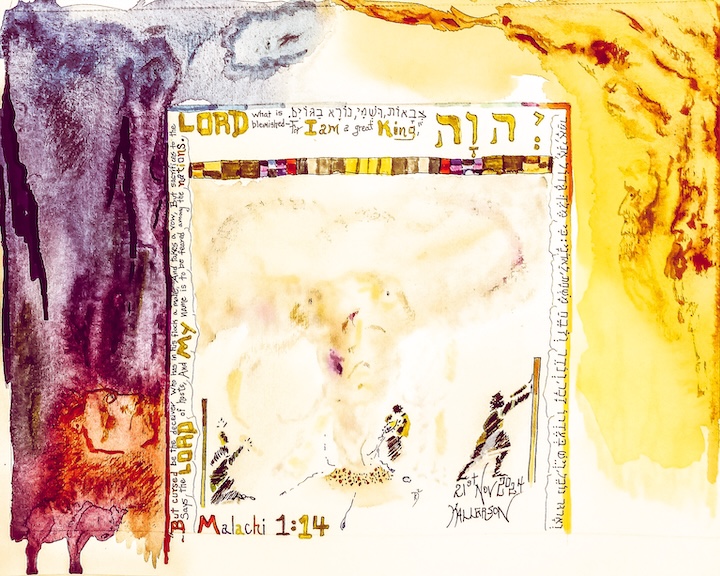
Artwork by the amazing Douglas Kallerson
Malachi 1:9-14
For a Great King, I
(Typed 26 August 2024 – Jim and Rhoda’s birthday). There are times when my mind will stop whatever I am considering and mull the greatness of who Jesus is. It often happens right while I am closing up a sermon or at some other point when the fact that Jesus is God comes to the forefront of my attention.
It is so hard to actually grab on to this idea that the thoughts are not expressible in words. Even though the Bible tells us that God came in human flesh, and the way it came about is clearly stated in Luke 1:35, it is still something that defies proper description.
Mary was told that the Holy Spirit would come upon her and the power of the Highest would overshadow her. And yet, how can we conceive of the infinite God of the universe uniting with humanity? It’s like considering the moment of creation: there was nothing and suddenly everything in an instant.
There was no time, and then time began passing. There was no space, and suddenly it existed. There was nothing solid, but then everything we are, everything we see, and everything that exists was there. How did things go from the first state to the next?
We know it happened, and we know that God did it. The Lord God is, and He is great. That is what Malachi tells the people of Israel. And yet they treated Him with absolute contempt in their conduct.
Jesus is the Lord God. Though there is the physical aspect in Jesus the Man, and there is the eternal, all-powerful, and all-knowing aspect of His deity. The Power behind creation and our continued existence is the same Power that united with humanity. And yet, how do we treat Him? Would Malachi’s words to Israel be even partly true of us in our conduct toward the Lord?
Text Verse: “For the Father judges no one, but has committed all judgment to the Son, 23 that all should honor the Son just as they honor the Father. He who does not honor the Son does not honor the Father who sent Him.” John 5:22, 23
The people and priests of Israel defiled the name of the Lord. They treated it contemptuously, failing to honor Him as their Sovereign. When Jesus came, they did the same to Him. They rejected Him and have suffered the punishment they deserve for this betrayal of the Lord their God. In failing to honor Him, they failed to honor the Father who sent Him.
But the “Christian” world has been no better. There are people walking around in poofy hats and flowing vestments who prey on little children, sleep with the wives of their congregants, and defile themselves and the name of the Lord through their actions, while pretending that they are holy to the Lord.
Televangelists enrich themselves with millions of dollars while spewing out cliches and false promises, ensnaring the people they should be leading to a right knowledge of the word.
And the people who accept these things are no better in their attitude towards the Lord. They are looking for easy religion that will never provide them with a sound understanding of Him and what He expects.
We all know that sound theology is hard work. Sunday mornings are not meant to add to the already long work weeks we have to go through, right? Our conduct and actions toward the Lord are dismissive of the fact that Jesus is God and that He is a great King.
May we make every effort to acknowledge Him with the honor and respect He is due. It is a certain truth that is to be found in His superior word. And so, let us turn to that precious word once again, and… May God speak to us through His word today, and may His glorious name ever be praised.
I. Shut the Double-Doors (verses 9-11)
9 “But now entreat God’s favor,
v’atah khalu na phene el – “And now, rub, I pray, faces God!” The same word just used in verse 8 is used again –
“And when approach lame and rubbed [khalah] – ‘Not evil!’”
“And now, rub [khalah], I pray, faces God!”
It is debated whether this is actually a call for turning and entreating God or whether it is an ironic statement contrasting what has just been said. The latter seems more likely, and that is how I translated it. The priests were shoving defective sacrifices in the face of God, thus treating Him as defective, unworthy of proper sacrifice and offering.
The irony, then, is to be a tool of learning. Rather than offer a rubbed (meaning a defective) sacrifice to the Lord, the priests are being shown that they are to do the opposite. They are to rub (meaning entreat as if stroking) God’s faces and thus His favor. One can see the intent of this word from other passages, such as Daniel 9:13 –
“as it is written in the law of Moses, all this evil hath come upon us, and we have not appeased [khalah: to rub] the face of Jehovah our God to turn back from our iniquities, and to act wisely in Thy truth.”
Further, notice that in Malachi’s words it says “God,” not “Yehovah.” Yehovah is God, but the priests have denied this through their conduct, treating Him shamefully. The word “God” is thus set in opposition to “governor” of the previous verse –
“Near it, I pray, to your governor!”
“And now, rub, I pray, faces God,”
Who is greater? The governor appointed over the land by a foreign ruler, or God who governs all things according to His infinite wisdom? They would never think of treating a human governor with such disrespect.
Therefore, the priests should do their utmost to appease God through careful and attentive priestly conduct, and yet they have not. The irony continues with…
9 (con’t) That He may be gracious to us.
Vikhanenu – “And He favors us?” Malachi includes himself among the collective people known as Israel. The priests represented all of them. How could the people receive God’s grace when they were treating Him with contempt?
Obviously, grace means getting what you do not deserve and so one could argue that this isn’t grace at all. But it is the priests who are the mediators between God and Israel. How does God pour out His grace on us now? Through our Mediator, Jesus –
“And of His fullness we have all received, and grace for grace.” John 1:16
One can see, then, that the grace must come through the right actions of the representatives of the people. This is why it said this to the priests in Numbers 6 –
“Speak to Aaron and his sons, saying, ‘This is the way you shall bless the children of Israel. Say to them:
24 “The Lord bless you and keep you;
25 The Lord make His face shine upon you,
And be gracious to you;
26 The Lord lift up His countenance upon you,
And give you peace.”’
27 So they shall put My name on the children of Israel, and I will bless them.” Numbers 6:23-27
With that, a parenthetical thought is next expressed…
9 (con’t) While this is being done by your hands,
The words “your hand” are to be taken emphatically: miyedkhem hay’tah – “(From your hand became this!)” The Lord, through Malachi, states that this is just what the priests have been doing. They were responsible as the representatives of the people to administer the priestly functions of the Law of Moses. And yet, the Lord is charging them with violating it through their abominable treatment of Him before the people.
How can they pronounce a priestly blessing upon the people if they are disparaging the One who is the Subject of the blessing? Why would the Lord even consider blessing them through the lifting of their wicked hands?
To understand what is going on, think of any church in the world today not adhering to what the word says. They teach a false doctrine, and yet they petition the Lord to bless the people. They appoint adulterers, women, homosexuals, transexuals, etc., as their leaders, contrary to the word, and yet they expect the Lord to look with favor upon them.
The priests of Israel were appeasing their governor, but they were unwilling to please their God. But more, they were shoving their conduct right in His face. Pastors and preachers appease the government through their wicked appointments, and yet by their actions, they shove the grace of Christ right back in the face of God. When they do this, the ironic question is asked…
9 (con’t) Will He accept you favorably?”
Says the Lord of hosts.
zoth hayisa mikem panim amar Y’hovah ts’vaoth –
“‘Lifts from you faces?’
Said Yehovah Sabaoth.”
The words mean, “Will He find you acceptable?” They are either speaking of the priests or the people in general. My guess is it is directed to the priests. Malachi included himself, and thus all the people, in a previous clause. Here, the words are in the second person.
As such, he is saying that the Lord will not accept the priests. That, in turn, means He will not accept the people. Next, Malachi again affixes the Source of His words to them, “Yehovah Sabaoth has spoken. I am conveying His words to you now.” With that, the word of the Lord to the priests continues…
10 “Who is there even among you who would shut the doors,
mi gam bakhem v’yisgor d’lathayim – “‘Who also in you, and shut double-doors!” The meaning, although debated, is probably a wearied exclamation, “O! Won’t one of you priests just shut the temple doors?” The Lord is completely fed up with them and their conduct.
It would be better for them to just shut the temple than to have to put up with their abominable conduct and worthless sacrifices. This reprehensible thought takes the reader back to the conduct of the priests before they were exiled –
“For our fathers have trespassed and done evil in the eyes of the Lord our God; they have forsaken Him, have turned their faces away from the dwelling place of the Lord, and turned their backs on Him. 7 They have also shut up the doors of the vestibule, put out the lamps, and have not burned incense or offered burnt offerings in the holy place to the God of Israel. 8 Therefore the wrath of the Lord fell upon Judah and Jerusalem, and He has given them up to trouble, to desolation, and to jeering, as you see with your eyes. 9 For indeed, because of this our fathers have fallen by the sword; and our sons, our daughters, and our wives are in captivity.” 2 Chronicles 29:6-9
The priests abandoned the temple, shutting it up, and neglected their duties given according to the Law of Moses. This was one of the causes of all of the trouble and distress that had fallen upon the people of Judah.
And yet, the Lord now says that He would rather be neglected by the priests than be served by them with their contemptible offerings. With the doors shut, it would preclude them from going in and conducting their abhorrent affairs, including…
10 (con’t) So that you would not kindle fire on My altar in vain?
v’lo tairu misb’khi khinam – “And no light my altar gratuitously!” The word khinam means gratis, without charge. Thus, they were entering the temple and lighting the incense altar – a picture of petitioning God through prayers for the people – in a manner that was wholly inappropriate and, as the NKJV rightly paraphrases it, in vain.
To avoid this, because the Lord would not respond to their prayers, He simply tells them to shut the double-doors and not come into His presence to petition Him. This is because…
10 (con’t) I have no pleasure in you,”
Says the Lord of hosts,
ein li khephesh bakhem amar Y’hovah ts’vaoth –
“‘Not to Me pleasure in you.’
Said Yehovah Sabaoth.”
What good would it be for the priests, the mediators of the covenant, to light the twice daily incense before the Lord? They had made themselves unacceptable to Him. In not accepting them, He would not welcome or receive their mediation on behalf of the prayers of the people, represented by the incense. And more…
10 (con’t) “Nor will I accept an offering from your hands.
u-minkhah lo ertseh miyedkhem – “And present – no accept from your hand.” The minkhah, or present (as in presenting an offering) refers to the grain offering of Leviticus 2 –
“When anyone offers a grain offering to the Lord, his offering shall be of fine flour. And he shall pour oil on it, and put frankincense on it. 2 He shall bring it to Aaron’s sons, the priests, one of whom shall take from it his handful of fine flour and oil with all the frankincense. And the priest shall burn it as a memorial on the altar, an offering made by fire, a sweet aroma to the Lord.” Leviticus 2:1, 2
Frankincense was added to this offering from the people. Thus, there was the sense of asking for favor on behalf of the people who offered. However, this was not accepted. Because the priests were defiled through their conduct, the people were not accepted through the priestly mediation.
Imagine it! Offering a defiled Jesus to God. But this is essentially what churches do when they ignore His word and claim they are petitioning God through Him. They defile what Jesus represents. Thus, the Lord will not accept their perverted version of Jesus. This is reflected in the words of Paul –
“For if he who comes preaches another Jesus whom we have not preached, or if you receive a different spirit which you have not received, or a different gospel which you have not accepted—you may well put up with it!” 2 Corinthians 11:4
People go to churches where another, a false, Jesus is on prominent display, and yet they put up with it. When a church ignores what the word says that church ignores what God has instructed. Their Jesus is not the Jesus described in the word, and God will not hear them when they call out to Him. Their gifts have been defiled by those who are supposed to proclaim Jesus as God has instructed.
The priests of Israel were defiling the people before God because they and their actions were defiled. They made the name of the Lord ignoble. In contrast to that…
11 For from the rising of the sun, even to its going down,
My name shall be great among the Gentiles;
ki mimizrakh shemesh v’ad m’voo gadol sh’mi bagoyim –
“‘For from ascension sun, and until his descension,
Great My name in the Gentiles.”
Verse 11 has only two verbs, both in the participle form. The intent of them must be obtained from the surrounding context. Are they referring to the present or the future? They must be future. The words clearly anticipate the dispensation of grace, the ending of the Mosaic code, the inclusion of Gentiles in proper worship of God, and so much more.
In the time of Malachi, under the dispensation of the law, the temple in Jerusalem was to be the sole place for the worship of the Lord –
“Take heed to yourself that you do not offer your burnt offerings in every place that you see; 14 but in the place which the Lord chooses, in one of your tribes, there you shall offer your burnt offerings, and there you shall do all that I command you.” Deuteronomy 12:13, 14
This was said to be the place even for Gentiles who sought the Lord –
“Moreover, concerning a foreigner, who is not of Your people Israel, but has come from a far country for Your name’s sake 42 (for they will hear of Your great name and Your strong hand and Your outstretched arm), when he comes and prays toward this temple, 43 hear in heaven Your dwelling place, and do according to all for which the foreigner calls to You, that all peoples of the earth may know Your name and fear You, as do Your people Israel, and that they may know that this temple which I have built is called by Your name.” 1 Kings 8:41-43
Some Jewish and Christian commentators claim that because of what Malachi is saying, that the name of the Lord was already held in esteem by the nations of the world somewhat in a manner of Job. This is entirely incorrect.
Even in the New Testament, Paul tells us in 1 Corinthians 10:20 that the worship of the Gentiles, apart from coming to faith in Jesus, was not conducted in an acceptable manner to the Lord.
Rather, the words of this verse are set in contrast to the conduct of the priests in the temple where the Gentiles were to come and discover the proper worship of the Lord.
This system, set up and designed to anticipate the coming Messiah in every detail, had failed to produce anything but apostasy by the people. Its rites and rituals would end and a new form of worship “in spirit and in truth” (John 4:23, 24), would come about.
As for Job, he lived at the tail end of a time when knowledge of the true God and the promise of His coming Messiah remained, passed down from the times of Noah. That worship was being lost and so the Lord called Israel to preserve those things until the time for Messiah was realized.
During this time, the world fell into a complete lack of proper worship of the Lord. Israel alone preserved this knowledge for a set duration. That time was to end with the coming of Jesus…
11 (con’t) In every place incense shall be offered to My name,
uv’khal maqom muqtar mugash lishmi – “And in every place, incense approached to My name.” This is not to be taken literally, as in the RCC and other such churches. The “incense” that is offered is Jesus, the type anticipating the Antitype.
To fully understand this and all of the beautiful pictures involved in the incense, your homework for tonight is to go back and watch the Superior Word sermon on Exodus 30:22-38 (The Holy Anointing Oil and the Holy Incense).
The offering of Jesus will be acknowledged throughout the Gentile world. Thus, it is as if the incense that anticipated Him is being offered. Further…
11 (con’t) And a pure offering;
uminkhah t’horah – “And present, pure.” In contrast to the defiled offerings of the priests of Israel, and like the incense, the minkhah offered by the Gentiles will be considered pure and acceptable. This is because Jesus is the fulfillment of every detail of the Levitical grain offering.
As additional homework for you tonight, please be sure to watch the Superior Word sermon Leviticus 2:1-16 (The Grain Offering). The type was given in anticipation of the Antitype, Jesus. It is through Him that the greatness of God is exalted…
11 (con’t) For My name shall be great among the nations,”
Says the Lord of hosts.
ki gadol sh’mi bagoyim amar Y’hovah ts’vaoth –
“‘For great My name in the Gentiles,’
Said Yehovah Sabaoth.”
In Genesis 4, it says –
“And in the process of time it came to pass that Cain brought an offering of the fruit of the ground to the Lord. 4 Abel also brought of the firstborn of his flock and of their fat. And the Lord respected Abel and his offering, 5 but He did not respect Cain and his offering. And Cain was very angry, and his countenance fell.” Genesis 4:3-5
The rejection of Cain’s offering and the acceptance of Abel’s is not because of the type of offering. Both are noted as a minkhah. The reason for the difference is explained in Hebrews 11:4, saying, “By faith Abel offered to God a more excellent sacrifice than Cain.”
Abel had faith in what he presented to the Lord. Cain did not. The priests, if they had faith, would have aligned their sacrifices and offerings in accord with the law that mandated them. An offering of Jesus, meaning the true Jesus, is one of faith in Jesus.
People can and do go to church while not believing a thing. Others offer a false Jesus to God. Some just offer lip service to Him. But for those who have faith in Jesus as recorded in Scripture, their offering is that which exalts Yehovah Sabaoth.
Throughout the entire Gentile world, the message of Jesus, when properly presented, has been received by the Gentiles and it has brought honor to God, just as our text verse today says. Israel, however, contrasts how the Gentiles would exalt the name of the Lord…
Sweet smelling spices combined into one
To make a holy incense for Me
Every detail points to the coming Christ, My Son
This is the reason for such specificity
The work that He will do is revealed in each sweet smell
And the salt speaks of Him, and His work also
Every detail has a wondrous story to tell
Ponder each, and their meaning you will know
Look into these things as recorded for you
Consider them and take each to heart
In so doing, a marvelous sight comes into view
Wonderful things will this precious word to you impart
II. Behold! What Distress (verses 12-14)
12 “But you profane it,
In that you say,
v’atem m’khal’lim otho beemarkhem – “And you pierce it in your saying.” The word is khalal, to bore or pierce. It is a word that can have several meanings based on the context. In this case, it would signify to wound or even kill.
In other words, this is contrasted to the Gentiles exalting the name of the Lord, making it great. Rather than that, the priests of Israel essentially slaughter it. They do this by saying…
12 (con’t) ‘The table of the Lord is defiled;
shulkhan Adonay m’goal hu – “Table Adonai – defiled it.” The thought being presented returns and expands upon the thought from the previous sermon of verses 1:7, 8 –
“‘Son honors father,
And servant his master.
And if Father, I –
Where My honor?
And if Lords, I –
Where My fear?’
Said Yehovah Sabaoth to you, the priests, disesteeming My name.’
And said, ‘In what we disesteemed Your name?’
7 ‘Approaching upon My altar bread defiled.
And said, ‘In what defiled You?’
In your saying, ‘Table, Yehovah – disesteemed it.’
8 ‘And when (surely) approach blind to sacrifice – “Not evil!”
And when approach lame and rubbed – “Not evil!”
Near it, I pray, to your governor!
He accept you or lift faces you?’
Said Yehovah Sabaoth.”
In this first clause, through their actions, they have made the table of the Lord, His altar, where He symbolically feasts upon their sacrifices, defiled.
When someone brings something unacceptable before the Lord as an offering, it is as if the priests actively call out, “Don’t worry about it. At least it’s not a pig. Just toss it on the altar. The Lord doesn’t care! By the way, if you have a pig, toss it on too. After all, the Lord has said ‘…every beast of the forest is Mine!’ (Psalm 50:12). He really doesn’t care!”
Their unholy attitude continues with the next words…
12 (con’t) And its fruit, its food, is contemptible.’
v’nivo nivzeh akhlo – “And His produce – disesteemed His food.’” The word is nov, produce, coming from nuv, to germinate. Fruit doesn’t really give the sense because it refers to what is placed upon the altar. Things were prepared, such as the grain offering with the frankincense.
This was then burnt to the Lord as His food. But through their conduct and actions, they had rendered this produce, which was to be the Lord’s food, as disesteemed. And more…
13 You also say,
‘Oh, what a weariness!’
v’amartem hineh mat’laah – “And say, ‘Behold! What distress!’” The word is a noun found only here in Scripture, mat’laah. It is derived from mah, what or how, and t’laah, distress. That, in turn, comes from laah, to tire.
The priests considered their jobs as menial and degrading. They had to make the same offerings every morning and every evening to the Lord. They had other sacrifices and offerings to make as required by the law and as necessitated by whatever circumstances brought them about.
If the priests believed they were offering these things to the Lord, they would treat their duties as an honor. But their attitude was that their offerings were required by Moses, not the Lord who spoke through Moses.
Believing they are unobserved will eventually wear out the priests from doing repetitive and seemingly menial tasks. Thus, their actions are those of men lacking faith. This was their job. No person saw whether they did it well, and so they trudged along from day to day, uncaring about how they performed it. And more…
13 (con’t) And you sneer at it,”
Says the Lord of hosts.
v’hipakhtem oto amar Y’hovah ts’vaoth –
“‘And puffed it,’
Said Yehovah Sabaoth.”
The sense is that of the priests doing their jobs while exhaling through their lips, “bpbpbpbpb! Man, this is such tedious, boring work. Why was I born in the line of Aaron? I need a day off… one that lasts forever.”
Adam Clarke and others take this to refer to the food rather than the duties. This is because the priests participated in eating many of the sacrifices and offerings of the sanctuary. Because of this, Clarke says the puff is “A metaphor taken from cattle which do not like their fodder. They blow strongly through their nose upon it; and after this neither they nor any other cattle will eat it.”
It is a possibility, but why anyone would puff at the pay they received, unless they were complaining about the amount, seems hard to reconcile. That would be the one thing about the job that was actually rewarding.
Rather, the context appears to refer to their duties and how they conducted them, completely lacking faith that they had any effect at all in pleasing the Lord they may or may not actually believe in. That continues to be seen with…
13 (con’t) “And you bring the stolen, the lame, and the sick;
v’havetem gazul v’eth ha’piseakh v’eth hakholeh –
“And brought plucked, and the lame, and the rubbing.”
The word gazul signifies to pluck off. It is something seized away, torn away, robbed, and so forth. According to Leviticus 6, when something was stolen, it was to be restored and a fifth more of its value was to be given to the person from whom it was stolen.
The priests were to ensure the Lord was not robbed, and yet, they not only ignored the theft, but they willingly presented it to the Lord. They also brought offerings that were lame. As seen last week, this was a direct violation of the law. They also brought the khalah, that which is rubbed. It is the same word used in verses 8 and 9.
The Lord is incredulous and exclaims…
13 (con’t) Thus you bring an offering!
v’havethem eth ha’minkhah – “And brought the present!” Despite what is being offered being completely contemptible and in total violation of the law, it is brought forward as an offering to the Creator God, Israel’s Redeemer. The Lord, through Malachi, thus asks…
13 (con’t) Should I accept this from your hand?”
Says the Lord.
haertseh othah miyedkhem amar Y’hovah –
“‘Accept it from your hand?’
Said Yehovah.”
The question demands a negative response. Verse 1:8 asked if the governor would be pleased with them or accept them over such an offense. How much more should the King of the Universe despise their offerings and reject such people who would presume to treat Him so shamefully?
In these words, the actions not only include the priests who accept the offerings, but the people who have brought them forward. It was the priests’ job to ensure that what was brought was according to the law, but the people would know very well what most of the requirements were before coming forward with their offerings. This continues to be seen in the next words…
14 “But cursed be the deceiver
Who has in his flock a male,
And takes a vow,
But sacrifices to the Lord what is blemished—
v’arur nokhel v’yesh b’edro zakhar v’noder v’zoveakh mashkhath ladonay –
“And cursed defrauding,
And is in his flock male,
And vowing,
And sacrificing ruined to Adonai.”
The word nakal signifies to defraud. Such a person is cheating the Lord of his rightful due according to the precepts of the law. The violation is two-fold. First, when one made a vow, he was to present a male. Second, it was to be without any defect.
However, the implication of these words is that there is a male in the flock that is acceptable for a vow but that the ruined animal is a female. However, the law would accept neither –
“Speak to Aaron and his sons, and to all the children of Israel, and say to them: ‘Whatever man of the house of Israel, or of the strangers in Israel, who offers his sacrifice for any of his vows or for any of his freewill offerings, which they offer to the Lord as a burnt offering— 19 you shall offer of your own free will a male without blemish from the cattle, from the sheep, or from the goats. 20 Whatever has a defect, you shall not offer, for it shall not be acceptable on your behalf. 21 And whoever offers a sacrifice of a peace offering to the Lord, to fulfill his vow, or a freewill offering from the cattle or the sheep, it must be perfect to be accepted; there shall be no defect in it.” Leviticus 22:18-21
The one vowing would know he had a better animal in the flock. The priest may not know that, but he would know that a female was not acceptable as a vow. Thus, at a minimum, there is guilt by the giver for being stingy and presumptuous, and the priest was guilty of accepting a ruined animal and a female.
This attitude was completely unacceptable. Unlike a governor who was merely a man and one who was appointed by a human king of a Gentile nation that the people would have despised, the Lord is God…
14 (con’t) For I am a great King,”
Says the Lord of hosts,
The words are emphatic: ki melekh gadol ani amar Y’hovah ts’vaoth –
“‘For King great, I,’
Said Yehovah Sabaoth.”
As with each such proclamation, the words from Malachi are stated as an authoritative fact that the Lord said (it is in the perfect aspect). Yehovah has emphatically proclaimed His greatness. He is not just a king, but He is great and worthy of respect, reverence, and appropriate sacrifices and worship. Further…
*14 (fin) “And My name is to be feared among the nations.
ushmi nora bagoyim – “And My name feared in the Gentiles.” Like in verse 11, the verb is a participle. Whether this is in accord with a future proclamation (shall be feared), or whether the Lord is contrasting the attitude of Israel to the current state of the Gentile world who had come to fear Yehovah, either way, it is a truth.
The Lord’s name would be feared among the Gentiles through the exaltation of Jesus. But even at Malachi’s time, the Lord’s name was feared among the Gentiles. In Daniel 6, King Darius said –
“I make a decree that in every dominion of my kingdom men must tremble and fear before the God of Daniel.” Daniel 6:26
Darius lived from 522 BC until 486 BC. Thus, it was after the time of the return of the exiles with Ezra in 538 BC and not long before the time of Malachi. The fear of Yehovah among the Gentiles would have been remembered, even if He was not properly worshipped at that time. But how quickly Israel, who was the center of His attention, forgot the greatness of their true King.
Because of their unholy and contemptible attitude, Adam Clarke rightly says –
“It was high time to break up this corrupt service; and after this time God does not appear to have paid any regard to it, for he sent them no other prophet.”
Malachi called out to the people concerning their conduct. He will continue to do so for three more chapters. But after that, no further word from the Lord would be forthcoming until the time when the priest Zechariah would be told of the birth of his son, John. It is he who would be the one to prepare the way of the Lord, the great King of Israel.
Only in honoring the Son do we honor the Father. This is because, as Jesus said in John 14:10, “Do you not believe that I am in the Father, and the Father in Me?” Jesus and the Father are One. Jesus is He who reveals the unseen Father to us.
As difficult as it is for humans to get their minds around this, it is what the Bible proclaims. The unseen God, who was able to simply speak everything we behold into existence, was willing to unite with His creation in order to return us back to Himself.
The humility of His incarnation, the stresses of His life, and the brutality of His death were all deemed as acceptable to God to purchase us from the power of the devil. We exist in the presence of absolute holiness and infinite greatness. How can we do anything but be fearful and have reverence for this great King?
Closing Verse: “Behold, He is coming with clouds, and every eye will see Him, even they who pierced Him. And all the tribes of the earth will mourn because of Him. Even so, Amen.
8 “I am the Alpha and the Omega, the Beginning and the End,” says the Lord, “who is and who was and who is to come, the Almighty.’” Revelation 1:7, 8
Next Week: Malachi 2:1-9 I have kept it, but they went awry (My Covenant With Levi) (4th Malachi Sermon)
The Lord has you exactly where He wants you. He has a good plan and purpose for you. He has sent His Messenger to carry the good news to all people. Jesus! God promised, and God delivered. The time of the law has ended, and grace has come. Praise God for Jesus.
Malachi 1:9-14
9 “‘And now, rub, I pray, faces God!
And He favors us?
(From your hand became this!)
He lifts from you faces?’
Said Yehovah Sabaoth.”
10 “‘Who also in you, and shut double-doors!
And no light my altar gratuitously!
Not to Me pleasure in you.’
Said Yehovah Sabaoth.
‘And present – no accept from your hand.’”
11 “‘For from ascension sun, and until his descension,
Great My name in the Gentiles.
And in every place, incense approached to My name,
And present, pure.
For great My name in the Gentiles,’
Said Yehovah Sabaoth.”
12 “And you pierce it in your saying,
‘Table Adonai – defiled it,
And His produce – disesteemed His food.’
13 And say, ‘Behold! What distress!’
And puffed it,
Said Yehovah Sabaoth.
And brought stripped, and the lame, and the rubbing.
And brought the present!
Accept it from your hand?’
Said Yehovah.”
14 “‘And cursed deceiving,
And is in his flock male,
And vowing,
And sacrificing ruined to Adonai.
For King great, I,’
Said Yehovah Sabaoth.
‘And My name feared in the Gentiles.’”
“But now entreat God’s favor,
That He may be gracious to us.
While this is being done by your hands,
Will He accept you favorably?”
Says the Lord of hosts.
10 “Who is there even among you who would shut the doors,
So that you would not kindle fire on My altar in vain?
I have no pleasure in you,”
Says the Lord of hosts,
“Nor will I accept an offering from your hands.
11 For from the rising of the sun, even to its going down,
My name shall be great among the Gentiles;
In every place incense shall be offered to My name,
And a pure offering;
For My name shall be great among the nations,”
Says the Lord of hosts.
12 “But you profane it,
In that you say,
‘The table of the Lord is defiled;
And its fruit, its food, is contemptible.’
13 You also say,
‘Oh, what a weariness!’
And you sneer at it,”
Says the Lord of hosts.
“And you bring the stolen, the lame, and the sick;
Thus you bring an offering!
Should I accept this from your hand?”
Says the Lord.
14 “But cursed be the deceiver
Who has in his flock a male,
And takes a vow,
But sacrifices to the Lord what is blemished—
For I am a great King,”
Says the Lord of hosts,
“And My name is to be feared among the nations.